Minimalist IAS
CSAT

UPSC CSE 2018 · Paper II (qualifying, 33%) · Series A

CSAT (GS Paper II) 2018

All 80 questions in UPSC's order, with the official answer key.

What this paper asked, by skill▾

नीचे दिए गए त्रिविमीय चित्र पर विचार कीजिए :
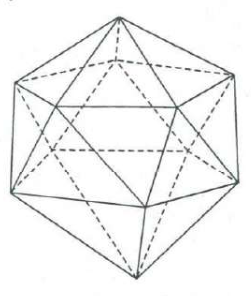
A regular icosahedron drawn as a wire frame, with hidden edges dashed: 12 vertices, 30 edges and triangular faces all round.
From UPSC's question paper.

उपर्युक्त चित्र में कितने त्रिभुज हैं?

Read this question in English

Consider the following three-dimensional figure:

How many triangles does the above figure have?

(a) 18 · (b) 20 · (c) 22 · (d) 24

उत्तर और व्याख्या · explanation in English

Answer: (b) 20

The solid is a regular icosahedron, and every one of its faces is a triangle. Its edges close into no triangles other than the faces, so the count is simply the number of faces: 20.

  1. Identify the solid: every face is a triangle and five faces meet at each vertex — a regular icosahedron.
  2. Count the faces in three layers: 5 around the top vertex, 5 around the bottom vertex and a band of 10 in the middle.
  3. 5 + 10 + 5 = 20 triangular faces.
  4. No three edges outside a face close into a triangle, so there are no extra triangles to add.
  5. Check: Euler's formula V − E + F = 2 with 12 vertices and 30 edges gives F = 20.

Remember · For a solid made of triangular faces, count faces layer by layer and confirm with Euler's formula V − E + F = 2.

Question and answer: UPSC's official GS Paper II (2018, Series A) — paper ↗ · answer key ↗. Explanation: Minimalist IAS, checked 1 Oct 2026 (how we verify). Permalink ·
नीचे दिए गए योग पर विचार कीजिए :

• + 1• + 2• + •3 + •1 = 21•

उपर्युक्त योग में • किसके लिए है?

Read this question in English

Consider the following sum:

• + 1• + 2• + •3 + •1 = 21•

In the above sum, • stands for

(a) 4 · (b) 5 · (c) 6 · (d) 8

उत्तर और व्याख्या · explanation in English

Answer: (d) 8

Treat • as one digit x and write every term by place value. The equation 23x + 34 = 210 + x gives x = 8.

  1. Let • = x. Then 1• = 10 + x, 2• = 20 + x, •3 = 10x + 3, •1 = 10x + 1 and 21• = 210 + x.
  2. Left side: x + (10 + x) + (20 + x) + (10x + 3) + (10x + 1) = 23x + 34.
  3. 23x + 34 = 210 + x, so 22x = 176 and x = 8.
  4. Check: 8 + 18 + 28 + 83 + 81 = 218, which is 21• with • = 8.

Remember · Write each symbol-number by place value (tens digit × 10 + units digit), then solve one linear equation.

Question and answer: UPSC's official GS Paper II (2018, Series A) — paper ↗ · answer key ↗. Explanation: Minimalist IAS, checked 30 Sept 2026 (how we verify). Permalink ·

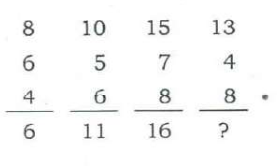
संख्याओं के निम्नलिखित प्रतिरूप पर विचार कीजिए :

8101513
6574
4688
61116?
Four columns of three numbers, each ruled off with a result below it: 8, 6, 4 → 6; 10, 5, 6 → 11; 15, 7, 8 → 16; 13, 4, 8 → ?.
From UPSC's question paper.

उपर्युक्त प्रतिरूप में ? के स्थान पर कौन-सी संख्या आएगी?

Read this question in English

Consider the following pattern of numbers:

What is the number at? in the above pattern?

(a) 17 · (b) 19 · (c) 21 · (d) 23

उत्तर और व्याख्या · explanation in English

Answer: (a) 17

In each column the result is the first number plus the third minus the second: 8 + 4 − 6 = 6, 10 + 6 − 5 = 11 and 15 + 8 − 7 = 16. The last column gives 13 + 8 − 4 = 17.

  1. Column 1: 8 + 4 − 6 = 6. Column 2: 10 + 6 − 5 = 11. Column 3: 15 + 8 − 7 = 16.
  2. The same rule — top + bottom − middle — fits all three complete columns.
  3. Column 4: 13 + 8 − 4 = 17.

Remember · In column puzzles, try simple combinations (+, −, ×) of the entries on every complete column before filling the gap.

Question and answer: UPSC's official GS Paper II (2018, Series A) — paper ↗ · answer key ↗. Explanation: Minimalist IAS, checked 1 Oct 2026 (how we verify). Permalink ·
एक अष्टभुज के शीर्षों को जोड़कर कितने विकर्ण खींचे जा सकते हैं?

Read this question in English

How many diagonals can be drawn by joining the vertices of an octagon?

(a) 20 · (b) 24 · (c) 28 · (d) 64

उत्तर और व्याख्या · explanation in English

Answer: (a) 20

Any two of the 8 vertices can be joined in C(8, 2) = 28 ways. Eight of those joins are the sides, so 20 are diagonals.

  1. Lines joining two vertices: C(8, 2) = 8 × 7 ÷ 2 = 28.
  2. Of these, 8 are sides of the octagon.
  3. Diagonals = 28 − 8 = 20.
  4. Check with the formula n(n − 3)/2 = 8 × 5 ÷ 2 = 20.

Remember · Diagonals of an n-sided polygon = n(n − 3)/2: each vertex joins n − 3 non-adjacent vertices, and each diagonal is counted twice.

Question and answer: UPSC's official GS Paper II (2018, Series A) — paper ↗ · answer key ↗. Explanation: Minimalist IAS, checked 30 Sept 2026 (how we verify). Permalink ·

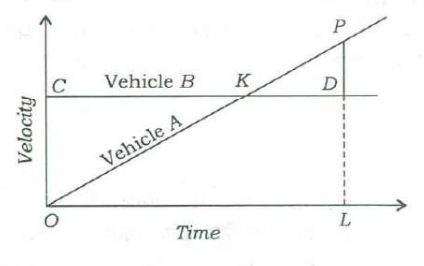
नीचे दिए गए चित्र में A और B दो वाहनों के वेग के आलेख (ग्राफ) दिए गए हैं। सरलरेखा OKP किसी भी क्षण में वाहन A के वेग को दर्शाती है, जबकि क्षैतिज सरलरेखा CKD किसी भी क्षण में वाहन B के वेग को दर्शाती है। चित्र में, D वह बिन्दु है जहाँ P से क्षैतिज रेखा CKD पर लम्ब इस प्रकार मिलता है कि PD = 1/2 LD :

Velocity–time graph: A's velocity rises along a straight line from the origin O through K to P; B's velocity is the horizontal line C–K–D; P lies above time L, D is on B's line directly below P, and PL is dotted down to the time axis.
From UPSC's question paper.

समय अंतराल OL में वाहन A और वाहन B द्वारा तय की गई दूरियों के बीच क्या अनुपात है?

Read this question in English

The figure drawn below gives the velocity graphs of two vehicles A and B. The straight line OKP represents the velocity of vehicle A at any instant, whereas the horizontal straight line CKD represents the velocity of vehicle B at any instant. In the figure, D is the point where perpendicular from P meets the horizontal line CKD such that PD = 1/2 LD:

What is the ratio between the distances covered by vehicles A and B in the time interval OL?

(a) 1: 2 · (b) 2: 3 · (c) 3: 4 · (d) 1: 1

उत्तर और व्याख्या · explanation in English

Answer: (c) 3 : 4

Distance is the area under a velocity–time graph. A's distance is the triangle OLP and B's is the rectangle of height LD over OL; since PL = 3/2 × LD, the triangle is 3/4 of the rectangle.

  1. Let LD (B's constant velocity) = 2 units; then PD = 1 and A's velocity at time L is PL = PD + DL = 3.
  2. Distance of B in time OL = rectangle = OL × 2 = 2 × OL.
  3. Distance of A in time OL = triangle OLP = 1/2 × OL × 3 = 1.5 × OL.
  4. Ratio A : B = 1.5 : 2 = 3 : 4.

Remember · On a velocity–time graph, distance = area under the line: a triangle for steady acceleration from rest, a rectangle for constant speed.

Question and answer: UPSC's official GS Paper II (2018, Series A) — paper ↗ · answer key ↗. Explanation: Minimalist IAS, checked 1 Oct 2026 (how we verify). Permalink ·
200 मीटर लम्बी एक ट्रेन 40 कि॰ मी॰ प्रति घंटा की दर से चल रही है। रेलवे लाइन के निकट खड़े किसी व्यक्ति को यह ट्रेन कितने सेकंड में पार करेगी?

Read this question in English

A train 200 metres long is moving at the rate of 40 kmph. In how many seconds will it cross a man standing near the railway line?

(a) 12 · (b) 15 · (c) 16 · (d) 18

उत्तर और व्याख्या · explanation in English

Answer: (d) 18

To pass a man standing still, the train covers only its own length, 200 m. At 40 km/h, which is 100/9 m/s, that takes 18 seconds.

  1. Distance to cover = length of the train = 200 m (the man adds no length).
  2. Speed: 40 km/h = 40 × 5/18 = 100/9 m/s.
  3. Time = 200 ÷ (100/9) = 18 seconds.
  4. Check: in 18 s at 40 km/h the train covers 40,000 × 18 ÷ 3600 = 200 m.

Remember · A train passing a pole or a standing person covers only its own length; convert km/h to m/s by multiplying by 5/18.

Question and answer: UPSC's official GS Paper II (2018, Series A) — paper ↗ · answer key ↗. Explanation: Minimalist IAS, checked 30 Sept 2026 (how we verify). Permalink ·

निम्नलिखित 4 (चार) प्रश्नांशों के लिए निर्देश : नीचे दिए गए चार परिच्छेदों को पढ़िए और परिच्छेदों के नीचे आने वाले प्रश्नांशों के उत्तर दीजिए। इन प्रश्नांशों के आपके उत्तर केवल इन परिच्छेदों पर ही आधारित होने चाहिए।

परिच्छेद—1

विश्व की जनसंख्या 1990 में 1·6 अरब के लगभग थी—आज यह 7·2 अरब के लगभग है और बढ़ रही है। जनसंख्या वृद्धि पर किए गए हाल के आकलनों से यह पूर्वानुमान होता है कि विश्व की जनसंख्या 2050 में 9·6 अरब और 2100 में 10·9 अरब हो जाएगी। यूरोप और उत्तरी अमेरिका के असदृश जहाँ केवल तीन से चार प्रतिशत जनसंख्या ही कृषि में लगी है, भारत की लगभग 47 प्रतिशत जनसंख्या कृषि पर निर्भर है। यदि भारत सेवा क्षेत्र में लगातार प्रगति करता रहे और विनिर्माण क्षेत्र तेजी से बढ़ता रहे, तो भी यह संभावना की जाती है कि 2030 के आस-पास जब भारत चीन से आगे निकल कर विश्व का सबसे अधिक जनसंख्या वाला देश होगा, भारत की लगभग 42 प्रतिशत जनसंख्या प्रधान रूप से कृषि पर निर्भर होगी।

उपर्युक्त परिच्छेद से निम्नलिखित में से कौन-सा सर्वाधिक तार्किक और तर्कसंगत निष्कर्ष (इंफेरेंस) निकाला जा सकता है?

Read this question in English

Which of the following is the most logical and rational inference that can be made from the above passage?

(a) Prosperity of agriculture sector is of critical importance to India. · (b) Indian economy greatly depends on its agriculture. · (c) India should take strict measures to control its rapid population growth. · (d) India’s farming communities should switch over to other occupations to improve their economic conditions.

उत्तर और व्याख्या · explanation in English

Answer: (a) कृषि क्षेत्र की समृद्धता भारत के लिए क्रांतिक महत्त्व की है।

The passage's point is that around 47 per cent of Indians depend on agriculture today and nearly 42 per cent will still do so in 2030, even if services and manufacturing grow. When so many livelihoods hang on one sector, its prosperity is critical to India.

  • ✓ (a) Follows directly: with close to half the population dependent on farming now and in 2030, how well agriculture does decides the well-being of a huge share of Indians.
  • ✗ (b) The passage speaks of people dependent on agriculture, not of agriculture's share of the economy; many people depending on a sector is not the same as the economy depending greatly on it.
  • ✗ (c) The population figures are background; the passage proposes no population policy, let alone 'strict measures'.
  • ✗ (d) The passage expects many to remain in farming even as other sectors grow; it gives no advice to farmers to change occupations.

Remember · Pick the inference that follows from the passage's central fact; reject options that add a policy the author never proposes.

Question and answer: UPSC's official GS Paper II (2018, Series A) — paper ↗ · answer key ↗. Explanation: Minimalist IAS, checked 30 Sept 2026 (how we verify). Permalink ·

परिच्छेद—2

खाद्य-जात बीमारियाँ उत्पन्न करने वाले बहुत-से रोगाणुओं के विषय में जानकारी नहीं है। खाद्य संक्रमण खेत से लेकर थाली तक किसी भी चरण में हो सकता है। चूँकि खाद्य विषाक्तीकरण की अनेकों घटनाएँ अप्रतिवेदित रह जाती हैं, वैश्विक खाद्य-जात बीमारियों का सही प्रसार अज्ञात है। अंतर्राष्ट्रीय परिवेक्षण में सुधार के कारण जन जागरूकता में बढ़ोतरी हुई है, तदपि खाद्य उत्पादन में तीव्र वैश्वीकरण से खाद्य को नियंत्रित करना तथा अनुरेखित करना कठिनतर होने के कारण उपभोक्ता की भेद्यता बढ़ गई है। डब्ल्यू॰ एच॰ ओ॰ के एक अधिकारी का कथन है, “विश्व हमारी प्लेट पर है।”

निम्नलिखित में से कौन-सा उपर्युक्त परिच्छेद का सर्वाधिक तार्किक उपनिगमन (कोरोलरी) है?

Read this question in English

Which of the following is the most logical corollary to the above passage?

(a) With more options for food come more risks. · (b) Food processing is the source of all foodborne illnesses. · (c) We should depend on locally produced food only. · (d) Globalization of food production should be curtailed.

उत्तर और व्याख्या · explanation in English

Answer: (a) खाद्य के विकल्प अधिक होने के कारण जोखिम अधिक आते हैं।

The passage says the rapid globalization of food production raises consumers' vulnerability because food becomes harder to regulate and trace — 'We have the world on our plates'. Food from everywhere means more choice and, with it, more risk.

  • ✓ (a) Food drawn from across the world ('the world on our plates') widens choice, and the passage says this same globalization makes food harder to trace and consumers more vulnerable.
  • ✗ (b) Contamination can happen 'at any stage from farm to plate'; processing is not singled out, and 'all' is too sweeping.
  • ✗ (c) A prescription the passage never makes; it describes a risk without asking people to eat only local food.
  • ✗ (d) The passage notes the risk of globalized food production but does not call for curbing it.

Remember · A corollary is a direct consequence of the passage's claim; drop options that turn a described risk into a policy demand.

Question and answer: UPSC's official GS Paper II (2018, Series A) — paper ↗ · answer key ↗. Explanation: Minimalist IAS, checked 30 Sept 2026 (how we verify). Permalink ·

परिच्छेद—3

मैं वैज्ञानिक हूँ, मेरा सौभाग्य है कि मैं इस प्रकार का व्यक्ति हूँ जो विज्ञान के साधनों का उपयोग करके प्रकृति को समझ सकता है। लेकिन यह भी स्पष्ट है कि कुछ महत्त्वपूर्ण प्रश्न सचमुच में ऐसे हैं, जिनका उत्तर वास्तव में विज्ञान नहीं दे सकता, जैसे कि कुछ भी न होने के स्थान पर कुछ क्यों है? हम यहाँ क्यों हैं? उन दायरों में मैंने पाया है कि आस्था इनके उत्तरों के लिए बेहतर मार्ग उपलब्ध कराती है। मैं इसको विषम रूप से कालदोषयुक्त पाता हूँ कि आज की संस्कृति में एक व्यापक धारणा प्रतीत होती है कि वैज्ञानिक और आध्यात्मिक विचार असंगत हैं।

उपर्युक्त परिच्छेद से निम्नलिखित में से कौन-सा सर्वाधिक तार्किक और तर्कसंगत निष्कर्ष (इंफेरेंस) निकाला जा सकता है?

Read this question in English

Which of the following is the most logical and rational inference that can be made from the above passage?

(a) It is the faith and not science that can finally solve all the problems of mankind. · (b) Science and faith can be mutually complementary if their proper domains are understood. · (c) There are some very fundamental questions which cannot be answered by either science or faith. · (d) In today’s culture, scientific views are given more importance than spiritual views.

उत्तर और व्याख्या · explanation in English

Answer: (b) विज्ञान और आस्था आपस में संपूरक हो सकते हैं यदि उनके समुचित दायरों को समझ लिया जाए।

The author uses science to understand nature and turns to faith for questions science cannot answer, and finds the belief that the two are incompatible oddly out of date. The inference is that each has its own domain, and seen that way they complement each other.

  • ✗ (a) Too extreme: faith is a better path only 'In those domains', the questions science cannot answer; the author never says faith can solve all of mankind's problems.
  • ✓ (b) One person practises science for nature and relies on faith for questions like 'Why are we here?'; the author rejects the presumption that the two are incompatible.
  • ✗ (c) The author says faith 'provides a better path to answers' for these questions, so they are not beyond both.
  • ✗ (d) The passage mentions a presumption of incompatibility, not that science is valued above spirituality.

Remember · Watch for 'all', 'only' and 'neither'; the right inference keeps the author's limits, such as 'in those domains'.

Question and answer: UPSC's official GS Paper II (2018, Series A) — paper ↗ · answer key ↗. Explanation: Minimalist IAS, checked 30 Sept 2026 (how we verify). Permalink ·

परिच्छेद—4

यद्यपि मैंने बहुत-सी पुरानी परम्पराओं एवं प्रथाओं को त्याग दिया है और मैं उत्सुक हूँ कि भारत स्वतः उन सभी बेड़ियों को उतार फेंके जो उसे बाँधती हैं, रोकती हैं और उसके लोगों को विभाजित करती हैं, और उनमें से अधिसंख्य लोगों का दमन करती हैं तथा शरीर एवं आत्मा के स्वतंत्र विकास को रोकती हैं। यद्यपि मैं ये सब चाहता हूँ फिर भी अपने-आप को अतीत से पूरी तरह काटना नहीं चाहता। मुझे अपनी महान विरासत पर गर्व है जो हमारी रही है और है भी और मैं सचेत हूँ कि मैं भी, हम सभी की तरह, उस अटूट शृंखला की कड़ी हूँ जो इतिहास के उषाकाल के भारत के अविस्मरणीय अतीत से संबद्ध है।

लेखक चाहता है कि भारत अपने को अतीत के बंधनों से मुक्त करे, क्योंकि

Read this question in English

The author wants India to rid herself of certain past bonds because

(a) he is not able to see the relevance of the past · (b) there is not much to be proud of · (c) he is not interested in the history of India · (d) they obstruct her physical and spiritual growth

उत्तर और व्याख्या · explanation in English

Answer: (d) वे उसके भौतिक और आध्यात्मिक विकास को रोकते हैं

The author wants India free of shackles that bind and divide her people, suppress vast numbers of them and 'prevent the free development of the body and the spirit'. That reason is option (d); everywhere else he speaks of pride in the past.

  • ✗ (a) He sees the past as relevant: he does not wish to cut himself off from it and calls himself a link in an unbroken chain.
  • ✗ (b) Contradicts the passage: 'I am proud of that great inheritance'.
  • ✗ (c) His sense of belonging to a chain going back to 'the dawn of history' shows deep interest in India's history.
  • ✓ (d) Stated in the passage: the shackles 'prevent the free development of the body and the spirit' — physical and spiritual growth.

Remember · For a 'because' question, find the reason clause in the passage itself; options contradicting the author's stated feelings fall away.

Question and answer: UPSC's official GS Paper II (2018, Series A) — paper ↗ · answer key ↗. Explanation: Minimalist IAS, checked 30 Sept 2026 (how we verify). Permalink ·

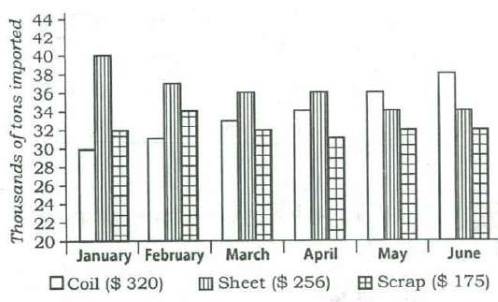
निम्नलिखित 3 (तीन) प्रश्नांशों के लिए निर्देश : निम्नलिखित तीन प्रश्नांश नीचे दिए गए आलेख (ग्राफ) पर आधारित हैं जो किसी वर्ष में छः माह की अवधि के दौरान तीन अलग-अलग प्रकार के स्टील के आयातों को दर्शाता है। इस आलेख का अध्ययन कीजिए और इसके पश्चात् आने वाले तीन प्रश्नांशों के उत्तर दीजिए।

कोष्ठक में दिए गए आँकड़े छः माह की अवधि के दौरान प्रति टन औसत लागत दर्शाते हैं।

माहकुंडली ($ 320)चादर ($ 256)कतरन ($ 175)
जनवरी304032
फरवरी313734
मार्च333632
अप्रैल343631
मई363432
जून383432
Bar chart of steel imports (thousands of tons, axis 20 to 44) for January to June, with bars for coil, sheet and scrap each month; the table gives the bar heights read from the chart.
From UPSC's question paper.

वर्ष के प्रथम तीन माह में चादर (शीट) स्टील का आयात (हजार टन में मापते हुए), कुंडली (कॉइल) स्टील के आयात से कितना अधिक था?

Read this question in English

Directions for the following 3 (three) items: The following three items are based on the graph given below which shows imports of three different types of steel over a period of six months of a year. Study the graph and answer the three items that follow.

The figures in the brackets indicate the average cost per ton over six months period.

By how much (measured in thousands of tons) did the import of sheet steel exceed the import of coil steel in the first three months of the year?

(a) 11 · (b) 15 · (c) 19 · (d) 23

उत्तर और व्याख्या · explanation in English

Answer: (c) 19

Add the January–March bars: sheet 40 + 37 + 36 = 113 and coil 30 + 31 + 33 = 94 thousand tons. Sheet exceeds coil by 19 thousand tons.

  1. Sheet, January–March: 40 + 37 + 36 = 113 thousand tons.
  2. Coil, January–March: 30 + 31 + 33 = 94 thousand tons.
  3. Excess = 113 − 94 = 19.
  4. Check month by month: 10 + 6 + 3 = 19.

Remember · For a total difference over several months, add the month-by-month gaps; it is quicker and cross-checks the totals.

Question and answer: UPSC's official GS Paper II (2018, Series A) — paper ↗ · answer key ↗. Explanation: Minimalist IAS, checked 1 Oct 2026 (how we verify). Permalink ·
निम्नलिखित 3 (तीन) प्रश्नांशों के लिए निर्देश : निम्नलिखित तीन प्रश्नांश नीचे दिए गए आलेख (ग्राफ) पर आधारित हैं जो किसी वर्ष में छः माह की अवधि के दौरान तीन अलग-अलग प्रकार के स्टील के आयातों को दर्शाता है। इस आलेख का अध्ययन कीजिए और इसके पश्चात् आने वाले तीन प्रश्नांशों के उत्तर दीजिए।

कोष्ठक में दिए गए आँकड़े छः माह की अवधि के दौरान प्रति टन औसत लागत दर्शाते हैं।

माहकुंडली ($ 320)चादर ($ 256)कतरन ($ 175)
जनवरी304032
फरवरी313734
मार्च333632
अप्रैल343631
मई363432
जून383432

Uses the same figure as Q11 ↑

छः माह की अवधि के दौरान आयात किए गए चादर (शीट) स्टील का सन्निकट कुल मूल्य ($ में) क्या था?

Read this question in English

Directions for the following 3 (three) items: The following three items are based on the graph given below which shows imports of three different types of steel over a period of six months of a year. Study the graph and answer the three items that follow.

The figures in the brackets indicate the average cost per ton over six months period.

What was the approximate total value (in $) of sheet steel imported over the six months period?

(a) 45,555 · (b) 50,555 · (c) 55,550 · (d) 65,750

उत्तर और व्याख्या · explanation in English

Answer: (c) 55,550

Sheet imports over the six months total 217 thousand tons; at the average $256 a ton that is 55,552 — nearest to 55,550. Because the tonnage is in thousands, the value is in thousands of dollars too.

  1. Sheet imports: 40 + 37 + 36 + 36 + 34 + 34 = 217 thousand tons.
  2. Value = 217 × 256 = 55,552 (thousand $), using the average cost of $256 per ton.
  3. Nearest option: 55,550.
  4. Check: 217 × 256 is close to 220 × 250 = 55,000, which rules out 45,555, 50,555 and 65,750.

Remember · Total value = total quantity × average price; keep the units (here thousands) in mind and round to eliminate far-off options.

Question and answer: UPSC's official GS Paper II (2018, Series A) — paper ↗ · answer key ↗. Explanation: Minimalist IAS, checked 1 Oct 2026 (how we verify). Permalink ·
निम्नलिखित 3 (तीन) प्रश्नांशों के लिए निर्देश : निम्नलिखित तीन प्रश्नांश नीचे दिए गए आलेख (ग्राफ) पर आधारित हैं जो किसी वर्ष में छः माह की अवधि के दौरान तीन अलग-अलग प्रकार के स्टील के आयातों को दर्शाता है। इस आलेख का अध्ययन कीजिए और इसके पश्चात् आने वाले तीन प्रश्नांशों के उत्तर दीजिए।

कोष्ठक में दिए गए आँकड़े छः माह की अवधि के दौरान प्रति टन औसत लागत दर्शाते हैं।

माहकुंडली ($ 320)चादर ($ 256)कतरन ($ 175)
जनवरी304032
फरवरी313734
मार्च333632
अप्रैल343631
मई363432
जून383432

Uses the same figure as Q11 ↑

वर्ष के प्रथम तीन माह में आयातित चादर (शीट) स्टील और कतरन (स्क्रैप) स्टील का सन्निकट अनुपात क्या था?

Read this question in English

Directions for the following 3 (three) items: The following three items are based on the graph given below which shows imports of three different types of steel over a period of six months of a year. Study the graph and answer the three items that follow.

The figures in the brackets indicate the average cost per ton over six months period.

What was the approximate ratio of sheet steel and scrap steel imports in the first three months of the year?

(a) 1: 1 · (b) 1.2: 1 · (c) 1.4: 1 · (d) 1.6: 1

उत्तर और व्याख्या · explanation in English

Answer: (b) 1·2 : 1

In January–March, sheet imports total 113 and scrap imports 32 + 34 + 32 = 98 thousand tons. 113 ÷ 98 is about 1.15, which is closest to 1.2 : 1.

  1. Sheet, January–March: 40 + 37 + 36 = 113.
  2. Scrap, January–March: 32 + 34 + 32 = 98.
  3. 113 ÷ 98 ≈ 1.15, so the ratio is about 1.2 : 1.
  4. Check: 1.4 : 1 would need sheet near 137, and 1 : 1 would need equal totals — neither fits.

Remember · For an approximate ratio, divide the two totals once and choose the nearest option.

Question and answer: UPSC's official GS Paper II (2018, Series A) — paper ↗ · answer key ↗. Explanation: Minimalist IAS, checked 1 Oct 2026 (how we verify). Permalink ·
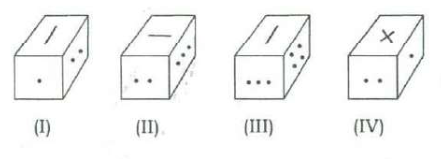
निम्नलिखित 3 (तीन) प्रश्नांशों के लिए निर्देश : किसी एक ही ठोस की घूर्णित (रोटेटेड) स्थितियाँ नीचे दर्शाई गई हैं। ठोस के विभिन्न फलक, भिन्न-भिन्न प्रतीकों जैसे बिन्दुओं, क्रॉस तथा रेखा द्वारा चिह्नित हैं। दिए गए चित्रों के बाद आने वाले तीन प्रश्नांशों के उत्तर दीजिए।

Four views (I)–(IV) of one rectangular block, each showing its top, front and right faces: (I) line, one dot, two dots; (II) line, two dots, three dots; (III) line, three dots, four dots; (IV) cross, two dots, one dot.
From UPSC's question paper.

एक ही बिन्दु वाले फलक के विपरीत फलक पर क्या प्रतीक है?

Read this question in English

Directions for the following 3 (three) items: Rotated positions of a single solid are shown below. The various faces of the solid are marked with different symbols like dots, cross and line. Answer the three items that follow the given figures.

What is the symbol on the face opposite to that containing a single dot?

(a) Four dots · (b) Three dots · (c) Two dots · (d) Cross

उत्तर और व्याख्या · explanation in English

Answer: (b) तीन बिन्दु

The line is on top in views (I)–(III), so the four dot-faces all touch it and form the ring around the solid, and the cross, the sixth face, is opposite the line. Around the ring the order is one, two, three, four dots, so one dot is opposite three dots.

  1. Views (I)–(III) all have the line on top and between them show one, two, three and four dots on the sides: all four dot-faces touch the line.
  2. The only face left, the cross, must be opposite the line.
  3. Side faces in order: (I) one then two; (II) two then three; (III) three then four — the ring runs 1, 2, 3, 4.
  4. In a ring of four faces, alternate faces are opposite: one dot is opposite three dots (and two dots opposite four dots).
  5. Check with (IV): cross on top, two dots in front, one dot on the right — one and two dots are adjacent, as the ring requires.

Remember · A face seen beside four different faces is opposite the sixth; the other four then form a ring in which alternate faces are opposite.

Question and answer: UPSC's official GS Paper II (2018, Series A) — paper ↗ · answer key ↗. Explanation: Minimalist IAS, checked 1 Oct 2026 (how we verify). Permalink ·
निम्नलिखित 3 (तीन) प्रश्नांशों के लिए निर्देश : किसी एक ही ठोस की घूर्णित (रोटेटेड) स्थितियाँ नीचे दर्शाई गई हैं। ठोस के विभिन्न फलक, भिन्न-भिन्न प्रतीकों जैसे बिन्दुओं, क्रॉस तथा रेखा द्वारा चिह्नित हैं। दिए गए चित्रों के बाद आने वाले तीन प्रश्नांशों के उत्तर दीजिए।

Uses the same figure as Q14 ↑

दो बिन्दुओं वाले फलक के विपरीत फलक पर क्या प्रतीक है?

Read this question in English

Directions for the following 3 (three) items: Rotated positions of a single solid are shown below. The various faces of the solid are marked with different symbols like dots, cross and line. Answer the three items that follow the given figures.

What is the symbol on the face opposite to that containing two dots?

(a) Single dot · (b) Three dots · (c) Four dots · (d) Line

उत्तर और व्याख्या · explanation in English

Answer: (c) चार बिन्दु

Two dots is seen next to one dot, three dots, the line and the cross, but never next to four dots. The face it never touches — four dots — is its opposite.

  1. Faces seen beside two dots: one dot (I, IV), three dots (II), the line (II) and the cross (IV).
  2. That is four of the five other faces; four dots never appears with two dots.
  3. So four dots is opposite two dots.
  4. Check: the ring of side faces runs 1, 2, 3, 4, and alternate faces of a ring of four are opposite.

Remember · The opposite face is the one never seen together with the given face in any of the views.

Question and answer: UPSC's official GS Paper II (2018, Series A) — paper ↗ · answer key ↗. Explanation: Minimalist IAS, checked 1 Oct 2026 (how we verify). Permalink ·
निम्नलिखित 3 (तीन) प्रश्नांशों के लिए निर्देश : किसी एक ही ठोस की घूर्णित (रोटेटेड) स्थितियाँ नीचे दर्शाई गई हैं। ठोस के विभिन्न फलक, भिन्न-भिन्न प्रतीकों जैसे बिन्दुओं, क्रॉस तथा रेखा द्वारा चिह्नित हैं। दिए गए चित्रों के बाद आने वाले तीन प्रश्नांशों के उत्तर दीजिए।

Uses the same figure as Q14 ↑

क्रॉस वाले फलक के विपरीत फलक पर क्या प्रतीक है?

Read this question in English

Directions for the following 3 (three) items: Rotated positions of a single solid are shown below. The various faces of the solid are marked with different symbols like dots, cross and line. Answer the three items that follow the given figures.

What is the symbol on the face opposite to that containing the cross?

(a) Single dot · (b) Two dots · (c) Line · (d) Four dots

उत्तर और व्याख्या · explanation in English

Answer: (c) रेखा

The line is seen beside one, two, three and four dots across views (I)–(III). The only face it never touches is the cross, so the cross is opposite the line.

  1. Faces beside the line: one and two dots (I), two and three dots (II), three and four dots (III).
  2. That covers four of the five other faces; the cross never appears with the line.
  3. So the cross is opposite the line.
  4. Check with (IV): with the cross on top, dot-faces fill the sides, as expected for the face opposite the line.

Remember · A face that appears next to four others is opposite the sixth — the quickest opposite-face test for dice and blocks.

Question and answer: UPSC's official GS Paper II (2018, Series A) — paper ↗ · answer key ↗. Explanation: Minimalist IAS, checked 1 Oct 2026 (how we verify). Permalink ·
निम्नलिखित 4 (चार) प्रश्नांशों के लिए निर्देश : नीचे दिए गए परिच्छेद को पढ़िए और परिच्छेद के नीचे आने वाले चार प्रश्नांशों के उत्तर दीजिए। इन प्रश्नांशों के आपके उत्तर केवल इस परिच्छेद पर ही आधारित होने चाहिए।

परिच्छेद

अब शिक्षा की सार्वभौम पहुँच प्रदान करने की मात्र बात करना हमारे लिए पर्याप्त नहीं है। विद्यालयी सुविधाएँ उपलब्ध कराना एक आवश्यक पूर्वापेक्षा तो है, किन्तु यह सुनिश्चित करने के लिए कि सभी बच्चे विद्यालय जाएँ और सीखने की प्रक्रिया में भाग लें, यह अपर्याप्त है। संभव है कि विद्यालय हो, किन्तु बच्चे न जाएँ या कुछ माह बाद विद्यालय छोड़ दें। विद्यालय और सामाजिक सुव्यवस्था (सोशल मैपिंग) द्वारा, हमें व्यापक सामाजिक, आर्थिक, सांस्कृतिक और अवश्य ही भाषाई और शैक्षिक मुद्दों को तथा उन कारकों को, जो कमजोर वर्गों और सुविधा-वंचित समूहों के बच्चों को, लड़कियों को भी, नियमित विद्यालय जाने और प्रारंभिक शिक्षा पूरी करने से रोकते हैं, सुलझाना चाहिए। हमारा ध्यान निर्धनतम और सबसे असुरक्षित वर्ग पर केन्द्रित होना चाहिए क्योंकि ये सर्वाधिक अशक्त हैं और इन्हीं को अपने शिक्षा के अधिकार का अतिक्रमण होने या उससे वंचित होने का सबसे अधिक जोखिम है।

शिक्षा के अधिकार का दायरा निःशुल्क और अनिवार्य शिक्षा से कहीं आगे तक है और इसमें सभी के लिए गुणतापूर्ण शिक्षा शामिल है। गुणता शिक्षा के अधिकार का अभिन्न अंग है। यदि शिक्षा प्रक्रिया में गुणता का अभाव है, तो बच्चों को उनके अधिकार से वंचित किया जा रहा है। बच्चों का निःशुल्क एवं अनिवार्य शिक्षा का अधिकार अधिनियम यह अधिकथित करता है कि पाठ्यक्रम में कार्यकलाप, अन्वेषण और खोज के माध्यम से शिक्षा प्राप्ति का प्रावधान होना चाहिए। इससे हम पर यह बाध्यता आती है कि बच्चों को विद्या के निष्क्रिय प्राप्तकर्ता के रूप में देखने का नजरिया बदला जाए और परीक्षाओं के आधार के रूप में पाठ्यपुस्तकों के उपयोग की परिपाटी से आगे बढ़ा जाए। शिक्षण और शिक्षा-ग्रहण प्रणाली को तनावमुक्त होना ही चाहिए और शिक्षार्थी-अनुकूली अधिगम प्रणाली की व्यवस्था के लिए पाठ्यक्रम सुधार का एक व्यापक कार्यक्रम शुरू किया जाना चाहिए जो अधिकाधिक संगत और सशक्तीकारक हो। शिक्षक उत्तरदायित्व प्रणालियों और प्रक्रियाओं से यह अवश्य सुनिश्चित होना चाहिए कि बच्चे शिक्षा प्राप्त कर रहे हैं और शिक्षार्थी-अनुकूली वातावरण में शिक्षा प्राप्त करने के उनके अधिकार का उल्लंघन नहीं हो रहा है। परीक्षण और मूल्यांकन प्रणालियों की पुनर्परीक्षा कर उन्हें इस रूप में पुनः अभिकल्पित किया जाना चाहिए ताकि यह सुनिश्चित हो कि बच्चे विद्यालय और अनुशिक्षण (ट्यूशन) केन्द्रों के बीच संघर्ष करते-करते अपने बचपन से वंचित रह जाने को बाध्य न हों।

इस परिच्छेद के अनुसार, निम्नलिखित में से किसका/किनका शिक्षा के अधिकार के अधीन सर्वोपरि महत्त्व है?

  1. 1.सभी माता-पिता द्वारा अपने बच्चों को विद्यालय भेजा जाना
  2. 2.विद्यालयों में पर्याप्त भौतिक आधारभूत संरचना की व्यवस्था
  3. 3.शिक्षार्थी-अनुकूली शिक्षा-प्राप्ति प्रणाली विकसित करने हेतु पाठ्यक्रम सुधार करना

नीचे दिए गए कूट का प्रयोग कर सही उत्तर चुनिए।

Read this question in English

According to the passage, which of the following is/are of paramount importance under the Right to Education?

1. Sending of children to school by all parents

2. Provision of adequate physical infrastructure in schools

3. Curricular reforms for developing child-friendly learning system

Select the correct answer using the code given below.

(a) 1 only · (b) 1 and 2 only · (c) 3 only · (d) None of the above

उत्तर और व्याख्या · explanation in English

Answer: (c) केवल 3

The passage calls schooling facilities 'an essential prerequisite, but … insufficient', and says quality is integral to the right, calling for 'a massive programme for curricular reform' for a child-friendly learning system. Only statement 3 is presented as central.

  • ✗ 1. Parents are never mentioned; the passage speaks of social, economic and cultural factors that keep children away, not of parents sending them.
  • ✗ 2. Facilities are necessary but 'insufficient'; the passage deliberately moves the focus away from infrastructure.
  • ✓ 3. Quality is 'an integral part of the right to education', and a massive curricular reform for 'a child-friendly learning system' is demanded.

Remember · What the passage calls 'necessary but insufficient' is not the paramount factor; look for what the author insists must change.

Question and answer: UPSC's official GS Paper II (2018, Series A) — paper ↗ · answer key ↗. Explanation: Minimalist IAS, checked 30 Sept 2026 (how we verify). Permalink ·

उपर्युक्त परिच्छेद के संदर्भ में, निम्नलिखित पूर्वधारणाएँ बनाई गई हैं :

  1. 1.शिक्षा का अधिकार बच्चों की शिक्षा-प्राप्ति प्रक्रिया के लिए शिक्षक का उत्तरदायित्व होने की गारंटी देता है।
  2. 2.शिक्षा का अधिकार विद्यालयों में बच्चों के 100% नामांकन होने की गारंटी देता है।
  3. 3.शिक्षा के अधिकार का आशय जनांकिकीय लाभांश का पूरा लाभ उठाने का है।

उपर्युक्त में से कौन-सी पूर्वधारणा/पूर्वधारणाएँ वैध है/हैं?

Read this question in English

With reference to the above passage, the following assumptions have been made:

1. The Right to Education guarantees teachers’ accountability for the learning process of children.

2. The Right to Education guarantees 100% enrolment of children in the schools.

3. The Right to Education intends to take full advantage of demographic dividend.

Which of the above assumptions is/are valid?

(a) 1 only · (b) 2 and 3 only · (c) 3 only · (d) 1, 2 and 3

उत्तर और व्याख्या · explanation in English

Answer: (a) केवल 1

The passage builds teacher accountability into the right to quality education: accountability systems 'must ensure that children are learning'. It never promises full enrolment — it warns children may not attend — and never mentions the demographic dividend.

  • ✓ 1. Quality is part of the right, and 'Teacher accountability systems and processes must ensure that children are learning' — accountability for learning flows from the right as the passage describes it.
  • ✗ 2. The passage says the opposite: the school may be there but children 'may not attend or they may drop out', so no guarantee of 100% enrolment is assumed.
  • ✗ 3. Demographic dividend is outside the passage, which is concerned with children's rights, quality and childhood, not the economic use of population.

Remember · An assumption must be needed by the author's argument; ideas the passage never touches, like demographic dividend, are invalid.

Question and answer: UPSC's official GS Paper II (2018, Series A) — paper ↗ · answer key ↗. Explanation: Minimalist IAS, checked 30 Sept 2026 (how we verify). Permalink ·

इस परिच्छेद के अनुसार, शिक्षा में गुणता लाने हेतु निम्नलिखित में से कौन-सा एक निर्णायक है?

Read this question in English

According to the passage, which one of the following is critical in bringing quality in education?

(a) Ensuring regular attendance of children as well as teachers in school · (b) Giving pecuniary benefits to teachers to motivate them · (c) Understanding the socio-cultural background of children · (d) Inculcating learning through activities and discovery

उत्तर और व्याख्या · explanation in English

Answer: (d) कार्यकलाप और खोज के माध्यम से शिक्षा-प्राप्ति का अंतर्निवेशन (इन्कल्केटिंग लर्निंग)

Right after saying quality is integral to the right to education, the passage cites the Act: the curriculum should provide for 'learning through activities, exploration and discovery'. That is its route to quality.

  • ✗ (a) Children's attendance is discussed under access, not quality; teachers' attendance is not mentioned.
  • ✗ (b) Pay or incentives for teachers appear nowhere in the passage.
  • ✗ (c) Social and cultural factors come up in the first paragraph as reasons children stay away — an access issue, not the quality discussion.
  • ✓ (d) The quality paragraph says the curriculum should provide for 'learning through activities, exploration and discovery' and asks us to stop treating children as passive receivers.

Remember · Match the option to the paragraph that answers the question; here access and quality are discussed in separate paragraphs.

Question and answer: UPSC's official GS Paper II (2018, Series A) — paper ↗ · answer key ↗. Explanation: Minimalist IAS, checked 30 Sept 2026 (how we verify). Permalink ·

इस परिच्छेद में सारभूत संदेश क्या है?

Read this question in English

What is the essential message in this passage?

(a) The Right to Education now is a Fundamental Right. · (b) The Right to Education enables the children of poor and weaker sections of the society to attend schools. · (c) The Right to Free and Compulsory Education should include quality education for all. · (d) The Government as well as parents should ensure that all children attend schools.

उत्तर और व्याख्या · explanation in English

Answer: (c) निःशुल्क एवं अनिवार्य शिक्षा के अधिकार में सभी के लिए गुणतापूर्ण शिक्षा शामिल होना चाहिए।

The passage opens by saying access is no longer enough and builds to its thesis: 'The right to education goes beyond free and compulsory education to include quality education for all.' The essential message is quality, not mere enrolment.

  • ✗ (a) A fact from outside the passage; the constitutional status of the right is never discussed.
  • ✗ (b) The passage stresses that children of weaker sections may still stay away even where schools exist — which is why more than access is needed.
  • ✓ (c) Quality is 'an integral part of the right to education', and without it children 'are being denied their right'.
  • ✗ (d) Attendance is one point in the first paragraph, and the passage never assigns this duty to the Government and parents.

Remember · The essential message is the claim the whole passage builds towards — often a 'not just X but also Y' idea, here quality beyond access.

Question and answer: UPSC's official GS Paper II (2018, Series A) — paper ↗ · answer key ↗. Explanation: Minimalist IAS, checked 30 Sept 2026 (how we verify). Permalink ·

यदि MUMBAI के लिए कूट है LSJXVC, तो DELHI के लिए कूट है

Read this question in English

If LSJXVC is the code for MUMBAI, the code for DELHI is

(a) CCIDD · (b) CDKGH · (c) CCJFG · (d) CCIFE

उत्तर और व्याख्या · explanation in English

Answer: (a) CCIDD

Each letter of MUMBAI is moved back by 1, 2, 3, 4, 5 and 6 places in turn, wrapping from A round to Z. Moving the letters of DELHI back by 1 to 5 gives CCIDD.

  1. M − 1 = L, U − 2 = S, M − 3 = J, B − 4 = X (B → A → Z → Y → X), A − 5 = V, I − 6 = C.
  2. DELHI: D − 1 = C, E − 2 = C, L − 3 = I, H − 4 = D, I − 5 = D.
  3. Code: CCIDD.
  4. Check: (d) CCIFE agrees in the first three letters but fails at H − 4 = D.

Remember · In letter codes, write the shift for each position; a growing shift (−1, −2, −3 …) is common, and letters wrap from A to Z.

Question and answer: UPSC's official GS Paper II (2018, Series A) — paper ↗ · answer key ↗. Explanation: Minimalist IAS, checked 30 Sept 2026 (how we verify). Permalink ·

यदि RAMON को 12345 के रूप में तथा DINESH को 675849 के रूप में लिखा जाता है, तो HAMAM को किस रूप में लिखा जाएगा?

Read this question in English

If RAMON is written as 12345 and DINESH as 675849, then HAMAM will be written as

(a) 92233 · (b) 92323 · (c) 93322 · (d) 93232

उत्तर और व्याख्या · explanation in English

Answer: (b) 92323

Each letter stands for a fixed digit. From the two words, H = 9, A = 2 and M = 3, so HAMAM reads 9-2-3-2-3.

  1. RAMON = 12345: R = 1, A = 2, M = 3, O = 4, N = 5.
  2. DINESH = 675849: D = 6, I = 7, N = 5, E = 8, S = 4, H = 9.
  3. HAMAM = H, A, M, A, M = 9, 2, 3, 2, 3 = 92323.

Remember · For letter-to-digit codes, map each letter once and read the new word letter by letter; repeated letters repeat their digit.

Question and answer: UPSC's official GS Paper II (2018, Series A) — paper ↗ · answer key ↗. Explanation: Minimalist IAS, checked 30 Sept 2026 (how we verify). Permalink ·

यदि X, −3 और −1 के बीच में है तथा Y, −1 और 1 के बीच में है, तो X² − Y² निम्नलिखित में से किनके बीच में होगा?

Read this question in English

If X is between −3 and −1, and Y is between −1 and 1, then X² − Y² is in between which of the following?

(a) −9 and 1 · (b) −9 and −1 · (c) 0 and 8 · (d) 0 and 9

उत्तर और व्याख्या · explanation in English

Answer: (d) 0 और 9

Squaring removes the signs: X² lies between 1 and 9, and Y² between 0 and 1. So X² − Y² is more than 1 − 1 = 0 and less than 9 − 0 = 9.

  1. −3 < X < −1 gives 1 < X² < 9.
  2. −1 < Y < 1 gives 0 ≤ Y² < 1.
  3. Smallest value of X² − Y²: just above 1 − 1 = 0. Largest: just below 9 − 0 = 9.
  4. So X² − Y² lies between 0 and 9.
  5. Check: X = −2.9 and Y = 0 give 8.41, more than 8, so (c) is too narrow.

Remember · For the range of a difference, pair the largest first term with the smallest second term and vice versa; square before combining.

Question and answer: UPSC's official GS Paper II (2018, Series A) — paper ↗ · answer key ↗. Explanation: Minimalist IAS, checked 30 Sept 2026 (how we verify). Permalink ·

X और Y, 1 के अलावा धनपूर्णांक हैं तथा Y, X से बड़ा है। निम्नलिखित में से कौन-सा सबसे बड़ी संख्या को निरूपित करता है?

Read this question in English

X and Y are natural numbers other than 1, and Y is greater than X. Which of the following represents the largest number?

(a) XY · (b) X / Y · (c) Y / X · (d) (X + Y) / XY

उत्तर और व्याख्या · explanation in English

Answer: (a) XY

With X at least 2, the product XY is at least 2Y, while Y/X is at most Y/2, X/Y is below 1 and (X + Y)/XY is below 1. XY is always the largest.

  1. Try the smallest values X = 2, Y = 3: XY = 6, X/Y ≈ 0.67, Y/X = 1.5, (X + Y)/XY = 5/6.
  2. In general X ≥ 2, so XY ≥ 2Y > Y > Y/X.
  3. X/Y < 1 because Y > X, and (X + Y)/XY = 1/X + 1/Y ≤ 1/2 + 1/3 < 1.
  4. So XY is the largest.

Remember · For 'which is largest' under conditions, test the smallest allowed values first, then confirm with a general inequality.

Question and answer: UPSC's official GS Paper II (2018, Series A) — paper ↗ · answer key ↗. Explanation: Minimalist IAS, checked 30 Sept 2026 (how we verify). Permalink ·

निम्नलिखित 2 (दो) प्रश्नांशों के लिए निर्देश : निम्नलिखित जानकारी को पढ़िए और उसके पश्चात् आने वाले दो प्रश्नांशों के उत्तर दीजिए।

छः अधिकारियों A, B, C, D, E और F के लिए किसी कार्यालय खण्ड की योजना इस प्रकार है : B और C दोनों के कार्यालय, इस कार्यालय खण्ड में प्रवेश करते ही गलियारे की दायीं ओर है, और A का कार्यालय गलियारे की बायीं ओर है। E और F के कार्यालय गलियारे के विपरीत पार्श्वों पर हैं किन्तु उनके कार्यालय आमने-सामने नहीं हैं। C और D के कार्यालय आमने-सामने हैं। E का कार्यालय किनारे पर नहीं है। F का कार्यालय गलियारे में A के कार्यालय के और आगे किन्तु उसी पार्श्व में है।

यदि E अपने कार्यालय में गलियारे की ओर मुँह करके बैठता है, तो उसकी बायीं ओर किसका कार्यालय है?

Read this question in English

Directions for the following 2 (two) items: Read the following information and answer the two items that follow.

The plan of an office block for six officers A, B, C, D, E and F is as follows: Both B and C occupy offices to the right of the corridor (as one enters the office block) and A occupies on the left of the corridor. E and F occupy offices on opposite sides of the corridor but their offices do not face each other. The offices of C and D face each other. E does not have a corner office. F’s office is further down the corridor than A’s, but on the same side.

If E sits in his office and faces the corridor, whose office is to his left?

(a) A · (b) B · (c) C · (d) D

उत्तर और व्याख्या · explanation in English

Answer: (c) C

The offices, from the entrance, are D, A, F on the left and C, E, B on the right. Sitting in the middle office on the right and facing the corridor, E has the entrance end on his left — and C's office is there.

  1. Sides: B and C are on the right, A on the left. D faces C, so D is on the left; F is on A's side, so F is on the left, and E is on the right.
  2. Each side has three offices. E has no corner office, so E is in the middle office on the right.
  3. F does not face E, so F is not in the middle; F is further down than A, so F has the far-end office on the left.
  4. D must face C; the middle office on the right is E's, so C and D take the offices nearest the entrance. A is left-middle and B right far-end.
  5. Layout from the entrance — left side: D, A, F; right side: C, E, B.
  6. E sits on the right side facing the corridor, i.e. facing across towards the left side; his left hand then points back towards the entrance, where C's office is.

Remember · In corridor puzzles, fix each person's side first, then use 'corner', 'faces' and 'further down'; finally turn the map to the person's own facing.

Question and answer: UPSC's official GS Paper II (2018, Series A) — paper ↗ · answer key ↗. Explanation: Minimalist IAS, checked 30 Sept 2026 (how we verify). Permalink ·

निम्नलिखित 2 (दो) प्रश्नांशों के लिए निर्देश : निम्नलिखित जानकारी को पढ़िए और उसके पश्चात् आने वाले दो प्रश्नांशों के उत्तर दीजिए।

छः अधिकारियों A, B, C, D, E और F के लिए किसी कार्यालय खण्ड की योजना इस प्रकार है : B और C दोनों के कार्यालय, इस कार्यालय खण्ड में प्रवेश करते ही गलियारे की दायीं ओर है, और A का कार्यालय गलियारे की बायीं ओर है। E और F के कार्यालय गलियारे के विपरीत पार्श्वों पर हैं किन्तु उनके कार्यालय आमने-सामने नहीं हैं। C और D के कार्यालय आमने-सामने हैं। E का कार्यालय किनारे पर नहीं है। F का कार्यालय गलियारे में A के कार्यालय के और आगे किन्तु उसी पार्श्व में है।

F का/के निकटतम पड़ोसी कौन है/हैं?

Read this question in English

Directions for the following 2 (two) items: Read the following information and answer the two items that follow.

The plan of an office block for six officers A, B, C, D, E and F is as follows: Both B and C occupy offices to the right of the corridor (as one enters the office block) and A occupies on the left of the corridor. E and F occupy offices on opposite sides of the corridor but their offices do not face each other. The offices of C and D face each other. E does not have a corner office. F’s office is further down the corridor than A’s, but on the same side.

Who is/are F’s immediate neighbour/neighbours?

(a) A only · (b) A and D · (c) C only · (d) B and C

उत्तर और व्याख्या · explanation in English

Answer: (a) केवल A

F has the corner office at the far end of the left side, with A's office beside it (D, A, F from the entrance). B's office faces F across the corridor but is not beside it, so A is F's only immediate neighbour.

  1. Sides: B and C are on the right, A on the left. D faces C, so D is on the left; F is on A's side, so F is on the left, and E is on the right.
  2. Each side has three offices. E has no corner office, so E is in the middle office on the right.
  3. F does not face E, so F is not in the middle; F is further down than A, so F has the far-end office on the left.
  4. D must face C; the middle office on the right is E's, so C and D take the offices nearest the entrance. A is left-middle and B right far-end.
  5. Layout from the entrance — left side: D, A, F; right side: C, E, B.
  6. F is at the end of the left side, so the only office beside F is A's; B, across the corridor, faces F rather than adjoins it.

Remember · Neighbours share a wall on the same side; an office across the corridor is 'facing', not 'next to'.

Question and answer: UPSC's official GS Paper II (2018, Series A) — paper ↗ · answer key ↗. Explanation: Minimalist IAS, checked 30 Sept 2026 (how we verify). Permalink ·

निम्नलिखित 7 (सात) प्रश्नांशों के लिए निर्देश : नीचे दिए गए चार परिच्छेदों को पढ़िए और परिच्छेदों के नीचे आने वाले प्रश्नांशों के उत्तर दीजिए। इन प्रश्नांशों के आपके उत्तर केवल इन परिच्छेदों पर ही आधारित होने चाहिए।

परिच्छेद—1

‘मरुभवन (डेज़र्टिफिकेशन)’ किसी पारितंत्र की जैव उत्पादकता के ह्रास की उस प्रक्रिया की व्याख्या करने वाला शब्द है, जिसके परिणामस्वरूप उत्पादकता की संपूर्ण हानि हो जाती है। यद्यपि यह घटना प्रायः शुष्क, अर्धशुष्क और अल्पार्द्र पारितंत्रों से जुड़ी हुई है, तथापि आर्द्र उष्णकटिबंधों में भी इसका प्रभाव अत्यंत नाटकीय हो सकता है। मानव-प्रभावित स्थलीय पारितंत्रों का दरिद्रण (इंपोवरिशमेंट) विविध रूपों में दिख सकता है : त्वरित अपरदन, जैसा कि देश के पर्वतीय क्षेत्रों में है; भूमि का लवणीभवन, जैसा कि देश के अर्धशुष्क और शुष्क ‘हरितक्रांति’ क्षेत्रों, उदाहरणार्थ हरियाणा और पश्चिमी उत्तर प्रदेश में है और स्थल गुणता ह्रास, जो कि भारत के सभी मैदानों पर वनस्पति-आच्छादन के व्यापक ह्रास और धान/गेहूँ की एकरस एकधान्य कृषि के कारण होने वाली एक आम घटना है। वनोन्मूलन का एक प्रमुख दुष्परिणाम जलविज्ञान में प्रतिकूल परिवर्तनों और संबंधित मृदा और पोषकों की हानियों से संबंधित है। वनोन्मूलन के दुष्परिणाम निरपवाद रूप से अपरदनकारी हानियों के माध्यम से होने वाले स्थल अवक्रमण के कारण उत्पन्न होते हैं। उष्णकटिबंधीय एशिया, अफ्रीका और दक्षिण अमेरिका में अपरदन उच्चतम स्तर पर हैं। उष्णकटिबंधों पर पहले से ही इसकी उच्च दरें वनोन्मूलन के, और वनों के नष्ट हो जाने के उपरांत किए जाने वाले बेमेल भूमि-प्रबंधन प्रणालियों के कारण चिंताजनक दर से बढ़ रही हैं (उदाहरणार्थ, भारतीय संदर्भ में प्रमुख नदीतंत्रों—गंगा और ब्रह्मपुत्र के माध्यम से)। पर्वत के संदर्भ में, पर्वतीय मृदा का कम होता जा रहा आर्द्रता-धारण, हिमालयी क्षेत्र में अंतर्भौम झरनों और अपेक्षाकृत छोटी नदियों के सूखते जाने का श्रेय वन-आच्छादन में आए उग्र परिवर्तनों को दिया जा सकता है। एक अप्रत्यक्ष परिणाम, जल के माध्यम से होने वाले उच्चभूमि-निम्नभूमि की अन्योन्यक्रिया में आया उग्र बदलाव है। असम के चायरोपण करने वालों की तात्कालिक चिंता ब्रह्मपुत्र के कछारों के साथ आने वाले बारम्बार आप्लावन के कारण चाय-बागानों को होने वाली क्षति के बारे में है, एवं चाय-बागान की क्षति और परिणामस्वरूप होने वाली चाय उत्पादकता की हानि, नदीतंत्र के बदलते मार्ग और गाद-भराई (सिल्टेशन) के कारण नदी-तल के बढ़ते जाते स्तर के कारण हैं। स्थल मरुभवन के अंतिम परिणाम हैं : मृदा निम्नीकरण, उपलब्ध जल और उसकी गुणता में परिवर्तन, और इसके परिणामस्वरूप, ग्रामीण समुदाय के आर्थिक कल्याण के लिए आवश्यक खाद्य, चारा और ईंधन-काष्ठ उत्पादन में होने वाला ह्रास।

इस परिच्छेद के अनुसार, निम्नलिखित में से कौन-से वन-आच्छादन में आए ह्रास के परिणाम हैं?

  1. 1.उपरिमृदा की हानि
  2. 2.अपेक्षाकृत छोटी नदियों की हानि
  3. 3.कृषि उत्पादन पर प्रतिकूल प्रभाव
  4. 4.भौमजल की हानि

नीचे दिए गए कूट का प्रयोग कर सही उत्तर चुनिए।

Read this question in English

According to the passage, which of the following are the consequences of decline in forest cover?

1. Loss of topsoil

2. Loss of smaller rivers

3. Adverse effect on agricultural production

4. Declining of groundwater

Select the correct answer using the code given below.

(a) 1, 2 and 3 only · (b) 2, 3 and 4 only · (c) 1 and 4 only · (d) 1, 2, 3 and 4

उत्तर और व्याख्या · explanation in English

Answer: (d) 1, 2, 3 और 4

The passage traces a chain from forest loss to erosion, drying springs and rivers, altered water availability and finally falling food, fodder and fuel-wood yields. Each of the four statements is a link in that chain.

  • ✓ 1. Deforestation brings 'soil and nutrient losses' through 'erosive losses', and soil degradation is named among the ultimate consequences.
  • ✓ 2. 'drying up of the underground springs and smaller rivers in the Himalayan region' is attributed to drastic changes in forest cover.
  • ✓ 3. The ultimate consequences include 'decline in food, fodder and fuel-wood yields', and the Assam example shows lost tea productivity.
  • ✓ 4. Falling moisture retention of mountain soils, drying underground springs and 'alteration in available water' point to declining groundwater.

Remember · In 'consequences' questions, follow the passage's causal chain to its end; indirect and ultimate consequences count too.

Question and answer: UPSC's official GS Paper II (2018, Series A) — paper ↗ · answer key ↗. Explanation: Minimalist IAS, checked 30 Sept 2026 (how we verify). Permalink ·

इस परिच्छेद से, निम्नलिखित में से कौन-सा/से सही निष्कर्ष (इंफेरेंस) निकाला जा सकता है/निकाले जा सकते हैं?

  1. 1.वनोन्मूलन के कारण नदियों के मार्ग में परिवर्तन हो सकता है।
  2. 2.भूमि का लवणीभवन केवल मानवीय क्रियाकलाप के कारण होता है।
  3. 3.मैदानों में गहन एकधान्य कृषि-प्रथा, उष्णकटिबंधीय एशिया, अफ्रीका और दक्षिण अमेरिका में मरुभवन का प्रमुख कारण है।

नीचे दिए गए कूट का प्रयोग कर सही उत्तर चुनिए।

Read this question in English

Which of the following is/are the correct inference/inferences that can be made from the passage?

1. Deforestation can cause changes in the course of rivers.

2. Salinization of land takes place due to human activities only.

3. Intense monoculture practice in plains is a major reason for desertification in Tropical Asia, Africa and South America.

Select the correct answer using the code given below.

(a) 1 only · (b) 1 and 2 only · (c) 2 and 3 only · (d) None of the above is a correct inference

उत्तर और व्याख्या · explanation in English

Answer: (a) केवल 1

The Brahmaputra example links deforestation-driven erosion and siltation to 'the changing course of the river system', so statement 1 follows. Statement 2 adds 'only', and statement 3 carries the monoculture of the Indian plains over to other continents — neither is in the passage.

  • ✓ 1. Deforestation causes erosive losses and siltation, and the passage ties 'siltation and the changing course of the river system' together in the Brahmaputra example.
  • ✗ 2. Salinization in 'green revolution' areas is one example of impoverishment of human-impacted ecosystems; the passage never says human activity is its only cause.
  • ✗ 3. Rice/wheat monoculture is mentioned for 'the Indian plains'; the high erosion in Tropical Asia, Africa and South America is linked to deforestation and ill-suited land management.

Remember · Reject inferences that add absolute words ('only') or move an example from one place to a different region.

Question and answer: UPSC's official GS Paper II (2018, Series A) — paper ↗ · answer key ↗. Explanation: Minimalist IAS, checked 30 Sept 2026 (how we verify). Permalink ·

‘मरुभवन’ के संदर्भ में, जैसा कि परिच्छेद में वर्णन किया गया है, निम्नलिखित पूर्वधारणाएँ बनाई गई हैं :

  1. 1.मरुभवन, केवल उष्णकटिबंधीय क्षेत्रों की एक घटना है।
  2. 2.बाढ़ और मरुभवन, वनोन्मूलन के अनिवार्य परिणाम हैं।

उपर्युक्त में से कौन-सी पूर्वधारणा/पूर्वधारणाएँ वैध है/हैं?

Read this question in English

With reference to ‘desertification’, as described in the passage, the following assumptions have been made:

1. Desertification is a phenomenon in tropical areas only.

2. Deforestation invariably leads to floods and desertification.

Which of the above assumptions is/are valid?

(a) 1 only · (b) 2 only · (c) Both 1 and 2 · (d) Neither 1 nor 2

उत्तर और व्याख्या · explanation in English

Answer: (d) न तो 1 और न ही 2

Desertification is 'often linked to the arid, semi-arid and sub-humid ecosystems', and the humid tropics are added with 'even', so it is not a tropical phenomenon only. The passage's 'invariably' describes how deforestation's consequences arise, not a rule that every deforestation ends in floods and desertification.

  • ✗ 1. Arid, semi-arid and sub-humid ecosystems come first; the tropics are mentioned with 'even', as an addition, not the only setting.
  • ✗ 2. 'Invariably' in the passage refers to consequences arising 'out of site degradation through erosive losses'. Floods appear only in the Brahmaputra example, so the statement stretches the passage into a universal rule.

Remember · Check where the passage's 'invariably' or 'only' actually applies; an option that moves such a word to a new claim is usually wrong.

Question and answer: UPSC's official GS Paper II (2018, Series A) — paper ↗ · answer key ↗. Explanation: Minimalist IAS, checked 30 Sept 2026 (how we verify). Permalink ·

परिच्छेद—2

जलवायु परिवर्तन का सामना करने और उत्पादक कृषि, वानिकी तथा मत्स्यपालन को सुनिश्चित करने के लिए प्राकृतिक परिसम्पत्तियों की विविधता की आवश्यकता होगी। उदाहरण के लिए, ऐसी फसल किस्मों की आवश्यकता है जो सूखा, गर्मी और बढ़ी हुई CO₂ के अंतर्गत अच्छा निष्पादन करें। लेकिन फसलों को चुनने के लिए निजी-क्षेत्र और किसान-प्रेरित प्रक्रिया अतीत अथवा वर्तमान दशाओं में अपनाई गई एकरूप किस्मों का समर्थन करती है न कि उन किस्मों का जो अपेक्षाकृत गर्म, आर्द्र अथवा शुष्क दशाओं में सतत उच्च उत्पादन देने में समर्थ हैं। वर्तमान फसलों, नस्लों और उनके वन्य संबंधियों के आनुवंशिक संसाधनों की अपेक्षाकृत व्यापक निकायों (पूल) को संरक्षित रखने के लिए त्वरित प्रजनन कार्यक्रमों की आवश्यकता है। अपेक्षाकृत अक्षुण्ण पारितंत्रों, जैसे कि वनारोपित जलग्रहण-क्षेत्र, मैंग्रोव, आर्द्रभूमियाँ जलवायु परिवर्तन के प्रभावों को रोक सकते हैं। बदलती हुई जलवायु के अंतर्गत ये पारितंत्र स्वयं संकट में हैं और प्रबंधन उपागमों को अपेक्षाकृत अधिक पूर्व-सक्रिय और अनुकूली बनाना होगा। प्राकृतिक क्षेत्रों के बीच के संयोजनों, जैसे कि प्रवासन गलियारों, की आवश्यकता जातियों की गतिशीलता सुकर बनाने के लिए होगी जिससे कि जलवायु परिवर्तन का सामना किया जा सके।

उपर्युक्त परिच्छेद के संदर्भ में निम्नलिखित में से कौन-से, जलवायु परिवर्तन का सामना करने के लिए सहायक होंगे?

  1. 1.प्राकृतिक जल स्रोतों का संरक्षण
  2. 2.अपेक्षाकृत व्यापक जीन पूल का संरक्षण
  3. 3.विद्यमान फसल प्रबंधन पद्धतियाँ
  4. 4.प्रवासन गलियारे

नीचे दिए गए कूट का प्रयोग कर सही उत्तर चुनिए।

Read this question in English

With reference to the above passage, which of the following would assist us in coping with the climate change?

1. Conservation of natural water sources

2. Conservation of wider gene pool

3. Existing crop management practices

4. Migration corridors

Select the correct answer using the code given below.

(a) 1, 2 and 3 only · (b) 1, 2 and 4 only · (c) 3 and 4 only · (d) 1, 2, 3 and 4

उत्तर और व्याख्या · explanation in English

Answer: (b) केवल 1, 2 और 4

The passage names intact ecosystems such as forested catchments and wetlands, a wider pool of genetic resources, and migration corridors as aids to coping. Current crop choices, which favour homogeneity suited to past conditions, are part of the problem, not the solution.

  • ✓ 1. 'Relatively intact ecosystems, such as forested catchments, mangroves, wetlands, can buffer the impacts of climate change' — these are natural water sources.
  • ✓ 2. 'Accelerated breeding programmes are needed to conserve a wider pool of genetic resources'.
  • ✗ 3. The existing process 'favours homogeneity adapted to past or current conditions', not varieties for warmer, wetter or drier conditions; the passage wants it changed.
  • ✓ 4. Migration corridors 'may be needed to facilitate species movements to keep up with the change in climate'.

Remember · Separate what the passage recommends from what it criticises; 'existing' or 'current' practices are often the criticised part.

Question and answer: UPSC's official GS Paper II (2018, Series A) — paper ↗ · answer key ↗. Explanation: Minimalist IAS, checked 30 Sept 2026 (how we verify). Permalink ·

उपर्युक्त परिच्छेद के संदर्भ में, निम्नलिखित पूर्वधारणाएँ बनाई गई हैं :

  1. 1.जीविका का विविधीकरण, जलवायु परिवर्तन का सामना करने की एक योजना के रूप में कार्य करता है।
  2. 2.एकधान्य फसल-पद्धति को अपनाने से पादप किस्में और उनके वन्य संबंधी, समाप्ति की ओर अग्रसर होते हैं।

उपर्युक्त में से कौन-सी पूर्वधारणा/पूर्वधारणाएँ वैध है/हैं?

Read this question in English

With reference to the above passage, the following assumptions have been made:

1. Diversification of livelihoods acts as a coping strategy for climate change.

2. Adoption of monocropping practice leads to the extinction of plant varieties and their wild relatives.

Which of the above assumptions is/are valid?

(a) 1 only · (b) 2 only · (c) Both 1 and 2 · (d) Neither 1 nor 2

उत्तर और व्याख्या · explanation in English

Answer: (c) 1 और 2 दोनों

UPSC's official answer: (c) · the answer UPSC accepted, and the one that counts in the exam

Also defensible: (b)

  • Assumption 2 is clearly made. Crop choice 'favours homogeneity', and 'accelerated breeding programmes are needed to conserve a wider pool of genetic resources of existing crops, breeds, and their wild relatives'. One conserves what is being lost, so the author assumes that uniform cropping is losing varieties and their wild relatives.
  • Assumption 1 speaks of 'diversification of livelihoods'. The passage says 'a diversity of natural assets will be needed to cope with climate change and ensure productive agriculture, forestry, and fisheries': the diversity it wants is of natural assets (crop varieties, ecosystems, corridors), and livelihoods are never mentioned.
  • UPSC's key reads 'agriculture, forestry, and fisheries' as diversified livelihoods and accepts 1, giving (c); on the passage's own words only 2 is assumed, giving (b).

UPSC's key accepts both assumptions; a stricter reading of 'diversity of natural assets' accepts only 2, giving (b). In the exam, when a passage's central idea is 'diversity helps us cope', UPSC accepts a broadly worded restatement of it as a valid assumption, so pick 'both' unless a statement contradicts the passage.

This box is Minimalist IAS's analysis, with its sources; it does not change UPSC's answer.

UPSC's key accepts both assumptions. The passage opens by making diversity the way to cope with climate change and keep agriculture, forestry and fisheries productive, the livelihoods that rest on natural assets; and it urges conservation of a wider gene pool because crop choice is drifting towards homogeneity, which assumes that uniform cropping is losing varieties and their wild relatives.

  • ✓ 1. The opening sentence ties a 'diversity of natural assets' to coping with climate change and to productive 'agriculture, forestry, and fisheries'. Read for its underlying belief, the author assumes that spreading the basis of livelihoods across diverse assets and sectors is how people cope with a changing climate.
  • ✓ 2. Crop choice 'favours homogeneity', and breeding programmes are 'needed to conserve a wider pool of genetic resources of existing crops, breeds, and their wild relatives'. One conserves what is being lost: the author assumes that uniform (mono) cropping is driving varieties and their wild relatives towards extinction.

Remember · An assumption is the unstated belief behind a recommendation: urging conservation of a gene pool assumes current practice is depleting it, and calling diversity the answer to climate change assumes that diversification is a coping strategy.

Question and answer: UPSC's official GS Paper II (2018, Series A) — paper ↗ · answer key ↗. Explanation: Minimalist IAS, checked 1 Oct 2026 (how we verify). Permalink ·
परिच्छेद—3

आज शीर्ष पर्यावरणीय चुनौती जन तथा इनकी आकांक्षाओं का समुच्चय है। यदि आकांक्षाएँ द्वितीय विश्वयुद्ध के बाद की किफ़ायती प्रकार की हों, तब बहुत अधिक संभावनाएँ बनती हैं, उस दृष्टिकोण की तुलना में जो पृथ्वी को एक विशालकाय शॉपिंग मॉल की भाँति देखता है। हमें चमक-दमक के आकर्षण के परे जाना चाहिए तथा यह समझना चाहिए कि पृथ्वी एक जैविक तंत्र की भाँति कार्य करती है।

उपर्युक्त परिच्छेद से, निम्नलिखित में से कौन-सा सर्वाधिक निर्णायक और तार्किक निष्कर्ष (इंफेरेंस) निकाला जा सकता है?

Read this question in English

Which of the following is the most crucial and logical inference that can be made from the above passage?

(a) The Earth can meet only the basic needs of humans for food, clothing and shelter. · (b) The only way to meet environmental challenge is to limit human population. · (c) Reducing our consumerism is very much in our own interest. · (d) Knowledge of biological systems can only help us save this planet.

उत्तर और व्याख्या · explanation in English

Answer: (c) हमारे लिए उपभोक्तावाद को कम करना अपने ही हित में है।

The passage makes aspirations the core environmental challenge: with frugal aspirations 'a lot more is possible' than if we treat the planet as a giant shopping mall. The inference is that curbing consumerism serves our own interest.

  • ✗ (a) The passage asks for frugal aspirations, not that the Earth can meet only food, clothing and shelter.
  • ✗ (b) The focus is on aspirations; population control is never offered, let alone as 'the only way'.
  • ✓ (c) Frugal aspirations make 'a lot more' possible, while the 'giant shopping mall' view and 'fascination with glitter' must be left behind — less consumerism works in our favour.
  • ✗ (d) Understanding the planet as a biological system is part of the message, but 'can only help' overstates it and misses the point about consumption.

Remember · In short passages, find the contrast the author draws (frugal versus shopping mall); the answer states it plainly, without 'only'.

Question and answer: UPSC's official GS Paper II (2018, Series A) — paper ↗ · answer key ↗. Explanation: Minimalist IAS, checked 30 Sept 2026 (how we verify). Permalink ·

परिच्छेद—4

कुछ लोगों का विश्वास है कि नेतृत्व एक ऐसा गुण है जो या तो जन्म से होता है या बिलकुल नहीं होता। यह सिद्धांत मिथ्या है, क्योंकि नेतृत्व की कला अर्जित की जा सकती है और अवश्य ही सिखाई जा सकती है। यह खोज युद्ध के समय में की गई है और प्राप्त परिणाम प्रशिक्षकों को भी आश्चर्य में डाल सकते हैं। बायें जाने या दायें जाने के विकल्पों का सामना होने पर, हर सैनिक जल्दी ही समझ जाता है कि किसी भी तरफ जाने का एक त्वरित निर्णय लेना अंतहीन चर्चा में लगे रहने से बेहतर है। किसी भी दिशा का एक दृढ़ चुनाव कर लें तो उसमें सही होने का तब भी संयोग हो सकता है जबकि कुछ न करना लगभग निश्चित तौर पर गलत है।

इस परिच्छेद के लेखक का यह मत है कि

Read this question in English

The author of the passage holds the view that

(a) leadership can be taught through war experience only · (b) leadership can be acquired as well as taught · (c) the results of training show that more people acquire leadership than are expected · (d) despite rigorous instruction, very few leaders are produced

उत्तर और व्याख्या · explanation in English

Answer: (b) नेतृत्व को अर्जित भी किया जा सकता है साथ ही सिखाया भी जा सकता है

The author rejects the idea that leadership is inborn and states that 'the art of leadership can be acquired and can indeed be taught'. Option (b) is that view.

  • ✗ (a) The discovery 'is made in time of war', but war is where it is noticed, not the only way leadership can be taught.
  • ✓ (b) Stated almost word for word: leadership 'can be acquired and can indeed be taught'.
  • ✗ (c) The results 'can surprise even the instructors', but the passage says nothing about how many people acquire leadership; the option reads numbers into 'surprise'.
  • ✗ (d) Contradicts the passage, which is confident that leadership can be taught.

Remember · 'Holds the view' questions reward the stated thesis; avoid options that add 'only' or read numbers into vague words.

Question and answer: UPSC's official GS Paper II (2018, Series A) — paper ↗ · answer key ↗. Explanation: Minimalist IAS, checked 30 Sept 2026 (how we verify). Permalink ·

एक संख्या तीन अंकों से बनी है जिनमें मध्य वाला अंक शून्य है और उनका योग 4 है। यदि प्रथम और अंतिम अंकों का विनिमय (इंटरचेंज) करने पर बनी संख्या स्वयं उसी संख्या से 198 अधिक है, तो प्रथम तथा अंतिम अंकों के बीच अंतर है

Read this question in English

A number consists of three digits of which the middle one is zero and their sum is 4. If the number formed by interchanging the first and last digits is greater than the number itself by 198, then the difference between the first and last digits is

(a) 1 · (b) 2 · (c) 3 · (d) 4

उत्तर और व्याख्या · explanation in English

Answer: (b) 2

Swapping the first and last digits of a three-digit number changes it by 99 × (difference of those digits). 198 ÷ 99 = 2, so the digits differ by 2 — the number is 103, which becomes 301.

  1. Let the number be 100a + c (middle digit 0); interchanged, it is 100c + a.
  2. (100c + a) − (100a + c) = 99(c − a) = 198, so c − a = 2.
  3. With a + c = 4: a = 1 and c = 3, so the number is 103.
  4. Check: 301 − 103 = 198.

Remember · Interchanging the end digits of a three-digit number changes it by 99 × their difference; divide the change by 99.

Question and answer: UPSC's official GS Paper II (2018, Series A) — paper ↗ · answer key ↗. Explanation: Minimalist IAS, checked 30 Sept 2026 (how we verify). Permalink ·

3 से॰ मी॰ भुजा वाले एक ठोस घन के सभी फलकों को रंग कर उसे 1 से॰ मी॰ भुजा वाले छोटे घनों में काटा गया है। छोटे घनों में से कितने घनों के केवल दो फलक रंगे हुए होंगे?

Read this question in English

A solid cube of 3 cm side, painted on all its faces, is cut up into small cubes of 1 cm side. How many of the small cubes will have exactly two painted faces?

(a) 12 · (b) 8 · (c) 6 · (d) 4

उत्तर और व्याख्या · explanation in English

Answer: (a) 12

Small cubes with exactly two painted faces sit along the edges of the big cube, excluding the corners. A cube has 12 edges, each with 3 − 2 = 1 such cube here, giving 12.

  1. The cube splits into 3 × 3 × 3 = 27 small cubes.
  2. Corner cubes have 3 painted faces; edge cubes other than corners have exactly 2.
  3. Each edge has 3 small cubes, 2 of them corners, leaving 1 per edge.
  4. 12 edges × 1 = 12 cubes with exactly two painted faces.
  5. Check: 8 (three faces) + 12 (two) + 6 (one) + 1 (none) = 27.

Remember · Painted n-cube: 8 corners with three faces, 12(n − 2) edge cubes with two, 6(n − 2)² with one.

Question and answer: UPSC's official GS Paper II (2018, Series A) — paper ↗ · answer key ↗. Explanation: Minimalist IAS, checked 30 Sept 2026 (how we verify). Permalink ·

यदि 700 से 1000 तक सभी संख्याएँ लिखी जाएँ, तो ऐसी कितनी संख्याएँ आती हैं जिनमें सैकड़े का अंक, दहाई के अंक से तथा दहाई का अंक, इकाई के अंक से बड़ा है?

Read this question in English

While writing all the numbers from 700 to 1000, how many numbers occur in which the digit at hundred’s place is greater than the digit at ten’s place, and the digit at ten’s place is greater than the digit at unit’s place?

(a) 61 · (b) 64 · (c) 85 · (d) 91

उत्तर और व्याख्या · explanation in English

Answer: (c) 85

Fix the hundreds digit h (7, 8 or 9). Any two different digits smaller than h, written in decreasing order, give exactly one valid number, so the count is C(7, 2) + C(8, 2) + C(9, 2) = 21 + 28 + 36 = 85.

  1. Hundreds digit 7: tens and units are two different digits from 0–6, written in decreasing order: C(7, 2) = 21.
  2. Hundreds digit 8: two digits from 0–7: C(8, 2) = 28.
  3. Hundreds digit 9: two digits from 0–8: C(9, 2) = 36.
  4. 1000 does not qualify. Total = 21 + 28 + 36 = 85.
  5. Check for 7: tens digit 6 allows 6 numbers (760–765), tens 5 allows 5, and so on: 6 + 5 + 4 + 3 + 2 + 1 = 21.

Remember · For strictly decreasing digits, choosing the digits fixes their order: count with combinations, not arrangements.

Question and answer: UPSC's official GS Paper II (2018, Series A) — paper ↗ · answer key ↗. Explanation: Minimalist IAS, checked 30 Sept 2026 (how we verify). Permalink ·

यदि लेखनी < पेंसिल, पेंसिल < पुस्तक तथा पुस्तक > टोपी, तो निम्नलिखित में से कौन-सा एक सदैव सत्य है?

Read this question in English

If Pen < Pencil, Pencil < Book and Book > Cap, then which one of the following is always true?

(a) Pen > Cap · (b) Pen < Book · (c) Pencil = Cap · (d) Pencil > Cap

उत्तर और व्याख्या · explanation in English

Answer: (b) लेखनी < पुस्तक

Pen < Pencil < Book is an unbroken chain, so Pen < Book always. Cap is tied only through Book > Cap, which says nothing about how Cap compares with Pen or Pencil.

  1. Join the first two relations: Pen < Pencil < Book, so Pen < Book.
  2. Book > Cap points the other way; Cap could be above or below Pen and Pencil.
  3. So (a), (c) and (d) are not always true, while (b) is.

Remember · A comparison is certain only if an unbroken chain of signs points the same way between the two items.

Question and answer: UPSC's official GS Paper II (2018, Series A) — paper ↗ · answer key ↗. Explanation: Minimalist IAS, checked 30 Sept 2026 (how we verify). Permalink ·

एक पुस्तक विक्रेता ने ₹ x प्रति पुस्तक की दर से भूगोल की ‘a’ पुस्तकें बेचीं, ₹ (x + 2) प्रति पुस्तक की दर से इतिहास की ‘a + 2’ पुस्तकें बेचीं तथा ₹ (x − 2) प्रति पुस्तक की दर से गणित की ‘a − 2’ पुस्तकें बेचीं। उसकी कुल बिक्री (₹ में) कितनी है?

Read this question in English

A bookseller sold ‘a’ number of Geography textbooks at the rate of ₹x per book, ‘a + 2’ number of History textbooks at the rate of ₹(x + 2) per book and ‘a − 2’ number of Mathematics textbooks at the rate of ₹(x − 2) per book. What is his total sale in ₹?

(a) 3x + 3a · (b) 3ax + 8 · (c) 9ax · (d) x³a³

उत्तर और व्याख्या · explanation in English

Answer: (b) 3ax + 8

Total sale = ax + (a + 2)(x + 2) + (a − 2)(x − 2). The terms 2a + 2x and −2a − 2x cancel, leaving 3ax + 8.

  1. Geography: a × x = ax.
  2. History: (a + 2)(x + 2) = ax + 2a + 2x + 4.
  3. Mathematics: (a − 2)(x − 2) = ax − 2a − 2x + 4.
  4. Sum: 3ax + 8.
  5. Check with a = 3, x = 5: 15 + 5 × 7 + 1 × 3 = 53, and 3 × 3 × 5 + 8 = 53.

Remember · Check algebraic options by putting small numbers into both the question and each option.

Question and answer: UPSC's official GS Paper II (2018, Series A) — paper ↗ · answer key ↗. Explanation: Minimalist IAS, checked 30 Sept 2026 (how we verify). Permalink ·

किसी झोले में 15 लाल गेंदें और 20 काली गेंदें हैं। प्रत्येक गेंद पर 1 या 2 या 3 की संख्या लिखी है। लाल गेंदों के 20% पर संख्या 1 तथा उनके 40% पर संख्या 3 लिखी है। इसी प्रकार, काली गेंदों में 45% पर संख्या 2 तथा 30% पर संख्या 3 लिखी है। एक बालक यदृच्छया एक गेंद निकालता है। यह गेंद यदि लाल है और उस पर 3 की संख्या है अथवा यदि गेंद काली है और उस पर 1 या 2 की संख्या है, तो बालक जीत जाता है। उसके जीतने की प्रायिकता क्या है?

Read this question in English

A bag contains 15 red balls and 20 black balls. Each ball is numbered either 1 or 2 or 3. 20% of the red balls are numbered 1 and 40% of them are numbered 3. Similarly, among the black balls, 45% are numbered 2 and 30% are numbered 3. A boy picks a ball at random. He wins if the ball is red and numbered 3 or if it is black and numbered 1 or 2. What are the chances of his winning?

(a) 1/2 · (b) 4/7 · (c) 5/9 · (d) 12/13

उत्तर और व्याख्या · explanation in English

Answer: (b) 4/7

Winning balls are the red ones numbered 3 (40% of 15 = 6) and the black ones numbered 1 or 2 (70% of 20 = 14). That is 20 winning balls out of 35, a chance of 4/7.

  1. Red numbered 3: 40% of 15 = 6.
  2. Black numbered 3: 30% of 20 = 6, so black numbered 1 or 2 = 20 − 6 = 14.
  3. Winning balls = 6 + 14 = 20 out of 35.
  4. Probability = 20/35 = 4/7.

Remember · Count the favourable balls directly; use a complement (100% − 30%) when it is quicker than adding separate percentages.

Question and answer: UPSC's official GS Paper II (2018, Series A) — paper ↗ · answer key ↗. Explanation: Minimalist IAS, checked 30 Sept 2026 (how we verify). Permalink ·

दो व्यक्ति A और B किसी वृत्तीय मार्ग पर दौड़ रहे हैं। प्रारंभ में B, A से आगे है तथा उनकी स्थितियाँ वृत्त के केन्द्र पर 30° का कोण बनाती हैं। जब A, उस बिन्दु पर पहुँचता है जो कि उसके प्रारम्भिक बिन्दु से व्यासतः सम्मुख है, तब वह B से मिलता है। A और B की चालों में क्या अनुपात है, यदि वे एकसमान चाल से दौड़ रहे हैं?

Read this question in English

Two persons, A and B are running on a circular track. At the start, B is ahead of A and their positions make an angle of 30° at the centre of the circle. When A reaches the point diametrically opposite to his starting point, he meets B. What is the ratio of speeds of A and B, if they are running with uniform speeds?

(a) 6: 5 · (b) 4: 3 · (c) 6: 1 · (d) 4: 2

उत्तर और व्याख्या · explanation in English

Answer: (a) 6 : 5

A covers half the track, 180°. B started 30° ahead and is caught at that same point, so B covered 180° − 30° = 150° in the same time. The speeds are in the ratio 180 : 150 = 6 : 5.

  1. A runs from his start to the diametrically opposite point: an arc of 180°.
  2. B started 30° ahead in the direction of running and is met there: B runs 180° − 30° = 150°.
  3. Same time, so speed ratio = arc ratio = 180 : 150 = 6 : 5.

Remember · On a circular track, measure distances as angles; in equal time, the speed ratio equals the ratio of arcs covered.

Question and answer: UPSC's official GS Paper II (2018, Series A) — paper ↗ · answer key ↗. Explanation: Minimalist IAS, checked 30 Sept 2026 (how we verify). Permalink ·

किसी परीक्षा में पास होने के लिए एक विद्यार्थी को 40% अंक चाहिए। मान लीजिए कि उसे 30 अंक मिलते हैं तथा वह 30 अंकों से अनुत्तीर्ण हो जाता है, तो परीक्षा में अधिकतम अंक कितने हैं?

Read this question in English

A student has to get 40% marks to pass in an examination. Suppose he gets 30 marks and fails by 30 marks, then what are the maximum marks in the examination?

(a) 100 · (b) 120 · (c) 150 · (d) 300

उत्तर और व्याख्या · explanation in English

Answer: (c) 150

Scoring 30 and falling 30 short means the pass mark is 60. If 60 is 40% of the maximum, the maximum is 60 ÷ 0.4 = 150.

  1. Pass mark = marks scored + shortfall = 30 + 30 = 60.
  2. 40% of maximum = 60, so maximum = 60 × 100 ÷ 40 = 150.
  3. Check: 40% of 150 = 60, and 60 − 30 = 30.

Remember · Pass mark = marks scored + shortfall; divide it by the pass percentage to get the maximum marks.

Question and answer: UPSC's official GS Paper II (2018, Series A) — paper ↗ · answer key ↗. Explanation: Minimalist IAS, checked 30 Sept 2026 (how we verify). Permalink ·

हॉकी खेलने के लिए 19 लड़के आए हैं। उनमें से 11 हॉकी की कमीज़ पहने हुए हैं और 14 हॉकी की पैंट पहने हुए हैं। एक भी लड़का ऐसा नहीं है जिसने कमीज़ और/या पैंट न पहनी हो। पूरी वर्दी पहने लड़कों की संख्या क्या है?

Read this question in English

19 boys turn out for playing hockey. Of these, 11 are wearing hockey shirts and 14 are wearing hockey pants. There are no boys without shirts and/or pants. What is the number of boys wearing full uniform?

(a) 3 · (b) 5 · (c) 6 · (d) 8

उत्तर और व्याख्या · explanation in English

Answer: (c) 6

Every boy wears at least a shirt or pants, so adding shirts and pants counts the boys in full uniform twice. 11 + 14 − 19 = 6 boys wear both.

  1. Every one of the 19 boys wears a shirt, pants or both.
  2. Shirts + pants = 11 + 14 = 25, which counts the boys wearing both twice.
  3. Both = 25 − 19 = 6.
  4. Check: 5 with shirts only + 8 with pants only + 6 with both = 19.

Remember · For two overlapping groups that together cover everyone: both = first group + second group − total.

Question and answer: UPSC's official GS Paper II (2018, Series A) — paper ↗ · answer key ↗. Explanation: Minimalist IAS, checked 30 Sept 2026 (how we verify). Permalink ·

निम्नलिखित 6 (छः) प्रश्नांशों के लिए निर्देश : नीचे दी गई जानकारी को पढ़िए और उसके पश्चात् आने वाले छः प्रश्नांशों के उत्तर दीजिए।

A, B, C और D छात्र हैं। वे चार विभिन्न शहरों—P, Q, R और S (अनिवार्यतः इसी क्रम में नहीं) में पढ़ रहे हैं। वे साइंस कॉलेज, आर्ट्स कॉलेज, कॉमर्स कॉलेज और इंजीनियरी कॉलेज (अनिवार्यतः इसी क्रम में नहीं) में पढ़ रहे हैं जो चार विभिन्न राज्यों—गुजरात, राजस्थान, असम और केरल (अनिवार्यतः इसी क्रम में नहीं) में स्थित हैं। यह भी दिया गया है कि—

  1. i.D असम में पढ़ रहा है
  2. ii.आर्ट्स कॉलेज शहर S में है, जो राजस्थान में स्थित है
  3. iii.A कॉमर्स कॉलेज में पढ़ रहा है
  4. iv.B शहर Q में पढ़ रहा है
  5. v.साइंस कॉलेज केरल में स्थित है

A पढ़ रहा है

Read this question in English

Directions for the following 6 (six) items: Read the information given below and answer the six items that follow.

A, B, C and D are students. They are studying in four different cities, viz., P, Q, R and S (not necessarily in that order). They are studying in Science college, Arts college, Commerce college and Engineering college (not necessarily in that order), which are situated in four different States, viz., Gujarat, Rajasthan, Assam and Kerala (not necessarily in that order). Further, it is given that—

i. D is studying in Assam

ii. Arts college is located in city S which is in Rajasthan

iii. A is studying in Commerce college

iv. B is studying in city Q

v. Science college is located in Kerala

A is studying in

(a) Rajasthan · (b) Gujarat · (c) city Q · (d) Kerala

उत्तर और व्याख्या · explanation in English

Answer: (b) गुजरात में

Science and Arts take Kerala and Rajasthan, leaving Gujarat and Assam for Commerce and Engineering. D is in Assam and cannot be in A's Commerce college, so Engineering is in Assam and A's Commerce college is in Gujarat.

  1. Science is in Kerala and Arts in Rajasthan (city S), so Commerce and Engineering are in Gujarat and Assam.
  2. D is in Assam, so D studies Commerce or Engineering; Commerce is A's, so D is in Engineering — in Assam — and A's Commerce college is in Gujarat.
  3. B and C share Science and Arts. B is in city Q, but Arts is in city S, so B is in Science (Kerala, city Q) and C in Arts (Rajasthan, city S).
  4. A and D are in cities P and R, in an order the data do not fix.
  5. Result: A — Commerce, Gujarat; B — Science, Kerala, city Q; C — Arts, Rajasthan, city S; D — Engineering, Assam.
  6. So A studies in Gujarat; Rajasthan is C's State, Kerala is B's, and city Q is B's city.

Remember · In grid puzzles, place the fixed pairs first (college with State), then use the 'who is where' clues to settle the two-way choices.

Question and answer: UPSC's official GS Paper II (2018, Series A) — paper ↗ · answer key ↗. Explanation: Minimalist IAS, checked 30 Sept 2026 (how we verify). Permalink ·

निम्नलिखित 6 (छः) प्रश्नांशों के लिए निर्देश : नीचे दी गई जानकारी को पढ़िए और उसके पश्चात् आने वाले छः प्रश्नांशों के उत्तर दीजिए।

A, B, C और D छात्र हैं। वे चार विभिन्न शहरों—P, Q, R और S (अनिवार्यतः इसी क्रम में नहीं) में पढ़ रहे हैं। वे साइंस कॉलेज, आर्ट्स कॉलेज, कॉमर्स कॉलेज और इंजीनियरी कॉलेज (अनिवार्यतः इसी क्रम में नहीं) में पढ़ रहे हैं जो चार विभिन्न राज्यों—गुजरात, राजस्थान, असम और केरल (अनिवार्यतः इसी क्रम में नहीं) में स्थित हैं। यह भी दिया गया है कि—

  1. i.D असम में पढ़ रहा है
  2. ii.आर्ट्स कॉलेज शहर S में है, जो राजस्थान में स्थित है
  3. iii.A कॉमर्स कॉलेज में पढ़ रहा है
  4. iv.B शहर Q में पढ़ रहा है
  5. v.साइंस कॉलेज केरल में स्थित है

साइंस कॉलेज स्थित है

Read this question in English

Directions for the following 6 (six) items: Read the information given below and answer the six items that follow.

A, B, C and D are students. They are studying in four different cities, viz., P, Q, R and S (not necessarily in that order). They are studying in Science college, Arts college, Commerce college and Engineering college (not necessarily in that order), which are situated in four different States, viz., Gujarat, Rajasthan, Assam and Kerala (not necessarily in that order). Further, it is given that—

i. D is studying in Assam

ii. Arts college is located in city S which is in Rajasthan

iii. A is studying in Commerce college

iv. B is studying in city Q

v. Science college is located in Kerala

Science college is located in

(a) city Q · (b) city S · (c) city R · (d) city P

उत्तर और व्याख्या · explanation in English

Answer: (a) शहर Q में

B is in city Q. B cannot be in the Arts college, which is in city S, and Commerce and Engineering belong to A and D, so B is in the Science college — which places Science in city Q.

  1. Science is in Kerala and Arts in Rajasthan (city S), so Commerce and Engineering are in Gujarat and Assam.
  2. D is in Assam, so D studies Commerce or Engineering; Commerce is A's, so D is in Engineering — in Assam — and A's Commerce college is in Gujarat.
  3. B and C share Science and Arts. B is in city Q, but Arts is in city S, so B is in Science (Kerala, city Q) and C in Arts (Rajasthan, city S).
  4. A and D are in cities P and R, in an order the data do not fix.
  5. Result: A — Commerce, Gujarat; B — Science, Kerala, city Q; C — Arts, Rajasthan, city S; D — Engineering, Assam.
  6. B studies Science and is in city Q, so the Science college is in city Q.

Remember · In grid puzzles, place the fixed pairs first (college with State), then use the 'who is where' clues to settle the two-way choices.

Question and answer: UPSC's official GS Paper II (2018, Series A) — paper ↗ · answer key ↗. Explanation: Minimalist IAS, checked 30 Sept 2026 (how we verify). Permalink ·

निम्नलिखित 6 (छः) प्रश्नांशों के लिए निर्देश : नीचे दी गई जानकारी को पढ़िए और उसके पश्चात् आने वाले छः प्रश्नांशों के उत्तर दीजिए।

A, B, C और D छात्र हैं। वे चार विभिन्न शहरों—P, Q, R और S (अनिवार्यतः इसी क्रम में नहीं) में पढ़ रहे हैं। वे साइंस कॉलेज, आर्ट्स कॉलेज, कॉमर्स कॉलेज और इंजीनियरी कॉलेज (अनिवार्यतः इसी क्रम में नहीं) में पढ़ रहे हैं जो चार विभिन्न राज्यों—गुजरात, राजस्थान, असम और केरल (अनिवार्यतः इसी क्रम में नहीं) में स्थित हैं। यह भी दिया गया है कि—

  1. i.D असम में पढ़ रहा है
  2. ii.आर्ट्स कॉलेज शहर S में है, जो राजस्थान में स्थित है
  3. iii.A कॉमर्स कॉलेज में पढ़ रहा है
  4. iv.B शहर Q में पढ़ रहा है
  5. v.साइंस कॉलेज केरल में स्थित है

C पढ़ रहा है

Read this question in English

Directions for the following 6 (six) items: Read the information given below and answer the six items that follow.

A, B, C and D are students. They are studying in four different cities, viz., P, Q, R and S (not necessarily in that order). They are studying in Science college, Arts college, Commerce college and Engineering college (not necessarily in that order), which are situated in four different States, viz., Gujarat, Rajasthan, Assam and Kerala (not necessarily in that order). Further, it is given that—

i. D is studying in Assam

ii. Arts college is located in city S which is in Rajasthan

iii. A is studying in Commerce college

iv. B is studying in city Q

v. Science college is located in Kerala

C is studying in

(a) Science college · (b) Rajasthan · (c) Gujarat · (d) city Q

उत्तर और व्याख्या · explanation in English

Answer: (b) राजस्थान में

Once A (Commerce), D (Engineering) and B (Science, city Q) are placed, C is left with the Arts college, which is in city S in Rajasthan.

  1. Science is in Kerala and Arts in Rajasthan (city S), so Commerce and Engineering are in Gujarat and Assam.
  2. D is in Assam, so D studies Commerce or Engineering; Commerce is A's, so D is in Engineering — in Assam — and A's Commerce college is in Gujarat.
  3. B and C share Science and Arts. B is in city Q, but Arts is in city S, so B is in Science (Kerala, city Q) and C in Arts (Rajasthan, city S).
  4. A and D are in cities P and R, in an order the data do not fix.
  5. Result: A — Commerce, Gujarat; B — Science, Kerala, city Q; C — Arts, Rajasthan, city S; D — Engineering, Assam.
  6. C studies in the Arts college in city S, Rajasthan; Science and city Q are B's, and Gujarat is A's.

Remember · In grid puzzles, place the fixed pairs first (college with State), then use the 'who is where' clues to settle the two-way choices.

Question and answer: UPSC's official GS Paper II (2018, Series A) — paper ↗ · answer key ↗. Explanation: Minimalist IAS, checked 30 Sept 2026 (how we verify). Permalink ·

निम्नलिखित 6 (छः) प्रश्नांशों के लिए निर्देश : नीचे दी गई जानकारी को पढ़िए और उसके पश्चात् आने वाले छः प्रश्नांशों के उत्तर दीजिए।

A, B, C और D छात्र हैं। वे चार विभिन्न शहरों—P, Q, R और S (अनिवार्यतः इसी क्रम में नहीं) में पढ़ रहे हैं। वे साइंस कॉलेज, आर्ट्स कॉलेज, कॉमर्स कॉलेज और इंजीनियरी कॉलेज (अनिवार्यतः इसी क्रम में नहीं) में पढ़ रहे हैं जो चार विभिन्न राज्यों—गुजरात, राजस्थान, असम और केरल (अनिवार्यतः इसी क्रम में नहीं) में स्थित हैं। यह भी दिया गया है कि—

  1. i.D असम में पढ़ रहा है
  2. ii.आर्ट्स कॉलेज शहर S में है, जो राजस्थान में स्थित है
  3. iii.A कॉमर्स कॉलेज में पढ़ रहा है
  4. iv.B शहर Q में पढ़ रहा है
  5. v.साइंस कॉलेज केरल में स्थित है

निम्नलिखित कथनों में से कौन-सा एक सही है?

Read this question in English

Directions for the following 6 (six) items: Read the information given below and answer the six items that follow.

A, B, C and D are students. They are studying in four different cities, viz., P, Q, R and S (not necessarily in that order). They are studying in Science college, Arts college, Commerce college and Engineering college (not necessarily in that order), which are situated in four different States, viz., Gujarat, Rajasthan, Assam and Kerala (not necessarily in that order). Further, it is given that—

i. D is studying in Assam

ii. Arts college is located in city S which is in Rajasthan

iii. A is studying in Commerce college

iv. B is studying in city Q

v. Science college is located in Kerala

Which one of the following statements is correct?

(a) D is not studying in city S. · (b) A is studying in Science college. · (c) A is studying in Kerala. · (d) Engineering college is located in Gujarat.

उत्तर और व्याख्या · explanation in English

Answer: (a) D शहर S में नहीं पढ़ रहा है।

City S holds the Arts college, which is C's, so D — in the Engineering college in Assam — cannot be in city S. The other statements contradict the solved grid: A is in Commerce in Gujarat, and Engineering is in Assam.

  1. Science is in Kerala and Arts in Rajasthan (city S), so Commerce and Engineering are in Gujarat and Assam.
  2. D is in Assam, so D studies Commerce or Engineering; Commerce is A's, so D is in Engineering — in Assam — and A's Commerce college is in Gujarat.
  3. B and C share Science and Arts. B is in city Q, but Arts is in city S, so B is in Science (Kerala, city Q) and C in Arts (Rajasthan, city S).
  4. A and D are in cities P and R, in an order the data do not fix.
  5. Result: A — Commerce, Gujarat; B — Science, Kerala, city Q; C — Arts, Rajasthan, city S; D — Engineering, Assam.
  6. (a) is true because city S is C's; (b) and (c) fail since A is in Commerce in Gujarat; (d) fails since Engineering is in Assam.

Remember · In grid puzzles, place the fixed pairs first (college with State), then use the 'who is where' clues to settle the two-way choices.

Question and answer: UPSC's official GS Paper II (2018, Series A) — paper ↗ · answer key ↗. Explanation: Minimalist IAS, checked 30 Sept 2026 (how we verify). Permalink ·

निम्नलिखित 6 (छः) प्रश्नांशों के लिए निर्देश : नीचे दी गई जानकारी को पढ़िए और उसके पश्चात् आने वाले छः प्रश्नांशों के उत्तर दीजिए।

A, B, C और D छात्र हैं। वे चार विभिन्न शहरों—P, Q, R और S (अनिवार्यतः इसी क्रम में नहीं) में पढ़ रहे हैं। वे साइंस कॉलेज, आर्ट्स कॉलेज, कॉमर्स कॉलेज और इंजीनियरी कॉलेज (अनिवार्यतः इसी क्रम में नहीं) में पढ़ रहे हैं जो चार विभिन्न राज्यों—गुजरात, राजस्थान, असम और केरल (अनिवार्यतः इसी क्रम में नहीं) में स्थित हैं। यह भी दिया गया है कि—

  1. i.D असम में पढ़ रहा है
  2. ii.आर्ट्स कॉलेज शहर S में है, जो राजस्थान में स्थित है
  3. iii.A कॉमर्स कॉलेज में पढ़ रहा है
  4. iv.B शहर Q में पढ़ रहा है
  5. v.साइंस कॉलेज केरल में स्थित है

इंजीनियरी कॉलेज के संबंध में, निम्नलिखित कौन-सा एक कथन सही है?

Read this question in English

Directions for the following 6 (six) items: Read the information given below and answer the six items that follow.

A, B, C and D are students. They are studying in four different cities, viz., P, Q, R and S (not necessarily in that order). They are studying in Science college, Arts college, Commerce college and Engineering college (not necessarily in that order), which are situated in four different States, viz., Gujarat, Rajasthan, Assam and Kerala (not necessarily in that order). Further, it is given that—

i. D is studying in Assam

ii. Arts college is located in city S which is in Rajasthan

iii. A is studying in Commerce college

iv. B is studying in city Q

v. Science college is located in Kerala

Which one of the following statements is correct regarding Engineering college?

(a) C is studying there. · (b) B is studying there. · (c) It is located in Gujarat. · (d) D is studying there.

उत्तर और व्याख्या · explanation in English

Answer: (d) D वहाँ पढ़ रहा है।

D is in Assam, and only Commerce or Engineering can be in Assam; since Commerce is A's, D studies in the Engineering college.

  1. Science is in Kerala and Arts in Rajasthan (city S), so Commerce and Engineering are in Gujarat and Assam.
  2. D is in Assam, so D studies Commerce or Engineering; Commerce is A's, so D is in Engineering — in Assam — and A's Commerce college is in Gujarat.
  3. B and C share Science and Arts. B is in city Q, but Arts is in city S, so B is in Science (Kerala, city Q) and C in Arts (Rajasthan, city S).
  4. A and D are in cities P and R, in an order the data do not fix.
  5. Result: A — Commerce, Gujarat; B — Science, Kerala, city Q; C — Arts, Rajasthan, city S; D — Engineering, Assam.
  6. Engineering is D's college, in Assam; B is in Science, C in Arts, and Gujarat has the Commerce college.

Remember · In grid puzzles, place the fixed pairs first (college with State), then use the 'who is where' clues to settle the two-way choices.

Question and answer: UPSC's official GS Paper II (2018, Series A) — paper ↗ · answer key ↗. Explanation: Minimalist IAS, checked 30 Sept 2026 (how we verify). Permalink ·

निम्नलिखित 6 (छः) प्रश्नांशों के लिए निर्देश : नीचे दी गई जानकारी को पढ़िए और उसके पश्चात् आने वाले छः प्रश्नांशों के उत्तर दीजिए।

A, B, C और D छात्र हैं। वे चार विभिन्न शहरों—P, Q, R और S (अनिवार्यतः इसी क्रम में नहीं) में पढ़ रहे हैं। वे साइंस कॉलेज, आर्ट्स कॉलेज, कॉमर्स कॉलेज और इंजीनियरी कॉलेज (अनिवार्यतः इसी क्रम में नहीं) में पढ़ रहे हैं जो चार विभिन्न राज्यों—गुजरात, राजस्थान, असम और केरल (अनिवार्यतः इसी क्रम में नहीं) में स्थित हैं। यह भी दिया गया है कि—

  1. i.D असम में पढ़ रहा है
  2. ii.आर्ट्स कॉलेज शहर S में है, जो राजस्थान में स्थित है
  3. iii.A कॉमर्स कॉलेज में पढ़ रहा है
  4. iv.B शहर Q में पढ़ रहा है
  5. v.साइंस कॉलेज केरल में स्थित है

निम्नलिखित कथनों में से कौन-सा एक सही है?

Read this question in English

Directions for the following 6 (six) items: Read the information given below and answer the six items that follow.

A, B, C and D are students. They are studying in four different cities, viz., P, Q, R and S (not necessarily in that order). They are studying in Science college, Arts college, Commerce college and Engineering college (not necessarily in that order), which are situated in four different States, viz., Gujarat, Rajasthan, Assam and Kerala (not necessarily in that order). Further, it is given that—

i. D is studying in Assam

ii. Arts college is located in city S which is in Rajasthan

iii. A is studying in Commerce college

iv. B is studying in city Q

v. Science college is located in Kerala

Which one of the following statements is correct?

(a) Engineering college is located in Assam. · (b) City Q is situated in Assam. · (c) C is studying in Kerala. · (d) B is studying in Gujarat.

उत्तर और व्याख्या · explanation in English

Answer: (a) इंजीनियरी कॉलेज असम में स्थित है।

D, who is in Assam, studies Engineering, so the Engineering college is in Assam. City Q is B's city in Kerala, C is in Rajasthan and B is in Kerala, so the other three statements are false.

  1. Science is in Kerala and Arts in Rajasthan (city S), so Commerce and Engineering are in Gujarat and Assam.
  2. D is in Assam, so D studies Commerce or Engineering; Commerce is A's, so D is in Engineering — in Assam — and A's Commerce college is in Gujarat.
  3. B and C share Science and Arts. B is in city Q, but Arts is in city S, so B is in Science (Kerala, city Q) and C in Arts (Rajasthan, city S).
  4. A and D are in cities P and R, in an order the data do not fix.
  5. Result: A — Commerce, Gujarat; B — Science, Kerala, city Q; C — Arts, Rajasthan, city S; D — Engineering, Assam.
  6. (a) holds; city Q is in Kerala (not Assam), C is in Rajasthan and B is in Kerala.

Remember · In grid puzzles, place the fixed pairs first (college with State), then use the 'who is where' clues to settle the two-way choices.

Question and answer: UPSC's official GS Paper II (2018, Series A) — paper ↗ · answer key ↗. Explanation: Minimalist IAS, checked 30 Sept 2026 (how we verify). Permalink ·

निम्नलिखित 8 (आठ) प्रश्नांशों के लिए निर्देश : नीचे दिए गए आठ परिच्छेदों को पढ़िए और परिच्छेदों के नीचे आने वाले प्रश्नांशों के उत्तर दीजिए। इन प्रश्नांशों के आपके उत्तर केवल इन परिच्छेदों पर ही आधारित होने चाहिए।

परिच्छेद—1

जलवायु परिवर्तन का निवारण करने की सभी कार्यवाहियों में अंततः लागत अंतर्निहित होती है। भारत जैसे देशों के लिए अनुकूलन तथा प्रशमन योजनाओं और परियोजनाओं को अभिकल्पित एवं कार्यान्वित करने के लिए वित्तपोषण उचित रूप से बहुत अहम है। भारत जैसे विकासशील देश के लिए, जो कि जलवायु परिवर्तन की सर्वाधिक मार झेलनेवालों में से एक होगा, वित्तीय विकास की इसकी आवश्यकताओं को देखते हुए, यह समस्या और भी गंभीर है। अधिकतर देश निश्चित ही जलवायु परिवर्तन को वास्तविक खतरे के रूप में देखते हैं और अपने पास के सीमित संसाधनों को अधिक व्यापक और एकीकृत तरीके से प्रयोग कर इसके निवारण का प्रयास कर रहे हैं।

उपर्युक्त परिच्छेद के संदर्भ में, निम्नलिखित पूर्वधारणाएँ बनाई गई हैं :

  1. 1.जलवायु परिवर्तन, विकसित देशों के लिए चुनौती नहीं है।
  2. 2.अनेक देशों के लिए, जलवायु परिवर्तन एक जटिल नीतिगत मुद्दा है और एक विकास का मुद्दा भी।
  3. 3.वित्तीय तरीके और साधन खोजने होंगे ताकि विकासशील देश अपनी अनुकूलन क्षमता बढ़ा सकें।

उपर्युक्त में से कौन-सी पूर्वधारणा/पूर्वधारणाएँ वैध है/हैं?

Read this question in English

With reference to the above passage, the following assumptions have been made:

1. Climate change is not a challenge for developed countries.

2. Climate change is a complex policy issue and also a development issue for many countries.

3. Ways and means of finance must be found to enable developing countries to enhance their adaptive capacity.

Which of the above assumptions is/are valid?

(a) 1 and 2 only · (b) 3 only · (c) 2 and 3 only · (d) 1, 2 and 3

उत्तर और व्याख्या · explanation in English

Answer: (c) केवल 2 और 3

Climate action is costly, and developing countries like India must fund it alongside their development needs. The passage therefore assumes climate change is bound up with development (2) and that finance must be found for adaptation (3); nothing suggests developed countries face no challenge.

  • ✗ 1. The problem is 'more severe' for developing countries — a comparison implying it exists for others too — and 'Most countries' treat it as a real threat.
  • ✓ 2. India's difficulty is tied to 'its need to finance development', and countries tackle it 'in a more comprehensive and integrated manner' — a policy and development issue.
  • ✓ 3. 'Funding is vital' for adaptation and mitigation plans, and resources are 'limited'; the argument assumes finance must be found for developing countries.

Remember · 'More severe for X' implies the problem exists for others as well; an assumption denying it for others is invalid.

Question and answer: UPSC's official GS Paper II (2018, Series A) — paper ↗ · answer key ↗. Explanation: Minimalist IAS, checked 30 Sept 2026 (how we verify). Permalink ·

परिच्छेद—2

भारत में जैव मात्रा तथा कोयले से खाना पकाना स्वास्थ्य समस्याओं के प्रमुख कारक के रूप में स्वीकृत है तथा निर्धन जनसमुदाय की स्त्रियाँ तथा बच्चे सर्वाधिक जोखिम का सामना करते हैं। प्रति वर्ष इन घरों में 10 लाख से अधिक असामयिक मृत्यु घरेलू वायु प्रदूषण, जो कि खाना बनाने में प्रयुक्त प्रदूषक ईंधन से होता है, के कारण होती है तथा ऐसे ईंधन से देश में बाह्य वायु प्रदूषण के चलते 1·5 लाख अन्य मृत्यु होती हैं। यद्यपि स्वच्छ खाना बनाने के ईंधन, जैसे कि एल॰ पी॰ जी॰, प्राकृतिक गैस तथा बिजली, का उपयोग करने वाले भारतीय जनसमुदाय का हिस्सा धीरे-धीरे बढ़ रहा है, प्रदूषक ठोस ईंधन को प्रमुख खाना बनाने वाले ईंधन के रूप में उपयोग में लाने वाली संख्या लगभग 30 वर्षों से 70 करोड़ पर स्थिर है।

उपर्युक्त परिच्छेद से, निम्नलिखित में से कौन-सा सर्वाधिक निर्णायक और तार्किक निष्कर्ष (इंफेरेंस) निकाला जा सकता है?

Read this question in English

Which of the following is the most crucial and logical inference that can be made from the above passage?

(a) Rural people are giving up the use of polluting solid fuels due to their increasing awareness of health hazards. · (b) Subsidizing the use of clean cooking fuels will solve the problem of India’s indoor air pollution. · (c) India should increase its import of natural gas and produce more electricity. · (d) Access to cooking gas can reduce premature deaths in poor households.

उत्तर और व्याख्या · explanation in English

Answer: (d) निर्धन घरों में खाना बनाने की गैस तक उनकी पहुँच बनाकर असामयिक मृत्यु को कम किया जा सकता है।

Polluting cooking fuels cause more than 10 lakh premature deaths a year from household air pollution, with the poor at greatest risk. If households get clean fuels such as LPG, these deaths can come down — option (d).

  • ✗ (a) The number using solid fuels 'has remained static for nearly 30 years at about 70 crore', and rural awareness is never mentioned.
  • ✗ (b) Subsidies are not discussed, and 'will solve the problem' is far stronger than the passage allows.
  • ✗ (c) Gas imports and power generation are policy choices the passage does not consider.
  • ✓ (d) The deaths come from 'household air pollution due to polluting cooking fuels', and poor women and children face the greatest risk; clean cooking gas removes that cause, so access to it can reduce deaths.

Remember · Prefer the modest inference that links the passage's cause and effect ('can reduce') over sweeping solutions ('will solve').

Question and answer: UPSC's official GS Paper II (2018, Series A) — paper ↗ · answer key ↗. Explanation: Minimalist IAS, checked 30 Sept 2026 (how we verify). Permalink ·

परिच्छेद—3

वैज्ञानिक ज्ञान के अपने संकट हैं लेकिन सभी बड़ी चीजों के साथ ऐसा ही है। उन संकटों के परे, जिनके द्वारा यह ज्ञान वर्तमान को डराता है, एक सम्भावित सुखी विश्व, जो कि गरीबी-रहित है, युद्ध-रहित है, रोगमुक्त है, का भविष्य निरूपण (विजन) करता है, जो और किसी से नहीं हो सकता। विज्ञान के चाहे कोई भी अप्रिय परिणाम हो सकते हों, वह अपनी विशेष प्रकृति में मुक्तिदाता है।

निम्नलिखित में से कौन-सा एक इस परिच्छेद का सबसे महत्त्वपूर्ण निहितार्थ है?

Read this question in English

Which one of the following is the most important implication of the passage?

(a) A happy world is a dream of science. · (b) Science only can build a happy world, but it is also the only major threat. · (c) A happy world is not possible without science. · (d) A happy world is not at all possible with or without science.

उत्तर और व्याख्या · explanation in English

Answer: (a) सुखी विश्व विज्ञान का स्वप्न है।

Why not the tempting option · UPSC's key is (a). The tempting (c) leans on 'as nothing else can', but that phrase describes how science opens up the vision; the passage never says a happy world is impossible without science, so (c) states a stricter condition than the text supports. In the exam, keep to the passage's own strength of claim: a 'vision of a possible' world is a dream, not a necessary condition.

Despite its dangers, science 'opens up as nothing else can, the vision of a possible happy world', without poverty, war or much illness, and is 'in its very nature a liberator'. The passage's claim is about a vision, a possibility: a happy world is what science holds out, its dream, so (a).

  • ✓ (a) The passage speaks of the 'vision of a possible happy world' that science opens up; a happy world is the dream science holds out.
  • ✗ (b) Science is never called the only major threat; the passage says every great thing has its dangers.
  • ✗ (c) 'As nothing else can' describes how science opens up the vision; it does not say a happy world is impossible without science. (c) turns a vision into a strict necessary condition the passage never states.
  • ✗ (d) Contradicts the passage, which speaks of a 'possible' happy world.

Remember · When a passage speaks of a 'vision' or 'possibility', prefer the option that keeps that tone over one that states a strict condition.

Question and answer: UPSC's official GS Paper II (2018, Series A) — paper ↗ · answer key ↗. Explanation: Minimalist IAS, checked 1 Oct 2026 (how we verify). Permalink ·
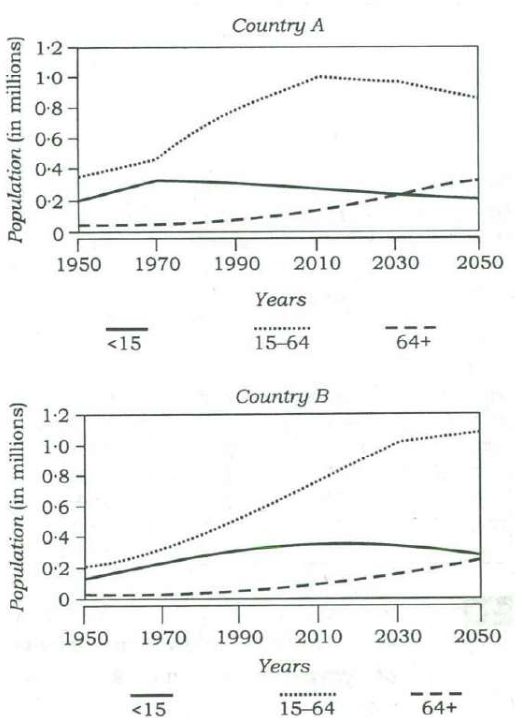
परिच्छेद—4

आर्कटिक के जीवाश्म ईंधन, मत्स्य और खनिजों के विपुल भण्डार अब वर्ष में कहीं अधिक लम्बे समय तक सुलभ हैं। लेकिन अंटार्कटिका, जो कि शीत युद्ध (कोल्ड वार) के दौरान हुई अंटार्कटिक संधि के कारण शोषण से संरक्षित है और किसी भी देश द्वारा किए जाने वाले राज्यक्षेत्रीय दावों के अंतर्गत नहीं आता, के विपरीत आर्कटिक को उद्योगीकरण से सुरक्षित रखने के लिए कोई कानूनी व्यवस्था नहीं है, विशेषकर उस समय जब विश्व अधिक से अधिक संसाधनों के लिए लालायित है। हिम-मुक्त ग्रीष्म की सुस्पष्ट संभावना ने आर्कटिक तट वाले देशों को पिघलते सागर के बड़े खण्डों की छीना-झपटी के लिए उत्साहित किया है।

निम्नलिखित में से कौन-सा एक इस परिच्छेद का सबसे महत्त्वपूर्ण निहितार्थ है?

Read this question in English

Which one of the following is the most important implication of the passage?

(a) India can have territorial claims in the Arctic territory and free access to its resources. · (b) Melting of summer ice in the Arctic leads to changes in the geopolitics. · (c) The Arctic region will solve the world’s future problem of resource crunch. · (d) The Arctic region has more resources than Antarctica.

उत्तर और व्याख्या · explanation in English

Answer: (b) आर्कटिक में ग्रीष्म हिम का पिघलना भू-राजनीति में परिवर्तनों का कारण बनता है।

Melting has made Arctic resources reachable for longer, and with no legal regime like the Antarctic Treaty, countries with Arctic coastline are scrambling for chunks of the ocean. Melting ice is reshaping geopolitics — option (b).

  • ✗ (a) India is not mentioned; the scramble is among countries with an Arctic coastline.
  • ✓ (b) The 'distinct possibility of ice-free summer has prompted countries with Arctic coastline to scramble for great chunks of the melting ocean' — a geopolitical change driven by melting.
  • ✗ (c) The passage notes the world's craving for resources but never says the Arctic will end the shortage.
  • ✗ (d) The two poles are compared on legal protection, not on the size of their resources.

Remember · An implication links the passage's cause (melting ice, no treaty) to its effect (a scramble for territory); ignore actors or comparisons not in the text.

Question and answer: UPSC's official GS Paper II (2018, Series A) — paper ↗ · answer key ↗. Explanation: Minimalist IAS, checked 30 Sept 2026 (how we verify). Permalink ·

परिच्छेद—5

डब्ल्यू॰ टी॰ ओ॰ का सदस्य होने के कारण भारत उन समझौतों से बँधा हुआ है जिन पर भारत समेत इसके सदस्यों ने हस्ताक्षर किए हैं एवं अनुसमर्थन किया है। समझा जाता है कि कृषि समझौते के अनुच्छेद 6 के अनुसार कृषि उत्पादों के लिए न्यूनतम समर्थन मूल्य उपलब्ध कराने से विकृति आएगी और इसे सीमाओं के अधीन रखा गया है। ‘न्यूनतम समर्थनों’ से उत्पन्न आर्थिक सहायता विकासशील देशों के लिए कृषि उत्पादन के मूल्य के 10 प्रतिशत से अधिक नहीं हो सकती। भारत में पी॰ डी॰ एस॰ के लिए न्यूनतम समर्थन मूल्य और खाद्यान्न का सार्वजनिक स्टॉकहोल्डिंग आवश्यक हैं। यह संभव है कि कुछ वर्षों में उत्पादकों को दी जाने वाली आर्थिक सहायता कृषि उत्पादन के मूल्य के 10 प्रतिशत से अधिक बढ़ जाए।

उपर्युक्त परिच्छेद क्या निर्णायक संदेश देता है?

Read this question in English

What is the crucial message conveyed by the above passage?

(a) India should revise its PDS. · (b) India should not be a member of WTO. · (c) For India, food security collides with trade. · (d) India provides food security to its poor.

उत्तर और व्याख्या · explanation in English

Answer: (c) भारत के लिए, खाद्य सुरक्षा व्यापार के साथ टकराव उत्पन्न करती है।

India's PDS rests on minimum support prices and public stockholding, but WTO rules cap such support at 10 per cent of the value of agricultural production — a cap India may exceed in some years. The crucial message is the clash between food security and trade commitments.

  • ✗ (a) A prescription the passage does not make; it points out the conflict without saying which side should give way.
  • ✗ (b) Too extreme; the passage takes membership as given and says India is bound by the agreements.
  • ✓ (c) PDS (food security) needs minimum support prices that WTO's Agriculture Agreement (trade) limits to 10 per cent — the two collide.
  • ✗ (d) Background at most; the passage is about the conflict with WTO rules, not a statement of India's achievement.

Remember · When a passage sets two commitments against each other, the crucial message is the conflict itself, not a remedy.

Question and answer: UPSC's official GS Paper II (2018, Series A) — paper ↗ · answer key ↗. Explanation: Minimalist IAS, checked 30 Sept 2026 (how we verify). Permalink ·

परिच्छेद—6

भारत की शिक्षा प्रणाली उस व्यापक शिक्षा प्रणाली के नमूने पर बनी है जो यूरोप में 19वीं शताब्दी में विकसित हुई और बाद में विश्व में फैल गई। इस व्यवस्था का उद्देश्य है कि बच्चों को ‘अच्छे’ नागरिक और उत्पादक श्रमिक के रूप में अनुकूलित किया जाए। यह व्यवस्था औद्योगिक युग के लिए उपयुक्त थी जिसमें सीमित क्षमतावाले अनुपालनकर्ता श्रमिकों की लगातार पूर्ति की माँग थी। हमारे शिक्षण संस्थान ऐसे कारखानों की तरह हैं जिनमें घंटियाँ होती हैं, वर्दियाँ होती हैं और शिक्षार्थियों के जत्थे तैयार किए जाते हैं, ऐसे शिक्षार्थी जो अनुपालन के लिए ही बनाए जा रहे हैं। किन्तु, आर्थिक दृष्टिकोण से वर्तमान वातावरण पूर्णतः भिन्न है। यह एक जटिल, अस्थिर एवं भूमंडलीय रूप से अंतःसंबंधित संसार है।

उपर्युक्त परिच्छेद के संदर्भ में, निम्नलिखित पूर्वधारणाएँ बनाई गई हैं :

  1. 1.भारत अपनी त्रुटिपूर्ण शिक्षा प्रणाली के कारण तत्त्वतः विकासशील देश बना हुआ है।
  2. 2.आज के शिक्षार्थियों के लिए नए युग के कौशल-समूह प्राप्त करना आवश्यक है।
  3. 3.काफी संख्या में भारतीय शिक्षा प्राप्त करने के लिए कुछ विकसित देशों में जाते हैं क्योंकि वहाँ की शिक्षा प्रणालियाँ उन समाजों का पूर्ण प्रतिबिम्ब है जिनमें वे कार्य करती हैं।

उपर्युक्त में से कौन-सी पूर्वधारणा/पूर्वधारणाएँ वैध है/हैं?

Read this question in English

With reference to the above passage, the following assumptions have been made:

1. India continues to be a developing country essentially due to its faulty education system.

2. Today’s learners need to acquire new-age skill-sets.

3. A good number of Indians go to some developed countries for education because the educational systems there are a perfect reflection of the societies in which they function.

Which of the above assumptions is/are valid?

(a) 1 and 3 only · (b) 2 only · (c) 2 and 3 only · (d) 1, 2 and 3

उत्तर और व्याख्या · explanation in English

Answer: (b) केवल 2

India's schools were built to supply a compliant, narrowly skilled workforce for the industrial age, while today's world is complex, volatile and interconnected. The author must assume learners now need new skills; nothing links education to India's development status or to Indians studying abroad.

  • ✗ 1. The passage never connects the education system to India remaining a developing country; 'essentially due to' is an unsupported causal claim.
  • ✓ 2. Contrasting the industrial age's 'narrow set of capabilities' with today's 'complex, volatile and globally interconnected world' assumes learners need new skills.
  • ✗ 3. Indians studying abroad and systems that 'perfectly reflect' their societies lie outside the passage.

Remember · An assumption bridges the author's premise and point; new causes or facts the passage never touches are not assumptions.

Question and answer: UPSC's official GS Paper II (2018, Series A) — paper ↗ · answer key ↗. Explanation: Minimalist IAS, checked 30 Sept 2026 (how we verify). Permalink ·

परिच्छेद—7

आहार-नियंत्रण (डाइटिंग) का प्रचलन महामारी बन चुका है; हर कोई एक श्रेष्ठ शरीर प्राप्त करने के तरीके की तलाश में है। हम सभी संजातीयता, आनुवंशिकी, पारिवारिक इतिहास, लिंग, आयु, शारीरिक और मानसिक तथा आध्यात्मिक स्वास्थ्य स्थिति, जीवनशैली एवं वरीयता के संदर्भ में भिन्न हैं। इस कारण से हम किस आहार को सहन कर सकते हैं या किस आहार के प्रति संवेदनशील हैं, इस मामले में भी भिन्न हैं। अतः हम वास्तव में अनेक जटिलताओं में कमी एक आहार या आहार-पुस्तिका में नहीं ला सकते। यह विश्वभर में मोटापे पर नियंत्रण रखने में आहारों (डाइट) की विफलता को स्पष्ट करता है। जब तक वजन बढ़ने के कारणों को भली-भाँति समझा नहीं जाएगा और उन्हें दूर नहीं किया जाएगा और जब तक आदतों को स्थायी तौर पर बदला नहीं जाएगा, कोई भी आहार शायद सफल नहीं होगा।

उपर्युक्त परिच्छेद से कौन-सा सर्वाधिक तार्किक और तर्कसंगत निष्कर्ष (इंफेरेंस) निकाला जा सकता है?

Read this question in English

What is the most logical and rational inference that can be made from the above passage?

(a) Obesity has become an epidemic all over the world. · (b) A lot of people are obsessed with attaining a perfect body. · (c) Obesity is essentially an incurable disease. · (d) There is no perfect diet or one solution for obesity.

उत्तर और व्याख्या · explanation in English

Answer: (d) मोटापे के लिए कोई पूर्ण आहार अथवा एक समाधान नहीं है।

People differ in genetics, age, health, lifestyle and the foods they tolerate, so the passage says so many complexities cannot be reduced to one diet — which is why diets fail to curb obesity. The inference: no perfect diet, no single solution.

  • ✗ (a) The passage calls dieting an epidemic, not obesity; the option swaps the subject.
  • ✗ (b) That everyone seeks a perfect body is the passage's opening observation, not the inference its argument leads to.
  • ✗ (c) Diets fail unless causes are addressed and habits change — which implies obesity can be tackled, not that it is incurable.
  • ✓ (d) 'we really cannot reduce so many complexities into one diet or diet book' — no single diet suits everyone.

Remember · The inference is where the argument lands, not a restated opening line; also watch for options that swap the passage's subject.

Question and answer: UPSC's official GS Paper II (2018, Series A) — paper ↗ · answer key ↗. Explanation: Minimalist IAS, checked 30 Sept 2026 (how we verify). Permalink ·

परिच्छेद—8

एकधान्य कृषि करने में बड़े जोखिम हैं। कोई एकमात्र रोग या पीड़क विश्वभर के खाद्य उत्पादन की कतारों का समूल नाश कर सकता है, एक भयप्रद सम्भावना यह है कि इसकी बढ़ती हुई और अपेक्षाकृत धनाढ्य जनसंख्या 2050 तक 70% और अधिक खाद्य का उपभोग करेगी। परिवर्तित होती जलवायु से ये जोखिम और अधिक बढ़ गए हैं। जैसे-जैसे ग्रह गर्म होगा और मानसून वर्षा में तीव्रता आएगी, एशिया की कृषिभूमियाँ बाढ़ग्रस्त हो जाएँगी। उत्तरी अमेरिका को अधिक गहन सूखे का सामना करना होगा और फसल के रोग नए परिमाणों तक विस्तारित हो जाएँगे।

निम्नलिखित में से कौन-सा सर्वाधिक तार्किक, तर्कसंगत और निर्णायक संदेश इस परिच्छेद द्वारा दिया गया है?

Read this question in English

Which of the following is the most logical, rational and crucial message given by the passage?

(a) Preserving crop genetic diversity is an insurance against the effects of climate change. · (b) Despite great risks, monoculture is the only way to ensure food security in the world. · (c) More and more genetically modified crops only can save the world from impending shortages of food. · (d) Asia and North America will be worst sufferers from climate change and the consequent shortage of food.

उत्तर और व्याख्या · explanation in English

Answer: (a) फसल आनुवंशिक विविधता को सुरक्षित रखना जलवायु परिवर्तन के प्रभावों के विरुद्ध बीमा है।

Monoculture is risky because a single disease or pest can wipe out large parts of food production, and climate change magnifies that risk. Keeping crop genetic diversity spreads the risk — an insurance against climate effects.

  • ✓ (a) The opposite of monoculture is diversity; since 'A single disease or pest can wipe out swathes' of production and climate change magnifies the risk, preserving genetic diversity is the logical safeguard.
  • ✗ (b) Contradicts the opening warning that 'Monoculture carries great risks'.
  • ✗ (c) Genetically modified crops are not mentioned, and 'only' is extreme.
  • ✗ (d) Asia and North America are examples of climate effects; the passage does not rank them as the worst sufferers.

Remember · When a passage warns against a practice, its crucial message is often the opposite as a safeguard — here, diversity against monoculture.

Question and answer: UPSC's official GS Paper II (2018, Series A) — paper ↗ · answer key ↗. Explanation: Minimalist IAS, checked 30 Sept 2026 (how we verify). Permalink ·

कोई दुकानदार किसी वस्तु को ₹ 40 में बेचकर X % लाभ कमाता है। तथापि, जब वह उस वस्तु को ₹ 20 में बेचता है, तो उसे उतने ही प्रतिशत की हानि होती है। वस्तु की मूल लागत कितनी है?

Read this question in English

A shopkeeper sells an article at ₹40 and gets X% profit. However, when he sells it at ₹20, he faces same percentage of loss. What is the original cost of the article?

(a) ₹10 · (b) ₹20 · (c) ₹30 · (d) ₹40

उत्तर और व्याख्या · explanation in English

Answer: (c) ₹ 30

An equal percentage profit and loss on the same cost means the two selling prices lie equally far above and below the cost. The cost is the average of ₹40 and ₹20, i.e. ₹30 (profit and loss both 33⅓%).

  1. Let the cost be C. Then 40 = C(1 + X/100) and 20 = C(1 − X/100).
  2. Adding the two: 60 = 2C, so C = ₹30.
  3. Check: ₹40 is 33⅓% above ₹30, and ₹20 is 33⅓% below it.

Remember · Same percentage profit and loss on one cost price: the cost is the average of the two selling prices.

Question and answer: UPSC's official GS Paper II (2018, Series A) — paper ↗ · answer key ↗. Explanation: Minimalist IAS, checked 30 Sept 2026 (how we verify). Permalink ·

किसी वृत्त की परिधि पर समान दूरी पर 24 बिन्दुएँ हैं। इनमें से शीर्ष के रूप में तीन बिन्दुओं के समुच्चयों से अधिकतम कितने समबाहु त्रिभुज बन सकते हैं?

Read this question in English

There are 24 equally spaced points lying on the circumference of a circle. What is the maximum number of equilateral triangles that can be drawn by taking sets of three points as the vertices?

(a) 4 · (b) 6 · (c) 8 · (d) 12

उत्तर और व्याख्या · explanation in English

Answer: (c) 8

An equilateral triangle inscribed in a circle has its vertices 120° apart — every 8th point of 24. Each point belongs to exactly one such triangle, so there are 24 ÷ 3 = 8.

  1. Adjacent points are 360° ÷ 24 = 15° apart.
  2. An inscribed equilateral triangle needs vertices 120° apart: 120 ÷ 15 = 8 steps.
  3. Starting at points 1 to 8 gives different triangles (1-9-17, 2-10-18, …, 8-16-24); starting at 9 repeats the first.
  4. Number of triangles = 24 ÷ 3 = 8.

Remember · On n equally spaced points, inscribed regular k-gons exist only if k divides n, and there are n/k of them.

Question and answer: UPSC's official GS Paper II (2018, Series A) — paper ↗ · answer key ↗. Explanation: Minimalist IAS, checked 30 Sept 2026 (how we verify). Permalink ·

निम्नलिखित अनुक्रम पर विचार कीजिए :

4/12/95, 1/1/96, 29/1/96, 26/2/96, ...

इस अनुक्रम का अगला पद क्या होगा?

Read this question in English

Consider the sequence given below:

4/12/95, 1/1/96, 29/1/96, 26/2/96, ....

What is the next term of the series?

(a) 24/3/96 · (b) 25/3/96 · (c) 26/3/96 · (d) 27/3/96

उत्तर और व्याख्या · explanation in English

Answer: (b) 25/3/96

Each date is 28 days after the one before. 26 February 1996 plus 28 days is 25 March, because 1996 is a leap year and February has 29 days.

  1. 4 December 1995 to 1 January 1996: 27 days to the end of December + 1 = 28 days.
  2. 1 January to 29 January: 28 days; 29 January to 26 February: 2 + 26 = 28 days.
  3. 1996 is divisible by 4, so February 1996 has 29 days.
  4. 26 February + 28 days: 3 days to 29 February, then 25 more — 25 March 1996.

Remember · In date sequences, find the constant gap in days and watch for leap years when crossing February.

Question and answer: UPSC's official GS Paper II (2018, Series A) — paper ↗ · answer key ↗. Explanation: Minimalist IAS, checked 30 Sept 2026 (how we verify). Permalink ·

5 से॰ मी॰ विकर्ण के आयत में फिट करने के लिए बारह समान वर्गों को रखा गया है। आयत में तीन पंक्तियाँ हैं, प्रत्येक में चार वर्ग हैं। निकटवर्ती वर्गों के बीच कोई रिक्त स्थान नहीं है। प्रत्येक वर्ग का क्षेत्रफल क्या है?

Read this question in English

Twelve equal squares are placed to fit in a rectangle of diagonal 5 cm. There are three rows containing four squares each. No gaps are left between adjacent squares. What is the area of each square?

(a) 5/7 sq cm · (b) 7/5 sq cm · (c) 1 sq cm · (d) 25/12 sq cm

उत्तर और व्याख्या · explanation in English

Answer: (c) 1 वर्ग से॰ मी॰

With squares of side s, the rectangle measures 4s by 3s, so its diagonal is 5s by Pythagoras. 5s = 5 cm gives s = 1 cm and an area of 1 sq cm.

  1. Let each square have side s; the rectangle is 4s long and 3s wide.
  2. Diagonal = √((4s)² + (3s)²) = 5s.
  3. 5s = 5, so s = 1 cm and each square's area is 1 sq cm.
  4. Check: a 4 cm × 3 cm rectangle has diagonal √25 = 5 cm.

Remember · Spot the 3-4-5 triangle: sides in the ratio 3 : 4 make the diagonal 5 parts.

Question and answer: UPSC's official GS Paper II (2018, Series A) — paper ↗ · answer key ↗. Explanation: Minimalist IAS, checked 30 Sept 2026 (how we verify). Permalink ·

नीचे दिए गए आलेख (ग्राफ) पर विचार कीजिए :

Line graph of % of work (0–100%) from 1st April to 1st September. The dashed ‘Expected progress’ line reaches about 25% by May, 50% by June, about 70% by August and 100% on 1st September; the solid ‘Actual progress’ line rises slowly to about 42% by August, then climbs steeply, crosses above the expected line and reaches 100% before 1st September.
From UPSC's question paper.

निम्नलिखित में से कौन-सा कथन ऊपर दिए गए आलेख के संदर्भ में सही नहीं है?

Read this question in English

Consider the following graph:

Which one of the following statements is not correct with reference to the graph given above?

(a) On 1st June, the actual progress of work was less than expected. · (b) The actual rate of progress of work was the greatest during the month of August. · (c) The work was actually completed before the expected time. · (d) During the period from 1st April to 1st September, at no time was the actual progress more than the expected progress.

उत्तर और व्याख्या · explanation in English

Answer: (d) 1 अप्रैल से 1 सितम्बर की अवधि में किसी भी समय वास्तविक प्रगति अपेक्षित प्रगति से अधिक नहीं थी।

In August the actual-progress line shoots up, crosses above the expected line and reaches 100% before 1st September. So for a while actual progress did exceed expected progress, which makes statement (d) the incorrect one.

  1. (a) On 1st June actual progress is about 22% against an expected 50% — true.
  2. (b) The actual line is steepest in August, rising from about 42% to 100% — true.
  3. (c) Actual progress reaches 100% during August, before the expected finish on 1st September — true.
  4. (d) In late August the actual line crosses above the expected line, so actual progress was more than expected for a time — false.
  5. The statement that is not correct is (d).

Remember · In 'not correct' graph items, test every option against the picture, and look closely where two lines cross.

Question and answer: UPSC's official GS Paper II (2018, Series A) — paper ↗ · answer key ↗. Explanation: Minimalist IAS, checked 1 Oct 2026 (how we verify). Permalink ·
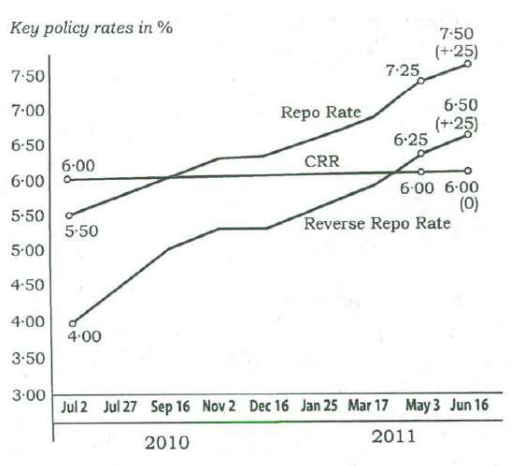
एक खेल प्रतियोगिता के लिए लकड़ी के तीन खण्डकों को मिलाकर बने विजेता-मंच का आकार नीचे दिया गया है :

A winners' stand of three rectangular blocks side by side: the tallest on the left, a middle-height block next to it and the shortest on the right.
From UPSC's question paper.

उपलब्ध छः विभिन्न रंगों में से रंग चुनने हैं और लकड़ी के तीनों खण्डकों में से प्रत्येक को इस प्रकार रंगा जाना है कि कोई भी दो खण्डकों का रंग एकसमान न हो। विजेता-मंच को कितने अलग-अलग तरीकों से रंगा जा सकता है?

Read this question in English

For a sports meet, a winners’ stand comprising three wooden blocks is in the following form:

There are six different colours available to choose from and each of the three wooden blocks is to be painted such that no two of them has the same colour. In how many different ways can the winners’ stand be painted?

(a) 120 · (b) 81 · (c) 66 · (d) 36

उत्तर और व्याख्या · explanation in English

Answer: (a) 120

The three blocks are different (first, second and third place), so the order of colours matters. With six colours and no repeats there are 6 × 5 × 4 = 120 ways.

  1. The blocks differ in height, so each assignment of colours to blocks is a different painting.
  2. Tallest block: 6 choices; next block: 5; last block: 4.
  3. Ways = 6 × 5 × 4 = 120 (that is, ⁶P₃).

Remember · When the positions are distinct, use permutations: n × (n − 1) × … for as many positions as are filled.

Question and answer: UPSC's official GS Paper II (2018, Series A) — paper ↗ · answer key ↗. Explanation: Minimalist IAS, checked 1 Oct 2026 (how we verify). Permalink ·
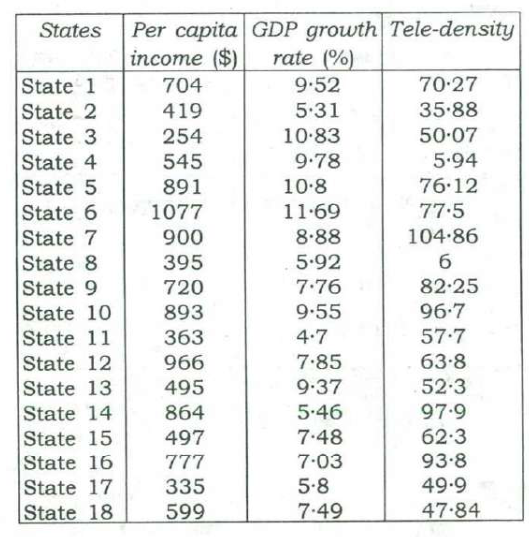
निम्नलिखित 2 (दो) प्रश्नांशों के लिए निर्देश : नीचे दिए गए आलेख (ग्राफ) पर विचार कीजिए जिसमें किसी देश की जन्मदर और मृत्युदर दी गई हैं, और उसके आगे आने वाले दो प्रश्नांशों के उत्तर दीजिए :

Line graph, 1970–2010, of birth and death rates per thousand: the birthrate (solid) falls from 30 to about 22.5 in 1990 and 19 in 2000, then levels off at about 18; the death rate (dashed) falls from 25 to about 14 in 1990 and about 6.5 by 2000, then stays near 6.5–7.
From UPSC's question paper.

आलेख को देखकर यह निष्कर्ष निकाला जा सकता है कि वर्ष 1990 से 2010 तक

Read this question in English

Directions for the following 2 (two) items: Consider the following graph in which the birthrate and death rate of a country are given, and answer the two items that follow.

Looking at the graph, it can be inferred that from 1990 to 2010

(a) population growth rate has increased · (b) population growth rate has decreased · (c) growth rate of population has remained stable · (d) population growth rate shows no trend

उत्तर और व्याख्या · explanation in English

Answer: (d) जनसंख्या की वृद्धि-दर किसी प्रवृत्ति को नहीं दिखाती

Why not the tempting option · UPSC's key is (d). The gap between the two curves, which is the growth rate, widens from about 8.5 per thousand in 1990 to about 11.5 in 2000, then flattens and eases slightly to about 11 by 2010, so there is no single direction across 1990–2010. 'Has increased' is tempting because 2010 sits higher than 1990, but the rise ends at 2000 and the gap drifts down after that. In the exam, read a trend over a stated period as one consistent direction across the whole period, as UPSC does; its key to the next item likewise treats the growth rate as having stabilised after 2005.

The population growth rate is the gap between the birthrate and the death rate. From 1990 the gap widens, from about 8.5 to about 11.5 per thousand by 2000, and then flattens and eases slightly to about 11 by 2010. A rise followed by a plateau is not a single direction, so over 1990–2010 the growth rate shows no trend: (d).

  1. Natural growth rate = birthrate − death rate: the vertical gap between the two curves.
  2. 1990: about 22.5 − 14 = 8.5 per thousand. 1995: about 20 − 9.5 = 10.5.
  3. 2000: about 18.5 − 7 = 11.5. 2005: about 18 − 6.5 = 11.5. 2010: about 18 − 7 = 11.
  4. So the gap rises through the 1990s, then stops rising and dips a little through the 2000s.
  5. 'Increased' needs the rise to run through the whole period, but it ends at 2000; 'decreased' and 'stable' fail for the 1990s. A rise that then levels off is no single trend: (d).

Remember · Population growth rate = birth rate − death rate: read the gap between the curves, not the curves themselves. A rise that then levels off is 'no trend' over the whole period, not 'increased'.

Question and answer: UPSC's official GS Paper II (2018, Series A) — paper ↗ · answer key ↗. Explanation: Minimalist IAS, checked 1 Oct 2026 (how we verify). Permalink ·
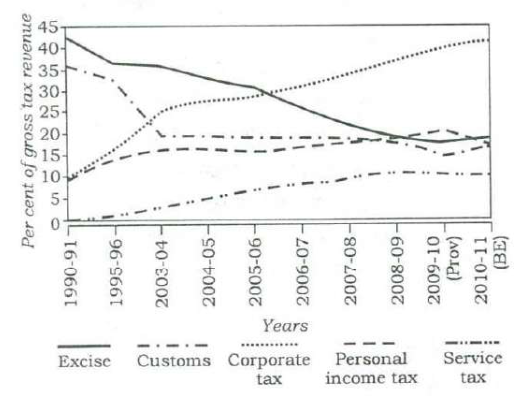
निम्नलिखित 2 (दो) प्रश्नांशों के लिए निर्देश : नीचे दिए गए आलेख (ग्राफ) पर विचार कीजिए जिसमें किसी देश की जन्मदर और मृत्युदर दी गई हैं, और उसके आगे आने वाले दो प्रश्नांशों के उत्तर दीजिए :

ऊपर दिए गए आलेख के संदर्भ में, 1970 को आधार वर्ष मानकर निम्नलिखित कथनों पर विचार कीजिए :

  1. 1.35 वर्षों के पश्चात् जनसंख्या स्थिर हो गई है।
  2. 2.35 वर्षों के पश्चात् जनसंख्या वृद्धि-दर स्थिर हो गई है।
  3. 3.पहले 10 वर्षों में मृत्युदर में 10% की गिरावट हुई है।
  4. 4.35 वर्षों के बाद जन्मदर स्थिर हो गई है।

Uses the same figure as Q63 ↑

उपर्युक्त में से कौन-से सर्वाधिक तार्किक एवं तर्कसंगत कथन हैं जो कि इस आलेख से बनाए जा सकते हैं?

Read this question in English

Directions for the following 2 (two) items: Consider the following graph in which the birthrate and death rate of a country are given, and answer the two items that follow.

With reference to the above graph, consider the following statements considering 1970 as base year:

1. Population has stabilized after 35 years.

2. Population growth rate has stabilized after 35 years.

3. Death rate has fallen by 10% in the first 10 years.

4. Birthrate has stabilized after 35 years.

Which of the above are the most logical and rational statements that can be made from the above graph?

(a) 1 and 2 only · (b) 1, 2 and 3 · (c) 3 and 4 · (d) 2 and 4

उत्तर और व्याख्या · explanation in English

Answer: (d) 2 और 4

From 2005 (35 years after 1970) both curves flatten — the birthrate near 18 and the death rate near 6.5–7 — so the birthrate and the growth rate (their gap) have stabilised. The population itself keeps growing, and the death rate fell by much more than 10% in 1970–80.

  1. 35 years after 1970 is 2005; compare the curves from 2005 to 2010.
  2. Birthrate: about 18 throughout; death rate: about 6.5 to 7; gap about 11 throughout.
  3. 1970–80: death rate from 25 to about 21, a fall of about 16%.
  • ✗ 1. Births stay well above deaths after 2005, so the population keeps growing; only its growth rate is steady.
  • ✓ 2. After 2005 the gap between the curves stays at about 11 per thousand, so the growth rate has stabilised.
  • ✗ 3. The death rate falls from 25 to about 21 per thousand in 1970–80, about 16% (4 points), not 10%.
  • ✓ 4. The birthrate curve runs flat at about 18 per thousand from 2005 to 2010.

Remember · A steady growth rate is not a steady population; population stops growing only when births equal deaths.

Question and answer: UPSC's official GS Paper II (2018, Series A) — paper ↗ · answer key ↗. Explanation: Minimalist IAS, checked 1 Oct 2026 (how we verify). Permalink ·

चित्र A और B में एक फर्म में श्रमिकों की प्रति वर्ष औसत प्रति घंटा आय (E) निरूपित की गई है :

वर्ष20132014201520162017
चित्र A में E2025303540
चित्र B में E2025303540
Two line graphs of hourly earnings E for 2013–2017. Fig. A's vertical axis starts at 20 and is marked every 5; Fig. B's starts near 0 and is marked every 10. Both plot E = 20, 25, 30, 35 and 40, so the lines look different only because the scales differ.
From UPSC's question paper.

चित्रों से यह देखा जा सकता है कि

Read this question in English

Average hourly earnings per year (E) of the workers in a firm are represented in figures A and B as follows:

From the figures, it is observed that the

(a) values of E are different · (b) ranges (i.e., the difference between the maximum and the minimum) of E are different · (c) slopes of the graphs are same · (d) rates of increase of E are different

उत्तर और व्याख्या · explanation in English

Answer: (c) आलेखों (ग्राफ) की प्रवणता समान है

Both figures plot the same data: E rises from 20 to 40 by 5 each year. Only the axis scales differ, making one line look steeper; the actual slope — 5 per year — is the same in both.

  1. Fig. A: E = 20, 25, 30, 35, 40 for 2013–17; Fig. B shows the same points on a differently scaled axis.
  2. (a) The values are identical — false.
  3. (b) The range is 40 − 20 = 20 in both — false.
  4. (d) E rises by 5 a year in both — false.
  5. (c) Slope = change in E per year = 5 in both — true; the visual difference comes only from the scale.

Remember · Before comparing graphs, read the axis scales; stretching an axis changes how steep a line looks, not the data.

Question and answer: UPSC's official GS Paper II (2018, Series A) — paper ↗ · answer key ↗. Explanation: Minimalist IAS, checked 1 Oct 2026 (how we verify). Permalink ·

नीचे दिए गए चित्रों पर विचार कीजिए :

A 3 × 3 grid of line figures; the last cell is ‘?’. Each figure joins one of three bodies (a U-shaped curve with a dot, a straight bar with a solid square, an arc ending in a triangle) to one of three leg sets (two bent legs, three short T-shaped legs, four long forked legs). The four options are also drawn as figures.
From UPSC's question paper.

प्रश्नवाचक चिह्न के स्थान पर उपयुक्त रूप से आने वाला सही उत्तर है

Read this question in English

Consider the figures given below:

To fit the question mark, the correct answer is

(a) Figure: a straight bar with a solid square at its left end and two bent legs · (b) Figure: a straight bar with a solid dot at its left end and two bent legs · (c) Figure: a straight bar with a triangle at its left end and two long forked legs · (d) Figure: a straight bar with a solid dot at its right end and two short legs

उत्तर और व्याख्या · explanation in English

Answer: (a)

Each row and each column uses each body once and each set of legs once. The last row already has the arc-with-triangle and U-with-dot bodies, and the T-shaped and forked legs, so the missing figure is the bar with a square and two bent legs — (a).

  1. Bodies: U-curve with dot, straight bar with square, arc with triangle. Legs: two bent, three T-shaped, four forked.
  2. Row 1: U + two bent; bar + three T; arc + four forked. Row 2: bar + four forked; arc + two bent; U + three T.
  3. Row 3 has arc + three T and U + four forked, so it lacks the bar body and the two bent legs.
  4. Column 3 agrees: arc and U are used, so the bar is missing; forked and T-shaped legs are used, so two bent legs are missing.
  5. Only (a) — a bar with a square and two bent legs — fits.

Remember · In 3 × 3 figure matrices, split each figure into parts and check that each part appears once in every row and column.

Question and answer: UPSC's official GS Paper II (2018, Series A) — paper ↗ · answer key ↗. Explanation: Minimalist IAS, checked 1 Oct 2026 (how we verify). Permalink ·

निम्नांकित चित्रों A और B पर विचार कीजिए :

अददों की संख्याउत्पादन की लागत (₹ लाख में), चित्र Aप्रति अदद विक्रय मूल्य (₹), चित्र B
10006400
20007350
30008300
Fig. A: cost of production (₹ lakh) rises in a straight line from 5 at zero to 6, 7 and 8 at 1000, 2000 and 3000 pieces. Fig. B: selling price per piece falls along a curve from above ₹500 to ₹400 at 1000 pieces sold, then in a straight line to ₹350 at 2000 and ₹300 at 3000.
From UPSC's question paper.

क्रमशः चित्र A और B में किसी उत्पाद की निर्माण लागत और प्रक्षेपित बिक्री दिखाई गई है। कम-से-कम कितने अददों का निर्माण किया जाना चाहिए ताकि हानि न हो?

Read this question in English

Consider the following figures A and B:

The manufacturing cost and projected sales for a product are shown in the above figures A and B respectively. What is the minimum number of pieces that should be manufactured to avoid a loss?

(a) 2000 · (b) 2500 · (c) 3000 · (d) 3500

उत्तर और व्याख्या · explanation in English

Answer: (a) 2000

Revenue is pieces × price. At 1000 pieces it is ₹4 lakh against a cost of ₹6 lakh; at 2000 pieces it is 2000 × ₹350 = ₹7 lakh, exactly the cost. So 2000 pieces is the minimum that avoids a loss.

  1. 1000 pieces: revenue 1000 × 400 = ₹4 lakh; cost ₹6 lakh — a loss of ₹2 lakh.
  2. 1500 pieces: price about ₹375, revenue about ₹5.6 lakh; cost ₹6.5 lakh — still a loss.
  3. 2000 pieces: revenue 2000 × 350 = ₹7 lakh; cost ₹7 lakh — no loss (break-even).
  4. 3000 pieces: revenue 3000 × 300 = ₹9 lakh against ₹8 lakh — a profit, but 2000 already suffices.
  5. Minimum number to avoid a loss: 2000.

Remember · Break-even: compare revenue (quantity × price) with cost at each point; the first point where revenue reaches cost is the answer.

Question and answer: UPSC's official GS Paper II (2018, Series A) — paper ↗ · answer key ↗. Explanation: Minimalist IAS, checked 1 Oct 2026 (how we verify). Permalink ·

एक लिफ्ट में 18 वयस्क या 30 बच्चों को ले जाने की क्षमता है। लिफ्ट में 12 वयस्कों के साथ कितने बच्चे आ सकते हैं?

Read this question in English

A lift has the capacity of 18 adults or 30 children. How many children can board the lift with 12 adults?

(a) 6 · (b) 10 · (c) 12 · (d) 15

उत्तर और व्याख्या · explanation in English

Answer: (b) 10

18 adults take the same space as 30 children, so one adult equals 5/3 of a child. 12 adults use the space of 20 children, leaving room for 10.

  1. 18 adults = 30 children, so 1 adult = 30/18 = 5/3 children.
  2. 12 adults = 12 × 5/3 = 20 children's worth of space.
  3. Room left = 30 − 20 = 10 children.
  4. Check: 12 adults fill 12/18 = 2/3 of the lift; the remaining 1/3 of 30 children is 10.

Remember · Convert everything to one unit (here child-spaces), subtract what is used, and read off what remains.

Question and answer: UPSC's official GS Paper II (2018, Series A) — paper ↗ · answer key ↗. Explanation: Minimalist IAS, checked 30 Sept 2026 (how we verify). Permalink ·

किसी व्यक्ति ने ₹22,800 कीमत का रेफ्रीजरेटर 12·5% चक्रवृद्धि ब्याज (वार्षिक) पर खरीदा। पहले वर्ष के अंत पर उसने ₹8,650 एवं दूसरे वर्ष के अंत पर ₹9,125 चुकाए। ऋण पूरा चुकाने के लिए उसे तीसरे वर्ष के अंत में कितने रुपये का भुगतान करना होगा?

Read this question in English

A person bought a refrigerator worth ₹22,800 with 12.5% interest compounded yearly. At the end of first year he paid ₹8,650 and at the end of second year ₹9,125. How much will he have to pay at the end of third year to clear the debt?

(a) ₹9,990 · (b) ₹10,000 · (c) ₹10,590 · (d) ₹11,250

उत्तर और व्याख्या · explanation in English

Answer: (d) ₹11,250

Add a year's interest (12.5%, one-eighth) to the balance and subtract each payment. The balance falls to ₹17,000 after year 1 and ₹10,000 after year 2, so year 3 needs ₹10,000 × 1.125 = ₹11,250.

  1. Year 1: 22,800 × 1.125 = 25,650; after paying 8,650 the balance is 17,000.
  2. Year 2: 17,000 × 1.125 = 19,125; after paying 9,125 the balance is 10,000.
  3. Year 3: 10,000 × 1.125 = 11,250 clears the debt.
  4. Check: ₹10,000 is only the balance at the start of year 3; it still earns a year's interest.

Remember · For instalments at compound interest, roll the balance forward: add the year's interest, subtract the payment. 12.5% is one-eighth.

Question and answer: UPSC's official GS Paper II (2018, Series A) — paper ↗ · answer key ↗. Explanation: Minimalist IAS, checked 30 Sept 2026 (how we verify). Permalink ·

निम्नांकित चित्रों पर विचार कीजिए :

Six circles (I)–(VI), each cut into six sectors by a horizontal line and two diagonals, holding a small square and a small triangle. Square: top, upper right, lower right, bottom, lower left, upper left. Triangle: lower left, bottom, lower right, upper right, top, upper left. The four options are drawn as circles too.
From UPSC's question paper.

ऊपर चित्र (I) से (VI) तक में कुछ भाग नियमित दिशाओं में अपनी स्थितियाँ बदलते हुए दिखाए गए हैं। उसी अनुक्रम का अनुसरण करते हुए नीचे दिए गए चित्रों में से कौन-सा चरण (VII) में आएगा?

Read this question in English

Consider the following figures:

In the figures (I) to (VI) above, some parts are shown to change their positions in regular directions. Following the same sequence, which of the figures given below will appear at (VII) stage?

(a) Figure: triangle in the upper-left sector, square in the lower-right sector · (b) Figure: square in the top sector, triangle in the lower-left sector · (c) Figure: square and triangle together in the bottom sector · (d) Figure: triangle in the top sector, square in the bottom sector

उत्तर और व्याख्या · explanation in English

Answer: (b)

The square moves one sector clockwise at each step and the triangle one sector anticlockwise. At stage (VII) the square returns to the top and the triangle to the lower left — option (b).

  1. Name the sectors clockwise: top, upper right, lower right, bottom, lower left, upper left.
  2. Square in (I)–(VI): top, upper right, lower right, bottom, lower left, upper left — one step clockwise each time.
  3. Triangle in (I)–(VI): lower left, bottom, lower right, upper right, top, upper left — one step anticlockwise each time.
  4. Stage (VII): the square moves from upper left to top; the triangle moves from upper left to lower left.
  5. Check: after six steps both are back where they were in (I), as expected in a six-sector circle.

Remember · Track each moving part separately — its direction and step size; after a full cycle the figure repeats.

Question and answer: UPSC's official GS Paper II (2018, Series A) — paper ↗ · answer key ↗. Explanation: Minimalist IAS, checked 1 Oct 2026 (how we verify). Permalink ·

निम्नांकित आलेखों पर विचार कीजिए। आलेखों में दिए गए वक्र कुछ दशकों की अवधि में दो देशों A और B की जनसंख्या में विभिन्न आयु-वर्गों को प्रदर्शित करते हैं :

उपर्युक्त आलेखों के संदर्भ में, निम्नलिखित में से कौन-से सर्वाधिक तार्किक और तर्कसंगत निष्कर्ष (इंफेरेंस) निकाले जा सकते हैं?

  1. 1.पिछले ढाई दशकों में देश B के निर्भरता अनुपात में कमी आई है।
  2. 2.अगले ढाई दशकों के अंत में, देश A का निर्भरता अनुपात, देश B के निर्भरता अनुपात की तुलना में बहुत कम हो जाएगा।
  3. 3.अगले दो दशकों में, देश A की तुलना में देश B में कुल जनसंख्या के सापेक्ष कार्यशील जनसंख्या बढ़ जाएगी।
Two line graphs, 1950–2050, of population (in millions) by age group (<15, 15–64, 64+). Country A: 15–64 rises to about 1.0 by 2010 and falls to about 0.87 by 2050; <15 drifts down from about 0.33 to 0.22; 64+ climbs past the <15 line around 2030 to about 0.34. Country B: 15–64 keeps rising to about 1.1 by 2050; <15 stays around 0.3–0.36; 64+ rises slowly to about 0.26.
From UPSC's question paper.

नीचे दिए गए कूट का प्रयोग कर सही उत्तर चुनिए।

Read this question in English

Consider the following graphs. The curves in the graphs indicate different age groups in the populations of two countries A and B over a period of few decades:

With reference to the above graphs, which of the following are the most logical and rational inferences that can be made?

1. Over the last two and a half decades, the dependency ratio for country B has decreased.

2. By the end of next two and a half decades, the dependency ratio of country A will be much less than that of country B.

3. In the next two decades, the work-force relative to its total population will increase in country B as compared to country A.

Select the correct answer using the code given below.

(a) 1 and 2 only · (b) 2 and 3 only · (c) 1 and 3 only · (d) 1, 2 and 3

उत्तर और व्याख्या · explanation in English

Answer: (c) केवल 1 और 3

Dependency ratio = (under-15 + over-64) ÷ working-age (15–64). In B the working-age group grew much faster than the dependants over the past 25 years, so the ratio fell (1). Ahead, A's working-age group shrinks while its elderly grow, so A's ratio will not be much lower than B's (2 fails), and B's working-age share rises while A's falls (3).

  1. Dependency ratio = (<15 + 64+) ÷ (15–64).
  2. Country B, about 1990: (0.32 + 0.05) ÷ 0.54 ≈ 0.69; about 2015: (0.36 + 0.11) ÷ 0.84 ≈ 0.56 — decreased.
  3. Around 2043: A ≈ (0.23 + 0.31) ÷ 0.92 ≈ 0.59; B ≈ (0.32 + 0.22) ÷ 1.07 ≈ 0.50 — A's ratio is higher, not much lower.
  4. Working-age share, about 2018 → 2038: B ≈ 0.65 → 0.67 (up); A ≈ 0.68 → 0.65 (down).
  • ✓ 1. In B the 15–64 group grows from about 0.54 to 0.84 million over the period while dependants rise only from about 0.37 to 0.47, so the ratio falls.
  • ✗ 2. By the early 2040s A's elderly have overtaken its children and its working-age group is shrinking; its ratio (about 0.59) is above B's (about 0.50).
  • ✓ 3. B's working-age group keeps growing faster than its dependants, while A's working-age group declines and its elderly grow.

Remember · Dependency ratio = (children + elderly) ÷ working-age; read all three curves at both dates before judging the direction.

Question and answer: UPSC's official GS Paper II (2018, Series A) — paper ↗ · answer key ↗. Explanation: Minimalist IAS, checked 1 Oct 2026 (how we verify). Permalink ·

लक्ष्मी, उसका भाई, उसकी पुत्री तथा उसका पुत्र बैडमिंटन खिलाड़ी हैं। एक युगल (डबल्स) खेल प्रारंभ होने वाला है :

  1. i.लक्ष्मी का भाई उसकी पुत्री से नेट के पार ठीक सम्मुख है।
  2. ii.उसका पुत्र, सबसे खराब खिलाड़ी के सहोदर से नेट के पार विकर्णतः सम्मुख है।
  3. iii.सबसे अच्छा खिलाड़ी तथा सबसे खराब खिलाड़ी नेट के एक ही तरफ हैं।

सबसे अच्छा खिलाड़ी कौन है?

Read this question in English

Lakshmi, her brother, her daughter and her son are badminton players. A game of doubles is about to begin:

i. Lakshmi’s brother is directly across the net from her daughter.

ii. Her son is diagonally across the net from the worst player’s sibling.

iii. The best player and the worst player are on the same side of the net.

Who is the best player?

(a) Her brother · (b) Her daughter · (c) Her son · (d) Lakshmi

उत्तर और व्याख्या · explanation in English

Answer: (a) उसका भाई

The brother and the daughter face each other, so Lakshmi and her son are also on opposite sides. Whichever side the son takes, clue (ii) puts the worst player on the brother's side of the net, and clue (iii) then makes the brother the best player.

  1. Siblings: Lakshmi and her brother; the daughter and the son.
  2. Clue (i): the brother and daughter are on opposite sides, directly facing; so Lakshmi and her son are on opposite sides too.
  3. Case 1 — the son partners the brother: the son is diagonally across from the daughter, so the worst player's sibling is the daughter and the worst is the son. By (iii) the best is his partner, the brother.
  4. Case 2 — the son partners the daughter: the son is diagonally across from the brother, so the worst player's sibling is the brother and the worst is Lakshmi. The best is her partner — again the brother.
  5. Both cases give the brother as the best player.

Remember · When the clues allow two layouts, work out both; if they agree on the person asked about, that is the answer.

Question and answer: UPSC's official GS Paper II (2018, Series A) — paper ↗ · answer key ↗. Explanation: Minimalist IAS, checked 30 Sept 2026 (how we verify). Permalink ·

नीचे दिए गए आलेख में एक वर्ष की अवधि में केन्द्रीय बैंक द्वारा प्रमुख नीतिगत दरों में अनेक बार किए गए परिवर्तनों को दिखाया गया है :

प्रमुख नीतिगत दरें, % मेंजु 2मई 3जून 16
रेपो दर5·507·257·50 (+·25)
रिवर्स रेपो दर4·006·256·50 (+·25)
सी॰ आर॰ आर॰6·006·006·00 (0)
Line graph of key policy rates from 2 July 2010 to 16 June 2011: the repo rate rises in steps from 5.50% to 7.50% and the reverse repo rate from 4.00% to 6.50%, while the CRR stays flat at 6.00%; the table lists the values labelled on the graph.
From UPSC's question paper.

निम्नलिखित में से कौन-सा एक केन्द्रीय बैंक की इस कार्रवाई का सबसे संभव कारण है?

Read this question in English

The graph given below indicates the changes in key policy rates made by the Central Bank several times in a year:

Which one of the following can be the most likely reason for the Central Bank for such an action?

(a) Encouraging foreign investment · (b) Increasing the liquidity · (c) Encouraging both public and private savings · (d) Anti-inflationary stance

उत्तर और व्याख्या · explanation in English

Answer: (d) स्फीति-विरोधी कदम

The central bank raised the repo and reverse repo rates again and again — by 2 and 2.5 percentage points in under a year — while keeping CRR unchanged. Repeated rate hikes make borrowing dearer and pull money out of the system, the standard response to high inflation.

  1. Repo rate: 5.50% → 7.50%; reverse repo: 4.00% → 6.50%; CRR steady at 6.00%.
  2. Higher policy rates raise banks' cost of funds and lending rates, slowing credit and money supply.
  3. That tightens liquidity — the opposite of (b).
  4. Attracting foreign investment or savings is not the purpose of a year of repeated hikes; cooling demand and prices is — an anti-inflationary stance.

Remember · Rising repo and reverse repo rates mean tight money to fight inflation; falling rates mean easing to support growth and liquidity.

Question and answer: UPSC's official GS Paper II (2018, Series A) — paper ↗ · answer key ↗. Explanation: Minimalist IAS, checked 1 Oct 2026 (how we verify). Permalink ·

निम्नलिखित 2 (दो) प्रश्नांशों के लिए निर्देश : नीचे दी गई तालिका में किसी विशेष वर्ष में किसी देश के विभिन्न राज्यों की जी॰ डी॰ पी॰ वृद्धि-दर और दूरसंचार सघनता आँकड़े दिखाए गए हैं। इस तालिका का अध्ययन कीजिए और आगे आने वाले दो प्रश्नांशों के उत्तर दीजिए।

ऊपर दी गई तालिका के संदर्भ में, निम्नलिखित में से कौन-सा/से सर्वाधिक तार्किक और तर्कसंगत निष्कर्ष (इंफेरेंस) निकाला जा सकता है/निकाले जा सकते हैं?

  1. 1.उच्चतर प्रति व्यक्ति आय सामान्यतः उच्चतर दूरसंचार सघनता से संबद्ध होती है।
  2. 2.उच्चतर जी॰ डी॰ पी॰ वृद्धि-दर सदा उच्चतर प्रति व्यक्ति आय को सुनिश्चित करती है।
  3. 3.उच्चतर जी॰ डी॰ पी॰ वृद्धि-दर उच्चतर दूरसंचार सघनता को आवश्यक रूप से सुनिश्चित नहीं करती।
राज्यप्रति व्यक्ति आय ($)जी॰ डी॰ पी॰ वृद्धि-दर (%)दूरसंचार सघनता
राज्य 17049·5270·27
राज्य 24195·3135·88
राज्य 325410·8350·07
राज्य 45459·785·94
राज्य 589110·876·12
राज्य 6107711·6977·5
राज्य 79008·88104·86
राज्य 83955·926
राज्य 97207·7682·25
राज्य 108939·5596·7
राज्य 113634·757·7
राज्य 129667·8563·8
राज्य 134959·3752·3
राज्य 148645·4697·9
राज्य 154977·4862·3
राज्य 167777·0393·8
राज्य 173355·849·9
राज्य 185997·4947·84
A table of 18 States giving per capita income ($), GDP growth rate (%) and tele-density.
From UPSC's question paper.

नीचे दिए गए कूट का प्रयोग कर सही उत्तर चुनिए।

Read this question in English

Directions for the following 2 (two) items: The following table gives the GDP growth rate and Tele-density data of different States of a country in a particular year. Study the table and answer the two items that follow.

With reference to the above table, which of the following is/are the most logical and rational inference/inferences that can be made?

1. Higher per capita income is generally associated with higher Tele-density.

2. Higher GDP growth rate always ensures higher per capita income.

3. Higher GDP growth rate does not necessarily ensure higher Tele-density.

Select the correct answer using the code given below.

(a) 1 only · (b) 2 and 3 · (c) 1 and 3 · (d) 3 only

उत्तर और व्याख्या · explanation in English

Answer: (c) 1 और 3

Sorted by income, the richer States mostly have high tele-density: the nine highest-income States average about 85, the nine lowest about 41. State 3, with the second-highest growth rate, has the lowest per capita income, which defeats 'always' in 2; State 4 grows at 9.78% with tele-density of only 5.94, confirming 3.

  1. Statement 1: the nine richest States (6, 12, 7, 10, 5, 14, 16, 9, 1) average tele-density of about 85; the nine poorest average about 41 — a general association.
  2. Statement 2: State 3 grows at 10.83% (second highest) but has the lowest per capita income, $254 — 'always' fails.
  3. Statement 3: State 4 grows at 9.78% with tele-density 5.94, while State 14 grows at 5.46% with 97.9 — high growth does not ensure high tele-density.
  • ✓ 1. Exceptions exist (State 3 at $254 has 50.07), but 'generally' allows them; income and tele-density clearly move together across the table.
  • ✗ 2. One counter-example is enough: State 3 has the second-highest growth and the lowest per capita income.
  • ✓ 3. State 4 (9.78% growth, 5.94 tele-density) shows high growth without high tele-density.

Remember · 'Generally' tolerates exceptions; 'always' falls to one counter-example. Scan the table for a single contradicting row.

Question and answer: UPSC's official GS Paper II (2018, Series A) — paper ↗ · answer key ↗. Explanation: Minimalist IAS, checked 1 Oct 2026 (how we verify). Permalink ·

निम्नलिखित 2 (दो) प्रश्नांशों के लिए निर्देश : नीचे दी गई तालिका में किसी विशेष वर्ष में किसी देश के विभिन्न राज्यों की जी॰ डी॰ पी॰ वृद्धि-दर और दूरसंचार सघनता आँकड़े दिखाए गए हैं। इस तालिका का अध्ययन कीजिए और आगे आने वाले दो प्रश्नांशों के उत्तर दीजिए।

ऊपर दी गई तालिका के संदर्भ में, निम्नलिखित पूर्वधारणाएँ बनाई गई हैं :

  1. 1.आजकल, पहले से ही उच्च निष्पादन करने वाले किसी राज्य की संपन्नता दूरसंचार अवसंरचना में वृहत् निवेशों को जारी रखे बिना कायम नहीं रखी जा सकती।
  2. 2.आजकल, बहुत उच्च दूरसंचार सघनता किसी राज्य में व्यवसाय एवं आर्थिक विकास को प्रोत्साहित करने के लिए एक सबसे महत्त्वपूर्ण शर्त है।
राज्यप्रति व्यक्ति आय ($)जी॰ डी॰ पी॰ वृद्धि-दर (%)दूरसंचार सघनता
राज्य 17049·5270·27
राज्य 24195·3135·88
राज्य 325410·8350·07
राज्य 45459·785·94
राज्य 589110·876·12
राज्य 6107711·6977·5
राज्य 79008·88104·86
राज्य 83955·926
राज्य 97207·7682·25
राज्य 108939·5596·7
राज्य 113634·757·7
राज्य 129667·8563·8
राज्य 134959·3752·3
राज्य 148645·4697·9
राज्य 154977·4862·3
राज्य 167777·0393·8
राज्य 173355·849·9
राज्य 185997·4947·84

Uses the same figure as Q74 ↑

उपर्युक्त में से कौन-सी पूर्वधारणा/पूर्वधारणाएँ वैध है/हैं?

Read this question in English

Directions for the following 2 (two) items: The following table gives the GDP growth rate and Tele-density data of different States of a country in a particular year. Study the table and answer the two items that follow.

With reference to the above table, the following assumptions have been made:

1. Nowadays, prosperity of an already high performing State cannot be sustained without making further large investments in its telecom infrastructure.

2. Nowadays, a very high Tele-density is the most essential condition for promoting the business and economic growth in a State.

Which of the above assumptions is/are valid?

(a) 1 only · (b) 2 only · (c) Both 1 and 2 · (d) Neither 1 nor 2

उत्तर और व्याख्या · explanation in English

Answer: (d) न तो 1 और न ही 2

The table records one year's figures; it cannot show what sustains prosperity or which condition growth needs most. Both statements make causal claims ('cannot be sustained without', 'most essential condition') that the data cannot bear — and the data even run against statement 2.

  • ✗ 1. A one-year snapshot says nothing about sustaining prosperity or the need for further telecom investment; the claim is a causal prediction beyond the table.
  • ✗ 2. The table shows high growth with very low tele-density (State 4: 9.78%, 5.94) and very high tele-density with modest growth (State 14: 5.46%, 97.9), so tele-density cannot be the most essential condition.

Remember · A single table shows associations, not causes; reject assumptions claiming 'cannot without' or 'most essential' from it.

Question and answer: UPSC's official GS Paper II (2018, Series A) — paper ↗ · answer key ↗. Explanation: Minimalist IAS, checked 1 Oct 2026 (how we verify). Permalink ·

नीचे दिया गया आलेख दो दशकों की अवधि में हमारे कर राजस्व के संयोजन को प्रदर्शित करता है :

ऊपर दिए गए आलेख के संदर्भ में, निम्नलिखित में से कौन-सा/से सर्वाधिक तार्किक और तर्कसंगत निष्कर्ष (इंफेरेंस) निकाला जा सकता है/निकाले जा सकते हैं?

  1. 1.दी गई समयावधि में समग्र कर राजस्व के प्रतिशत के रूप में प्रत्यक्ष करों से राजस्व में वृद्धि हुई है जबकि अप्रत्यक्ष करों से राजस्व में कमी आई है।
  2. 2.उत्पाद शुल्क से प्राप्त राजस्व की प्रवृत्ति प्रदर्शित करती है कि दी हुई समयावधि में निर्माण क्षेत्र का विकास ऋणात्मक रहा है।
Line graph, 1990-91 to 2010-11 (BE), of each tax's per cent share of gross tax revenue: excise falls from about 42 to about 19, customs from about 36 to about 17, corporate tax rises from about 9 to about 42, personal income tax from about 9 to about 18, and service tax from 0 to about 11.
From UPSC's question paper.

नीचे दिए गए कूट का प्रयोग कर सही उत्तर चुनिए।

Read this question in English

The following graph indicates the composition of our tax revenue for a period of two decades:

With reference to the above graph, which of the following is/are the most logical and rational inference/inferences that can be made?

1. During the given period, the revenue from Direct Taxes as percentage of gross tax revenue has increased while that of Indirect Taxes decreased.

2. The trend in the revenue from Excise Duty demonstrates that the growth of manufacturing sector has been negative during the given period.

Select the correct answer using the code given below.

(a) 1 only · (b) 2 only · (c) Both 1 and 2 · (d) Neither 1 nor 2

उत्तर और व्याख्या · explanation in English

Answer: (a) केवल 1

Corporate and personal income tax (direct taxes) together rise from about 19% to about 60% of gross tax revenue, while excise, customs and service tax (indirect) fall from about 78% to about 48% — statement 1. A falling share of excise says nothing about whether manufacturing shrank, so statement 2 does not follow.

  1. Direct taxes: corporate (about 9 → 42) + personal income tax (about 9 → 18) = about 19% → 60%.
  2. Indirect taxes: excise (42 → 19) + customs (36 → 17) + service tax (0 → 11) = about 78% → 48%.
  3. The graph gives shares of the total, not amounts collected.
  • ✓ 1. The direct-tax share roughly triples while the indirect-tax share falls by about 30 points.
  • ✗ 2. Excise's share can fall while its collections and manufacturing output grow, for example if direct taxes grow faster or duty rates are cut; a share graph cannot show negative growth.

Remember · A falling share is not a falling amount — percentage-composition graphs cannot show absolute decline.

Question and answer: UPSC's official GS Paper II (2018, Series A) — paper ↗ · answer key ↗. Explanation: Minimalist IAS, checked 1 Oct 2026 (how we verify). Permalink ·

यदि x − y = 8 है, तो निम्नलिखित में से कौन-सा/से सत्य होना/होने ही चाहिए?

  1. 1.x, y के किसी भी मान के लिए x तथा y दोनों धनात्मक होने ही चाहिए।
  2. 2.x, y के किसी भी मान के लिए यदि x धनात्मक है, तो y ऋणात्मक होना ही चाहिए।
  3. 3.x, y के किसी भी मान के लिए यदि x ऋणात्मक है, तो y धनात्मक होना ही चाहिए।

नीचे दिए गए कूट का प्रयोग कर सही उत्तर चुनिए।

Read this question in English

If x − y = 8, then which of the following must be true?

1. Both x and y must be positive for any value of x and y.

2. If x is positive, y must be negative for any value of x and y.

3. If x is negative, y must be positive for any value of x and y.

Select the correct answer using the code given below.

(a) 1 only · (b) 2 only · (c) Both 1 and 2 · (d) Neither 1 nor 2 nor 3

उत्तर और व्याख्या · explanation in English

Answer: (d) 1, 2 और 3 में से कोई नहीं

y is always 8 less than x. When x is positive, y can be positive or negative (x = 10, y = 2; x = 2, y = −6), and when x is negative, y is even more negative. None of the three statements must hold.

  1. Rewrite the condition as y = x − 8.
  2. x = 2 gives y = −6: both need not be positive.
  3. x = 10 gives y = 2: y need not be negative when x is positive.
  4. If x is negative, y = x − 8 is below −8, so y can never be positive.
  • ✗ 1. x = 2, y = −6 satisfies x − y = 8 with y negative.
  • ✗ 2. x = 10, y = 2 satisfies the equation with both positive.
  • ✗ 3. A negative x makes y = x − 8 even more negative, never positive.

Remember · For 'must be true' statements, one counter-example disproves each; express one variable in terms of the other first.

Question and answer: UPSC's official GS Paper II (2018, Series A) — paper ↗ · answer key ↗. Explanation: Minimalist IAS, checked 30 Sept 2026 (how we verify). Permalink ·

निम्नलिखित 3 (तीन) प्रश्नांशों के लिए निर्देश : नीचे दिए गए दो परिच्छेदों को पढ़िए और परिच्छेदों के नीचे आने वाले प्रश्नांशों के उत्तर दीजिए। इन प्रश्नांशों के आपके उत्तर केवल इन परिच्छेदों पर ही आधारित होने चाहिए।

परिच्छेद—1

सस्ते और प्रचुर मांस की तलाश के परिणामस्वरूप फैक्टरी फार्म बनाए गए हैं जहाँ अधिक से अधिक पशुओं को क्रूर और शोचनीय दशाओं में छोटी-छोटी ढेरियों में ठूँसा जाता है। इस प्रकार के प्रचलनों के परिणामस्वरूप विश्व की अनेक स्वास्थ्य संबंधी देशांतरगामी महामारियाँ उठ खड़ी हुई हैं, जैसे कि एवियन फ्लू। विश्वभर में पशुधन का पालन लगातार बढ़ती हुई क्रूर और तंग दशाओं में किया जा रहा है, जहाँ पशु अपना लघु जीवन कृत्रिम प्रकाश, प्रतिजैविकों और वृद्धि हॉर्मोनों के ठसाठस इस्तेमाल के बीच वध होने के दिन तक व्यतीत करते हैं। मांस उत्पादन जल की अत्यधिक खपत माँगता है। मांस के प्रत्येक किलोग्राम के लिए 15000 लीटर जल की आवश्यकता होती है जबकि 1 किलोग्राम धान के लिए 3400 लीटर, 1 किलोग्राम अंडों के लिए 3300 लीटर और 1 किलोग्राम आलू के लिए 255 लीटर जल की आवश्यकता होती है।

इस परिच्छेद द्वारा दिया गया सर्वाधिक तर्कसंगत और निर्णायक संदेश कौन-सा है?

Read this question in English

What is the most rational and crucial message given by the passage?

(a) Mass production of meat through industrial farming is cheap and is suitable for providing protein nutrition to poor countries. · (b) Meat-producing industry violates the laws against cruelty to animals. · (c) Mass production of meat through industrial farming is undesirable and should be stopped immediately. · (d) Environmental cost of meat production is unsustainable when it is produced through industrial farming.

उत्तर और व्याख्या · explanation in English

Answer: (d) मांस उत्पादन की पर्यावरणीय लागत अधारणीय होती है जब इसका उत्पादन औद्योगिक पशुपालन से किया जाता है।

The passage describes factory farming's cruelty and health risks and ends on its water cost — 15000 litres per kilogram of meat against 255 for potatoes. The crucial message is that industrially produced meat carries an unsustainable environmental cost.

  • ✗ (a) The quest for 'cheap and plentiful meat' is mentioned only to criticise where it has led; nothing recommends it for poor countries.
  • ✗ (b) Conditions are called 'cruel', but the passage never mentions laws or their violation.
  • ✗ (c) The passage criticises industrial farming but calls for no immediate stop; the option goes further than the text.
  • ✓ (d) The passage's evidence builds to this: meat is 'water-intensive', needing 15000 litres a kilogram against far less for rice, eggs or potatoes — a cost industrial scale makes unsustainable.

Remember · Choose the message the passage's evidence builds towards; avoid options that add legal claims or drastic prescriptions.

Question and answer: UPSC's official GS Paper II (2018, Series A) — paper ↗ · answer key ↗. Explanation: Minimalist IAS, checked 30 Sept 2026 (how we verify). Permalink ·

परिच्छेद—2

एक नर बाघ को पेंच बाघ अभयारण्य (टाइगर रिज़र्व) से हटाकर पन्ना राष्ट्रीय पार्क में ले जाकर रखा गया। बाद में, इस बाघ ने अपने घर की ओर 250 मील लंबी दूरी तय की। इस अकेले बाघ की यह यात्रा एक संकट पर प्रकाश डालती है। कई वन्य जीव अभयारण्य मानवता के विशाल सागर के बीच भंगुर आवास के द्वीपों के रूप में विद्यमान हैं। फिर भी कोई बाघ शिकार, जोड़े और अपने क्षेत्र की तलाश में सौ मील के परास में घूम सकता है। भारत के लगभग एक-तिहाई बाघ, बाघ अभयारण्यों के बाहर रहते हैं। यह स्थिति मानव और पशु दोनों के लिए ही संकटपूर्ण है। बाघ और उसके शिकार तभी अलग रह सकते हैं यदि अभयारण्यों के बीच भूमि के मान्य गलियारे हों, ताकि वे बिना छेड़छाड़ के आ-जा सकें।

इस परिच्छेद द्वारा दिया गया सर्वाधिक तर्कसंगत और निर्णायक संदेश निम्नलिखित में से कौन-सा है?

Read this question in English

Which of the following is the most rational and crucial message given by the passage?

(a) The conflict between man and wildlife cannot be resolved, no matter what efforts we make. · (b) Safe wildlife corridors between protected areas is an essential aspect of conservation efforts. · (c) India needs to declare more protected areas and set up more tiger reserves. · (d) India’s National Parks and Tiger Reserves need to be professionally managed.

उत्तर और व्याख्या · explanation in English

Answer: (b) संरक्षित क्षेत्रों के बीच सुरक्षित वन्य जीव गलियारे, संरक्षण के प्रयत्नों का आवश्यक पहलू है।

Reserves are islands in a sea of people, yet tigers range widely and a third of them live outside reserves. The passage concludes that prey and tigers can disperse only through recognised corridors between protected areas — option (b).

  • ✗ (a) The passage offers a remedy — corridors — so it does not call the conflict unresolvable.
  • ✓ (b) The last sentence: prey and tigers 'can only disperse if there are recognized corridors of land between protected areas'.
  • ✗ (c) The problem is the isolation of existing reserves, not their number; more reserves are never proposed.
  • ✗ (d) Management of parks is not discussed; the issue is connectivity between protected areas.

Remember · A passage's closing solution sentence often carries its crucial message; drop options that add remedies it never mentions.

Question and answer: UPSC's official GS Paper II (2018, Series A) — paper ↗ · answer key ↗. Explanation: Minimalist IAS, checked 30 Sept 2026 (how we verify). Permalink ·

उपर्युक्त परिच्छेद के संदर्भ में, निम्नलिखित पूर्वधारणाएँ बनाई गई हैं :

  1. 1.एक संरक्षित क्षेत्र से दूसरे संरक्षित क्षेत्र में स्थान-परिवर्तन हुए वन्य जीव के संरक्षण करने की रणनीति प्रायः सफल नहीं होती है।
  2. 2.भारत में बाघों की सुरक्षा के लिए उपयुक्त कानून नहीं हैं और इसके संरक्षण के प्रयास असफल हो गए हैं जिसके कारण बाघ संरक्षित क्षेत्रों से बाहर रहने पर बाध्य हैं।

उपर्युक्त में से कौन-सी पूर्वधारणा/पूर्वधारणाएँ वैध है/हैं?

Read this question in English

With reference to the above passage, the following assumptions have been made:

1. The strategy of conservation of wildlife by relocating them from one protected area to another is not often successful.

2. India does not have suitable legislation to save the tigers, and its conservation efforts have failed which forced the tigers to live outside protected areas.

Which of the above assumptions is/are valid?

(a) 1 only · (b) 2 only · (c) Both 1 and 2 · (d) Neither 1 nor 2

उत्तर और व्याख्या · explanation in English

Answer: (a) केवल 1

Why not the tempting option · UPSC's key takes statement 1 as the assumption behind the author's use of the Panna tiger: if relocating tigers between isolated reserves usually worked, one tiger's trek home would not 'highlight a crisis'. A strict reader may object that one case cannot show relocation is 'not often' successful, but in CSAT an assumption is valid when the author's argument leans on it, and this author presents the case as typical. Statement 2 brings in legislation, which the passage never mentions, so (a) is the best answer.

The author offers the relocated tiger's 250-mile trek home as a sign of 'a crisis', which only works if moving tigers between isolated reserves usually does not hold them, which is statement 1. Legislation is never mentioned, and tigers live outside reserves because they range over a hundred miles, not because conservation has failed, so statement 2 is invalid.

  • ✓ 1. The tiger moved from Pench to Panna headed back towards home, and the author calls the trek a 'crisis'; using one relocation as a warning assumes such relocations are not often successful.
  • ✗ 2. Laws are never mentioned; the passage explains tigers outside reserves by their wide range and by reserves being 'islands' without corridors, not by failed conservation.

Remember · An assumption is what the author must believe to use an example as evidence; claims about laws or failures the passage never raises are invalid.

Question and answer: UPSC's official GS Paper II (2018, Series A) — paper ↗ · answer key ↗. Explanation: Minimalist IAS, checked 1 Oct 2026 (how we verify). Permalink ·