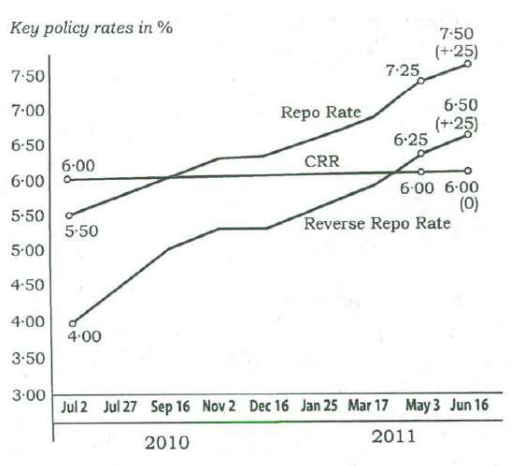
नीचे दिए गए आलेख में एक वर्ष की अवधि में केन्द्रीय बैंक द्वारा प्रमुख नीतिगत दरों में अनेक बार किए गए परिवर्तनों को दिखाया गया है :
| प्रमुख नीतिगत दरें, % में | जु 2 | मई 3 | जून 16 |
|---|---|---|---|
| रेपो दर | 5·50 | 7·25 | 7·50 (+·25) |
| रिवर्स रेपो दर | 4·00 | 6·25 | 6·50 (+·25) |
| सी॰ आर॰ आर॰ | 6·00 | 6·00 | 6·00 (0) |
निम्नलिखित में से कौन-सा एक केन्द्रीय बैंक की इस कार्रवाई का सबसे संभव कारण है?
Read this question in English
The graph given below indicates the changes in key policy rates made by the Central Bank several times in a year:
Which one of the following can be the most likely reason for the Central Bank for such an action?
(a) Encouraging foreign investment · (b) Increasing the liquidity · (c) Encouraging both public and private savings · (d) Anti-inflationary stance
उत्तर और व्याख्या · explanation in English
Answer: (d) स्फीति-विरोधी कदम
The central bank raised the repo and reverse repo rates again and again — by 2 and 2.5 percentage points in under a year — while keeping CRR unchanged. Repeated rate hikes make borrowing dearer and pull money out of the system, the standard response to high inflation.
- Repo rate: 5.50% → 7.50%; reverse repo: 4.00% → 6.50%; CRR steady at 6.00%.
- Higher policy rates raise banks' cost of funds and lending rates, slowing credit and money supply.
- That tightens liquidity — the opposite of (b).
- Attracting foreign investment or savings is not the purpose of a year of repeated hikes; cooling demand and prices is — an anti-inflationary stance.
Remember · Rising repo and reverse repo rates mean tight money to fight inflation; falling rates mean easing to support growth and liquidity.
Question and answer: UPSC's official GS Paper II (2018, Series A) — paper ↗ · answer key ↗. Explanation: Minimalist IAS, checked 1 Oct 2026 (how we verify). ·