New · 2027 edition
The UPSC Syllabus X-Ray
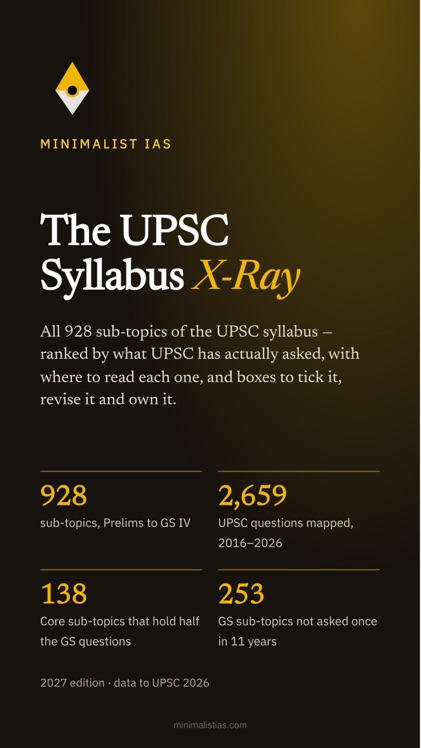
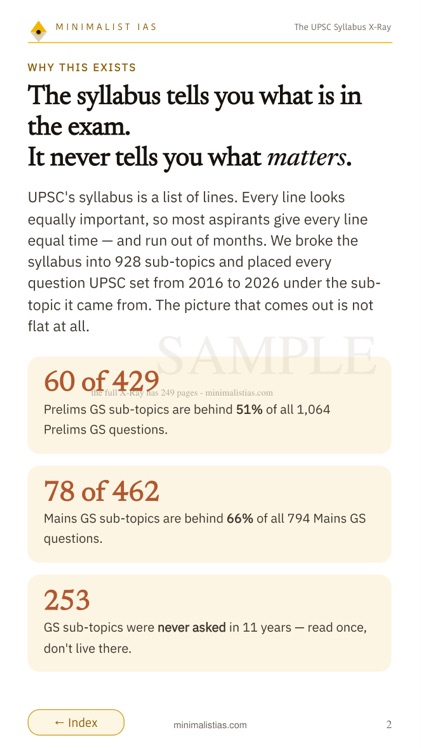
The syllabus tells you what is in the exam. It never tells you what matters. We placed every UPSC question from 2016 to 2026 under the sub-topic it came from, and ranked all 928.
- Prelims
- 60/429
- Mains
- 78/462
- Never asked
- 253
Prelims sub-topics behind 51% of Prelims questions
Mains sub-topics behind 66% of Mains questions
GS sub-topics not asked once in 11 years
The UPSC Syllabus X-Ray · 2027 edition
₹199₹249
Launch price · until 30 November, then ₹249
One payment. Twelve files, English and Hindi, phone and print. Download again any time.
- 🔒 Secure payment by Razorpay. Card details never reach us.
- ⬇ Files the moment you pay, and an email with the link.
- ✉ A question first? minimalistias@gmail.com
Why it works
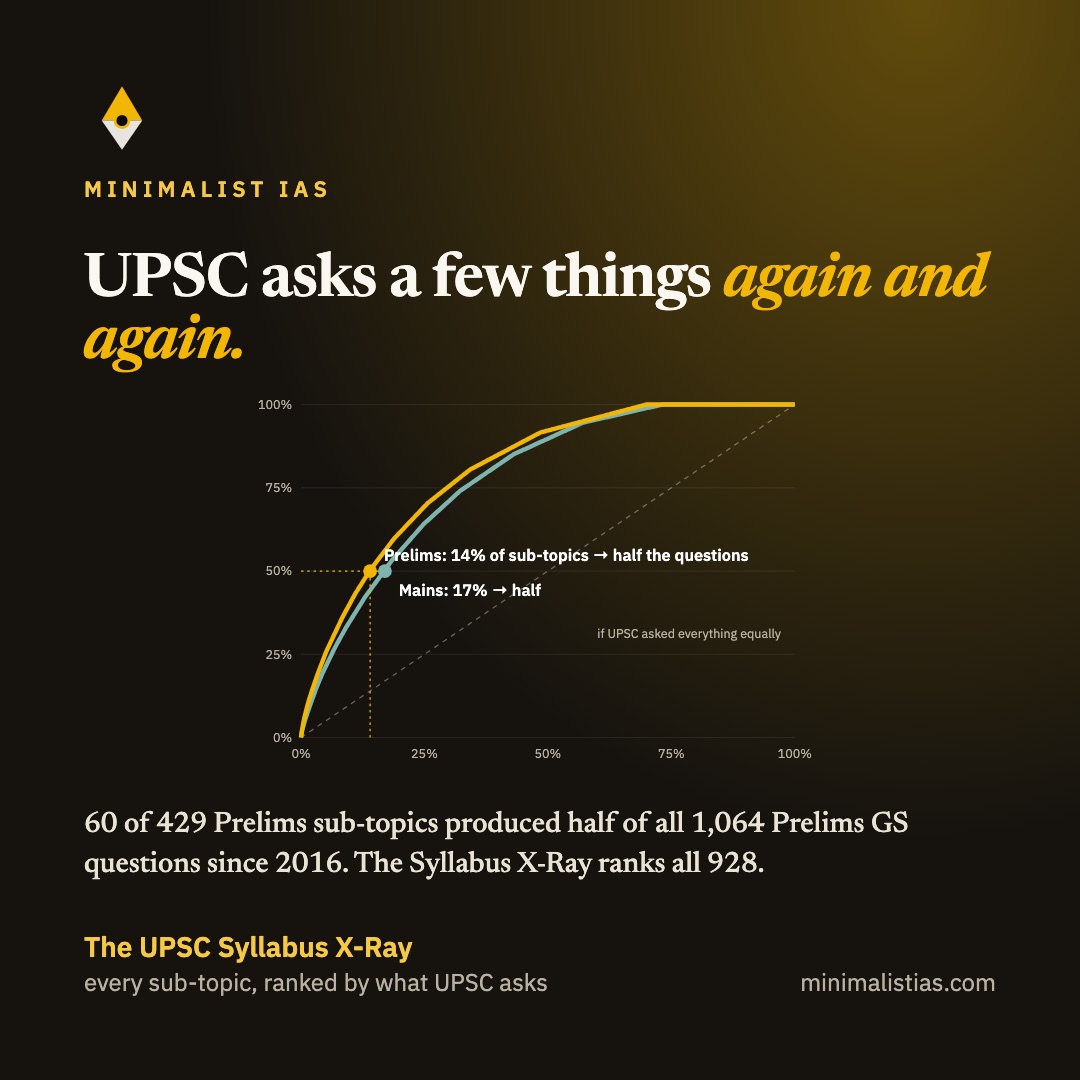
UPSC asks a few things again and again.
Most aspirants give every line of the syllabus equal time, and run out of months. The X-Ray shows how uneven the exam really is. Then it turns that into an order of study and a weekly number:
- CoreThe fewest sub-topics that hold half of each exam's questions: 138 of them. Study these first, whatever your stage.
- HighThe next ones, up to four-fifths of the questions.
- SteadyAsked, less often. Give them steady, lighter time.
- RareNever asked since 2016. Read once, don't live there.
Every sub-topic, taken apart
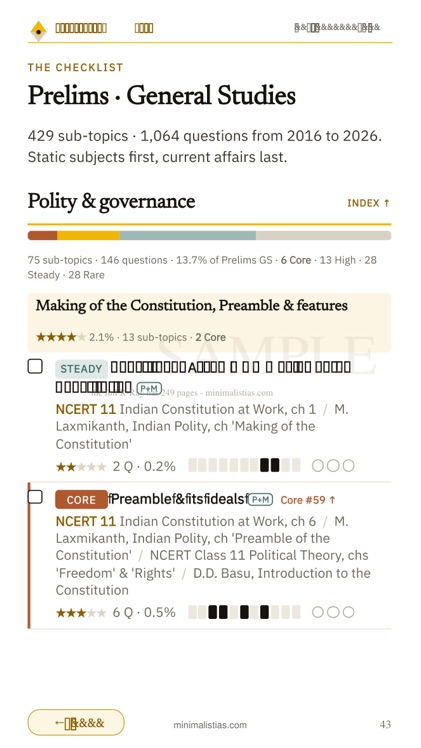
Each row tells you how much it matters, where to read it, and when to revise it.
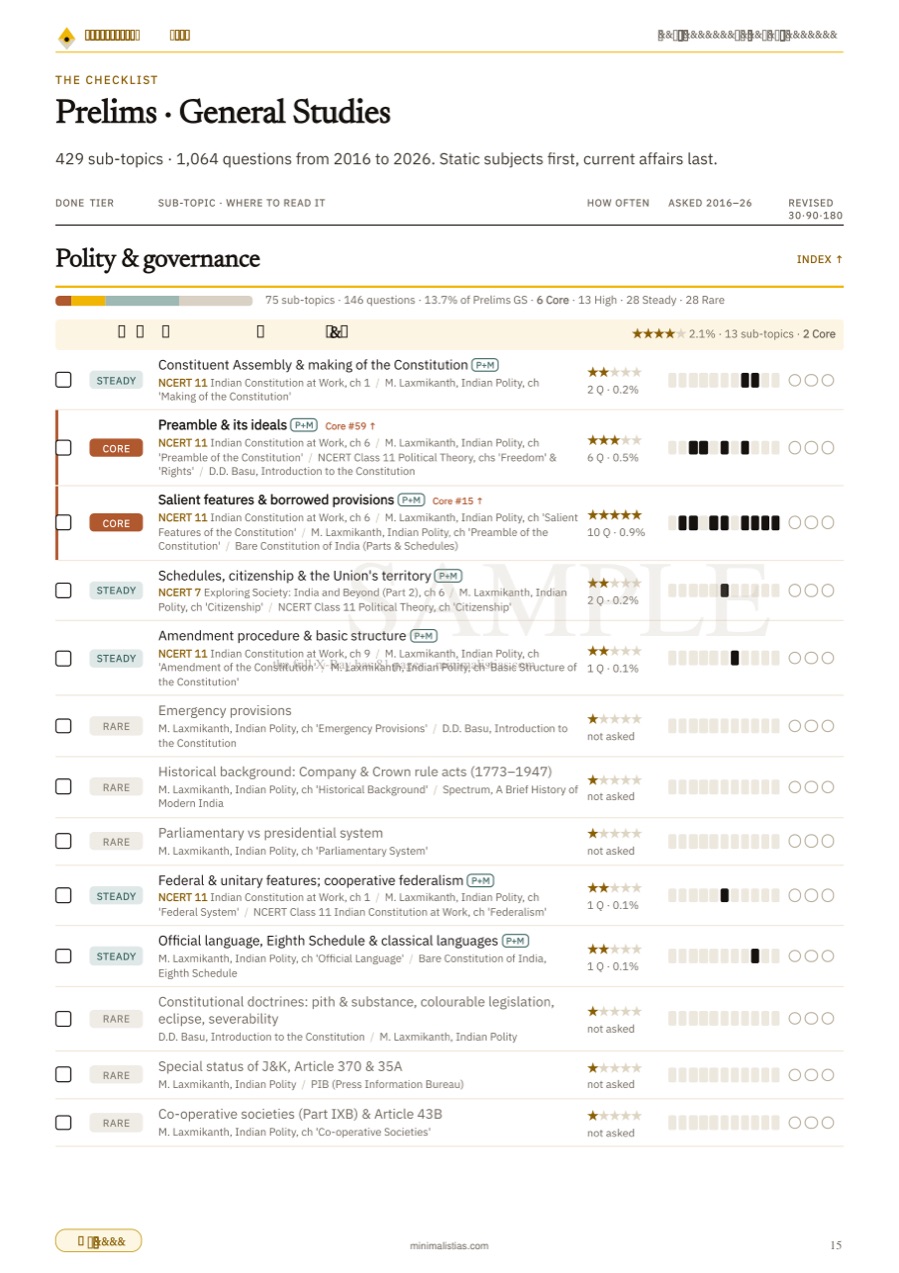
- Tier. Core, High, Steady or Rare, from the counts.
- Where to read it. The NCERT chapter first, then one to three sources chosen from the questions UPSC actually set under that sub-topic, with the current-affairs angle where it matters.
- How often. Stars, the number of questions, and its share of the exam.
- Asked when. One cell per year, 2016 to 2026. A dark right end means it's live.
- Revise on a clock. Three circles: 30, 90 and 180 days after you tick it.
- P+M. Asked in Prelims and Mains: one reading, two returns.
Made for your phone
A phone edition, not a shrunken PDF.
Large type on a narrow page, one column, every line of the contents and index a link. In English and in Hindi.
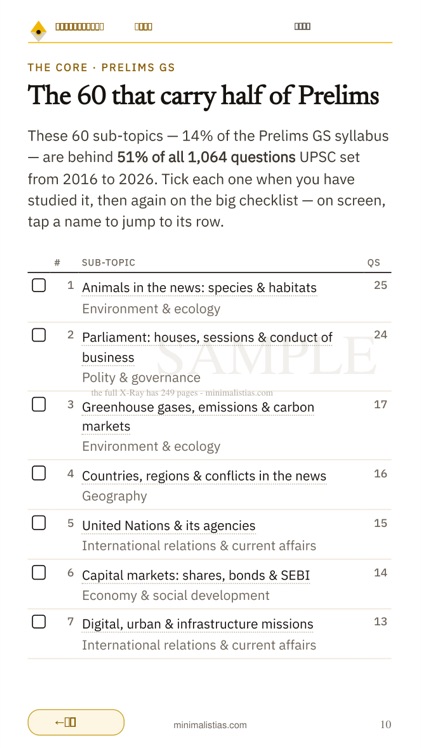
See for yourself: phone sample (PDF) · A4 sample (PDF)
What you get
Six files, in English and in Hindi.
01
Start here
One page: what each file is for, and your first hour.
02
The X-Ray · phone edition
Big type, one column, every line a link. Made for the phone you study on.
03
The X-Ray · A4 print edition
The same X-Ray for paper: tick, date and shade the revision circles by hand.
04
The Core poster · A3
All 138 Core sub-topics on one sheet for your wall.
05
The Core pack · A4
The two Core lists as a short booklet, with a Core-only progress page.
06
The companion sheet
Google Sheets or Excel: tick boxes, and revision dates that turn red when due.
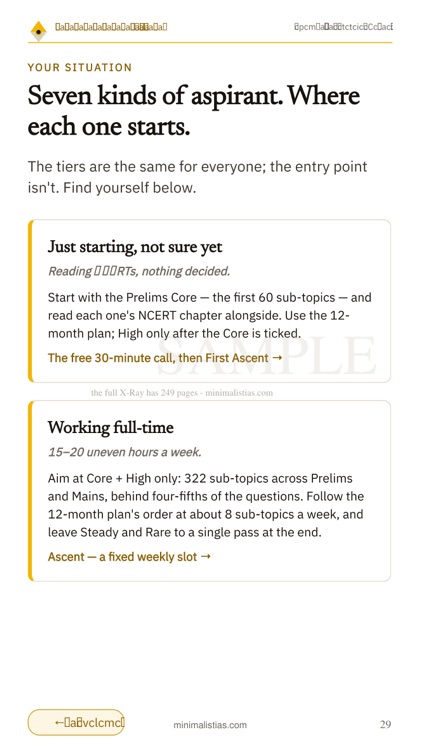
Plus a plan for 12, 9 or 6 months, seven situations with where each one starts, a progress page to count every Sunday, and an email every Sunday with that week's Core sub-topics.
Questions
Before you buy
Where do the numbers come from?
Every question UPSC set in the Civil Services exam from 2016 to 2026: 1,064 Prelims GS, 801 CSAT and 794 Mains GS. Each one is placed under the sub-topic of the detailed syllabus it tests. The tiers follow from the counts; nobody's opinion decides them.
Does “Rare” mean I can skip it?
No. UPSC can ask anything in its syllabus. The 253 never-asked GS sub-topics get one quick read and two lines of notes. The X-Ray changes the order you study in and the time you give, not the syllabus.
Is it in Hindi?
Yes. You get both: the English and the Hindi edition, each for phone and for print, with Hindi names for every sub-topic, theme and book.
Will it work on my phone?
That's the edition most people use. It's a narrow page with large type, so nothing needs zooming; tap the contents or the index to jump, and “← Index” on any page to come back.
Can I print it?
Yes, any number of copies for yourself. The PDFs print and take notes and highlights, but can't be edited, and every page carries your email as its licence. Please don't share them.
How do I get the files?
Right after you pay, on your files page, and by email. They stay in your account: sign in and download them again any time, on any device.
Is it refundable?
The files are yours the moment you download them, so the X-Ray can't be returned. If a file doesn't open or something is wrong, write to us and we'll put it right.
What about next year?
After UPSC 2027 we fold in the new papers. Buyers of this edition get the next one at a reduced price.
Start with the 138 that matter most.
₹199 at launch, then ₹249. Less than one coaching class, and it changes the order you study in from day one.