Minimalist IAS
CSAT

UPSC CSE 2021 · Paper II (qualifying, 33%) · Series A

CSAT (GS Paper II) 2021

All 80 questions in UPSC's order, with the official answer key.

What this paper asked, by skill▾

निम्नलिखित 4 (चार) प्रश्नांशों के लिए निर्देश : नीचे दिए गए चार परिच्छेदों को पढ़िए और परिच्छेदों के नीचे आने वाले प्रश्नांशों के उत्तर दीजिए । इन प्रश्नांशों के लिए आपके उत्तर केवल इन परिच्छेदों पर ही आधारित होने चाहिए ।

परिच्छेद – 1

शोधकर्ताओं ने मटर के कीड़ों (पी-ऐफ़िड) और रस चूसने वाले कीड़ों से युक्त कृत्रिम तृण-भूखंडों को रात में स्ट्रीट लाइट के अनुरूप आलोकित किया । इन्हें दो अलग-अलग प्रकार के प्रकाश में रखा गया — नवीनतर वाणिज्यिक LED प्रकाश के सदृश श्वेत प्रकाश और सोडियम स्ट्रीट लैंपों के सदृश एंबर प्रकाश । मटर कुल के जंगली पौधे — जो कि तृणभूमि में मटर के कीड़ों के लिए खाद्य के स्रोत हैं — इन पौधों पर निम्न तीव्रतायुक्त एंबर प्रकाश डालने पर यह देखा गया कि इससे पुष्पण प्रेरित होने की बजाय, बाधित होता है । प्रकाश के प्रभाव के अंतर्गत, सीमित मात्रा में खाद्य उपलब्ध होने के कारण कीड़ों (ऐफ़िड) की संख्या में भी उल्लेखनीय कमी आई ।

उपर्युक्त परिच्छेद के आधार पर प्रतिपादित, निम्नलिखित में से कौन-सा कथन सर्वाधिक निर्णायक निष्कर्ष को सर्वोत्तम रूप से दर्शाता है ?

Read this question in English

Which one of the following statements best reflects the most critical inference that can be made from the passage given above?

(a) Low intensity light has more adverse effect on the plants as compared to high intensity light. · (b) Light pollution can have a permanent adverse impact on an ecosystem. · (c) White light is better for the flowering of plants as compared to the light of other colours. · (d) Proper intensity of light in an ecosystem is important not only for plants but for animals too.

उत्तर और व्याख्या · explanation in English

Answer: (b) प्रकाश प्रदूषण का किसी पारिस्थितिक तंत्र पर स्थायी रूप से प्रतिकूल प्रभाव पड़ सकता है ।

Artificial night lighting stopped a wild pea-family plant from flowering, and the aphids that feed on it declined because food ran short. The harm travels through the food chain, so the passage's widest valid inference is that light pollution can damage a whole ecosystem, not just one plant.

  • ✗ (a) Only the low intensity amber light is reported; no high-intensity result is given, so this comparison cannot be made.
  • ✓ (b) The light suppressed flowering and, through the food shortage, the aphid population — an effect across two links of the ecosystem. 'Can have' keeps it a possibility, and it is the only option that captures this chain.
  • ✗ (c) The passage reports no effect of the white light on flowering, so nothing supports ranking white above other colours.
  • ✗ (d) The passage never speaks of a 'proper' intensity of light; it shows that artificial light at night harmed plants and, through them, insects.

Remember · For the 'most critical inference', choose the option that covers the passage's whole cause-and-effect chain, not a comparison it never tested.

Question and answer: UPSC's official GS Paper II (2021, Series A) — paper ↗ · answer key ↗. Explanation: Minimalist IAS, checked 30 Sept 2026 (how we verify). Permalink ·
परिच्छेद – 2

सभी पुष्पधारी पौधों की जातियों में से लगभग 80 प्रतिशत में परागण प्राणियों द्वारा होता है, जिसमें पक्षी और स्तनधारी प्राणी शामिल हैं, किंतु कीट मुख्य परागणकारी हैं । परागण हमें पौधों से उत्पन्न कई औषधियों के साथ-साथ विविध प्रकार के खाद्य उपलब्ध कराने के लिए उत्तरदायी है । विश्व की कम-से-कम एक-तिहाई कृषि फ़सलें परागण पर निर्भर हैं । परागण के लिए मक्षिका सर्वाधिक प्रभावी वर्ग हैं और ये चार सौ से भी अधिक फ़सलों के लिए अत्यंत महत्त्वपूर्ण हैं । परागण एक ऐसी अनिवार्य व्यवस्था है जो पौधों और प्राणियों के बीच जटिल संबंधों का परिणाम है, और इनमें से किसी की भी कमी या ह्रास होने से दोनों का अस्तित्व प्रभावित होता है । प्रभावी परागण के लिए मूल प्राकृतिक वनस्पति के आश्रय जैसे संसाधनों की आवश्यकता है ।

उपर्युक्त परिच्छेद के आधार पर, निम्नलिखित पूर्वधारणाएँ बनाई गई हैं :

  1. 1.परागणकारी प्राणियों की विविधता के बिना भारत के अनाज खाद्यान्न का संधारणीय उत्पादन संभव नहीं है ।
  2. 2.उद्यान फ़सलों की एकधान्य कृषि, कीटों के अस्तित्व के लिए बाधक है ।
  3. 3.प्राकृतिक वनस्पति से विहीन कृषि क्षेत्रों में परागणकारियों की अत्यधिक कमी हो जाती है ।
  4. 4.कीटों में विविधता, पौधों में विविधता लाती है ।

उपर्युक्त में से कौन-सी पूर्वधारणा/पूर्वधारणाएँ मान्य है/हैं ?

Read this question in English

On the basis of the passage given above, the following assumptions have been made:

1. Sustainable production of India’s cereal food grains is impossible without the diversity of pollinating animals.

2. Monoculture of horticultural crops hampers the survival of insects.

3. Pollinators become scarce in cultivated areas devoid of natural vegetation.

4. Diversity in insects induces diversity of plants.

Which of the above assumptions is/are valid?

(a) 1 only · (b) 2, 3 and 4 only · (c) 1 and 2 only · (d) 3 and 4 only

उत्तर और व्याख्या · explanation in English

Answer: (d) केवल 3 और 4

The passage ties plants and pollinators together — the loss of either hurts both — and says pollination needs refuges of natural vegetation. That supports 3 and 4; India's cereals and monoculture are topics the passage never raises.

  • ✗ 1. The passage speaks of crops in general ('at least one-third'), not India's cereals, and 'impossible' is far stronger than anything it says.
  • ✗ 2. Monoculture and horticulture are not mentioned; this brings in a new subject.
  • ✓ 3. 'Effective pollination requires resources, such as refuges of pristine natural vegetation' — where such vegetation is missing, pollinators lose their support.
  • ✓ 4. Pollination rests on 'intricate relationships between plants and animals', and the loss of either affects both; so a richer variety of insect pollinators sustains a richer variety of plants.

Remember · An assumption must rest on a line of the passage; reject statements that add a new subject or an absolute word like 'impossible'.

Question and answer: UPSC's official GS Paper II (2021, Series A) — paper ↗ · answer key ↗. Explanation: Minimalist IAS, checked 30 Sept 2026 (how we verify). Permalink ·
परिच्छेद – 3

तमिलनाडु की कावेरी नदी-घाटी पर क्षेत्रीय जलवायु मॉडलों का उपयोग करते हुए जलवायु परिवर्तन के प्रभावों पर किए गए अध्ययन में अधिकतम और न्यूनतम तापमानों में वृद्धि की प्रवृत्ति और वर्षा के दिनों की संख्या में कमी देखी गई । इन जलवायवी परिवर्तनों का इस क्षेत्र के जलीय चक्रों पर प्रभाव पड़ेगा, परिणामस्वरूप अधिक मात्रा में जल बह जाएगा और जल के पुनर्भरण (रीचार्ज) में कमी आएगी, तथा भौमजल-स्तर प्रभावित होंगे । इसके अतिरिक्त, राज्य में सूखा पड़ने की बारंबारता में वृद्धि हुई है । इसके कारण, फ़सलें बचाने के लिए भौमजल संसाधनों पर किसानों की निर्भरता बढ़ी है ।

निम्नलिखित में से कौन-सा कथन उपर्युक्त परिच्छेद के मूल भाव को सर्वोत्तम रूप से दर्शाता है ?

Read this question in English

Which one of the following statements best reflects the crux of the passage given above?

(a) Development of regional climate models helps in choosing climate-smart agricultural practices. · (b) Heavy dependence on groundwater resources can be reduced by adopting dry-land cropping systems. · (c) Climate changes increase the criticality of water resources while simultaneously threatening it. · (d) Climate changes cause the farmers to adopt unsustainable livelihoods and risky coping strategies.

उत्तर और व्याख्या · explanation in English

Answer: (c) जलवायु परिवर्तन से जल संसाधनों का महत्त्व बढ़ा है, जबकि साथ ही साथ इन पर संकट भी बढ़ा है ।

Higher temperatures and fewer rainy days mean more run-off, less recharge and falling groundwater tables, yet more frequent droughts push farmers to lean even harder on groundwater. Climate change makes water more critical while shrinking it — the crux in (c).

  • ✗ (a) Regional climate models are only the tool the study used; the passage is not about choosing farm practices.
  • ✗ (b) Dry-land cropping is never mentioned; it is a remedy from outside the passage.
  • ✓ (c) Groundwater is threatened ('less recharge', 'affect the groundwater tables') even as droughts 'increase dependency on groundwater resources' — both halves of the passage.
  • ✗ (d) The passage describes farmers relying on groundwater to secure crops; it does not call their livelihoods unsustainable or their strategies risky.

Remember · The crux usually joins the passage's two halves — here, the shrinking resource and the growing dependence on it.

Question and answer: UPSC's official GS Paper II (2021, Series A) — paper ↗ · answer key ↗. Explanation: Minimalist IAS, checked 30 Sept 2026 (how we verify). Permalink ·

परिच्छेद – 4

शोधकर्ता पर्यावरणीय प्रदूषक बिस्फीनॉल A (BPA) के तंत्रिआविषी (न्यूरोटॉक्सिक) प्रभावों का पता लगाने के लिए स्टेम कोशिकाओं का उपयोग करने में सफल रहे । उन्होंने मानव में हृदय रोग, मधुमेह और परिवर्धन अपसामान्यताओं के लिए ज़िम्मेदार माने जाने वाले यौगिक BPA के अनुप्रयोग के द्वारा मूषक की भ्रूणीय स्टेम कोशिकाओं के विभेदन के दौरान जीन अभिव्यक्ति प्रोफाइल की जाँच के लिए जैव-रासायनिक और कोशिका-आधारित आमापन के संयोजन का उपयोग किया । वे अंतःत्वचा और बाह्यत्वचा जैसे प्राथमिक जनन स्तरों (जर्म लेयर) के सही विनिर्देशन के लिए BPA आविषालुता (टॉक्सिसिटी) का पता लगाने और आमापन करने, तथा तंत्रिका प्रजनक कोशिकाएँ सृजित करने में सफल रहे ।

उपर्युक्त परिच्छेद के आधार पर, निम्नलिखित पूर्वधारणाएँ बनाई गई हैं :

  1. 1.BPA, जीवों में (इन वीवो) भ्रूणीय विकास को परिवर्तित कर सकता है ।
  2. 2.प्रदूषण से होने वाले रोगों के उपचारों की खोज करने में जैव-रासायनिक और कोशिका-आधारित आमापन उपयोगी हैं ।
  3. 3.पर्यावरणीय प्रदूषकों के शरीर-क्रियात्मक प्रभावों का मूल्यांकन करने के लिए भ्रूणीय स्टेम कोशिकाएँ मॉडल के रूप में कार्य कर सकती हैं ।

उपर्युक्त में से कौन-सी पूर्वधारणाएँ मान्य हैं ?

Read this question in English

On the basis of the passage given above, the following assumptions have been made:

1. BPA may alter embryonic development in vivo.

2. Biochemical and cell-based assays are useful in finding out treatments for pollution-induced diseases.

3. Embryonic stem cells could serve as a model to evaluate the physiological effects of environmental pollutants.

Which of the above assumptions are valid?

(a) 1 and 2 only · (b) 2 and 3 only · (c) 1 and 3 only · (d) 1, 2 and 3

उत्तर और व्याख्या · explanation in English

Answer: (c) केवल 1 और 3

The researchers used mouse embryonic stem cells to detect and measure BPA's toxicity to germ layers and neural progenitor cells. So stem cells can model pollutant effects (3), and BPA may disturb development in a living embryo (1); the passage says nothing about finding treatments (2).

  • ✓ 1. BPA disturbed 'the proper specification of primary germ layers' in embryonic cells and is known to cause 'developmental abnormalities in humans' — so it may alter development in a living body.
  • ✗ 2. The assays were used to examine gene expression and measure toxicity, not to find treatments for any disease.
  • ✓ 3. The whole study used stem cells 'to gauge the neurotoxic effects of the environmental pollutant' — exactly the role of a model system.

Remember · Separate what a method was shown to do (detect, measure) from what it was never said to do (treat, cure).

Question and answer: UPSC's official GS Paper II (2021, Series A) — paper ↗ · answer key ↗. Explanation: Minimalist IAS, checked 30 Sept 2026 (how we verify). Permalink ·

यदि 3²⁰¹⁹ को 10 से विभाजित किया जाए, तो क्या शेष रहेगा ?

Read this question in English

If 3²⁰¹⁹ is divided by 10, then what is the remainder?

(a) 1 · (b) 3 · (c) 7 · (d) 9

उत्तर और व्याख्या · explanation in English

Answer: (c) 7

The remainder on division by 10 is simply the last digit. Last digits of powers of 3 repeat as 3, 9, 7, 1, and 2019 leaves remainder 3 on division by 4, so 3²⁰¹⁹ ends in 7.

  1. The last digit of 3¹, 3², 3³, 3⁴ is 3, 9, 7, 1, and this cycle of 4 repeats.
  2. 2019 = 4 × 504 + 3, so 3²⁰¹⁹ has the same last digit as 3³.
  3. 3³ = 27 ends in 7.
  4. The remainder on dividing by 10 equals the last digit, so the remainder is 7.
  5. Check: 3⁷ = 2187 also ends in 7, and 7 = 4 + 3 — the pattern holds.

Remember · Remainder by 10 = units digit. For powers of 2, 3, 7, 8 the units digit cycles every 4, so use the exponent's remainder by 4.

Question and answer: UPSC's official GS Paper II (2021, Series A) — paper ↗ · answer key ↗. Explanation: Minimalist IAS, checked 30 Sept 2026 (how we verify). Permalink ·

संख्या 3798125P369 अंक 7 से भाज्य है । अंक P का मान क्या है ?

Read this question in English

The number 3798125P369 is divisible by 7. What is the value of the digit P?

(a) 1 · (b) 6 · (c) 7 · (d) 9

उत्तर और व्याख्या · explanation in English

Answer: (b) 6

Because 1001 = 7 × 11 × 13, a number is divisible by 7 when the alternating sum of its three-digit groups (taken from the right) is. That sum here is 1063 − P, and 1063 leaves remainder 6 on division by 7, so P = 6.

  1. Since 1001 = 7 × 11 × 13, a number is divisible by 7 if the alternating sum of its 3-digit groups, taken from the right, is divisible by 7.
  2. Groups of 3798125P369 from the right: 369, 25P, 981, 37.
  3. Alternating sum = 369 − 25P + 981 − 37 = 1313 − (250 + P) = 1063 − P.
  4. 1063 = 7 × 151 + 6, so 1063 − P is a multiple of 7 only when P = 6.
  5. Check: 37981256369 ÷ 7 = 5425893767 exactly.

Remember · For divisibility by 7, 11 or 13 in a long number, take the alternating sum of 3-digit groups from the right (1001 = 7 × 11 × 13).

Question and answer: UPSC's official GS Paper II (2021, Series A) — paper ↗ · answer key ↗. Explanation: Minimalist IAS, checked 30 Sept 2026 (how we verify). Permalink ·

1 जनवरी, 2021 से वर्ष के mवें दिन पेट्रोल का मूल्य (रुपए प्रति लीटर में) 80 + 0·1m है, जहाँ m = 1, 2, 3, ..., 100 है और तत्पश्चात अचर रहता है । वहीं दूसरी ओर, वर्ष 2021 के nवें दिन डीज़ल का मूल्य (रुपए प्रति लीटर में), n के किसी भी मान के लिए 69 + 0·15n है । वर्ष 2021 की किस तिथि को इन दोनों ईंधनों का मूल्य एकसमान होगा ?

Read this question in English

From January 1, 2021, the price of petrol (in Rupees per litre) on mth day of the year is 80 + 0.1m, where m = 1, 2, 3, ..., 100 and thereafter remains constant. On the other hand, the price of diesel (in Rupees per litre) on nth day of 2021 is 69 + 0.15n for any n. On which date in the year 2021 are the prices of these two fuels equal?

(a) 21st May · (b) 20th May · (c) 19th May · (d) 18th May

उत्तर और व्याख्या · explanation in English

Answer: (b) 20 मई

The two formulas never meet within the first 100 days, after which petrol stays at ₹90. Diesel reaches ₹90 on day 140, and day 140 of 2021 (not a leap year) is 20 May.

  1. While both formulas run (days 1–100): 80 + 0.1m = 69 + 0.15m gives 0.05m = 11, so m = 220 — outside 1 to 100, so no match in this period.
  2. From day 100 onwards petrol stays at 80 + 0.1 × 100 = ₹90.
  3. Diesel reaches ₹90 when 69 + 0.15n = 90, i.e. 0.15n = 21, so n = 140.
  4. Days up to 30 April: 31 + 28 + 31 + 30 = 120, so day 140 is the 20th day of May — 20 May.
  5. Check: on day 140 diesel = 69 + 0.15 × 140 = 69 + 21 = ₹90, equal to petrol.

Remember · For prices defined piece by piece, test each piece separately; then turn the day number into a date month by month.

Question and answer: UPSC's official GS Paper II (2021, Series A) — paper ↗ · answer key ↗. Explanation: Minimalist IAS, checked 30 Sept 2026 (how we verify). Permalink ·

एक हाई स्कूल की जीवविज्ञान की कक्षा ने पूर्वानुमान लगाया कि पशुओं की स्थानीय आबादी प्रत्येक 12 वर्ष में दुगुनी हो जाएगी । किए गए आकलन के अनुसार वर्ष 2021 के आरंभ में पशुओं की आबादी 50 होगी । यदि n वर्षों के पश्चात की आबादी को P से निरूपित किया जाता है, तो निम्नलिखित में से कौन-सा समीकरण, कक्षा द्वारा बनाए गए आबादी के मॉडल को निरूपित करता है ?

Read this question in English

A biology class at high school predicted that a local population of animals will double in size every 12 years. The population at the beginning of the year 2021 was estimated to be 50 animals. If P represents the population after n years, then which one of the following equations represents the model of the class for the population?

(a) P = 12 + 50n · (b) P = 50 + 12n · (c) P = 50 (2)^(12n) · (d) P = 50 (2)^(n/12)

उत्तर और व्याख्या · explanation in English

Answer: (d) P = 50 (2)^(n/12)

Doubling every 12 years is exponential growth: after n years the population has doubled n/12 times, so P = 50 × 2^(n/12). Putting n = 0 and n = 12 (giving 50 and 100) confirms it and rules out the other options.

  1. Doubling every 12 years means multiplying by 2 once for each 12-year block.
  2. In n years there are n/12 such blocks, so P = 50 × 2^(n/12).
  3. Check: n = 0 gives 50; n = 12 gives 100; n = 24 gives 200 — doubling every 12 years.
  4. Options (a) and (b) add a fixed number each year (linear growth); (c) gives 50 × 2¹² at n = 1, far too fast.

Remember · Test formula options by plugging in simple values — the start (n = 0) and one full period.

Question and answer: UPSC's official GS Paper II (2021, Series A) — paper ↗ · answer key ↗. Explanation: Minimalist IAS, checked 30 Sept 2026 (how we verify). Permalink ·

एक कक्षा में, 60% विद्यार्थी भारत से हैं और विद्यार्थियों का 50% लड़कियाँ हैं । यदि भारतीय विद्यार्थियों में 30% लड़कियाँ हैं, तो विदेशी विद्यार्थियों में कितने प्रतिशत लड़के हैं ?

Read this question in English

In a class, 60% of students are from India and 50% of the students are girls. If 30% of the Indian students are girls, then what percentage of foreign students are boys?

(a) 45% · (b) 40% · (c) 30% · (d) 20%

उत्तर और व्याख्या · explanation in English

Answer: (d) 20%

Take 100 students: 60 Indian and 40 foreign, with 50 girls. Indian girls are 18, so foreign girls are 32 and foreign boys only 8 — that is 8 out of 40 foreign students, or 20%.

  1. Take 100 students: 60 Indian, 40 foreign; 50 girls in all.
  2. Indian girls = 30% of 60 = 18.
  3. Foreign girls = 50 − 18 = 32, so foreign boys = 40 − 32 = 8.
  4. Share of boys among foreign students = 8/40 = 20%.
  5. Check: boys = 50; Indian boys 60 − 18 = 42 plus foreign boys 8 = 50.

Remember · Assume a total of 100 and fill a 2 × 2 table; then divide by the base the question names (here, foreign students).

Question and answer: UPSC's official GS Paper II (2021, Series A) — paper ↗ · answer key ↗. Explanation: Minimalist IAS, checked 30 Sept 2026 (how we verify). Permalink ·

एक कथन नीचे दिया गया है, जिसके उपरांत निष्कर्ष-I और निष्कर्ष-II दिए गए हैं । आपको इस कथन को सही मानते हुए प्रश्नों का उत्तर देना है, भले ही यह सामान्य रूप से ज्ञात तथ्यों की दृष्टि से संगत प्रतीत न हो । सभी निष्कर्षों को पढ़ें और तत्पश्चात निर्णय करें कि कौन-सा/कौन-से निष्कर्ष दिए गए कथन के अनुसार तर्कसंगत है/हैं, भले ही वे सामान्य रूप से ज्ञात तथ्यों की दृष्टि से संगत न हों ।

  1. कथन.कुछ रेडियो, मोबाइल हैं । सभी मोबाइल, कंप्यूटर हैं । कुछ कंप्यूटर, घड़ी हैं ।
  2. निष्कर्ष-I: कुछ रेडियो निश्चित रूप से घड़ी हैं ।
  3. निष्कर्ष-II: कुछ मोबाइल निश्चित रूप से घड़ी हैं ।

निम्नलिखित में से कौन-सा सही है ?

Read this question in English

A Statement followed by Conclusion-I and Conclusion-II is given below. You have to take the Statement to be true even if it seems to be at variance from the commonly known facts. Read all Conclusions and then decide which of the given Conclusion(s) logically follows/follow from the Statement, disregarding the commonly known facts.

Statement. Some radios are mobiles. All mobiles are computers. Some computers are watches.

Conclusion-I. Certainly some radios are watches.

Conclusion-II. Certainly some mobiles are watches.

Which one of the following is correct?

(a) Only Conclusion-I · (b) Only Conclusion-II · (c) Both Conclusion-I and Conclusion-II · (d) Neither Conclusion-I nor Conclusion-II

उत्तर और व्याख्या · explanation in English

Answer: (d) न तो निष्कर्ष-I, न ही निष्कर्ष-II

The only link to watches is 'some computers', and those computers need not include any mobile or radio. A diagram with the watches placed away from the mobiles fits every statement, so neither 'certainly' conclusion is forced.

  1. Some radios are mobiles and all mobiles are computers, so some radios are computers.
  2. 'Some computers are watches' does not say which computers.
  3. Draw the watches overlapping only the part of 'computers' that has no mobile and no radio — all three statements still hold.
  4. In that diagram no radio and no mobile is a watch, so neither conclusion is certain.
  • ✗ Conclusion-I Radios reach watches only through two 'some' links; a radio being a watch is possible but not certain.
  • ✗ Conclusion-II All mobiles are computers, but the computers that are watches may be the ones that are not mobiles.

Remember · A 'certainly' conclusion must hold in every possible diagram — try to draw one where it fails.

Question and answer: UPSC's official GS Paper II (2021, Series A) — paper ↗ · answer key ↗. Explanation: Minimalist IAS, checked 30 Sept 2026 (how we verify). Permalink ·

निम्नलिखित 4 (चार) प्रश्नांशों के लिए निर्देश : नीचे दिए गए चार परिच्छेदों को पढ़िए और परिच्छेदों के नीचे आने वाले प्रश्नांशों के उत्तर दीजिए । इन प्रश्नांशों के लिए आपके उत्तर केवल इन परिच्छेदों पर ही आधारित होने चाहिए ।

परिच्छेद – 1

अंजीर (जीनस फाइकस) के वृक्षों को भारत, पूर्वी एशिया और अफ्रीका में पवित्र माना जाता है और ये कृषि और शहरी क्षेत्रों में सामान्य रूप से पाए जाते हैं, जहाँ अन्य बड़े वृक्ष नहीं होते हैं । प्राकृतिक वनों में, जब अन्य संसाधनों की कमी होती है, अंजीर के वृक्ष वन्य प्राणियों के लिए भोजन उपलब्ध कराते हैं, और विविध प्रकार के फलभक्षियों (फल खाने वाले प्राणियों) की घनी आबादी को सहारा देते हैं । यदि फलभक्षी पक्षी और चमगादड़ अत्यधिक मानवीय हस्तक्षेप वाले स्थानों पर लगे अंजीर के वृक्षों पर निरंतर रूप से जाते रहें, तो पवित्र अंजीर वृक्ष प्रचुर संख्या में फलभक्षियों को बढ़ावा दे सकते हैं । अनुकूल सूक्ष्म-जलवायु में, अंजीर वृक्षों के आस-पास अन्य जातियों के वृक्षों के असंख्य पौध उग सकते हैं ।

उपर्युक्त परिच्छेद के आधार पर, निम्नलिखित पूर्वधारणाएँ बनाई गई हैं :

  1. 1.प्राकृतिक वनों में, अंजीर के वृक्ष प्रायः आधारिक जातियाँ (की-स्टोन स्पीशीज़) हो सकती हैं ।
  2. 2.अंजीर के वृक्ष वहाँ भी उग सकते हैं, जहाँ अन्य बड़े काष्ठीय वृक्ष की जातियाँ नहीं उग सकती हैं ।
  3. 3.जैव-विविधता के संरक्षण में पवित्र वृक्षों की भूमिका हो सकती है ।
  4. 4.अन्य वृक्ष जातियों के बीजों के प्रकीर्णन में अंजीर वृक्षों की भूमिका है ।

उपर्युक्त में से कौन-सी पूर्वधारणा/पूर्वधारणाएँ मान्य है/हैं ?

Read this question in English

On the basis of the passage given above, the following assumptions have been made:

1. Fig trees can often be keystone species in natural forests.

2. Fig trees can grow where other large woody species cannot grow.

3. Sacred trees can have a role in biodiversity conservation.

4. Fig trees have a role in the seed dispersal of other tree species.

Which of the above assumptions is/are valid?

(a) 1 and 2 only · (b) 3 only · (c) 2 and 4 only · (d) 1, 3 and 4 only

उत्तर और व्याख्या · explanation in English

Answer: (d) केवल 1, 3 और 4

Fig trees feed a dense, varied crowd of frugivores when other food is scarce (a keystone role), sacred figs keep frugivores around even in disturbed sites (a conservation role), and seedlings of other trees come up around them because visiting birds and bats drop seeds. The passage only says other large trees are absent in such places, not that they cannot grow.

  • ✓ 1. Fig trees 'provide food for wildlife when other resources are scarce and support a high density and diversity of frugivores' — many species depend on them, which is what a keystone species is.
  • ✗ 2. The passage says figs are common where other large trees 'are absent' — absence (perhaps because they were cleared) is not the same as 'cannot grow'.
  • ✓ 3. Sacred fig trees 'may promote frugivore abundance' even in sites with high human disturbance — their sacred status helps sustain wildlife.
  • ✓ 4. Frugivorous birds and bats visit fig trees and 'plenty of seedlings of other tree species' grow around them — the visitors bring seeds of other trees, so figs aid their dispersal.

Remember · Don't turn 'absent' into 'cannot exist' — assumptions that harden an observation into an impossibility are usually invalid.

Question and answer: UPSC's official GS Paper II (2021, Series A) — paper ↗ · answer key ↗. Explanation: Minimalist IAS, checked 30 Sept 2026 (how we verify). Permalink ·

परिच्छेद – 2

कृषि पारिस्थितिकी के मूल में यह अवधारणा है कि कृषि पारिस्थितिक तंत्रों को प्राकृतिक पारिस्थितिक तंत्रों के जैव-विविधता स्तरों और कार्य-प्रणाली का अनुकरण करना चाहिए । ऐसी कृषि अनुकृतियाँ (मिमिक्स), अपने प्राकृतिक मॉडलों की तरह उत्पादक, पीड़क-प्रतिरोधी, पोषक-संरक्षक, तथा प्रघात और तनाव के प्रति समुत्थानशील (रिज़िलिअंट) हो सकती हैं । पारिस्थितिक तंत्रों में कुछ भी ‘व्यर्थ’ नहीं जाता है, और पोषक तत्त्वों का अनंत काल तक पुनः चक्रण होता है । कृषि पारिस्थितिकी का उद्देश्य पोषक लूपों को बंद करना है, अर्थात्, मिट्टी से निकल चुके सभी पोषक तत्त्वों को फार्मयार्ड खाद के अनुप्रयोग जैसे तरीकों के द्वारा मिट्टी में पुनः वापस पहुँचाना है । इसके अंतर्गत, प्राकृतिक प्रक्रियाओं का उपयोग पीड़क नियंत्रण के लिए तथा अंतर-सस्य कृषि (इंटर-क्रॉपिंग) के द्वारा मृदा को उर्वर बनाने के लिए भी किया जाता है । कृषि पारिस्थितिकी पद्धतियों में पशुधन और फ़सलों के साथ वृक्षों का एकीकरण शामिल है ।

निम्नलिखित पर विचार कीजिए :

  1. 1.भूमि-संरक्षण-सस्य (कवर क्रॉप्स)
  2. 2.उर्वरक-सिंचाई (फर्टिगेशन)
  3. 3.जल संवर्धन
  4. 4.मिश्रित कृषि
  5. 5.बहु-सस्यन (पॉलीकल्चर)
  6. 6.ऊर्ध्वाधर कृषि (वर्टिकल फार्मिंग)

परिच्छेद के अनुसार, उपर्युक्त में से कौन-सी कृषि पद्धतियाँ कृषि पारिस्थितिकी के अनुकूल हो सकती हैं ?

Read this question in English

Consider the following:

1. Cover crops

2. Fertigation

3. Hydroponics

4. Mixed farming

5. Polyculture

6. Vertical farming

Which of the above farming practices can be compatible with agroecology, as implied by the passage?

(a) 1, 4 and 5 only · (b) 2, 3, 4 and 5 only · (c) 1, 2, 3 and 6 only · (d) 4 and 6 only

उत्तर और व्याख्या · explanation in English

Answer: (a) केवल 1, 4 और 5

Agroecology, as described, copies natural ecosystems: high biodiversity, nutrients returned to the soil, natural pest control and trees, crops and livestock integrated. Cover crops, mixed farming and polyculture fit these principles; fertigation, hydroponics and vertical farming depend on external inputs or soil-free, controlled systems.

  • ✓ 1. Cover crops protect the soil and return nutrients to it — 'closing nutrient loops' and building soil fertility.
  • ✗ 2. Fertigation feeds soluble fertiliser through irrigation water — an external input rather than recycling nutrients back to the soil.
  • ✗ 3. Hydroponics grows plants without soil in nutrient solutions, so there is no soil nutrient loop or natural ecosystem to mimic.
  • ✓ 4. Mixed farming combines crops with livestock, matching 'integrating trees with livestock and crops', and its manure returns nutrients to the soil.
  • ✓ 5. Growing many crops together, like intercropping, mimics natural biodiversity and uses natural pest control.
  • ✗ 6. Vertical farming is a controlled, often soil-less indoor system — far from mimicking the biodiversity and functioning of natural ecosystems.

Remember · Match each practice against the passage's defining principles (biodiversity, soil nutrient loops, integration); reject high-input or soil-free systems.

Question and answer: UPSC's official GS Paper II (2021, Series A) — paper ↗ · answer key ↗. Explanation: Minimalist IAS, checked 30 Sept 2026 (how we verify). Permalink ·

परिच्छेद – 3

न केवल क्रेडिट कार्ड के विवरण और डाटाबेस जैसे अमूर्त डाटा के साथ कंप्यूटरों का संबंध उत्तरोत्तर बढ़ता जा रहा है, बल्कि भौतिक वस्तुओं की वास्तविक दुनिया और संवेदनशील मानव शरीर के साथ भी यह संबंध बढ़ रहा है । एक आधुनिक कार, पहियों पर एक कंप्यूटर है; एक विमान, पंखों पर एक कंप्यूटर है । “इंटरनेट ऑफ थिंग्स” के आगमन से सड़क चिह्नों और एम.आर.आई. स्कैनरों से लेकर कृत्रिम अंगों (प्रॉस्थैटिक्स) और इंसुलिन पंपों तक प्रत्येक वस्तु में कंप्यूटर शामिल हो जाएगा । इस बात का प्रमाण नगण्य है कि ये उपकरण (गैजेट), इनके डेस्कटॉप समकक्षों की तुलना में अधिक विश्वासयोग्य होंगे । हैकर पहले ही यह प्रमाणित कर चुके हैं कि वे इंटरनेट से जुड़ी कारों और पेसमेकरों का दूरस्थ नियंत्रण (रिमोट कंट्रोल) कर सकते हैं ।

उपर्युक्त परिच्छेद के आधार पर प्रतिपादित, निम्नलिखित में से कौन-सा कथन सर्वाधिक निर्णायक निष्कर्ष को सर्वोत्तम रूप से दर्शाता है ?

Read this question in English

Which one of the following statements best reflects the most critical inference that can be made from the passage given above?

(a) Computers are not completely safe. · (b) Companies producing the software do not take cyber security seriously. · (c) Stringent data security laws are needed. · (d) The present trend of communication technologies will affect our lives in future.

उत्तर और व्याख्या · explanation in English

Answer: (a) कंप्यूटर पूरी तरह सुरक्षित नहीं हैं ।

Computers now run cars, aeroplanes and medical devices, there is little evidence they are more trustworthy than desktops, and hackers have already taken control of cars and pacemakers. The direct inference is that computers are not completely safe; blaming companies or calling for laws goes beyond the text.

  • ✓ (a) 'Little evidence that these gadgets will be any more trustworthy' plus hackers controlling 'cars and pacemakers' leads straight to this.
  • ✗ (b) The attitude of software companies is never discussed; this assigns blame the passage does not.
  • ✗ (c) Laws are a remedy the passage never proposes; an inference should come from the text, not add a solution.
  • ✗ (d) Too general and vague; it misses the passage's specific point about vulnerability to hacking.

Remember · Choose the inference the evidence directly supports; drop options that assign blame or prescribe remedies the passage never mentions.

Question and answer: UPSC's official GS Paper II (2021, Series A) — paper ↗ · answer key ↗. Explanation: Minimalist IAS, checked 30 Sept 2026 (how we verify). Permalink ·

परिच्छेद – 4

ग़रीबी, असमानता, अस्वास्थ्यकर और अस्वच्छता की दशाओं से जूझता सामाजिक और भौतिक वातावरण संक्रामक रोगों का ख़तरा उत्पन्न करता है । स्वास्थ्य-विधि (हाइजीन) के भिन्न-भिन्न स्तर हैं : व्यक्तिगत, घरेलू और सामुदायिक स्वास्थ्य-विधि । इसमें कोई संदेह नहीं है कि व्यक्तिगत सफाई रखने से संक्रामक रोगों की दर में कमी आती है । किंतु इस क्षेत्र में बाज़ार के प्रवेश ने सुरक्षा की झूठी भावना को जन्म दिया है, जो विज्ञापनों के आक्रामक प्रभाव द्वारा अनुकूलित होती है और प्रबल होती है । पश्चिम यूरोप का अनुभव यह दर्शाता है कि व्यक्तिगत स्वास्थ्य-विधि के साथ-साथ वातावरणीय दशाओं में सामान्य सुधार तथा स्वच्छ जल, स्वच्छता और खाद्य सुरक्षा जैसे घटकों से शिशु/बाल मृत्यु/संक्रमण की दरों में पर्याप्त कमी आई है । हाथों को स्वच्छ रखने के प्रति जुनून व्यक्तिगत स्वास्थ्य पर बाज़ार के निरंतर प्रभाव को भी लाता है, जिससे पारिस्थितिकी पर इसके नकारात्मक प्रभाव की अवहेलना होती है अथवा उसे हाशिए पर डाल दिया जाता है और इससे प्रतिरोधी रोगाणुओं का प्रादुर्भाव होता है ।

उपर्युक्त परिच्छेद के आधार पर, निम्नलिखित पूर्वधारणाएँ बनाई गई हैं :

  1. 1.ऐसे लोग जिनमें व्यक्तिगत स्वास्थ्य-विधि का जुनून होता है, वे सामुदायिक स्वास्थ्य-विधि पर ध्यान नहीं देते हैं ।
  2. 2.व्यक्तिगत स्वच्छता से बहु-औषधि प्रतिरोधी रोगाणुओं के प्रादुर्भाव का निवारण किया जा सकता है ।
  3. 3.स्वास्थ्य-विधि के क्षेत्र में बाज़ार के प्रवेश से संक्रामक रोगों का ख़तरा बढ़ा है ।
  4. 4.संक्रामक रोगों के बोझ को कम करने के लिए वैज्ञानिक और सूक्ष्म-स्तरीय हस्तक्षेप पर्याप्त नहीं हैं ।
  5. 5.यह जन स्वास्थ्य उपायों के माध्यम से कार्यान्वित सामुदायिक स्वास्थ्य-विधि है, जो संक्रामक रोगों के विरुद्ध लड़ाई में वास्तव में कारगर है ।

उपर्युक्त में से कौन-सी पूर्वधारणाएँ मान्य हैं ?

Read this question in English

On the basis of the passage given above, the following assumptions have been made:

1. People who are obsessed with personal hygiene tend to ignore the community hygiene.

2. Emergence of multi-drug resistant germs can be prevented by personal cleanliness.

3. Entry of the market in the domain of hygiene increases the risk of infectious diseases.

4. Scientific and micro-level interventions are not sufficient to bring down the burden of infectious diseases.

5. It is community hygiene implemented through public health measures that is really effective in the battle against infectious diseases.

Which of the above assumptions are valid?

(a) 1 and 2 only · (b) 3 and 4 only · (c) 4 and 5 only · (d) 1, 2 and 4 only

उत्तर और व्याख्या · explanation in English

Answer: (c) केवल 4 और 5

The passage grants that personal cleanliness helps, but credits the big fall in infections in Western Europe to clean water, sanitation and food security alongside it, and warns that market-driven hygiene gives a false sense of security. So personal, micro-level steps are not enough (4), and community-level public health measures are what really work (5).

  • ✗ 1. The passage says the market creates 'a false sense of security'; it never says hygiene-obsessed people ignore community hygiene.
  • ✗ 2. The passage links the obsession with hand hygiene to 'the emergence of resistant germs' — the opposite of prevention.
  • ✗ 3. The market creates a false sense of security; the passage does not say its entry raises the risk of infection.
  • ✓ 4. Personal hygiene alone did not do the job in Western Europe; 'general improvements in environmental conditions' were needed — so product-based, individual measures are insufficient.
  • ✓ 5. The fall in infant/child infection rates came with clean water, sanitation and food security — community-level, public health measures.

Remember · When a passage says 'along with X, Y brought the result', the valid assumption is that X alone is not enough.

Question and answer: UPSC's official GS Paper II (2021, Series A) — paper ↗ · answer key ↗. Explanation: Minimalist IAS, checked 30 Sept 2026 (how we verify). Permalink ·

एक कथन नीचे दिया गया है, जिसके उपरांत निष्कर्ष-I और निष्कर्ष-II दिए गए हैं । आपको इस कथन को सही मानते हुए प्रश्नों का उत्तर देना है, भले ही यह सामान्य रूप से ज्ञात तथ्यों की दृष्टि से संगत प्रतीत न हो । सभी निष्कर्षों को पढ़ें और तत्पश्चात निर्णय करें कि कौन-सा/कौन-से निष्कर्ष दिए गए कथन के अनुसार तर्कसंगत है/हैं, भले ही वे सामान्य रूप से ज्ञात तथ्यों की दृष्टि से संगत न हों ।

  1. कथन.कुछ बिल्लियाँ अलमारी हैं । कुछ अलमारियाँ कुर्सी हैं । सभी कुर्सियाँ मेज़ हैं ।
  2. निष्कर्ष-I: कुछ अलमारियाँ निश्चित रूप से मेज़ हैं ।
  3. निष्कर्ष-II: कुछ बिल्लियाँ कुर्सी नहीं भी हो सकती हैं ।

निम्नलिखित में से कौन-सा सही है ?

Read this question in English

A Statement followed by Conclusion-I and Conclusion-II is given below. You have to take the Statement to be true even if it seems to be at variance from the commonly known facts. Read all Conclusions and then decide which of the given Conclusion(s) logically follows/follow from the Statement, disregarding the commonly known facts.

Statement. Some cats are almirahs. Some almirahs are chairs. All chairs are tables.

Conclusion-I. Certainly some almirahs are tables.

Conclusion-II. Some cats may not be chairs.

Which one of the following is correct?

(a) Only Conclusion-I · (b) Only Conclusion-II · (c) Both Conclusion-I and Conclusion-II · (d) Neither Conclusion-I nor Conclusion-II

उत्तर और व्याख्या · explanation in English

Answer: (c) निष्कर्ष-I और निष्कर्ष-II दोनों

The almirahs that are chairs are also tables, so Conclusion-I is certain. Conclusion-II only claims a possibility ('may not'), and since nothing fixes how cats relate to chairs, that possibility is open — so both follow.

  1. Some almirahs are chairs and all chairs are tables, so those almirahs are tables — 'some almirahs are tables' is certain.
  2. Cats connect to chairs only through 'some almirahs', a particular link, so there is no definite relation between cats and chairs.
  3. With no definite relation, a diagram where some cats are not chairs is allowed — so 'some cats may not be chairs' follows.
  • ✓ Conclusion-I 'Some almirahs are chairs' + 'All chairs are tables' gives 'some almirahs are tables' with certainty.
  • ✓ Conclusion-II It states only a possibility; since the statements do not force every cat to be a chair, the possibility holds.

Remember · 'Some A are B' + 'All B are C' gives 'some A are C'. A 'may / may not' conclusion follows when no definite relation rules it out.

Question and answer: UPSC's official GS Paper II (2021, Series A) — paper ↗ · answer key ↗. Explanation: Minimalist IAS, checked 30 Sept 2026 (how we verify). Permalink ·

एक बालक गेंद से खेल रहा है और वह गेंद को 1·5 m की ऊँचाई से गिराता है । प्रत्येक बार जब भी गेंद ज़मीन से टकराती है, तो वह पूर्ववर्ती ऊँचाई की 4/5 ऊँचाई तक उछाल लेती है । यदि पूर्ववर्ती ऊँचाई 50 cm से कम है, तो गेंद नहीं उछलती है । गेंद की उछाल रुकने से पूर्व, गेंद कितनी बार ज़मीन से टकराती है ?

Read this question in English

A boy plays with a ball and he drops it from a height of 1.5 m. Every time the ball hits the ground, it bounces back to attain a height 4/5th of the previous height. The ball does not bounce further if the previous height is less than 50 cm. What is the number of times the ball hits the ground before the ball stops bouncing?

(a) 4 · (b) 5 · (c) 6 · (d) 7

उत्तर और व्याख्या · explanation in English

Answer: (b) 5

Why not the tempting option · UPSC's key is 5. A very literal reading of 'previous height' lets the ball rise once more, to 49.15 cm, and touch the ground a sixth time; but that final contact is the ball coming to rest, not a hit before it stops bouncing, so 5 remains the better count. In the exam, stop at the first height that breaks the threshold and do not add the final landing.

Each bounce reaches 4/5 of the previous height: 150 → 120 → 96 → 76.8 → 61.44 cm. The next rise would be only 49.15 cm, below the 50 cm limit, so the ball does not bounce again; by then it has hit the ground 5 times.

  1. Heights in cm: dropped from 150, the ball rises to 4/5 of each previous height — 120, 96, 76.8, 61.44.
  2. Every rise is preceded by a hit: hits after falling from 150, 120, 96, 76.8 and 61.44 cm — that is 5 hits.
  3. The rise after the 5th hit would be 4/5 × 61.44 = 49.152 cm, below 50 cm, so the ball does not bounce further.
  4. Number of times the ball hits the ground before it stops bouncing = 5.

Remember · List the geometric sequence of heights, stop at the first term that breaks the threshold, and count the hits up to that point; do not add an extra landing after the ball has stopped bouncing.

Question and answer: UPSC's official GS Paper II (2021, Series A) — paper ↗ · answer key ↗. Explanation: Minimalist IAS, checked 1 Oct 2026 (how we verify). Permalink ·

एक दर्पण में अंग्रेज़ी वर्णमाला (बड़े अक्षरों में) के व्यंजनों के प्रतिबिंबों का अवलोकन किया जाता है । इनमें से उन प्रतिबिंबों की संख्या कितनी है जो अपनी मूल आकृति के समान दिखाई नहीं देते हैं ?

Read this question in English

Images of consonants of the English alphabet (Capitals) are observed in a mirror. What is the number of images of these which do not look like their original shapes?

(a) 13 · (b) 14 · (c) 15 · (d) 16

उत्तर और व्याख्या · explanation in English

Answer: (b) 14

A capital letter looks unchanged in a mirror only if it is symmetric about a vertical line. Of the 21 consonants, only H, M, T, V, W, X and Y are, so 14 consonants look different.

  1. The alphabet has 26 − 5 = 21 consonants (leaving out A, E, I, O, U).
  2. A mirror flips left and right, so only letters symmetric about a vertical line look the same.
  3. Such consonants: H, M, T, V, W, X, Y — 7 letters.
  4. Consonants whose images look different: 21 − 7 = 14.
  5. Check: B, C, D, F, G, J, K, L, N, P, Q, R, S, Z — 14 letters.

Remember · Mirror-symmetric capitals: A, H, I, M, O, T, U, V, W, X, Y — learn the list once.

Question and answer: UPSC's official GS Paper II (2021, Series A) — paper ↗ · answer key ↗. Explanation: Minimalist IAS, checked 30 Sept 2026 (how we verify). Permalink ·

एक बैंक कर्मचारी अपने घर से दक्षिण की ओर 10 km गाड़ी चलाती है, फिर वह अपने बायीं ओर मुड़ती है और 20 km गाड़ी चलाती है । वह पुनः अपने बायीं ओर मुड़ती है और 40 km गाड़ी चलाती है, फिर वह अपने दायीं ओर मुड़ती है और 5 km गाड़ी चलाती है । वह पुनः अपने दायीं ओर मुड़ती है और 30 km गाड़ी चलाकर अपने बैंक पहुँचती है, जहाँ वह कार्यरत है । उसके बैंक और उसके घर के बीच न्यूनतम दूरी कितनी है ?

Read this question in English

A bank employee drives 10 km towards South from her house and turns to her left and drives another 20 km. She again turns left and drives 40 km, then she turns to her right and drives for another 5 km. She again turns to her right and drives another 30 km to reach her bank where she works. What is the shortest distance between her bank and her house?

(a) 20 km · (b) 25 km · (c) 30 km · (d) 35 km

उत्तर और व्याख्या · explanation in English

Answer: (b) 25 km

Tracking the turns, the north–south legs cancel out (10 south, 40 north, 30 south) and the east legs add to 20 + 5 = 25 km. The bank is 25 km due East of the house.

  1. Place the house at (0, 0), East as +x and North as +y.
  2. 10 km South → (0, −10). Facing South, a left turn faces East: 20 km → (20, −10).
  3. Left again faces North: 40 km → (20, 30). Right faces East: 5 km → (25, 30).
  4. Right again faces South: 30 km → (25, 0), the bank.
  5. The bank is 25 km due East of the house, so the shortest distance is 25 km.

Remember · Add the net East–West and North–South movements separately; use Pythagoras only if both are non-zero.

Question and answer: UPSC's official GS Paper II (2021, Series A) — paper ↗ · answer key ↗. Explanation: Minimalist IAS, checked 30 Sept 2026 (how we verify). Permalink ·

700 से 1000 तक के पूर्णांकों को सूचीबद्ध किया गया है । इनमें से कितने पूर्णांकों में, अंकों का योगफल 10 है ?

Read this question in English

Integers are listed from 700 to 1000. In how many integers is the sum of the digits 10?

(a) 6 · (b) 7 · (c) 8 · (d) 9

उत्तर और व्याख्या · explanation in English

Answer: (d) 9

Fix the hundreds digit and count the ways the last two digits can make up the rest: sums of 3, 2 and 1 give 4, 3 and 2 numbers. 1000 does not qualify, so the total is 9.

  1. 7ab: a + b = 3 → 703, 712, 721, 730 (4 numbers).
  2. 8ab: a + b = 2 → 802, 811, 820 (3 numbers).
  3. 9ab: a + b = 1 → 901, 910 (2 numbers).
  4. 1000 has digit sum 1, so it does not count. Total = 4 + 3 + 2 = 9.

Remember · Two digits adding to k (k ≤ 9) can be chosen in k + 1 ways.

Question and answer: UPSC's official GS Paper II (2021, Series A) — paper ↗ · answer key ↗. Explanation: Minimalist IAS, checked 30 Sept 2026 (how we verify). Permalink ·

एक महिला उत्तर की ओर 12 km दौड़ती है, फिर वह दक्षिण की ओर 6 km तथा उसके पश्चात पूर्व की ओर 8 km दौड़ती है । अपने प्रस्थान बिंदु से वह किस दिशा में है ?

Read this question in English

A woman runs 12 km towards her North, then 6 km towards her South and then 8 km towards her East. In which direction is she from her starting point?

(a) An angle less than 45° South of East · (b) An angle less than 45° North of East · (c) An angle more than 45° South of East · (d) An angle more than 45° North of East

उत्तर और व्याख्या · explanation in English

Answer: (b) उत्तर-पूर्व में 45° से कम कोण पर

She ends 6 km North and 8 km East of the start. Because the northward part (6) is smaller than the eastward part (8), she is North of East at an angle below 45°.

  1. Net North = 12 − 6 = 6 km; East = 8 km.
  2. She is 8 km East and 6 km North of the start.
  3. tan θ = 6/8 = 0.75, which is less than 1, so the angle from East towards North is less than 45° (about 36.9°).

Remember · Compare the two net components: the direction lies within 45° of the axis with the larger component.

Question and answer: UPSC's official GS Paper II (2021, Series A) — paper ↗ · answer key ↗. Explanation: Minimalist IAS, checked 30 Sept 2026 (how we verify). Permalink ·

निम्नलिखित 4 (चार) प्रश्नांशों के लिए निर्देश : नीचे दिए गए चार परिच्छेदों को पढ़िए और परिच्छेदों के नीचे आने वाले प्रश्नांशों के उत्तर दीजिए । इन प्रश्नांशों के लिए आपके उत्तर केवल इन परिच्छेदों पर ही आधारित होने चाहिए ।

परिच्छेद – 1

ऊर्जा और जलवायु संबंधी नीति-निर्माण के क्षेत्र में भारत चुनौतीपूर्ण आसन्न भविष्य का सामना कर रहा है । समस्याएँ कई हैं : जीवाश्मी ईंधन की उत्पादन क्षमताओं में अस्थिरता; सबसे ग़रीब लोगों के लिए बिजली और खाना पकाने के आधुनिक ईंधन की सीमित पहुँच; अस्थिर वैश्विक ऊर्जा के संदर्भ में ईंधन के आयात में वृद्धि; बिजली के निरंतर मूल्य निर्धारण और शासन की चुनौतियों के फलस्वरूप बिजली की अत्यधिक कमी अथवा अतिरिक्त आपूर्ति; केवल यही नहीं, भूमि, जल तथा वायु पर बढ़ता हुआ पर्यावरणीय विवाद । किंतु यह सब इतना निराशाजनक भी नहीं है : बढ़ते हुए ऊर्जा दक्षता कार्यक्रम; एकीकृत शहरीकरण और परिवहन नीति पर चर्चा; ऊर्जा तक पहुँच और ऊर्जा सुरक्षा बढ़ाने के लिए ठोस प्रयास; और नवीकरणीय ऊर्जा हेतु साहसिक पहल, भले ही इनकी पूरी संकल्पना तैयार नहीं है, तथापि ये परिवर्तन की आशा की ओर संकेत करते हैं ।

निम्नलिखित में से कौन-सा कथन उपर्युक्त परिच्छेद का सर्वाधिक निर्णायक संदेश प्रस्तुत करता है ?

Read this question in English

Which one of the following statements best reflects the critical message conveyed by the passage given above?

(a) India’s energy decision-making process is ever more complex and interconnected. · (b) India’s energy and climate policy is heavily tuned to sustainable development goals. · (c) India’s energy and climate actions are not compatible with its broader social, economic and environmental goals. · (d) India’s energy decision-making process is straightforward supply-oriented and ignores the demand side.

उत्तर और व्याख्या · explanation in English

Answer: (a) भारत के ऊर्जा निर्णयन की प्रक्रिया सदैव जटिल और अंतःसंबधित है ।

The passage lists linked problems — fuel production, access for the poorest, imports, pricing and governance, land, water and air — and then an equally varied set of hopeful initiatives. The message is that India's energy decisions involve many connected strands, which is (a).

  • ✓ (a) 'The problems are multiple' and span supply, access, imports, pricing, governance and environment, while responses span efficiency, urbanisation, transport and renewables — a complex, interconnected picture.
  • ✗ (b) The passage never says policy is 'heavily tuned' to sustainable development goals; it even calls renewable initiatives 'not fully conceptualised'.
  • ✗ (c) Too negative: 'all is not bleak' and there is 'the promise of transformation'; no incompatibility is claimed.
  • ✗ (d) The passage mentions demand-side measures such as energy efficiency and access; nothing is called straightforward.

Remember · When a passage piles up interlinked problems and responses, the message is usually complexity, not a one-sided verdict.

Question and answer: UPSC's official GS Paper II (2021, Series A) — paper ↗ · answer key ↗. Explanation: Minimalist IAS, checked 30 Sept 2026 (how we verify). Permalink ·

परिच्छेद – 2

ऐसी रिपोर्ट आईं हैं कि बाज़ार में बेची जाने वाली कुछ प्रतिजैविक औषधियाँ (ऐन्टिबायोटिक्स) वृद्धिकारक (ग्रोथ प्रोमोटर) के रूप में कुक्कुट (पोल्ट्री) और अन्य पशुधन को खिलाई जाती हैं । इन औषधियों के अति-प्रयोग से ऐसे सुपरबग और रोगाणु उत्पन्न हो सकते हैं, जो बहु-औषधियों के लिए प्रतिरोधी हों और जो मनुष्यों में भी प्रवेश कर सकते हैं । इससे सचेत होकर, कुछ कुक्कुट-पालन कंपनियों ने कुक्कुटों का तेज़ी से वज़न बढ़ाने के लिए औषधियों का प्रयोग बंद कर दिया है । 1990 के दशक से जब डेनमार्क ने प्रतिजैविक वृद्धिकारक (ग्रोथ प्रोमोटर ऐन्टिबायोटिक) के प्रयोग पर रोक लगाई है, प्रमुख शूकर-मांस निर्यातक का कहना है कि अधिक संख्या में शूकर पैदा हो रहे हैं — और पशुओं में भी रोग कम हो रहे हैं ।

निम्नलिखित में से कौन-सा कथन उपर्युक्त परिच्छेद का सर्वाधिक निर्णायक संदेश प्रस्तुत करता है ?

Read this question in English

Which one of the following statements best reflects the critical message conveyed by the passage given above?

(a) People should avoid consuming the products of animal farming. · (b) Foods of animal origin should be replaced with foods of plant origin. · (c) Using antibiotics on animals should be banned. · (d) Antibiotics should only be used to treat diseases.

उत्तर और व्याख्या · explanation in English

Answer: (d) प्रतिजैविक औषधियों का प्रयोग केवल रोगों के उपचार के लिए ही किया जाना चाहिए ।

The concern is antibiotics fed to livestock as growth promoters, which can breed superbugs; Denmark banned growth promoters and its pigs got fewer diseases. The message is to keep antibiotics for treating disease, not to ban them for animals altogether.

  • ✗ (a) Too extreme; the passage objects to one misuse of antibiotics, not to eating animal products.
  • ✗ (b) Plant versus animal foods is never discussed.
  • ✗ (c) Too broad: Denmark banned antibiotic 'growth promoters', not all antibiotic use; sick animals may still need treatment.
  • ✓ (d) The harm comes from using antibiotics 'as growth promoters'; stopping that worked, so antibiotics should be kept for treating disease.

Remember · Pick the option that targets exactly the misuse the passage criticises; blanket bans and lifestyle changes overshoot.

Question and answer: UPSC's official GS Paper II (2021, Series A) — paper ↗ · answer key ↗. Explanation: Minimalist IAS, checked 30 Sept 2026 (how we verify). Permalink ·

परिच्छेद – 3

नीति-निर्माताओं और जन-संचार माध्यमों (मीडिया) ने खाद्य पदार्थों की आसमान छूती कीमतों के लिए कई कारकों को दोषी ठहराया है, जिसमें ईंधन की उच्च कीमतें, प्रमुख खाद्य-उत्पादक देशों में खराब मौसम और खाद्येतर पदार्थों के उत्पादन के लिए भूमि का उपयोग शामिल है । फिर भी, सर्वाधिक आबादी वाली उभरती हुई अर्थव्यवस्थाओं से खाद्य पदार्थों की माँग में वृद्धि पर अधिक बल दिया गया है । इससे इस बात की बहुत अधिक संभावना बनती है कि इन देशों में अत्यधिक खपत से खाद्य संकट उत्पन्न हो सकता है ।

उपर्युक्त परिच्छेद के संदर्भ में, निम्नलिखित पूर्वधारणाएँ बनाई गई हैं :

  1. 1.खाद्य पदार्थों के उच्च मूल्यों का एक कारण तेल उत्पादक देश हैं ।
  2. 2.यदि निकट भविष्य में, विश्व में खाद्य संकट उत्पन्न होता है, तो वह उभरती हुई अर्थव्यवस्थाओं में होगा ।

उपर्युक्त में से कौन-सी पूर्वधारणा/पूर्वधारणाएँ मान्य है/हैं ?

Read this question in English

With reference to the above passage, the following assumptions have been made:

1. Oil producing countries are one of the reasons for high food prices.

2. If there is a food crisis in the world in the near future, it will be in the emerging economies.

Which of the above assumptions is/are valid?

(a) 1 only · (b) 2 only · (c) Both 1 and 2 · (d) Neither 1 nor 2

उत्तर और व्याख्या · explanation in English

Answer: (d) न तो 1, न ही 2

The passage mentions high fuel prices, not oil-producing countries, and says demand from the emerging economies could create a food crisis — not that the crisis would be confined to them. Both assumptions stretch the text.

  • ✗ 1. Policy makers blame 'high fuel prices'; the passage never blames oil-producing countries — that is a new link.
  • ✗ 2. Mass consumption in emerging economies 'could be well poised to create a food crisis' — they are the cause, but the crisis could be global, not located only there.

Remember · Watch for a shift in who or where: a crisis caused by some countries need not happen only in those countries.

Question and answer: UPSC's official GS Paper II (2021, Series A) — paper ↗ · answer key ↗. Explanation: Minimalist IAS, checked 30 Sept 2026 (how we verify). Permalink ·

परिच्छेद – 4

आधुनिक विकास अर्थशास्त्र का मुख्य संदेश आय में वृद्धि को महत्त्व देना है, जिसका आशय सकल घरेलू उत्पाद (जी.डी.पी.) में वृद्धि से है । सिद्धांततः, बढ़ती हुई जी.डी.पी., रोज़गार और निवेश के अवसर सृजित करती है । जब किसी ऐसे देश की आय में वृद्धि होती है, जिसकी जी.डी.पी. का स्तर कभी निम्न था, तब परिवार, समुदाय और सरकार अच्छे जीवन के लिए आवश्यक वस्तुओं के उत्पादन हेतु कुछ निधि को अलग रखने में उत्तरोत्तर समर्थ होते हैं । आज विकास शब्दावली (डेवलपमेंट लेक्सिकॉन) में, जी.डी.पी. ऐसे महत्त्वपूर्ण स्थान पर आ गया है कि यदि कोई “आर्थिक वृद्धि” का उल्लेख करता है, तो हम जान जाते हैं कि उनका आशय जी.डी.पी. में वृद्धि से है ।

उपर्युक्त परिच्छेद के संदर्भ में, निम्नलिखित पूर्वधारणाएँ बनाई गई हैं :

  1. 1.बढ़ती हुई जी.डी.पी. किसी देश को विकसित देश बनने के लिए अनिवार्य है ।
  2. 2.बढ़ती हुई जी.डी.पी. सभी परिवारों में आय का समुचित वितरण सुनिश्चित करती है ।

उपर्युक्त में से कौन-सी पूर्वधारणा/पूर्वधारणाएँ मान्य है/हैं ?

Read this question in English

With reference to the above passage, the following assumptions have been made:

1. Rising GDP is essential for a country to be a developed country.

2. Rising GDP guarantees a reasonable distribution of income to all households.

Which of the above assumptions is/are valid?

(a) 1 only · (b) 2 only · (c) Both 1 and 2 · (d) Neither 1 nor 2

उत्तर और व्याख्या · explanation in English

Answer: (d) न तो 1, न ही 2

The passage reports how central GDP growth has become in development thinking and what it does 'in theory'. It never says rising GDP is necessary for developed status and says nothing about how income is shared, so neither assumption holds.

  • ✗ 1. The passage describes GDP's importance in development economics and its effects 'in theory'; it does not claim that rising GDP is essential to become a developed country.
  • ✗ 2. Distribution of income is never discussed, and 'guarantees' is far stronger than anything in the passage.

Remember · Reporting how popular an idea is ('central message', 'in theory') is not endorsing it; beware words like 'essential' and 'guarantees'.

Question and answer: UPSC's official GS Paper II (2021, Series A) — paper ↗ · answer key ↗. Explanation: Minimalist IAS, checked 30 Sept 2026 (how we verify). Permalink ·

सात पुस्तकें P, Q, R, S, T, U और V साथ-साथ रखी हैं । R, Q और T के आवरण नीले हैं और अन्य पुस्तकों के आवरण लाल रंग के हैं । केवल S और U नई पुस्तकें हैं और शेष पुस्तकें पुरानी हैं । P, R और S विधि रिपोर्ट हैं; शेष गज़ेटियर हैं । नीले आवरण वाले पुराने गज़ेटियर कौन-से हैं ?

Read this question in English

Seven books P, Q, R, S, T, U and V are placed side by side. R, Q and T have blue covers and other books have red covers. Only S and U are new books and the rest are old. P, R and S are law reports; the rest are Gazetteers. Books of old Gazetteers with blue covers are

(a) Q and R · (b) Q and U · (c) Q and T · (d) T and U

उत्तर और व्याख्या · explanation in English

Answer: (c) Q और T

Write the three sets — blue covers (Q, R, T), old books (all but S and U) and Gazetteers (all but P, R and S) — and take what is common. Only Q and T are in all three.

  1. Blue covers: Q, R, T.
  2. Old books: all except S and U → P, Q, R, T, V.
  3. Gazetteers: all except the law reports P, R, S → Q, T, U, V.
  4. Common to all three: Q and T (R is a law report; U is new and red).

Remember · For multi-attribute questions, list each set and intersect; one mismatch eliminates an option.

Question and answer: UPSC's official GS Paper II (2021, Series A) — paper ↗ · answer key ↗. Explanation: Minimalist IAS, checked 30 Sept 2026 (how we verify). Permalink ·

एक दिए गए अनुक्रम

3, 2, 7, 4, 13, 10, 21, 18, 31, 28, 43, 40 में,

ग़लत पद को सही पद से बदलें, जहाँ विषम पद और सम पद समान पैटर्न का अनुसरण करते हैं ।

Read this question in English

Replace the incorrect term by the correct term in the given sequence

3, 2, 7, 4, 13, 10, 21, 18, 31, 28, 43, 40

where odd terms and even terms follow the same pattern.

(a) 0 · (b) 1 · (c) 3 · (d) 6

उत्तर और व्याख्या · explanation in English

Answer: (a) 0

The odd-place terms rise by 4, 6, 8, 10, 12. The even-place terms follow the same steps only from 4 onwards, so their first term should be 4 − 4 = 0, not 2.

  1. Odd places: 3, 7, 13, 21, 31, 43 — differences 4, 6, 8, 10, 12.
  2. Even places: 2, 4, 10, 18, 28, 40 — differences 2, 6, 8, 10, 12.
  3. Only the first even-place difference breaks the pattern; to match, the first even term must be 4 − 4 = 0.
  4. So the incorrect term 2 should be replaced by 0.
  5. Check: each even-place term is then 3 less than the odd-place term before it — 0, 4, 10, 18, 28, 40.

Remember · In an alternating series, split it into two sub-series and compare their differences; the misfit shows itself.

Question and answer: UPSC's official GS Paper II (2021, Series A) — paper ↗ · answer key ↗. Explanation: Minimalist IAS, checked 30 Sept 2026 (how we verify). Permalink ·

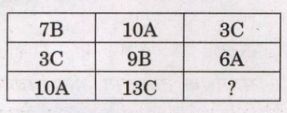
कुछ प्रविष्टियों का आव्यूह नीचे दिया गया है । प्रविष्टियाँ पंक्तिवार एक निश्चित प्रवृत्ति का अनुसरण करती हैं । तदनुसार अप्राप्त प्रविष्टि (?) का चयन कीजिए ।

7B10A3C
3C9B6A
10A13C?
A 3 × 3 matrix in boxes: row 1 — 7B, 10A, 3C; row 2 — 3C, 9B, 6A; row 3 — 10A, 13C, ?.
From UPSC's question paper.
Read this question in English

Following is a matrix of certain entries. The entries follow a certain trend row-wise. Choose the missing entry (?) accordingly.

(a) 9B · (b) 3A · (c) 3B · (d) 3C

उत्तर और व्याख्या · explanation in English

Answer: (c) 3B

In each row the third number is the second minus the first, and the letters A, B and C each appear once. Row 3 therefore needs 13 − 10 = 3 with the letter B: 3B.

  1. Numbers, row 1: 10 − 7 = 3; row 2: 9 − 3 = 6 — the third number is the second minus the first.
  2. Row 3: 13 − 10 = 3.
  3. Letters: each row uses A, B and C once; row 3 already has A and C, so it needs B.
  4. The missing entry is 3B.

Remember · In matrix puzzles treat numbers and letters as separate patterns, and check each rule against every row.

Question and answer: UPSC's official GS Paper II (2021, Series A) — paper ↗ · answer key ↗. Explanation: Minimalist IAS, checked 1 Oct 2026 (how we verify). Permalink ·

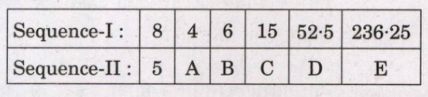
नीचे दो पंक्तियों में दो सर्वसम अनुक्रम दिए गए हैं :

अनुक्रम-I :8461552·5236·25
अनुक्रम-II :5ABCDE
A two-row table: Sequence-I — 8, 4, 6, 15, 52.5, 236.25; Sequence-II — 5, A, B, C, D, E.
From UPSC's question paper.

अनुक्रम-II के लिए C के स्थान पर क्या प्रविष्टि है ?

Read this question in English

You are given two identical sequences in two rows:

What is the entry in the place of C for the Sequence-II?

(a) 2.5 · (b) 5 · (c) 9.375 · (d) 32.8125

उत्तर और व्याख्या · explanation in English

Answer: (c) 9·375

Sequence-I multiplies by 0.5, 1.5, 2.5, 3.5 and 4.5 in turn. Starting from 5, Sequence-II runs 2.5, 3.75, 9.375, so C = 9.375.

  1. Sequence-I: 8 × 0.5 = 4, 4 × 1.5 = 6, 6 × 2.5 = 15, 15 × 3.5 = 52.5, 52.5 × 4.5 = 236.25 — the multiplier rises by 1 each time.
  2. Sequence-II from 5: A = 5 × 0.5 = 2.5, B = 2.5 × 1.5 = 3.75.
  3. C = 3.75 × 2.5 = 9.375.
  4. Check: D = 9.375 × 3.5 = 32.8125 — option (d) is the next term, a trap; (a) is A.

Remember · When terms first fall and then shoot up, test multipliers; options often offer the neighbouring terms as traps.

Question and answer: UPSC's official GS Paper II (2021, Series A) — paper ↗ · answer key ↗. Explanation: Minimalist IAS, checked 1 Oct 2026 (how we verify). Permalink ·

एक व्यक्ति X, स्थान A से तथा एक अन्य व्यक्ति Y, स्थान B से एक ही समय पर एक-दूसरे की ओर चलना आरंभ करते हैं । दोनों स्थानों के बीच की दूरी 15 km है ।

X, 1·5 km/hr की एकसमान चाल से चलता है और Y पहले घंटे में 1 km/hr की एकसमान चाल से, दूसरे घंटे में 1·25 km/hr की एकसमान चाल से तथा तीसरे घंटे में 1·5 km/hr की एकसमान चाल से चलता है और इसी प्रकार आगे भी चलना जारी रखता है ।

निम्नलिखित में से कौन-सा/कौन-से सही है/हैं ?

  1. 1.उन दोनों को मिलने में 5 घंटे का समय लगेगा ।
  2. 2.वे दोनों A तथा B स्थानों के बीचों-बीच मिलेंगे ।

नीचे दिए गए कूट का प्रयोग कर सही उत्तर चुनिए :

Read this question in English

A person X from a place A and another person Y from a place B set out at the same time to walk towards each other. The places are separated by a distance of 15 km.

X walks with a uniform speed of 1.5 km/hr and Y walks with a uniform speed of 1 km/hr in the first hour, with a uniform speed of 1.25 km/hr in the second hour and with a uniform speed of 1.5 km/hr in the third hour and so on.

Which of the following is/are correct?

1. They take 5 hours to meet.

2. They meet midway between A and B.

Select the correct answer using the code given below:

(a) 1 only · (b) 2 only · (c) Both 1 and 2 · (d) Neither 1 nor 2

उत्तर और व्याख्या · explanation in English

Answer: (c) 1 और 2 दोनों

Adding the hourly distances, the two close the 15 km gap exactly at the end of the 5th hour. X walks 5 × 1.5 = 7.5 km and Y walks 1 + 1.25 + 1.5 + 1.75 + 2 = 7.5 km, so they meet midway — both statements hold.

  1. Distance closed in each hour: 1.5 + 1 = 2.5, then 1.5 + 1.25 = 2.75, then 3, 3.25, 3.5 km.
  2. Running total: 2.5, 5.25, 8.25, 11.5, 15 km — they meet at the end of the 5th hour.
  3. X covers 5 × 1.5 = 7.5 km; Y covers 1 + 1.25 + 1.5 + 1.75 + 2 = 7.5 km.
  4. Each covers half of 15 km, so they meet midway.
  5. Check: Y's average speed over 5 hours is 7.5 ÷ 5 = 1.5 km/hr, equal to X's speed — hence midway.
  • ✓ 1. The combined distance reaches 15 km exactly after 5 hours.
  • ✓ 2. Both walk 7.5 km in those 5 hours, so the meeting point is the midpoint.

Remember · With speeds changing hour by hour, tabulate the hours; for an arithmetic progression of speeds, the average speed gives a quick check.

Question and answer: UPSC's official GS Paper II (2021, Series A) — paper ↗ · answer key ↗. Explanation: Minimalist IAS, checked 30 Sept 2026 (how we verify). Permalink ·

एक विद्यार्थी परीक्षा के 6 प्रश्न-पत्रों में बैठता है । प्रत्येक प्रश्न-पत्र के लिए अधिकतम अंक एकसमान हैं । इन प्रश्न-पत्रों में उसके प्राप्तांक 5 : 6 : 7 : 8 : 9 : 10 के अनुपात में हैं । कुल मिलाकर उसने 60% अंक प्राप्त किए । उसने कितने प्रश्न-पत्रों में अधिकतम अंकों के 60% से कम अंक प्राप्त किए ?

Read this question in English

A student appeared in 6 papers. The maximum marks are the same for each paper. His marks in these papers are in the proportion of 5: 6: 7: 8: 9: 10. Overall he scored 60%. In how many number of papers did he score less than 60% of the maximum marks?

(a) 2 · (b) 3 · (c) 4 · (d) 5

उत्तर और व्याख्या · explanation in English

Answer: (b) 3

With equal maximum marks, the overall 60% equals the average of the six papers' shares, and the average of 5 to 10 is 7.5. Only the papers with shares 5, 6 and 7 fall below that level — 3 papers.

  1. Let the marks be 5k, 6k, 7k, 8k, 9k and 10k; the total is 45k.
  2. Since every paper has the same maximum, the overall 60% equals the average paper score: 45k ÷ 6 = 7.5k is 60% of the maximum.
  3. Papers below 7.5k: 5k, 6k and 7k — 3 papers.
  4. Check: if the maximum is 12.5k, the marks are 40%, 48%, 56%, 64%, 72%, 80% — three below 60%.

Remember · When maximum marks are equal, the overall percentage is the average of the paper percentages; compare each paper with the mean.

Question and answer: UPSC's official GS Paper II (2021, Series A) — paper ↗ · answer key ↗. Explanation: Minimalist IAS, checked 30 Sept 2026 (how we verify). Permalink ·

निम्नलिखित 4 (चार) प्रश्नांशों के लिए निर्देश : नीचे दिए गए चार परिच्छेदों को पढ़िए और परिच्छेदों के नीचे आने वाले प्रश्नांशों के उत्तर दीजिए । इन प्रश्नांशों के लिए आपके उत्तर केवल इन परिच्छेदों पर ही आधारित होने चाहिए ।

परिच्छेद – 1

तथाकथित धार्मिक संप्रदायों के संबंध में, यदि प्रत्येक व्यक्ति को अपने धर्म का आकलन करने के लिए कहा जाए, तो धर्म के रूप में ऐसी कोई बात नहीं होगी जो ग़लत हो; किंतु यदि वे एक-दूसरे के धर्म का आकलन करते हैं, तो धर्म के रूप में ऐसी कोई बात नहीं होगी जो सही हो, और इसलिए धर्म के संदर्भ में, संपूर्ण विश्व सही है या संपूर्ण विश्व ग़लत है ।

उपर्युक्त परिच्छेद के आधार पर, सर्वाधिक तर्कसंगत पूर्वधारणा कौन-सी हो सकती है ?

Read this question in English

What is the most logical assumption that can be made from the passage given above?

(a) No man can live without adhering to some religious denomination. · (b) It is the duty of everyone to propagate one’s religious denomination. · (c) Religious denominations tend to ignore the unity of man. · (d) Men do not understand their own religious denomination.

उत्तर और व्याख्या · explanation in English

Answer: (c) धार्मिक संप्रदायों में मनुष्य की एकता की उपेक्षा करने की प्रवृत्ति होती है ।

Each denomination finds itself right and every other one wrong, so taken together either the whole world is right or the whole world is wrong. Behind this lies the assumption that denominations dwell on their differences and lose sight of what unites people.

  • ✗ (a) The passage says nothing about whether a person can live without a denomination.
  • ✗ (b) No duty to spread one's denomination is stated or implied.
  • ✓ (c) Because each group judges the others wrong, the passage concludes that 'all the world is right or all the world is wrong' — it assumes denominations focus on what divides and ignore the common humanity they share.
  • ✗ (d) Each person, judging his own religion, finds it right; the passage never says people misunderstand their own denomination.

Remember · For the 'most logical assumption', choose the unstated belief that makes the author's conclusion sensible, not a claim the passage never touches.

Question and answer: UPSC's official GS Paper II (2021, Series A) — paper ↗ · answer key ↗. Explanation: Minimalist IAS, checked 30 Sept 2026 (how we verify). Permalink ·

परिच्छेद – 2

यह निश्चित है कि राजद्रोह, युद्ध, और विधि (लॉ) की अवहेलना अथवा उल्लंघन को प्रजा की अनैतिकता पर उतना नहीं मढ़ा जा सकता, जितना कि उस अधिराज्य (डोमिनियन) की बुरी स्थिति पर । क्योंकि, मनुष्य जन्मजात रूप से नागरिकता के लिए उपयुक्त नहीं होते हैं, अपितु उन्हें नागरिकता के लिए उपयुक्त बनाया जाना चाहिए । इसके अतिरिक्त, मनुष्य में नैसर्गिक मनोभाव सर्वत्र समान होते हैं; और यदि अनैतिकता अधिक प्रबल होती है, और किसी राष्ट्रमंडल (कॉमनवेल्थ) में, दूसरे राष्ट्रमंडल की तुलना में अधिक अपराध होते हैं, तो यह निश्चित है कि पूर्ववर्ती राष्ट्रमंडल ने एकता के लक्ष्य के लिए पर्याप्त रूप से न तो प्रयास किया है, और न ही पूर्व-विचार करके अपनी विधि बनाई है; और इसीलिए, वह राष्ट्रमंडल के रूप में अपने अधिकार को बेहतर बनाने में विफल रहा है ।

उपर्युक्त परिच्छेद के आधार पर, निम्नलिखित में से कौन-सा सर्वाधिक तर्कसंगत और विवेकपूर्ण निष्कर्ष निकाला जा सकता है ?

Read this question in English

Which among the following is the most logical and rational inference that can be made from the passage given above?

(a) Seditions, wars and breach of the laws are inevitable in every dominion. · (b) It is not the people, but the sovereign who is responsible for all the problems of any dominion. · (c) That dominion is the best which pursues the aim of unity and has laws for good citizenship. · (d) It is impossible for men to establish a good dominion.

उत्तर और व्याख्या · explanation in English

Answer: (c) वह अधिराज्य सर्वोत्तम है जो एकता के लक्ष्य के लिए प्रयास करता है और जिसके पास सु-नागरिकता (गुड सिटिज़नशिप) के लिए विधि (लॉ) है ।

The author traces disorder mainly to the bad state of a dominion: people must be made fit for citizenship, and a commonwealth with more offences has failed to pursue unity and to frame laws with forethought. Turned around, the best dominion is one that pursues unity and has laws that make good citizens.

  • ✗ (a) Offences differ from one commonwealth to another according to how it is run, so they are not inevitable everywhere.
  • ✗ (b) The passage says disorder is 'not so much' due to the subjects as to the state of the dominion — a matter of degree; 'all the problems' is too extreme.
  • ✓ (c) Failure is traced to not pursuing 'the end of unity' and not framing laws 'with sufficient forethought', while men 'must be made' fit for citizenship — so the best dominion does both.
  • ✗ (d) The passage implies a well-run commonwealth is possible; nothing says a good dominion cannot be established.

Remember · Reverse the author's diagnosis: if failure comes from lacking X, the rational inference is that success comes with X.

Question and answer: UPSC's official GS Paper II (2021, Series A) — paper ↗ · answer key ↗. Explanation: Minimalist IAS, checked 30 Sept 2026 (how we verify). Permalink ·

परिच्छेद – 3

असमानता इस मूल लोकतांत्रिक प्रतिमानक का उल्लंघन करती है कि सभी नागरिक समान हैं । समानता वह संबंध है, जो कुछेक मूलभूत विशेषताओं के संबंध में व्यक्तियों के बीच होती है, जिसे वे सामान्य रूप से साझा करते हैं । नैतिकता की दृष्टि से कहें तो समानता एक स्वतः निर्धारित सिद्धांत है । इसलिए प्रजाति, जाति, लिंग, संजातीयता, निःशक्तता, या वर्ग जैसे आधारों पर व्यक्तियों के बीच भेदभाव नहीं किया जाना चाहिए । मानवीय स्थिति की ये विशेषताएँ नैतिक दृष्टि से संगत नहीं हैं । यह विचार कि व्यक्तियों के साथ सम्मानपूर्वक व्यवहार किया जाना चाहिए, न केवल इस कारण से कि इनमें से कुछेक व्यक्तियों के पास कुछ असाधारण विशेषताएँ अथवा प्रतिभा होती है, जैसे, इनमें से कुछेक व्यक्ति कुशल क्रिकेट खिलाड़ी, प्रतिभाशाली संगीतकार, अथवा विख्यात साहित्यकार होते हैं, बल्कि इसलिए भी कि वे सभी मनुष्य हैं, अब सामान्यबुद्धि-नीति का अंग बन गया है ।

उपर्युक्त परिच्छेद के संदर्भ में, निम्नलिखित पूर्वधारणाएँ बनाई गई हैं :

  1. 1.समानता, लोगों के लिए समाज के बहुविध व्यवहारों में आत्मविश्वास के साथ भाग लेने की एक पूर्वपेक्षा है ।
  2. 2.असमानता का होना लोकतंत्र के अस्तित्व के लिए हानिकारक है ।
  3. 3.सभी नागरिकों के समान होने का विचार ऐसा है, जिसे किसी लोकतंत्र में भी वास्तव में कार्यान्वित नहीं किया जा सकता है ।
  4. 4.समानता के अधिकार को हमारे मूल्यों और दिन-प्रतिदिन की राजनीतिक शब्दावली में समाविष्ट किया जाना चाहिए ।

उपर्युक्त में से कौन-सी पूर्वधारणाएँ मान्य हैं ?

Read this question in English

With reference to the above passage, the following assumptions have been made:

1. Equality is a prerequisite for people to participate in the multiple transactions of society from a position of confidence.

2. Occurrence of inequality is detrimental to the survival of democracy.

3. Equal standing of all citizens is an idea that cannot actually be realised even in a democracy.

4. Right to equality should be incorporated into our values and day-to-day political vocabulary.

Which of the above assumptions are valid?

(a) 1 and 2 only · (b) 2 and 3 only · (c) 1 and 4 only · (d) 3 and 4 only

उत्तर और व्याख्या · explanation in English

Answer: (c) केवल 1 और 4

The author treats the equal standing of citizens as a basic norm and a default principle, and notes that respecting persons simply as human beings is now commonsense morality. This rests on equality mattering for people to take part in society with confidence (1) and belonging in our everyday values (4); claims about democracy's survival or equality being unattainable go beyond or against the text.

  • ✓ 1. Equal standing and respect for persons 'because persons are human beings', whatever their caste, gender or class, is what lets people deal with society without being lowered — the premise behind calling equality a default principle.
  • ✗ 2. Inequality 'violates a basic democratic norm'; the passage does not say it threatens the survival of democracy — that escalates the claim.
  • ✗ 3. This contradicts the passage, which says equal respect is 'by now part of commonsense morality'.
  • ✓ 4. Since equal respect is a moral default and part of commonsense morality, the author assumes equality belongs in our values and everyday political language.

Remember · 'Violates a norm' is not 'threatens survival' — reject assumptions that escalate the passage's claim.

Question and answer: UPSC's official GS Paper II (2021, Series A) — paper ↗ · answer key ↗. Explanation: Minimalist IAS, checked 30 Sept 2026 (how we verify). Permalink ·

परिच्छेद – 4

अभिजातीय शासन स्वयं को उस दायरे में अत्यधिक रूप से सीमाबद्ध करके विनष्ट कर लेता है, जिस दायरे में सत्ता सीमित होती है; अल्पतंत्रीय शासन तात्कालिक धन प्राप्ति के लिए असावधानीपूर्वक संघर्ष कर स्वयं को विनष्ट करता है । यहाँ तक कि, लोकतंत्र के अतिरेक से लोकतंत्र भी स्वयं को विनष्ट करता है । इसका मूलभूत सिद्धांत यह है कि पद धारण करने और लोक नीति निर्धारण करने का सबको समान अधिकार है । प्रथम दृष्टि में, यह एक सुखद व्यवस्था है; किंतु यह विनाशकारी बन जाता है, क्योंकि लोग समुचित रूप से शिक्षित नहीं होते हैं कि वे उत्तम शासकों और सर्वाधिक विवेकपूर्ण मार्ग का चयन कर सकें । लोगों में समझ नहीं होती है और वे केवल वही दोहराते हैं जो उनके शासक उन्हें कहना पसंद करते हैं । ऐसा लोकतंत्र, निरंकुश शासन या स्वेच्छाचारी शासन होता है ।

— प्लेटो

निम्नलिखित में से कौन-सा कथन उपर्युक्त परिच्छेद के मर्म को सर्वोत्तम रूप से दर्शाता है ?

Read this question in English

Which one of the following statements best reflects the crux of the passage given above?

(a) Human societies experiment with different forms of governments. · (b) Any form of government tends to deteriorate by excess of its basic principle. · (c) Education of all citizens ensures a perfect, functional and sustainable democracy. · (d) Having a government is a necessary evil because tyranny is inherent in any form of government.

उत्तर और व्याख्या · explanation in English

Answer: (b) अपने मूलभूत सिद्धांत के अतिरेक के कारण शासन के किसी भी रूप का अपकर्ष हो जाता है ।

Plato shows aristocracy, oligarchy and democracy each ruining itself by overdoing the very principle that defines it — democracy 'by excess of democracy'. That shared pattern is the crux, option (b).

  • ✗ (a) True in general but not the point; the passage explains how each form destroys itself.
  • ✓ (b) Aristocracy narrows power too far, oligarchy scrambles for wealth, and democracy 'ruins itself by excess of democracy' — each through excess of its own principle.
  • ✗ (c) The passage blames poor education for democracy's failure but never claims education 'ensures' a perfect democracy.
  • ✗ (d) 'Necessary evil' is not stated; tyranny arises from excess, not as something inherent in every government.

Remember · When a passage runs parallel examples, the crux is the pattern they share, not any single example.

Question and answer: UPSC's official GS Paper II (2021, Series A) — paper ↗ · answer key ↗. Explanation: Minimalist IAS, checked 30 Sept 2026 (how we verify). Permalink ·

120 व्यक्तियों के समूह में, 80 भारतीय हैं और शेष विदेशी हैं । इसके अतिरिक्त, इस समूह में 70 व्यक्ति अंग्रेज़ी बोल सकते हैं । ऐसे भारतीयों की संख्या कितनी है जो अंग्रेज़ी बोल सकते हैं ?

Read this question in English

In a group of 120 persons, 80 are Indians and rest are foreigners. Further, 70 persons in the group can speak English. The number of Indians who can speak English is

(a) 20 · (b) 30 · (c) 30 or less · (d) 30 or more

उत्तर और व्याख्या · explanation in English

Answer: (d) 30 या उससे अधिक

There are only 40 foreigners, so at most 40 of the 70 English speakers can be foreigners. At least 30 must be Indians, and the number could be higher, so the answer is '30 or more'.

  1. Foreigners = 120 − 80 = 40.
  2. Even if all 40 foreigners speak English, at least 70 − 40 = 30 English speakers are Indians.
  3. If all 70 English speakers were Indians, the number would be 70; the data do not fix it.
  4. So the number of Indians who speak English is 30 or more.

Remember · Minimum overlap of two groups = (size of A + size of B) − total; give a range when the data do not fix an exact value.

Question and answer: UPSC's official GS Paper II (2021, Series A) — paper ↗ · answer key ↗. Explanation: Minimalist IAS, checked 30 Sept 2026 (how we verify). Permalink ·

तीन शून्येतर (नॉन-ज़ीरो) अंकों के प्रयोग (अंकों की पुनरावृत्ति के बिना) से प्राप्त 3 अंकों वाली सभी संख्याओं पर विचार कीजिए जो 3 के गुणज हैं । मान लीजिए इन संख्याओं का योगफल S है ।

निम्नलिखित में से कौन-सा/कौन-से सही है/हैं ?

  1. 1.S सदैव 74 से भाज्य है ।
  2. 2.S सदैव 9 से भाज्य है ।

नीचे दिए गए कूट का प्रयोग कर सही उत्तर चुनिए :

Read this question in English

Consider all 3-digit numbers (without repetition of digits) obtained using three non-zero digits which are multiples of 3. Let S be their sum.

Which of the following is/are correct?

1. S is always divisible by 74.

2. S is always divisible by 9.

Select the correct answer using the code given below:

(a) 1 only · (b) 2 only · (c) Both 1 and 2 · (d) Neither 1 nor 2

उत्तर और व्याख्या · explanation in English

Answer: (c) 1 और 2 दोनों

With the digits 3, 6 and 9, the six numbers add up to 222 × 18 = 3996, which is 74 × 54 and 9 × 444. In general, the six arrangements of three digits add to 222 × (digit sum), and 222 = 3 × 74, so both statements hold.

  1. The non-zero digits that are multiples of 3 are 3, 6 and 9; without repetition they give 3! = 6 numbers.
  2. Each digit appears twice in each place, so S = 2 × (3 + 6 + 9) × 111 = 222 × 18 = 3996.
  3. 3996 = 74 × 54, so S is divisible by 74.
  4. 3996 = 9 × 444, so S is divisible by 9.
  5. Check (general case): any three distinct digits a, b, c give six numbers summing to 222(a + b + c) = 3 × 74 × (a + b + c); when the numbers are multiples of 3, a + b + c is too, so S is a multiple of 9 × 74 = 666.
  • ✓ 1. S = 222 × (digit sum) and 222 = 3 × 74, so 74 always divides S.
  • ✓ 2. 222 carries one factor 3 and the digit sum (a multiple of 3) carries another, so 9 always divides S.

Remember · Sum of all arrangements of 3 distinct digits = 222 × (sum of the digits).

Question and answer: UPSC's official GS Paper II (2021, Series A) — paper ↗ · answer key ↗. Explanation: Minimalist IAS, checked 30 Sept 2026 (how we verify). Permalink ·

दो कक्षाओं A और B में क्रमशः 25 और 30 विद्यार्थी हैं । कक्षा-A में अधिकतम प्राप्तांक 21 है तथा न्यूनतम प्राप्तांक 17 है । कक्षा-B में अधिकतम प्राप्तांक 30 है तथा न्यूनतम प्राप्तांक 22 है । कक्षा-A से 4 विद्यार्थी कक्षा-B में स्थानांतरित किए जाते हैं ।

निम्नलिखित कथनों पर विचार कीजिए :

  1. 1.कक्षा-B का औसत प्राप्तांक निश्चित रूप से घटेगा ।
  2. 2.कक्षा-A का औसत प्राप्तांक निश्चित रूप से बढ़ेगा ।

उपर्युक्त कथनों में से कौन-सा/कौन-से सही है/हैं ?

Read this question in English

There are two Classes A and B having 25 and 30 students respectively. In Class-A the highest score is 21 and lowest score is 17. In Class-B the highest score is 30 and lowest score is 22. Four students are shifted from Class-A to Class-B.

Consider the following statements:

1. The average score of Class-B will definitely decrease.

2. The average score of Class-A will definitely increase.

Which of the above statements is/are correct?

(a) 1 only · (b) 2 only · (c) Both 1 and 2 · (d) Neither 1 nor 2

उत्तर और व्याख्या · explanation in English

Answer: (a) केवल 1

Every shifted student scored at most 21, below Class-B's lowest score of 22, so Class-B's average must fall. Class-A's average can rise or fall depending on which four students leave, so statement 2 is not certain.

  1. Each shifted student scored at most 21; every Class-B student scored at least 22.
  2. Adding scores lower than all existing scores pulls Class-B's average down — statement 1 is certain.
  3. Class-A's new average depends on whether the four who left were above or below Class-A's average.
  4. If the four scored 21 each, Class-A's average falls; if they scored 17 each, it rises — so statement 2 is not definite.
  • ✓ 1. New members all score below Class-B's minimum, so its average must decrease.
  • ✗ 2. Removing students raises the average only if they were below it; the data do not say which four moved.

Remember · Adding values below every existing value lowers the mean; removing values changes it only relative to the current mean.

Question and answer: UPSC's official GS Paper II (2021, Series A) — paper ↗ · answer key ↗. Explanation: Minimalist IAS, checked 30 Sept 2026 (how we verify). Permalink ·

दो कथनों और एक प्रश्न पर विचार कीजिए :

  1. कथन-1: प्रिया, सीमा से 4 स्थान नीचे है और सबसे निचले स्थान से 31वें स्थान पर है ।
  2. कथन-2: ईना, सीमा से 2 स्थान ऊपर है और सबसे निचले स्थान से 37वें स्थान पर है ।
  3. प्रश्न: 40 विद्यार्थियों की कक्षा में, शीर्ष स्थान से सीमा का कौन-सा स्थान है ?

कथनों और प्रश्न के संदर्भ में, निम्नलिखित में से कौन-सा सही है ?

Read this question in English

Consider two Statements and a Question:

Statement-1. Priya is 4 ranks below Seema and is 31st from the bottom.

Statement-2. Ena is 2 ranks above Seema and is 37th from the bottom.

Question. What is Seema’s rank from the top in the class of 40 students?

Which one of the following is correct in respect of the Statements and the Question?

(a) Statement-1 alone is not sufficient to answer the Question · (b) Statement-2 alone is not sufficient to answer the Question · (c) Either Statement-1 alone or Statement-2 alone is sufficient to answer the Question · (d) Both Statement-1 and Statement-2 are required to answer the Question

उत्तर और व्याख्या · explanation in English

Answer: (c) प्रश्न का उत्तर देने के लिए या तो केवल कथन-1 या केवल कथन-2 पर्याप्त है

Each statement on its own places Seema 35th from the bottom (31 + 4, or 37 − 2). In a class of 40 that is 40 − 35 + 1 = 6th from the top, so either statement alone is enough.

  1. Statement-1: Priya is 31st from the bottom and 4 ranks below Seema, so Seema is 31 + 4 = 35th from the bottom.
  2. Rank from top = 40 − 35 + 1 = 6. Statement-1 alone answers the Question.
  3. Statement-2: Ena is 37th from the bottom and 2 ranks above Seema, so Seema is 37 − 2 = 35th from the bottom — again 6th from the top.
  4. Each statement alone is sufficient.
  • ✗ (a) Statement-1 alone gives Seema's rank (6th from the top).
  • ✗ (b) Statement-2 alone also gives 6th from the top.
  • ✓ (c) Either statement alone fixes Seema at 35th from the bottom, i.e. 6th from the top.
  • ✗ (d) Combining is not needed, since each statement alone is enough.

Remember · Rank from top + rank from bottom = total + 1. In data sufficiency, test each statement alone before combining.

Question and answer: UPSC's official GS Paper II (2021, Series A) — paper ↗ · answer key ↗. Explanation: Minimalist IAS, checked 30 Sept 2026 (how we verify). Permalink ·

दो कथनों और एक प्रश्न पर विचार कीजिए :

  1. कथन-1: A और D में से प्रत्येक, B, E और F में प्रत्येक से अधिक भारी है, किंतु उनमें से कोई भी सबसे अधिक भारी नहीं है ।
  2. कथन-2: A, D से अधिक भारी है, किंतु C से हल्का है ।
  3. प्रश्न: A, B, C, D और E में सबसे अधिक भारी कौन है ?

कथनों और प्रश्न के संदर्भ में, निम्नलिखित में से कौन-सा सही है ?

Read this question in English

Consider two Statements and a Question:

Statement-1. Each of A and D is heavier than each of B, E and F, but none of them is the heaviest.

Statement-2. A is heavier than D, but is lighter than C.

Question. Who is the heaviest among A, B, C, D and E?

Which one of the following is correct in respect of the Statements and the Question?

(a) Statement-1 alone is sufficient to answer the Question · (b) Statement-2 alone is sufficient to answer the Question · (c) Both Statement-1 and Statement-2 are required to answer the Question · (d) Neither Statement-1 alone nor Statement-2 alone is sufficient to answer the Question

उत्तर और व्याख्या · explanation in English

Answer: (c) प्रश्न का उत्तर देने के लिए कथन-1 और कथन-2 दोनों की आवश्यकता है — UPSC also accepted (d)

Statement-2 gives C > A > D, and Statement-1 adds that A and D are heavier than B and E; only together do they show that C is the heaviest of the five. UPSC's final key accepted both (c) and (d), because when both statements are required it is also true that neither alone is sufficient.

  1. Statement-1: A and D are heavier than B, E and F, but C is never compared with anyone, and 'the heaviest' may be someone outside the list — so it cannot name the heaviest of A, B, C, D, E.
  2. Statement-2: C > A > D, but B and E are not compared with C — not sufficient alone.
  3. Together: C > A > D, and A, D > B, E, so C is heavier than all the others — C is the heaviest.
  4. Both statements are required (c). That also makes 'neither statement alone is sufficient' (d) true, and UPSC accepted both.
  • ✗ (a) Statement-1 never places C, so it cannot settle who is heaviest among the five.
  • ✗ (b) Statement-2 says nothing about B and E relative to C.
  • ✓ (c) Combining gives C > A > D, with A and D both heavier than B and E, so C is the heaviest.
  • ✓ (d) Since both statements are needed, neither alone is sufficient — literally true, and accepted by UPSC.

Remember · In data sufficiency, 'both are required' also means 'neither alone suffices' — watch for overlapping options.

Question and answer: UPSC's official GS Paper II (2021, Series A) — paper ↗ · answer key ↗. Explanation: Minimalist IAS, checked 30 Sept 2026 (how we verify). Permalink ·

अंग्रेज़ी वर्णमाला में, प्रारंभिक 4 अक्षर विपरीत क्रम में लिखे जाते हैं; और अगले 4 अक्षर विपरीत क्रम में लिखे जाते हैं और आगे भी इसी तरह लिखा जाता है; और अंत में Y और Z को परस्पर बदल दिया जाता है । 13वें अक्षर के दायीं ओर से चौथा अक्षर कौन-सा होगा ?

Read this question in English

In the English alphabet, the first 4 letters are written in opposite order; and the next 4 letters are written in opposite order and so on; and at the end Y and Z are interchanged. Which will be the fourth letter to the right of the 13th letter?

(a) N · (b) T · (c) H · (d) I

उत्तर और व्याख्या · explanation in English

Answer: (b) T

After reversing each block of four, the 13th place holds P (block PONM). Four places to its right is the 17th place, which starts the next block TSRQ — so the letter is T.

  1. Reverse each block of four: DCBA HGFE LKJI PONM TSRQ XWVU, and then Y Z become Z Y.
  2. Places 1–12 hold D C B A H G F E L K J I, so the 13th letter is P.
  3. The fourth letter to its right is in the 17th place: places 13–17 are P, O, N, M, T.
  4. The answer is T.

Remember · Work with positions: in reversed blocks of four, place 4k − 3 holds the letter numbered 4k.

Question and answer: UPSC's official GS Paper II (2021, Series A) — paper ↗ · answer key ↗. Explanation: Minimalist IAS, checked 30 Sept 2026 (how we verify). Permalink ·

निम्नलिखित 4 (चार) प्रश्नांशों के लिए निर्देश : नीचे दिए गए चार परिच्छेदों को पढ़िए और परिच्छेदों के नीचे आने वाले प्रश्नांशों के उत्तर दीजिए । इन प्रश्नांशों के लिए आपके उत्तर केवल इन परिच्छेदों पर ही आधारित होने चाहिए ।

परिच्छेद – 1

नैसर्गिक राज्य में ऐसा कुछ भी विद्यमान नहीं हो सकता, जिसे सामान्य सहमति से अच्छा या बुरा कहा जा सके, क्योंकि प्रत्येक व्यक्ति जो नैसर्गिक राज्य में रहता है, वह केवल अपने ही लाभ का ध्यान रखता है, और अपनी पसंद के अनुसार तथा जहाँ तक कि उसके अपने लाभ का संबंध है, अच्छे या बुरे का निर्णय करता है, और स्वयं को किसी भी विधि (लॉ) के अंतर्गत अपने सिवा अन्य किसी के प्रति उत्तरदायी नहीं मानता है; और इसलिए, नैसर्गिक राज्य में अपराध की कल्पना नहीं की जा सकती, केवल सिविल राज्य में ही ऐसा संभव है, जहाँ सामान्य सहमति से अच्छे या बुरे का निर्णय किया जाता है, और प्रत्येक व्यक्ति स्वयं को राज्य के प्रति उत्तरदायी मानता है ।

निम्नलिखित में से कौन-सा कथन उपर्युक्त परिच्छेद के मूल विचार को सर्वोत्तम रूप से दर्शाता है ?

Read this question in English

Which one of the following statements best reflects the central idea of the passage given above?

(a) The conceptions of what is right or wrong exist due to the formation of a state. · (b) Unless a ruling authority decides as to what is right or wrong, no man would be morally right. · (c) Man is inherently immoral and selfish in a natural state. · (d) The idea of what is right or wrong is necessary for the survival of human species.

उत्तर और व्याख्या · explanation in English

Answer: (a) क्या सही या ग़लत है — ये अवधारणाएँ राज्य के निर्माण के कारण अस्तित्व में हैं ।

In a natural state each man judges good and bad by his own advantage, so nothing is good or bad by common assent and 'sin cannot be conceived'. Only in a civil state is good and bad decreed by common consent — so shared notions of right and wrong come with the formation of the state.

  • ✓ (a) 'Sin cannot be conceived in a natural state, but only in a civil state, which is decreed by common consent what is good or bad' — right and wrong, as shared ideas, arise with the state.
  • ✗ (b) The passage speaks of common consent in a civil state, not a ruling authority deciding; and it does not say individuals cannot be morally right.
  • ✗ (c) Man in a natural state consults his own advantage, but the passage does not call him 'inherently immoral' — it says sin cannot even be conceived there.
  • ✗ (d) The survival of the human species is never discussed.

Remember · The central idea is the passage's main contrast (here, natural state versus civil state); reject options that add labels like 'immoral' or new themes.

Question and answer: UPSC's official GS Paper II (2021, Series A) — paper ↗ · answer key ↗. Explanation: Minimalist IAS, checked 30 Sept 2026 (how we verify). Permalink ·

परिच्छेद – 2

आसन्न भविष्य में, हम कई नई प्रौद्योगिकियाँ — कृत्रिम बुद्धि (आर्टिफिशियल इंटेलिजेंस) एवं रोबोटविज्ञान (रोबोटिक्स), 3D विनिर्माण, ग्राहकों की माँग के अनुसार निर्मित जैविक एवं औषधीय उत्पादों, घातक स्वचालित शस्त्रों एवं चालकरहित कारों का बढ़ता पण्यकरण (कमोडिफिकेशन) देखेंगे । इससे विकट समस्याएँ उत्पन्न होंगी । इस नैतिक प्रश्न पर प्रायः विचार किया गया है कि चालकरहित कार नियम न मानने वाले पदातिक (जेवॉकर) को टक्कर मारने एवं अचानक एक ओर मुड़कर कार को क्षतिग्रस्त करने के बीच में निर्णय कैसे लेगी । इसका उत्तर दोनों है, सरल — मानव-जीवन को बचाना, और जटिल भी । कितने कोण पर कार को मुड़ना चाहिए — क्या केवल उस नियम को न मानने वाले पदातिक को बचाने भर या उससे अधिक ? यदि चालकरहित कार डबलिन में होगी, तो निर्णय कौन करेगा ? उसका निर्णय आइरिश सरकार करेगी, या कैलिफोर्निया में मौजूद कार का मूल कूटलेखक करेगा, या फिर हैदराबाद में मौजूद वह सॉफ्टवेयर प्रोग्रामर करेगा, जिसे कार का अनुरक्षण कार्य सौंपा गया है ? यदि भिन्न-भिन्न राष्ट्रीय क्षेत्राधिकारों में मानव-जीवन को प्राथमिकता देने के बारे में भिन्न-भिन्न सूक्ष्म नियम (फाइन प्रिंट) होंगे, तो यह पारराष्ट्रीय (ट्रांसनेशनल) निर्णयों सहित बीमा एवं निवेश संबंधी निर्णयों को किस तरह प्रभावित करेगा ?

उपर्युक्त परिच्छेद के आधार पर, निम्नलिखित में से कौन-से कथन विवेकपूर्ण, युक्तियुक्त एवं व्यावहारिक निहितार्थों को बेहतर दर्शाते हैं ?

  1. 1.अत्यधिक वैश्वीकरण किसी भी देश के सर्वोत्तम हित में नहीं है ।
  2. 2.आधुनिक प्रौद्योगिकियाँ आर्थिक सीमाओं को तेज़ी से मिटा रही हैं ।
  3. 3.नवाचार और पूँजी ने राज्य के अधिकार-क्षेत्र पर अतिक्रमण कर लिया है ।
  4. 4.प्रत्येक देश की सार्वजनिक नीति अपनी निजी आपूर्ति शृंखलाओं (सप्लाई चेन) के विकास पर केंद्रित होनी चाहिए ।
  5. 5.भू-राजनीति को कई अस्पष्टताओं और अनिश्चितताओं का निराकरण करना होगा ।

नीचे दिए गए कूट का प्रयोग कर सही उत्तर चुनिए :

Read this question in English

Which of the following statements best reflect the rational, plausible and practical implications that can be derived from the passage given above?

1. Too much globalization is not in the best interests of any country.

2. Modern technologies are increasingly blurring the economic borders.

3. Innovation and capital have impinged on the domain of the State.

4. Public policy of every country should focus on developing its own supply chains.

5. Geopolitics will have to reconcile to many ambiguities and uncertainties.

Select the correct answer using the code given below:

(a) 1, 4 and 5 only · (b) 1, 2, 3 and 4 only · (c) 2, 3 and 5 only · (d) 1, 2, 3, 4 and 5

उत्तर और व्याख्या · explanation in English

Answer: (c) केवल 2, 3 और 5

A driverless car running in Dublin, coded in California and maintained from Hyderabad raises questions no single government can settle, and differing national rules will affect transnational insurance and investment. So technology is blurring economic borders (2), innovation and capital are entering the State's domain (3), and geopolitics must live with uncertainty (5); the passage neither condemns globalisation nor prescribes self-reliant supply chains.

  • ✗ 1. The passage raises dilemmas; it passes no judgement that globalisation is harmful.
  • ✓ 2. One product spans Dublin, California and Hyderabad, and decisions are 'transnational' — technology cuts across economic borders.
  • ✓ 3. A life-and-death choice may rest with a code writer or an outsourced programmer rather than the Irish Government — private innovation and capital now reach into what was the State's domain.
  • ✗ 4. Supply chains are not discussed; this is a policy prescription the passage does not make.
  • ✓ 5. 'Who would take the decision?' and different 'fine print' across jurisdictions leave open questions that countries must learn to handle.

Remember · For 'implications', keep what flows from the passage's own questions; drop prescriptions ('should') and value judgements it never makes.

Question and answer: UPSC's official GS Paper II (2021, Series A) — paper ↗ · answer key ↗. Explanation: Minimalist IAS, checked 30 Sept 2026 (how we verify). Permalink ·

परिच्छेद – 3

दिवाला और शोधन अक्षमता संहिता (कोड) के अनुसार भारतीय बैंकों के दिवालिया मामलों का समाधान किया जाए, तो वह अनर्जक परिसंपत्ति (एन.पी.ए.) स्थिति को कुछ सीमा तक नियंत्रित करने में सहायक हो सकता है । राष्ट्रीय कंपनी विधि अधिकरण द्वारा किए जाने वाले समाधानों की गति धीमी होने के बावजूद, यह संहिता भावी ऋण-चक्रों में बैंक बहियों को शोधित (क्लीन अप) करने में सहायक हो सकती है । सार्वजनिक क्षेत्र के बैंकों का पुनः पूँजीकरण भी बैंकों के गुंजाइश पूँजी (कैपिटल कुशन) को बढ़ाने और उन्हें अधिक ऋण देने और आर्थिक गतिविधि को बढ़ावा देने के लिए प्रेरित करने में सहायक हो सकता है । किंतु, अशोध्य कर्ज़ का समाधान और पुनः पूँजीकरण, इस समाधान का एक अंगमात्र ही हैं, क्योंकि वे उस अनियंत्रित ऋण को रोकने में बहुत कम ही सहायक हो सकते हैं, जिसने भारतीय बैंकिंग प्रणाली को उसकी वर्तमान दयनीय अवस्था में ला खड़ा किया है । जब तक अधारणीय ऋण की समस्या के समाधान के लिए प्रणालीगत सुधार नहीं किए जाते हैं, तब तक भावी ऋण-चक्र बैंकिंग प्रणाली पर दबाव डालते रहेंगे ।

उपर्युक्त परिच्छेद के अनुसार, निम्नलिखित कथनों में से कौन-सा सर्वाधिक तर्कसंगत, विवेकपूर्ण और व्यावहारिक सुझाव को बेहतर दर्शाता है ?

Read this question in English

Which one of the following statements best reflects the most logical, rational and practical suggestion implied by the passage given above?

(a) Lending by the banks should be closely monitored and regulated by the Central Government. · (b) Interest rates should be kept low so as to induce banks to lend more, promote credit growth and thereby boost economic activity. · (c) Merger of many banks into a few large banks alone is the long-term solution to make them viable and prevent their bad performance. · (d) Indian banking system requires structural reforms as a long-term solution for bad loans problem.

उत्तर और व्याख्या · explanation in English

Answer: (d) अशोध्य ऋण की समस्या के दीर्घकालिक समाधान के रूप में, भारतीय बैंकिंग प्रणाली में संरचनात्मक सुधार आवश्यक हैं ।

Bad-debt resolution and recapitalisation help, but the passage calls them only part of the solution: unless systemic reforms tackle unsustainable lending, future credit cycles will stress the banks again. The suggestion is structural reform as the long-term remedy.

  • ✗ (a) Close monitoring by the Central Government is one possible reform, but the passage names no agency or method — this is too specific.
  • ✗ (b) The passage worries about reckless lending; pushing banks to lend more through low rates works against that concern.
  • ✗ (c) Mergers are never mentioned, and 'alone is the long-term solution' is too absolute.
  • ✓ (d) 'Unless there are systemic reforms that address the problem of unsustainable lending, future credit cycles will continue to stress the banking system.'

Remember · When a passage ends 'unless X, the problem continues', X is the suggestion — pick the option that restates it without adding specifics.

Question and answer: UPSC's official GS Paper II (2021, Series A) — paper ↗ · answer key ↗. Explanation: Minimalist IAS, checked 30 Sept 2026 (how we verify). Permalink ·

परिच्छेद – 4

भारत में, समष्टि आर्थिक नीति का उद्देश्य लोगों के आर्थिक कल्याण को बढ़ाना है, और ऐसी समष्टि आर्थिक नीति की किसी भी शाखा (विंग), मौद्रिक हो या राजकोषीय, दूसरी शाखा के सक्रिय समर्थन के बिना, स्वतंत्र रूप से कार्य नहीं कर सकती ।

निम्नलिखित में से कौन-सा कथन, उपर्युक्त परिच्छेद के उप-सिद्धांत को बेहतर दर्शाता है ?

Read this question in English

Which one of the following statements best reflects the corollary to the passage given above?

(a) The central bank cannot work independently of the Government. · (b) Government should regulate financial markets and institutions closely. · (c) Market economy is not compatible with the socialist policies of the Government. · (d) Financial sector reforms are required for enhancing the economic welfare of the people.

उत्तर और व्याख्या · explanation in English

Answer: (a) केंद्रीय बैंक सरकार से स्वतंत्र होकर कार्य नहीं कर सकता ।

The passage says neither wing of macroeconomic policy — monetary or fiscal — can work independently without the other's support. Monetary policy is run by the central bank and fiscal policy by the Government, so the corollary is that the central bank cannot work independently of the Government.

  • ✓ (a) Monetary policy (the central bank) 'cannot independently work without active support' of fiscal policy (the Government) — a direct restatement.
  • ✗ (b) Regulation of financial markets and institutions is not mentioned.
  • ✗ (c) Market economy versus socialist policies lies outside the passage.
  • ✗ (d) Financial sector reforms are not discussed; the passage is about coordination between monetary and fiscal policy.

Remember · A corollary follows directly from the statement; translate its terms (monetary = central bank, fiscal = Government) and look for the restatement.

Question and answer: UPSC's official GS Paper II (2021, Series A) — paper ↗ · answer key ↗. Explanation: Minimalist IAS, checked 30 Sept 2026 (how we verify). Permalink ·

निम्नलिखित सारणी पर विचार कीजिए :

खिलाड़ीपहली पारी में बनाए गए रनपहली पारी में खेली गई गेंदेंदूसरी पारी में बनाए गए रनदूसरी पारी में खेली गई गेंदें
A61991476
B05125085
C15752050
D13551250
A table of runs scored and balls faced by players A, B, C and D in the first and second innings of a Test Match.
From UPSC's question paper.

इस टेस्ट मैच में, सबसे तेज़ रन बनाने वाला कौन है ?

Read this question in English

Consider the following Table:

Who is the fastest run scorer in the Test Match?

(a) A · (b) B · (c) C · (d) D

उत्तर और व्याख्या · explanation in English

Answer: (b) B

Speed of scoring is runs per ball over the whole match. B scores 55 runs off 97 balls (about 0.57 a ball), ahead of A (75 off 175), C (35 off 125) and D (25 off 105).

  1. Fastest scorer = highest total runs ÷ total balls across both innings.
  2. A: (61 + 14) ÷ (99 + 76) = 75 ÷ 175 ≈ 0.43 runs per ball.
  3. B: (5 + 50) ÷ (12 + 85) = 55 ÷ 97 ≈ 0.57.
  4. C: 35 ÷ 125 = 0.28; D: 25 ÷ 105 ≈ 0.24.
  5. B has the highest rate, so B is the fastest run scorer.
  6. Check: only B scores more than half a run per ball (55 > 97 ÷ 2).

Remember · Compare ratios of totals, not innings by innings; a simple benchmark (here half a run per ball) often settles it.

Question and answer: UPSC's official GS Paper II (2021, Series A) — paper ↗ · answer key ↗. Explanation: Minimalist IAS, checked 1 Oct 2026 (how we verify). Permalink ·

एक ग्राम में आधे ग्रामवासियों के अपने घर हैं । 1/5 ग्रामवासी धान की खेती करते हैं । 1/3 ग्रामवासी साक्षर हैं । 4/5 ग्रामवासियों की आयु 25 वर्ष से कम है । निम्नलिखित कथनों में से कौन-सा निश्चित रूप से सही है ?

Read this question in English

Half of the villagers of a certain village have their own houses. One-fifth of the villagers cultivate paddy. One-third of the villagers are literate. Four-fifth of the villagers are under 25 years of age. Which one of the following statements is certainly correct?

(a) All the villagers who have their own houses are literate. · (b) Some villagers under 25 years of age are literate. · (c) Only half of the villagers who cultivate paddy are literate. · (d) No villager under 25 years of age has his own house.

उत्तर और व्याख्या · explanation in English

Answer: (b) 25 वर्ष से कम आयु वाले कुछ ग्रामवासी साक्षर हैं ।

Fractions of the same village that add up to more than 1 must overlap. Under-25s (4/5) and literates (1/3) together make 17/15, so at least 2/15 of the villagers are both — some under-25s are certainly literate.

  1. Under 25: 4/5 of the villagers; literate: 1/3.
  2. 4/5 + 1/3 = 12/15 + 5/15 = 17/15, which is more than the whole village.
  3. So at least 17/15 − 1 = 2/15 of the villagers are both under 25 and literate — (b) is certain.
  4. Check the rest: house-owners (1/2) outnumber literates (1/3), so (a) is impossible; house-owners and under-25s (1/2 + 4/5 = 13/10) must overlap, so (d) is false; (c) cannot be fixed from the data.
  • ✗ (a) Half the villagers own houses but only a third are literate, so not all house-owners can be literate.
  • ✓ (b) 4/5 + 1/3 exceeds 1, so at least 2/15 of the villagers are both under 25 and literate.
  • ✗ (c) Nothing tells us how literacy is spread among paddy growers.
  • ✗ (d) 1/2 + 4/5 = 13/10 exceeds 1, so at least 3/10 of the villagers are under 25 and own a house.

Remember · If two fractions of one group add to more than 1, the excess over 1 is the guaranteed minimum overlap.

Question and answer: UPSC's official GS Paper II (2021, Series A) — paper ↗ · answer key ↗. Explanation: Minimalist IAS, checked 30 Sept 2026 (how we verify). Permalink ·

दो कथनों और एक प्रश्न पर विचार कीजिए :

  1. कथन-1: किसी माह का अंतिम दिन बुधवार है ।
  2. कथन-2: इस माह का तृतीय शनिवार उसका 17वाँ दिन है ।
  3. प्रश्न: इस माह के 14वें दिन कौन-सा वार है ?

कथनों और प्रश्न के संदर्भ में, निम्नलिखित में से कौन-सा सही है ?

Read this question in English

Consider two Statements and a Question:

Statement-1. The last day of the month is a Wednesday.

Statement-2. The third Saturday of the month was the seventeenth day.

Question. What day is the fourteenth of the given month?

Which one of the following is correct in respect of the Statements and the Question?

(a) Statement-1 alone is sufficient to answer the Question · (b) Statement-2 alone is sufficient to answer the Question · (c) Both Statement-1 and Statement-2 are required to answer the Question · (d) Neither Statement-1 alone nor Statement-2 alone is sufficient to answer the Question

उत्तर और व्याख्या · explanation in English

Answer: (b) प्रश्न का उत्तर देने के लिए केवल कथन-2 पर्याप्त है

Knowing the third Saturday is the 17th fixes every date: Saturdays fall on the 3rd, 10th and 17th, so the 14th is a Wednesday. The last day being a Wednesday does not help without knowing how many days the month has.

  1. Statement-2: the third Saturday is the 17th, so Saturdays fall on the 3rd, 10th and 17th.
  2. The 14th is 4 days after Saturday the 10th — a Wednesday. Statement-2 alone answers the Question.
  3. Statement-1: the last day is a Wednesday, but the month may have 28, 29, 30 or 31 days, so the 14th could be Wednesday, Tuesday, Monday or Sunday — not sufficient.
  4. So Statement-2 alone is sufficient.
  • ✗ (a) Without the month's length, the last day being Wednesday leaves four possibilities for the 14th.
  • ✓ (b) Saturday the 17th means Saturday the 10th, so the 14th is a Wednesday.
  • ✗ (c) Statement-1 is not needed.
  • ✗ (d) Statement-2 alone is sufficient.

Remember · A dated weekday fixes the whole month; a 'last day' clue also needs the month's length.

Question and answer: UPSC's official GS Paper II (2021, Series A) — paper ↗ · answer key ↗. Explanation: Minimalist IAS, checked 30 Sept 2026 (how we verify). Permalink ·

10 अक्टूबर, 2027 कौन-सा वार होगा ?

Read this question in English

Which day is 10th October, 2027?

(a) Sunday · (b) Monday · (c) Tuesday · (d) Saturday

उत्तर और व्याख्या · explanation in English

Answer: (a) रविवार

Counting odd days gives 4 for the years 2001–2026 and 3 for 2027 up to 10 October — 7 in all, i.e. none left over, so the day is Sunday. A quicker route: this very paper was held on Sunday, 10 October 2021, and six years with one leap day add exactly 7 days.

  1. Odd days up to the end of 2000: 0 (every 400 years has 0 odd days).
  2. 2001–2026: 26 years with 6 leap years (2004, 2008, 2012, 2016, 2020, 2024), so 26 + 6 = 32 odd days; 32 = 4 × 7 + 4, leaving 4.
  3. 2027 up to 10 October: Jan 3, Feb 0, Mar 3, Apr 2, May 3, Jun 2, Jul 3, Aug 3, Sep 2, Oct 3 — total 24, leaving 3.
  4. Total = 4 + 3 = 7 odd days, i.e. 0, so 10 October 2027 is a Sunday.
  5. Check: 10 October 2021 (the date of this paper) was a Sunday; 2022–2027 add 6 + 1 (for 29 February 2024) = 7 days — Sunday again.

Remember · Anchor on a date you know: each ordinary year moves the weekday on by 1 and each leap year by 2.

Question and answer: UPSC's official GS Paper II (2021, Series A) — paper ↗ · answer key ↗. Explanation: Minimalist IAS, checked 30 Sept 2026 (how we verify). Permalink ·

नीचे दिए गए दो कथनों और चार निष्कर्षों पर विचार कीजिए । आपको इन कथनों को सही मानते हुए प्रश्नों का उत्तर देना है, भले ही वे सामान्य रूप से ज्ञात तथ्यों की दृष्टि से संगत प्रतीत न हों । सभी निष्कर्षों को पढ़ें और तत्पश्चात निर्णय करें कि कौन-सा/कौन-से निष्कर्ष दिए गए कथनों के अनुसार तर्कसंगत है/हैं, भले ही वे सामान्य रूप से ज्ञात तथ्यों की दृष्टि से संगत न हों ।

  1. कथन-1: कुछ हरे नीले हैं ।
  2. कथन-2: कुछ नीले काले हैं ।
  3. निष्कर्ष-1: कुछ हरे काले हैं ।
  4. निष्कर्ष-2: कोई भी हरा काला नहीं है ।
  5. निष्कर्ष-3: सभी हरे काले हैं ।
  6. निष्कर्ष-4: सभी काले हरे हैं ।

निम्नलिखित में से कौन-सा सही है ?

Read this question in English

Consider two Statements and four Conclusions given below. You have to take the Statements to be true even if they seem to be at variance from the commonly known facts. Read all Conclusions and then decide which of the given Conclusion(s) logically follows/follow from the Statements, disregarding the commonly known facts.

Statement-1. Some greens are blues.

Statement-2. Some blues are blacks.

Conclusion-1. Some greens are blacks.

Conclusion-2. No green is black.

Conclusion-3. All greens are blacks.

Conclusion-4. All blacks are greens.

Which one of the following is correct?

(a) Conclusion-1 and Conclusion-2 only · (b) Conclusion-2 and Conclusion-3 only · (c) Conclusion-3 and Conclusion-4 only · (d) Neither Conclusion 1 nor 2 nor 3 nor 4

उत्तर और व्याख्या · explanation in English

Answer: (d) न तो निष्कर्ष 1, न ही 2, न ही 3, न ही 4

Two 'some' statements joined only through blues give no definite link between greens and blacks. None of the four conclusions follows on its own; at most, 1 and 2 form an either-or pair, which no option offers.

  1. Both statements are particular ('some') and meet only in blues, so no definite relation between greens and blacks can be drawn.
  2. Conclusion-1 and Conclusion-2 are each possible, but neither is certain.
  3. Conclusions 3 and 4 ('all') cannot come from 'some' premises.
  4. None follows. (1 and 2 together make an either-or pair, but option (a) claims both follow, which is impossible.)
  • ✗ Conclusion-1 Greens and blacks may or may not overlap; nothing forces it.
  • ✗ Conclusion-2 A diagram with some greens being blacks fits the statements, so 'no green is black' is not certain.
  • ✗ Conclusion-3 An 'all' conclusion cannot follow from two 'some' statements.
  • ✗ Conclusion-4 Likewise, nothing says every black is green.

Remember · Two particular ('some') premises never give a definite conclusion; use the either-or rule only when an option offers 'either … or'.

Question and answer: UPSC's official GS Paper II (2021, Series A) — paper ↗ · answer key ↗. Explanation: Minimalist IAS, checked 30 Sept 2026 (how we verify). Permalink ·

अनुक्रम 2, 7, 22, 67, 202, X, 1822 में ‘X’ का मान क्या है ?

Read this question in English

What is the value of ‘X’ in the sequence 2, 7, 22, 67, 202, X, 1822?

(a) 603 · (b) 605 · (c) 607 · (d) 608

उत्तर और व्याख्या · explanation in English

Answer: (c) 607

Every term is three times the previous one plus 1. So X = 202 × 3 + 1 = 607, and 607 × 3 + 1 = 1822 confirms it.

  1. 2 × 3 + 1 = 7, 7 × 3 + 1 = 22, 22 × 3 + 1 = 67, 67 × 3 + 1 = 202 — each term is 3 × previous + 1.
  2. X = 202 × 3 + 1 = 607.
  3. Check: 607 × 3 + 1 = 1822, the next term.

Remember · When terms roughly triple, test '× 3 ± k', and always verify with the term after the blank.

Question and answer: UPSC's official GS Paper II (2021, Series A) — paper ↗ · answer key ↗. Explanation: Minimalist IAS, checked 30 Sept 2026 (how we verify). Permalink ·

निम्नलिखित 2 (दो) प्रश्नांशों के लिए निर्देश : नीचे दिए गए दो परिच्छेदों को पढ़िए और परिच्छेदों के नीचे आने वाले प्रश्नांशों के उत्तर दीजिए । इन प्रश्नांशों के लिए आपके उत्तर केवल इन परिच्छेदों पर ही आधारित होने चाहिए ।

परिच्छेद – 1

हार्वर्ड और एम.आई.टी. जैसे सर्वोत्तम विश्वविद्यालय, उनके वेतन-पत्रक (पे-रोल) पर वास्तव में कुछ उत्कृष्ट अध्यापकों की सुविधा होने के बावजूद, “फ्लिप कक्षा” (Flipped classroom) प्रारूप को तेज़ी से अपना रहे हैं, जहाँ विद्यार्थी घर बैठे वीडियो व्याख्यान सुनते हैं, और कक्षा के समय में अपने ज्ञान का अनुप्रयोग, समस्याओं का समाधान, उदाहरणों पर चर्चा, इत्यादि करते हैं । प्रोफेसर उस चर्चा को संचालित करते हैं और आवश्यकतानुसार अपने विचार देते हैं, उन अंशों को स्पष्ट करते हैं, जो विद्यार्थियों को अस्पष्ट प्रतीत होते हैं और उन्हें ऐसे उन्नत विचारों से अवगत कराते हैं जो प्रासंगिक हों । इन विश्वविद्यालयों ने अपने वीडियो व्याख्यानों को पूरे विश्व में सबके लिए निःशुल्क उपलब्ध किया है । वे संपूर्ण विश्व के महाविद्यालयों और विश्वविद्यालयों को इन ऑनलाइन पाठ्यक्रमों को एकीकृत करके अपने अध्यापन में शामिल करने, अपनी आवश्यकताओं के अनुरूप उपयुक्त खंडों को लेकर उसके आधार पर पैकेज तैयार करने के लिए भी प्रोत्साहित कर रहे हैं ।

निम्नलिखित में से कौन-सा कथन उपर्युक्त परिच्छेद के केंद्रीय विचार को सर्वोत्तम रूप से दर्शाता है ?

Read this question in English

Which one of the following statements best reflects the central idea of the passage given above?

(a) Efficacy of universities would be better in online mode of conducting classroom tuition as compared to conventional method. · (b) Availability of higher education can be made easier and cheaper without diluting the content. · (c) We need not invest much in infrastructure related to higher education and yet develop better human and social capital. · (d) Private sector institutions in higher education as well as coaching institutes can take advantage of this opportunity and thrive well.

उत्तर और व्याख्या · explanation in English

Answer: (b) विषय-वस्तु में कोई कमी किए बिना उच्चतर शिक्षा सहजता से और कम व्यय में उपलब्ध कराई जा सकेगी ।

The best universities pair video lectures with active class discussion, give those lectures free to the world, and invite other colleges to build them into their own teaching. The central idea is that good higher education can reach more people, more cheaply, without losing quality.

  • ✗ (a) The passage describes a blended 'flipped classroom', with class time and professors, not a claim that online mode beats conventional teaching.
  • ✓ (b) Lectures by excellent teachers are 'available free for anyone in the world' and can be integrated by colleges everywhere — easier, cheaper access to the same content.
  • ✗ (c) Infrastructure spending is never discussed, and 'human and social capital' is a leap.
  • ✗ (d) Private institutions and coaching institutes are not mentioned.

Remember · The central idea generalises what the passage's examples achieve; reject options about groups or costs the passage never mentions.

Question and answer: UPSC's official GS Paper II (2021, Series A) — paper ↗ · answer key ↗. Explanation: Minimalist IAS, checked 30 Sept 2026 (how we verify). Permalink ·

परिच्छेद – 2

हमारे नगर, जनसंख्या के अधिक संकेन्द्रण और अपर्याप्त आधारिक संरचनाओं के कारण जलवायु परिवर्तन के प्रति अत्यधिक सुभेद्य हैं । इसके अतिरिक्त, उनमें जनसंख्या घनत्व बढ़ रहा है, किंतु हमने जलवायु परिवर्तन के प्रभावों के निराकरण के लिए अभी तक कोई प्रणाली विकसित नहीं की है । जी.डी.पी. में, हमारे नगरों का योगदान 65% है, किंतु उनमें जनता की आवश्यकताओं को पूरा करने के लिए पर्याप्त सुविधाएँ नहीं हैं । वायु की गुणता, परिवहन, आदि, से संबंधित समस्याओं पर ध्यान देना महत्त्वपूर्ण है, जो कि संधारणीय समाधान ढूँढ़ने के लिए अत्यावश्यक हैं । हमें नगर योजना बनाने के कार्य में नागरिकों को सम्मिलित करने की आवश्यकता है और ऐसे पारिस्थितिक तंत्र का सृजन करना होगा जो लोगों की आवश्यकताओं को पूरा कर सके ।

उपर्युक्त परिच्छेद के आधार पर प्रतिपादित, निम्नलिखित में से कौन-सा सर्वाधिक तर्कसंगत और विवेकपूर्ण निष्कर्ष हो सकता है ?

Read this question in English

Which among the following is the most logical and rational inference that can be made from the passage given above?

(a) Our cities need to have well-defined administrative set-up with sufficient autonomy. · (b) Ever increasing population densities is a hindrance in our efforts to achieve sustainable development. · (c) To maintain and develop our cities we need to adopt sustainability related interventions. · (d) Public-Private Partnership mode of development is the viable long-term solution for the infrastructure and sustainability problems of India.

उत्तर और व्याख्या · explanation in English

Answer: (c) हमारे नगरों के रख-रखाव और विकास के लिए हमें संधारणीयता संबंधी हस्तक्षेप करने की आवश्यकता है ।

Cities are vulnerable to climate change, crowded and short of facilities, and the passage calls for sustainable solutions on air quality and transport with citizens involved in planning. The rational inference is that our cities need sustainability-related interventions.

  • ✗ (a) Administrative set-up and autonomy are not discussed.
  • ✗ (b) The passage notes rising densities, but its concern is that 'we have not yet developed the systems' to cope — it does not call density itself the hindrance.
  • ✓ (c) Issues of air quality and transport 'are vital to identifying sustainable solutions', and cities must 'create an ecosystem that meets the needs of the people'.
  • ✗ (d) Public-Private Partnership is never mentioned; this names a mechanism from outside the passage.

Remember · The most logical inference restates the passage's own remedy; options naming a specific mechanism (autonomy, PPP) go beyond it.

Question and answer: UPSC's official GS Paper II (2021, Series A) — paper ↗ · answer key ↗. Explanation: Minimalist IAS, checked 30 Sept 2026 (how we verify). Permalink ·

जय तथा विजय ने एक ही दुकान से एक ही प्रकार के कुछ पेन और विशेष पेंसिलें खरीदने के लिए समान धनराशि खर्च की । यदि जय ने 3 पेन और 5 पेंसिलें खरीदीं, और विजय ने 2 पेन और 7 पेंसिलें खरीदीं, तो निम्नलिखित में से कौन-सा सही है ?

Read this question in English

Jay and Vijay spent an equal amount of money to buy some pens and special pencils of the same quality from the same store. If Jay bought 3 pens and 5 pencils, and Vijay bought 2 pens and 7 pencils, then which one of the following is correct?

(a) A pencil costs more than a pen · (b) The price of a pencil is equal to that of a pen · (c) The price of a pen is two times the price of a pencil · (d) The price of a pen is three times the price of a pencil

उत्तर और व्याख्या · explanation in English

Answer: (c) पेन का मूल्य, पेंसिल के मूल्य से दुगुना है

Both spent the same, so 3 pens + 5 pencils cost as much as 2 pens + 7 pencils. Cancelling the common items leaves 1 pen = 2 pencils.

  1. Equal spending: 3 pens + 5 pencils = 2 pens + 7 pencils.
  2. Remove 2 pens and 5 pencils from both sides: 1 pen = 2 pencils.
  3. So a pen costs twice as much as a pencil.

Remember · With equal totals, cancel what both sides share — the leftovers must balance.

Question and answer: UPSC's official GS Paper II (2021, Series A) — paper ↗ · answer key ↗. Explanation: Minimalist IAS, checked 30 Sept 2026 (how we verify). Permalink ·

एक परीक्षा में P ने Q से 40 अंक अधिक प्राप्त किए । यदि Q ने P से 10% कम अंक प्राप्त किए, तो Q ने कितने अंक प्राप्त किए ?

Read this question in English

P scored 40 marks more than Q in an examination. If Q scored 10% less marks than P, then how much did Q score?

(a) 360 · (b) 380 · (c) 400 · (d) 420

उत्तर और व्याख्या · explanation in English

Answer: (a) 360

Q's score is 10% below P's, so the 40-mark gap is 10% of P's score. P scored 400 and Q scored 360.

  1. Q scored 10% less than P, so the gap of 40 marks is 10% of P's marks.
  2. P = 40 ÷ 0.10 = 400.
  3. Q = 400 − 40 = 360.
  4. Check: 360 is 90% of 400.

Remember · 'x% less than P' means the difference is x% of P — use it to find P first.

Question and answer: UPSC's official GS Paper II (2021, Series A) — paper ↗ · answer key ↗. Explanation: Minimalist IAS, checked 30 Sept 2026 (how we verify). Permalink ·

एक व्यक्ति P ने अपने तीन मित्रों में से एक मित्र X से पूछा कि उसके पास कितना धन है । X ने उत्तर दिया, “यदि Y मुझे ₹ 40 देता है, तो Y के पास Z से आधा धन होगा, किंतु यदि Z मुझे ₹ 40 देता है, तो हम तीनों के पास बराबर धन होगा ।” X, Y और Z के पास कुल कितना धन है ?

Read this question in English

A person P asks one of his three friends X as to how much money he had. X replied, “If Y gives me ₹ 40, then Y will have half of as much as Z, but if Z gives me ₹ 40, then three of us will have equal amount.” What is the total amount of money that X, Y and Z have?

(a) ₹ 420 · (b) ₹ 360 · (c) ₹ 300 · (d) ₹ 270

उत्तर और व्याख्या · explanation in English

Answer: (b) ₹ 360

The second condition gives X + 40 = Y = Z − 40, and the first gives Y − 40 = Z/2. Solving, Z = 160, Y = 120 and X = 80, a total of ₹360.

  1. Let X, Y and Z have x, y and z rupees.
  2. If Z gives X ₹40, all three are equal: x + 40 = y = z − 40.
  3. If Y gives X ₹40, Y has half of Z: y − 40 = z/2.
  4. Put y = z − 40: z − 80 = z/2, so z = 160, y = 120, x = 80.
  5. Total = 80 + 120 + 160 = ₹360.
  6. Check: after Y gives ₹40, Y has 80, half of Z's 160; after Z gives ₹40, everyone has 120.

Remember · Turn 'then all will be equal' into a chain of equalities; it reduces everything to one unknown.

Question and answer: UPSC's official GS Paper II (2021, Series A) — paper ↗ · answer key ↗. Explanation: Minimalist IAS, checked 30 Sept 2026 (how we verify). Permalink ·

एक कूट-भाषा में ‘MATHEMATICS’ को ‘LBSIDNZUHDR’ के रूप में लिखा जाता है । उस कूट-भाषा में ‘CHEMISTRY’ को कैसे लिखा जाएगा ?

Read this question in English

In a code language ‘MATHEMATICS’ is written as ‘LBSIDNZUHDR’. How is ‘CHEMISTRY’ written in that code language?

(a) DIDLHRSSX · (b) BIDNHTSSX · (c) BIDLHTSSX · (d) DGFLIRUQZ

उत्तर और व्याख्या · explanation in English

Answer: (b) BIDNHTSSX

The code moves letters alternately one step back and one step forward (M→L, A→B, T→S, H→I …). Applied to CHEMISTRY, this gives BIDNHTSSX.

  1. MATHEMATICS → LBSIDNZUHDR: M−1 = L, A+1 = B, T−1 = S, H+1 = I, E−1 = D, M+1 = N, A−1 = Z … — alternately −1 and +1.
  2. CHEMISTRY: C−1 = B, H+1 = I, E−1 = D, M+1 = N, I−1 = H, S+1 = T, T−1 = S, R+1 = S, Y−1 = X.
  3. Code: BIDNHTSSX.
  4. Check: (c) BIDLHTSSX differs only in the 4th letter — M+1 is N, not L.

Remember · In letter codes, write the shift under each letter; alternating shifts (−1, +1) are common. Compare options only where they differ.

Question and answer: UPSC's official GS Paper II (2021, Series A) — paper ↗ · answer key ↗. Explanation: Minimalist IAS, checked 30 Sept 2026 (how we verify). Permalink ·

निम्नलिखित में से किस समय, किसी घड़ी के घंटे की सुई तथा मिनट की सुई आपस में 180° का कोण बनाएँगी ?

Read this question in English

At which one of the following times, do the hour hand and the minute hand of the clock make an angle of 180° with each other?

(a) At 7:00 hours · (b) Between 7:00 hours and 7:05 hours · (c) At 7:05 hours · (d) Between 7:05 hours and 7:10 hours

उत्तर और व्याख्या · explanation in English

Answer: (d) 7:05 और 7:10 बजे के बीच

At 7:00 the hour hand is 210° ahead of the minute hand, and the minute hand gains 5.5° every minute. The gap falls to 180° after 30 ÷ 5.5 = 5 5/11 minutes — just after 7:05.

  1. Angle between the hands = |30H − 5.5M| degrees (H = hour, M = minutes).
  2. At 7:00 the angle is 30 × 7 = 210°, and it shrinks by 5.5° each minute.
  3. 210 − 5.5M = 180 gives M = 30 ÷ 5.5 = 5 5/11 minutes.
  4. The hands are opposite at 7:05 5/11, i.e. between 7:05 and 7:10.
  5. Check: at 7:05 the angle is 210 − 27.5 = 182.5°, still above 180°.

Remember · Angle = |30H − 5.5M|; the minute hand gains 5.5° a minute on the hour hand.

Question and answer: UPSC's official GS Paper II (2021, Series A) — paper ↗ · answer key ↗. Explanation: Minimalist IAS, checked 30 Sept 2026 (how we verify). Permalink ·

90 प्रश्न वाली एक वस्तुनिष्ठ परीक्षा में, प्रत्येक सही उत्तर के लिए 5 अंक निर्धारित किए गए हैं और प्रत्येक ग़लत उत्तर के लिए 2 अंक घटाए जाते हैं । सभी 90 प्रश्नों का उत्तर देने पर, एक विद्यार्थी को कुल 387 अंक प्राप्त हुए । ग़लत उत्तरों की संख्या कितनी है ?

Read this question in English

In an objective type test of 90 questions, 5 marks are allotted for every correct answer and 2 marks are deducted for every wrong answer. After attempting all the 90 questions, a student got a total of 387 marks. What is the number of incorrect responses?

(a) 9 · (b) 13 · (c) 27 · (d) 43

उत्तर और व्याख्या · explanation in English

Answer: (a) 9

Full marks would be 90 × 5 = 450, and each wrong answer costs 5 + 2 = 7 marks compared with a right one. The shortfall of 63 marks means 9 wrong answers.

  1. If all 90 were correct: 90 × 5 = 450 marks.
  2. Each wrong answer loses 5 + 2 = 7 marks compared with a correct one.
  3. Shortfall = 450 − 387 = 63, so wrong answers = 63 ÷ 7 = 9.
  4. Check: 81 × 5 − 9 × 2 = 405 − 18 = 387.

Remember · Start from full marks and divide the shortfall by (marks for a correct answer + penalty for a wrong one).

Question and answer: UPSC's official GS Paper II (2021, Series A) — paper ↗ · answer key ↗. Explanation: Minimalist IAS, checked 30 Sept 2026 (how we verify). Permalink ·

निम्नलिखित जोड़ (एडिशन) के प्रश्न पर विचार कीजिए :

3P + 4P + PP + PP = RQ2; जहाँ P, Q तथा R भिन्न अंक हैं ।

इन सभी संभाव्य योगफलों का समांतर माध्य क्या है ?

Read this question in English

Consider the following addition problem:

3P + 4P + PP + PP = RQ2; where P, Q and R are different digits.

What is the arithmetic mean of all such possible sums?

(a) 102 · (b) 120 · (c) 202 · (d) 220

उत्तर और व्याख्या · explanation in English

Answer: (c) 202

In place-value form the four numbers add to 70 + 24P, and a units digit of 2 allows only P = 3 or P = 8. The sums 142 and 262 both keep P, Q and R different, and their mean is 202.

  1. 3P + 4P + PP + PP = (30 + P) + (40 + P) + 11P + 11P = 70 + 24P.
  2. The sum ends in 2, so 24P ends in 2, i.e. 4P ends in 2: P = 3 or P = 8.
  3. P = 3: 70 + 72 = 142, so R = 1, Q = 4 — the digits 3, 4, 1 are different.
  4. P = 8: 70 + 192 = 262, so R = 2, Q = 6 — the digits 8, 6, 2 are different.
  5. Mean of the possible sums = (142 + 262) ÷ 2 = 202.

Remember · Write letter-numbers in place-value form (3P = 30 + P, PP = 11P), then shortlist with the units digit.

Question and answer: UPSC's official GS Paper II (2021, Series A) — paper ↗ · answer key ↗. Explanation: Minimalist IAS, checked 30 Sept 2026 (how we verify). Permalink ·

निम्नलिखित गुणन (मल्टिप्लिकेशन) के प्रश्न पर विचार कीजिए :

(PQ) × 3 = RQQ, जहाँ P, Q और R भिन्न अंक हैं और R ≠ 0 है ।

(P + R) ÷ Q का मान क्या है ?

Read this question in English

Consider the following multiplication problem:

(PQ) × 3 = RQQ, where P, Q and R are different digits and R ≠ 0.

What is the value of (P + R) ÷ Q?

(a) 1 · (b) 2 · (c) 5 · (d) Cannot be determined due to insufficient data

उत्तर और व्याख्या · explanation in English

Answer: (b) 2

Three times Q must end in Q, so Q is 0 or 5, and only Q = 5 works. Then 85 × 3 = 255 is the only fit, so P = 8, R = 2 and (P + R) ÷ Q = 10 ÷ 5 = 2.

  1. The units digit of 3 × Q must be Q, so Q = 0 or 5.
  2. Q = 0: P0 × 3 = R00 needs 30P = 100R, i.e. 3P = 10R — no digit P works with R ≠ 0.
  3. Q = 5: (10P + 5) × 3 = 100R + 55 gives 30P = 100R + 40, i.e. 3P = 10R + 4, so P = 8 and R = 2.
  4. 85 × 3 = 255, and (P + R) ÷ Q = (8 + 2) ÷ 5 = 2.

Remember · In digit puzzles, start with the units place — digits whose multiples end in themselves narrow things quickly.

Question and answer: UPSC's official GS Paper II (2021, Series A) — paper ↗ · answer key ↗. Explanation: Minimalist IAS, checked 30 Sept 2026 (how we verify). Permalink ·

निम्नलिखित 2 (दो) प्रश्नांशों के लिए निर्देश : नीचे दिए गए दो परिच्छेदों को पढ़िए और परिच्छेदों के नीचे आने वाले प्रश्नांशों के उत्तर दीजिए । इन प्रश्नांशों के लिए आपके उत्तर केवल इन परिच्छेदों पर ही आधारित होने चाहिए ।

परिच्छेद – 1

क्या कोई लोकतंत्र दीर्घ समय तक कल्याणकारी राज्य होने से बच सकता है ? जन कल्याण को पूर्ण रूप से बाज़ार पर क्यों नहीं छोड़ा जा सकता है ? बाज़ार और लोकतंत्र के बीच अंतर्निहित तनाव विद्यमान है । बाज़ार एक-व्यक्ति-एक-मत (वोट) के सिद्धांत पर कार्य नहीं करते हैं, जैसा कि लोकतंत्र में होता है । कोई व्यक्ति बाज़ार से क्या ले पाता है, यह उसकी प्रतिभा, कौशल, क्रय-शक्ति तथा माँग और आपूर्ति की क्षमता पर निर्भर करता है । बाज़ार व्यक्ति के प्रयासों और कौशल का प्रतिफल देते हैं, और बहुत से लोगों को समाज के निचले पायदान से ऊपर भी उठा सकते हैं, किंतु कुछ लोगों को ऐसे कौशलों के विकास के लिए कभी अवसर ही नहीं मिल पाता है, बाज़ार में जिनकी माँग है; ऐसे लोग सामान्यतः बहुत ग़रीब होते हैं और बहुत अक्षम होते हैं; अथवा इनमें कौशल विकसित करने में काफी समय लगता है । बाज़ार नौकरियाँ सृजित करके अकुशल लोगों की भी सहायता कर सकते हैं, किंतु पूँजीवाद हमेशा से बेरोज़गारी-विस्फोट का साक्षी रहा है ।

उपर्युक्त परिच्छेद के संदर्भ में, निम्नलिखित पूर्वधारणाएँ बनाई गई हैं :

  1. 1.आधुनिक लोकतंत्र बाज़ार की शक्तियों पर निर्भर करते हैं ताकि वे कल्याणकारी राज्य बन सकें ।
  2. 2.लोकतंत्रों को प्रभावी बनाने के लिए आवश्यक पर्याप्त आर्थिक वृद्धि को बाज़ार सुनिश्चित करते हैं ।
  3. 3.आर्थिक विकास में पीछे छूट गए लोगों के लिए सरकारी कार्यक्रमों की आवश्यकता है ।

उपर्युक्त में से कौन-सी पूर्वधारणा/पूर्वधारणाएँ मान्य है/हैं ?

Read this question in English

With reference to the above passage, the following assumptions have been made:

1. Modern democracies rely on the market forces to enable them to be welfare states.

2. Markets ensure sufficient economic growth necessary for democracies to be effective.

3. Government programmes are needed for those left behind in economic growth.

Which of the above assumptions is/are valid?

(a) 1 and 3 only · (b) 3 only · (c) 2 and 3 only · (d) 1, 2 and 3

उत्तर और व्याख्या · explanation in English

Answer: (b) केवल 3

Markets reward endowments and skills, but some people are too poor or handicapped to benefit, and capitalism has bursts of unemployment. The passage therefore assumes welfare cannot be left entirely to markets — government programmes are needed for those left behind.

  • ✗ 1. The passage stresses a 'built-in tension between markets and democracy' and asks why welfare cannot be left to markets; it does not say democracies rely on markets to be welfare states.
  • ✗ 2. Markets 'may' help, but 'capitalism has always witnessed bursts of unemployment' — the passage does not claim markets ensure sufficient growth.
  • ✓ 3. Some people 'never get the opportunity to develop skills that markets demand', so a democracy cannot avoid welfare — state support for those left behind is assumed.

Remember · A passage that lists what markets cannot do assumes a role for the state; it does not assume markets deliver what it doubts.

Question and answer: UPSC's official GS Paper II (2021, Series A) — paper ↗ · answer key ↗. Explanation: Minimalist IAS, checked 30 Sept 2026 (how we verify). Permalink ·

परिच्छेद – 2

हमारे विद्यालयों में, हम अपने बच्चों को भौतिकी, गणित और इतिहास तथा हमारे पास जो कुछ ज्ञान है, उनके बारे में सब कुछ पढ़ाते हैं जिन्हें जानने की आवश्यकता है । किंतु क्या हम उन्हें देश में महामारी की तरह फैले जातिभेद की कड़वाहट के बारे में, हमारी भूमि के बहुत बड़े हिस्से को ग्रसित करने वाले सूखे के दुष्परिणामों के बारे में, महिलाओं के प्रति संवेदनशीलता (जेंडर सेंसिटिविटी) के बारे में, विकल्प के रूप में निरीश्वरवाद की संभावना, आदि के बारे में शिक्षा देते हैं ? यह भी उतना ही महत्त्वपूर्ण है कि क्या हम उन्हें प्रश्न पूछने की शिक्षा देते हैं, अथवा उन्हें केवल निष्क्रिय रहकर हमारे प्रज्ञान ग्रहण करने की शिक्षा देते हैं ? विद्यालय की संवृत (कोकून्ड) दुनिया से निकलकर, अचानक ही, किशोर/किशोरी स्वयं को विश्वविद्यालय की उन्मुक्त दुनिया में पाता/पाती है । यहाँ वह विचारों, प्रभावों और विचारधाराओं के द्वंद्व में बह जाता/जाती है । यह संक्रमण उसके लिए कष्टदायी हो सकता है, जिसे प्रश्न पूछने और राय कायम करने के लिए हतोत्साहित किया गया है ।

निम्नलिखित में से कौन-सा कथन उपर्युक्त परिच्छेद के केंद्रीय विचार को सर्वोत्तम रूप से दर्शाता है ?

Read this question in English

Which one of the following statements best reflects the central idea of the passage given above?

(a) School curriculum is not compatible with the expectations of children and parents. · (b) Emphasis on academic achievements does give time for development of personality and skills. · (c) Preparing the children to be better citizens should be the responsibility of the education system. · (d) To be a better citizen, the present world order demands societal and life-coping skills in addition to academic content.

उत्तर और व्याख्या · explanation in English

Answer: (d) बेहतर नागरिक बनने के लिए, वर्तमान विश्व व्यवस्था शैक्षिक विषय-वस्तु के अतिरिक्त, सामाजिक और जीवन-साधक कौशल की माँग भी करती है ।

Schools teach physics, maths and history but not caste, famine, gender sensitivity or the habit of asking questions, so the move into the open world of university can be painful. The central idea is that academic content must be complemented by societal and life-coping skills.

  • ✗ (a) The expectations of children and parents are not discussed.
  • ✗ (b) The passage suggests the opposite — schools neglect social awareness and questioning.
  • ✗ (c) The passage does not frame the issue as the education system's responsibility for citizenship; its concern is the specific skills and awareness that are missing alongside academics.
  • ✓ (d) Awareness of social realities and the ability 'to ask questions' and form opinions are needed in addition to 'physics, maths and history' — without them the transition 'can be painful'.

Remember · A central idea often has an 'in addition to' shape: the passage accepts what exists and asks for what is missing.

Question and answer: UPSC's official GS Paper II (2021, Series A) — paper ↗ · answer key ↗. Explanation: Minimalist IAS, checked 30 Sept 2026 (how we verify). Permalink ·

तीन बिंदु P, Q तथा R एक सरल रेखा पर इस प्रकार स्थित हैं कि PQ : QR = 3 : 5 है । यदि PQ : PR के संभाव्य मानों की संख्या n है, तो n किसके बराबर है ?

Read this question in English

There are three points P, Q and R on a straight line such that PQ: QR = 3: 5. If n is the number of possible values of PQ: PR, then what is n equal to?

(a) 1 · (b) 2 · (c) 3 · (d) 4

उत्तर और व्याख्या · explanation in English

Answer: (b) 2

With PQ = 3 and QR = 5, either Q lies between P and R (PR = 8) or P lies between Q and R (PR = 2); R cannot lie between P and Q because QR is longer than PQ. That gives two ratios, 3 : 8 and 3 : 2.

  1. Take PQ = 3 and QR = 5 units.
  2. Q between P and R: PR = 3 + 5 = 8, so PQ : PR = 3 : 8.
  3. P between Q and R: QR = QP + PR, so PR = 5 − 3 = 2, giving PQ : PR = 3 : 2.
  4. R between P and Q is impossible: then QR (5) would be part of PQ (3).
  5. So there are 2 possible values: n = 2.

Remember · For points on a line, try each point as the middle one and drop the orders that break the given lengths.

Question and answer: UPSC's official GS Paper II (2021, Series A) — paper ↗ · answer key ↗. Explanation: Minimalist IAS, checked 30 Sept 2026 (how we verify). Permalink ·

एक बिसात (शतरंज बोर्ड) पर एक सीधे पथ की लंबाई में विकर्णों पर 6 क्रमागत वर्गों को कितने विभिन्न प्रकार से चयनित किया जा सकता है ?

Read this question in English

On a chess board, in how many different ways can 6 consecutive squares be chosen on the diagonals along a straight path?

(a) 4 · (b) 6 · (c) 8 · (d) 12

उत्तर और व्याख्या · explanation in English

Answer: (b) 6

The diagonals of a chess board are its two main diagonals of 8 squares each. A run of 6 consecutive squares fits in 8 − 6 + 1 = 3 positions on each, giving 6 ways.

  1. 'The diagonals' of a chess board are the two main diagonals, each 8 squares long.
  2. On a line of 8 squares, 6 consecutive squares can start at square 1, 2 or 3 — 8 − 6 + 1 = 3 ways.
  3. Two diagonals: 3 × 2 = 6 ways.
  4. Note: counting every diagonal line of 6 or more squares would give 18, which is not an option — confirming the main-diagonal reading.

Remember · Runs of k consecutive cells in a line of n cells = n − k + 1.

Question and answer: UPSC's official GS Paper II (2021, Series A) — paper ↗ · answer key ↗. Explanation: Minimalist IAS, checked 30 Sept 2026 (how we verify). Permalink ·

नीचे दिए गए चार विकल्पों में से एक विकल्प का उपयोग करते हुए श्रेणी _b_a_ba_b_abab_aab में विद्यमान छह रिक्त स्थानों ( _ ) को इस तरह भरें ताकि यह श्रेणी, एक विशिष्ट क्रम का अनुसरण करे ।

Read this question in English

In the series _b_a_ba_b_abab_aab; fill in the six blanks ( _ ) using one of the following given four choices such that the series follows a specific order.

(a) bababa · (b) baabba · (c) bbaabb · (d) ababab

उत्तर और व्याख्या · explanation in English

Answer: (d) ababab

Filling the blanks with a, b, a, b, a, b turns the series into abbaab abbaab abbaab — one six-letter block repeated three times. None of the other choices produces a repeating block.

  1. The series has 18 places, so look for a repeating block of 6 (or 3, 9).
  2. Fill the blanks with a, b, a, b, a, b: abbaababbaababbaab.
  3. This splits as abbaab | abbaab | abbaab — the same block three times.
  4. Check: bababa gives bbaabbaabbababaaab, which has no repeating block.

Remember · For letter-series gaps, count the length and test whether the filled series splits into equal repeating blocks.

Question and answer: UPSC's official GS Paper II (2021, Series A) — paper ↗ · answer key ↗. Explanation: Minimalist IAS, checked 30 Sept 2026 (how we verify). Permalink ·

अंकों के रूप में 2, 2, 3, 3, 3 का प्रयोग करते हुए, 30000 से बड़ी कितनी भिन्न संख्याएँ बन सकती हैं ?

Read this question in English

Using 2, 2, 3, 3, 3 as digits, how many distinct numbers greater than 30000 can be formed?

(a) 3 · (b) 6 · (c) 9 · (d) 12

उत्तर और व्याख्या · explanation in English

Answer: (b) 6

A five-digit number from these digits exceeds 30000 only if it starts with 3. The remaining digits 2, 2, 3, 3 can be arranged in 4!/(2! × 2!) = 6 distinct ways.

  1. A number made from 2, 2, 3, 3, 3 is greater than 30000 only if its first digit is 3.
  2. The remaining digits 2, 2, 3, 3 can be arranged in 4! ÷ (2! × 2!) = 24 ÷ 4 = 6 ways.
  3. So 6 distinct numbers are greater than 30000.
  4. Check: 32233, 32323, 32332, 33223, 33232, 33322.

Remember · Arrangements with repeated items = n! ÷ (product of the factorials of the repeat counts).

Question and answer: UPSC's official GS Paper II (2021, Series A) — paper ↗ · answer key ↗. Explanation: Minimalist IAS, checked 30 Sept 2026 (how we verify). Permalink ·

निम्नलिखित कथनों पर विचार कीजिए :

  1. 1.5 क्रमागत पूर्णांकों का योगफल 100 हो सकता है ।
  2. 2.तीन क्रमागत धन-पूर्णांकों का गुणनफल उनके योगफल के बराबर हो सकता है ।

उपर्युक्त कथनों में से कौन-सा/कौन-से सही है/हैं ?

Read this question in English

Consider the following statements:

1. The sum of 5 consecutive integers can be 100.

2. The product of three consecutive natural numbers can be equal to their sum.

Which of the above statements is/are correct?

(a) 1 only · (b) 2 only · (c) Both 1 and 2 · (d) Neither 1 nor 2

उत्तर और व्याख्या · explanation in English

Answer: (c) 1 और 2 दोनों

Five consecutive integers add to five times the middle one, so 18 to 22 give 100. And 1, 2, 3 have product 6 and sum 6, so both statements are correct.

  1. Five consecutive integers add to 5 × (middle one); 5 × 20 = 100, e.g. 18 + 19 + 20 + 21 + 22 = 100. Statement 1 is correct.
  2. 1 × 2 × 3 = 6 and 1 + 2 + 3 = 6. Statement 2 is correct.
  3. Both statements are correct.
  • ✓ 1. 18 + 19 + 20 + 21 + 22 = 100.
  • ✓ 2. 1, 2, 3: product 6 = sum 6.

Remember · A 'can be' statement is proved by one example; try the smallest numbers first.

Question and answer: UPSC's official GS Paper II (2021, Series A) — paper ↗ · answer key ↗. Explanation: Minimalist IAS, checked 30 Sept 2026 (how we verify). Permalink ·

1 m भुजा वाला एक घनीय पात्र जल से पूरा भरा हुआ है । उसमें कितने मिलिलीटर जल है (पात्र की मोटाई को नगण्य मानें) ?

Read this question in English

A cubical vessel of side 1 m is filled completely with water. How many millilitres of water is contained in it (neglect thickness of the vessel)?

(a) 1000 · (b) 10000 · (c) 100000 · (d) 1000000

उत्तर और व्याख्या · explanation in English

Answer: (d) 1000000

A cube of side 1 m holds 1 m³ = 100 × 100 × 100 cm³ = 10 lakh cm³, and each cubic centimetre is one millilitre. So it contains 1000000 mL, i.e. 1000 litres.

  1. Volume = 1 m × 1 m × 1 m = 1 m³.
  2. 1 m³ = 100 cm × 100 cm × 100 cm = 1000000 cm³.
  3. 1 cm³ = 1 mL, so the vessel holds 1000000 mL.
  4. Check: 1 m³ = 1000 litres, and 1 litre = 1000 mL.

Remember · 1 m³ = 1000 L = 10⁶ mL; 1 cm³ = 1 mL.

Question and answer: UPSC's official GS Paper II (2021, Series A) — paper ↗ · answer key ↗. Explanation: Minimalist IAS, checked 30 Sept 2026 (how we verify). Permalink ·

एक पंक्ति में 6 व्यक्ति हैं । एक अन्य व्यक्ति को उनमें से 3 व्यक्तियों से इस प्रकार हाथ मिलाना है कि वह दो क्रमागत व्यक्तियों से हाथ नहीं मिलाएगा । ऐसे कितने भिन्न संभाव्य संयोजनों में हाथ मिलाए जा सकते हैं ?

Read this question in English

There are 6 persons arranged in a row. Another person has to shake hands with 3 of them so that he should not shake hands with two consecutive persons. In how many distinct possible combinations can the handshakes take place?

(a) 3 · (b) 4 · (c) 5 · (d) 6

उत्तर और व्याख्या · explanation in English

Answer: (b) 4

Choosing 3 of 6 people in a row with no two next to each other leaves only {1, 3, 5}, {1, 3, 6}, {1, 4, 6} and {2, 4, 6}. That is 4 combinations, matching C(4, 3).

  1. Number the persons 1 to 6 and choose 3 with no two adjacent.
  2. Possible sets: {1, 3, 5}, {1, 3, 6}, {1, 4, 6}, {2, 4, 6}.
  3. So there are 4 combinations.
  4. Check: C(n − k + 1, k) = C(6 − 3 + 1, 3) = C(4, 3) = 4.

Remember · Ways to pick k non-adjacent items from n in a row = C(n − k + 1, k).

Question and answer: UPSC's official GS Paper II (2021, Series A) — paper ↗ · answer key ↗. Explanation: Minimalist IAS, checked 30 Sept 2026 (how we verify). Permalink ·

कुछ धनराशि A, B और C के बीच में p : q : r के अनुपात में वितरित की गई ।

निम्नलिखित कथनों पर विचार कीजिए :

  1. 1.यदि p, (q + r) से अधिक हो, तो A को अधिकतम अंश मिलेगा ।
  2. 2.यदि r, (p + q) से कम हो, तो C को न्यूनतम अंश मिलेगा ।

उपर्युक्त कथनों में से कौन-सा/कौन-से सही है/हैं ?

Read this question in English

An amount of money was distributed among A, B and C in the ratio p: q: r.

Consider the following statements:

1. A gets the maximum share if p is greater than (q + r).

2. C gets the minimum share if r is less than (p + q).

Which of the above statements is/are correct?

(a) 1 only · (b) 2 only · (c) Both 1 and 2 · (d) Neither 1 nor 2

उत्तर और व्याख्या · explanation in English

Answer: (a) केवल 1

If one part exceeds the other two combined, it certainly exceeds each of them, so A gets the most. But being less than the sum of the other two says nothing about being the smallest, as 1 : 3 : 2 shows.

  1. Statement 1: shares are positive, so p > q + r means p > q and p > r — A gets the maximum. Correct.
  2. Statement 2: take p : q : r = 1 : 3 : 2. Here r = 2 < p + q = 4, yet A, not C, gets the least. Incorrect.
  3. So only Statement 1 is correct.
  • ✓ 1. p > q + r forces p above both q and r.
  • ✗ 2. r < p + q can hold even when r is not the smallest, e.g. 1 : 3 : 2.

Remember · Test 'if … then' claims with a quick counterexample: 'greater than the sum' implies 'greatest', but 'less than the sum' does not imply 'least'.

Question and answer: UPSC's official GS Paper II (2021, Series A) — paper ↗ · answer key ↗. Explanation: Minimalist IAS, checked 30 Sept 2026 (how we verify). Permalink ·

निम्नलिखित 3 (तीन) प्रश्नांशों के लिए निर्देश : नीचे दिए गए दो परिच्छेदों को पढ़िए और परिच्छेदों के नीचे आने वाले प्रश्नांशों के उत्तर दीजिए । इन प्रश्नांशों के लिए आपके उत्तर केवल इन परिच्छेदों पर ही आधारित होने चाहिए ।

परिच्छेद – 1

मध्ययुगीन व्यापारी चीन के बाज़ारों तक पहुँचने के लिए रेशम मार्ग (सिल्क रोड) के ख़तरों का जोखिम उठाते थे; 15वीं शताब्दी में, हल्के पाल वाले पुर्तगाली जहाज़ों ने ज्ञान की अपेक्षा स्वर्ण और मसालों की खोज में परिचित विश्व की सीमाओं से परे यात्रा की । ऐतिहासिक दृष्टि से देखें तो हमेशा संसाधनों की खोज ही सरहदों की खोज करने के लिए प्रेरक रहा है । विज्ञान और जिज्ञासा कमज़ोर प्रेरक हैं । चाहे सौर मंडल हो अथवा अंतरातारकीय अंतरिक्ष, आर्थिक इंजन का निर्माण ही अंतरिक्ष को उन्मुक्त करने का एकमात्र साधन है — और संसाधनों का निष्कर्षण ही वह इंजन है ।

निम्नलिखित में से कौन-सा कथन उपर्युक्त परिच्छेद का सर्वोत्तम सार है ?

Read this question in English

Which one of the following statements best sums up the passage given above?

(a) Wealth generation is the primary motive for any human endeavour. · (b) Space, whether space in solar system or interstellar space, will govern our future economy. · (c) Human beings are motivated to explore new frontiers principally by economic considerations. · (d) Wealth generation is based on the risk-taking behaviour of some men.

उत्तर और व्याख्या · explanation in English

Answer: (c) मनुष्य मुख्यतः आर्थिक प्रतिफल के लिए नई सरहदों की खोज करने के लिए प्रेरित होते हैं ।

From medieval merchants to Portuguese caravels, the passage says frontiers have always been opened in search of resources, with science and curiosity weaker drivers — and space will be no different. The summary is that new frontiers are explored mainly for economic reasons.

  • ✗ (a) 'Any human endeavour' widens the claim far beyond opening frontiers.
  • ✗ (b) The passage says resource extraction is the engine for opening space, not that space will govern our future economy.
  • ✓ (c) 'The driver for opening frontiers has always been the search for resources. Science and curiosity are weaker drivers.'
  • ✗ (d) Risk-taking appears only in the examples; the basis of wealth generation is not discussed.

Remember · A summary keeps the passage's scope (here, opening frontiers); options about 'any human endeavour' stretch it too far.

Question and answer: UPSC's official GS Paper II (2021, Series A) — paper ↗ · answer key ↗. Explanation: Minimalist IAS, checked 30 Sept 2026 (how we verify). Permalink ·

परिच्छेद – 2

“....... अधिकांश लोग सहमत होंगे कि शायद ऐसी कुछ विशेष परिस्थितियों को छोड़कर, जहाँ सत्य बोलने से अधिक हानि होगी, जान-बूझकर असत्य बोलना ग़लत है । यहाँ तक कि सर्वाधिक सत्यवादी लोग संभवतः बहुत सारे असत्य बोलते हैं, जिन्हें अर्थ-विषयक (सिमेंटिक) असत्य माना जा सकता है; उनके शब्द-प्रयोग में कुछ मात्रा में असत्य होता है, जो कमोबेश सोचा-समझा होता है ।”

इस परिच्छेद के प्रथम अंश में, किस विचार का उल्लेख किया गया है ?

Read this question in English

The idea which the first part of the passage mentions is

(a) agreement about telling lies. · (b) disagreement about telling lies. · (c) disagreement about telling the truth. · (d) disagreement about the harm in telling the truth.

उत्तर और व्याख्या · explanation in English

Answer: (d) सत्य बोलने से होने वाली हानि के संबंध में असहमति

UPSC's official answer: (d) · the answer UPSC accepted, and the one that counts in the exam

Also defensible: (a)

  • The first part is one sentence: 'most people would agree that telling deliberate lies is wrong, except perhaps in certain special situations where more harm will be done by telling the truth.'
  • Its main clause states an agreement about lying, 'most people would agree that telling deliberate lies is wrong', which is option (a) in so many words.
  • UPSC's key builds on the qualifier: 'except perhaps' leaves open whether, and when, the truth does more harm than a lie, so the sentence also raises an unsettled point about the harm in telling the truth, option (d).
  • Options (b) and (c) fail outright: nobody is said to disagree about lying in general or about telling the truth as such. The choice is between the plain main clause (a) and the hedged exception (d).

UPSC's key is (d), built on the 'except perhaps' hedge; the plain main clause gives (a). In the exam, when the stem asks for 'the idea' a part 'mentions', weigh the qualifying clause as heavily as the main clause.

This box is Minimalist IAS's analysis, with its sources; it does not change UPSC's answer.

The first part grants in passing that most people think deliberate lies are wrong, and then turns on its exception: 'except perhaps in certain special situations where more harm will be done by telling the truth'. The 'perhaps' marks that exception as unsettled: people are not of one mind about whether, and when, telling the truth does more harm than a lie. That unsettled point is the idea the first part raises, so (d).

  • ✗ (a) The agreement that deliberate lies are wrong is the sentence's starting point, not its idea; the sentence exists to qualify that agreement with the 'except perhaps' clause.
  • ✗ (b) No disagreement about lying in general is described; most people are said to agree that deliberate lies are wrong.
  • ✗ (c) Nobody is said to dispute telling the truth as such; the doubt is about the harm the truth may do in special situations.
  • ✓ (d) 'Except perhaps in certain special situations where more harm will be done by telling the truth': the hedge 'perhaps' shows people differ over the harm the truth can do, and that is the idea the first part mentions.

Remember · Watch qualifiers like 'except perhaps': the examiner often builds the answer on the hedge rather than on the main clause.

Question and answer: UPSC's official GS Paper II (2021, Series A) — paper ↗ · answer key ↗. Explanation: Minimalist IAS, checked 1 Oct 2026 (how we verify). Permalink ·

निम्नलिखित में से कौन-सी आदत अच्छे लोगों में बहुधा पाई जाती है ?

Read this question in English

Which one of the following habits is found more often in good people?

(a) Mixing up the true and false · (b) Intentional mixing up of truth with the false · (c) Falsification of facts · (d) Complete concealment of truth

उत्तर और व्याख्या · explanation in English

Answer: (b) सत्य को असत्य के साथ साभिप्राय मिश्रित करना

Even the most truthful people tell 'semantic lies': their words carry 'some measure of falsehood, more or less deliberate'. So the habit found in good people is a knowing blend of truth with falsehood — not outright falsification or concealment.

  • ✗ (a) Mixing does happen, but the passage adds that it is 'more or less deliberate'; this option leaves out the intent that (b) captures.
  • ✓ (b) Semantic lies contain 'some measure of falsehood, more or less deliberate' — an intentional mixing of truth with falsehood.
  • ✗ (c) Falsifying facts is outright lying, which the passage says most people consider wrong.
  • ✗ (d) Complete concealment is not mentioned; semantic lies carry only 'some measure' of falsehood.

Remember · Match every qualifier in the text — here 'some measure' (mixing, not total) and 'deliberate' (intentional).

Question and answer: UPSC's official GS Paper II (2021, Series A) — paper ↗ · answer key ↗. Explanation: Minimalist IAS, checked 30 Sept 2026 (how we verify). Permalink ·

एक वृत्तारेख (पाई आरेख), मानव शरीर में प्रोटीन, जल तथा अन्य शुष्क तत्त्वों के प्रतिशतता वितरण को दर्शाता है । यह दिया गया है कि प्रोटीन 16% है तथा जल 70% है । यदि प्रोटीन तथा अन्य शुष्क तत्त्व — दोनों को मिलाकर p% है, तो वृत्तारेख में p को निरूपित करने वाले त्रिज्यखंड (सेक्टर) का केंद्रीय कोण कितना है ?

Read this question in English

A pie diagram shows the percentage distribution of proteins, water and other dry elements in the human body. Given that proteins correspond to 16% and water corresponds to 70%. If both proteins and the other dry elements correspond to p%, then what is the central angle of the sector representing p on the pie diagram?

(a) 54° · (b) 96° · (c) 108° · (d) 120°

उत्तर और व्याख्या · explanation in English

Answer: (c) 108°

Everything other than water is 100 − 70 = 30%, so p = 30 (the 16% for proteins is not needed). Its sector angle is 30% of 360°, i.e. 108°.

  1. Proteins + water + other dry elements = 100%, so proteins + other dry elements = 100 − 70 = 30%; p = 30.
  2. Central angle = 30% of 360° = 0.3 × 360° = 108°.
  3. Check: water's sector is 70% of 360° = 252°, and 252° + 108° = 360°.

Remember · Pie-chart angle = percentage × 3.6°; use the complement when that is quicker.

Question and answer: UPSC's official GS Paper II (2021, Series A) — paper ↗ · answer key ↗. Explanation: Minimalist IAS, checked 30 Sept 2026 (how we verify). Permalink ·

जोसेफ क्लब में प्रत्येक 5वें दिन जाता है, हर्ष प्रत्येक 24वें दिन जाता है, जबकि सुमित प्रत्येक 9वें दिन जाता है । यदि सभी तीनों किसी रविवार को क्लब में मिलें, तो वे तीनों पुनः क्लब में किस दिन मिलेंगे ?

Read this question in English

Joseph visits the club on every 5th day, Harsh visits on every 24th day, while Sumit visits on every 9th day. If all three of them met at the club on a Sunday, then on which day will all three of them meet again?

(a) Monday · (b) Wednesday · (c) Thursday · (d) Sunday

उत्तर और व्याख्या · explanation in English

Answer: (b) बुधवार

All three meet again after LCM(5, 24, 9) = 360 days. That is 51 weeks and 3 days, so the meeting falls three days after Sunday — on Wednesday.

  1. They meet together again after LCM(5, 24, 9) days.
  2. 24 = 2³ × 3 and 9 = 3², so LCM = 2³ × 3² × 5 = 360.
  3. 360 = 7 × 51 + 3, so the weekday moves on by 3 days.
  4. Sunday + 3 days = Wednesday.

Remember · Next joint meeting = LCM of the intervals; the weekday shifts by (LCM mod 7).

Question and answer: UPSC's official GS Paper II (2021, Series A) — paper ↗ · answer key ↗. Explanation: Minimalist IAS, checked 30 Sept 2026 (how we verify). Permalink ·

एक 2-अंकों वाली संख्या तथा इन अंकों के स्थानों को परस्पर बदल कर प्राप्त होने वाली संख्या का अंतर 54 है ।

निम्नलिखित कथनों पर विचार कीजिए :

  1. 1.इस संख्या के दोनों अंकों का योगफल केवल तभी निकाला जा सकता है जब दोनों अंकों का गुणनफल ज्ञात हो ।
  2. 2.इस संख्या के दोनों अंकों के बीच के अंतर को निकाला जा सकता है ।

उपर्युक्त कथनों में से कौन-सा/कौन-से सही है/हैं ?

Read this question in English

The difference between a 2-digit number and the number obtained by interchanging the positions of the digits is 54.

Consider the following statements:

1. The sum of the two digits of the number can be determined only if the product of the two digits is known.

2. The difference between the two digits of the number can be determined.

Which of the above statements is/are correct?

(a) 1 only · (b) 2 only · (c) Both 1 and 2 · (d) Neither 1 nor 2

उत्तर और व्याख्या · explanation in English

Answer: (b) केवल 2

A 2-digit number and its reverse differ by 9 times the difference of the digits, so 54 means the digits differ by 6 — that is fixed. The digit sum could be 6, 8, 10 or 12; a known product would settle it, but so would other information, so 'only if the product is known' is not true.

  1. (10a + b) − (10b + a) = 9(a − b), so 9 × (difference of digits) = 54.
  2. The digits differ by 6 — Statement 2 is correct.
  3. Possible numbers: 60, 71, 82, 93 (or 17, 28, 39 the other way round), with digit sums 6, 8, 10, 12.
  4. Knowing the product (0, 7, 16 or 27) would fix the sum, but so would other clues, such as the larger digit — the product is not the only way, so Statement 1 is incorrect.
  • ✗ 1. The product is one way to fix the sum, not the only way, so 'only if' makes the statement false.
  • ✓ 2. 9 × (difference of digits) = 54 gives a difference of 6.

Remember · Number − its reverse = 9 × (difference of digits); number + its reverse = 11 × (sum of digits).

Question and answer: UPSC's official GS Paper II (2021, Series A) — paper ↗ · answer key ↗. Explanation: Minimalist IAS, checked 30 Sept 2026 (how we verify). Permalink ·

X ने Y से कहा, “आपके जन्म के समय मेरी आयु आपकी वर्तमान आयु की दुगुनी थी ।” यदि X की वर्तमान आयु 42 वर्ष है, तो निम्नलिखित कथनों पर विचार कीजिए :

  1. 1.8 वर्ष पहले, X की आयु, Y की आयु की पाँच गुणा थी ।
  2. 2.14 वर्ष बाद, X की आयु, Y की आयु की दुगुनी होगी ।

उपर्युक्त कथनों में से कौन-सा/कौन-से सही है/हैं ?

Read this question in English

X said to Y, “At the time of your birth I was twice as old as you are at present.” If the present age of X is 42 years, then consider the following statements:

1. 8 years ago, the age of X was five times the age of Y.

2. After 14 years, the age of X would be two times the age of Y.

Which of the above statements is/are correct?

(a) 1 only · (b) 2 only · (c) Both 1 and 2 · (d) Neither 1 nor 2

उत्तर और व्याख्या · explanation in English

Answer: (b) केवल 2

X's age at Y's birth is the age gap X − Y, which equals twice Y's present age; so X = 3Y and Y = 14. Eight years ago they were 34 and 6 (not five times), but in 14 years they will be 56 and 28 (exactly twice).

  1. At Y's birth X's age was X − Y, and this equals 2Y, so X = 3Y.
  2. X = 42, so Y = 14.
  3. Statement 1: 8 years ago X was 34 and Y was 6; 5 × 6 = 30, not 34. Incorrect.
  4. Statement 2: after 14 years X will be 56 and Y 28; 56 = 2 × 28. Correct.
  • ✗ 1. 34 is not five times 6.
  • ✓ 2. 56 is exactly twice 28.

Remember · 'My age at your birth' is simply the age difference, which never changes.

Question and answer: UPSC's official GS Paper II (2021, Series A) — paper ↗ · answer key ↗. Explanation: Minimalist IAS, checked 30 Sept 2026 (how we verify). Permalink ·

यदि किसी वस्तु के मूल्य में 20% ह्रास होता है और फिर नए मूल्य में 25% वृद्धि होती है, तो मूल्य में नेट परिवर्तन कितना हुआ है ?

Read this question in English

If the price of an article is decreased by 20% and then the new price is increased by 25%, then what is the net change in the price?

(a) 0% · (b) 5% increase · (c) 5% decrease · (d) Cannot be determined due to insufficient data

उत्तर और व्याख्या · explanation in English

Answer: (a) 0%

A 20% cut takes ₹100 to ₹80, and 25% of 80 is 20, bringing it back to ₹100. The multipliers 0.8 × 1.25 = 1, so there is no net change.

  1. Let the price be ₹100. After a 20% decrease it is ₹80.
  2. A 25% increase on ₹80 is ₹20, giving ₹100.
  3. Net change = 0%.
  4. Check: 0.8 × 1.25 = 1.

Remember · Successive changes multiply: a fall of 1/5 is exactly undone by a rise of 1/4.

Question and answer: UPSC's official GS Paper II (2021, Series A) — paper ↗ · answer key ↗. Explanation: Minimalist IAS, checked 30 Sept 2026 (how we verify). Permalink ·

जब किसी निश्चित संख्या को 7 से गुणा किया जाए, तो गुणनफल में पूर्ण रूप से केवल एक का अंक (1111...) ही समाविष्ट होता है । ऐसी लघुतम संख्या कौन-सी है ?

Read this question in English

When a certain number is multiplied by 7, the product entirely comprises ones only (1111...). What is the smallest such number?

(a) 15713 · (b) 15723 · (c) 15783 · (d) 15873

उत्तर और व्याख्या · explanation in English

Answer: (d) 15873

The smallest number made only of 1s that 7 divides is 111111 (six ones). 111111 ÷ 7 = 15873.

  1. Divide 1, 11, 111, … by 7: the remainders are 1, 4, 6, 5, 2, 0 — the first zero comes at 111111.
  2. 111111 ÷ 7 = 15873.
  3. Check: 15873 × 7 = 111111.
  4. Useful fact: 111111 = 3 × 7 × 11 × 13 × 37.

Remember · Divide repunits (1, 11, 111 …) by 7 until the remainder is 0; 111111 = 7 × 15873.

Question and answer: UPSC's official GS Paper II (2021, Series A) — paper ↗ · answer key ↗. Explanation: Minimalist IAS, checked 30 Sept 2026 (how we verify). Permalink ·

एक व्यक्ति किसी कार्य के 7/8 अंश को 21 दिन में पूरा करता है । यदि कार्य की मात्रा में 50% की और वृद्धि हो जाए, तो उसे उस कार्य को समाप्त करने में कितने दिन और लगेंगे ?

Read this question in English

A man completes 7/8 of a job in 21 days. How many more days will it take him to finish the job if quantum of work is further increased by 50%?

(a) 24 · (b) 21 · (c) 18 · (d) 15

उत्तर और व्याख्या · explanation in English

Answer: (d) 15

He does 1/8 of the job every 3 days, so the whole job takes 24 days. When the job grows to 1.5 times its size, 5/8 of the original job remains, which takes 15 more days.

  1. 7/8 of the job in 21 days, so the whole job takes 21 ÷ 7/8 = 24 days (1/24 of the job per day).
  2. The work is increased by 50%, so the total becomes 1.5 jobs.
  3. Work left = 1.5 − 7/8 = 12/8 − 7/8 = 5/8 of the original job.
  4. Days needed = 5/8 × 24 = 15.
  5. Check: 7/8 + 15/24 = 7/8 + 5/8 = 12/8 = 1.5 jobs.

Remember · Turn work done into a daily rate first; then express the remaining work as a fraction of the original job.

Question and answer: UPSC's official GS Paper II (2021, Series A) — paper ↗ · answer key ↗. Explanation: Minimalist IAS, checked 30 Sept 2026 (how we verify). Permalink ·