Minimalist IAS
CSAT

UPSC CSE 2021 · Paper II (qualifying, 33%) · Series A

CSAT (GS Paper II) 2021

All 80 questions in UPSC's order, with the official answer key.

What this paper asked, by skill▾

Directions for the following 4 (four) items: Read the following four passages and answer the items that follow. Your answers to these items should be based on the passages only.

Passage—1

Researchers simulated street lighting on artificial grassland plots containing pea-aphids, sap-sucking insects, at night. These were exposed to two different types of light — a white light similar to newer commercial LED lights and an amber light similar to sodium street lamps. The low intensity amber light was shown to inhibit, rather than induce, flowering in a wild plant of the pea family which is a source of food for the pea-aphids in grasslands. The number of aphids was also significantly suppressed under the light treatment due to the limited amount of food available.

Which one of the following statements best reflects the most critical inference that can be made from the passage given above?

Answer & explanation

Answer: (b) Light pollution can have a permanent adverse impact on an ecosystem.

Artificial night lighting stopped a wild pea-family plant from flowering, and the aphids that feed on it declined because food ran short. The harm travels through the food chain, so the passage's widest valid inference is that light pollution can damage a whole ecosystem, not just one plant.

  • ✗ (a) Only the low intensity amber light is reported; no high-intensity result is given, so this comparison cannot be made.
  • ✓ (b) The light suppressed flowering and, through the food shortage, the aphid population — an effect across two links of the ecosystem. 'Can have' keeps it a possibility, and it is the only option that captures this chain.
  • ✗ (c) The passage reports no effect of the white light on flowering, so nothing supports ranking white above other colours.
  • ✗ (d) The passage never speaks of a 'proper' intensity of light; it shows that artificial light at night harmed plants and, through them, insects.

Remember · For the 'most critical inference', choose the option that covers the passage's whole cause-and-effect chain, not a comparison it never tested.

Question and answer: UPSC's official GS Paper II (2021, Series A) — paper ↗ · answer key ↗. Explanation: Minimalist IAS, checked 30 Sept 2026 (how we verify). Permalink ·
Passage—2

Approximately 80 percent of all flowering plant species are pollinated by animals, including birds and mammals, but the main pollinators are insects. Pollination is responsible for providing us with a wide variety of food, as well as many plant-derived medicines. At least one-third of the world’s agricultural crops depend upon pollination. Bees are the most dominant taxa when it comes to pollination and they are crucial to more than four hundred crops. Pollination is an essential service that is the result of intricate relationships between plants and animals, and the reduction or loss of either affects the survival of both. Effective pollination requires resources, such as refuges of pristine natural vegetation.

On the basis of the passage given above, the following assumptions have been made:

  1. 1.Sustainable production of India’s cereal food grains is impossible without the diversity of pollinating animals.
  2. 2.Monoculture of horticultural crops hampers the survival of insects.
  3. 3.Pollinators become scarce in cultivated areas devoid of natural vegetation.
  4. 4.Diversity in insects induces diversity of plants.

Which of the above assumptions is/are valid?

Answer & explanation

Answer: (d) 3 and 4 only

The passage ties plants and pollinators together — the loss of either hurts both — and says pollination needs refuges of natural vegetation. That supports 3 and 4; India's cereals and monoculture are topics the passage never raises.

  • ✗ 1. The passage speaks of crops in general ('at least one-third'), not India's cereals, and 'impossible' is far stronger than anything it says.
  • ✗ 2. Monoculture and horticulture are not mentioned; this brings in a new subject.
  • ✓ 3. 'Effective pollination requires resources, such as refuges of pristine natural vegetation' — where such vegetation is missing, pollinators lose their support.
  • ✓ 4. Pollination rests on 'intricate relationships between plants and animals', and the loss of either affects both; so a richer variety of insect pollinators sustains a richer variety of plants.

Remember · An assumption must rest on a line of the passage; reject statements that add a new subject or an absolute word like 'impossible'.

Question and answer: UPSC's official GS Paper II (2021, Series A) — paper ↗ · answer key ↗. Explanation: Minimalist IAS, checked 30 Sept 2026 (how we verify). Permalink ·
Passage—3

A study conducted on the impacts of climate change over the Cauvery basin of Tamil Nadu using regional climate models showed an increasing trend for maximum and minimum temperatures, and a decrease in the number of rainy days. These climatic shifts will have an impact on the hydrological cycles in the region, lead to more run-off and less recharge, and affect the groundwater tables. Further, there has been an increase in the frequency of droughts in the State. This has driven farmers to increase dependency on groundwater resources to secure their crops.

Which one of the following statements best reflects the crux of the passage given above?

Answer & explanation

Answer: (c) Climate changes increase the criticality of water resources while simultaneously threatening it.

Higher temperatures and fewer rainy days mean more run-off, less recharge and falling groundwater tables, yet more frequent droughts push farmers to lean even harder on groundwater. Climate change makes water more critical while shrinking it — the crux in (c).

  • ✗ (a) Regional climate models are only the tool the study used; the passage is not about choosing farm practices.
  • ✗ (b) Dry-land cropping is never mentioned; it is a remedy from outside the passage.
  • ✓ (c) Groundwater is threatened ('less recharge', 'affect the groundwater tables') even as droughts 'increase dependency on groundwater resources' — both halves of the passage.
  • ✗ (d) The passage describes farmers relying on groundwater to secure crops; it does not call their livelihoods unsustainable or their strategies risky.

Remember · The crux usually joins the passage's two halves — here, the shrinking resource and the growing dependence on it.

Question and answer: UPSC's official GS Paper II (2021, Series A) — paper ↗ · answer key ↗. Explanation: Minimalist IAS, checked 30 Sept 2026 (how we verify). Permalink ·

Passage—4

Researchers were able to use stem cells to gauge the neurotoxic effects of the environmental pollutant Bisphenol A (BPA). They used a combination of biochemical and cell-based assays to examine the gene expression profile during the differentiation of mouse embryonic stem cells upon treatment with BPA, a compound known to cause heart diseases, diabetes, and developmental abnormalities in humans. They were able to detect and measure BPA toxicity towards the proper specification of primary germ layers, such as endoderm and ectoderm, and the establishment of neural progenitor cells.

On the basis of the passage given above, the following assumptions have been made:

  1. 1.BPA may alter embryonic development in vivo.
  2. 2.Biochemical and cell-based assays are useful in finding out treatments for pollution-induced diseases.
  3. 3.Embryonic stem cells could serve as a model to evaluate the physiological effects of environmental pollutants.

Which of the above assumptions are valid?

Answer & explanation

Answer: (c) 1 and 3 only

The researchers used mouse embryonic stem cells to detect and measure BPA's toxicity to germ layers and neural progenitor cells. So stem cells can model pollutant effects (3), and BPA may disturb development in a living embryo (1); the passage says nothing about finding treatments (2).

  • ✓ 1. BPA disturbed 'the proper specification of primary germ layers' in embryonic cells and is known to cause 'developmental abnormalities in humans' — so it may alter development in a living body.
  • ✗ 2. The assays were used to examine gene expression and measure toxicity, not to find treatments for any disease.
  • ✓ 3. The whole study used stem cells 'to gauge the neurotoxic effects of the environmental pollutant' — exactly the role of a model system.

Remember · Separate what a method was shown to do (detect, measure) from what it was never said to do (treat, cure).

Question and answer: UPSC's official GS Paper II (2021, Series A) — paper ↗ · answer key ↗. Explanation: Minimalist IAS, checked 30 Sept 2026 (how we verify). Permalink ·

If 3²⁰¹⁹ is divided by 10, then what is the remainder?

Answer & explanation

Answer: (c) 7

The remainder on division by 10 is simply the last digit. Last digits of powers of 3 repeat as 3, 9, 7, 1, and 2019 leaves remainder 3 on division by 4, so 3²⁰¹⁹ ends in 7.

  1. The last digit of 3¹, 3², 3³, 3⁴ is 3, 9, 7, 1, and this cycle of 4 repeats.
  2. 2019 = 4 × 504 + 3, so 3²⁰¹⁹ has the same last digit as 3³.
  3. 3³ = 27 ends in 7.
  4. The remainder on dividing by 10 equals the last digit, so the remainder is 7.
  5. Check: 3⁷ = 2187 also ends in 7, and 7 = 4 + 3 — the pattern holds.

Remember · Remainder by 10 = units digit. For powers of 2, 3, 7, 8 the units digit cycles every 4, so use the exponent's remainder by 4.

Question and answer: UPSC's official GS Paper II (2021, Series A) — paper ↗ · answer key ↗. Explanation: Minimalist IAS, checked 30 Sept 2026 (how we verify). Permalink ·

The number 3798125P369 is divisible by 7. What is the value of the digit P?

Answer & explanation

Answer: (b) 6

Because 1001 = 7 × 11 × 13, a number is divisible by 7 when the alternating sum of its three-digit groups (taken from the right) is. That sum here is 1063 − P, and 1063 leaves remainder 6 on division by 7, so P = 6.

  1. Since 1001 = 7 × 11 × 13, a number is divisible by 7 if the alternating sum of its 3-digit groups, taken from the right, is divisible by 7.
  2. Groups of 3798125P369 from the right: 369, 25P, 981, 37.
  3. Alternating sum = 369 − 25P + 981 − 37 = 1313 − (250 + P) = 1063 − P.
  4. 1063 = 7 × 151 + 6, so 1063 − P is a multiple of 7 only when P = 6.
  5. Check: 37981256369 ÷ 7 = 5425893767 exactly.

Remember · For divisibility by 7, 11 or 13 in a long number, take the alternating sum of 3-digit groups from the right (1001 = 7 × 11 × 13).

Question and answer: UPSC's official GS Paper II (2021, Series A) — paper ↗ · answer key ↗. Explanation: Minimalist IAS, checked 30 Sept 2026 (how we verify). Permalink ·

From January 1, 2021, the price of petrol (in Rupees per litre) on mth day of the year is 80 + 0.1m, where m = 1, 2, 3, ..., 100 and thereafter remains constant. On the other hand, the price of diesel (in Rupees per litre) on nth day of 2021 is 69 + 0.15n for any n. On which date in the year 2021 are the prices of these two fuels equal?

Answer & explanation

Answer: (b) 20th May

The two formulas never meet within the first 100 days, after which petrol stays at ₹90. Diesel reaches ₹90 on day 140, and day 140 of 2021 (not a leap year) is 20 May.

  1. While both formulas run (days 1–100): 80 + 0.1m = 69 + 0.15m gives 0.05m = 11, so m = 220 — outside 1 to 100, so no match in this period.
  2. From day 100 onwards petrol stays at 80 + 0.1 × 100 = ₹90.
  3. Diesel reaches ₹90 when 69 + 0.15n = 90, i.e. 0.15n = 21, so n = 140.
  4. Days up to 30 April: 31 + 28 + 31 + 30 = 120, so day 140 is the 20th day of May — 20 May.
  5. Check: on day 140 diesel = 69 + 0.15 × 140 = 69 + 21 = ₹90, equal to petrol.

Remember · For prices defined piece by piece, test each piece separately; then turn the day number into a date month by month.

Question and answer: UPSC's official GS Paper II (2021, Series A) — paper ↗ · answer key ↗. Explanation: Minimalist IAS, checked 30 Sept 2026 (how we verify). Permalink ·

A biology class at high school predicted that a local population of animals will double in size every 12 years. The population at the beginning of the year 2021 was estimated to be 50 animals. If P represents the population after n years, then which one of the following equations represents the model of the class for the population?

Answer & explanation

Answer: (d) P = 50 (2)^(n/12)

Doubling every 12 years is exponential growth: after n years the population has doubled n/12 times, so P = 50 × 2^(n/12). Putting n = 0 and n = 12 (giving 50 and 100) confirms it and rules out the other options.

  1. Doubling every 12 years means multiplying by 2 once for each 12-year block.
  2. In n years there are n/12 such blocks, so P = 50 × 2^(n/12).
  3. Check: n = 0 gives 50; n = 12 gives 100; n = 24 gives 200 — doubling every 12 years.
  4. Options (a) and (b) add a fixed number each year (linear growth); (c) gives 50 × 2¹² at n = 1, far too fast.

Remember · Test formula options by plugging in simple values — the start (n = 0) and one full period.

Question and answer: UPSC's official GS Paper II (2021, Series A) — paper ↗ · answer key ↗. Explanation: Minimalist IAS, checked 30 Sept 2026 (how we verify). Permalink ·

In a class, 60% of students are from India and 50% of the students are girls. If 30% of the Indian students are girls, then what percentage of foreign students are boys?

Answer & explanation

Answer: (d) 20%

Take 100 students: 60 Indian and 40 foreign, with 50 girls. Indian girls are 18, so foreign girls are 32 and foreign boys only 8 — that is 8 out of 40 foreign students, or 20%.

  1. Take 100 students: 60 Indian, 40 foreign; 50 girls in all.
  2. Indian girls = 30% of 60 = 18.
  3. Foreign girls = 50 − 18 = 32, so foreign boys = 40 − 32 = 8.
  4. Share of boys among foreign students = 8/40 = 20%.
  5. Check: boys = 50; Indian boys 60 − 18 = 42 plus foreign boys 8 = 50.

Remember · Assume a total of 100 and fill a 2 × 2 table; then divide by the base the question names (here, foreign students).

Question and answer: UPSC's official GS Paper II (2021, Series A) — paper ↗ · answer key ↗. Explanation: Minimalist IAS, checked 30 Sept 2026 (how we verify). Permalink ·

A Statement followed by Conclusion-I and Conclusion-II is given below. You have to take the Statement to be true even if it seems to be at variance from the commonly known facts. Read all Conclusions and then decide which of the given Conclusion(s) logically follows/follow from the Statement, disregarding the commonly known facts.

  1. Statement: Some radios are mobiles. All mobiles are computers. Some computers are watches.
  2. Conclusion-I: Certainly some radios are watches.
  3. Conclusion-II: Certainly some mobiles are watches.

Which one of the following is correct?

Answer & explanation

Answer: (d) Neither Conclusion-I nor Conclusion-II

The only link to watches is 'some computers', and those computers need not include any mobile or radio. A diagram with the watches placed away from the mobiles fits every statement, so neither 'certainly' conclusion is forced.

  1. Some radios are mobiles and all mobiles are computers, so some radios are computers.
  2. 'Some computers are watches' does not say which computers.
  3. Draw the watches overlapping only the part of 'computers' that has no mobile and no radio — all three statements still hold.
  4. In that diagram no radio and no mobile is a watch, so neither conclusion is certain.
  • ✗ Conclusion-I Radios reach watches only through two 'some' links; a radio being a watch is possible but not certain.
  • ✗ Conclusion-II All mobiles are computers, but the computers that are watches may be the ones that are not mobiles.

Remember · A 'certainly' conclusion must hold in every possible diagram — try to draw one where it fails.

Question and answer: UPSC's official GS Paper II (2021, Series A) — paper ↗ · answer key ↗. Explanation: Minimalist IAS, checked 30 Sept 2026 (how we verify). Permalink ·

Directions for the following 4 (four) items: Read the following four passages and answer the items that follow. Your answers to these items should be based on the passages only.

Passage—1

Fig trees (genus Ficus) are considered sacred in India, East Asia and Africa and are common in agricultural and urban landscapes where other large trees are absent. In natural forests, fig trees provide food for wildlife when other resources are scarce and support a high density and diversity of frugivores (fruit-eating animals). If frugivorous birds and bats continue to visit fig trees located in sites with high human disturbance, sacred fig trees may promote frugivore abundance. Under favourable microclimate, plenty of seedlings of other tree species would grow around fig trees.

On the basis of the passage given above, the following assumptions have been made:

  1. 1.Fig trees can often be keystone species in natural forests.
  2. 2.Fig trees can grow where other large woody species cannot grow.
  3. 3.Sacred trees can have a role in biodiversity conservation.
  4. 4.Fig trees have a role in the seed dispersal of other tree species.

Which of the above assumptions is/are valid?

Answer & explanation

Answer: (d) 1, 3 and 4 only

Fig trees feed a dense, varied crowd of frugivores when other food is scarce (a keystone role), sacred figs keep frugivores around even in disturbed sites (a conservation role), and seedlings of other trees come up around them because visiting birds and bats drop seeds. The passage only says other large trees are absent in such places, not that they cannot grow.

  • ✓ 1. Fig trees 'provide food for wildlife when other resources are scarce and support a high density and diversity of frugivores' — many species depend on them, which is what a keystone species is.
  • ✗ 2. The passage says figs are common where other large trees 'are absent' — absence (perhaps because they were cleared) is not the same as 'cannot grow'.
  • ✓ 3. Sacred fig trees 'may promote frugivore abundance' even in sites with high human disturbance — their sacred status helps sustain wildlife.
  • ✓ 4. Frugivorous birds and bats visit fig trees and 'plenty of seedlings of other tree species' grow around them — the visitors bring seeds of other trees, so figs aid their dispersal.

Remember · Don't turn 'absent' into 'cannot exist' — assumptions that harden an observation into an impossibility are usually invalid.

Question and answer: UPSC's official GS Paper II (2021, Series A) — paper ↗ · answer key ↗. Explanation: Minimalist IAS, checked 30 Sept 2026 (how we verify). Permalink ·

Passage—2

At the heart of agroecology is the idea that agroecosystems should mimic the biodiversity levels and functioning of natural ecosystems. Such agricultural mimics, like their natural models, can be productive, pest-resistant, nutrient conserving, and resilient to shocks and stresses. In ecosystems there is no ‘waste’, nutrients are recycled indefinitely. Agroecology aims at closing nutrient loops, i.e., returning all nutrients that come out of the soil back to the soil such as through application of farmyard manure. It also harnesses natural processes to control pests and build soil fertility i.e., through intercropping. Agroecological practices include integrating trees with livestock and crops.

Consider the following:

  1. 1.Cover crops
  2. 2.Fertigation
  3. 3.Hydroponics
  4. 4.Mixed farming
  5. 5.Polyculture
  6. 6.Vertical farming

Which of the above farming practices can be compatible with agroecology, as implied by the passage?

Answer & explanation

Answer: (a) 1, 4 and 5 only

Agroecology, as described, copies natural ecosystems: high biodiversity, nutrients returned to the soil, natural pest control and trees, crops and livestock integrated. Cover crops, mixed farming and polyculture fit these principles; fertigation, hydroponics and vertical farming depend on external inputs or soil-free, controlled systems.

  • ✓ 1. Cover crops protect the soil and return nutrients to it — 'closing nutrient loops' and building soil fertility.
  • ✗ 2. Fertigation feeds soluble fertiliser through irrigation water — an external input rather than recycling nutrients back to the soil.
  • ✗ 3. Hydroponics grows plants without soil in nutrient solutions, so there is no soil nutrient loop or natural ecosystem to mimic.
  • ✓ 4. Mixed farming combines crops with livestock, matching 'integrating trees with livestock and crops', and its manure returns nutrients to the soil.
  • ✓ 5. Growing many crops together, like intercropping, mimics natural biodiversity and uses natural pest control.
  • ✗ 6. Vertical farming is a controlled, often soil-less indoor system — far from mimicking the biodiversity and functioning of natural ecosystems.

Remember · Match each practice against the passage's defining principles (biodiversity, soil nutrient loops, integration); reject high-input or soil-free systems.

Question and answer: UPSC's official GS Paper II (2021, Series A) — paper ↗ · answer key ↗. Explanation: Minimalist IAS, checked 30 Sept 2026 (how we verify). Permalink ·

Passage—3

Computers increasingly deal not just with abstract data like credit card details and databases, but also with the real world of physical objects and vulnerable human bodies. A modern car is a computer on wheels; an aeroplane is a computer on wings. The arrival of the “Internet of Things” will see computers baked into everything from road signs and MRI scanners to prosthetics and insulin pumps. There is little evidence that these gadgets will be any more trustworthy than their desktop counterparts. Hackers have already proved that they can take remote control of internet connected cars and pacemakers.

Which one of the following statements best reflects the most critical inference that can be made from the passage given above?

Answer & explanation

Answer: (a) Computers are not completely safe.

Computers now run cars, aeroplanes and medical devices, there is little evidence they are more trustworthy than desktops, and hackers have already taken control of cars and pacemakers. The direct inference is that computers are not completely safe; blaming companies or calling for laws goes beyond the text.

  • ✓ (a) 'Little evidence that these gadgets will be any more trustworthy' plus hackers controlling 'cars and pacemakers' leads straight to this.
  • ✗ (b) The attitude of software companies is never discussed; this assigns blame the passage does not.
  • ✗ (c) Laws are a remedy the passage never proposes; an inference should come from the text, not add a solution.
  • ✗ (d) Too general and vague; it misses the passage's specific point about vulnerability to hacking.

Remember · Choose the inference the evidence directly supports; drop options that assign blame or prescribe remedies the passage never mentions.

Question and answer: UPSC's official GS Paper II (2021, Series A) — paper ↗ · answer key ↗. Explanation: Minimalist IAS, checked 30 Sept 2026 (how we verify). Permalink ·

Passage—4

A social and physical environment riddled with poverty, inequities, unhygienic and insanitary conditions generates the risk of infectious diseases. Hygiene has different levels: personal, domestic and community hygiene. There is no doubt that personal cleanliness brings down the rate of infectious diseases. But the entry of the market into this domain has created a false sense of security that gets conditioned and reinforced by the onslaught of advertisements. Experience in Western Europe shows that along with personal hygiene, general improvements in environmental conditions and components like clean water, sanitation and food security have brought down infant/child death/infection rates considerably. The obsession with hand hygiene also brings in the persisting influence of the market on personal health, overriding or marginalising the negative impact on ecology and the emergence of resistant germs.

On the basis of the passage given above, the following assumptions have been made:

  1. 1.People who are obsessed with personal hygiene tend to ignore the community hygiene.
  2. 2.Emergence of multi-drug resistant germs can be prevented by personal cleanliness.
  3. 3.Entry of the market in the domain of hygiene increases the risk of infectious diseases.
  4. 4.Scientific and micro-level interventions are not sufficient to bring down the burden of infectious diseases.
  5. 5.It is community hygiene implemented through public health measures that is really effective in the battle against infectious diseases.

Which of the above assumptions are valid?

Answer & explanation

Answer: (c) 4 and 5 only

The passage grants that personal cleanliness helps, but credits the big fall in infections in Western Europe to clean water, sanitation and food security alongside it, and warns that market-driven hygiene gives a false sense of security. So personal, micro-level steps are not enough (4), and community-level public health measures are what really work (5).

  • ✗ 1. The passage says the market creates 'a false sense of security'; it never says hygiene-obsessed people ignore community hygiene.
  • ✗ 2. The passage links the obsession with hand hygiene to 'the emergence of resistant germs' — the opposite of prevention.
  • ✗ 3. The market creates a false sense of security; the passage does not say its entry raises the risk of infection.
  • ✓ 4. Personal hygiene alone did not do the job in Western Europe; 'general improvements in environmental conditions' were needed — so product-based, individual measures are insufficient.
  • ✓ 5. The fall in infant/child infection rates came with clean water, sanitation and food security — community-level, public health measures.

Remember · When a passage says 'along with X, Y brought the result', the valid assumption is that X alone is not enough.

Question and answer: UPSC's official GS Paper II (2021, Series A) — paper ↗ · answer key ↗. Explanation: Minimalist IAS, checked 30 Sept 2026 (how we verify). Permalink ·

A Statement followed by Conclusion-I and Conclusion-II is given below. You have to take the Statement to be true even if it seems to be at variance from the commonly known facts. Read all Conclusions and then decide which of the given Conclusion(s) logically follows/follow from the Statement, disregarding the commonly known facts.

  1. Statement: Some cats are almirahs. Some almirahs are chairs. All chairs are tables.
  2. Conclusion-I: Certainly some almirahs are tables.
  3. Conclusion-II: Some cats may not be chairs.

Which one of the following is correct?

Answer & explanation

Answer: (c) Both Conclusion-I and Conclusion-II

The almirahs that are chairs are also tables, so Conclusion-I is certain. Conclusion-II only claims a possibility ('may not'), and since nothing fixes how cats relate to chairs, that possibility is open — so both follow.

  1. Some almirahs are chairs and all chairs are tables, so those almirahs are tables — 'some almirahs are tables' is certain.
  2. Cats connect to chairs only through 'some almirahs', a particular link, so there is no definite relation between cats and chairs.
  3. With no definite relation, a diagram where some cats are not chairs is allowed — so 'some cats may not be chairs' follows.
  • ✓ Conclusion-I 'Some almirahs are chairs' + 'All chairs are tables' gives 'some almirahs are tables' with certainty.
  • ✓ Conclusion-II It states only a possibility; since the statements do not force every cat to be a chair, the possibility holds.

Remember · 'Some A are B' + 'All B are C' gives 'some A are C'. A 'may / may not' conclusion follows when no definite relation rules it out.

Question and answer: UPSC's official GS Paper II (2021, Series A) — paper ↗ · answer key ↗. Explanation: Minimalist IAS, checked 30 Sept 2026 (how we verify). Permalink ·

A boy plays with a ball and he drops it from a height of 1.5 m. Every time the ball hits the ground, it bounces back to attain a height 4/5th of the previous height. The ball does not bounce further if the previous height is less than 50 cm. What is the number of times the ball hits the ground before the ball stops bouncing?

Answer & explanation

Answer: (b) 5

Why not the tempting option · UPSC's key is 5. A very literal reading of 'previous height' lets the ball rise once more, to 49.15 cm, and touch the ground a sixth time; but that final contact is the ball coming to rest, not a hit before it stops bouncing, so 5 remains the better count. In the exam, stop at the first height that breaks the threshold and do not add the final landing.

Each bounce reaches 4/5 of the previous height: 150 → 120 → 96 → 76.8 → 61.44 cm. The next rise would be only 49.15 cm, below the 50 cm limit, so the ball does not bounce again; by then it has hit the ground 5 times.

  1. Heights in cm: dropped from 150, the ball rises to 4/5 of each previous height — 120, 96, 76.8, 61.44.
  2. Every rise is preceded by a hit: hits after falling from 150, 120, 96, 76.8 and 61.44 cm — that is 5 hits.
  3. The rise after the 5th hit would be 4/5 × 61.44 = 49.152 cm, below 50 cm, so the ball does not bounce further.
  4. Number of times the ball hits the ground before it stops bouncing = 5.

Remember · List the geometric sequence of heights, stop at the first term that breaks the threshold, and count the hits up to that point; do not add an extra landing after the ball has stopped bouncing.

Question and answer: UPSC's official GS Paper II (2021, Series A) — paper ↗ · answer key ↗. Explanation: Minimalist IAS, checked 1 Oct 2026 (how we verify). Permalink ·

Images of consonants of the English alphabet (Capitals) are observed in a mirror. What is the number of images of these which do not look like their original shapes?

Answer & explanation

Answer: (b) 14

A capital letter looks unchanged in a mirror only if it is symmetric about a vertical line. Of the 21 consonants, only H, M, T, V, W, X and Y are, so 14 consonants look different.

  1. The alphabet has 26 − 5 = 21 consonants (leaving out A, E, I, O, U).
  2. A mirror flips left and right, so only letters symmetric about a vertical line look the same.
  3. Such consonants: H, M, T, V, W, X, Y — 7 letters.
  4. Consonants whose images look different: 21 − 7 = 14.
  5. Check: B, C, D, F, G, J, K, L, N, P, Q, R, S, Z — 14 letters.

Remember · Mirror-symmetric capitals: A, H, I, M, O, T, U, V, W, X, Y — learn the list once.

Question and answer: UPSC's official GS Paper II (2021, Series A) — paper ↗ · answer key ↗. Explanation: Minimalist IAS, checked 30 Sept 2026 (how we verify). Permalink ·

A bank employee drives 10 km towards South from her house and turns to her left and drives another 20 km. She again turns left and drives 40 km, then she turns to her right and drives for another 5 km. She again turns to her right and drives another 30 km to reach her bank where she works. What is the shortest distance between her bank and her house?

Answer & explanation

Answer: (b) 25 km

Tracking the turns, the north–south legs cancel out (10 south, 40 north, 30 south) and the east legs add to 20 + 5 = 25 km. The bank is 25 km due East of the house.

  1. Place the house at (0, 0), East as +x and North as +y.
  2. 10 km South → (0, −10). Facing South, a left turn faces East: 20 km → (20, −10).
  3. Left again faces North: 40 km → (20, 30). Right faces East: 5 km → (25, 30).
  4. Right again faces South: 30 km → (25, 0), the bank.
  5. The bank is 25 km due East of the house, so the shortest distance is 25 km.

Remember · Add the net East–West and North–South movements separately; use Pythagoras only if both are non-zero.

Question and answer: UPSC's official GS Paper II (2021, Series A) — paper ↗ · answer key ↗. Explanation: Minimalist IAS, checked 30 Sept 2026 (how we verify). Permalink ·

Integers are listed from 700 to 1000. In how many integers is the sum of the digits 10?

Answer & explanation

Answer: (d) 9

Fix the hundreds digit and count the ways the last two digits can make up the rest: sums of 3, 2 and 1 give 4, 3 and 2 numbers. 1000 does not qualify, so the total is 9.

  1. 7ab: a + b = 3 → 703, 712, 721, 730 (4 numbers).
  2. 8ab: a + b = 2 → 802, 811, 820 (3 numbers).
  3. 9ab: a + b = 1 → 901, 910 (2 numbers).
  4. 1000 has digit sum 1, so it does not count. Total = 4 + 3 + 2 = 9.

Remember · Two digits adding to k (k ≤ 9) can be chosen in k + 1 ways.

Question and answer: UPSC's official GS Paper II (2021, Series A) — paper ↗ · answer key ↗. Explanation: Minimalist IAS, checked 30 Sept 2026 (how we verify). Permalink ·

A woman runs 12 km towards her North, then 6 km towards her South and then 8 km towards her East. In which direction is she from her starting point?

Answer & explanation

Answer: (b) An angle less than 45° North of East

She ends 6 km North and 8 km East of the start. Because the northward part (6) is smaller than the eastward part (8), she is North of East at an angle below 45°.

  1. Net North = 12 − 6 = 6 km; East = 8 km.
  2. She is 8 km East and 6 km North of the start.
  3. tan θ = 6/8 = 0.75, which is less than 1, so the angle from East towards North is less than 45° (about 36.9°).

Remember · Compare the two net components: the direction lies within 45° of the axis with the larger component.

Question and answer: UPSC's official GS Paper II (2021, Series A) — paper ↗ · answer key ↗. Explanation: Minimalist IAS, checked 30 Sept 2026 (how we verify). Permalink ·

Directions for the following 4 (four) items: Read the following four passages and answer the items that follow. Your answers to these items should be based on the passages only.

Passage—1

India faces a challenging immediate future in energy and climate policy-making. The problems are multiple: sputtering fossil fuel production capabilities; limited access to electricity and modern cooking fuel for the poorest; rising fuel imports in an unstable global energy context; continued electricity pricing and governance challenges leading to its costly deficits or surplus supply; and not least, growing environmental contestation around land, water and air. But all is not bleak: growing energy efficiency programmes; integrated urbanisation and transport policy discussions; inroads to enhancing energy access and security; and bold renewable energy initiatives, even if not fully conceptualised, suggest the promise of transformation.

Which one of the following statements best reflects the critical message conveyed by the passage given above?

Answer & explanation

Answer: (a) India’s energy decision-making process is ever more complex and interconnected.

The passage lists linked problems — fuel production, access for the poorest, imports, pricing and governance, land, water and air — and then an equally varied set of hopeful initiatives. The message is that India's energy decisions involve many connected strands, which is (a).

  • ✓ (a) 'The problems are multiple' and span supply, access, imports, pricing, governance and environment, while responses span efficiency, urbanisation, transport and renewables — a complex, interconnected picture.
  • ✗ (b) The passage never says policy is 'heavily tuned' to sustainable development goals; it even calls renewable initiatives 'not fully conceptualised'.
  • ✗ (c) Too negative: 'all is not bleak' and there is 'the promise of transformation'; no incompatibility is claimed.
  • ✗ (d) The passage mentions demand-side measures such as energy efficiency and access; nothing is called straightforward.

Remember · When a passage piles up interlinked problems and responses, the message is usually complexity, not a one-sided verdict.

Question and answer: UPSC's official GS Paper II (2021, Series A) — paper ↗ · answer key ↗. Explanation: Minimalist IAS, checked 30 Sept 2026 (how we verify). Permalink ·

Passage—2

There are reports that some of the antibiotics sold in the market are fed to poultry and other livestock as growth promoters. Overusing these substances can create superbugs, pathogens that are resistant to multiple drugs and could be passed along humans. Mindful of that, some farming companies have stopped using the drugs to make chickens gain weight faster. Since Denmark banned antibiotic growth promoters in the 1990s, the major pork exporter says it is producing more pigs — and the animals get fewer diseases.

Which one of the following statements best reflects the critical message conveyed by the passage given above?

Answer & explanation

Answer: (d) Antibiotics should only be used to treat diseases.

The concern is antibiotics fed to livestock as growth promoters, which can breed superbugs; Denmark banned growth promoters and its pigs got fewer diseases. The message is to keep antibiotics for treating disease, not to ban them for animals altogether.

  • ✗ (a) Too extreme; the passage objects to one misuse of antibiotics, not to eating animal products.
  • ✗ (b) Plant versus animal foods is never discussed.
  • ✗ (c) Too broad: Denmark banned antibiotic 'growth promoters', not all antibiotic use; sick animals may still need treatment.
  • ✓ (d) The harm comes from using antibiotics 'as growth promoters'; stopping that worked, so antibiotics should be kept for treating disease.

Remember · Pick the option that targets exactly the misuse the passage criticises; blanket bans and lifestyle changes overshoot.

Question and answer: UPSC's official GS Paper II (2021, Series A) — paper ↗ · answer key ↗. Explanation: Minimalist IAS, checked 30 Sept 2026 (how we verify). Permalink ·

Passage—3

Policy makers and media have placed the blame for skyrocketing food prices on a variety of factors, including high fuel prices, bad weather in key food producing countries, and the diversion of land to non-food production. Increased emphasis, however, has been placed on a surge in demand for food from the most populous emerging economies. It seems highly probable that mass consumption in these countries could be well poised to create a food crisis.

With reference to the above passage, the following assumptions have been made:

  1. 1.Oil producing countries are one of the reasons for high food prices.
  2. 2.If there is a food crisis in the world in the near future, it will be in the emerging economies.

Which of the above assumptions is/are valid?

Answer & explanation

Answer: (d) Neither 1 nor 2

The passage mentions high fuel prices, not oil-producing countries, and says demand from the emerging economies could create a food crisis — not that the crisis would be confined to them. Both assumptions stretch the text.

  • ✗ 1. Policy makers blame 'high fuel prices'; the passage never blames oil-producing countries — that is a new link.
  • ✗ 2. Mass consumption in emerging economies 'could be well poised to create a food crisis' — they are the cause, but the crisis could be global, not located only there.

Remember · Watch for a shift in who or where: a crisis caused by some countries need not happen only in those countries.

Question and answer: UPSC's official GS Paper II (2021, Series A) — paper ↗ · answer key ↗. Explanation: Minimalist IAS, checked 30 Sept 2026 (how we verify). Permalink ·

Passage—4

A central message of modern development economics is the importance of income growth, by which is meant growth in Gross Domestic Product (GDP). In theory, rising GDP creates employment and investment opportunities. As incomes grow in a country where the level of GDP was once low, households, communities, and governments are increasingly able to set aside some funds for the production of things that make for a good life. Today GDP has assumed such a significant place in the development lexicon, that if someone mentions “economic growth”, we know they mean growth in GDP.

With reference to the above passage, the following assumptions have been made:

  1. 1.Rising GDP is essential for a country to be a developed country.
  2. 2.Rising GDP guarantees a reasonable distribution of income to all households.

Which of the above assumptions is/are valid?

Answer & explanation

Answer: (d) Neither 1 nor 2

The passage reports how central GDP growth has become in development thinking and what it does 'in theory'. It never says rising GDP is necessary for developed status and says nothing about how income is shared, so neither assumption holds.

  • ✗ 1. The passage describes GDP's importance in development economics and its effects 'in theory'; it does not claim that rising GDP is essential to become a developed country.
  • ✗ 2. Distribution of income is never discussed, and 'guarantees' is far stronger than anything in the passage.

Remember · Reporting how popular an idea is ('central message', 'in theory') is not endorsing it; beware words like 'essential' and 'guarantees'.

Question and answer: UPSC's official GS Paper II (2021, Series A) — paper ↗ · answer key ↗. Explanation: Minimalist IAS, checked 30 Sept 2026 (how we verify). Permalink ·

Seven books P, Q, R, S, T, U and V are placed side by side. R, Q and T have blue covers and other books have red covers. Only S and U are new books and the rest are old. P, R and S are law reports; the rest are Gazetteers. Books of old Gazetteers with blue covers are

Answer & explanation

Answer: (c) Q and T

Write the three sets — blue covers (Q, R, T), old books (all but S and U) and Gazetteers (all but P, R and S) — and take what is common. Only Q and T are in all three.

  1. Blue covers: Q, R, T.
  2. Old books: all except S and U → P, Q, R, T, V.
  3. Gazetteers: all except the law reports P, R, S → Q, T, U, V.
  4. Common to all three: Q and T (R is a law report; U is new and red).

Remember · For multi-attribute questions, list each set and intersect; one mismatch eliminates an option.

Question and answer: UPSC's official GS Paper II (2021, Series A) — paper ↗ · answer key ↗. Explanation: Minimalist IAS, checked 30 Sept 2026 (how we verify). Permalink ·

Replace the incorrect term by the correct term in the given sequence

3, 2, 7, 4, 13, 10, 21, 18, 31, 28, 43, 40

where odd terms and even terms follow the same pattern.

Answer & explanation

Answer: (a) 0

The odd-place terms rise by 4, 6, 8, 10, 12. The even-place terms follow the same steps only from 4 onwards, so their first term should be 4 − 4 = 0, not 2.

  1. Odd places: 3, 7, 13, 21, 31, 43 — differences 4, 6, 8, 10, 12.
  2. Even places: 2, 4, 10, 18, 28, 40 — differences 2, 6, 8, 10, 12.
  3. Only the first even-place difference breaks the pattern; to match, the first even term must be 4 − 4 = 0.
  4. So the incorrect term 2 should be replaced by 0.
  5. Check: each even-place term is then 3 less than the odd-place term before it — 0, 4, 10, 18, 28, 40.

Remember · In an alternating series, split it into two sub-series and compare their differences; the misfit shows itself.

Question and answer: UPSC's official GS Paper II (2021, Series A) — paper ↗ · answer key ↗. Explanation: Minimalist IAS, checked 30 Sept 2026 (how we verify). Permalink ·

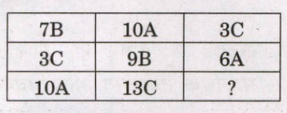
Following is a matrix of certain entries. The entries follow a certain trend row-wise. Choose the missing entry (?) accordingly.

7B10A3C
3C9B6A
10A13C?
A 3 × 3 matrix in boxes: row 1 — 7B, 10A, 3C; row 2 — 3C, 9B, 6A; row 3 — 10A, 13C, ?.
From UPSC's question paper.
Answer & explanation

Answer: (c) 3B

In each row the third number is the second minus the first, and the letters A, B and C each appear once. Row 3 therefore needs 13 − 10 = 3 with the letter B: 3B.

  1. Numbers, row 1: 10 − 7 = 3; row 2: 9 − 3 = 6 — the third number is the second minus the first.
  2. Row 3: 13 − 10 = 3.
  3. Letters: each row uses A, B and C once; row 3 already has A and C, so it needs B.
  4. The missing entry is 3B.

Remember · In matrix puzzles treat numbers and letters as separate patterns, and check each rule against every row.

Question and answer: UPSC's official GS Paper II (2021, Series A) — paper ↗ · answer key ↗. Explanation: Minimalist IAS, checked 1 Oct 2026 (how we verify). Permalink ·

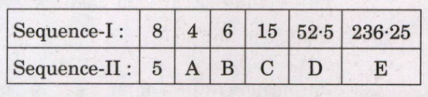
You are given two identical sequences in two rows:

Sequence-I:8461552·5236·25
Sequence-II:5ABCDE
A two-row table: Sequence-I — 8, 4, 6, 15, 52.5, 236.25; Sequence-II — 5, A, B, C, D, E.
From UPSC's question paper.

What is the entry in the place of C for the Sequence-II?

Answer & explanation

Answer: (c) 9.375

Sequence-I multiplies by 0.5, 1.5, 2.5, 3.5 and 4.5 in turn. Starting from 5, Sequence-II runs 2.5, 3.75, 9.375, so C = 9.375.

  1. Sequence-I: 8 × 0.5 = 4, 4 × 1.5 = 6, 6 × 2.5 = 15, 15 × 3.5 = 52.5, 52.5 × 4.5 = 236.25 — the multiplier rises by 1 each time.
  2. Sequence-II from 5: A = 5 × 0.5 = 2.5, B = 2.5 × 1.5 = 3.75.
  3. C = 3.75 × 2.5 = 9.375.
  4. Check: D = 9.375 × 3.5 = 32.8125 — option (d) is the next term, a trap; (a) is A.

Remember · When terms first fall and then shoot up, test multipliers; options often offer the neighbouring terms as traps.

Question and answer: UPSC's official GS Paper II (2021, Series A) — paper ↗ · answer key ↗. Explanation: Minimalist IAS, checked 1 Oct 2026 (how we verify). Permalink ·

A person X from a place A and another person Y from a place B set out at the same time to walk towards each other. The places are separated by a distance of 15 km.

X walks with a uniform speed of 1.5 km/hr and Y walks with a uniform speed of 1 km/hr in the first hour, with a uniform speed of 1.25 km/hr in the second hour and with a uniform speed of 1.5 km/hr in the third hour and so on.

Which of the following is/are correct?

  1. 1.They take 5 hours to meet.
  2. 2.They meet midway between A and B.

Select the correct answer using the code given below:

Answer & explanation

Answer: (c) Both 1 and 2

Adding the hourly distances, the two close the 15 km gap exactly at the end of the 5th hour. X walks 5 × 1.5 = 7.5 km and Y walks 1 + 1.25 + 1.5 + 1.75 + 2 = 7.5 km, so they meet midway — both statements hold.

  1. Distance closed in each hour: 1.5 + 1 = 2.5, then 1.5 + 1.25 = 2.75, then 3, 3.25, 3.5 km.
  2. Running total: 2.5, 5.25, 8.25, 11.5, 15 km — they meet at the end of the 5th hour.
  3. X covers 5 × 1.5 = 7.5 km; Y covers 1 + 1.25 + 1.5 + 1.75 + 2 = 7.5 km.
  4. Each covers half of 15 km, so they meet midway.
  5. Check: Y's average speed over 5 hours is 7.5 ÷ 5 = 1.5 km/hr, equal to X's speed — hence midway.
  • ✓ 1. The combined distance reaches 15 km exactly after 5 hours.
  • ✓ 2. Both walk 7.5 km in those 5 hours, so the meeting point is the midpoint.

Remember · With speeds changing hour by hour, tabulate the hours; for an arithmetic progression of speeds, the average speed gives a quick check.

Question and answer: UPSC's official GS Paper II (2021, Series A) — paper ↗ · answer key ↗. Explanation: Minimalist IAS, checked 30 Sept 2026 (how we verify). Permalink ·

A student appeared in 6 papers. The maximum marks are the same for each paper. His marks in these papers are in the proportion of 5: 6: 7: 8: 9: 10. Overall he scored 60%. In how many number of papers did he score less than 60% of the maximum marks?

Answer & explanation

Answer: (b) 3

With equal maximum marks, the overall 60% equals the average of the six papers' shares, and the average of 5 to 10 is 7.5. Only the papers with shares 5, 6 and 7 fall below that level — 3 papers.

  1. Let the marks be 5k, 6k, 7k, 8k, 9k and 10k; the total is 45k.
  2. Since every paper has the same maximum, the overall 60% equals the average paper score: 45k ÷ 6 = 7.5k is 60% of the maximum.
  3. Papers below 7.5k: 5k, 6k and 7k — 3 papers.
  4. Check: if the maximum is 12.5k, the marks are 40%, 48%, 56%, 64%, 72%, 80% — three below 60%.

Remember · When maximum marks are equal, the overall percentage is the average of the paper percentages; compare each paper with the mean.

Question and answer: UPSC's official GS Paper II (2021, Series A) — paper ↗ · answer key ↗. Explanation: Minimalist IAS, checked 30 Sept 2026 (how we verify). Permalink ·

Directions for the following 4 (four) items: Read the following four passages and answer the items that follow. Your answers to these items should be based on the passages only.

Passage—1

With respect to what are called denominations of religion, if everyone is left to be a judge of his own religion, there is no such thing as religion that is wrong; but if they are to be a judge of each other’s religion, there is no such thing as a religion that is right, and therefore all the world is right or all the world is wrong in the matter of religion.

What is the most logical assumption that can be made from the passage given above?

Answer & explanation

Answer: (c) Religious denominations tend to ignore the unity of man.

Each denomination finds itself right and every other one wrong, so taken together either the whole world is right or the whole world is wrong. Behind this lies the assumption that denominations dwell on their differences and lose sight of what unites people.

  • ✗ (a) The passage says nothing about whether a person can live without a denomination.
  • ✗ (b) No duty to spread one's denomination is stated or implied.
  • ✓ (c) Because each group judges the others wrong, the passage concludes that 'all the world is right or all the world is wrong' — it assumes denominations focus on what divides and ignore the common humanity they share.
  • ✗ (d) Each person, judging his own religion, finds it right; the passage never says people misunderstand their own denomination.

Remember · For the 'most logical assumption', choose the unstated belief that makes the author's conclusion sensible, not a claim the passage never touches.

Question and answer: UPSC's official GS Paper II (2021, Series A) — paper ↗ · answer key ↗. Explanation: Minimalist IAS, checked 30 Sept 2026 (how we verify). Permalink ·

Passage—2

It is certain, that seditions, wars, and contempt or breach of the laws are not so much to be imputed to the wickedness of the subjects, as to the bad state of a dominion. For men are not born fit for citizenship, but must be made so. Besides, men’s natural passions are everywhere the same; and if wickedness more prevails, and more offences are committed in one commonwealth than in another, it is certain that the former has neither enough pursued the end of unity, nor framed its laws with sufficient forethought; and that, therefore, it has failed in making quite good its right as a commonwealth.

Which among the following is the most logical and rational inference that can be made from the passage given above?

Answer & explanation

Answer: (c) That dominion is the best which pursues the aim of unity and has laws for good citizenship.

The author traces disorder mainly to the bad state of a dominion: people must be made fit for citizenship, and a commonwealth with more offences has failed to pursue unity and to frame laws with forethought. Turned around, the best dominion is one that pursues unity and has laws that make good citizens.

  • ✗ (a) Offences differ from one commonwealth to another according to how it is run, so they are not inevitable everywhere.
  • ✗ (b) The passage says disorder is 'not so much' due to the subjects as to the state of the dominion — a matter of degree; 'all the problems' is too extreme.
  • ✓ (c) Failure is traced to not pursuing 'the end of unity' and not framing laws 'with sufficient forethought', while men 'must be made' fit for citizenship — so the best dominion does both.
  • ✗ (d) The passage implies a well-run commonwealth is possible; nothing says a good dominion cannot be established.

Remember · Reverse the author's diagnosis: if failure comes from lacking X, the rational inference is that success comes with X.

Question and answer: UPSC's official GS Paper II (2021, Series A) — paper ↗ · answer key ↗. Explanation: Minimalist IAS, checked 30 Sept 2026 (how we verify). Permalink ·

Passage—3

Inequality violates a basic democratic norm: the equal standing of citizens. Equality is a relation that obtains between persons in respect of some fundamental characteristic that they share in common. Equality is, morally speaking, a default principle. Therefore, persons should not be discriminated on grounds such as race, caste, gender, ethnicity, disability, or class. These features of human condition are morally irrelevant. The idea that one should treat persons with respect not only because some of these persons possess some special features or talent, for example skilled cricketers, gifted musicians, or literary giants, but because persons are human beings, is by now part of commonsense morality.

With reference to the above passage, the following assumptions have been made:

  1. 1.Equality is a prerequisite for people to participate in the multiple transactions of society from a position of confidence.
  2. 2.Occurrence of inequality is detrimental to the survival of democracy.
  3. 3.Equal standing of all citizens is an idea that cannot actually be realised even in a democracy.
  4. 4.Right to equality should be incorporated into our values and day-to-day political vocabulary.

Which of the above assumptions are valid?

Answer & explanation

Answer: (c) 1 and 4 only

The author treats the equal standing of citizens as a basic norm and a default principle, and notes that respecting persons simply as human beings is now commonsense morality. This rests on equality mattering for people to take part in society with confidence (1) and belonging in our everyday values (4); claims about democracy's survival or equality being unattainable go beyond or against the text.

  • ✓ 1. Equal standing and respect for persons 'because persons are human beings', whatever their caste, gender or class, is what lets people deal with society without being lowered — the premise behind calling equality a default principle.
  • ✗ 2. Inequality 'violates a basic democratic norm'; the passage does not say it threatens the survival of democracy — that escalates the claim.
  • ✗ 3. This contradicts the passage, which says equal respect is 'by now part of commonsense morality'.
  • ✓ 4. Since equal respect is a moral default and part of commonsense morality, the author assumes equality belongs in our values and everyday political language.

Remember · 'Violates a norm' is not 'threatens survival' — reject assumptions that escalate the passage's claim.

Question and answer: UPSC's official GS Paper II (2021, Series A) — paper ↗ · answer key ↗. Explanation: Minimalist IAS, checked 30 Sept 2026 (how we verify). Permalink ·

Passage—4

Aristocratic government ruins itself by limiting too narrowly the circle within which power is confined; oligarchic government ruins itself by the incautious scramble for immediate wealth. But even democracy ruins itself by excess of democracy. Its basic principle is the equal right of all to hold office and determine public policy. This is, at first glance, a delightful arrangement; it becomes disastrous because the people are not properly equipped by education to select the best rulers and the wisest courses. The people have no understanding and only repeat what their rulers are pleased to tell them. Such a democracy is tyranny or autocracy.

— Plato

Which one of the following statements best reflects the crux of the passage given above?

Answer & explanation

Answer: (b) Any form of government tends to deteriorate by excess of its basic principle.

Plato shows aristocracy, oligarchy and democracy each ruining itself by overdoing the very principle that defines it — democracy 'by excess of democracy'. That shared pattern is the crux, option (b).

  • ✗ (a) True in general but not the point; the passage explains how each form destroys itself.
  • ✓ (b) Aristocracy narrows power too far, oligarchy scrambles for wealth, and democracy 'ruins itself by excess of democracy' — each through excess of its own principle.
  • ✗ (c) The passage blames poor education for democracy's failure but never claims education 'ensures' a perfect democracy.
  • ✗ (d) 'Necessary evil' is not stated; tyranny arises from excess, not as something inherent in every government.

Remember · When a passage runs parallel examples, the crux is the pattern they share, not any single example.

Question and answer: UPSC's official GS Paper II (2021, Series A) — paper ↗ · answer key ↗. Explanation: Minimalist IAS, checked 30 Sept 2026 (how we verify). Permalink ·

In a group of 120 persons, 80 are Indians and rest are foreigners. Further, 70 persons in the group can speak English. The number of Indians who can speak English is

Answer & explanation

Answer: (d) 30 or more

There are only 40 foreigners, so at most 40 of the 70 English speakers can be foreigners. At least 30 must be Indians, and the number could be higher, so the answer is '30 or more'.

  1. Foreigners = 120 − 80 = 40.
  2. Even if all 40 foreigners speak English, at least 70 − 40 = 30 English speakers are Indians.
  3. If all 70 English speakers were Indians, the number would be 70; the data do not fix it.
  4. So the number of Indians who speak English is 30 or more.

Remember · Minimum overlap of two groups = (size of A + size of B) − total; give a range when the data do not fix an exact value.

Question and answer: UPSC's official GS Paper II (2021, Series A) — paper ↗ · answer key ↗. Explanation: Minimalist IAS, checked 30 Sept 2026 (how we verify). Permalink ·

Consider all 3-digit numbers (without repetition of digits) obtained using three non-zero digits which are multiples of 3. Let S be their sum.

Which of the following is/are correct?

  1. 1.S is always divisible by 74.
  2. 2.S is always divisible by 9.

Select the correct answer using the code given below:

Answer & explanation

Answer: (c) Both 1 and 2

With the digits 3, 6 and 9, the six numbers add up to 222 × 18 = 3996, which is 74 × 54 and 9 × 444. In general, the six arrangements of three digits add to 222 × (digit sum), and 222 = 3 × 74, so both statements hold.

  1. The non-zero digits that are multiples of 3 are 3, 6 and 9; without repetition they give 3! = 6 numbers.
  2. Each digit appears twice in each place, so S = 2 × (3 + 6 + 9) × 111 = 222 × 18 = 3996.
  3. 3996 = 74 × 54, so S is divisible by 74.
  4. 3996 = 9 × 444, so S is divisible by 9.
  5. Check (general case): any three distinct digits a, b, c give six numbers summing to 222(a + b + c) = 3 × 74 × (a + b + c); when the numbers are multiples of 3, a + b + c is too, so S is a multiple of 9 × 74 = 666.
  • ✓ 1. S = 222 × (digit sum) and 222 = 3 × 74, so 74 always divides S.
  • ✓ 2. 222 carries one factor 3 and the digit sum (a multiple of 3) carries another, so 9 always divides S.

Remember · Sum of all arrangements of 3 distinct digits = 222 × (sum of the digits).

Question and answer: UPSC's official GS Paper II (2021, Series A) — paper ↗ · answer key ↗. Explanation: Minimalist IAS, checked 30 Sept 2026 (how we verify). Permalink ·

There are two Classes A and B having 25 and 30 students respectively. In Class-A the highest score is 21 and lowest score is 17. In Class-B the highest score is 30 and lowest score is 22. Four students are shifted from Class-A to Class-B.

Consider the following statements:

  1. 1.The average score of Class-B will definitely decrease.
  2. 2.The average score of Class-A will definitely increase.

Which of the above statements is/are correct?

Answer & explanation

Answer: (a) 1 only

Every shifted student scored at most 21, below Class-B's lowest score of 22, so Class-B's average must fall. Class-A's average can rise or fall depending on which four students leave, so statement 2 is not certain.

  1. Each shifted student scored at most 21; every Class-B student scored at least 22.
  2. Adding scores lower than all existing scores pulls Class-B's average down — statement 1 is certain.
  3. Class-A's new average depends on whether the four who left were above or below Class-A's average.
  4. If the four scored 21 each, Class-A's average falls; if they scored 17 each, it rises — so statement 2 is not definite.
  • ✓ 1. New members all score below Class-B's minimum, so its average must decrease.
  • ✗ 2. Removing students raises the average only if they were below it; the data do not say which four moved.

Remember · Adding values below every existing value lowers the mean; removing values changes it only relative to the current mean.

Question and answer: UPSC's official GS Paper II (2021, Series A) — paper ↗ · answer key ↗. Explanation: Minimalist IAS, checked 30 Sept 2026 (how we verify). Permalink ·

Consider two Statements and a Question:

  1. Statement-1: Priya is 4 ranks below Seema and is 31st from the bottom.
  2. Statement-2: Ena is 2 ranks above Seema and is 37th from the bottom.
  3. Question: What is Seema’s rank from the top in the class of 40 students?

Which one of the following is correct in respect of the Statements and the Question?

Answer & explanation

Answer: (c) Either Statement-1 alone or Statement-2 alone is sufficient to answer the Question

Each statement on its own places Seema 35th from the bottom (31 + 4, or 37 − 2). In a class of 40 that is 40 − 35 + 1 = 6th from the top, so either statement alone is enough.

  1. Statement-1: Priya is 31st from the bottom and 4 ranks below Seema, so Seema is 31 + 4 = 35th from the bottom.
  2. Rank from top = 40 − 35 + 1 = 6. Statement-1 alone answers the Question.
  3. Statement-2: Ena is 37th from the bottom and 2 ranks above Seema, so Seema is 37 − 2 = 35th from the bottom — again 6th from the top.
  4. Each statement alone is sufficient.
  • ✗ (a) Statement-1 alone gives Seema's rank (6th from the top).
  • ✗ (b) Statement-2 alone also gives 6th from the top.
  • ✓ (c) Either statement alone fixes Seema at 35th from the bottom, i.e. 6th from the top.
  • ✗ (d) Combining is not needed, since each statement alone is enough.

Remember · Rank from top + rank from bottom = total + 1. In data sufficiency, test each statement alone before combining.

Question and answer: UPSC's official GS Paper II (2021, Series A) — paper ↗ · answer key ↗. Explanation: Minimalist IAS, checked 30 Sept 2026 (how we verify). Permalink ·

Consider two Statements and a Question:

  1. Statement-1: Each of A and D is heavier than each of B, E and F, but none of them is the heaviest.
  2. Statement-2: A is heavier than D, but is lighter than C.
  3. Question: Who is the heaviest among A, B, C, D and E?

Which one of the following is correct in respect of the Statements and the Question?

Answer & explanation

Answer: (c) Both Statement-1 and Statement-2 are required to answer the Question — UPSC also accepted (d)

Statement-2 gives C > A > D, and Statement-1 adds that A and D are heavier than B and E; only together do they show that C is the heaviest of the five. UPSC's final key accepted both (c) and (d), because when both statements are required it is also true that neither alone is sufficient.

  1. Statement-1: A and D are heavier than B, E and F, but C is never compared with anyone, and 'the heaviest' may be someone outside the list — so it cannot name the heaviest of A, B, C, D, E.
  2. Statement-2: C > A > D, but B and E are not compared with C — not sufficient alone.
  3. Together: C > A > D, and A, D > B, E, so C is heavier than all the others — C is the heaviest.
  4. Both statements are required (c). That also makes 'neither statement alone is sufficient' (d) true, and UPSC accepted both.
  • ✗ (a) Statement-1 never places C, so it cannot settle who is heaviest among the five.
  • ✗ (b) Statement-2 says nothing about B and E relative to C.
  • ✓ (c) Combining gives C > A > D, with A and D both heavier than B and E, so C is the heaviest.
  • ✓ (d) Since both statements are needed, neither alone is sufficient — literally true, and accepted by UPSC.

Remember · In data sufficiency, 'both are required' also means 'neither alone suffices' — watch for overlapping options.

Question and answer: UPSC's official GS Paper II (2021, Series A) — paper ↗ · answer key ↗. Explanation: Minimalist IAS, checked 30 Sept 2026 (how we verify). Permalink ·

In the English alphabet, the first 4 letters are written in opposite order; and the next 4 letters are written in opposite order and so on; and at the end Y and Z are interchanged. Which will be the fourth letter to the right of the 13th letter?

Answer & explanation

Answer: (b) T

After reversing each block of four, the 13th place holds P (block PONM). Four places to its right is the 17th place, which starts the next block TSRQ — so the letter is T.

  1. Reverse each block of four: DCBA HGFE LKJI PONM TSRQ XWVU, and then Y Z become Z Y.
  2. Places 1–12 hold D C B A H G F E L K J I, so the 13th letter is P.
  3. The fourth letter to its right is in the 17th place: places 13–17 are P, O, N, M, T.
  4. The answer is T.

Remember · Work with positions: in reversed blocks of four, place 4k − 3 holds the letter numbered 4k.

Question and answer: UPSC's official GS Paper II (2021, Series A) — paper ↗ · answer key ↗. Explanation: Minimalist IAS, checked 30 Sept 2026 (how we verify). Permalink ·

Directions for the following 4 (four) items: Read the following four passages and answer the items that follow. Your answers to these items should be based on the passages only.

Passage—1

Nothing can exist in a natural state which can be called good or bad by common assent, since every man who is in a natural state consults only his own advantage, and determines what is good or bad according to his own fancy and insofar as he has regard for his own advantage alone, and holds himself responsible to no one save himself by any law; and therefore sin cannot be conceived in a natural state, but only in a civil state, which is decreed by common consent what is good or bad, and each one holds himself responsible to the state.

Which one of the following statements best reflects the central idea of the passage given above?

Answer & explanation

Answer: (a) The conceptions of what is right or wrong exist due to the formation of a state.

In a natural state each man judges good and bad by his own advantage, so nothing is good or bad by common assent and 'sin cannot be conceived'. Only in a civil state is good and bad decreed by common consent — so shared notions of right and wrong come with the formation of the state.

  • ✓ (a) 'Sin cannot be conceived in a natural state, but only in a civil state, which is decreed by common consent what is good or bad' — right and wrong, as shared ideas, arise with the state.
  • ✗ (b) The passage speaks of common consent in a civil state, not a ruling authority deciding; and it does not say individuals cannot be morally right.
  • ✗ (c) Man in a natural state consults his own advantage, but the passage does not call him 'inherently immoral' — it says sin cannot even be conceived there.
  • ✗ (d) The survival of the human species is never discussed.

Remember · The central idea is the passage's main contrast (here, natural state versus civil state); reject options that add labels like 'immoral' or new themes.

Question and answer: UPSC's official GS Paper II (2021, Series A) — paper ↗ · answer key ↗. Explanation: Minimalist IAS, checked 30 Sept 2026 (how we verify). Permalink ·

Passage—2

In the immediate future, we will see the increasing commodification of many new technologies — artificial intelligence and robotics, 3D manufacturing, custom made biological and pharmaceutical products, lethal autonomous weapons and driverless cars. This will pose conundrums. The moral question of how a driverless car will decide between hitting a jaywalker and swerving and damaging the car has often been debated. The answer is both simple — save the human life — and complex. At which angle should the car swerve — just enough to save the jaywalker or more than enough? If the driverless car is in Dublin, who would take the decision? The Irish Government, or the car’s original code writer in California, or a software programmer in Hyderabad to whom maintenance is outsourced? If different national jurisdictions have different fine print on prioritising a human life, how will it affect insurance and investment decisions, including transnational ones?

Which of the following statements best reflect the rational, plausible and practical implications that can be derived from the passage given above?

  1. 1.Too much globalization is not in the best interests of any country.
  2. 2.Modern technologies are increasingly blurring the economic borders.
  3. 3.Innovation and capital have impinged on the domain of the State.
  4. 4.Public policy of every country should focus on developing its own supply chains.
  5. 5.Geopolitics will have to reconcile to many ambiguities and uncertainties.

Select the correct answer using the code given below:

Answer & explanation

Answer: (c) 2, 3 and 5 only

A driverless car running in Dublin, coded in California and maintained from Hyderabad raises questions no single government can settle, and differing national rules will affect transnational insurance and investment. So technology is blurring economic borders (2), innovation and capital are entering the State's domain (3), and geopolitics must live with uncertainty (5); the passage neither condemns globalisation nor prescribes self-reliant supply chains.

  • ✗ 1. The passage raises dilemmas; it passes no judgement that globalisation is harmful.
  • ✓ 2. One product spans Dublin, California and Hyderabad, and decisions are 'transnational' — technology cuts across economic borders.
  • ✓ 3. A life-and-death choice may rest with a code writer or an outsourced programmer rather than the Irish Government — private innovation and capital now reach into what was the State's domain.
  • ✗ 4. Supply chains are not discussed; this is a policy prescription the passage does not make.
  • ✓ 5. 'Who would take the decision?' and different 'fine print' across jurisdictions leave open questions that countries must learn to handle.

Remember · For 'implications', keep what flows from the passage's own questions; drop prescriptions ('should') and value judgements it never makes.

Question and answer: UPSC's official GS Paper II (2021, Series A) — paper ↗ · answer key ↗. Explanation: Minimalist IAS, checked 30 Sept 2026 (how we verify). Permalink ·

Passage—3

The resolution of bankruptcy cases of Indian banks under the Insolvency and Bankruptcy Code should help bring non-performing assets (NPA) situation under some control. Despite the slow pace of resolutions by the National Company Law Tribunal, the Code can be helpful in cleaning up bank books in future credit cycles. The recapitalisation of public sector banks too can help increase the capital cushion of banks and induce them to lend more and boost economic activity. But bad debt resolution and recapitalisation are only a part of the solution as they, by themselves, can do very little to rein in reckless lending that has pushed the Indian banking system to its current sorry state. Unless there are systemic reforms that address the problem of unsustainable lending, future credit cycles will continue to stress the banking system.

Which one of the following statements best reflects the most logical, rational and practical suggestion implied by the passage given above?

Answer & explanation

Answer: (d) Indian banking system requires structural reforms as a long-term solution for bad loans problem.

Bad-debt resolution and recapitalisation help, but the passage calls them only part of the solution: unless systemic reforms tackle unsustainable lending, future credit cycles will stress the banks again. The suggestion is structural reform as the long-term remedy.

  • ✗ (a) Close monitoring by the Central Government is one possible reform, but the passage names no agency or method — this is too specific.
  • ✗ (b) The passage worries about reckless lending; pushing banks to lend more through low rates works against that concern.
  • ✗ (c) Mergers are never mentioned, and 'alone is the long-term solution' is too absolute.
  • ✓ (d) 'Unless there are systemic reforms that address the problem of unsustainable lending, future credit cycles will continue to stress the banking system.'

Remember · When a passage ends 'unless X, the problem continues', X is the suggestion — pick the option that restates it without adding specifics.

Question and answer: UPSC's official GS Paper II (2021, Series A) — paper ↗ · answer key ↗. Explanation: Minimalist IAS, checked 30 Sept 2026 (how we verify). Permalink ·

Passage—4

In India, the objective of macroeconomic policy is to enhance the economic welfare of the people, and any one wing of such macro policy, monetary or fiscal, cannot independently work without active support of another.

Which one of the following statements best reflects the corollary to the passage given above?

Answer & explanation

Answer: (a) The central bank cannot work independently of the Government.

The passage says neither wing of macroeconomic policy — monetary or fiscal — can work independently without the other's support. Monetary policy is run by the central bank and fiscal policy by the Government, so the corollary is that the central bank cannot work independently of the Government.

  • ✓ (a) Monetary policy (the central bank) 'cannot independently work without active support' of fiscal policy (the Government) — a direct restatement.
  • ✗ (b) Regulation of financial markets and institutions is not mentioned.
  • ✗ (c) Market economy versus socialist policies lies outside the passage.
  • ✗ (d) Financial sector reforms are not discussed; the passage is about coordination between monetary and fiscal policy.

Remember · A corollary follows directly from the statement; translate its terms (monetary = central bank, fiscal = Government) and look for the restatement.

Question and answer: UPSC's official GS Paper II (2021, Series A) — paper ↗ · answer key ↗. Explanation: Minimalist IAS, checked 30 Sept 2026 (how we verify). Permalink ·

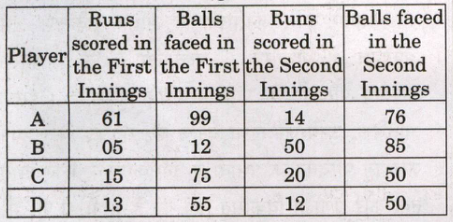
Consider the following Table:

PlayerRuns scored in the First InningsBalls faced in the First InningsRuns scored in the Second InningsBalls faced in the Second Innings
A61991476
B05125085
C15752050
D13551250
A table of runs scored and balls faced by players A, B, C and D in the first and second innings of a Test Match.
From UPSC's question paper.

Who is the fastest run scorer in the Test Match?

Answer & explanation

Answer: (b) B

Speed of scoring is runs per ball over the whole match. B scores 55 runs off 97 balls (about 0.57 a ball), ahead of A (75 off 175), C (35 off 125) and D (25 off 105).

  1. Fastest scorer = highest total runs ÷ total balls across both innings.
  2. A: (61 + 14) ÷ (99 + 76) = 75 ÷ 175 ≈ 0.43 runs per ball.
  3. B: (5 + 50) ÷ (12 + 85) = 55 ÷ 97 ≈ 0.57.
  4. C: 35 ÷ 125 = 0.28; D: 25 ÷ 105 ≈ 0.24.
  5. B has the highest rate, so B is the fastest run scorer.
  6. Check: only B scores more than half a run per ball (55 > 97 ÷ 2).

Remember · Compare ratios of totals, not innings by innings; a simple benchmark (here half a run per ball) often settles it.

Question and answer: UPSC's official GS Paper II (2021, Series A) — paper ↗ · answer key ↗. Explanation: Minimalist IAS, checked 1 Oct 2026 (how we verify). Permalink ·

Half of the villagers of a certain village have their own houses. One-fifth of the villagers cultivate paddy. One-third of the villagers are literate. Four-fifth of the villagers are under 25 years of age. Which one of the following statements is certainly correct?

Answer & explanation

Answer: (b) Some villagers under 25 years of age are literate.

Fractions of the same village that add up to more than 1 must overlap. Under-25s (4/5) and literates (1/3) together make 17/15, so at least 2/15 of the villagers are both — some under-25s are certainly literate.

  1. Under 25: 4/5 of the villagers; literate: 1/3.
  2. 4/5 + 1/3 = 12/15 + 5/15 = 17/15, which is more than the whole village.
  3. So at least 17/15 − 1 = 2/15 of the villagers are both under 25 and literate — (b) is certain.
  4. Check the rest: house-owners (1/2) outnumber literates (1/3), so (a) is impossible; house-owners and under-25s (1/2 + 4/5 = 13/10) must overlap, so (d) is false; (c) cannot be fixed from the data.
  • ✗ (a) Half the villagers own houses but only a third are literate, so not all house-owners can be literate.
  • ✓ (b) 4/5 + 1/3 exceeds 1, so at least 2/15 of the villagers are both under 25 and literate.
  • ✗ (c) Nothing tells us how literacy is spread among paddy growers.
  • ✗ (d) 1/2 + 4/5 = 13/10 exceeds 1, so at least 3/10 of the villagers are under 25 and own a house.

Remember · If two fractions of one group add to more than 1, the excess over 1 is the guaranteed minimum overlap.

Question and answer: UPSC's official GS Paper II (2021, Series A) — paper ↗ · answer key ↗. Explanation: Minimalist IAS, checked 30 Sept 2026 (how we verify). Permalink ·

Consider two Statements and a Question:

  1. Statement-1: The last day of the month is a Wednesday.
  2. Statement-2: The third Saturday of the month was the seventeenth day.
  3. Question: What day is the fourteenth of the given month?

Which one of the following is correct in respect of the Statements and the Question?

Answer & explanation

Answer: (b) Statement-2 alone is sufficient to answer the Question

Knowing the third Saturday is the 17th fixes every date: Saturdays fall on the 3rd, 10th and 17th, so the 14th is a Wednesday. The last day being a Wednesday does not help without knowing how many days the month has.

  1. Statement-2: the third Saturday is the 17th, so Saturdays fall on the 3rd, 10th and 17th.
  2. The 14th is 4 days after Saturday the 10th — a Wednesday. Statement-2 alone answers the Question.
  3. Statement-1: the last day is a Wednesday, but the month may have 28, 29, 30 or 31 days, so the 14th could be Wednesday, Tuesday, Monday or Sunday — not sufficient.
  4. So Statement-2 alone is sufficient.
  • ✗ (a) Without the month's length, the last day being Wednesday leaves four possibilities for the 14th.
  • ✓ (b) Saturday the 17th means Saturday the 10th, so the 14th is a Wednesday.
  • ✗ (c) Statement-1 is not needed.
  • ✗ (d) Statement-2 alone is sufficient.

Remember · A dated weekday fixes the whole month; a 'last day' clue also needs the month's length.

Question and answer: UPSC's official GS Paper II (2021, Series A) — paper ↗ · answer key ↗. Explanation: Minimalist IAS, checked 30 Sept 2026 (how we verify). Permalink ·

Which day is 10th October, 2027?

Answer & explanation

Answer: (a) Sunday

Counting odd days gives 4 for the years 2001–2026 and 3 for 2027 up to 10 October — 7 in all, i.e. none left over, so the day is Sunday. A quicker route: this very paper was held on Sunday, 10 October 2021, and six years with one leap day add exactly 7 days.

  1. Odd days up to the end of 2000: 0 (every 400 years has 0 odd days).
  2. 2001–2026: 26 years with 6 leap years (2004, 2008, 2012, 2016, 2020, 2024), so 26 + 6 = 32 odd days; 32 = 4 × 7 + 4, leaving 4.
  3. 2027 up to 10 October: Jan 3, Feb 0, Mar 3, Apr 2, May 3, Jun 2, Jul 3, Aug 3, Sep 2, Oct 3 — total 24, leaving 3.
  4. Total = 4 + 3 = 7 odd days, i.e. 0, so 10 October 2027 is a Sunday.
  5. Check: 10 October 2021 (the date of this paper) was a Sunday; 2022–2027 add 6 + 1 (for 29 February 2024) = 7 days — Sunday again.

Remember · Anchor on a date you know: each ordinary year moves the weekday on by 1 and each leap year by 2.

Question and answer: UPSC's official GS Paper II (2021, Series A) — paper ↗ · answer key ↗. Explanation: Minimalist IAS, checked 30 Sept 2026 (how we verify). Permalink ·

Consider two Statements and four Conclusions given below. You have to take the Statements to be true even if they seem to be at variance from the commonly known facts. Read all Conclusions and then decide which of the given Conclusion(s) logically follows/follow from the Statements, disregarding the commonly known facts.

  1. Statement-1: Some greens are blues.
  2. Statement-2: Some blues are blacks.
  3. Conclusion-1: Some greens are blacks.
  4. Conclusion-2: No green is black.
  5. Conclusion-3: All greens are blacks.
  6. Conclusion-4: All blacks are greens.

Which one of the following is correct?

Answer & explanation

Answer: (d) Neither Conclusion 1 nor 2 nor 3 nor 4

Two 'some' statements joined only through blues give no definite link between greens and blacks. None of the four conclusions follows on its own; at most, 1 and 2 form an either-or pair, which no option offers.

  1. Both statements are particular ('some') and meet only in blues, so no definite relation between greens and blacks can be drawn.
  2. Conclusion-1 and Conclusion-2 are each possible, but neither is certain.
  3. Conclusions 3 and 4 ('all') cannot come from 'some' premises.
  4. None follows. (1 and 2 together make an either-or pair, but option (a) claims both follow, which is impossible.)
  • ✗ Conclusion-1 Greens and blacks may or may not overlap; nothing forces it.
  • ✗ Conclusion-2 A diagram with some greens being blacks fits the statements, so 'no green is black' is not certain.
  • ✗ Conclusion-3 An 'all' conclusion cannot follow from two 'some' statements.
  • ✗ Conclusion-4 Likewise, nothing says every black is green.

Remember · Two particular ('some') premises never give a definite conclusion; use the either-or rule only when an option offers 'either … or'.

Question and answer: UPSC's official GS Paper II (2021, Series A) — paper ↗ · answer key ↗. Explanation: Minimalist IAS, checked 30 Sept 2026 (how we verify). Permalink ·

What is the value of ‘X’ in the sequence 2, 7, 22, 67, 202, X, 1822?

Answer & explanation

Answer: (c) 607

Every term is three times the previous one plus 1. So X = 202 × 3 + 1 = 607, and 607 × 3 + 1 = 1822 confirms it.

  1. 2 × 3 + 1 = 7, 7 × 3 + 1 = 22, 22 × 3 + 1 = 67, 67 × 3 + 1 = 202 — each term is 3 × previous + 1.
  2. X = 202 × 3 + 1 = 607.
  3. Check: 607 × 3 + 1 = 1822, the next term.

Remember · When terms roughly triple, test '× 3 ± k', and always verify with the term after the blank.

Question and answer: UPSC's official GS Paper II (2021, Series A) — paper ↗ · answer key ↗. Explanation: Minimalist IAS, checked 30 Sept 2026 (how we verify). Permalink ·

Directions for the following 2 (two) items: Read the following two passages and answer the items that follow. Your answers to these items should be based on the passages only.

Passage—1

The best universities like Harvard and MIT, despite having the luxury of having some truly excellent teachers on their payroll, are increasingly embracing the “flipped classroom” format, where students listen to video lectures at home, and spend class time applying their knowledge, solving problems, discussing examples, etc. Professors guide that discussion and fill in wherever necessary, explaining those bits that seem to be eluding the students and throwing in advanced ideas that happen to be topical. These universities have made their video lectures available free for anyone in the world. They are also encouraging colleges and universities all over the world to integrate these online courses into their own pedagogy, picking the pieces that are appropriate for their needs and building a package around them.

Which one of the following statements best reflects the central idea of the passage given above?

Answer & explanation

Answer: (b) Availability of higher education can be made easier and cheaper without diluting the content.

The best universities pair video lectures with active class discussion, give those lectures free to the world, and invite other colleges to build them into their own teaching. The central idea is that good higher education can reach more people, more cheaply, without losing quality.

  • ✗ (a) The passage describes a blended 'flipped classroom', with class time and professors, not a claim that online mode beats conventional teaching.
  • ✓ (b) Lectures by excellent teachers are 'available free for anyone in the world' and can be integrated by colleges everywhere — easier, cheaper access to the same content.
  • ✗ (c) Infrastructure spending is never discussed, and 'human and social capital' is a leap.
  • ✗ (d) Private institutions and coaching institutes are not mentioned.

Remember · The central idea generalises what the passage's examples achieve; reject options about groups or costs the passage never mentions.

Question and answer: UPSC's official GS Paper II (2021, Series A) — paper ↗ · answer key ↗. Explanation: Minimalist IAS, checked 30 Sept 2026 (how we verify). Permalink ·

Passage—2

Our cities are extremely vulnerable to climate change because of large concentrations of populations and poor infrastructure. Moreover, population densities are increasing in them but we have not yet developed the systems to address climate change impacts. Our cities contribute to 65 per cent of the GDP, but there are not enough facilities to cater to the needs of the people. It is important to address the issues of air quality, transport, etc., that are vital to identifying sustainable solutions. We need to involve citizens in city planning and create an ecosystem that meets the needs of the people.

Which among the following is the most logical and rational inference that can be made from the passage given above?

Answer & explanation

Answer: (c) To maintain and develop our cities we need to adopt sustainability related interventions.

Cities are vulnerable to climate change, crowded and short of facilities, and the passage calls for sustainable solutions on air quality and transport with citizens involved in planning. The rational inference is that our cities need sustainability-related interventions.

  • ✗ (a) Administrative set-up and autonomy are not discussed.
  • ✗ (b) The passage notes rising densities, but its concern is that 'we have not yet developed the systems' to cope — it does not call density itself the hindrance.
  • ✓ (c) Issues of air quality and transport 'are vital to identifying sustainable solutions', and cities must 'create an ecosystem that meets the needs of the people'.
  • ✗ (d) Public-Private Partnership is never mentioned; this names a mechanism from outside the passage.

Remember · The most logical inference restates the passage's own remedy; options naming a specific mechanism (autonomy, PPP) go beyond it.

Question and answer: UPSC's official GS Paper II (2021, Series A) — paper ↗ · answer key ↗. Explanation: Minimalist IAS, checked 30 Sept 2026 (how we verify). Permalink ·

Jay and Vijay spent an equal amount of money to buy some pens and special pencils of the same quality from the same store. If Jay bought 3 pens and 5 pencils, and Vijay bought 2 pens and 7 pencils, then which one of the following is correct?

Answer & explanation

Answer: (c) The price of a pen is two times the price of a pencil

Both spent the same, so 3 pens + 5 pencils cost as much as 2 pens + 7 pencils. Cancelling the common items leaves 1 pen = 2 pencils.

  1. Equal spending: 3 pens + 5 pencils = 2 pens + 7 pencils.
  2. Remove 2 pens and 5 pencils from both sides: 1 pen = 2 pencils.
  3. So a pen costs twice as much as a pencil.

Remember · With equal totals, cancel what both sides share — the leftovers must balance.

Question and answer: UPSC's official GS Paper II (2021, Series A) — paper ↗ · answer key ↗. Explanation: Minimalist IAS, checked 30 Sept 2026 (how we verify). Permalink ·

P scored 40 marks more than Q in an examination. If Q scored 10% less marks than P, then how much did Q score?

Answer & explanation

Answer: (a) 360

Q's score is 10% below P's, so the 40-mark gap is 10% of P's score. P scored 400 and Q scored 360.

  1. Q scored 10% less than P, so the gap of 40 marks is 10% of P's marks.
  2. P = 40 ÷ 0.10 = 400.
  3. Q = 400 − 40 = 360.
  4. Check: 360 is 90% of 400.

Remember · 'x% less than P' means the difference is x% of P — use it to find P first.

Question and answer: UPSC's official GS Paper II (2021, Series A) — paper ↗ · answer key ↗. Explanation: Minimalist IAS, checked 30 Sept 2026 (how we verify). Permalink ·

A person P asks one of his three friends X as to how much money he had. X replied, “If Y gives me ₹ 40, then Y will have half of as much as Z, but if Z gives me ₹ 40, then three of us will have equal amount.” What is the total amount of money that X, Y and Z have?

Answer & explanation

Answer: (b) ₹ 360

The second condition gives X + 40 = Y = Z − 40, and the first gives Y − 40 = Z/2. Solving, Z = 160, Y = 120 and X = 80, a total of ₹360.

  1. Let X, Y and Z have x, y and z rupees.
  2. If Z gives X ₹40, all three are equal: x + 40 = y = z − 40.
  3. If Y gives X ₹40, Y has half of Z: y − 40 = z/2.
  4. Put y = z − 40: z − 80 = z/2, so z = 160, y = 120, x = 80.
  5. Total = 80 + 120 + 160 = ₹360.
  6. Check: after Y gives ₹40, Y has 80, half of Z's 160; after Z gives ₹40, everyone has 120.

Remember · Turn 'then all will be equal' into a chain of equalities; it reduces everything to one unknown.

Question and answer: UPSC's official GS Paper II (2021, Series A) — paper ↗ · answer key ↗. Explanation: Minimalist IAS, checked 30 Sept 2026 (how we verify). Permalink ·

In a code language ‘MATHEMATICS’ is written as ‘LBSIDNZUHDR’. How is ‘CHEMISTRY’ written in that code language?

Answer & explanation

Answer: (b) BIDNHTSSX

The code moves letters alternately one step back and one step forward (M→L, A→B, T→S, H→I …). Applied to CHEMISTRY, this gives BIDNHTSSX.

  1. MATHEMATICS → LBSIDNZUHDR: M−1 = L, A+1 = B, T−1 = S, H+1 = I, E−1 = D, M+1 = N, A−1 = Z … — alternately −1 and +1.
  2. CHEMISTRY: C−1 = B, H+1 = I, E−1 = D, M+1 = N, I−1 = H, S+1 = T, T−1 = S, R+1 = S, Y−1 = X.
  3. Code: BIDNHTSSX.
  4. Check: (c) BIDLHTSSX differs only in the 4th letter — M+1 is N, not L.

Remember · In letter codes, write the shift under each letter; alternating shifts (−1, +1) are common. Compare options only where they differ.

Question and answer: UPSC's official GS Paper II (2021, Series A) — paper ↗ · answer key ↗. Explanation: Minimalist IAS, checked 30 Sept 2026 (how we verify). Permalink ·

At which one of the following times, do the hour hand and the minute hand of the clock make an angle of 180° with each other?

Answer & explanation

Answer: (d) Between 7:05 hours and 7:10 hours

At 7:00 the hour hand is 210° ahead of the minute hand, and the minute hand gains 5.5° every minute. The gap falls to 180° after 30 ÷ 5.5 = 5 5/11 minutes — just after 7:05.

  1. Angle between the hands = |30H − 5.5M| degrees (H = hour, M = minutes).
  2. At 7:00 the angle is 30 × 7 = 210°, and it shrinks by 5.5° each minute.
  3. 210 − 5.5M = 180 gives M = 30 ÷ 5.5 = 5 5/11 minutes.
  4. The hands are opposite at 7:05 5/11, i.e. between 7:05 and 7:10.
  5. Check: at 7:05 the angle is 210 − 27.5 = 182.5°, still above 180°.

Remember · Angle = |30H − 5.5M|; the minute hand gains 5.5° a minute on the hour hand.

Question and answer: UPSC's official GS Paper II (2021, Series A) — paper ↗ · answer key ↗. Explanation: Minimalist IAS, checked 30 Sept 2026 (how we verify). Permalink ·

In an objective type test of 90 questions, 5 marks are allotted for every correct answer and 2 marks are deducted for every wrong answer. After attempting all the 90 questions, a student got a total of 387 marks. What is the number of incorrect responses?

Answer & explanation

Answer: (a) 9

Full marks would be 90 × 5 = 450, and each wrong answer costs 5 + 2 = 7 marks compared with a right one. The shortfall of 63 marks means 9 wrong answers.

  1. If all 90 were correct: 90 × 5 = 450 marks.
  2. Each wrong answer loses 5 + 2 = 7 marks compared with a correct one.
  3. Shortfall = 450 − 387 = 63, so wrong answers = 63 ÷ 7 = 9.
  4. Check: 81 × 5 − 9 × 2 = 405 − 18 = 387.

Remember · Start from full marks and divide the shortfall by (marks for a correct answer + penalty for a wrong one).

Question and answer: UPSC's official GS Paper II (2021, Series A) — paper ↗ · answer key ↗. Explanation: Minimalist IAS, checked 30 Sept 2026 (how we verify). Permalink ·

Consider the following addition problem:

3P + 4P + PP + PP = RQ2; where P, Q and R are different digits.

What is the arithmetic mean of all such possible sums?

Answer & explanation

Answer: (c) 202

In place-value form the four numbers add to 70 + 24P, and a units digit of 2 allows only P = 3 or P = 8. The sums 142 and 262 both keep P, Q and R different, and their mean is 202.

  1. 3P + 4P + PP + PP = (30 + P) + (40 + P) + 11P + 11P = 70 + 24P.
  2. The sum ends in 2, so 24P ends in 2, i.e. 4P ends in 2: P = 3 or P = 8.
  3. P = 3: 70 + 72 = 142, so R = 1, Q = 4 — the digits 3, 4, 1 are different.
  4. P = 8: 70 + 192 = 262, so R = 2, Q = 6 — the digits 8, 6, 2 are different.
  5. Mean of the possible sums = (142 + 262) ÷ 2 = 202.

Remember · Write letter-numbers in place-value form (3P = 30 + P, PP = 11P), then shortlist with the units digit.

Question and answer: UPSC's official GS Paper II (2021, Series A) — paper ↗ · answer key ↗. Explanation: Minimalist IAS, checked 30 Sept 2026 (how we verify). Permalink ·

Consider the following multiplication problem:

(PQ) × 3 = RQQ, where P, Q and R are different digits and R ≠ 0.

What is the value of (P + R) ÷ Q?

Answer & explanation

Answer: (b) 2

Three times Q must end in Q, so Q is 0 or 5, and only Q = 5 works. Then 85 × 3 = 255 is the only fit, so P = 8, R = 2 and (P + R) ÷ Q = 10 ÷ 5 = 2.

  1. The units digit of 3 × Q must be Q, so Q = 0 or 5.
  2. Q = 0: P0 × 3 = R00 needs 30P = 100R, i.e. 3P = 10R — no digit P works with R ≠ 0.
  3. Q = 5: (10P + 5) × 3 = 100R + 55 gives 30P = 100R + 40, i.e. 3P = 10R + 4, so P = 8 and R = 2.
  4. 85 × 3 = 255, and (P + R) ÷ Q = (8 + 2) ÷ 5 = 2.

Remember · In digit puzzles, start with the units place — digits whose multiples end in themselves narrow things quickly.

Question and answer: UPSC's official GS Paper II (2021, Series A) — paper ↗ · answer key ↗. Explanation: Minimalist IAS, checked 30 Sept 2026 (how we verify). Permalink ·

Directions for the following 2 (two) items: Read the following two passages and answer the items that follow. Your answers to these items should be based on the passages only.

Passage—1

Can a democracy avoid being a welfare state for long? Why cannot mass welfare be left entirely to the markets? There is a built-in tension between markets and democracy. Markets do not work on a one-person-one-vote principle as democracies do. What one gets out of the market place depends on one’s endowments, skills, purchasing power and the forces of demand and supply. Markets reward individual initiative and skill, and may also lift many from the bottom rungs of society, but some people never get the opportunity to develop skills that markets demand; they are simply too poor and too handicapped; or skill formation takes too long. By creating jobs, markets may be able to help even unskilled people, but capitalism has always witnessed bursts of unemployment.

With reference to the above passage, the following assumptions have been made:

  1. 1.Modern democracies rely on the market forces to enable them to be welfare states.
  2. 2.Markets ensure sufficient economic growth necessary for democracies to be effective.
  3. 3.Government programmes are needed for those left behind in economic growth.

Which of the above assumptions is/are valid?

Answer & explanation

Answer: (b) 3 only

Markets reward endowments and skills, but some people are too poor or handicapped to benefit, and capitalism has bursts of unemployment. The passage therefore assumes welfare cannot be left entirely to markets — government programmes are needed for those left behind.

  • ✗ 1. The passage stresses a 'built-in tension between markets and democracy' and asks why welfare cannot be left to markets; it does not say democracies rely on markets to be welfare states.
  • ✗ 2. Markets 'may' help, but 'capitalism has always witnessed bursts of unemployment' — the passage does not claim markets ensure sufficient growth.
  • ✓ 3. Some people 'never get the opportunity to develop skills that markets demand', so a democracy cannot avoid welfare — state support for those left behind is assumed.

Remember · A passage that lists what markets cannot do assumes a role for the state; it does not assume markets deliver what it doubts.

Question and answer: UPSC's official GS Paper II (2021, Series A) — paper ↗ · answer key ↗. Explanation: Minimalist IAS, checked 30 Sept 2026 (how we verify). Permalink ·

Passage—2

In our schools; we teach our children all that is there to know about physics, maths and history and what-have-you. But do we teach them about the bitter caste divide that plagues the country, about the spectre of famine that stalks large parts of our land, about gender sensitivity, about the possibility of atheism as a choice, etc.? Equally important, do we teach them to ask questions, or do we teach them only to passively receive our wisdom? From the cocooned world of school, suddenly, the adolescent finds himself/herself in the unfettered world of university. Here he/she is swept up in a turmoil of ideas, influences and ideologies. For someone who has been discouraged from asking questions and forming an opinion, this transition can be painful.

Which one of the following statements best reflects the central idea of the passage given above?

Answer & explanation

Answer: (d) To be a better citizen, the present world order demands societal and life-coping skills in addition to academic content.

Schools teach physics, maths and history but not caste, famine, gender sensitivity or the habit of asking questions, so the move into the open world of university can be painful. The central idea is that academic content must be complemented by societal and life-coping skills.

  • ✗ (a) The expectations of children and parents are not discussed.
  • ✗ (b) The passage suggests the opposite — schools neglect social awareness and questioning.
  • ✗ (c) The passage does not frame the issue as the education system's responsibility for citizenship; its concern is the specific skills and awareness that are missing alongside academics.
  • ✓ (d) Awareness of social realities and the ability 'to ask questions' and form opinions are needed in addition to 'physics, maths and history' — without them the transition 'can be painful'.

Remember · A central idea often has an 'in addition to' shape: the passage accepts what exists and asks for what is missing.

Question and answer: UPSC's official GS Paper II (2021, Series A) — paper ↗ · answer key ↗. Explanation: Minimalist IAS, checked 30 Sept 2026 (how we verify). Permalink ·

There are three points P, Q and R on a straight line such that PQ: QR = 3: 5. If n is the number of possible values of PQ: PR, then what is n equal to?

Answer & explanation

Answer: (b) 2

With PQ = 3 and QR = 5, either Q lies between P and R (PR = 8) or P lies between Q and R (PR = 2); R cannot lie between P and Q because QR is longer than PQ. That gives two ratios, 3 : 8 and 3 : 2.

  1. Take PQ = 3 and QR = 5 units.
  2. Q between P and R: PR = 3 + 5 = 8, so PQ : PR = 3 : 8.
  3. P between Q and R: QR = QP + PR, so PR = 5 − 3 = 2, giving PQ : PR = 3 : 2.
  4. R between P and Q is impossible: then QR (5) would be part of PQ (3).
  5. So there are 2 possible values: n = 2.

Remember · For points on a line, try each point as the middle one and drop the orders that break the given lengths.

Question and answer: UPSC's official GS Paper II (2021, Series A) — paper ↗ · answer key ↗. Explanation: Minimalist IAS, checked 30 Sept 2026 (how we verify). Permalink ·

On a chess board, in how many different ways can 6 consecutive squares be chosen on the diagonals along a straight path?

Answer & explanation

Answer: (b) 6

The diagonals of a chess board are its two main diagonals of 8 squares each. A run of 6 consecutive squares fits in 8 − 6 + 1 = 3 positions on each, giving 6 ways.

  1. 'The diagonals' of a chess board are the two main diagonals, each 8 squares long.
  2. On a line of 8 squares, 6 consecutive squares can start at square 1, 2 or 3 — 8 − 6 + 1 = 3 ways.
  3. Two diagonals: 3 × 2 = 6 ways.
  4. Note: counting every diagonal line of 6 or more squares would give 18, which is not an option — confirming the main-diagonal reading.

Remember · Runs of k consecutive cells in a line of n cells = n − k + 1.

Question and answer: UPSC's official GS Paper II (2021, Series A) — paper ↗ · answer key ↗. Explanation: Minimalist IAS, checked 30 Sept 2026 (how we verify). Permalink ·

In the series _b_a_ba_b_abab_aab; fill in the six blanks ( _ ) using one of the following given four choices such that the series follows a specific order.

Answer & explanation

Answer: (d) ababab

Filling the blanks with a, b, a, b, a, b turns the series into abbaab abbaab abbaab — one six-letter block repeated three times. None of the other choices produces a repeating block.

  1. The series has 18 places, so look for a repeating block of 6 (or 3, 9).
  2. Fill the blanks with a, b, a, b, a, b: abbaababbaababbaab.
  3. This splits as abbaab | abbaab | abbaab — the same block three times.
  4. Check: bababa gives bbaabbaabbababaaab, which has no repeating block.

Remember · For letter-series gaps, count the length and test whether the filled series splits into equal repeating blocks.

Question and answer: UPSC's official GS Paper II (2021, Series A) — paper ↗ · answer key ↗. Explanation: Minimalist IAS, checked 30 Sept 2026 (how we verify). Permalink ·

Using 2, 2, 3, 3, 3 as digits, how many distinct numbers greater than 30000 can be formed?

Answer & explanation

Answer: (b) 6

A five-digit number from these digits exceeds 30000 only if it starts with 3. The remaining digits 2, 2, 3, 3 can be arranged in 4!/(2! × 2!) = 6 distinct ways.

  1. A number made from 2, 2, 3, 3, 3 is greater than 30000 only if its first digit is 3.
  2. The remaining digits 2, 2, 3, 3 can be arranged in 4! ÷ (2! × 2!) = 24 ÷ 4 = 6 ways.
  3. So 6 distinct numbers are greater than 30000.
  4. Check: 32233, 32323, 32332, 33223, 33232, 33322.

Remember · Arrangements with repeated items = n! ÷ (product of the factorials of the repeat counts).

Question and answer: UPSC's official GS Paper II (2021, Series A) — paper ↗ · answer key ↗. Explanation: Minimalist IAS, checked 30 Sept 2026 (how we verify). Permalink ·

Consider the following statements:

  1. 1.The sum of 5 consecutive integers can be 100.
  2. 2.The product of three consecutive natural numbers can be equal to their sum.

Which of the above statements is/are correct?

Answer & explanation

Answer: (c) Both 1 and 2

Five consecutive integers add to five times the middle one, so 18 to 22 give 100. And 1, 2, 3 have product 6 and sum 6, so both statements are correct.

  1. Five consecutive integers add to 5 × (middle one); 5 × 20 = 100, e.g. 18 + 19 + 20 + 21 + 22 = 100. Statement 1 is correct.
  2. 1 × 2 × 3 = 6 and 1 + 2 + 3 = 6. Statement 2 is correct.
  3. Both statements are correct.
  • ✓ 1. 18 + 19 + 20 + 21 + 22 = 100.
  • ✓ 2. 1, 2, 3: product 6 = sum 6.

Remember · A 'can be' statement is proved by one example; try the smallest numbers first.

Question and answer: UPSC's official GS Paper II (2021, Series A) — paper ↗ · answer key ↗. Explanation: Minimalist IAS, checked 30 Sept 2026 (how we verify). Permalink ·

A cubical vessel of side 1 m is filled completely with water. How many millilitres of water is contained in it (neglect thickness of the vessel)?

Answer & explanation

Answer: (d) 1000000

A cube of side 1 m holds 1 m³ = 100 × 100 × 100 cm³ = 10 lakh cm³, and each cubic centimetre is one millilitre. So it contains 1000000 mL, i.e. 1000 litres.

  1. Volume = 1 m × 1 m × 1 m = 1 m³.
  2. 1 m³ = 100 cm × 100 cm × 100 cm = 1000000 cm³.
  3. 1 cm³ = 1 mL, so the vessel holds 1000000 mL.
  4. Check: 1 m³ = 1000 litres, and 1 litre = 1000 mL.

Remember · 1 m³ = 1000 L = 10⁶ mL; 1 cm³ = 1 mL.

Question and answer: UPSC's official GS Paper II (2021, Series A) — paper ↗ · answer key ↗. Explanation: Minimalist IAS, checked 30 Sept 2026 (how we verify). Permalink ·

There are 6 persons arranged in a row. Another person has to shake hands with 3 of them so that he should not shake hands with two consecutive persons. In how many distinct possible combinations can the handshakes take place?

Answer & explanation

Answer: (b) 4

Choosing 3 of 6 people in a row with no two next to each other leaves only {1, 3, 5}, {1, 3, 6}, {1, 4, 6} and {2, 4, 6}. That is 4 combinations, matching C(4, 3).

  1. Number the persons 1 to 6 and choose 3 with no two adjacent.
  2. Possible sets: {1, 3, 5}, {1, 3, 6}, {1, 4, 6}, {2, 4, 6}.
  3. So there are 4 combinations.
  4. Check: C(n − k + 1, k) = C(6 − 3 + 1, 3) = C(4, 3) = 4.

Remember · Ways to pick k non-adjacent items from n in a row = C(n − k + 1, k).

Question and answer: UPSC's official GS Paper II (2021, Series A) — paper ↗ · answer key ↗. Explanation: Minimalist IAS, checked 30 Sept 2026 (how we verify). Permalink ·

An amount of money was distributed among A, B and C in the ratio p: q: r.

Consider the following statements:

  1. 1.A gets the maximum share if p is greater than (q + r).
  2. 2.C gets the minimum share if r is less than (p + q).

Which of the above statements is/are correct?

Answer & explanation

Answer: (a) 1 only

If one part exceeds the other two combined, it certainly exceeds each of them, so A gets the most. But being less than the sum of the other two says nothing about being the smallest, as 1 : 3 : 2 shows.

  1. Statement 1: shares are positive, so p > q + r means p > q and p > r — A gets the maximum. Correct.
  2. Statement 2: take p : q : r = 1 : 3 : 2. Here r = 2 < p + q = 4, yet A, not C, gets the least. Incorrect.
  3. So only Statement 1 is correct.
  • ✓ 1. p > q + r forces p above both q and r.
  • ✗ 2. r < p + q can hold even when r is not the smallest, e.g. 1 : 3 : 2.

Remember · Test 'if … then' claims with a quick counterexample: 'greater than the sum' implies 'greatest', but 'less than the sum' does not imply 'least'.

Question and answer: UPSC's official GS Paper II (2021, Series A) — paper ↗ · answer key ↗. Explanation: Minimalist IAS, checked 30 Sept 2026 (how we verify). Permalink ·

Directions for the following 3 (three) items: Read the following two passages and answer the items that follow. Your answers to these items should be based on the passages only.

Passage—1

Medieval merchants risked the hazards of the Silk Road to reach the markets of China; Portuguese caravels in the 15th century sailed beyond the bounds of the known world, searching less for knowledge than for gold and spices. Historically, the driver for opening frontiers has always been the search for resources. Science and curiosity are weaker drivers. The only way to open up space, whether the space of solar system or interstellar space is to create an economic engine and that engine is resource extraction.

Which one of the following statements best sums up the passage given above?

Answer & explanation

Answer: (c) Human beings are motivated to explore new frontiers principally by economic considerations.

From medieval merchants to Portuguese caravels, the passage says frontiers have always been opened in search of resources, with science and curiosity weaker drivers — and space will be no different. The summary is that new frontiers are explored mainly for economic reasons.

  • ✗ (a) 'Any human endeavour' widens the claim far beyond opening frontiers.
  • ✗ (b) The passage says resource extraction is the engine for opening space, not that space will govern our future economy.
  • ✓ (c) 'The driver for opening frontiers has always been the search for resources. Science and curiosity are weaker drivers.'
  • ✗ (d) Risk-taking appears only in the examples; the basis of wealth generation is not discussed.

Remember · A summary keeps the passage's scope (here, opening frontiers); options about 'any human endeavour' stretch it too far.

Question and answer: UPSC's official GS Paper II (2021, Series A) — paper ↗ · answer key ↗. Explanation: Minimalist IAS, checked 30 Sept 2026 (how we verify). Permalink ·

Passage—2

“...... most people would agree that telling deliberate lies is wrong, except perhaps in certain special situations where more harm will be done by telling the truth. Even the most truthful people probably tell a good many more lies that might be regarded as semantic lies; their use of words contains some measure of falsehood, more or less deliberate.”

The idea which the first part of the passage mentions is

Answer & explanation

Answer: (d) disagreement about the harm in telling the truth.

UPSC's official answer: (d) · the answer UPSC accepted, and the one that counts in the exam

Also defensible: (a)

  • The first part is one sentence: 'most people would agree that telling deliberate lies is wrong, except perhaps in certain special situations where more harm will be done by telling the truth.'
  • Its main clause states an agreement about lying, 'most people would agree that telling deliberate lies is wrong', which is option (a) in so many words.
  • UPSC's key builds on the qualifier: 'except perhaps' leaves open whether, and when, the truth does more harm than a lie, so the sentence also raises an unsettled point about the harm in telling the truth, option (d).
  • Options (b) and (c) fail outright: nobody is said to disagree about lying in general or about telling the truth as such. The choice is between the plain main clause (a) and the hedged exception (d).

UPSC's key is (d), built on the 'except perhaps' hedge; the plain main clause gives (a). In the exam, when the stem asks for 'the idea' a part 'mentions', weigh the qualifying clause as heavily as the main clause.

This box is Minimalist IAS's analysis, with its sources; it does not change UPSC's answer.

The first part grants in passing that most people think deliberate lies are wrong, and then turns on its exception: 'except perhaps in certain special situations where more harm will be done by telling the truth'. The 'perhaps' marks that exception as unsettled: people are not of one mind about whether, and when, telling the truth does more harm than a lie. That unsettled point is the idea the first part raises, so (d).

  • ✗ (a) The agreement that deliberate lies are wrong is the sentence's starting point, not its idea; the sentence exists to qualify that agreement with the 'except perhaps' clause.
  • ✗ (b) No disagreement about lying in general is described; most people are said to agree that deliberate lies are wrong.
  • ✗ (c) Nobody is said to dispute telling the truth as such; the doubt is about the harm the truth may do in special situations.
  • ✓ (d) 'Except perhaps in certain special situations where more harm will be done by telling the truth': the hedge 'perhaps' shows people differ over the harm the truth can do, and that is the idea the first part mentions.

Remember · Watch qualifiers like 'except perhaps': the examiner often builds the answer on the hedge rather than on the main clause.

Question and answer: UPSC's official GS Paper II (2021, Series A) — paper ↗ · answer key ↗. Explanation: Minimalist IAS, checked 1 Oct 2026 (how we verify). Permalink ·

Which one of the following habits is found more often in good people?

Answer & explanation

Answer: (b) Intentional mixing up of truth with the false

Even the most truthful people tell 'semantic lies': their words carry 'some measure of falsehood, more or less deliberate'. So the habit found in good people is a knowing blend of truth with falsehood — not outright falsification or concealment.

  • ✗ (a) Mixing does happen, but the passage adds that it is 'more or less deliberate'; this option leaves out the intent that (b) captures.
  • ✓ (b) Semantic lies contain 'some measure of falsehood, more or less deliberate' — an intentional mixing of truth with falsehood.
  • ✗ (c) Falsifying facts is outright lying, which the passage says most people consider wrong.
  • ✗ (d) Complete concealment is not mentioned; semantic lies carry only 'some measure' of falsehood.

Remember · Match every qualifier in the text — here 'some measure' (mixing, not total) and 'deliberate' (intentional).

Question and answer: UPSC's official GS Paper II (2021, Series A) — paper ↗ · answer key ↗. Explanation: Minimalist IAS, checked 30 Sept 2026 (how we verify). Permalink ·

A pie diagram shows the percentage distribution of proteins, water and other dry elements in the human body. Given that proteins correspond to 16% and water corresponds to 70%. If both proteins and the other dry elements correspond to p%, then what is the central angle of the sector representing p on the pie diagram?

Answer & explanation

Answer: (c) 108°

Everything other than water is 100 − 70 = 30%, so p = 30 (the 16% for proteins is not needed). Its sector angle is 30% of 360°, i.e. 108°.

  1. Proteins + water + other dry elements = 100%, so proteins + other dry elements = 100 − 70 = 30%; p = 30.
  2. Central angle = 30% of 360° = 0.3 × 360° = 108°.
  3. Check: water's sector is 70% of 360° = 252°, and 252° + 108° = 360°.

Remember · Pie-chart angle = percentage × 3.6°; use the complement when that is quicker.

Question and answer: UPSC's official GS Paper II (2021, Series A) — paper ↗ · answer key ↗. Explanation: Minimalist IAS, checked 30 Sept 2026 (how we verify). Permalink ·

Joseph visits the club on every 5th day, Harsh visits on every 24th day, while Sumit visits on every 9th day. If all three of them met at the club on a Sunday, then on which day will all three of them meet again?

Answer & explanation

Answer: (b) Wednesday

All three meet again after LCM(5, 24, 9) = 360 days. That is 51 weeks and 3 days, so the meeting falls three days after Sunday — on Wednesday.

  1. They meet together again after LCM(5, 24, 9) days.
  2. 24 = 2³ × 3 and 9 = 3², so LCM = 2³ × 3² × 5 = 360.
  3. 360 = 7 × 51 + 3, so the weekday moves on by 3 days.
  4. Sunday + 3 days = Wednesday.

Remember · Next joint meeting = LCM of the intervals; the weekday shifts by (LCM mod 7).

Question and answer: UPSC's official GS Paper II (2021, Series A) — paper ↗ · answer key ↗. Explanation: Minimalist IAS, checked 30 Sept 2026 (how we verify). Permalink ·

The difference between a 2-digit number and the number obtained by interchanging the positions of the digits is 54.

Consider the following statements:

  1. 1.The sum of the two digits of the number can be determined only if the product of the two digits is known.
  2. 2.The difference between the two digits of the number can be determined.

Which of the above statements is/are correct?

Answer & explanation

Answer: (b) 2 only

A 2-digit number and its reverse differ by 9 times the difference of the digits, so 54 means the digits differ by 6 — that is fixed. The digit sum could be 6, 8, 10 or 12; a known product would settle it, but so would other information, so 'only if the product is known' is not true.

  1. (10a + b) − (10b + a) = 9(a − b), so 9 × (difference of digits) = 54.
  2. The digits differ by 6 — Statement 2 is correct.
  3. Possible numbers: 60, 71, 82, 93 (or 17, 28, 39 the other way round), with digit sums 6, 8, 10, 12.
  4. Knowing the product (0, 7, 16 or 27) would fix the sum, but so would other clues, such as the larger digit — the product is not the only way, so Statement 1 is incorrect.
  • ✗ 1. The product is one way to fix the sum, not the only way, so 'only if' makes the statement false.
  • ✓ 2. 9 × (difference of digits) = 54 gives a difference of 6.

Remember · Number − its reverse = 9 × (difference of digits); number + its reverse = 11 × (sum of digits).

Question and answer: UPSC's official GS Paper II (2021, Series A) — paper ↗ · answer key ↗. Explanation: Minimalist IAS, checked 30 Sept 2026 (how we verify). Permalink ·

X said to Y, “At the time of your birth I was twice as old as you are at present.” If the present age of X is 42 years, then consider the following statements:

  1. 1.8 years ago, the age of X was five times the age of Y.
  2. 2.After 14 years, the age of X would be two times the age of Y.

Which of the above statements is/are correct?

Answer & explanation

Answer: (b) 2 only

X's age at Y's birth is the age gap X − Y, which equals twice Y's present age; so X = 3Y and Y = 14. Eight years ago they were 34 and 6 (not five times), but in 14 years they will be 56 and 28 (exactly twice).

  1. At Y's birth X's age was X − Y, and this equals 2Y, so X = 3Y.
  2. X = 42, so Y = 14.
  3. Statement 1: 8 years ago X was 34 and Y was 6; 5 × 6 = 30, not 34. Incorrect.
  4. Statement 2: after 14 years X will be 56 and Y 28; 56 = 2 × 28. Correct.
  • ✗ 1. 34 is not five times 6.
  • ✓ 2. 56 is exactly twice 28.

Remember · 'My age at your birth' is simply the age difference, which never changes.

Question and answer: UPSC's official GS Paper II (2021, Series A) — paper ↗ · answer key ↗. Explanation: Minimalist IAS, checked 30 Sept 2026 (how we verify). Permalink ·

If the price of an article is decreased by 20% and then the new price is increased by 25%, then what is the net change in the price?

Answer & explanation

Answer: (a) 0%

A 20% cut takes ₹100 to ₹80, and 25% of 80 is 20, bringing it back to ₹100. The multipliers 0.8 × 1.25 = 1, so there is no net change.

  1. Let the price be ₹100. After a 20% decrease it is ₹80.
  2. A 25% increase on ₹80 is ₹20, giving ₹100.
  3. Net change = 0%.
  4. Check: 0.8 × 1.25 = 1.

Remember · Successive changes multiply: a fall of 1/5 is exactly undone by a rise of 1/4.

Question and answer: UPSC's official GS Paper II (2021, Series A) — paper ↗ · answer key ↗. Explanation: Minimalist IAS, checked 30 Sept 2026 (how we verify). Permalink ·

When a certain number is multiplied by 7, the product entirely comprises ones only (1111...). What is the smallest such number?

Answer & explanation

Answer: (d) 15873

The smallest number made only of 1s that 7 divides is 111111 (six ones). 111111 ÷ 7 = 15873.

  1. Divide 1, 11, 111, … by 7: the remainders are 1, 4, 6, 5, 2, 0 — the first zero comes at 111111.
  2. 111111 ÷ 7 = 15873.
  3. Check: 15873 × 7 = 111111.
  4. Useful fact: 111111 = 3 × 7 × 11 × 13 × 37.

Remember · Divide repunits (1, 11, 111 …) by 7 until the remainder is 0; 111111 = 7 × 15873.

Question and answer: UPSC's official GS Paper II (2021, Series A) — paper ↗ · answer key ↗. Explanation: Minimalist IAS, checked 30 Sept 2026 (how we verify). Permalink ·

A man completes 7/8 of a job in 21 days. How many more days will it take him to finish the job if quantum of work is further increased by 50%?

Answer & explanation

Answer: (d) 15

He does 1/8 of the job every 3 days, so the whole job takes 24 days. When the job grows to 1.5 times its size, 5/8 of the original job remains, which takes 15 more days.

  1. 7/8 of the job in 21 days, so the whole job takes 21 ÷ 7/8 = 24 days (1/24 of the job per day).
  2. The work is increased by 50%, so the total becomes 1.5 jobs.
  3. Work left = 1.5 − 7/8 = 12/8 − 7/8 = 5/8 of the original job.
  4. Days needed = 5/8 × 24 = 15.
  5. Check: 7/8 + 15/24 = 7/8 + 5/8 = 12/8 = 1.5 jobs.

Remember · Turn work done into a daily rate first; then express the remaining work as a fraction of the original job.

Question and answer: UPSC's official GS Paper II (2021, Series A) — paper ↗ · answer key ↗. Explanation: Minimalist IAS, checked 30 Sept 2026 (how we verify). Permalink ·