You are given two identical sequences in two rows:
| Sequence-I: | 8 | 4 | 6 | 15 | 52·5 | 236·25 |
| Sequence-II: | 5 | A | B | C | D | E |
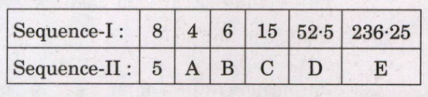
What is the entry in the place of C for the Sequence-II?
Answer & explanation
Answer: (c) 9.375
Sequence-I multiplies by 0.5, 1.5, 2.5, 3.5 and 4.5 in turn. Starting from 5, Sequence-II runs 2.5, 3.75, 9.375, so C = 9.375.
- Sequence-I: 8 × 0.5 = 4, 4 × 1.5 = 6, 6 × 2.5 = 15, 15 × 3.5 = 52.5, 52.5 × 4.5 = 236.25 — the multiplier rises by 1 each time.
- Sequence-II from 5: A = 5 × 0.5 = 2.5, B = 2.5 × 1.5 = 3.75.
- C = 3.75 × 2.5 = 9.375.
- Check: D = 9.375 × 3.5 = 32.8125 — option (d) is the next term, a trap; (a) is A.
Remember · When terms first fall and then shoot up, test multipliers; options often offer the neighbouring terms as traps.
Question and answer: UPSC's official GS Paper II (2021, Series A) — paper ↗ · answer key ↗. Explanation: Minimalist IAS, checked 1 Oct 2026 (how we verify). ·