Minimalist IAS
CSAT

UPSC CSE 2026 · Paper II (qualifying, 33%) · Series A

CSAT (GS Paper II) 2026

All 80 questions in UPSC's order, with the provisional answer key (UPSC releases the final key after the final result).

What this paper asked, by skill▾

Directions for the following 5 (five) items: Each item in this section contains a question followed by two statements. Answer each item using the following instructions and mark your response on the Answer Sheet accordingly.

Question: X receives three coins of different denominations: 1, 2, 5, 10 and 20. If the total amount received by X is m, does X receive a coin of denomination 5?

  1. Statement I: m is not a prime number.
  2. Statement II: The sum of the digits of m is greater than 5.
Answer & explanation

Answer: (a) Select this option if the question can be answered using one of these statements alone, but cannot be answered using other statement

There are only ten ways to pick three different coins, so list their totals. Every total whose digits add up to more than 5 includes the 5-coin, so Statement II settles it; Statement I leaves 32 (2 + 10 + 20) as an exception.

  1. Three different coins from {1, 2, 5, 10, 20} can be chosen in 10 ways.
  2. With the 5-coin: 1+2+5 = 8, 1+5+10 = 16, 1+5+20 = 26, 2+5+10 = 17, 2+5+20 = 27, 5+10+20 = 35.
  3. Without the 5-coin: 1+2+10 = 13, 1+2+20 = 23, 1+10+20 = 31, 2+10+20 = 32.
  4. Statement I (m not prime): m can be 8, 16, 26, 27, 35 (5-coin present) or 32 (5-coin absent). Not sufficient.
  5. Statement II (digit sum > 5): 8, 16, 26, 17, 27, 35 have digit sums 8, 7, 8, 8, 9, 8; the totals without the 5-coin have digit sums 4, 5, 4, 5. So m always includes the 5-coin. Sufficient.
  6. One statement alone works and the other does not.
  • ✗ Statement I Not sufficient alone: non-prime totals include 32 = 2 + 10 + 20, which has no 5-coin, as well as 8, 16, 26, 27 and 35, which do.
  • ✓ Statement II Sufficient alone: every total with digit sum above 5 (8, 16, 17, 26, 27, 35) uses the 5-coin; totals without it (13, 23, 31, 32) have digit sums of only 4 or 5.

Remember · In data sufficiency with a small finite set, list every case first, then test each statement against the list.

Question and answer: UPSC's provisional GS Paper II (2026, Series A) — paper ↗ · answer key ↗. Explanation: Minimalist IAS, checked 30 Sept 2026 (how we verify). Permalink ·
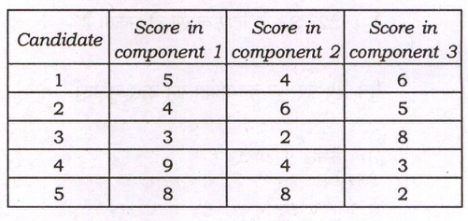
Directions for the following 5 (five) items: Each item in this section contains a question followed by two statements. Answer each item using the following instructions and mark your response on the Answer Sheet accordingly.

Question: For two distinct real numbers x and y, which of them is bigger?

  1. Statement I: x² < y < 1
  2. Statement II: y < √x < 1
Answer & explanation

Answer: (d) Select this option if the question cannot be answered even using any of the statements

Both statements together only trap y between x² and √x, and for 0 < x < 1 the number x itself lies inside that gap. So y can sit on either side of x and the question stays open.

  1. Statement I: x = 0.9, y = 0.85 fits (0.81 < 0.85 < 1) and gives x > y; x = 0.1, y = 0.5 also fits and gives y > x. Not sufficient.
  2. Statement II: √x < 1 means 0 ≤ x < 1. x = 0.25, y = 0.4 fits (0.4 < 0.5) with y > x; x = 0.25, y = 0.1 fits with y < x. Not sufficient.
  3. Together: x² < y < √x with 0 < x < 1. Take x = 0.25: y must lie between 0.0625 and 0.5.
  4. y = 0.4 gives y > x, y = 0.1 gives y < x. Still not decided.
  5. Check: for 0 < x < 1, x² < x < √x, so x always lies inside the allowed range of y.
  • ✗ Statement I Not sufficient alone: x = 0.9, y = 0.85 and x = 0.1, y = 0.5 both satisfy it but order x and y differently.
  • ✗ Statement II Not sufficient alone: with x = 0.25, both y = 0.4 and y = 0.1 are below √x = 0.5, yet one is above x and one below.

Remember · For numbers between 0 and 1, x² < x < √x. A range that straddles x never decides which is bigger.

Question and answer: UPSC's provisional GS Paper II (2026, Series A) — paper ↗ · answer key ↗. Explanation: Minimalist IAS, checked 30 Sept 2026 (how we verify). Permalink ·

Directions for the following 5 (five) items: Each item in this section contains a question followed by two statements. Answer each item using the following instructions and mark your response on the Answer Sheet accordingly.

Question: If x and y are integers, then is x even?

  1. Statement I: x²y² is even.
  2. Statement II: 1 + x² + y² is odd.
Answer & explanation

Answer: (c) Select this option if the question can be answered using both the statements together, but cannot be answered using either statement alone

Statement I says at least one of x and y is even; Statement II says x and y have the same parity. Only together do they force both to be even, which answers the question.

  1. Statement I: x²y² = (xy)² is even, so xy is even, so at least one of x, y is even. x could be odd (x = 1, y = 2). Not sufficient.
  2. Statement II: 1 + x² + y² is odd, so x² + y² is even, so x and y are both even or both odd. Not sufficient.
  3. Together: they share parity and at least one is even, so both are even. x is even — answered.
  4. Check: x = 1, y = 1 satisfies II but not I; x = 2, y = 2 satisfies both.
  • ✗ Statement I Not sufficient alone: x = 1, y = 2 gives x²y² = 4 (even) with x odd, while x = 2, y = 1 gives x even.
  • ✗ Statement II Not sufficient alone: it only says x and y have the same parity; x = y = 1 and x = y = 2 both fit.

Remember · Parity items: turn each statement into a plain rule (at least one even / same parity), then combine the rules.

Question and answer: UPSC's provisional GS Paper II (2026, Series A) — paper ↗ · answer key ↗. Explanation: Minimalist IAS, checked 30 Sept 2026 (how we verify). Permalink ·

Directions for the following 5 (five) items: Each item in this section contains a question followed by two statements. Answer each item using the following instructions and mark your response on the Answer Sheet accordingly.

Question: X is a collection of certain odd numbers whereas Y is a collection of certain even numbers. T consists of the numbers all of which are either from X or from Y. Is every number of T from Y?

  1. Statement I: The sum of any two numbers belonging to T is even.
  2. Statement II: If both p and q are picked from T, then (p − 1)q is even.
Answer & explanation

Answer: (d) Select this option if the question cannot be answered even using any of the statements

Each statement only tells us that T cannot mix odd and even numbers. An all-odd T and an all-even T satisfy both statements, so whether T comes wholly from Y cannot be decided.

  1. Statement I: the sum of two numbers is even only when both have the same parity. So T is all odd or all even. Not sufficient.
  2. Statement II: if T is all odd, p − 1 is even, so (p − 1)q is even. If T is all even, q is even, so (p − 1)q is even. Both cases fit.
  3. A mixed T fails II: an even p and an odd q give (odd) × (odd) = odd. So II also means 'all odd or all even'. Not sufficient.
  4. Together: an all-odd T (from X) and an all-even T (from Y) satisfy both statements. Still not answered.
  • ✗ Statement I Not sufficient alone: T = {1, 3} and T = {2, 4} both have even pairwise sums.
  • ✗ Statement II Not sufficient alone: for T = {1, 3}, p − 1 is always even; for T = {2, 4}, q is always even. Both give (p − 1)q even.

Remember · When every statement is satisfied by two opposite cases, even combined, mark 'cannot be answered'.

Question and answer: UPSC's provisional GS Paper II (2026, Series A) — paper ↗ · answer key ↗. Explanation: Minimalist IAS, checked 30 Sept 2026 (how we verify). Permalink ·

Directions for the following 5 (five) items: Each item in this section contains a question followed by two statements. Answer each item using the following instructions and mark your response on the Answer Sheet accordingly.

Question: If x, y and z are integers, each greater than 1, then is x a prime number?

  1. Statement I: xy² = 116
  2. Statement II: xz = 261
Answer & explanation

Answer: (a) Select this option if the question can be answered using one of these statements alone, but cannot be answered using other statement

Factorise both numbers: 116 = 2² × 29 and 261 = 3² × 29. The first leaves only y = 2 and x = 29, a prime; the second allows x = 3, 9, 29 or 87, so it cannot decide.

  1. 116 = 2² × 29. With y > 1, the only square factor is y² = 4, so y = 2 and x = 29.
  2. 29 is prime, so Statement I alone answers the question (yes).
  3. 261 = 3² × 29. With x, z > 1, x can be 3, 9, 29 or 87.
  4. 3 and 29 are prime but 9 and 87 are not, so Statement II alone cannot answer.
  5. One statement alone works and the other does not.
  • ✓ Statement I Sufficient alone: 116 = 4 × 29 forces y = 2 and x = 29, which is prime.
  • ✗ Statement II Not sufficient alone: 261 = 9 × 29 allows x = 3 or 29 (prime) and x = 9 or 87 (not prime).

Remember · Prime factorisation first; then ask which factor splits are allowed by the given conditions (here, every variable > 1).

Question and answer: UPSC's provisional GS Paper II (2026, Series A) — paper ↗ · answer key ↗. Explanation: Minimalist IAS, checked 30 Sept 2026 (how we verify). Permalink ·

Directions for the next 2 (two) items: Read the following passage and answer the items that follow. Your answers should be based solely on the passage.

Passage

‘Kalagram’, the cultural village set up at the Maha Kumbh Mela, unfolded as a mosaic of India’s diverse regions, each represented by seven meticulously crafted ‘Sanskriti Angans’—stepping through the grand portal was like entering another world. These thematic zones, inspired by iconic temples like the Dakshineshwar Kali Temple and the Brahma Mandir, were treasure troves of regional artistry. Bengal’s Pattachitra paintings, Assam’s bamboo crafts, Tamil Nadu’s Thanjavur paintings, and Madhya Pradesh’s tribal sculpture—all were showcased in these living galleries where 230 master artisans breathed life into them using age-old techniques, their hands shaping India’s ancient history into creations to behold.

CSAT 2026 · Q6

Reading comprehension Medium Provisional key

Which of the following conclusions are valid?

  1. 1.Seven Sanskriti Angans, representing different regions of India, had been showcased in Kalagram.
  2. 2.Regional artistry was recognised via the inspiration drawn from iconic temples.
  3. 3.India’s ancient history had been crafted by the contemporary craftsmanship of 230 artisans into creations to behold.
  4. 4.Art forms from all regions of India had been showcased in these living galleries.

Select the answer using the code given below.

Answer & explanation

Answer: (a) 1 and 2 only

Statements 1 and 2 restate what the passage says about the seven Angans and the temple-inspired zones full of regional art. Statement 3 swaps the passage's 'age-old techniques' for 'contemporary craftsmanship', and statement 4 overreaches with 'all regions'.

  • ✓ 1. The passage says India's diverse regions were represented by seven 'Sanskriti Angans' in Kalagram.
  • ✓ 2. The thematic zones were 'inspired by iconic temples' and were 'treasure troves of regional artistry', so the regional art was presented through temple-inspired zones.
  • ✗ 3. The artisans worked with 'age-old techniques'; calling it 'contemporary craftsmanship' changes what the passage says.
  • ✗ 4. Only a few examples (Bengal, Assam, Tamil Nadu, Madhya Pradesh) are named; 'all regions of India' is an overstatement.

Remember · Check each qualifying word against the passage: 'all', 'contemporary', 'only' often turn a near-copy into a wrong statement.

Question and answer: UPSC's provisional GS Paper II (2026, Series A) — paper ↗ · answer key ↗. Explanation: Minimalist IAS, checked 30 Sept 2026 (how we verify). Permalink ·

CSAT 2026 · Q7

Reading comprehension Easy Provisional key

Which one of the following statements is not correct?

Answer & explanation

Answer: (a) Paintings from four States of India have been mentioned.

Four States are mentioned, but only two of them for paintings: Bengal's Pattachitra and Tamil Nadu's Thanjavur. Assam is named for bamboo crafts and Madhya Pradesh for tribal sculpture, so statement (a) is the incorrect one.

  • ✗ (a) Only Pattachitra (Bengal) and Thanjavur (Tamil Nadu) are paintings; bamboo crafts and tribal sculpture are not. So this is the statement that is not correct.
  • ✓ (b) The passage says stepping through the grand portal 'was like entering another world'.
  • ✓ (c) The art forms were showcased 'in these living galleries', i.e., the Angans.
  • ✓ (d) The Angans are called 'thematic zones, inspired by iconic temples' such as Dakshineshwar Kali Temple and Brahma Mandir.

Remember · In 'not correct' items, count and classify details carefully; a right number with the wrong category is a common trap.

Question and answer: UPSC's provisional GS Paper II (2026, Series A) — paper ↗ · answer key ↗. Explanation: Minimalist IAS, checked 30 Sept 2026 (how we verify). Permalink ·

The weight of X, in kg, is denoted by X. The weights of A, B, C, D, P, Q, R and S are measured. Given:

A + B + C + D = 17

A + C = 6

P + Q + S + D = 15

P + Q + R + B = 17

P = R and Q = S

Which one of the following statements is correct?

Answer & explanation

Answer: (b) P and Q together weigh more than the total weight of A and C.

Adding the last two equations after substituting R = P and S = Q gives 3(P + Q) + B + D = 32, and B + D = 11 from the first two. So P + Q = 7, which is more than A + C = 6.

  1. From A + B + C + D = 17 and A + C = 6: B + D = 11.
  2. Put S = Q: P + 2Q + D = 15. Put R = P: 2P + Q + B = 17.
  3. Add them: 3P + 3Q + B + D = 32, so 3(P + Q) = 32 − 11 = 21 and P + Q = 7.
  4. (a) B + D = 11 is not less than 7 — false. (b) P + Q = 7 > A + C = 6 — true.
  5. P and Q individually are not fixed (for example P = 3, Q = 4 or P = 4, Q = 3 with suitable B, D), so (c) and (d) cannot be asserted.
  • ✗ (a) B + D = 11 is more than P + Q = 7.
  • ✓ (b) P + Q = 7 exceeds A + C = 6.
  • ✗ (c) Only P + Q = 7 is fixed; P can be larger or smaller than Q.
  • ✗ (d) Same reason: the data do not fix which of P and Q is heavier.

Remember · When single values can't be found, add the equations to get the combined quantity the options ask about.

Question and answer: UPSC's provisional GS Paper II (2026, Series A) — paper ↗ · answer key ↗. Explanation: Minimalist IAS, checked 30 Sept 2026 (how we verify). Permalink ·

How many words can one form by shuffling the letters of the word QUEUE, if Q is always followed by U? The words thus formed need not necessarily have any meaning.

Answer & explanation

Answer: (d) 12

Glue Q and U together as one block 'QU'. Then arrange four units — QU, U, E, E — where the two E's are identical: 4!/2! = 12.

  1. QUEUE has Q, U, U, E, E.
  2. Tie Q to a U as a block: the units are QU, U, E, E.
  3. Arrangements = 4! ÷ 2! (two identical E's) = 24 ÷ 2 = 12.
  4. Check: Q occurs once, so each word has exactly one block position — no word is counted twice.

Remember · 'X always followed by Y' → treat XY as one block, then divide by factorials of repeated letters.

Question and answer: UPSC's provisional GS Paper II (2026, Series A) — paper ↗ · answer key ↗. Explanation: Minimalist IAS, checked 30 Sept 2026 (how we verify). Permalink ·

CSAT 2026 · Q10

Number system Easy Provisional key

X, Y and Z jump forward 4′, 6′ and 5′, respectively. At 8 AM, they all land on mark 199′. How many times will they all land on the same mark (need not be at the same moment) between mark 195′ and 1000′, if all of them cross mark 1000′ by 9 AM?

Answer & explanation

Answer: (d) 14

All three touch 199′, and after that their landing marks coincide every LCM(4, 6, 5) = 60 feet. Counting 199, 259, … up to 979 gives 14 common marks in the range.

  1. LCM of 4, 6 and 5 is 60, so common marks are 199 + 60k.
  2. 199 − 60 = 139 is below 195, so the first common mark in range is 199′ itself.
  3. 199 + 60k ≤ 1000 gives k ≤ 13.35, so k = 0, 1, …, 13.
  4. Number of common marks = 14 (199′, 259′, …, 979′).

Remember · Common landing points of different step lengths repeat every LCM of the steps; count terms of the resulting sequence.

Question and answer: UPSC's provisional GS Paper II (2026, Series A) — paper ↗ · answer key ↗. Explanation: Minimalist IAS, checked 30 Sept 2026 (how we verify). Permalink ·

Directions for the next 2 (two) items: Read the following passage and answer the items that follow. Your answers should be based solely on the passage.

Passage

Sport is not just about winning medals or getting jobs through a sports quota. Today’s generation is struggling with issues like depression and anxiety. Parents often say that their children are inactive and rarely leave the house. Sport can help tackle these problems. From sport you can learn time management, fitness, teamwork, coordination, and so much more. We need to develop a culture in which sport is seen as a way of life—a path to building a healthier, happier society.

Which of the following conclusions are valid?

  1. 1.Sport is more than just games; it is a way of life.
  2. 2.Sport can help mitigate the problems of seclusion among the young.
  3. 3.Earning laurels in sport can help one secure a job on the basis of an assigned quota.
  4. 4.Standard corporate sector skills cannot be learnt through sport.

Select the answer using the code given below.

Answer & explanation

Answer: (d) 1, 2 and 3

The passage treats sport as a way of life, says it can help children who are inactive and rarely leave the house, and takes sports-quota jobs as a given benefit. Statement 4 contradicts the skills it lists — time management, teamwork, coordination.

  • ✓ 1. The passage opens with 'Sport is not just about winning medals…' and ends by calling for sport to be seen 'as a way of life'.
  • ✓ 2. Children who are 'inactive and rarely leave the house' are described, and 'Sport can help tackle these problems.'
  • ✓ 3. 'getting jobs through a sports quota' is mentioned as one of the things sport already brings; the passage only adds that sport is more than that.
  • ✗ 4. The passage lists time management, teamwork and coordination as things learnt from sport — the opposite of this statement.

Remember · A statement that denies something the passage lists as a benefit is invalid, however plausible it sounds.

Question and answer: UPSC's provisional GS Paper II (2026, Series A) — paper ↗ · answer key ↗. Explanation: Minimalist IAS, checked 30 Sept 2026 (how we verify). Permalink ·

Which of the following statements is/are correct?

  1. 1.Parents are not encouraging enough when it comes to children playing sport.
  2. 2.Participation in sporting activities can help develop life skills.
  3. 3.Sport as a way of life can help evolve the very nature of society itself.

Select the answer using the code given below.

Answer & explanation

Answer: (b) 2 and 3

The passage says sport teaches time management, teamwork and coordination, and that a culture of sport can build a healthier, happier society. It never blames parents; it only reports what parents say about their children.

  • ✗ 1. Parents are only quoted as saying their children are inactive; nothing is said about parents failing to encourage sport.
  • ✓ 2. 'From sport you can learn time management, fitness, teamwork, coordination, and so much more' — these are life skills.
  • ✓ 3. The passage calls sport as a way of life 'a path to building a healthier, happier society', i.e., it can change the character of society.

Remember · Reported speech is not a judgement: 'parents say children are inactive' does not mean 'parents are not encouraging'.

Question and answer: UPSC's provisional GS Paper II (2026, Series A) — paper ↗ · answer key ↗. Explanation: Minimalist IAS, checked 30 Sept 2026 (how we verify). Permalink ·

A toy T jumps forward or backward. In each forward jump, it moves 5′ forward whereas in each backward jump, it moves 2′ backward. If in 31 jumps, T moves exactly 15′ forward, then what is the difference of the number of forward and backward jumps?

Answer & explanation

Answer: (d) 9

Let f forward and b backward jumps: f + b = 31 and 5f − 2b = 15. This gives f = 11 and b = 20, so the difference is 9.

  1. f + b = 31 and 5f − 2b = 15.
  2. Substitute b = 31 − f: 5f − 62 + 2f = 15, so 7f = 77 and f = 11.
  3. b = 31 − 11 = 20.
  4. Difference = 20 − 11 = 9 (more backward jumps than forward).
  5. Check: 11 × 5 − 20 × 2 = 55 − 40 = 15′ forward.

Remember · Two unknowns, two facts (count and net result): write both equations and eliminate one variable.

Question and answer: UPSC's provisional GS Paper II (2026, Series A) — paper ↗ · answer key ↗. Explanation: Minimalist IAS, checked 30 Sept 2026 (how we verify). Permalink ·

Eight persons P, Q, R, S, T, U, V and W sit around a round table in eight different seats placed with equal distance between any two consecutive seats. Both P and R are adjacent to Q. Both T and R are adjacent to S. Both U and W are adjacent to V. S and W are on opposite chairs. If while going in the clockwise direction around the table from P, one meets R before T, then how many persons shall Q cross while moving in the clockwise direction around the table before meeting W?

Answer & explanation

Answer: (a) 5

The clues chain into the block P-Q-R-S-T, leaving three seats for U-V-W with V in the middle. W must be opposite S, which fixes the full circle as P, Q, R, S, T, U, V, W in clockwise order, so Q passes R, S, T, U and V before W.

  1. P and R sit on both sides of Q, and R and T on both sides of S: this gives the block P-Q-R-S-T (5 seats).
  2. The remaining 3 seats go to U, V, W with V in the middle (U and W both next to V).
  3. Number the seats 1 to 8: P1, Q2, R3, S4, T5. The seat opposite S (4) is seat 8, so W8, V7, U6.
  4. From P, going the way P → Q → R → S → T meets R before T, so this direction is clockwise.
  5. Clockwise from Q: R, S, T, U, V, then W. Q crosses 5 persons.

Remember · In circular seating, first join 'adjacent' clues into blocks; the 'opposite' clue then fixes the rest.

Question and answer: UPSC's provisional GS Paper II (2026, Series A) — paper ↗ · answer key ↗. Explanation: Minimalist IAS, checked 30 Sept 2026 (how we verify). Permalink ·

The top of a table is rectangular and its dimensions are 6′ × 10′. Two rectangular portions of the table top are painted in blue colour; both these portions have dimensions 2.5′ × 8′ and each of them has exactly two sides common with two edges of the table top. If the table is fixed to the ground and the remaining portion of the table top is painted in white, how many different patterns are possible when observed from above?

Answer & explanation

Answer: (b) 4

Each 2·5′ × 8′ strip must lie with its 8′ side along a 10′ edge and sit in a corner. Two strips cannot share the same 10′ edge without overlapping, so one strip goes to each long edge, at its left or right end: 2 × 2 = 4 patterns.

  1. The 8′ side cannot lie along the 6′ edge (8 > 6), so it lies along a 10′ edge and the 2·5′ side along a 6′ edge.
  2. Two sides common with two table edges means the strip sits in a corner (it cannot touch two opposite edges, since 2·5 < 6 and 8 < 10).
  3. Two strips along the same 10′ edge would overlap (8 + 8 > 10), so one strip lies along each 10′ edge; they do not meet since 2·5 + 2·5 = 5 < 6.
  4. Each strip can be at the left or the right end of its edge: 2 × 2 = 4.
  5. The table is fixed, so these four layouts (both left, both right, and the two diagonal ones) all look different from above.

Remember · Fix the orientation first (which side fits which edge), then count positions; a fixed table means mirror images count separately.

Question and answer: UPSC's provisional GS Paper II (2026, Series A) — paper ↗ · answer key ↗. Explanation: Minimalist IAS, checked 30 Sept 2026 (how we verify). Permalink ·

Directions for the next 2 (two) items: Read the following passage and answer the items that follow. Your answers should be based solely on the passage.

Passage

How is deflation done? Most countries use a method called ‘double deflation’, where input and output prices are deflated separately. Consider a manufacturer importing oil for use in production. If oil prices fall, output prices do not and quantities remain the same, real value added should not change. But if the same deflator is used for inputs and outputs, as in India, it would look as if the manufacturer had become more productive.

CSAT 2026 · Q16

Reading comprehension Medium Provisional key

Which of the following statements is/are correct?

  1. 1.Real value should not change in the instance of static output cost and unchanged quantities against falling oil prices.
  2. 2.Deflators are to be used separately for inputs and outputs, and this is a practice universally adopted by all economies.

Select the answer using the code given below.

Answer & explanation

Answer: (d) Neither 1 nor 2

Statement 1 looks like a paraphrase but changes two terms: the passage holds output prices (not output cost) steady and speaks of real value added (not real value). Statement 2 turns 'most countries' into 'all economies', which India itself contradicts.

  • ✗ 1. The passage's example keeps output prices unchanged while oil (an input) gets cheaper — so the cost of producing output actually falls. It says real value added, not 'real value', stays the same. The statement misstates both terms.
  • ✗ 2. The passage says 'Most countries' use double deflation and notes India uses the same deflator for inputs and outputs, so it is not universal.

Remember · Compare near-copy statements word by word; 'price' vs 'cost' and 'most' vs 'all' decide such items.

Question and answer: UPSC's provisional GS Paper II (2026, Series A) — paper ↗ · answer key ↗. Explanation: Minimalist IAS, checked 30 Sept 2026 (how we verify). Permalink ·

Which of the following assumptions is/are valid?

  1. 1.Deflation strategies can be used to make manufacturers appear to be doing better than they actually are.
  2. 2.When input and output prices are both deflated against a single input price, it is referred to as ‘double deflation’.

Select the answer using the code given below.

Answer & explanation

Answer: (a) 1 only

The passage shows that using one deflator for inputs and outputs can make a manufacturer look more productive than it is, so the choice of deflation method can flatter performance. Statement 2 inverts the definition: double deflation deflates input and output prices separately.

  • ✓ 1. With a single deflator 'it would look as if the manufacturer had become more productive' — the method of deflation can make performance look better than it is.
  • ✗ 2. Double deflation is where 'input and output prices are deflated separately'; using a single deflator is the Indian practice the passage criticises.

Remember · Definition-based statements: check the definition in the passage exactly; a reversed definition is always invalid.

Question and answer: UPSC's provisional GS Paper II (2026, Series A) — paper ↗ · answer key ↗. Explanation: Minimalist IAS, checked 30 Sept 2026 (how we verify). Permalink ·

A pattern formed by two characters a and b is repeated more than once in the following string:

× b × a × a × × a × a × bab

What is × × in the 7th and 8th positions from the left in the above string?

Answer & explanation

Answer: (d) bb

The string has 15 places, so the repeating block has length 3 or 5. Length 3 clashes (place 2 is b but place 11 is a); length 5 fits every known letter and gives the block 'abbab', so places 7 and 8 are b and b.

  1. Number the 15 places: 1 ×, 2 b, 3 ×, 4 a, 5 ×, 6 a, 7 ×, 8 ×, 9 a, 10 ×, 11 a, 12 ×, 13 b, 14 a, 15 b.
  2. Block length 3 fails: places 2 and 11 should match but are b and a.
  3. Block length 5: places 1, 6, 11 → a; 2, 7, 12 → b; 3, 8, 13 → b; 4, 9, 14 → a; 5, 10, 15 → b.
  4. Block = abbab, repeated three times: abbab abbab abbab.
  5. Places 7 and 8 = 2nd and 3rd letters of the block = b, b.

Remember · For a repeated pattern, try block lengths that divide the string length; letters one block apart must match.

Question and answer: UPSC's provisional GS Paper II (2026, Series A) — paper ↗ · answer key ↗. Explanation: Minimalist IAS, checked 30 Sept 2026 (how we verify). Permalink ·

CSAT 2026 · Q19

Number system Easy Provisional key

If 10ᵐ × 1000 × n = 75²⁵ × 25³² × 32⁷⁵, where n is not divisible by 10, then the value of m is

Answer & explanation

Answer: (b) 111

Break the right side into primes: 2³⁷⁵ × 3²⁵ × 5¹¹⁴. The number of 10s is the smaller of the powers of 2 and 5, i.e., 114, and n must hold none of them, so m + 3 = 114.

  1. 75²⁵ = (3 × 5²)²⁵ = 3²⁵ × 5⁵⁰.
  2. 25³² = 5⁶⁴.
  3. 32⁷⁵ = (2⁵)⁷⁵ = 2³⁷⁵.
  4. Right side = 2³⁷⁵ × 3²⁵ × 5¹¹⁴, which contains exactly 10¹¹⁴ (limited by the 5s).
  5. n = 2²⁶¹ × 3²⁵ is not divisible by 10, so 10ᵐ × 10³ = 10¹¹⁴ and m = 111.

Remember · Powers of 10 in a product = min(power of 2, power of 5). Count both, take the smaller.

Question and answer: UPSC's provisional GS Paper II (2026, Series A) — paper ↗ · answer key ↗. Explanation: Minimalist IAS, checked 30 Sept 2026 (how we verify). Permalink ·

The speed of a train T is 100 km per hour and the speed of a person P is 4 km per hour. T crosses P in 15 seconds, if P travels along the direction of motion of T. If P travels along the opposite direction of T, then in how much time does T cross P, in seconds, approximately?

Answer & explanation

Answer: (c) 13.85

The train's length is fixed, so crossing time is inversely proportional to relative speed. Relative speed changes from 96 km/h to 104 km/h, so the new time is 15 × 96/104 ≈ 13·85 seconds.

  1. Same direction: relative speed = 100 − 4 = 96 km/h. Opposite direction: 100 + 4 = 104 km/h.
  2. Length of T = 96 × (5/18) m/s × 15 s = 400 m.
  3. Time in the opposite case = 400 ÷ (104 × 5/18) = 3600/260 ≈ 13·85 s.
  4. Check: 15 × 96/104 = 13·846 s.

Remember · Same length, different relative speed: new time = old time × old relative speed ÷ new relative speed.

Question and answer: UPSC's provisional GS Paper II (2026, Series A) — paper ↗ · answer key ↗. Explanation: Minimalist IAS, checked 30 Sept 2026 (how we verify). Permalink ·

CSAT 2026 · Q21

Number system Medium Provisional key

For 1/3 < x < y < 2, which of the following statements is/are always correct?

  1. I.x + 1/x < y + 1/y
  2. II.√(1 + y²)/y < √(1 + x²)/x

Select the answer using the code given below.

Answer & explanation

Answer: (b) II only

t + 1/t falls until t = 1 and rises after it, so Statement I breaks when x and y are on opposite sides of 1. Statement II simplifies to √(1/y² + 1) < √(1/x² + 1), which always holds because y > x > 0.

  1. Statement I: try x = 1/2, y = 1. Left = 0·5 + 2 = 2·5; right = 1 + 1 = 2. 2·5 < 2 is false, so I is not always correct.
  2. Statement II: divide inside the root by the square of the denominator: √(1 + y²)/y = √(1/y² + 1) and √(1 + x²)/x = √(1/x² + 1).
  3. Since 0 < x < y, 1/y² < 1/x², so √(1/y² + 1) < √(1/x² + 1). II always holds.
  4. Check II with numbers: x = 1, y = 1·5 gives 1·202 < 1·414.
  • ✗ I Fails for x = 1/2, y = 1: 2·5 is not less than 2. The function t + 1/t decreases on (1/3, 1).
  • ✓ II Equivalent to 1/y² < 1/x², true whenever 0 < x < y.

Remember · For 'always correct', hunt for one counter-example; for the other statement, simplify until the inequality is obvious.

Question and answer: UPSC's provisional GS Paper II (2026, Series A) — paper ↗ · answer key ↗. Explanation: Minimalist IAS, checked 30 Sept 2026 (how we verify). Permalink ·

CSAT 2026 · Q22

Number system Medium Provisional key

What is the minimum number of times one needs to measure to get 298 litres of water from a tank, if the measuring cylinders have capacities 1 litre, 6 litres, 25 litres and 100 litres?

Answer & explanation

Answer: (b) 5

Measuring can remove water as well as add it: take 100 litres three times (300 litres) and take out 1 litre twice. That is 5 measurements, and 4 cannot work because 298 is 2 short of 300 and no single cylinder holds 2 litres.

  1. 298 = 300 − 2 = 100 + 100 + 100 − 1 − 1: three fills of 100 litres and two removals of 1 litre = 5 measurements.
  2. Could 4 work? With at most two 100-litre fills, the other two measures add at most 50 litres: 250 < 298.
  3. So three 100-litre fills are needed, leaving one measure to remove exactly 2 litres — impossible with 1, 6, 25 or 100.
  4. Minimum = 5.
  5. Check: the greedy pour-in-only count 2 × 100 + 3 × 25 + 3 × 6 + 5 × 1 = 13 measures is the trap option.

Remember · For 'minimum measurements', aim just above the target with the big measure, then remove the excess.

Question and answer: UPSC's provisional GS Paper II (2026, Series A) — paper ↗ · answer key ↗. Explanation: Minimalist IAS, checked 30 Sept 2026 (how we verify). Permalink ·

There are four types of weights, namely 1 kg, 2 kg, 5 kg and 10 kg. What is the maximum number of different ways one can measure 20 kg, if at least eight but not more than eleven weights of 1 kg are to be used while measuring?

Answer & explanation

Answer: (b) 8

Fix the number of 1 kg weights at 8, 9, 10 or 11 and make up the rest with 2, 5 and 10 kg weights. The counts are 3, 1, 3 and 1, giving 8 ways.

  1. Eight 1 kg weights: 12 kg left → 10 + 2; 5 + 5 + 2; six 2s → 3 ways.
  2. Nine 1 kg weights: 11 kg left from 2, 5 and 10 kg weights. 11 is odd, so exactly one 5 is needed, plus three 2s → 1 way.
  3. Ten 1 kg weights: 10 kg left → 10; 5 + 5; five 2s → 3 ways.
  4. Eleven 1 kg weights: 9 kg left, odd again → 5 + 2 + 2 → 1 way.
  5. Total = 3 + 1 + 3 + 1 = 8.

Remember · Counting combinations of coins or weights: fix the most restricted item, then list the rest systematically from the largest.

Question and answer: UPSC's provisional GS Paper II (2026, Series A) — paper ↗ · answer key ↗. Explanation: Minimalist IAS, checked 30 Sept 2026 (how we verify). Permalink ·

A cut on a solid object divides the object into two parts where the new surfaces thus produced are plane. On the other hand, one single cut can be used to cut more than one object at a time. In an experiment, the total number of pieces produced by applying n cuts is denoted by xₙ. The experiment is performed on a solid cube where pieces remain unmoved after each cut. In this experiment, if after the third cut, the pieces are identical, then which of the following is not a possible value for x₄?

Answer & explanation

Answer: (a) 16

With pieces left unmoved, four plane cuts can give at most 15 pieces (1 + 4 + 6 + 4), so 16 is impossible. The other values arise easily from identical pieces after three cuts: 5 and 8 from four equal slabs, 12 from eight small cubes.

  1. Identical pieces after three cuts: 4 equal slabs (three parallel cuts), 6 equal blocks (two parallel + one perpendicular), or 8 small cubes (three mutually perpendicular cuts through the centre).
  2. Four plane cuts on an unmoved solid give at most 1 + 4 + 6 + 4 = 15 pieces; equivalently, the fourth plane can cross at most 7 of the 8 small cubes, giving 8 + 7 = 15.
  3. So x₄ = 16 is not possible.
  4. Check the rest: 4 slabs + a fourth parallel cut through one slab = 5; 4 slabs + a perpendicular cut through all four = 8; 8 cubes + a cut parallel to a face through four of them = 12.
  • ✗ (a) Not possible: four plane cuts on unmoved pieces give at most 15 pieces.
  • ✓ (b) Possible: after three central perpendicular cuts (8 cubes), a fourth cut parallel to one face through one layer splits 4 cubes → 12.
  • ✓ (c) Possible: after three parallel cuts (4 equal slabs), a fourth cut perpendicular to them splits all 4 → 8.
  • ✓ (d) Possible: after 4 equal slabs, a fourth cut parallel to them inside one slab → 5.

Remember · Unmoved pieces: plane cuts give at most 2, 4, 8 and 15 pieces for one to four cuts.

Question and answer: UPSC's provisional GS Paper II (2026, Series A) — paper ↗ · answer key ↗. Explanation: Minimalist IAS, checked 30 Sept 2026 (how we verify). Permalink ·

The class average x in a test increases by 4 when the score of a student is rectified, whose corrected score is 100 instead of 0. Later, the score of another student was found to have been recorded as 81 in place of 56. If there are no other corrections and the final corrected average is y, then y − x is

Answer & explanation

Answer: (b) 3

Adding 100 marks raised the average by 4, so the class has 25 students. The second correction removes 25 marks, lowering the average by 1, so the net rise is 4 − 1 = 3.

  1. First correction adds 100 − 0 = 100 marks and raises the average by 4, so number of students = 100 ÷ 4 = 25.
  2. Second correction: 81 recorded instead of 56 means the total falls by 25.
  3. Average falls by 25 ÷ 25 = 1.
  4. y − x = 4 − 1 = 3.

Remember · Change in average = change in total ÷ number of items; find the count from the first change.

Question and answer: UPSC's provisional GS Paper II (2026, Series A) — paper ↗ · answer key ↗. Explanation: Minimalist IAS, checked 30 Sept 2026 (how we verify). Permalink ·

Directions for the next 3 (three) items: Read the following passage and answer the items that follow. Your answers should be based solely on the passage.

Passage

When SARS-CoV-2 was first detected in 2019, it was a truly novel virus for the world. At that time, no one in the world had been exposed to SARS-CoV-2 or had specific immunity against it. In contrast, people across the world have been exposed to HMPV for decades and the virus is well-studied. HMPV and SARS-CoV-2 belong to two very different virus families with fundamentally different characteristics and epidemiology, with strong seasonality seen in HMPV, unlike SARS-CoV-2. Both viruses cause different severity of symptoms, particularly over the long term, and the affected population segments do not fully overlap. In general, HMPV causes milder illness with deaths being very rare and with no long-term post-viral symptoms.

CSAT 2026 · Q26

Reading comprehension Medium Provisional key

Which of the following conclusions is/are valid?

  1. 1.Though SARS-CoV-2 and HMPV are similar viruses with somewhat different epidemiology, the former became a pandemic because it was novel and people had not been exposed to it in the past.
  2. 2.The two viruses have fundamentally different impacts on human populations and should not therefore be dealt with in a similar manner.

Select the answer using the code given below.

Answer & explanation

Answer: (b) 2 only

The passage stresses that the two viruses are very different in family, epidemiology, severity and the people they affect, which supports not treating them alike. Statement 1 calls them 'similar viruses' and brings in a pandemic the passage never mentions.

  • ✗ 1. The passage says they belong to 'two very different virus families with fundamentally different characteristics and epidemiology' — not 'similar viruses with somewhat different epidemiology'. It also says nothing about a pandemic.
  • ✓ 2. Different severity, different long-term effects and non-overlapping affected groups add up to different impacts, which is the passage's reason for not equating HMPV with SARS-CoV-2.

Remember · Reject a statement that contradicts the passage's core contrast, even if its second half sounds reasonable.

Question and answer: UPSC's provisional GS Paper II (2026, Series A) — paper ↗ · answer key ↗. Explanation: Minimalist IAS, checked 30 Sept 2026 (how we verify). Permalink ·

CSAT 2026 · Q27

Reading comprehension Medium Provisional key

Which of the following reflect the intent of the writer in the above passage?

  1. 1.To evolve methodologies for objective analysis of the two viruses
  2. 2.To establish the epidemiological similarities and differences between the two viruses
  3. 3.To offer a better understanding of the remedies of HMPV when analysed in conjunction with SARS-CoV-2

Select the answer using the code given below.

Answer & explanation

Answer: (d) None of the above

The writer's aim is to show that HMPV is a familiar, milder and very different virus from SARS-CoV-2. The passage develops no method of analysis, does not set out similarities, and says nothing about remedies.

  • ✗ 1. No methodology is proposed; the passage simply states facts about the two viruses.
  • ✗ 2. The passage stresses only differences ('fundamentally different characteristics and epidemiology'); it does not set out similarities.
  • ✗ 3. Remedies or treatment are not discussed at all.

Remember · For 'intent of the writer', ask what the passage actually does; reject aims it never attempts (methods, remedies).

Question and answer: UPSC's provisional GS Paper II (2026, Series A) — paper ↗ · answer key ↗. Explanation: Minimalist IAS, checked 30 Sept 2026 (how we verify). Permalink ·

CSAT 2026 · Q28

Reading comprehension Medium Provisional key

Which of the following statements reflect the logical and rational inferences that can be drawn from the passage?

  1. 1.HMPV has, historically, had longer documentation of studies when compared with SARS-CoV-2.
  2. 2.The two viruses are different from each other and this results in markedly different outcomes amongst those affected.
  3. 3.Long-term impacts of the two viruses are dissimilar and this is an important differentiator between them.
  4. 4.One of the common factors between the two viruses is seasonal specificity.

Select the answer using the code given below.

Answer & explanation

Answer: (b) 1, 2 and 3

HMPV has been known and studied for decades, the two viruses differ in severity and outcomes, and the long-term effects are a clear point of difference. Seasonality is not shared: the passage says strong seasonality is seen in HMPV, unlike SARS-CoV-2.

  • ✓ 1. People have been exposed to HMPV 'for decades and the virus is well-studied', while SARS-CoV-2 was 'truly novel' in 2019.
  • ✓ 2. They 'cause different severity of symptoms'; HMPV causes milder illness with very rare deaths.
  • ✓ 3. Severity differs 'particularly over the long term', and HMPV leaves 'no long-term post-viral symptoms'.
  • ✗ 4. Seasonality is a difference, not a common factor: 'strong seasonality seen in HMPV, unlike SARS-CoV-2'.

Remember · Check 'common factor' claims against contrast words such as 'unlike', 'in contrast', 'whereas'.

Question and answer: UPSC's provisional GS Paper II (2026, Series A) — paper ↗ · answer key ↗. Explanation: Minimalist IAS, checked 30 Sept 2026 (how we verify). Permalink ·

CSAT 2026 · Q29

Number system Easy Provisional key

Three variables x, y and z take values 2, 3, 4 or 5 such that their values are always distinct. If M and N denote the largest possible value and the smallest possible value, respectively, for the expression {(x × y) + z}; then M − N is

Answer & explanation

Answer: (c) 13

The product dominates the sum, so put the two largest values in the product for M and the two smallest for N. M = 5 × 4 + 3 = 23 and N = 2 × 3 + 4 = 10, so M − N = 13.

  1. Largest: x × y = 5 × 4 = 20, z = 3 (largest value left): M = 23. (5 × 3 + 4 = 19 is smaller.)
  2. Smallest: x × y = 2 × 3 = 6, z = 4 (smallest value left): N = 10. (2 × 4 + 3 = 11 is larger.)
  3. M − N = 23 − 10 = 13.

Remember · To maximise or minimise xy + z, decide the product first; the added term matters less.

Question and answer: UPSC's provisional GS Paper II (2026, Series A) — paper ↗ · answer key ↗. Explanation: Minimalist IAS, checked 30 Sept 2026 (how we verify). Permalink ·

Suppose x, y and z are variables taking positive real numbers as their possible values. It is given that y is directly proportional to x² and x is inversely proportional to z. For z = 7/25, the values of x and y are 5 and 50, respectively. If y = 98, what is z equal to?

Answer & explanation

Answer: (b) 1/5

From y = kx², k = 50/25 = 2, so y = 98 gives x = 7. From xz = constant = 5 × 7/25 = 7/5, z = (7/5)/7 = 1/5.

  1. y = kx²: 50 = k × 25, so k = 2.
  2. y = 98: 2x² = 98, x² = 49, x = 7 (x is positive).
  3. xz = constant = 5 × 7/25 = 7/5.
  4. z = (7/5) ÷ 7 = 1/5.
  5. Check: x rose from 5 to 7, so z must fall in the ratio 5 : 7 — (7/25) × (5/7) = 1/5.

Remember · Direct variation: ratio stays constant; inverse variation: product stays constant. Find each constant from the given pair.

Question and answer: UPSC's provisional GS Paper II (2026, Series A) — paper ↗ · answer key ↗. Explanation: Minimalist IAS, checked 30 Sept 2026 (how we verify). Permalink ·

Directions for the next 2 (two) items: Read the following passage and answer the items that follow. Your answers should be based solely on the passage.

Passage

India is starting to deploy AI for critical use cases such as weather forecasting, pest detection and control, and crop yield optimisation. However, penetration is limited to a small subset of tech-savvy farmers. In the US and in Europe, generative AI tools have started offering precision farming at scale, integrating large datasets to provide real-time agronomic insights. For at-scale integration and accessibility of AI tools in India, it would be helpful to develop Indian languages-based AI tools for smallholder farmers, partner with AgTechs to create affordable AI solutions, and disseminate AI-based advisory services through government programmes.

CSAT 2026 · Q31

Reading comprehension Medium Provisional key

Which of the following assumptions is/are valid?

  1. 1.Agricultural productivity has marched ahead in the West because of the economies of scale facilitated by the adoption of AI tools.
  2. 2.Affordable AI tools rendered available in local languages can help AI-based solutions reach more and more small farmers.
  3. 3.Though penetration is as yet low, critical application areas deploying AI tools are already in use in India.

Select the answer using the code given below.

Answer & explanation

Answer: (d) 2 and 3 only

The passage's recommendations rest on the belief that affordable, local-language AI tools will reach more small farmers, and it notes AI is already being deployed in India for critical uses despite low penetration. It makes no claim that Western farm productivity rose because of AI-driven economies of scale.

  • ✗ 1. The passage only says AI tools in the US and Europe 'have started offering precision farming at scale'; it says nothing about productivity having marched ahead because of them.
  • ✓ 2. The passage recommends Indian languages-based and affordable AI tools 'for at-scale integration and accessibility' among smallholder farmers.
  • ✓ 3. India 'is starting to deploy AI for critical use cases' such as weather forecasting and pest control, though 'penetration is limited'.

Remember · An unstated cause-and-effect claim (X happened because of Y) is invalid unless the passage links the two.

Question and answer: UPSC's provisional GS Paper II (2026, Series A) — paper ↗ · answer key ↗. Explanation: Minimalist IAS, checked 30 Sept 2026 (how we verify). Permalink ·

CSAT 2026 · Q32

Reading comprehension Medium Provisional key

Which of the following statements is/are not correct?

  1. 1.Tech-savvy farmers will drive the AgTech companies of the future.
  2. 2.The development of advisory services by the government programmes for the use of AI tools in agriculture would be helpful.
  3. 3.In the US and Europe, AI tools have replaced traditional agricultural practices.
  4. 4.The integration of large datasets for use in real-time agronomic analysis is already a reality.

Select the answer using the code given below.

Answer & explanation

Answer: (a) 1 and 3 only

Nothing in the passage says tech-savvy farmers will drive future AgTech firms, or that AI has replaced traditional farming in the West. The government advisory route is recommended as helpful, and real-time use of large datasets is already happening in the US and Europe.

  • ✗ 1. Not supported: tech-savvy farmers are mentioned only as the small group AI has reached so far.
  • ✓ 2. The passage says it 'would be helpful' to disseminate AI-based advisory services through government programmes.
  • ✗ 3. The passage says generative AI tools 'have started offering precision farming at scale' — not that they have replaced traditional practices.
  • ✓ 4. In the US and Europe, AI tools are already 'integrating large datasets to provide real-time agronomic insights'.

Remember · In 'not correct' items, mark statements that go beyond the passage ('will drive', 'have replaced') as not correct.

Question and answer: UPSC's provisional GS Paper II (2026, Series A) — paper ↗ · answer key ↗. Explanation: Minimalist IAS, checked 30 Sept 2026 (how we verify). Permalink ·

P, Q, R, S and T are ranked 1 to 5 (not necessarily in that order). The rank of P is 4, the rank of Q is not 5, the rank of R is 1, the rank of S is not 2, the rank of T is not 3. Then which of the following is/are correct?

  1. I.If the rank of S is 3, then that of T is 2.
  2. II.If the rank of Q is 3, then that of T is 5.

Select the answer using the code given below.

Answer & explanation

Answer: (d) Neither I nor II

With P = 4 and R = 1, the ranks 2, 3 and 5 remain for Q, S and T, and only two orders fit the conditions: (Q, S, T) = (2, 3, 5) or (3, 5, 2). In each case the 'then' part of the statement is the opposite of what actually happens.

  1. P = 4, R = 1, so Q, S, T share ranks 2, 3 and 5.
  2. Q ≠ 5 → Q is 2 or 3; S ≠ 2 → S is 3 or 5; T ≠ 3 → T is 2 or 5.
  3. Q = 2: then T ≠ 3 forces T = 5 and S = 3.
  4. Q = 3: then S ≠ 2 forces S = 5 and T = 2.
  5. S = 3 happens only with T = 5, so I is wrong; Q = 3 happens only with T = 2, so II is wrong.
  • ✗ I S = 3 occurs only in the order Q = 2, S = 3, T = 5, so T is 5, not 2.
  • ✗ II Q = 3 occurs only in the order Q = 3, S = 5, T = 2, so T is 2, not 5.

Remember · List all arrangements that satisfy the restrictions; there are usually very few, then test each 'if…then' against them.

Question and answer: UPSC's provisional GS Paper II (2026, Series A) — paper ↗ · answer key ↗. Explanation: Minimalist IAS, checked 30 Sept 2026 (how we verify). Permalink ·

Two identical straight rods are painted in five distinct colours so that each of them gets divided into five equal parts along the length. In one of them, the portions are marked P1, P2, P3, P4 and P5 (not necessarily in that order) whereas in the other, they are marked Q1, Q2, Q3, Q4 and Q5 (not necessarily in that order). When the rods are kept parallel to each other side by side, P1 and Q3 match, P4 matches Q1 or Q2, and Q4 matches P3 or P5. If Q3 and Q5 are adjacent, which of the following is/are possible?

  1. I.Q3 is marked at the middle portion of the straight rod.
  2. II.P2 is marked at one of the extreme portions of the straight rod.

Select the answer using the code given below.

Answer & explanation

Answer: (c) Both I and II

For 'possible', one valid layout is enough. The layout Q4, Q5, Q3, Q1, Q2 beside P3, P5, P1, P4, P2 meets every condition, and it has Q3 in the middle and P2 at an end, so both are possible.

  1. Number the portions 1 to 5 along the rods. Try Q3 (and so P1) at portion 3, with Q5 next to it at portion 2.
  2. Put Q4 at portion 1 with P3 beside it (Q4 must match P3 or P5).
  3. Put Q1 at portion 4 with P4 beside it (P4 must match Q1 or Q2), and Q2 at portion 5.
  4. The remaining P5 goes to portion 2 and P2 to portion 5.
  5. Layout: Q-rod Q4, Q5, Q3, Q1, Q2; P-rod P3, P5, P1, P4, P2. All conditions hold.
  6. Here Q3 is in the middle (I possible) and P2 is at an end (II possible).
  • ✓ I Possible: in the layout Q4, Q5, Q3, Q1, Q2, Q3 occupies the middle portion and every condition holds.
  • ✓ II Possible: in the same layout, P2 sits at portion 5, an extreme end.

Remember · 'Is possible' needs just one example that satisfies every condition; 'must be' needs proof for all cases.

Question and answer: UPSC's provisional GS Paper II (2026, Series A) — paper ↗ · answer key ↗. Explanation: Minimalist IAS, checked 30 Sept 2026 (how we verify). Permalink ·

Seven persons A, B, C, D, E, F and G travel by three cars X, Y, Z. A and another two of them travel by X. Only E travels with G. C travels by Z, but B does not travel by Y. Besides, A and B do not travel by the same car. Then which of the following are correct?

  1. I.No one travels alone.
  2. II.Only D travels with F.
  3. III.Only C travels with B

Select the answer using the code given below.

Answer & explanation

Answer: (b) I and III only

B cannot be in Y or with A in X, so B joins C in Z. E and G ride alone together, which leaves them car Y; D and F then fill X with A. So cars are X: A, D, F; Y: E, G; Z: B, C — D is not the only one with F, since A is there too.

  1. B is not in Y and not in X (A is in X and A, B are apart), so B is in Z with C.
  2. E and G travel together with nobody else; X has A and Z has B, C, so E and G take Y.
  3. X has A and two others: the only ones left are D and F.
  4. Cars: X = A, D, F; Y = E, G; Z = B, C.
  5. I true (no car has one person); II false (A also travels with F); III true (Z has only B and C).
  • ✓ I Each car carries two or three persons.
  • ✗ II F shares car X with both A and D, so D is not the only one.
  • ✓ III Car Z carries only B and C.

Remember · Place the person with the most 'not' conditions first; the rest usually falls into place.

Question and answer: UPSC's provisional GS Paper II (2026, Series A) — paper ↗ · answer key ↗. Explanation: Minimalist IAS, checked 30 Sept 2026 (how we verify). Permalink ·

There are four statements X, Y, Z and W. Their relations are as follows:

If X is incorrect, then so is Z; if Y is incorrect, then W is correct; if W is correct, then X is incorrect.

Which of the following is/are correct?

  1. I.If X is correct, then so is Y.
  2. II.If Z is correct, then it is not necessary that Y is correct.

Select the answer using the code given below.

Answer & explanation

Answer: (a) I only

Flip each rule into its contrapositive: Z correct → X correct → W incorrect → Y correct. So X correct forces Y correct (I holds), and Z correct also forces Y correct, which makes II wrong.

  1. Rule 1: X incorrect → Z incorrect; contrapositive: Z correct → X correct.
  2. Rule 3: W correct → X incorrect; contrapositive: X correct → W incorrect.
  3. Rule 2: Y incorrect → W correct; contrapositive: W incorrect → Y correct.
  4. Chain: Z correct → X correct → W incorrect → Y correct.
  5. I: X correct → Y correct — true. II: Z correct forces Y correct, so 'not necessary' is false.
  • ✓ I X correct → W incorrect (rule 3) → Y correct (rule 2).
  • ✗ II Z correct → X correct (rule 1) → Y correct; so Y is necessarily correct.

Remember · 'If P then Q' equals 'if not Q then not P'. Rewrite each rule this way and chain them.

Question and answer: UPSC's provisional GS Paper II (2026, Series A) — paper ↗ · answer key ↗. Explanation: Minimalist IAS, checked 30 Sept 2026 (how we verify). Permalink ·

X and Y are two runners who run for the same duration of time on the same circular track. They started running at the same time in the same direction with uniform speeds. When X completed 7 rounds, Y did exactly 5. After completing 5 rounds, Y changed his direction and started running in the opposite direction with speed which is double of his earlier speed. On the other hand, X continued to run with the same speed. They stopped running when X completed exactly 21 rounds. How many times did X and Y meet after they had started and before they finally stopped?

Answer & explanation

Answer: (a) 35

On a circular track, runners meet once for every full round of difference (same direction) or every full round of combined distance (opposite directions). That gives 2 meetings in the first phase and 34 in the second, but the last one happens exactly at the stop, so 35 are counted.

  1. Speeds are in the ratio 7 : 5. Phase 1 (same direction): X runs 7 rounds, Y runs 5, so X gains 2 rounds → 2 meetings (the second at the start point when Y turns).
  2. Phase 2: X runs 21 − 7 = 14 more rounds. In the same time Y, at double speed (10 per 7 of X), runs 20 rounds the other way.
  3. Opposite directions: they meet once per round of combined distance: 14 + 20 = 34 meetings.
  4. The 34th meeting is exactly when they stop (X at 21 rounds, Y at 25 — both at the start point), which is not 'before they finally stopped'.
  5. Meetings counted = 2 + 34 − 1 = 35.

Remember · Circular track meetings = relative rounds covered (difference if same direction, sum if opposite). Check whether the final meeting falls at the stop.

Question and answer: UPSC's provisional GS Paper II (2026, Series A) — paper ↗ · answer key ↗. Explanation: Minimalist IAS, checked 30 Sept 2026 (how we verify). Permalink ·

In an objective type question paper, 5 marks are awarded for a correct answer and 2 marks are deducted for a wrong answer. A student attempted all the questions and got a score of 69. Had he been awarded 4 marks for a correct answer and 1 mark deducted for a wrong answer, he would have scored 84. How many questions were there in the question paper?

Answer & explanation

Answer: (b) 81

With c correct and w wrong, 5c − 2w = 69 and 4c − w = 84. Solving gives c = 33 and w = 48, so the paper had 81 questions.

  1. 5c − 2w = 69 and 4c − w = 84.
  2. From the second: w = 4c − 84.
  3. Substitute: 5c − 8c + 168 = 69, so 3c = 99 and c = 33.
  4. w = 132 − 84 = 48.
  5. Total = 33 + 48 = 81.
  6. Check: 5 × 33 − 2 × 48 = 165 − 96 = 69.

Remember · Two scoring schemes for the same answers give two equations; solve for right and wrong counts, then add.

Question and answer: UPSC's provisional GS Paper II (2026, Series A) — paper ↗ · answer key ↗. Explanation: Minimalist IAS, checked 30 Sept 2026 (how we verify). Permalink ·

Directions for the next 2 (two) items: Read the following passage and answer the items that follow. Your answers should be based solely on the passage.

Passage

The Juvenile Justice (Care and Protection of Children) Act, or the JJ Act, 2015 allows for the possibility for trying adolescents above 16 as adults if they are accused of committing a heinous offence. A heinous offence is one with a minimum punishment of seven years. Offences such as culpable homicide and causing death by negligence, which are common in drunken driving cases, are not heinous offences because they do not have a prescribed minimum punishment. The JJ Act, amended in 2021, now categorises an offence that has no minimum sentence, but has a maximum sentence of seven years or more as a serious offence which nonetheless, in the opinion of activists, does not merit the transfer of a case to the adult criminal justice system.

Which of the following conclusions is/are valid?

  1. 1.Only a serious offence as categorised by the revised JJ Act, justifies the transfer of a case to the adult judicial system.
  2. 2.The JJ Act, 2021, categorises an offence as a serious offence based on the maximum sentence it carries, rather than on the minimum sentence.

Select the answer using the code given below.

Answer & explanation

Answer: (b) 2 only

The 2021 amendment defines a serious offence by the maximum sentence (seven years or more) when there is no minimum sentence. Transfer to the adult system is linked to heinous offences, and activists say serious offences do not merit it — the reverse of statement 1.

  • ✗ 1. Trial as adults is allowed for heinous offences; for serious offences, activists say they do 'not merit the transfer of a case to the adult criminal justice system'.
  • ✓ 2. A serious offence 'has no minimum sentence, but has a maximum sentence of seven years or more' — it is defined by the maximum sentence.

Remember · Keep categories apart: note which label (heinous or serious) the passage attaches to which consequence.

Question and answer: UPSC's provisional GS Paper II (2026, Series A) — paper ↗ · answer key ↗. Explanation: Minimalist IAS, checked 30 Sept 2026 (how we verify). Permalink ·

Which of the following statements is/are correct?

  1. 1.If an offence has no minimum prescribed punishment, it cannot be considered heinous as per the JJ Act, 2015.
  2. 2.As per the JJ Act, 2021, an offence for which there is a provision for a maximum sentence of seven years or more, but no minimum sentence, is to be considered a serious offence.

Select the answer using the code given below.

Answer & explanation

Answer: (c) Both 1 and 2

A heinous offence under the 2015 Act needs a minimum punishment of seven years, so an offence without a prescribed minimum cannot be heinous. The 2021 amendment treats an offence with no minimum but a maximum of seven years or more as serious; both statements restate the passage.

  • ✓ 1. Culpable homicide and causing death by negligence 'are not heinous offences because they do not have a prescribed minimum punishment'.
  • ✓ 2. The amended Act 'categorises an offence that has no minimum sentence, but has a maximum sentence of seven years or more as a serious offence'.

Remember · Statements that restate a definition with its conditions intact are correct; check each condition is carried over.

Question and answer: UPSC's provisional GS Paper II (2026, Series A) — paper ↗ · answer key ↗. Explanation: Minimalist IAS, checked 30 Sept 2026 (how we verify). Permalink ·

An explosion takes place at a certain distance from an army camp. As soon as the sensor in the camp receives the sound of the explosion, a drone starts flying towards the spot of explosion. The drone clicks a picture from the spot and the camp receives it at the same time. Immediately another drone starts flying to the spot and it also sends a picture as soon as it reaches the spot. The two pictures were received at 5:02 PM and 5:05 PM, respectively. If the speed of the drones is 30 m/s, at what time did the explosion take place? Assume that the speed of sound is 300 m/s.

Answer & explanation

Answer: (c) 4:58:42 PM

The second drone's one-way trip takes the 3 minutes between the two pictures, so the spot is 180 × 30 = 5400 m away. The first drone left 3 minutes before 5:02, and the sound had taken 5400 ÷ 300 = 18 s to arrive, so the explosion was 3 min 18 s before 5:02 PM.

  1. The second drone starts at 5:02 PM and its picture arrives at 5:05 PM, so one trip takes 180 s.
  2. Distance = 30 m/s × 180 s = 5400 m.
  3. The first drone also needed 180 s, so it left the camp at 4:59:00 PM — the moment the sound arrived.
  4. Sound took 5400 ÷ 300 = 18 s, so the explosion happened at 4:59:00 − 18 s = 4:58:42 PM.
  5. Check: 4:58:42 + 18 s + 180 s = 5:02:00 PM.

Remember · Work backwards on a timeline: find the distance from the cleanest interval, then subtract each leg's travel time.

Question and answer: UPSC's provisional GS Paper II (2026, Series A) — paper ↗ · answer key ↗. Explanation: Minimalist IAS, checked 30 Sept 2026 (how we verify). Permalink ·

CSAT 2026 · Q42

Number system Easy Provisional key

The digit in the unit place of the number 6¹²⁹ × 7³⁰⁷ is

Answer & explanation

Answer: (c) 8

Any power of 6 ends in 6. Powers of 7 end in 7, 9, 3, 1 in a cycle of four; 307 leaves remainder 3 on division by 4, so 7³⁰⁷ ends in 3. The product ends in the last digit of 6 × 3 = 18, i.e., 8.

  1. 6¹²⁹ ends in 6.
  2. 7¹, 7², 7³, 7⁴ end in 7, 9, 3, 1; the cycle length is 4.
  3. 307 = 4 × 76 + 3, so 7³⁰⁷ ends in 3.
  4. 6 × 3 = 18, so the unit digit is 8.

Remember · Unit digits: 0, 1, 5, 6 never change; 2, 3, 7, 8 cycle every 4 — use the exponent's remainder on division by 4.

Question and answer: UPSC's provisional GS Paper II (2026, Series A) — paper ↗ · answer key ↗. Explanation: Minimalist IAS, checked 30 Sept 2026 (how we verify). Permalink ·

A person saves 10% of his salary every month. If his salary increases by 12% and the expenditure increases by 10%, then what will be the change in his saving per month?

Answer & explanation

Answer: (b) 30% increase

Take the salary as ₹100: saving ₹10, spending ₹90. After the changes, salary is ₹112 and spending ₹99, so saving becomes ₹13 — a 30% rise on ₹10.

  1. Let salary = ₹100. Saving = ₹10, expenditure = ₹90.
  2. New salary = ₹112; new expenditure = 90 × 1.1 = ₹99.
  3. New saving = 112 − 99 = ₹13.
  4. Change = (13 − 10)/10 × 100 = 30% increase.

Remember · Percentage problems with several parts: assume a base of 100 and compute each part directly.

Question and answer: UPSC's provisional GS Paper II (2026, Series A) — paper ↗ · answer key ↗. Explanation: Minimalist IAS, checked 30 Sept 2026 (how we verify). Permalink ·

P has a son and a daughter. S is the mother of T. S is R’s spouse. Q and R are children of P. Then how is Q related to S?

Answer & explanation

Answer: (d) Q is a sister of the husband of S

S is a mother, so S is female and her spouse R is male — P's son. P's other child Q must then be the daughter, making Q the sister of S's husband R.

  1. S is the mother of T, so S is female.
  2. R is S's spouse, so R is male.
  3. Q and R are P's two children, and P has one son and one daughter. R is the son, so Q is the daughter.
  4. Q is R's sister, and R is S's husband: Q is a sister of the husband of S.

Remember · In blood relations, fix genders first from words like mother, son, spouse; then place each person on a family tree.

Question and answer: UPSC's provisional GS Paper II (2026, Series A) — paper ↗ · answer key ↗. Explanation: Minimalist IAS, checked 30 Sept 2026 (how we verify). Permalink ·

CSAT 2026 · Q45

Number system Easy Provisional key

How many three-digit numbers can be expressed as an integral power of 2?

Answer & explanation

Answer: (c) 3

Powers of 2 run 64, 128, 256, 512, 1024. Only 2⁷, 2⁸ and 2⁹ — 128, 256 and 512 — have three digits.

  1. 2⁶ = 64 (two digits), 2⁷ = 128, 2⁸ = 256, 2⁹ = 512, 2¹⁰ = 1024 (four digits).
  2. Three-digit powers of 2: 128, 256, 512 — that is 3.

Remember · Know powers of 2 up to 2¹⁰ = 1024 by heart; they settle many CSAT items instantly.

Question and answer: UPSC's provisional GS Paper II (2026, Series A) — paper ↗ · answer key ↗. Explanation: Minimalist IAS, checked 30 Sept 2026 (how we verify). Permalink ·

Directions for the next 2 (two) items: Read the following passage and answer the items that follow. Your answers should be based solely on the passage.

Passage

The key source of the battle for clean skies and clear lungs is the fuel we burn—from household Chulhas to the thermal power plants. In most cases, it is biomass or coal. The Supreme Court banned the use of pet coke—the dirtiest of such fuels. The Delhi Government banned the use of coal, which was later extended to the entire National Capital Region. It was also agreed that the thermal power plants would clean up or shut down. Action on this has been patchy to say the least. The lesson from the transition to CNG is that people need alternatives for a ban to be effective. When diesel buses were stopped, CNG supply had to be assured. It also had to be feasible in terms of cost. The Supreme Court agreed that fiscal measures were needed to keep clean fuel cheaper than dirty fuel. Now even as coal is banned, the price of natural gas makes industry uncompetitive.

CSAT 2026 · Q46

Reading comprehension Medium Provisional key

Which of the following inferences is/are correct?

  1. 1.The source of the energy we consume is the key to the battle for cleaner air.
  2. 2.Bans are effective where the will is strong and the people are convinced that such bans are for the greater good of society.
  3. 3.There is judicial approval for a policy that intervenes fiscally to facilitate benevolent pricing for cleaner fuel.

Select the answer using the code given below.

Answer & explanation

Answer: (c) 1 and 3

The passage names the fuel we burn as the key to clean air and records the Supreme Court's agreement that fiscal measures should keep clean fuel cheaper. It says bans work when people have affordable alternatives — not when will is strong and people are convinced.

  • ✓ 1. 'The key source of the battle for clean skies and clear lungs is the fuel we burn'.
  • ✗ 2. The passage's lesson from CNG is that 'people need alternatives for a ban to be effective' and they must be affordable; will and conviction are not mentioned.
  • ✓ 3. 'The Supreme Court agreed that fiscal measures were needed to keep clean fuel cheaper than dirty fuel.'

Remember · When a statement gives a reason, check it is the passage's reason; a plausible but different reason makes it wrong.

Question and answer: UPSC's provisional GS Paper II (2026, Series A) — paper ↗ · answer key ↗. Explanation: Minimalist IAS, checked 30 Sept 2026 (how we verify). Permalink ·

Which of the following statements is/are correct?

  1. 1.Thermal power stations in Delhi were required to summarily shut down.
  2. 2.CNG supplies had to be assured once diesel vehicles were prohibited from plying.
  3. 3.The Supreme Court banned the use of coal across the National Capital Region.

Select the answer using the code given below.

Answer & explanation

Answer: (c) 2 only

Only the CNG statement matches the passage. Thermal plants were to clean up or shut down, not shut down summarily, and the coal ban came from the Delhi Government and was extended to the NCR — the Supreme Court banned pet coke.

  • ✗ 1. It was agreed that the plants 'would clean up or shut down' — a choice, not a summary shutdown.
  • ✓ 2. 'When diesel buses were stopped, CNG supply had to be assured.'
  • ✗ 3. The Delhi Government banned coal, later extended to the NCR; the Supreme Court's ban was on pet coke.

Remember · Match each action to the right actor: who banned what is a favourite trap in policy passages.

Question and answer: UPSC's provisional GS Paper II (2026, Series A) — paper ↗ · answer key ↗. Explanation: Minimalist IAS, checked 30 Sept 2026 (how we verify). Permalink ·

Consider the following statements:

Every red is blue. Every blue is green. Every green is yellow.

Which of the following statements denoted by P, Q and R are correct?

  1. P.Every blue is yellow.
  2. Q.Every red is green.
  3. R.Every red is yellow.

Select the answer using the code given below.

Answer & explanation

Answer: (d) P, Q and R

The statements form a chain of sets: red inside blue, blue inside green, green inside yellow. Anything inside a smaller set is inside every larger set, so all three conclusions follow.

  1. Red ⊂ Blue ⊂ Green ⊂ Yellow.
  2. P: Blue ⊂ Green ⊂ Yellow — follows.
  3. Q: Red ⊂ Blue ⊂ Green — follows.
  4. R: Red ⊂ … ⊂ Yellow — follows.
  • ✓ P Every blue is green and every green is yellow.
  • ✓ Q Every red is blue and every blue is green.
  • ✓ R Following the whole chain, every red is yellow.

Remember · 'Every A is B, every B is C' gives 'every A is C'; draw nested circles to see it at once.

Question and answer: UPSC's provisional GS Paper II (2026, Series A) — paper ↗ · answer key ↗. Explanation: Minimalist IAS, checked 30 Sept 2026 (how we verify). Permalink ·

CSAT 2026 · Q49

Number system Easy Provisional key

How many times does 5 appear in all two-digit positive integers?

Answer & explanation

Answer: (b) 19

5 is the tens digit in 50–59 (10 times) and the units digit in 15, 25, …, 95 (9 times). Counting appearances, 55 contributes two, and the total is 19.

  1. Tens place: 50, 51, …, 59 → 10 appearances.
  2. Units place: 15, 25, 35, 45, 55, 65, 75, 85, 95 → 9 appearances.
  3. Total = 10 + 9 = 19.

Remember · Count digit appearances place by place (tens, then units); a number like 55 is counted once in each place.

Question and answer: UPSC's provisional GS Paper II (2026, Series A) — paper ↗ · answer key ↗. Explanation: Minimalist IAS, checked 30 Sept 2026 (how we verify). Permalink ·

X travels 6 km on a bicycle with average speeds of 5 km per hour, 10 km per hour and 4 km per hour during the first 1 km, the next 2 km and the remaining 3 km, respectively. Y travels the same distances with average speeds of 4 km per hour, 10 km per hour and 5 km per hour, respectively. How many minutes early will Y complete the journey if both X and Y start at the same time?

Answer & explanation

Answer: (d) 6

Add the time for each stretch. X takes 12 + 12 + 45 = 69 minutes; Y takes 15 + 12 + 36 = 63 minutes, so Y finishes 6 minutes earlier.

  1. X: 1/5 h = 12 min; 2/10 h = 12 min; 3/4 h = 45 min. Total 69 min.
  2. Y: 1/4 h = 15 min; 2/10 h = 12 min; 3/5 h = 36 min. Total 63 min.
  3. Y is earlier by 69 − 63 = 6 minutes.

Remember · Average speed over a journey is never the average of the speeds; add time = distance ÷ speed for each stretch.

Question and answer: UPSC's provisional GS Paper II (2026, Series A) — paper ↗ · answer key ↗. Explanation: Minimalist IAS, checked 30 Sept 2026 (how we verify). Permalink ·

Seven cubes are identical in shape. Out of these, the weight of each of the six cubes is equal and the weight of the remaining cube is less than the weight of any other cube. A balance is used to identify the lightest cube. What is the minimum number of attempts required to distinguish the odd cube with certainty?

Answer & explanation

Answer: (a) 2

Each weighing has three outcomes (left lighter, right lighter, balance), so split the cubes into three groups: 3, 3 and 1. One weighing narrows the light cube to a group of at most three, and a second weighing of one against one finds it.

  1. Weigh 3 cubes against 3. If they balance, the 7th cube is the light one.
  2. If one side rises, the light cube is among those 3.
  3. Weigh 1 against 1 from that group: the lighter pan shows it; if balanced, it is the third cube.
  4. So 2 weighings always suffice; 1 cannot, since one weighing separates at most 3 possibilities, not 7.

Remember · A balance gives three outcomes: with k weighings you can find one odd (known-lighter) item among up to 3ᵏ items.

Question and answer: UPSC's provisional GS Paper II (2026, Series A) — paper ↗ · answer key ↗. Explanation: Minimalist IAS, checked 30 Sept 2026 (how we verify). Permalink ·

Directions for the next 2 (two) items: Read the following passage and answer the items that follow. Your answers should be based solely on the passage.

Passage

Previous waves of customer-service technology, including email and those pesky voice menus, stoked concerns of job losses, only for them to fail to materialise. AI could yet prove different. And if it does, its effects may be salutary. Human agents could be freed up to spend more time on creative and rewarding tasks, like using feedback to make products and services better—and thereby spend less time listening to irate customers!

CSAT 2026 · Q52

Reading comprehension Medium Provisional key

Which one among the following statements most appropriately reflects the point of view of the given passage?

Answer & explanation

Answer: (c) The value of human intervention in the workplace affected by AI might be enhanced through redirection towards more fulfilling tasks.

The author's point is hopeful: if AI does change customer service, its effects may be salutary, freeing human agents for creative and rewarding work. Option (c) captures exactly this redirection of human effort.

  • ✗ (a) The passage says humans would be freed for other tasks, not left with no work.
  • ✗ (b) It picks up only the side remark that 'AI could yet prove different' and frames AI as a job-killer; the author's view is that humans would be redeployed, not made redundant.
  • ✓ (c) 'Human agents could be freed up to spend more time on creative and rewarding tasks' — the author's main point, and 'its effects may be salutary'.
  • ✗ (d) Earlier waves such as email and voice menus also 'stoked concerns of job losses', so this is not unique to AI.

Remember · For 'point of view', pick the option that carries the author's attitude (here hopeful), not a side detail or a reversed claim.

Question and answer: UPSC's provisional GS Paper II (2026, Series A) — paper ↗ · answer key ↗. Explanation: Minimalist IAS, checked 30 Sept 2026 (how we verify). Permalink ·

CSAT 2026 · Q53

Reading comprehension Medium Provisional key

Which of the following conclusions, made on the basis of the given passage, is/are correct?

  1. 1.The advent of new customer-service technology had invariably sparked fears about job losses.
  2. 2.Often it is found that instead of job losses, alternative channels for employee engagement are discovered while certain tasks are replaced by technology.
  3. 3.The advent of technology inevitably leads to stressful outcomes.

Select the answer using the code given below.

Answer & explanation

Answer: (d) 1 and 2

Each earlier wave of customer-service technology raised job-loss fears that did not come true, and the passage expects workers to move to more rewarding tasks rather than lose jobs. Nothing suggests technology always brings stress — it would mean less time with irate customers.

  • ✓ 1. 'Previous waves of customer-service technology … stoked concerns of job losses' — each wave brought such fears.
  • ✓ 2. The feared job losses 'fail[ed] to materialise', and the passage expects agents to be 'freed up' for creative and rewarding tasks — new ways of engaging employees.
  • ✗ 3. The passage suggests the reverse: agents would 'spend less time listening to irate customers'.

Remember · Words like 'inevitably' need strong support; if the passage points the other way, reject the statement.

Question and answer: UPSC's provisional GS Paper II (2026, Series A) — paper ↗ · answer key ↗. Explanation: Minimalist IAS, checked 30 Sept 2026 (how we verify). Permalink ·

Directions for the next 2 (two) items: Read the following passage and answer the items that follow. Your answers should be based solely on the passage.

Passage

Cattle from the nearby villages came to the common ground to graze, and there was still a cool freshness in the air. Hori took several deep breaths and thought of sitting down for a while, since he’d be dying of heat in the scorching ‘loo’ wind the rest of the day. A number of farmers were eager to lease this bit of land and had offered a good price, but Rai Sahib—God bless him—had plainly told them it was reserved for grazing and would not be relinquished for any price. If he’d been one of those selfish Zamindars, he’d have said the cattle could go to hell, that there was no reason for him to miss the chance to make a little money. But the Rai Sahib still held to the old values, feeling that any landlord who didn’t look after his tenants was less than human.

CSAT 2026 · Q54

Reading comprehension Medium Provisional key

Which of the following conclusions is/are correct?

  1. 1.All landlords essentially have some goodness trapped within them.
  2. 2.The common grazing grounds of a village are intended for use by the cattle of that village.
  3. 3.Landlords who believe in tradition tend to be more concerned about their tenants.
  4. 4.Winds later in the day tend to be cooler post the hot winds of the morning.

Select the answer using the code given below.

Answer & explanation

Answer: (c) 3 only

Rai Sahib's care for his tenants is tied to his holding 'the old values', supporting statement 3. The passage mentions selfish zamindars, has cattle from several nearby villages sharing the ground, and says the hot 'loo' blows later in the day — so 1, 2 and 4 fail.

  • ✗ 1. The passage contrasts Rai Sahib with 'those selfish Zamindars'; it does not credit all landlords with goodness.
  • ✗ 2. 'Cattle from the nearby villages' graze on the common ground — not just one village's cattle.
  • ✓ 3. Rai Sahib 'still held to the old values', and that is why he felt a landlord must look after his tenants.
  • ✗ 4. It is the reverse: the morning had 'a cool freshness', and the scorching 'loo' would blow 'the rest of the day'.

Remember · Test each detail against the passage's exact words: 'nearby villages' is not 'that village'; 'rest of the day' tells you when it gets hot.

Question and answer: UPSC's provisional GS Paper II (2026, Series A) — paper ↗ · answer key ↗. Explanation: Minimalist IAS, checked 30 Sept 2026 (how we verify). Permalink ·

CSAT 2026 · Q55

Reading comprehension Medium Provisional key

Which of the following statements are not correct?

  1. 1.The landholdings of Rai Sahib were currently not being used for farming
  2. 2.Temperamentally, Rai Sahib was as greedy as other landlords.
  3. 3.It cannot be ascertained that Rai Sahib could have made some money by leasing out the grazing land.
  4. 4.It may be asserted that Rai Sahib valued his tenants and wanted to protect their livelihood.

Select the answer using the code given below.

Answer & explanation

Answer: (d) 1, 2 and 3

Only statement 4 fits the passage: Rai Sahib kept the grazing land for the villagers' cattle out of concern for his tenants. The passage speaks only of 'this bit of land', contrasts him with greedy landlords, and says farmers offered him a good price.

  • ✗ 1. Only 'this bit of land' was reserved for grazing; nothing is said about the rest of his landholdings.
  • ✗ 2. He is explicitly contrasted with 'those selfish Zamindars' who would grab the money.
  • ✗ 3. It can be ascertained: farmers 'had offered a good price' to lease the land.
  • ✓ 4. He refused to lease the grazing land 'for any price' and felt a landlord who did not look after his tenants was 'less than human'.

Remember · In 'not correct' items, reject overgeneralisations (one plot → all landholdings) and claims the passage directly contradicts.

Question and answer: UPSC's provisional GS Paper II (2026, Series A) — paper ↗ · answer key ↗. Explanation: Minimalist IAS, checked 30 Sept 2026 (how we verify). Permalink ·

A person facing the East travels 4 km straight and then turns right and travels 3 km, then further turns left and travels 2 km and finally turns left and travels 3 km. The minimum distance between the final point and the initial point, and the direction in which the person is facing at the final point are, respectively

Answer & explanation

Answer: (d) 6 km, North

Track each turn: East 4 km, right to South 3 km, left to East 2 km, left to North 3 km. The south and north legs cancel, leaving the person 6 km east of the start, facing North.

  1. Start facing East: 4 km East.
  2. Turn right → South: 3 km South.
  3. Turn left → East: 2 km East.
  4. Turn left → North: 3 km North.
  5. Net: 4 + 2 = 6 km East; 3 South − 3 North = 0. Distance 6 km, facing North.

Remember · Direction items: write the facing direction after every turn, then net out opposite legs.

Question and answer: UPSC's provisional GS Paper II (2026, Series A) — paper ↗ · answer key ↗. Explanation: Minimalist IAS, checked 30 Sept 2026 (how we verify). Permalink ·

In a sequence of numbers, each number other than the first two is the sum of the two immediately preceding numbers from it. If the first two numbers in the sequence are 4 and 7, then the sixth number is

Answer & explanation

Answer: (d) 47

Build the sequence by adding the last two terms each time: 4, 7, 11, 18, 29, 47. The sixth term is 47.

  1. Term 3 = 4 + 7 = 11.
  2. Term 4 = 7 + 11 = 18.
  3. Term 5 = 11 + 18 = 29.
  4. Term 6 = 18 + 29 = 47.

Remember · Short sequences: just write the terms out; count positions carefully (option 29 is the fifth term).

Question and answer: UPSC's provisional GS Paper II (2026, Series A) — paper ↗ · answer key ↗. Explanation: Minimalist IAS, checked 30 Sept 2026 (how we verify). Permalink ·

The ratio of male to female workers in two companies A and B is 13: 10 and 7: 5, respectively. If both the companies have the same number of female workers, then what is the ratio of the total number of workers in A to those in B?

Answer & explanation

Answer: (b) 23: 24

Make the female part equal: write B's 7 : 5 as 14 : 10. Then A has 13 + 10 = 23 parts and B has 14 + 10 = 24 parts.

  1. A: male : female = 13 : 10.
  2. B: 7 : 5 = 14 : 10, so females are 10 parts in both.
  3. Totals: A = 23 parts, B = 24 parts.
  4. Ratio = 23 : 24.

Remember · To compare two ratios sharing a common quantity, scale them so that the common term is equal.

Question and answer: UPSC's provisional GS Paper II (2026, Series A) — paper ↗ · answer key ↗. Explanation: Minimalist IAS, checked 30 Sept 2026 (how we verify). Permalink ·

CSAT 2026 · Q59

Number system Medium Provisional key

If the product of the HCF and LCM of two distinct numbers is the cube of one of the numbers, then which of the following statements is/are correct?

  1. I.The difference of the numbers is an even number.
  2. II.One of the numbers is a perfect square.

Select the answer using the code given below.

Answer & explanation

Answer: (c) Both I and II

HCF × LCM equals the product of the two numbers, so a × b = a³ means b = a². The numbers are a and a²: their difference a(a − 1) is a product of consecutive integers and hence even, and a² is a perfect square.

  1. For any two numbers, HCF × LCM = a × b.
  2. a × b = a³ gives b = a² (a ≠ 1, as the numbers are distinct).
  3. Difference = a² − a = a(a − 1), a product of two consecutive integers, so it is even.
  4. a² is a perfect square.
  5. Check: 3 and 9 — HCF 3, LCM 9, product 27 = 3³; difference 6, and 9 is a square.
  • ✓ I a² − a = a(a − 1) is always even.
  • ✓ II The second number is a², a perfect square.

Remember · HCF × LCM = product of the two numbers — the first thing to use in any HCF–LCM item.

Question and answer: UPSC's provisional GS Paper II (2026, Series A) — paper ↗ · answer key ↗. Explanation: Minimalist IAS, checked 30 Sept 2026 (how we verify). Permalink ·

CSAT 2026 · Q60

Number system Medium Provisional key

If x and y are two digits and the number 4x5y790 is divisible by 11, then what is the remainder, if x + y is divided by 11?

Answer & explanation

Answer: (d) 7

For divisibility by 11, the alternating digit sums must differ by a multiple of 11. Here that gives 7 − (x + y) ≡ 0 (mod 11), so x + y leaves remainder 7 when divided by 11.

  1. Digits from the right: 0, 9, 7, y, 5, x, 4.
  2. Odd places (1st, 3rd, 5th, 7th): 0 + 7 + 5 + 4 = 16.
  3. Even places (2nd, 4th, 6th): 9 + y + x.
  4. 16 − (9 + x + y) = 7 − (x + y) must be a multiple of 11.
  5. So x + y = 7 or 18; either way the remainder on division by 11 is 7.
  6. Check: x = 0, y = 7 gives 4057790 = 11 × 368890.

Remember · Divisibility by 11: (sum of digits in odd places) − (sum in even places) must be 0 or a multiple of 11.

Question and answer: UPSC's provisional GS Paper II (2026, Series A) — paper ↗ · answer key ↗. Explanation: Minimalist IAS, checked 30 Sept 2026 (how we verify). Permalink ·

Directions for the next 2 (two) items: Read the following passage and answer the items that follow. Your answers should be based solely on the passage.

Passage

Was it the sun-dappled ambience, the strawberries and cream, the frustration of Flavio Cobolli’s unforced errors against Serbian Novak Djokovic on Centre Court or simply the crushing weight of being a 64-year-old man in the third act of a very public life? Whatever the reason, Hugh Grant, the actor, deserves empathy. There he was, in the Royal Box at Wimbledon, flanked by Britain’s well-dressed and well-rested spectators, watching the men’s singles quarterfinals, when the actor did something quietly radical: head at a tilt, eyes closed, utterly unbothered, he took a nap. So praise be to Grant for serving up an unexpected ace. In that small, delicious moment, he didn’t merely catch forty winks, he made an elegant case for surrender. Not to laziness, but to limits. To the body’s quiet wisdom over society’s relentless performance metrics. Wimbledon had its tennis. The perpetually sleep-deprived discovered a leading man, not of action, but of rest.

CSAT 2026 · Q61

Reading comprehension Medium Provisional key

Which of the following statements is/are correct?

  1. 1.Radical action can also be attributed to mild surrender where one acts against societal expectations.
  2. 2.Submitting to one’s limitations, given the effect of age and other factors, ought not to be conflated with laziness.
  3. 3.‘Leading man’ usually refers to one who plays the lead role in a movie; in this instance the implication is that Hugh Grant is performing the role of not an action hero, but that of a resting one!

Select the answer using the code given below.

Answer & explanation

Answer: (c) 1, 2 and 3

The writer calls Grant's public nap 'quietly radical' — a gentle surrender that defies society's performance metrics. It is framed as yielding to limits, not laziness, given his age, and the closing line plays on 'leading man' as a hero of rest rather than action. All three statements read the passage correctly.

  • ✓ 1. The nap is 'something quietly radical' and 'an elegant case for surrender' against 'society's relentless performance metrics'.
  • ✓ 2. 'Not to laziness, but to limits' — and the passage cites 'the crushing weight of being a 64-year-old man' among possible reasons.
  • ✓ 3. The actor becomes 'a leading man, not of action, but of rest' — a play on the film term.

Remember · Literary passages: decode each figure of speech the passage uses (radical, surrender, leading man) and test the statement against it.

Question and answer: UPSC's provisional GS Paper II (2026, Series A) — paper ↗ · answer key ↗. Explanation: Minimalist IAS, checked 30 Sept 2026 (how we verify). Permalink ·

CSAT 2026 · Q62

Reading comprehension Medium Provisional key

Which of the following statements is/are correct?

  1. 1.Hugh Grant was watching, from the Royal Box, the men’s semifinal match on Centre Court between Flavio Cobolli and Novak Djokovic.
  2. 2.The phrase ‘unexpected ace’ in the context uses a term from the game of tennis to highlight Hugh Grant’s somewhat uncharacteristic act of catching ‘forty winks’; an act that is viewed with opprobrium.
  3. 3.Grant subjects the demands of society to the wisdom of his body.

Select the answer using the code given below.

Answer & explanation

Answer: (b) 3 only

Grant was watching the men's singles quarterfinals, not a semifinal, and the writer praises the nap rather than condemning it. Statement 3 restates the passage: the body's quiet wisdom was placed over society's performance demands.

  • ✗ 1. He was 'watching the men's singles quarterfinals', not a semifinal.
  • ✗ 2. 'Ace' is indeed a tennis term, but the writer says 'praise be to Grant' — the nap is admired, not viewed with opprobrium (strong disapproval).
  • ✓ 3. He chose 'the body's quiet wisdom over society's relentless performance metrics'.

Remember · Check factual details (round, venue, names) exactly, and check the author's tone before accepting words like 'opprobrium'.

Question and answer: UPSC's provisional GS Paper II (2026, Series A) — paper ↗ · answer key ↗. Explanation: Minimalist IAS, checked 30 Sept 2026 (how we verify). Permalink ·

Directions for the next 2 (two) items: Read the following passage and answer the items that follow. Your answers should be based solely on the passage.

Passage

The process by which countries close their labour-productivity gap with the technology leader is based on convergence theory. The convergence model divides economic eras into three phases: the breakaway, the catch-up, and the fine-tuning phase. It also divides economic entities into two categories: the technology leaders and the technology followers. The process begins with the development of a new technology, such as scavenging three million years ago (MYA), hunting—one MYA, farming—12 thousand years ago, and industrial technology—a little more than 200 years ago. During the breakaway phase, the per capita income of the technology leaders (e.g., Western Europe and North America in the industrial era) rises, but is unchanged for the technology followers. In the catch-up phase, the followers adopt the new technology and close their per capita income gap with the technology leaders. In the fine-tuning phase, where participants try to extract the remaining benefits from an increasingly exhausted technology, leaders and followers have similar per capita incomes.

CSAT 2026 · Q63

Reading comprehension Medium Provisional key

Which of the following conclusions are correct?

  1. 1.In the breakaway phase, economic progress is slow for the technology followers.
  2. 2.In the catch-up phase, leaders stagnate and followers, therefore, close the gap between them and the leaders.
  3. 3.In the fine-tuning phase, technology is exhausted, as it were, and both leaders and followers attempt to extract leftover benefits, leading to more or less similar per capita income levels.
  4. 4.Industrial technology followed scavenging, which preceded hunting, which itself was followed by farming.

Select the answer using the code given below.

Answer & explanation

Answer: (a) 3 and 4 only

The fine-tuning description and the order scavenging → hunting → farming → industry both match the passage. Statement 1 turns 'unchanged' income into 'slow' progress, and statement 2 invents stagnating leaders — the passage says followers catch up by adopting the technology.

  • ✗ 1. The followers' per capita income is 'unchanged' in the breakaway phase — there is no progress, not slow progress.
  • ✗ 2. Followers close the gap because they 'adopt the new technology'; nothing says the leaders stagnate.
  • ✓ 3. Participants 'try to extract the remaining benefits from an increasingly exhausted technology' and incomes become similar.
  • ✓ 4. The dates give scavenging (3 MYA), hunting (1 MYA), farming (12,000 years ago), industry (200 years ago); each link in the statement fits this order.

Remember · 'Unchanged' is not 'slow', and 'followers adopt' is not 'leaders stagnate'; reject statements that add a cause the passage never gives.

Question and answer: UPSC's provisional GS Paper II (2026, Series A) — paper ↗ · answer key ↗. Explanation: Minimalist IAS, checked 30 Sept 2026 (how we verify). Permalink ·

Which of the following statements is/are correct?

  1. 1.The convergence model divides nations into three phases of economic progress.
  2. 2.At the heart of the convergence theory is the closing of the gap between labour and productivity.
  3. 3.Technology leaders typically have arrived earlier at different economic eras.
  4. 4.The time period covered by the convergence theory presented herein encompasses, as mentioned, 4012200 years.

Select the answer using the code given below.

Answer & explanation

Answer: (b) 2 and 3

UPSC's official answer: (b) · the answer UPSC accepted, and the one that counts in the exam

Also defensible: (c)

  • Statement 3 holds: leaders develop each new technology first and 'during the breakaway phase, the per capita income of the technology leaders' rises 'but is unchanged for the technology followers', who arrive later 'in the catch-up phase'.
  • Statement 2 is the doubtful one. The passage speaks of countries closing 'their labour-productivity gap with the technology leader', a gap in labour productivity between countries. The statement speaks of 'the gap between labour and productivity', which is a different, and meaningless, gap.
  • UPSC's provisional key treats 2 as a clumsy paraphrase of the opening sentence and accepts it, giving (b); read as written, 2 misstates the passage and only 3 survives, giving (c).
  • Statements 1 and 4 fail on either reading: the model 'divides economic eras into three phases', not nations; and three million, one million, 12 thousand and 200 years ago are points on one timeline, not spans that add up to 4,012,200.

UPSC's provisional key accepts statement 2 as a paraphrase of the first sentence; read literally it misstates the passage, which gives (c). In the exam, match a clumsy paraphrase to the passage's idea unless it clearly contradicts the passage.

This box is Minimalist IAS's analysis, with its sources; it does not change UPSC's answer.

UPSC's key accepts statements 2 and 3. Statement 3 holds because the leaders develop and profit from each new technology before the followers adopt it. Statement 2 paraphrases the passage's opening sentence: the theory is about how countries close their labour-productivity gap with the leader. Statement 1 confuses eras with nations, and statement 4 wrongly adds up dates that lie on one timeline.

  • ✗ 1. The model divides economic eras into three phases and economic entities into two categories (leaders and followers); it does not sort nations into phases.
  • ✓ 2. The passage opens with the process by which countries 'close their labour-productivity gap with the technology leader'; gap-closing is the heart of the theory, and the key reads the statement as that idea.
  • ✓ 3. Leaders gain from each new technology first (their per capita income rises in the breakaway phase); followers reach the same era later, in the catch-up phase.
  • ✗ 4. Three million, one million, 12 thousand and 200 years ago are points on one timeline, so the span is about three million years; adding them to 4,012,200 is wrong.

Remember · Read the exact noun each claim is about: the model divides eras (not nations) into phases; dates on one timeline are never added.

Question and answer: UPSC's provisional GS Paper II (2026, Series A) — paper ↗ · answer key ↗. Explanation: Minimalist IAS, checked 1 Oct 2026 (how we verify). Permalink ·

An alloy P contains 20% copper and 80% zinc by weight. Another alloy Q contains 60% copper and 40% zinc by weight. A third alloy R is to be prepared from P and Q so that it contains equal amount of copper and zinc. In what ratio, amounts of P and Q be mixed in order to get R?

Answer & explanation

Answer: (a) 1: 3

R needs 50% copper. By alligation, P (20%) and Q (60%) must be mixed in the ratio (60 − 50) : (50 − 20) = 10 : 30 = 1 : 3.

  1. Equal copper and zinc means 50% copper in R.
  2. P : Q = (60 − 50) : (50 − 20) = 10 : 30 = 1 : 3.
  3. Check: 1 kg P + 3 kg Q has 0.2 + 1.8 = 2 kg copper out of 4 kg = 50%.

Remember · Alligation: ratio of cheaper to dearer = (dearer − mean) : (mean − cheaper).

Question and answer: UPSC's provisional GS Paper II (2026, Series A) — paper ↗ · answer key ↗. Explanation: Minimalist IAS, checked 30 Sept 2026 (how we verify). Permalink ·

CSAT 2026 · Q66

Number system Medium Provisional key

A is a 2-digit number with different digits. B is also a 2-digit number and is obtained by reversing the digits of A. If A − B is a multiple of 27, where A > B, how many such different A’s are possible?

Answer & explanation

Answer: (b) 9

A − B = 9 × (difference of digits), so the digit difference must be a multiple of 3: 3 or 6 (9 would need a 0 as the units digit, making B a one-digit number). That gives 6 + 3 = 9 numbers.

  1. A = 10a + b, B = 10b + a, so A − B = 9(a − b), with a > b.
  2. 9(a − b) is a multiple of 27 when a − b is 3, 6 or 9.
  3. B must be two-digit, so b ≥ 1. a − b = 9 would need b = 0 — not allowed.
  4. a − b = 3: 41, 52, 63, 74, 85, 96 → 6 numbers.
  5. a − b = 6: 71, 82, 93 → 3 numbers.
  6. Total = 9. (Allowing b = 0 would give 12 — the trap option.)

Remember · A two-digit number minus its reverse = 9 × (difference of the digits). Remember that the reverse must stay two-digit.

Question and answer: UPSC's provisional GS Paper II (2026, Series A) — paper ↗ · answer key ↗. Explanation: Minimalist IAS, checked 30 Sept 2026 (how we verify). Permalink ·

If ZERO is encoded as ADSN, then how do you encode STOP?

Answer & explanation

Answer: (b) TSPO

Letters shift alternately forward and back by one: Z → A (+1), E → D (−1), R → S (+1), O → N (−1). Applying +1, −1, +1, −1 to S, T, O, P gives T, S, P, O.

  1. Z + 1 = A, E − 1 = D, R + 1 = S, O − 1 = N.
  2. S + 1 = T, T − 1 = S, O + 1 = P, P − 1 = O.
  3. STOP → TSPO.

Remember · Coding items: write the shift for each letter position; alternating patterns are common.

Question and answer: UPSC's provisional GS Paper II (2026, Series A) — paper ↗ · answer key ↗. Explanation: Minimalist IAS, checked 30 Sept 2026 (how we verify). Permalink ·

CSAT 2026 · Q68

Number system Medium Provisional key

There are three types of rectangular tiles: 3′ × 3′, 3′ × 7′ and 3′ × 11′. An area of rectangular shape of dimensions 3′ × 100′ is to be covered using these tiles without breaking them. If x and y are the maximum and minimum numbers of tiles of various sizes, respectively, that can be used to cover the area exactly, then x − y is

Answer & explanation

Answer: (a) 20

Every tile is 3′ wide, so the tiles lie in one row and their lengths must add up to exactly 100: 3a + 7b + 11c = 100. Using mostly 3′ tiles gives at most 32 tiles; using mostly 11′ tiles gives at least 12, so x − y = 20.

  1. The strip is 3′ wide and every tile is 3′ on one side (a 7′ or 11′ side cannot fit across), so 3a + 7b + 11c = 100.
  2. Maximum: 100 = 3 × 33 + 1 is not possible with 3′ tiles alone; 3 × 31 + 7 = 100 gives 32 tiles — the most.
  3. Minimum: 11 × 8 + 3 × 4 = 100 gives 12 tiles (so does 11 × 4 + 7 × 8).
  4. 11 tiles cannot work: with a + b + c = 11, the equation becomes 8c + 4b = 67, and the left side is even. Fewer tiles fail the same way or fall short in length.
  5. x − y = 32 − 12 = 20.

Remember · Covering a strip: turn it into an equation of lengths, then push towards the smallest (max count) or largest (min count) pieces.

Question and answer: UPSC's provisional GS Paper II (2026, Series A) — paper ↗ · answer key ↗. Explanation: Minimalist IAS, checked 30 Sept 2026 (how we verify). Permalink ·

A train has to complete a journey of 800 km. If it meets a minor accident, its speed becomes half of the existing speed. If there is a mechanical defect, the speed becomes one-fourth of the existing speed. On its way, the train meets with a minor accident after 200 km; and 400 km thereafter, it develops a mechanical defect. Had the train developed the mechanical defect after 200 km and met the minor accident 400 km thereafter, it would have taken 4 more hours to reach its destination. What was the original speed of the train in km per hour?

Answer & explanation

Answer: (a) 200

With original speed v, the actual trip takes 200/v + 400/(v/2) + 200/(v/8) = 2600/v hours, and the alternative takes 200/v + 400/(v/4) + 200/(v/8) = 3400/v hours. The gap 800/v = 4 hours gives v = 200 km/h.

  1. Actual: first 200 km at v; next 400 km at v/2; last 200 km at (v/2)/4 = v/8.
  2. Time = 200/v + 800/v + 1600/v = 2600/v.
  3. Alternative: 200 km at v; 400 km at v/4; last 200 km at (v/4)/2 = v/8.
  4. Time = 200/v + 1600/v + 1600/v = 3400/v.
  5. 3400/v − 2600/v = 800/v = 4, so v = 200 km/h.
  6. Check: 13 h and 17 h — a 4-hour difference.

Remember · Write each scenario's time as distance ÷ speed with the speed in terms of v, then equate the given difference.

Question and answer: UPSC's provisional GS Paper II (2026, Series A) — paper ↗ · answer key ↗. Explanation: Minimalist IAS, checked 30 Sept 2026 (how we verify). Permalink ·

In a recruitment process, the selection of candidates is based on their performance in three components. The weightages of the components 1, 2 and 3 are 0.2, 0.3 and 0.5, respectively. Use the data given below and find the cutoff score if exactly three candidates are to be selected:

CandidateScore in component 1Score in component 2Score in component 3
1546
2465
3328
4943
5882
Table of scores of five candidates in components 1, 2 and 3.
From UPSC's question paper.
Answer & explanation

Answer: (a) 5.1

Weighted scores are 5·2, 5·1, 5·2, 4·5 and 5·0 for candidates 1 to 5. The top three are 5·2, 5·2 and 5·1, so a cutoff of 5·1 selects exactly three.

  1. Candidate 1: 0·2 × 5 + 0·3 × 4 + 0·5 × 6 = 1 + 1·2 + 3 = 5·2.
  2. Candidate 2: 0·8 + 1·8 + 2·5 = 5·1.
  3. Candidate 3: 0·6 + 0·6 + 4 = 5·2.
  4. Candidate 4: 1·8 + 1·2 + 1·5 = 4·5.
  5. Candidate 5: 1·6 + 2·4 + 1 = 5·0.
  6. Ranked: 5·2, 5·2, 5·1, 5·0, 4·5. For exactly three selections the cutoff is 5·1 (a cutoff of 5·2 would select only two).

Remember · Weighted score = Σ(weight × score). The cutoff is the lowest score among those who must be selected.

Question and answer: UPSC's provisional GS Paper II (2026, Series A) — paper ↗ · answer key ↗. Explanation: Minimalist IAS, checked 1 Oct 2026 (how we verify). Permalink ·

Consider the following three statements, namely S1, S2 and S3:

S1. Protecting the environment is an existential exigency for humans, given the impact of environmental degradation on climate change.

S2. Scientific consensus has not been achieved with regard to the extent of the contribution of human intervention to climate change.

S3. Environmental activism includes climate alarmism and other extremist points of view that often become the focus of climate change deniers.

Which of the following relationships based on the statements given above is/are correct?

  1. 1.S3 is a counterpoint to S1
  2. 2.S3 is unconnected to S1 and S2
  3. 3.S2 could be the reason for S3

Select the answer using the code given below.

Answer & explanation

Answer: (d) 3 only

All three statements belong to the same climate debate, so relationship 2 is false — and every option except (d) contains it. S3 does not argue against S1; it only notes that extreme voices within activism give deniers a target. The open question in S2 about how much humans contribute can explain why both alarmism and denial thrive.

  • ✗ 1. S3 does not deny that protecting the environment is vital; it describes extreme views within activism that deniers seize on. That is a comment on the debate, not a counter-argument to S1.
  • ✗ 2. S3 is about environmental activism and climate change deniers — the same subject as S1 and S2.
  • ✓ 3. The lack of scientific consensus on the human contribution (S2) leaves room for alarmist and extremist positions and for deniers to target them (S3).

Remember · When one relationship is clearly false, strike every option containing it first; often a single option survives.

Question and answer: UPSC's provisional GS Paper II (2026, Series A) — paper ↗ · answer key ↗. Explanation: Minimalist IAS, checked 30 Sept 2026 (how we verify). Permalink ·

Match List-I with List-II and select the answer using the code given below the Lists:

List-I (Relationship category)List-II (Communication type)
A.Between cricket captain and team members
B.Between judge and lawyers in court
C.Between Vice Chancellor and Deputy Registrar
D.Between peers and coworkers
1.Informal and firm
2.Informal and open-ended
3.Formal and open-ended
4.Formal and firm
List-I (Relationship category)List-II (Communication type)
A. Between cricket captain and team members1. Informal and firm
B. Between judge and lawyers in court2. Informal and open-ended
C. Between Vice Chancellor and Deputy Registrar3. Formal and open-ended
D. Between peers and coworkers4. Formal and firm

Code:

Answer & explanation

Answer: (b) A-1, B-4, C-3, D-2

Match each relationship on two scales: how formal it is and whether messages are firm or open to discussion. A captain gives firm calls in an informal team setting; a judge's court is formal and firm; a Vice Chancellor and Deputy Registrar talk formally but discuss issues; peers talk informally and openly.

  1. A — captain and team: a close, informal group, but on-field instructions are firm → 1.
  2. B — judge and lawyers in court: formal procedure and binding directions → 4.
  3. C — Vice Chancellor and Deputy Registrar: formal official hierarchy, with open discussion of administrative matters → 3.
  4. D — peers and coworkers: informal and open-ended → 2.
  5. Code: A-1, B-4, C-3, D-2.

Remember · For communication-type matches, place each relationship on two axes — formal/informal and firm/open-ended — then pair.

Question and answer: UPSC's provisional GS Paper II (2026, Series A) — paper ↗ · answer key ↗. Explanation: Minimalist IAS, checked 30 Sept 2026 (how we verify). Permalink ·

Match List-I with List-II and select the answer using the code given below the Lists:

List-I (Tool of communication)List-II (Purpose)
A.Memorandum
B.Flyer
C.Bcc
D.Minutes
1.To record decisions
2.To inform confidentially
3.To intimate a directive
4.To disseminate non-targeted information
List-I (Tool of communication)List-II (Purpose)
A. Memorandum1. To record decisions
B. Flyer2. To inform confidentially
C. Bcc3. To intimate a directive
D. Minutes4. To disseminate non-targeted information

Code:

Answer & explanation

Answer: (c) A-3, B-4, C-2, D-1

A memorandum conveys a directive within an organisation; a flyer spreads general information to anyone; Bcc hides recipients, so it informs confidentially; minutes record the decisions of a meeting.

  1. Memorandum → to intimate a directive (3).
  2. Flyer → to disseminate non-targeted information (4).
  3. Bcc (blind carbon copy) → other recipients cannot see it, so to inform confidentially (2).
  4. Minutes → to record decisions (1).
  5. Code: A-3, B-4, C-2, D-1.

Remember · Office tools by purpose: memo = instruct, minutes = record, Bcc = confidential copy, flyer = mass publicity.

Question and answer: UPSC's provisional GS Paper II (2026, Series A) — paper ↗ · answer key ↗. Explanation: Minimalist IAS, checked 30 Sept 2026 (how we verify). Permalink ·

Which among the following actions would constitute the most appropriate directive(s) in resolving interpersonal conflict in an office with culturally diverse personnel?

  1. 1.Direct personnel to practise activities that are the cultural markers of diverse groups
  2. 2.Allow conflicts to resolve naturally over time to set an appropriate precedent of leadership
  3. 3.Encourage personnel to seek each other’s perspectives

Select the answer using the code given below.

Answer & explanation

Answer: (c) 3 only

Encouraging colleagues to understand each other's perspectives addresses the root of cross-cultural friction. Forcing people to practise other groups' cultural markers is coercive and can deepen resentment, and leaving conflicts alone is a failure of leadership, not a precedent.

  • ✗ 1. Ordering people to adopt others' cultural practices is intrusive and can itself cause conflict; respect does not require imitation.
  • ✗ 2. Letting conflicts drift allows them to fester; it signals passive, not appropriate, leadership.
  • ✓ 3. Seeking each other's perspectives builds empathy and understanding across cultures — a constructive, lasting way to resolve conflict.

Remember · In conflict items, prefer actions that build mutual understanding; reject coercion and inaction.

Question and answer: UPSC's provisional GS Paper II (2026, Series A) — paper ↗ · answer key ↗. Explanation: Minimalist IAS, checked 30 Sept 2026 (how we verify). Permalink ·

Match List-I with List-II and select the answer using the code given below the Lists:

List-I (Barrier to communication)List-II (Example)
A.Semantic
B.Cognitive
C.Organisational
D.Affective
1.Lack of feedback
2.Misunderstanding the meaning of a word
3.Fear of social stigma
4.Information overload
List-I (Barrier to communication)List-II (Example)
A. Semantic1. Lack of feedback
B. Cognitive2. Misunderstanding the meaning of a word
C. Organisational3. Fear of social stigma
D. Affective4. Information overload

Code:

Answer & explanation

Answer: (d) A-2, B-4, C-1, D-3

Semantic barriers concern the meaning of words; cognitive barriers concern the mind's capacity to process, as in information overload; organisational barriers arise from structure and systems, such as missing feedback; affective barriers come from emotions such as fear of social stigma.

  1. Semantic (meaning of words) → misunderstanding the meaning of a word (2).
  2. Cognitive (processing capacity) → information overload (4).
  3. Organisational (systems and channels) → lack of feedback (1).
  4. Affective (emotions) → fear of social stigma (3).
  5. Code: A-2, B-4, C-1, D-3.

Remember · Barriers by root: semantic = words, cognitive = mental processing, organisational = structure/system, affective = feelings.

Question and answer: UPSC's provisional GS Paper II (2026, Series A) — paper ↗ · answer key ↗. Explanation: Minimalist IAS, checked 30 Sept 2026 (how we verify). Permalink ·

You are required to design a ‘questionnaire’ to be filled on-location by visitors, based on the following objective while writing a report:

“To determine the feasibility of setting up a family-oriented vacation resort in the vicinity of a lake destination in the mountains”

Which of the following heads would you include in the questionnaire to make it most appropriate for your purpose?

  1. 1.Size of family
  2. 2.Budget
  3. 3.Number of earners in the family
  4. 4.Food allergies and dietary restrictions

Select the answer using the code given below.

Answer & explanation

Answer: (c) 1 and 2 only

Feasibility of a family resort turns on who will come and what they will spend, so family size and budget are the right heads. The number of earners is intrusive and adds nothing that the budget does not already capture, and food allergies are an operational detail for later, not a feasibility question.

  • ✓ 1. A family-oriented resort must plan room sizes and facilities around typical family size.
  • ✓ 2. Visitors' budget shows whether the resort's pricing would be viable — central to feasibility.
  • ✗ 3. An intrusive personal question; spending capacity is already captured by the budget head.
  • ✗ 4. Useful for running a kitchen later, but not for deciding whether the resort is feasible.

Remember · Questionnaire design: keep only questions that serve the stated objective; drop intrusive or premature details.

Question and answer: UPSC's provisional GS Paper II (2026, Series A) — paper ↗ · answer key ↗. Explanation: Minimalist IAS, checked 30 Sept 2026 (how we verify). Permalink ·

With reference to ‘circular letters’, which of the following statements is/are correct?

  1. 1.Circular letters are usually addressed to a group of people.
  2. 2.Non-standard and customized content is typical of circular letters.
  3. 3.Circular letters are used to intimate appraisals and increments of employees within organisations.
  4. 4.Circular letters are less cost-effective than personalised and specific recipient-directed letters.

Select the answer using the code given below.

Answer & explanation

Answer: (d) 1 only

A circular sends the same standard message to many people at once — that is why it is cheap. Individual matters such as appraisals and increments go in personal, confidential letters, not circulars.

  • ✓ 1. A circular goes to many recipients — staff, customers or members — at once.
  • ✗ 2. Circulars carry standard, identical content; customised content belongs in individual letters.
  • ✗ 3. Appraisals and increments concern individuals and are confidential, so they are conveyed by personal letters.
  • ✗ 4. One message reproduced for many readers makes circulars more cost-effective, not less.

Remember · Circular = one standard message to many; anything individual or confidential needs a personal letter.

Question and answer: UPSC's provisional GS Paper II (2026, Series A) — paper ↗ · answer key ↗. Explanation: Minimalist IAS, checked 30 Sept 2026 (how we verify). Permalink ·

Three partners A, B and C entered into a business. A invested one-third of the capital for one-third duration. B invested one-fourth of the capital for one-fourth duration. C invested the remaining capital for the whole duration. Out of a profit of ₹ 17,000, how much profit will C get?

Answer & explanation

Answer: (a) ₹ 12,000

Profit is shared in the ratio of capital × time. A: 1/3 × 1/3 = 1/9, B: 1/4 × 1/4 = 1/16, C: 5/12 × 1 = 5/12, i.e., 16 : 9 : 60 out of 85. C gets 60/85 of ₹ 17,000 = ₹ 12,000.

  1. C's capital = 1 − 1/3 − 1/4 = 5/12.
  2. Capital × time: A = 1/9, B = 1/16, C = 5/12.
  3. Multiply by 144: A = 16, B = 9, C = 60; total 85.
  4. C's share = 17,000 × 60/85 = ₹ 12,000.
  5. Check: A gets ₹ 3,200 and B ₹ 1,800; 3,200 + 1,800 + 12,000 = 17,000.

Remember · Partnership: profit share ∝ capital × time. Clear fractions with a common denominator before dividing.

Question and answer: UPSC's provisional GS Paper II (2026, Series A) — paper ↗ · answer key ↗. Explanation: Minimalist IAS, checked 30 Sept 2026 (how we verify). Permalink ·

There are two chemicals which do not react with each other. A container contains 10 litres of the chemical A. One litre of this chemical is removed from it and one litre of the chemical B is poured. Then one litre of the mixture is removed from the container and one litre of B is poured. If this process of replacing one litre of the mixture by one litre of B is performed once more, then what is the volume of B that is present in the container approximately (in percentage)?

Answer & explanation

Answer: (b) 27

Each replacement keeps 9/10 of whatever A is present. After three replacements A = 10 × (0·9)³ = 7·29 litres, so B = 2·71 litres, about 27% of the 10 litres.

  1. Each step removes 1/10 of the mixture, so A falls by a factor 9/10 each time.
  2. After 3 steps, A = 10 × 0·9³ = 10 × 0·729 = 7·29 L.
  3. B = 10 − 7·29 = 2·71 L ≈ 27%.

Remember · Repeated replacement: amount left = original × (1 − removed/total)ⁿ.

Question and answer: UPSC's provisional GS Paper II (2026, Series A) — paper ↗ · answer key ↗. Explanation: Minimalist IAS, checked 30 Sept 2026 (how we verify). Permalink ·

A shopkeeper employs a delivery boy and gives him a motorcycle for home delivery. For every delivery, the boy is given ₹ 5. At the end of the day, he also gets ₹ 2 for every kilometre of the distance covered in the day. The boy wants to earn more than ₹ 500 a day, but does not want to travel more than 100 km. Which of the following numbers of deliveries would definitely meet his target?

Answer & explanation

Answer: (d) The question cannot be answered due to insufficient data

Earnings are 5 × deliveries + 2 × kilometres. Even 90 deliveries give only ₹ 450, so the target depends on the distance travelled, which is not given. No option guarantees more than ₹ 500.

  1. Earning = 5d + 2k, where d = deliveries and k ≤ 100 km.
  2. d = 80, 85, 90 give ₹ 400, ₹ 425, ₹ 450 from deliveries alone.
  3. Whether he crosses ₹ 500 depends on k: 90 deliveries need more than 25 km; 80 need more than 50 km.
  4. The distance is not given, so none of the numbers definitely meets the target.

Remember · 'Definitely' means it must hold in every allowed case; test the worst case (here, the shortest distance).

Question and answer: UPSC's provisional GS Paper II (2026, Series A) — paper ↗ · answer key ↗. Explanation: Minimalist IAS, checked 30 Sept 2026 (how we verify). Permalink ·