Directions for the following 6 (six) items: Read the following five passages and answer the items that follow. Your answers to these items should be based on the passages only.
Passage—1
In India, over the last decade or so, labour has been departing agriculture, but is only going to construction and unregistered manufacturing which are not markedly better jobs. Services, where labour tends to be most productive, are not generating the additional jobs the country needs. India will need 24 million or so jobs over the next decade. The new sector, e-commerce, can at best close only half the jobs gap. Only those sectors that drive domestic demand such as health and education can comfortably fill the other half.
Which one of the following is best implied in the passage?
Answer & explanation▾
Answer: (d) Increased social sector spending is imperative for large-scale job creation.
The passage is about closing a jobs gap of about 24 million. E-commerce can fill at best half of it, and the author says only demand-driving sectors such as health and education can fill the rest — so spending on these social sectors is what large-scale job creation needs.
✗(a)The passage notes labour leaving agriculture but never calls for curbing rural-to-urban migration.
✗(b)Construction and unregistered manufacturing are called 'not markedly better jobs', but improving their conditions is not the passage's concern; its concern is where new jobs will come from.
✗(c)This reverses the passage: services 'are not generating the additional jobs the country needs'.
✓(d)Health and education are the sectors that 'can comfortably fill the other half' of the jobs gap; that makes more spending on them necessary for jobs on this scale.
Remember · For 'best implied', find where the passage lands (its last line or its solution) and pick the option that restates it.
Question and answer: UPSC's official GS Paper II (2020, Series A) —
paper ↗ · answer key ↗.
Explanation: Minimalist IAS, checked 30 Sept 2026 (how we verify). Permalink ·
Passage—2
In India, the current focus on the right to privacy is based on some new realities of the digital age. A right is a substantive right only if it works in all situations, and for everyone. A right to free expression for an individual about her exploitation, for instance, is meaningless without actual availability of security that guarantees that private force cannot be used to thwart this right. The role of the State, therefore, is not just to abstain from preventing rightful free expression, but also to actively ensure that private parties are not able to block it.
On the basis of the above passage, the following assumptions have been made:
1.State should have some institutions to ensure its appropriate role in a digital society.
2.State should ensure that private parties do not violate the citizens’ right to privacy.
3.Digital economy is not compatible with the idea of not violating the citizens’ privacy.
Which of the above assumptions is/are valid?
Answer & explanation▾
Answer: (a) 1 and 2
The author says a right is real only when the State also stops private parties from blocking it. That rests on two unstated premises: the State must stop private violations of privacy (2), and it needs some institutional means to play this active role (1). Nothing suggests the digital economy and privacy are incompatible.
✓1.The State is asked to 'actively ensure' that private parties cannot block a right. An active guarantee of this kind needs some machinery — institutions — to carry it out.
✓2.The passage opens with the right to privacy and ends by saying the State's role is to ensure 'private parties are not able to block it' — a substantive right must hold against private force too.
✗3.The passage never says the digital economy and privacy cannot go together; it only says the digital age brings new realities that shape the focus on privacy.
Remember · An assumption is what the author must take for granted for the argument to work — check whether the conclusion collapses without it.
Question and answer: UPSC's official GS Paper II (2020, Series A) —
paper ↗ · answer key ↗.
Explanation: Minimalist IAS, checked 30 Sept 2026 (how we verify). Permalink ·
Passage—3
One of the biggest ironies around water is that it comes from rivers and other wetlands. Yet it is seen as divorced from them. While water is used as a resource, public policy does not always grasp that it is a part of the natural ecosystem. Efforts at engineering water systems are thus efforts at augmenting water supply rather than strengthening the capacities of ecological systems.
Which one of the following is the most logical and rational inference that can be made from the above passage?
Answer & explanation▾
Answer: (c) Wetlands need to be reinforced as more than just open sources of water.
The irony the author points to is that water comes from rivers and wetlands, yet policy treats it as a resource divorced from them and engineers supply instead of strengthening ecosystems. The inference is that wetlands must be seen as ecological systems, not merely as taps of water.
✗(a)The Ramsar Convention is outside the passage; the author criticises how policy views water, not the lack of a treaty listing.
✗(b)This is the very approach the author criticises — engineering to augment supply rather than strengthening ecological systems.
✓(c)Policy fails to 'grasp that it is a part of the natural ecosystem'; recognising wetlands as ecosystems rather than just sources of water answers that failure.
✗(d)Pricing, misuse and overuse of water are not discussed at all.
Remember · Name the author's complaint in one line; the right inference is its remedy, not an outside fact or a policy the passage never discusses.
Question and answer: UPSC's official GS Paper II (2020, Series A) —
paper ↗ · answer key ↗.
Explanation: Minimalist IAS, checked 30 Sept 2026 (how we verify). Permalink ·
Passage—4
Asset allocation is the most important investment decision we will ever make, and sadly, most of us do not give that decision the importance it deserves. We are adamant about seeking predictability with our future. We tend to think of investing in risky assets as extremely volatile and value eroding. We also dislike fluctuating returns and the loss of control of investment. We think our money is best left idle, unproductive but safe. There is no asset that is risk-free. We could lose our jobs, our homes can lose value, our banks can go bankrupt, our bonds can default, the government can collapse and companies we chose fondly may cease to exist. But we cannot live life assuming that all these extreme events are waiting to happen, and all at the same time. All these extreme forms of risks we know will not manifest at the same time.
Which one of the following statements best implies the suggestion given by the author of the passage?
Answer & explanation▾
Answer: (a) Distribute your wealth across different kinds of assets so that your risks would be minimized.
The author opens with asset allocation as the key decision, says no asset is risk-free, and ends by noting that the extreme risks will not all strike at the same time. The practical suggestion is to spread money across different assets so that one failure does not wipe out everything.
✓(a)Asset allocation is 'the most important investment decision', and since the risks 'will not manifest at the same time', spreading wealth across assets lowers overall risk.
✗(b)The author wants informed allocation, not risk-taking as a personality trait; 'necessary component' goes beyond the passage.
✗(c)Handing money to an asset manager is never mentioned; the author even notes our dislike of losing control of investment.
✗(d)This is only the starting fact ('no asset that is risk-free'), not the author's suggestion about what to do.
Remember · When a passage says 'every option is risky, but not all fail together', its advice is diversification.
Question and answer: UPSC's official GS Paper II (2020, Series A) —
paper ↗ · answer key ↗.
Explanation: Minimalist IAS, checked 30 Sept 2026 (how we verify). Permalink ·
Passage—5
Although most of the Genetically Modified (GM) crops cultivated now are genetically engineered for a single trait, in future, crops genetically engineered for more than one trait will be the norm. Thus, biotechnology’s role in agriculture and the regulation of the same cannot be understood solely in the context of the current generation of GM crops. Instead, there is a need to take a comprehensive look, taking into account various aspects, including socio-economic impacts, so that the potential of the technology can be harnessed while minimizing negative impacts. Given the importance of biotechnology in developing varieties that can help in climate change mitigation and adaptation, not using biotechnology as a part of the climate change action plan cannot be an option. Domestic regulation of biotechnology cannot be viewed in isolation of trade policy and obligations under various international treaties and conventions.
With reference to the above passage, the following assumptions have been made:
1.Biotechnology regulation is an evolving process.
2.Participation of people is needed in policy decisions regarding biotechnology regulation.
3.Biotechnology regulation should take into account socio-economic aspects in decision-making.
4.Wider involvement of political executive in biotechnology regulation improves its effectiveness in dealing with the country’s trade policies and international obligations.
Which of the above assumptions are valid?
Answer & explanation▾
Answer: (b) 1 and 3 only
The passage says regulation cannot be framed only for today's single-trait GM crops because multi-trait crops will be the norm — so regulation must keep evolving (1) — and it asks for a comprehensive look that includes socio-economic impacts (3). Public participation and the political executive are never mentioned.
✓1.Regulation 'cannot be understood solely in the context of the current generation of GM crops' because future crops will differ — it has to keep changing with the technology.
✗2.The passage does not mention public participation in policy decisions.
✓3.It asks for a comprehensive look 'including socio-economic impacts'.
✗4.The passage links domestic regulation to trade policy and treaties, but says nothing about the political executive or what improves effectiveness.
Remember · Accept an assumption only when a phrase of the passage supports it; reject statements that bring in new actors such as 'people' or 'political executive'.
Question and answer: UPSC's official GS Paper II (2020, Series A) —
paper ↗ · answer key ↗.
Explanation: Minimalist IAS, checked 30 Sept 2026 (how we verify). Permalink ·
Which one of the following statements best implies the crux of the passage?
Answer & explanation▾
Answer: (c) Biotechnology’s role is not confined to the current priorities of developing GM crops.
The whole passage widens the frame: future multi-trait crops, socio-economic impacts, climate action and trade obligations all bear on biotechnology. Its crux is that biotechnology's role cannot be seen only through today's GM crops.
✗(a)The precautionary principle is not mentioned; the passage speaks of minimising negative impacts while harnessing the technology.
✗(b)The passage says not using biotechnology in the climate plan 'cannot be an option' — it does not report whether it is used now.
✓(c)Role and regulation 'cannot be understood solely in the context of the current generation of GM crops'; the passage then adds climate, socio-economic and trade dimensions.
✗(d)Negative impacts are to be minimised, but the passage does not claim they are poorly understood.
Remember · The crux restates the passage's central claim; options that take a side detail and add a new judgement are traps.
Question and answer: UPSC's official GS Paper II (2020, Series A) —
paper ↗ · answer key ↗.
Explanation: Minimalist IAS, checked 30 Sept 2026 (how we verify). Permalink ·
Each trailing zero needs one pair of 2 and 5. Writing the product as 5¹² × 12! shows 14 fives but only 10 twos, so the twos run out first and there are 10 zeroes.
The terms after 1 are 5 × 1, 5 × 2, …, 5 × 12, so the product = 5¹² × (1 × 2 × … × 12) = 5¹² × 12!.
Fives: 12 from 5¹², plus 2 in 12! (from 5 and 10) = 14.
Twos: only from 12! — 6 + 3 + 1 = 10 (multiples of 2, 4 and 8 up to 12).
Zeroes = min(10, 14) = 10.
Check: 12! = 479001600 has two 5s and ten 2s, as used.
Remember · Trailing zeroes = the smaller of the counts of 2s and 5s. Do not assume 5s are always scarcer.
Question and answer: UPSC's official GS Paper II (2020, Series A) —
paper ↗ · answer key ↗.
Explanation: Minimalist IAS, checked 30 Sept 2026 (how we verify). Permalink ·
Let XYZ be a three-digit number, where (X + Y + Z) is not a multiple of 3. Then (XYZ + YZX + ZXY) is not divisible by
Answer & explanation▾
Answer: (b) 9
Adding the three rotations puts each digit once in the hundreds, tens and units places, so the sum is 111(X + Y + Z) = 3 × 37 × (X + Y + Z). It is divisible by 3, 37 and (X + Y + Z), but by 9 only if (X + Y + Z) were a multiple of 3 — which it is not.
111 = 3 × 37, so the sum = 3 × 37 × (X + Y + Z): divisible by 3, 37 and (X + Y + Z).
For 9, a second factor 3 must come from (X + Y + Z), which is not a multiple of 3.
So the sum is not divisible by 9.
Check: 124 + 241 + 412 = 777 = 111 × 7; 777 ÷ 9 is not whole.
Remember · Cyclic rotations of a 3-digit number always add up to 111 × (digit sum) = 3 × 37 × (digit sum).
Question and answer: UPSC's official GS Paper II (2020, Series A) —
paper ↗ · answer key ↗.
Explanation: Minimalist IAS, checked 30 Sept 2026 (how we verify). Permalink ·
Which one of the following is the largest natural number?
Answer & explanation▾
Answer: (c) r
Call the common value k. Then each number is k plus or minus a constant, and r = k + 2018 carries the largest addition.
Let p − 2016 = q + 2017 = r − 2018 = s + 2019 = k.
Then p = k + 2016, q = k − 2017, r = k + 2018, s = k − 2019.
The largest is r = k + 2018.
Remember · Set equal expressions to one variable k and compare what is added to k in each.
Question and answer: UPSC's official GS Paper II (2020, Series A) —
paper ↗ · answer key ↗.
Explanation: Minimalist IAS, checked 30 Sept 2026 (how we verify). Permalink ·
How many five-digit prime numbers can be obtained by using all the digits 1, 2, 3, 4 and 5 without repetition of digits?
Answer & explanation▾
Answer: (a) Zero
Every such number uses the digits 1 to 5 once, so its digit sum is 15. A digit sum of 15 makes every one of these numbers divisible by 3, so none can be prime.
Digit sum = 1 + 2 + 3 + 4 + 5 = 15, whatever the order.
15 is divisible by 3, so every such five-digit number is divisible by 3.
A number greater than 3 that is divisible by 3 is not prime, so the count is zero.
Remember · Before listing permutations for primes, check the digit sum: if it is a multiple of 3, no arrangement is prime.
Question and answer: UPSC's official GS Paper II (2020, Series A) —
paper ↗ · answer key ↗.
Explanation: Minimalist IAS, checked 30 Sept 2026 (how we verify). Permalink ·
Write the symbol as a digit x and expand each number by place value. The sum becomes a simple linear equation, 24x + 61 = 100 + 11x, which gives x = 3.
Remember · In symbol-for-digit sums, expand every number by place value and solve the resulting equation; then check it back.
Question and answer: UPSC's official GS Paper II (2020, Series A) —
paper ↗ · answer key ↗.
Explanation: Minimalist IAS, checked 30 Sept 2026 (how we verify). Permalink ·
If you have two straight sticks of length 7.5 feet and 3.25 feet, what is the minimum length can you measure?
Answer & explanation▾
Answer: (b) 0.25 foot
Laying the sticks end to end, forwards or backwards, measures any whole-number combination of 7·5 and 3·25 feet. The smallest positive length such combinations can give is their HCF, 0·25 foot.
Convert to hundredths of a foot: 7·5 = 750/100 and 3·25 = 325/100.
HCF(750, 325) = 25 (750 = 2 × 3 × 5³ and 325 = 5² × 13), so HCF of the lengths = 0·25 foot.
Any length made by laying the sticks forwards and backwards is a multiple of 0·25 foot, and 0·25 itself can be made.
Remember · The smallest length measurable with two rods (by adding and subtracting whole lengths) is the HCF of their lengths.
Question and answer: UPSC's official GS Paper II (2020, Series A) —
paper ↗ · answer key ↗.
Explanation: Minimalist IAS, checked 30 Sept 2026 (how we verify). Permalink ·
A simple mathematical operation in each number of the sequence 14, 18, 20, 24, 30, 32, ... results in a sequence with respect to prime numbers. Which one of the following is the next number in the sequence?
Answer & explanation▾
Answer: (c) 38
Subtracting 1 from each term gives 13, 17, 19, 23, 29, 31 — consecutive prime numbers. The next prime is 37, so the next term is 37 + 1 = 38.
The next prime after 31 is 37 (33, 35 are composite).
Next term = 37 + 1 = 38.
Remember · When a series 'relates to primes', try adding or subtracting 1 or 2 to each term and look for consecutive primes.
Question and answer: UPSC's official GS Paper II (2020, Series A) —
paper ↗ · answer key ↗.
Explanation: Minimalist IAS, checked 30 Sept 2026 (how we verify). Permalink ·
One page is torn from a booklet whose pages are numbered in the usual manner starting from the first page as 1. The sum of the numbers on the remaining pages is 195. The torn page contains which of the following numbers?
Answer & explanation▾
Answer: (b) 7, 8
The full booklet's page total must be just above 195. With 20 pages the total is 210, so the torn leaf carries numbers adding to 15 — pages 7 and 8.
Sum of pages 1 to n is n(n + 1)/2. For n = 19 it is 190 (too small); for n = 20 it is 210.
Missing sum = 210 − 195 = 15.
A leaf carries two consecutive numbers, odd then even: 7 + 8 = 15.
Check: n = 21 gives 231 − 195 = 36, which cannot be an odd + next-even pair (such pairs add to an odd number).
Remember · Missing leaf: find the first 1 + 2 + … + n above the given total; the gap is the two page numbers' sum.
Question and answer: UPSC's official GS Paper II (2020, Series A) —
paper ↗ · answer key ↗.
Explanation: Minimalist IAS, checked 30 Sept 2026 (how we verify). Permalink ·
Consider the following arrangement that has some missing letters:
abab_b_bcb_dcdcded_d
The missing letters which complete the arrangement are
Answer & explanation▾
Answer: (c) a, c, c, e
With a, c, c, e filled in, the string splits into four blocks of five letters — ababa, bcbcb, cdcdc, deded — each alternating two neighbouring letters. No other option gives a regular pattern.
The completed string has 20 letters; try blocks of 5.
Fill a, c, c, e: a b a b a | b c b c b | c d c d c | d e d e d.
Each block alternates two consecutive letters (ab, bc, cd, de), starting where the last block ended.
Check option (d) b, c, d, e: the first block becomes ababb, which breaks the alternation.
Remember · For letter-gap series, try splitting the full string into equal blocks; the blank count and length often reveal the block size.
Question and answer: UPSC's official GS Paper II (2020, Series A) —
paper ↗ · answer key ↗.
Explanation: Minimalist IAS, checked 30 Sept 2026 (how we verify). Permalink ·
Let A3BC and DE2F be four-digit numbers where each letter represents a different digit greater than 3. If the sum of the numbers is 15902, then what is the difference between the values of A and D?
Answer & explanation▾
Answer: (c) 3
Working column by column from the units, the carries force B = 7 and E = 5, and C and F must be 4 and 8. That leaves 6 and 9 for A and D, whose difference is 3.
Units: C + F ends in 2; both are at least 4, so C + F = 12, carry 1.
Tens: B + 2 + 1 ends in 0, so B + 3 = 10 and B = 7, carry 1.
Hundreds: 3 + E + 1 ends in 9, so E = 5, carry 0.
Thousands: A + D = 15.
Digits left from 4–9 after B = 7, E = 5: {4, 6, 8, 9}. C + F = 12 needs {4, 8}; so A and D are 6 and 9 (6 + 9 = 15).
Difference = 9 − 6 = 3.
Check: 6374 + 9528 = 15902.
Remember · In letter-addition puzzles, start from the units column, track every carry, and use 'different digits' to fix the pairs.
Question and answer: UPSC's official GS Paper II (2020, Series A) —
paper ↗ · answer key ↗.
Explanation: Minimalist IAS, checked 30 Sept 2026 (how we verify). Permalink ·
Two Statements S1 and S2 are given below followed by a Question:
S1.There are not more than two figures on any page of a 51-page book.
S2.There is at least one figure on every page.
Question:Are there more than 100 figures in that book?
Which one of the following is correct in respect of the above Statements and the Question?
Answer & explanation▾
Answer: (c) S1 and S2 together are not sufficient to answer the Question.
S1 caps the book at 2 × 51 = 102 figures and S2 guarantees at least 51. Together they only place the total between 51 and 102, which may or may not exceed 100.
S1: at most 2 figures on each of 51 pages, so at most 102 figures — could be above or below 100.
S2: at least 1 figure per page, so at least 51 figures — no upper limit.
Together: between 51 and 102. Both 101 and 60 are possible, so the Question cannot be answered.
Remember · In data sufficiency, find the range each statement allows; if the range still straddles the question's cut-off, the data are insufficient.
Question and answer: UPSC's official GS Paper II (2020, Series A) —
paper ↗ · answer key ↗.
Explanation: Minimalist IAS, checked 30 Sept 2026 (how we verify). Permalink ·
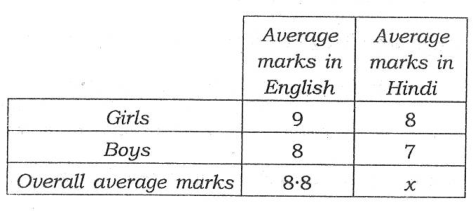
The overall English average of 8·8 lies four times nearer the girls' 9 than the boys' 8, so girls outnumber boys 4 : 1. Using the same weights on Hindi gives (4 × 8 + 1 × 7)/5 = 7·8.
Let there be g girls and b boys. English: 9g + 8b = 8·8(g + b).
So 0·2g = 0·8b, giving g : b = 4 : 1.
Hindi: x = (4 × 8 + 1 × 7)/5 = 39/5 = 7·8.
Check: English with the same weights = (4 × 9 + 8)/5 = 44/5 = 8·8.
Remember · Use the known overall average to find the group ratio, then apply that ratio to the other subject.
Question and answer: UPSC's official GS Paper II (2020, Series A) —
paper ↗ · answer key ↗.
Explanation: Minimalist IAS, checked 1 Oct 2026 (how we verify). Permalink ·
A family of two generations consisting of six members P, Q, R, S, T and U has three males and three females. There are two married couples and two unmarried siblings. U is P’s daughter and Q is R’s mother-in-law. T is an unmarried male and S is a male. Which one of the following is correct?
Answer & explanation▾
Answer: (b) R is S’s wife.
Q, a mother-in-law, belongs to the older couple, so P (U's parent) is her husband. Their children are U, T and one married child whose spouse is R. With three males already P, T and S, R must be female and married to S.
Q is R's mother-in-law, so Q is a woman of the older generation and R is married to Q's child.
Two couples: the older couple and R with Q's child. U is P's daughter, so P is the older couple's other member — P is Q's husband (male).
Males: P, T and S = three, so Q, U and R are the three females.
R, a female, is married to a son of Q. T is unmarried, so that son is S — R is S's wife.
The remaining two, U and T, are the unmarried siblings.
Check (a): R is female, so cannot be U's husband; (c): S is married.
Remember · In family puzzles, fix the generations first, then use the male/female count to settle the remaining roles.
Question and answer: UPSC's official GS Paper II (2020, Series A) —
paper ↗ · answer key ↗.
Explanation: Minimalist IAS, checked 30 Sept 2026 (how we verify). Permalink ·
If in a particular year 12th January is a Sunday, then which one of the following is correct?
Answer & explanation▾
Answer: (c) 12th July is a Sunday if the year is a leap year.
From 12 January to 12 July is 181 days in an ordinary year and 182 days in a leap year. 182 is exactly 26 weeks, so in a leap year 12 July falls on the same day, Sunday.
Days from 12 January to 12 July: January 31, February 28 or 29, March 31, April 30, May 31, June 30.
Ordinary year: 181 days = 25 weeks + 6 days, so 12 July is Saturday.
Leap year: 182 days = 26 weeks exactly, so 12 July is Sunday.
15 July is then Tuesday (ordinary year) or Wednesday (leap year), never Sunday — (a), (b) and (d) fail.
Remember · Count days between the two dates and divide by 7; the remainder is the number of weekdays to move forward.
Question and answer: UPSC's official GS Paper II (2020, Series A) —
paper ↗ · answer key ↗.
Explanation: Minimalist IAS, checked 30 Sept 2026 (how we verify). Permalink ·
Directions for the following 7 (seven) items: Read the following five passages and answer the items that follow. Your answers to these items should be based on the passages only.
Passage—1
Private investment in general is volatile. Foreign private investment is more volatile because the available investment avenues are significantly greater (i.e., the entire world). Therefore, the responsibility of providing employment cannot be left to Foreign Direct Investment (FDI). The current FDI inflows are volatile over time and across sectors and regions, which is a necessary consequence of their search for the highest returns. The adverse consequences are unstable employment and an accentuation of income and regional inequalities. A probable positive consequence of foreign investment is the inflow of new technology and its subsequent diffusion. However, the technology diffusion is not at all certain because the existing state of physical and human capital in India may prove inadequate for the diffusion.
With reference to the above passage, the following assumptions have been made:
1.Relying on foreign investment in the long run is not an economically sound policy.
2.Policies must be undertaken to reduce volatility in foreign private investment.
3.Policies must be undertaken to strengthen domestic private investment.
4.Public investment should be given priority over private investment.
5.Substantial public investment in education and health should be undertaken.
Which of the above assumptions is/are valid?
Answer & explanation▾
Answer: (b) 1, 3 and 5
Because FDI is volatile by nature and its technology gains depend on India's own physical and human capital, the passage implies: do not lean on foreign investment in the long run (1), build up domestic investment to carry employment (3), and invest in education and health so that technology can spread (5).
✓1.Employment 'cannot be left to' FDI, its volatility brings unstable jobs and wider inequalities, and even its technology benefit is 'not at all certain'.
✗2.The passage calls volatility 'a necessary consequence' of FDI's search for the highest returns — something built in, not something policy is expected to remove.
✓3.If employment cannot be entrusted to the more volatile foreign capital, the author must be counting on domestic investment to carry it.
✗4.The passage never ranks public against private investment; it contrasts foreign with domestic.
✓5.Technology diffusion may fail because India's 'physical and human capital' is inadequate; building human capital means investing in education and health.
Remember · In multi-statement items, settle the surest statements first; often only one option contains all of them.
Question and answer: UPSC's official GS Paper II (2020, Series A) —
paper ↗ · answer key ↗.
Explanation: Minimalist IAS, checked 30 Sept 2026 (how we verify). Permalink ·
Passage—2
Many opportunities to harness the highly skewed, seasonal and spatial distribution of monsoon flows, which occur in a four-month period from June to September annually, have been lost. Since these few months account for most of the rainfall and consequent freshwater availability, the need for holding rainwater in reservoirs, for subsequently releasing it for use over the year, is a necessity nobody can afford to overlook. Climate change will continue to affect weather conditions and create water shortages and excesses. While millions suffer from droughts and floods, waters in the country’s many rivers flow unutilized, and are discharged into the sea every year.
With reference to the above passage, which of the following could be the most rational and practical implications for India?
1.Inter-linking of rivers should be undertaken.
2.A network of dams and canals should be built across the country for proper distribution of water.
3.Farmers should be provided easy loans for digging borewells.
4.Usage of water for agriculture should be regulated by law.
5.Distribution of river water among regions should be regulated by the Union Government.
Select the correct answer using the code given below.
Answer & explanation▾
Answer: (a) 1 and 2
The passage's problem is that monsoon water comes in a short burst, unevenly across regions, and much of it runs to the sea while some areas face drought and others flood. Storing it (dams and canals) and moving it from surplus to deficit rivers (inter-linking) answer exactly that.
✓1.The monsoon flows have a skewed 'spatial distribution' and river waters 'flow unutilized' while millions face droughts and floods — linking rivers moves surplus water to deficit areas.
✓2.The passage calls holding rainwater in reservoirs and releasing it over the year 'a necessity nobody can afford to overlook'; dams and canals do this.
✗3.Borewells draw groundwater; they do nothing to capture the monsoon flows the passage says are being lost.
✗4.The passage is about capturing and storing water, not about legally restricting its use in farming.
✗5.Which level of government should allocate river water is never raised.
Remember · A practical implication must solve the passage's own problem; drop steps about other resources or about who holds power.
Question and answer: UPSC's official GS Paper II (2020, Series A) —
paper ↗ · answer key ↗.
Explanation: Minimalist IAS, checked 30 Sept 2026 (how we verify). Permalink ·
Passage—3
People will invest in education whenever they are granted the economic freedom to fully enjoy its benefits. Again, this is for the obvious reason that the return on education increases as the level of economic freedom rises. When people, thanks to lower tax rates, are allowed to retain most of the higher income that they gain from each incremental level of education, it makes eminent sense to invest in education. On the other hand, when the government decides to tax the higher income of educated individuals at even higher rates, it makes very little sense to invest in educating oneself further. The same incentives apply to parents who decide on whether to invest in their children’s education.
With reference to the above passage, the following assumptions have been made:
1.Lower tax rates in a country invariably translate into greater investments in higher education.
2.Investment in the education of children ensures their economic freedom.
3.Economic freedom has a positive impact on building up human capital.
Which of the above assumptions is/are valid?
Answer & explanation▾
Answer: (c) 3 only
The author argues that people invest more in education when they can keep its returns, that is, when economic freedom is greater. That supports the general link between economic freedom and human capital (3), but not the absolute claim in 1 or the reversed claim in 2.
✗1.Lower taxes make investing in education sensible, but 'invariably' is too strong, and the passage speaks of education in general, not 'higher education' alone.
✗2.The passage runs the other way: economic freedom encourages investment in education. It never says education guarantees economic freedom.
✓3.'The return on education increases as the level of economic freedom rises', so people invest more in education — that is, in human capital.
Remember · Watch for absolute words ('invariably', 'ensures') and for reversed cause and effect — both usually make an assumption invalid.
Question and answer: UPSC's official GS Paper II (2020, Series A) —
paper ↗ · answer key ↗.
Explanation: Minimalist IAS, checked 30 Sept 2026 (how we verify). Permalink ·
Passage—4
Our urban bodies cannot possibly ensure sustainable delivery of water in our cities unless financing mechanisms are put in place. Water delivery requires heavy investment in collecting it from a natural source, treating it to make it potable, and laying a distribution network of pipes for delivery to the users. It also requires investments in sewerage infrastructure and sewage treatment plants so that the sewers can carry the wastewater to these plants to ensure that no untreated sewage is discharged back into natural water bodies. If our cities were rich enough to meet the entire cost, water could be delivered free. They are not.
What is the most logical and crucial message conveyed by the passage?
Answer & explanation▾
Answer: (a) Urban local bodies must recover costs through user charges.
The passage lists the heavy costs of supplying water and treating sewage, says financing mechanisms are essential, and ends: water could be free only if cities could bear the whole cost — 'They are not.' The message is that the cost must be recovered, which points to charging users.
✓(a)Cities cannot meet 'the entire cost', so water cannot be delivered free; the financing the first line demands must come from the users of the service.
✗(b)The passage blames a lack of money, not inefficiency of the urban bodies.
✗(c)The author offers a way out — financing mechanisms — so the problem is not presented as unsolvable.
✗(d)Capping city populations is not discussed at all.
Remember · When a passage ends by ruling out 'free', its crucial message is about who should pay.
Question and answer: UPSC's official GS Paper II (2020, Series A) —
paper ↗ · answer key ↗.
Explanation: Minimalist IAS, checked 30 Sept 2026 (how we verify). Permalink ·
With reference to the above passage, the following assumptions have been made:
1.Rich cities only can ensure sustainable delivery of water.
2.Sustainable delivery of water in cities means much more than supplying water to households.
Which of the above assumptions is/are valid?
Answer & explanation▾
Answer: (b) 2 only
Sustainable delivery, as described, involves collecting, treating and piping water and also building sewers and treatment plants — far more than supplying households. The passage does not say only rich cities can manage it; any city can, once financing mechanisms are in place.
✗1.Riches would allow water to be delivered 'free'; sustainable delivery needs 'financing mechanisms', which cities that are not rich can also put in place.
✓2.It includes collecting and treating water, a distribution network, sewerage and sewage treatment so that 'no untreated sewage is discharged' into water bodies.
Remember · Test 'only' claims against the passage: if it names another way to reach the goal, the 'only' assumption fails.
Question and answer: UPSC's official GS Paper II (2020, Series A) —
paper ↗ · answer key ↗.
Explanation: Minimalist IAS, checked 30 Sept 2026 (how we verify). Permalink ·
Passage—5
In India, agriculture still engages about half of its workforce, and about 85 per cent of its farms are small and marginal. Compared to China and Vietnam, which have experienced fast structural and rural transformation, India’s story is of slow transformation. As a result, poverty reduction in India was at a much slower pace during 1988–2014, compared to China and Vietnam. India’s poverty reduction was slow during 1988–2005, but during 2005–2012, it accelerated dramatically—almost three times faster than during the earlier period. What did India do during this period? Research reveals that the relative price scenario changed significantly (by more than 50%) in favour of agriculture in the wake of rising global prices. This boosted private investments in agriculture by more than 50%. As a result, agri-GDP growth touched 4.1% during 2007–2012 as against 2.4% during 2002–2007. The net surplus of agri-trade touched $25 billion in 2013–2014; real farm wages rose by 7% per annum. All this led to unprecedented fall in poverty.
With reference to the above passage, the following assumptions have been made:
1.Structural and rural transformation is impossible when farms are mainly small and marginal.
2.A good price incentive can trigger investments in agriculture.
3.India needs to build value chains for high-value agri-products like livestock and horticulture.
4.Higher global prices of agricultural commodities are essential for India’s poverty reduction.
Which of the above assumptions are valid?
Answer & explanation▾
Answer: (c) 2 and 3
Statement 2 is the passage's own mechanism: better relative prices lifted private farm investment by over 50%. Statements 1 and 4 use absolute words ('impossible', 'essential') that the passage does not support, which leaves 2 and 3 as the only workable pair.
✗1.The passage calls India's transformation 'slow', not impossible, and does not make small farm size the barrier.
✓2.The relative price scenario moved in favour of agriculture by over 50%, and 'this boosted private investments in agriculture by more than 50%'.
✓3.Livestock and horticulture are not named, but the passage's lesson is that better returns on farm produce drive investment, growth and poverty reduction; value chains for high-value products are a way to secure such returns. It is the only remaining statement free of an overreach.
✗4.Global prices helped in one period, but 'essential' goes too far — the passage shows how the benefit came through prices and investment, not that poverty cannot fall any other way.
Remember · When one statement is certain, strike the options with extreme words ('impossible', 'essential'); the survivor is usually the answer.
Question and answer: UPSC's official GS Paper II (2020, Series A) —
paper ↗ · answer key ↗.
Explanation: Minimalist IAS, checked 30 Sept 2026 (how we verify). Permalink ·
Which one of the following statements best reflects the critical message of the passage?
Answer & explanation▾
Answer: (d) Inclusive agricultural growth is key to reduce poverty in the near future.
With half the workforce in farming and most farms small, the passage shows poverty falling fastest when agriculture grew — higher investment, faster agri-GDP growth and rising real farm wages. Growth that reaches this large farm population is the key to cutting poverty.
✗(a)The poverty fall came through agriculture itself; off-farm employment is not mentioned.
✗(b)Farmer producer companies are outside the passage.
✗(c)Private investment rose as a result of prices; the passage never compares it with public investment or ranks them.
✓(d)Agri-GDP growth of 4·1%, a trade surplus and real farm wages rising 7% a year together 'led to unprecedented fall in poverty' — growth that reached farmers and farm workers.
Remember · For the 'critical message', follow the passage's cause-and-effect chain to its end point and choose the option that names the whole chain.
Question and answer: UPSC's official GS Paper II (2020, Series A) —
paper ↗ · answer key ↗.
Explanation: Minimalist IAS, checked 30 Sept 2026 (how we verify). Permalink ·
Two Statements S1 and S2 are given below with regard to four numbers P, Q, R and S followed by a Question:
S1.R is greater than P as well as Q.
S2.S is not the largest one.
Question:Among four numbers P, Q, R and S, which one is the largest?
Which one of the following is correct in respect of the above Statements and the Question?
Answer & explanation▾
Answer: (c) S1 and S2 together are sufficient to answer the Question, but neither S1 alone nor S2 alone is sufficient to answer the Question.
S1 makes R bigger than P and Q but says nothing about S; S2 rules out S but says nothing about P, Q and R. Together, S is not the largest and R beats P and Q, so R is the largest.
S1 alone: R > P and R > Q, but S could exceed R — not sufficient.
S2 alone: the largest is one of P, Q, R — not sufficient.
Together: S is not the largest and R is above P and Q, so R is the largest.
Remember · Test each statement alone, then together; choose (c) only when neither alone works but the pair does.
Question and answer: UPSC's official GS Paper II (2020, Series A) —
paper ↗ · answer key ↗.
Explanation: Minimalist IAS, checked 30 Sept 2026 (how we verify). Permalink ·
Two Statements S1 and S2 are given below followed by a Question:
S1.n is a prime number.
S2.n leaves a remainder of 1 when divided by 4.
Question:If n is a unique natural number between 10 and 20, then what is n?
Which one of the following is correct in respect of the above Statements and the Question?
Answer & explanation▾
Answer: (d) S1 and S2 together are not sufficient to answer the Question.
Between 10 and 20 the primes are 11, 13, 17 and 19; of these, 13 and 17 both leave remainder 1 on division by 4. Even together the statements leave two possible values of n, so they are not sufficient.
S1: n = 11, 13, 17 or 19.
S2: n = 13 or 17 (the numbers between 10 and 20 that are 1 more than a multiple of 4).
Together: 13 and 17 both satisfy S1 and S2, so n is still not fixed.
Remember · In number data sufficiency, list every value that fits; if more than one survives, the data are insufficient.
Question and answer: UPSC's official GS Paper II (2020, Series A) —
paper ↗ · answer key ↗.
Explanation: Minimalist IAS, checked 30 Sept 2026 (how we verify). Permalink ·
Two Statements S1 and S2 are given below with regard to two numbers followed by a Question:
S1.Their product is 21.
S2.Their sum is 10.
Question:What are the two numbers?
Which one of the following is correct in respect of the above Statements and the Question?
Answer & explanation▾
Answer: (c) S1 and S2 together are sufficient to answer the Question, but neither S1 alone nor S2 alone is sufficient to answer the Question.
A product of 21 alone allows 3 and 7, 1 and 21 and many other pairs, and a sum of 10 alone allows endless pairs. Together, the numbers are the roots of t² − 10t + 21 = 0, which are exactly 3 and 7.
S1 alone: 3 × 7, 1 × 21, 2 × 10·5 … — not unique.
S2 alone: 3 + 7, 4 + 6, 5 + 5 … — not unique.
Together: the numbers satisfy t² − 10t + 21 = 0, i.e. (t − 3)(t − 7) = 0, so they are 3 and 7.
Remember · Two numbers are fixed by their sum and product together: they are the roots of t² − (sum)t + (product) = 0.
Question and answer: UPSC's official GS Paper II (2020, Series A) —
paper ↗ · answer key ↗.
Explanation: Minimalist IAS, checked 30 Sept 2026 (how we verify). Permalink ·
A man walks down the backside of his house straight 25 metres, then turns to the right and walks 50 metres again; then he turns towards left and again walks 25 metres. If his house faces to the East, what is his direction from the starting point?
Answer & explanation▾
Answer: (d) North-West
A house facing East has its back to the West, so he first walks West. A right turn from West points North, and a left turn from North points West again. He ends 50 m West and 50 m North of the start — North-West.
House faces East, so walking down its backside means walking West: 25 m West.
Right turn while facing West → facing North: 50 m North.
Left turn while facing North → facing West: 25 m West.
Net displacement: 50 m West and 50 m North, so he is North-West of the starting point.
Remember · Fix the first direction carefully (the back of an east-facing house is West), then apply each turn relative to the current heading.
Question and answer: UPSC's official GS Paper II (2020, Series A) —
paper ↗ · answer key ↗.
Explanation: Minimalist IAS, checked 30 Sept 2026 (how we verify). Permalink ·
Two Statements are given followed by two Conclusions:
Statements:All numbers are divisible by 2. All numbers are divisible by 3.
Conclusion-I:All numbers are divisible by 6.
Conclusion-II:All numbers are divisible by 4.
Which of the above Conclusions logically follows/follow from the two given Statements?
Answer & explanation▾
Answer: (a) Only Conclusion-I
A number divisible by both 2 and 3 is divisible by their LCM, 6, so Conclusion-I follows. Divisibility by 2 and 3 says nothing about a second factor of 2, so 4 need not divide the numbers — 6 itself is a counter-example.
2 and 3 have no common factor, so a number divisible by both is divisible by 2 × 3 = 6: Conclusion-I follows.
Divisibility by 4 needs two factors of 2; the statements guarantee only one.
Counter-example: 6 is divisible by 2 and 3 but not by 4, so Conclusion-II does not follow.
Remember · Divisible by a and b means divisible by LCM(a, b) — no more. Test any stronger claim with the LCM itself.
Question and answer: UPSC's official GS Paper II (2020, Series A) —
paper ↗ · answer key ↗.
Explanation: Minimalist IAS, checked 30 Sept 2026 (how we verify). Permalink ·
Two Statements are given followed by two Conclusions:
Statements:All cats are dogs. All cats are black.
Conclusion-I:All dogs are black.
Conclusion-II:Some dogs are not black.
Which of the above Conclusions logically follows/follow from the two given Statements, disregarding commonly known facts?
Answer & explanation▾
Answer: (c) Neither Conclusion-I nor Conclusion-II
The statements only tell us that every cat is both a dog and black, so some dogs are black. The other dogs may be black or not: 'all dogs are black' and 'some dogs are not black' are each possible, but neither is forced, so neither follows.
Cats lie inside both 'dogs' and 'black', so some dogs (the cats) are black.
Diagram 1: dogs outside the cats circle are not black — then Conclusion-I fails.
Diagram 2: all dogs lie inside 'black' — then Conclusion-II fails.
Each conclusion fails in some valid diagram, so neither follows. (Exactly one of them is true in any given case, but the statements do not tell us which.)
Remember · Draw one diagram where a conclusion fails; if you can, it does not follow. Contradictory conclusions can both fail to follow.
Question and answer: UPSC's official GS Paper II (2020, Series A) —
paper ↗ · answer key ↗.
Explanation: Minimalist IAS, checked 30 Sept 2026 (how we verify). Permalink ·
How many odd numbers are followed by the odd number in the above sequence?
Answer & explanation▾
Answer: (b) 6
Scan the 26 digits once and mark every place where an odd digit is immediately followed by another odd digit. There are six such places: 5-1, 7-3, 3-9, 5-7, 3-1 and 1-5.
After 5-8 the odd digits are 3, 5, 3 and 9, and each is followed by an even digit (8, 2, 4, 6).
Total odd-odd pairs = 6.
Remember · For adjacency counts, scan pairs left to right in one pass and tick each hit; do not restart counting.
Question and answer: UPSC's official GS Paper II (2020, Series A) —
paper ↗ · answer key ↗.
Explanation: Minimalist IAS, checked 30 Sept 2026 (how we verify). Permalink ·
A is 16th from the left end in a row of boys and V is 18th from the right end. G is 11th from A towards the right and 3rd from V towards the right end. How many boys are there in the row?
Answer & explanation▾
Answer: (b) 41
G is 11 places to the right of A, so G is 27th from the left. G is also 3 places to the right of V, so V is 24th from the left. V is 18th from the right, so the row has 24 + 18 − 1 = 41 boys.
A is 16th from the left; G is 11th to A's right, so G is 16 + 11 = 27th from the left.
G is 3rd to V's right, so V is 27 − 3 = 24th from the left.
V is 18th from the right, so total = 24 + 18 − 1 = 41.
Check: G is then 41 − 27 + 1 = 15th from the right, which is 3 places right of V (18th).
Remember · Convert every position to one end, then total = position from left + position from right − 1.
Question and answer: UPSC's official GS Paper II (2020, Series A) —
paper ↗ · answer key ↗.
Explanation: Minimalist IAS, checked 30 Sept 2026 (how we verify). Permalink ·
Three Statements S1, S2 and S3 are given below followed by a Question:
S1.C is younger than D, but older than A and B.
S2.D is the oldest.
S3.A is older than B.
Question:Who among A, B, C and D is the youngest?
Which one of the following is correct in respect of the above Statements and the Question?
Answer & explanation▾
Answer: (d) S1 and S3 together are sufficient to answer the Question.
S1 puts D above C and C above both A and B, so the youngest is A or B. S3 settles that pair: A is older than B, so B is the youngest. S2 adds nothing S1 did not already give.
S1: D > C > A and D > C > B, so the youngest is A or B — S1 alone is not enough.
S2 only repeats that D is the oldest, so S1 and S2 together still leave A or B.
S2 and S3: A > B, but C's position is unknown — C could be youngest.
S1 and S3: D > C > A > B, so B is the youngest.
Remember · Find what each statement leaves open, then pick the statement that closes exactly that gap.
Question and answer: UPSC's official GS Paper II (2020, Series A) —
paper ↗ · answer key ↗.
Explanation: Minimalist IAS, checked 30 Sept 2026 (how we verify). Permalink ·
How many integers are there between 1 and 100 which have 4 as a digit but are not divisible by 4?
Answer & explanation▾
Answer: (c) 12
There are 19 numbers below 100 containing the digit 4: 4, 14, 24, 34, 40 to 49, and 54, 64, 74, 84, 94. Seven of them are multiples of 4, which leaves 12.
Multiples of 4 among them: 4, 24, 40, 44, 48, 64, 84 = 7.
Required count = 19 − 7 = 12.
Remember · Count the whole set first, then subtract the ones to exclude — fewer chances to miss a number.
Question and answer: UPSC's official GS Paper II (2020, Series A) —
paper ↗ · answer key ↗.
Explanation: Minimalist IAS, checked 30 Sept 2026 (how we verify). Permalink ·
Let x, y be the volumes; m, n be the masses of two metallic cubes P and Q respectively. Each side of Q is two times that of P and mass of Q is two times that of P. Let u = m/x and v = n/y. Which one of the following is correct?
Answer & explanation▾
Answer: (a) u = 4v
Doubling the side multiplies a cube's volume by 2³ = 8, while the mass only doubles. So Q's mass per unit volume is 2/8 = 1/4 of P's, i.e. u = 4v.
Side of Q = 2 × side of P, so y = 2³ x = 8x.
n = 2m.
v = n/y = 2m/8x = (1/4)(m/x) = u/4.
So u = 4v.
Remember · Scaling a length by k scales volume by k³; compare ratios by writing each in terms of the smaller object.
Question and answer: UPSC's official GS Paper II (2020, Series A) —
paper ↗ · answer key ↗.
Explanation: Minimalist IAS, checked 30 Sept 2026 (how we verify). Permalink ·
The average age of a teacher and three students is 20 years. If all the three students are of same age and the difference between the age of the teacher and each student is 20 years, then what is the age of the teacher?
Answer & explanation▾
Answer: (c) 35 years
The four ages total 80. If each student is s years old, the teacher is s + 20, so 4s + 20 = 80 gives s = 15 and the teacher is 35.
Total of the four ages = 4 × 20 = 80.
Let each student be s years; the teacher is s + 20.
3s + (s + 20) = 80, so 4s = 60 and s = 15.
Teacher = 15 + 20 = 35 years.
Check: (35 + 15 + 15 + 15)/4 = 80/4 = 20.
Remember · Turn an average into a total first; then express every person in one unknown.
Question and answer: UPSC's official GS Paper II (2020, Series A) —
paper ↗ · answer key ↗.
Explanation: Minimalist IAS, checked 30 Sept 2026 (how we verify). Permalink ·
A person bought a car and sold it for ₹ 3,00,000. If he incurred a loss of 20%, then how much did he spend to buy the car?
Answer & explanation▾
Answer: (d) ₹ 3,75,000
A 20% loss means the selling price is 80% of the cost. So the cost is 3,00,000 ÷ 0·8 = ₹ 3,75,000.
Selling price = 80% of cost price.
Cost price = 3,00,000 ÷ 0·8 = ₹ 3,75,000.
Check: 20% of 3,75,000 = 75,000, and 3,75,000 − 75,000 = 3,00,000.
Remember · Loss and profit percentages are on cost price: CP = SP ÷ (1 − loss%).
Question and answer: UPSC's official GS Paper II (2020, Series A) —
paper ↗ · answer key ↗.
Explanation: Minimalist IAS, checked 30 Sept 2026 (how we verify). Permalink ·
Directions for the following 6 (six) items: Read the following five passages and answer the items that follow. Your answers to these items should be based on the passages only.
Passage—1
Spanish ships in the late 16th century first brought the potato tuber from South America to Europe whereby in the early 19th century, it had become a reliable backup to cereal crops, particularly in the cold, rain-soaked soils of Ireland. The Irish were soon almost wholly dependent on the potato as their staple food. And they were planting primarily one prodigious variety, the ‘Lumper’ potato, whose genetic frailty would be cruelly exposed by the fungus ‘Phytophthora infestans’. In 1845, spores of the deadly fungus began spreading across the country, destroying nearly all the Lumpers in its path. The resulting famine killed or displaced millions.
Which one of the following statements best reflects the critical message of the passage?
Answer & explanation▾
Answer: (d) Relying on a homogeneous food source is not desirable.
Ireland depended almost wholly on the potato, and mostly on a single variety, the Lumper. When one fungus struck that genetically frail variety, nearly the whole food supply failed at once. The lesson is the danger of depending on a uniform food source.
✗(a)The potato suited Ireland's 'cold, rain-soaked soils' well; the famine came from disease, not unsuitable soil or climate.
✗(b)The potato did serve as Ireland's staple; the passage faults reliance on one variety, not tubers as such.
✗(c)The passage does not say the fungus was unstoppable; the scale of disaster came from nearly all plants being the same vulnerable variety.
✓(d)The Irish were 'almost wholly dependent' on the potato and planted 'primarily one' variety, whose 'genetic frailty' let one fungus destroy nearly all of it.
Remember · Ask what turned one fungus into a national famine; the 'critical message' is that underlying cause, not the event itself.
Question and answer: UPSC's official GS Paper II (2020, Series A) —
paper ↗ · answer key ↗.
Explanation: Minimalist IAS, checked 30 Sept 2026 (how we verify). Permalink ·
Passage—2
India is at once among the fastest growing global economies and home to the largest number of malnourished children in the world. There are regions where malnutrition is not the exception but the norm. And across the country, malnutrition is the cause of death for roughly half the 1.3 million children who die before their fifth birthday each year. Even those children who survive suffer permanently from the damage that has already been done to their bodies and minds from not getting enough of the right foods and nutrients. Around 44 million children under 5 are stunted. That makes it harder for them to learn in school and subsequently earn a living as adults. Their lifetime earnings potential is almost a quarter less than that of their healthy peers.
With reference to the above passage, which of the following is/are the most rational and practical implication/implications?
1.India’s Public Distribution System should be monitored by the Union Government.
2.Girls should be encouraged to delay marriage and first pregnancy.
3.Mothers should be encouraged to breastfeed their children immediately after birth.
4.The supply of safe drinking water and proper sanitation facilities to all should be ensured.
5.Authorities should ensure the vaccination as prescribed.
Select the correct answer using the code given below.
Answer & explanation▾
Answer: (b) 2, 3, 4 and 5
The passage describes child malnutrition that kills, stunts and harms learning and earnings. Delayed marriage and pregnancy, early breastfeeding, safe water and sanitation, and vaccination all act directly on a young child's nutrition and health. Who monitors the PDS is an administrative question the passage gives no basis for.
✗1.The passage says nothing about the PDS failing or about which government should monitor it; shifting control does not follow from the problem described.
✓2.Very early pregnancies often mean undernourished mothers and low-weight babies; delaying marriage and first pregnancy gives the child a healthier start against the early damage the passage describes.
✓3.Children suffer from 'not getting enough of the right foods and nutrients'; breastfeeding from birth is the first and most direct source of them.
✓4.Unsafe water and poor sanitation cause repeated infections that stop a child's body from using food, feeding the stunting the passage describes.
✓5.Malnutrition causes about half of under-5 deaths; preventing diseases through vaccination protects already weak children and their growth.
Remember · For 'practical implications', keep steps that act directly on the problem described; drop those about which authority should control a scheme.
Question and answer: UPSC's official GS Paper II (2020, Series A) —
paper ↗ · answer key ↗.
Explanation: Minimalist IAS, checked 30 Sept 2026 (how we verify). Permalink ·
Passage—3
The pulse variety ‘Pusa Arhar 16’ has the potential to be grown in the paddy-growing regions of Punjab, Haryana and Uttar Pradesh and eventually in all of India. Its yield (about 2000 kg/hectare) will be significantly greater than those of the existing varieties and because its size will be uniform, it will be amenable to mechanical harvesting, an attractive feature for farmers in northern India who currently use this technology for paddy. Most important, Arhar straw, unlike paddy straw, is green and can be ploughed back into the soil. In paddy straw, the problem is the high silica content, which does not allow for easy decomposition. In the case of Arhar, the farmer, even after combine harvesting, just needs to run a rotovator to cut the leftover straw into pieces, which can be ploughed back and will decompose very fast. All this is difficult with leftover paddy stalks that cannot be easily salvaged or ploughed back. Farmers, therefore, choose the easiest option of simply burning it.
Which of the following are the most rational inferences that can be made from the passage?
1.Farmers’ income will be higher with pulse cultivation than with paddy cultivation.
2.Pulse cultivation causes less pollution as compared to paddy cultivation.
3.Pulse straw can be used to improve soil quality.
4.In the context of northern Indian agriculture, paddy straw has no usefulness.
5.Mechanized agriculture is the main cause for stubble burning.
Select the correct answer using the code given below.
Answer & explanation▾
Answer: (c) 2 and 3 only
Arhar straw is green, decomposes fast and can be ploughed back, while silica-rich paddy straw is hard to break down and so gets burnt. Two inferences follow: growing this pulse avoids the burning that pollutes (2), and its straw can enrich the soil (3).
✗1.The yield is compared with 'existing varieties' of arhar, not with paddy; nothing is said about income.
✓2.Paddy stalks are burnt because they cannot be ploughed back, while arhar straw is ploughed in — so the pulse crop avoids the smoke from stubble burning.
✓3.Arhar straw 'can be ploughed back into the soil' and 'will decompose very fast', returning organic matter to the soil.
✗4.The passage says paddy straw is hard to decompose or salvage, not that it has 'no usefulness' at all.
✗5.Arhar is also combine-harvested yet its straw is not burnt; the cause is paddy straw's 'high silica content'.
Remember · Reject inferences that compare things the passage never compares (income) or use extreme words ('no usefulness', 'main cause').
Question and answer: UPSC's official GS Paper II (2020, Series A) —
paper ↗ · answer key ↗.
Explanation: Minimalist IAS, checked 30 Sept 2026 (how we verify). Permalink ·
Passage—4
In India, authorities always look to store the maximum amount of water in reservoirs during the monsoon season, which is then used for irrigation and generation of electricity during the summer months. It is an internationally accepted practice that the water level of a reservoir should be kept below a certain level before the onset of monsoon season. This is so that when monsoon rains come, there is space to store the excess rainwater and also so that water can be released in a regulated manner. But the authorities store the maximum amount of water in reservoirs even before the close of the monsoon, only to ensure greater electricity generation and irrigation.
With reference to the above passage, the following assumptions have been made:
1.High risks involved in holding maximum water in reservoirs are due to our over-dependence on hydropower projects.
2.Storage capacity of dams should not be fully used before or during monsoon season.
3.Role of dams in flood control is underestimated in India.
Which of the above assumptions is/are valid?
Answer & explanation▾
Answer: (d) 1, 2 and 3
Why not the tempting option · UPSC's key accepts all three assumptions. Statement 1 is the weakest, because the passage blames the drive for electricity and irrigation rather than 'over-dependence on hydropower'; but statements 2 and 3 both follow from the passage, and only option (d) contains both, so (d) is the best answer available. In the exam, settle the clear statements first and let the options decide a doubtful one.
The author contrasts the international practice of keeping a reservoir below a set level before the monsoon, so that excess rain can be stored and released in a regulated way, with Indian authorities who fill reservoirs early for power and irrigation. Statement 2 restates that practice, statement 3 is what the author's criticism rests on, and statement 1 names the drive for electricity that the passage blames; UPSC's key accepts all three.
✓1.The passage says authorities fill reservoirs early 'only to ensure greater electricity generation and irrigation'; the push for power output is treated as the reason for the risky practice. This is the loosest of the three statements, but only option (d) contains both 2 and 3, so it must be taken as valid.
✓2.The accepted practice is to keep the level 'below a certain level before the onset of monsoon season' so that there is 'space to store the excess rainwater'.
✓3.By leaving no space for excess rain and regulated release, the authorities act as if a dam's flood-cushioning role mattered less than power and irrigation; the author's complaint assumes that role is being under-valued.
Remember · When two statements are clearly valid, let the option grid decide the third: only (d) holds both 2 and 3.
Question and answer: UPSC's official GS Paper II (2020, Series A) —
paper ↗ · answer key ↗.
Explanation: Minimalist IAS, checked 1 Oct 2026 (how we verify). Permalink ·
Passage—5
Economic liberalization in India was shaped largely by the economic problems of the government than by the economic priorities of the people or by the long-term development objectives. Thus, there were limitations in conception and design which have been subsequently validated by experience. Jobless growth, persistent poverty and rising inequality have mounted as problems since economic liberalization began. And all these years later, four quiet crises confront the economy; agriculture, infrastructure, industrialization and education as constraints on the country’s future prospects. These problems must be resolved if economic growth has to be sustained and transformed into meaningful development.
Which of the following is/are the most rational and logical inference/inferences that can be made from the passage?
1.It is essential to rethink and redefine the economic role of the State in the quest for development.
2.India has not made effective implementation of its policies in social sectors nor made sufficient investments in them.
Select the correct answer using the code given below.
Answer & explanation▾
Answer: (c) Both 1 and 2
UPSC's official answer: (c) · the answer UPSC accepted, and the one that counts in the exam
Also defensible: (a)
Inference 1 follows: the reforms were shaped 'by the economic problems of the government than by the economic priorities of the people or by the long-term development objectives', had 'limitations in conception and design', and 'these problems must be resolved' for growth to become development, so the State's economic role needs rethinking.
Inference 2 claims two specific failures: poor implementation of social-sector policies and insufficient investment in them. The passage names outcomes only, 'jobless growth, persistent poverty and rising inequality' and 'four quiet crises' in 'agriculture, infrastructure, industrialization and education'. It says nothing about how any policy was implemented or how much was invested.
UPSC's key takes the one step from those outcomes to their likely cause and accepts 2, giving (c); an inference that must rest on what the passage says stops at 1, giving (a).
UPSC's key is (c); a strict reading, on which an inference rests only on what the passage says, gives (a). In the exam, allow UPSC's one step from stated outcomes to their likely cause, but no more.
This box is Minimalist IAS's analysis, with its sources; it does not change UPSC's answer.
The passage says liberalization was shaped by the government's own economic problems rather than by people's priorities or long-term development goals, that its design flaws have been confirmed by experience — jobless growth, persistent poverty, rising inequality and four quiet crises including education — and that these must be resolved for growth to become meaningful development. UPSC's key takes both inferences as following: the State's economic role needs rethinking (1), and the social outcomes show that social-sector policies were neither delivered well nor funded enough (2).
✓1.The reforms reflected the government's problems, not 'the economic priorities of the people or ... the long-term development objectives', had 'limitations in conception and design', and 'these problems must be resolved' — so the State's economic role in development needs to be rethought and redefined.
✓2.Persistent poverty, rising inequality and a crisis in education decades into reform are the passage's evidence on the social side; UPSC's key reads them as showing that policies in the social sectors were neither effectively implemented nor adequately funded — the one step of reasoning that 'most rational and logical' allows.
Remember · For 'most rational and logical inference', ask what the passage's stated outcomes and causes, taken together, point to; UPSC allows one step of common-sense reasoning from outcome to cause.
Question and answer: UPSC's official GS Paper II (2020, Series A) —
paper ↗ · answer key ↗.
Explanation: Minimalist IAS, checked 1 Oct 2026 (how we verify). Permalink ·
With reference to the above passage, the following assumptions have been made:
1.India’s economy needs to be greatly integrated with global economy so as to create large number of jobs and to sustain its growth momentum.
2.Economic liberalization would cause large economic growth which would reduce poverty and create sufficient employment in the long run.
Which of the above assumptions is/are valid?
Answer & explanation▾
Answer: (d) Neither 1 nor 2
The passage is critical of how liberalization was designed and lists jobless growth, persistent poverty and inequality as its results. It neither prescribes deeper global integration nor assumes that liberalization will in time reduce poverty and create enough jobs — its evidence points the other way.
✗1.Integration with the global economy is never proposed; the remedies the passage points to lie in agriculture, infrastructure, industrialization and education.
✗2.The author reports 'jobless growth, persistent poverty and rising inequality' since liberalization began — the opposite of this assumption.
Remember · An assumption the author's own evidence contradicts cannot be valid.
Question and answer: UPSC's official GS Paper II (2020, Series A) —
paper ↗ · answer key ↗.
Explanation: Minimalist IAS, checked 30 Sept 2026 (how we verify). Permalink ·
A shop owner offers the following discount options on an article to a customer:
1.Successive discounts of 10% and 20%, and then pay a service tax of 10%
2.Successive discounts of 20% and 10%, and then pay a service tax of 10%
3.Pay a service tax of 10% first, then successive discounts of 20% and 10%
Which one of the following is correct?
Answer & explanation▾
Answer: (d) All the options are equally good for the customer.
Each option multiplies the price by the same three factors — 0·9, 0·8 and 1·1 — only in a different order. Multiplication does not depend on order, so the customer pays the same in every case.
Take the price as ₹ 100.
Option 1: 100 × 0·9 × 0·8 × 1·1 = ₹ 79·2.
Option 2: 100 × 0·8 × 0·9 × 1·1 = ₹ 79·2.
Option 3: 100 × 1·1 × 0·8 × 0·9 = ₹ 79·2.
All three cost the same, so all options are equally good.
Remember · Successive percentage changes are multiplying factors; their order never changes the final result.
Question and answer: UPSC's official GS Paper II (2020, Series A) —
paper ↗ · answer key ↗.
Explanation: Minimalist IAS, checked 30 Sept 2026 (how we verify). Permalink ·
The letters from A to Z are numbered from 1 to 26 respectively. If GHI = 1578 and DEF = 912, then what is ABC equal to?
Answer & explanation▾
Answer: (d) 246
G, H, I are 7, 8, 9 and 789 × 2 = 1578; D, E, F are 4, 5, 6 and 456 × 2 = 912. So each code is the three letter numbers written together and doubled: ABC = 123 × 2 = 246.
GHI → 7, 8, 9 → 789; 789 × 2 = 1578.
DEF → 4, 5, 6 → 456; 456 × 2 = 912.
ABC → 1, 2, 3 → 123; 123 × 2 = 246.
Remember · In number codes, write the letter positions side by side first and look for a single operation that gives the code.
Question and answer: UPSC's official GS Paper II (2020, Series A) —
paper ↗ · answer key ↗.
Explanation: Minimalist IAS, checked 30 Sept 2026 (how we verify). Permalink ·
Going from ACPQ to BESU, the four letters move forward by 1, 2, 3 and 4 places. Applying the same shifts to MNGI gives N, P, J and M.
A → B (+1), C → E (+2), P → S (+3), Q → U (+4).
M + 1 = N, N + 2 = P, G + 3 = J, I + 4 = M.
The missing term is NPJM.
Remember · In letter analogies, write the shift for each position separately; the shifts often run 1, 2, 3, 4.
Question and answer: UPSC's official GS Paper II (2020, Series A) —
paper ↗ · answer key ↗.
Explanation: Minimalist IAS, checked 30 Sept 2026 (how we verify). Permalink ·
A negative power of a fraction flips it: (1/a)⁻ⁿ = aⁿ. The four values are 2⁶ = 64, 4³ = 64, 3⁴ = 81 and 6² = 36, so (1/3)⁻⁴ is the largest.
(1/2)⁻⁶ = 2⁶ = 64.
(1/4)⁻³ = 4³ = 64.
(1/3)⁻⁴ = 3⁴ = 81.
(1/6)⁻² = 6² = 36.
The largest is 81, i.e. (1/3)⁻⁴.
Remember · (1/a) raised to −n equals aⁿ; rewrite every option this way before comparing.
Question and answer: UPSC's official GS Paper II (2020, Series A) —
paper ↗ · answer key ↗.
Explanation: Minimalist IAS, checked 30 Sept 2026 (how we verify). Permalink ·
What is the greatest length x such that 3½ m and 8¾ m are integral multiples of x?
Answer & explanation▾
Answer: (d) 1¾ m
The greatest length that divides both is their HCF. In quarters of a metre the lengths are 14/4 and 35/4, and HCF(14, 35) = 7, so x = 7/4 = 1¾ m.
3½ = 14/4 m and 8¾ = 35/4 m.
HCF(14, 35) = 7, so the greatest common length = 7/4 m = 1¾ m.
Check: 3½ ÷ 1¾ = 2 and 8¾ ÷ 1¾ = 5, both whole numbers.
Remember · HCF of fractions: put them over a common denominator, take the HCF of the numerators, keep the denominator.
Question and answer: UPSC's official GS Paper II (2020, Series A) —
paper ↗ · answer key ↗.
Explanation: Minimalist IAS, checked 30 Sept 2026 (how we verify). Permalink ·
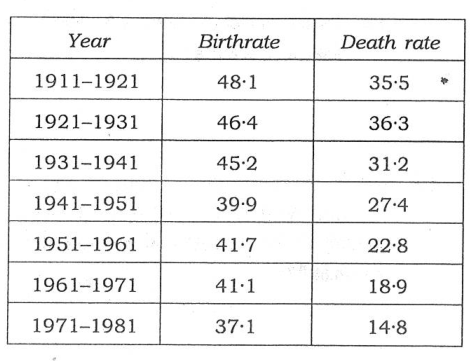
For which period was the natural growth rate maximum?
Answer & explanation▾
Answer: (d) 1971–1981
Natural growth rate is birth rate minus death rate. The gaps for the four offered periods are 12·6, 12·5, 22·2 and 22·3, so 1971–1981 is the highest, just ahead of 1961–1971.
1911–1921: 48·1 − 35·5 = 12·6.
1941–1951: 39·9 − 27·4 = 12·5.
1961–1971: 41·1 − 18·9 = 22·2.
1971–1981: 37·1 − 14·8 = 22·3 — the maximum.
Check: the periods not offered are lower too (10·1, 14·0, 18·9).
Remember · Natural growth = birth rate − death rate. Compute only the offered periods, and compute the close ones exactly.
Question and answer: UPSC's official GS Paper II (2020, Series A) —
paper ↗ · answer key ↗.
Explanation: Minimalist IAS, checked 1 Oct 2026 (how we verify). Permalink ·
The recurring decimal representation 1.272727... is equivalent to
Answer & explanation▾
Answer: (b) 14/11
The repeating block 27 has two digits, so 0·2727... = 27/99 = 3/11. Adding the whole part gives 1 + 3/11 = 14/11.
Let x = 1·2727...; then 100x = 127·2727...
100x − x = 126, so x = 126/99 = 14/11.
Check: 14 ÷ 11 = 1·2727...
Remember · A pure recurring decimal 0·(ab) repeating = ab/99; handle the whole-number part separately.
Question and answer: UPSC's official GS Paper II (2020, Series A) —
paper ↗ · answer key ↗.
Explanation: Minimalist IAS, checked 30 Sept 2026 (how we verify). Permalink ·
What is the least four-digit number when divided by 3, 4, 5 and 6 leaves a remainder 2 in each case?
Answer & explanation▾
Answer: (b) 1022
A number leaving remainder 2 with each divisor is 2 more than a common multiple of 3, 4, 5 and 6. Their LCM is 60, the first four-digit multiple of 60 is 1020, and so the answer is 1022.
LCM(3, 4, 5, 6) = 60.
Smallest four-digit multiple of 60: 60 × 17 = 1020 (60 × 16 = 960 has three digits).
Remember · Same remainder r for every divisor: the number = k × LCM + r. Find the smallest k that gives the required size.
Question and answer: UPSC's official GS Paper II (2020, Series A) —
paper ↗ · answer key ↗.
Explanation: Minimalist IAS, checked 30 Sept 2026 (how we verify). Permalink ·
In adult population of a city, 40% men and 30% women are married. What is the percentage of married adult population if no man marries more than one woman and no woman marries more than one man; and there are no widows and widowers?
Answer & explanation▾
Answer: (c) 34 2/7%
Every married man has exactly one wife in the city, so married men equal married women: 40% of men = 30% of women, which makes men : women = 3 : 4. Then 1·2 + 1·2 = 2·4 of every 7 adults are married, i.e. 34 2/7%.
Married men = married women, so 0·4M = 0·3W, giving M : W = 3 : 4.
Take 3 men and 4 women: married men = 0·4 × 3 = 1·2, married women = 0·3 × 4 = 1·2.
Married adults = 2·4 out of 7 = 24/70 = 12/35.
12/35 × 100 = 240/7 = 34 2/7%.
Remember · In marriage-count problems, equate married men and married women first; that fixes the ratio of the two groups.
Question and answer: UPSC's official GS Paper II (2020, Series A) —
paper ↗ · answer key ↗.
Explanation: Minimalist IAS, checked 30 Sept 2026 (how we verify). Permalink ·
What is the remainder when 51 × 27 × 35 × 62 × 75 is divided by 100?
Answer & explanation▾
Answer: (a) 50
Only the last two digits matter. 62 × 75 = 4650 ends in 50, and multiplying a number ending in 50 by any odd number again ends in 50. The other factors 51, 27 and 35 are all odd, so the remainder is 50.
62 × 75 = 4650, which ends in 50.
50 × (odd number) always ends in 50, since 50 × odd = 100k + 50.
51 × 27 × 35 = 48195 is odd, so the whole product ends in 50.
Remainder = 50.
Remember · Remainder on division by 100 = last two digits; pair factors that quickly give a round ending like 50 or 00.
Question and answer: UPSC's official GS Paper II (2020, Series A) —
paper ↗ · answer key ↗.
Explanation: Minimalist IAS, checked 30 Sept 2026 (how we verify). Permalink ·
A sum of ₹ 2,500 is distributed among X, Y and Z in the ratio 1/2: 3/4: 5/6. What is the difference between the maximum share and the minimum share?
Answer & explanation▾
Answer: (c) ₹ 400
Clearing the fractions by multiplying by 12 turns the ratio into 6 : 9 : 10, a total of 25 parts worth ₹ 100 each. The largest share (10 parts) exceeds the smallest (6 parts) by 4 parts, or ₹ 400.
Multiply 1/2 : 3/4 : 5/6 by 12 to get 6 : 9 : 10.
Total parts = 25; one part = 2,500 ÷ 25 = ₹ 100.
Maximum − minimum = (10 − 6) × 100 = ₹ 400.
Check: shares 600 + 900 + 1,000 = 2,500.
Remember · For a ratio of fractions, multiply every term by the LCM of the denominators to get whole-number parts.
Question and answer: UPSC's official GS Paper II (2020, Series A) —
paper ↗ · answer key ↗.
Explanation: Minimalist IAS, checked 30 Sept 2026 (how we verify). Permalink ·
For what value of n, the sum of digits in the number (10ⁿ + 1) is 2?
Answer & explanation▾
Answer: (b) For any whole number n
For any positive integer n, 10ⁿ + 1 is 1 followed by zeros and a final 1, so its digit sum is 2. For n = 0 it is 1 + 1 = 2, whose digit sum is also 2. So it holds for every whole number 0, 1, 2, …, but not for fractional n, where 10ⁿ + 1 is not a whole number.
n = 1, 2, 3 …: 11, 101, 1001 … — digit sum 2.
n = 0: 10⁰ + 1 = 2 — digit sum 2.
n = 1/2: 10ⁿ + 1 = √10 + 1 ≈ 4·16, not a whole number, so 'any real number' fails.
So the statement holds for any whole number n.
Remember · Always test the edge value n = 0 before choosing 'positive integers only'.
Question and answer: UPSC's official GS Paper II (2020, Series A) —
paper ↗ · answer key ↗.
Explanation: Minimalist IAS, checked 30 Sept 2026 (how we verify). Permalink ·
In a class, there are three groups A, B and C. If one student from group A and two students from group B are shifted to group C, then what happens to the average weight of the students of the class?
Answer & explanation▾
Answer: (c) It remains the same.
Shifting students between groups inside the class changes the group averages but not the class as a whole: the same students with the same total weight remain. So the class average stays the same.
Class average = total weight of all students ÷ number of students in the class.
Moving students from A and B to C keeps every student in the class.
Both the total weight and the head count are unchanged, so the class average is unchanged.
Remember · Ask which total is being averaged; moving members within that total leaves its average unchanged.
Question and answer: UPSC's official GS Paper II (2020, Series A) —
paper ↗ · answer key ↗.
Explanation: Minimalist IAS, checked 30 Sept 2026 (how we verify). Permalink ·
How many different sums can be formed with the denominations ₹ 50, ₹ 100, ₹ 200, ₹ 500 and ₹ 2,000 taking at least three denominations at a time?
Answer & explanation▾
Answer: (a) 16
Choosing 3, 4 or all 5 of the five denominations gives 10 + 5 + 1 = 16 selections. Each denomination is more than the sum of all the smaller ones, so no two selections can give the same amount — all 16 sums are different.
Ways to choose 3, 4 or 5 of 5 denominations: ⁵C₃ + ⁵C₄ + ⁵C₅ = 10 + 5 + 1 = 16.
100 > 50, 200 > 50 + 100, 500 > 50 + 100 + 200 and 2,000 > 850, so different selections always give different totals.
Number of different sums = 16.
Check: the 16 sums run from ₹ 350 (50 + 100 + 200) to ₹ 2,850 (all five) with no repeats.
Remember · Count selections with nCr, then check whether two selections can give the same total before answering.
Question and answer: UPSC's official GS Paper II (2020, Series A) —
paper ↗ · answer key ↗.
Explanation: Minimalist IAS, checked 30 Sept 2026 (how we verify). Permalink ·
Directions for the following 6 (six) items: Read the following five passages and answer the items that follow. Your answers to these items should be based on the passages only.
Passage—1
Bank credit to the industrial sector has started shrinking. Its decline has been a serious concern as credit growth is essential to revive investment. The problem’s origins lie in the incomplete reforms of the last 25 years. An institutional change that should have followed the 1991 reforms should have been setting up of a resolution corporation for banks. In a market economy with booms and busts, banks should be allowed to be set up and to fail. Today, we cannot shut down banks because there is no proper system to shut them down. Weak loss-making banks continue to need more capital.
Which one of the following is the most logical and rational inference that can be made from the above passage?
Answer & explanation▾
Answer: (c) India lacks the institutional mechanism to deal with the failure of banks.
The author traces shrinking industrial credit to one missing reform: a resolution corporation for banks. Because there is 'no proper system to shut them down', weak banks keep needing capital. The direct inference is that India lacks a mechanism to handle bank failure.
✗(a)Too sweeping: the passage flags shrinking credit to industry, not a banking system unable to support growth at all.
✗(b)The reforms are called 'incomplete' in one specific respect; the passage does not judge the whole economy against expectations.
✓(c)A 'resolution corporation for banks' was never set up, and 'there is no proper system to shut them down'.
✗(d)Foreign investment as a substitute for bank credit is never discussed.
Remember · Pick the inference that states the passage's own diagnosis; reject sweeping verdicts built from one problem.
Question and answer: UPSC's official GS Paper II (2020, Series A) —
paper ↗ · answer key ↗.
Explanation: Minimalist IAS, checked 30 Sept 2026 (how we verify). Permalink ·
Passage—2
India has tremendous potential for solar energy. We all realize that we have to stop burning fossil fuels to meet our energy needs. But certain renewable resources are still going through their cost curves and learning curves to get the required amount of output. The Indian Government has strongly committed to its targets of reducing emissions by 33 per cent by 2030, and towards this it has initiated a strong push towards a gas-based economy and has also invested heavily in renewable energy. However, business houses are wary of investing too heavily in renewable energy at a time when the technology is not yet ready.
Which one of the following is the most logical and rational inference that can be made from the above passage?
Answer & explanation▾
Answer: (c) Getting renewable resources to market too soon may be costly.
Renewables are 'still going through their cost curves and learning curves', and business houses hesitate to invest heavily while 'the technology is not yet ready'. The sound inference is that pushing these resources to market before they mature may prove costly.
✗(a)The government is 'strongly committed' and acting on two fronts; the passage makes no prediction that the target will be missed.
✗(b)Importing gas is not mentioned, and the passage does not ask India to stop investing in renewables.
✓(c)Technology still on its cost and learning curves is expensive per unit of output — which is why businesses are 'wary of investing too heavily' now.
✗(d)The passage mentions a push towards a gas-based economy but nothing about exploration.
Remember · Inferences should stay as cautious as the passage; predictions of failure and new policy prescriptions usually overreach.
Question and answer: UPSC's official GS Paper II (2020, Series A) —
paper ↗ · answer key ↗.
Explanation: Minimalist IAS, checked 30 Sept 2026 (how we verify). Permalink ·
With reference to the above passage, the following assumptions have been made:
1.Governments often provide inefficient and costly subsidies for technologies that may not be ready in the near future.
2.India’s commitment of reducing emissions by 33% by 2030 shall be on the basis of gas-based economy.
Which of the above assumptions is/are valid?
Answer & explanation▾
Answer: (a) 1 only
The government has 'invested heavily' in renewable energy even though the technology is 'not yet ready' and still costly — the passage's warning is that such early public spending can be inefficient and expensive (1). The emissions target rests on both a gas-based push and renewables, not on gas alone, so 2 fails.
✓1.The contrast between heavy government investment and business wariness 'at a time when the technology is not yet ready' assumes that public money put into unready technology can be inefficient and costly — the same idea as item 62's answer.
✗2.Towards the target the government 'has initiated a strong push towards a gas-based economy and has also invested heavily in renewable energy' — both, not gas alone.
Remember · Read 'and also' carefully: a goal pursued through two means cannot be said to rest on one of them.
Question and answer: UPSC's official GS Paper II (2020, Series A) —
paper ↗ · answer key ↗.
Explanation: Minimalist IAS, checked 30 Sept 2026 (how we verify). Permalink ·
Passage—3
Genome editing is different from genome modification. Genome editing typically involves finding the part of a plant genome that could be changed to render it less vulnerable to disease, or resistant to certain herbicides, or to increase yields. Researchers use ‘molecular scissors’ to dissect the genome and repair it, which is a process that occurs naturally when plants are under attack from diseases and can throw up new mutations that enable the plant to survive future attacks. This evolutionary process can effectively be speeded up now that it is possible to examine plant genomes in detail in laboratories, and create mechanisms through which the relevant genes can be altered very precisely.
With reference to the above passage, the following assumptions have been made:
1.Genome editing does not require the transfer of genes from one plant to another.
2.Through genome editing, the chosen genes can be altered precisely in a manner akin to the natural process that helps plants to adapt to the environmental factors.
Which of the above assumptions is/are valid?
Answer & explanation▾
Answer: (c) Both 1 and 2
The passage separates genome editing from genome modification: editing finds and changes the relevant part of the plant's own genome, as plants do naturally under attack. So it needs no gene transfer from another plant (1), and it alters chosen genes precisely in a way akin to the natural adaptive process (2).
✓1.Editing works by 'finding the part of a plant genome' to change and repairing it with molecular scissors; the stated contrast with genome modification implies that no gene is brought in from another plant.
✓2.The cutting and repair 'occurs naturally when plants are under attack', and laboratories can now alter 'the relevant genes ... very precisely', speeding up this evolutionary process.
Remember · When a passage opens with 'X is different from Y', expect an assumption that captures the difference.
Question and answer: UPSC's official GS Paper II (2020, Series A) —
paper ↗ · answer key ↗.
Explanation: Minimalist IAS, checked 30 Sept 2026 (how we verify). Permalink ·
Passage—4
Many people understand the connection between solid waste management and health in terms of the consequences of unattended heaps of dry garbage which become home for flies and other vermin. However, there is another aspect that is not well-understood, that is, what happens when unscientific solid waste management combines with poor drainage and dumping of untreated sewage into drains which are meant to carry storm water during rains. The result is choked drains which are full of stagnant water breeding mosquitoes, resulting in the spread of water-borne diseases.
In the context of India, which one of the following statements best reflects the critical message of the passage?
Answer & explanation▾
Answer: (c) Solid waste management should be integrated with the maintenance of drainage and sewerage networks.
The less understood danger, the author says, arises when poor solid waste management combines with poor drainage and sewage dumped into storm drains, producing choked drains that breed mosquitoes. The message is that these systems must be managed together, not in isolation.
✗(a)The passage says untreated sewage is dumped into storm-water drains, but it does not claim India has no separate networks; that detail is not the message.
✗(b)Resources and legal powers of local bodies are not discussed.
✓(c)The harm comes from 'unscientific solid waste management' combining with 'poor drainage and dumping of untreated sewage into drains' — so they must be handled as one system.
✗(d)The consequence described is disease from stagnant water, not drinking water shortage.
Remember · When a passage says harm arises when two failures 'combine', the critical message is usually to tackle them together.
Question and answer: UPSC's official GS Paper II (2020, Series A) —
paper ↗ · answer key ↗.
Explanation: Minimalist IAS, checked 30 Sept 2026 (how we verify). Permalink ·
Passage—5
In Part III of the Constitution, which assures people certain fundamental rights, Article 25 proclaims that “all persons are equally entitled to freedom of conscience and the right freely to profess, practise and propagate religion”. What people fail to notice is that this proclamation is prefixed with the words “subject to public order, morality, health and to the other provisions of this Part”, which set conditions precedent for the legal protection of religious practices of any community. The closing words of this prefatory rider in Article 25 virtually constitute a subordination clause placing other fundamental rights mentioned in Part III over and above the right to religious freedom. Among those other fundamental rights is the right to equality before law and equal protection of laws—assured at the outset and elaborated in later articles to mean, inter alia, that the State shall not deny equal protection of laws to any person or group of persons on the basis of religion alone.
What is the most logical inference from the above passage?
Answer & explanation▾
Answer: (b) Religious freedom under the Constitution is open to State intervention.
Article 25 grants religious freedom 'subject to public order, morality, health and to the other provisions' of Part III, which places other fundamental rights, such as equality before law, above it. So religious freedom is conditional, and the State can step in on these grounds.
✗(a)The 'subject to' rider allows State action on grounds of public order, morality, health and other fundamental rights.
✓(b)The rider sets 'conditions precedent' for protecting religious practices and subordinates religious freedom to the other rights in Part III.
✗(c)Article 25 sits in Part III, which 'assures people certain fundamental rights' — religious freedom is one of them.
✗(d)This reverses the passage, which stresses that religious practices are protected only subject to these conditions.
Remember · Look for the qualifier ('subject to', 'except', 'unless'); the inference usually follows from the limit, not the grant.
Question and answer: UPSC's official GS Paper II (2020, Series A) —
paper ↗ · answer key ↗.
Explanation: Minimalist IAS, checked 30 Sept 2026 (how we verify). Permalink ·
How many different 5-letter words (with or without meaning) can be constructed using all the letters of the word ‘DELHI’ so that each word has to start with D and end with I?
Answer & explanation▾
Answer: (d) 6
With D fixed first and I fixed last, only E, L and H are left to arrange in the three middle places. Three distinct letters can be arranged in 3! = 6 ways.
Positions 1 and 5 are fixed: D _ _ _ I.
E, L and H fill the three middle places in 3! = 3 × 2 × 1 = 6 ways.
Check: DELHI, DEHLI, DLEHI, DLHEI, DHELI, DHLEI — six words.
Remember · Fix the letters whose places are given, then arrange only the remaining ones: n distinct letters give n! orders.
Question and answer: UPSC's official GS Paper II (2020, Series A) —
paper ↗ · answer key ↗.
Explanation: Minimalist IAS, checked 30 Sept 2026 (how we verify). Permalink ·
A bottle contains 20 litres of liquid A. 4 litres of liquid A is taken out of it and replaced by same quantity of liquid B. Again 4 litres of the mixture is taken out and replaced by same quantity of liquid B. What is the ratio of quantity of liquid A to that of liquid B in the final mixture?
Answer & explanation▾
Answer: (c) 16: 9
Each removal takes away 4/20 = 1/5 of whatever A is present, leaving 4/5 of it. After two rounds A = 20 × (4/5)² = 12·8 litres and B = 7·2 litres, a ratio of 16 : 9.
After the first replacement: A = 20 − 4 = 16 litres.
Second removal takes 1/5 of the mixture, so A falls to 16 × 4/5 = 12·8 litres.
Question and answer: UPSC's official GS Paper II (2020, Series A) —
paper ↗ · answer key ↗.
Explanation: Minimalist IAS, checked 30 Sept 2026 (how we verify). Permalink ·
The average score of a batsman after his 50th innings was 46.4. After 60th innings, his average score increases by 2.6. What was his average score in the last ten innings?
Answer & explanation▾
Answer: (c) 62
Turn both averages into totals: 50 × 46·4 = 2320 and 60 × 49 = 2940. The last ten innings added 620 runs, an average of 62.
Runs after 50 innings = 50 × 46·4 = 2320.
New average = 46·4 + 2·6 = 49; runs after 60 innings = 60 × 49 = 2940.
Runs in the last 10 innings = 2940 − 2320 = 620.
Average of the last 10 = 620 ÷ 10 = 62.
Remember · Averages over different counts: convert each to a total, subtract, and divide by the new count.
Question and answer: UPSC's official GS Paper II (2020, Series A) —
paper ↗ · answer key ↗.
Explanation: Minimalist IAS, checked 30 Sept 2026 (how we verify). Permalink ·
As a result of 25% hike in the price of rice per kg, a person is able to purchase 6 kg less rice for ₹ 1,200. What was the original price of rice per kg?
Answer & explanation▾
Answer: (b) ₹ 40
A 25% price rise means the same money buys 1/1·25 = 4/5 of the earlier quantity, i.e. 1/5 less. That lost fifth is 6 kg, so ₹ 1,200 used to buy 30 kg, at ₹ 40 a kg.
New price = 5/4 of old, so quantity for ₹ 1,200 becomes 4/5 of the old quantity — a fall of 1/5.
1/5 of old quantity = 6 kg, so old quantity = 30 kg.
Original price = 1,200 ÷ 30 = ₹ 40 per kg.
Check: new price ₹ 50 buys 1,200 ÷ 50 = 24 kg, which is 6 kg less.
Remember · Price up by 1/n means quantity down by 1/(n + 1) for the same spending; here 25% = 1/4, so quantity falls by 1/5.
Question and answer: UPSC's official GS Paper II (2020, Series A) —
paper ↗ · answer key ↗.
Explanation: Minimalist IAS, checked 30 Sept 2026 (how we verify). Permalink ·
A person X can complete 20% of work in 8 days and another person Y can complete 25% of the same work in 6 days. If they work together, in how many days will 40% of the work be completed?
Answer & explanation▾
Answer: (a) 6
X would finish the whole work in 40 days and Y in 24 days, so together they do 1/40 + 1/24 = 1/15 of it each day. 40% of the work therefore takes 0·4 × 15 = 6 days.
X: 20% in 8 days, so 100% in 40 days. Y: 25% in 6 days, so 100% in 24 days.
Together per day: 1/40 + 1/24 = 3/120 + 5/120 = 8/120 = 1/15.
Whole work together = 15 days; 40% of it = 0·4 × 15 = 6 days.
Check: in 6 days X does 6/40 = 15% and Y does 6/24 = 25%; total 40%.
Remember · Convert partial work to full-job time first, add daily rates, then scale to the fraction of work asked.
Question and answer: UPSC's official GS Paper II (2020, Series A) —
paper ↗ · answer key ↗.
Explanation: Minimalist IAS, checked 30 Sept 2026 (how we verify). Permalink ·
A car travels from a place X to place Y at an average speed of v km/hr, from Y to X at an average speed of 2v km/hr, again from X to Y at an average speed of 3v km/hr and again from Y to X at an average speed of 4v km/hr. Then the average speed of the car for the entire journey
Answer & explanation▾
Answer: (b) lies between v and 2v km/hr
All four legs cover the same distance, so the slow legs take the most time and pull the average down. Total time = (d/v)(1 + 1/2 + 1/3 + 1/4) = 25d/12v for a distance of 4d, giving an average of 48v/25 = 1·92v.
Let XY = d km. Total distance = 4d.
Total time = d/v + d/2v + d/3v + d/4v = (d/v)(12 + 6 + 4 + 3)/12 = 25d/12v.
Average speed = 4d ÷ (25d/12v) = 48v/25 = 1·92v.
1·92v lies between v and 2v.
Remember · For equal distances at different speeds, average speed is the harmonic mean — always closer to the slower speeds.
Question and answer: UPSC's official GS Paper II (2020, Series A) —
paper ↗ · answer key ↗.
Explanation: Minimalist IAS, checked 30 Sept 2026 (how we verify). Permalink ·
1.The minimum number of points of intersection of a square and a circle is 2.
2.The maximum number of points of intersection of a square and a circle is 8.
Which of the above statements is/are correct?
Answer & explanation▾
Answer: (b) 2 only
A circle and a square need not meet at all — a small circle can sit inside the square without touching it — so the minimum is 0, not 2. Each side is a straight segment that can cut a circle at most twice, so four sides give at most 8 points, and 8 is actually reachable.
A small circle inside the square, or one far away from it, meets the square in 0 points — so the minimum is 0.
A straight line meets a circle in at most 2 points; the square has 4 sides, so at most 4 × 2 = 8 points.
8 is reached by a circle with the square's centre whose radius is more than half the side but less than half the diagonal: it crosses each side twice.
✗1.The minimum is 0 — the circle can lie wholly inside or wholly outside the square without touching it.
✓2.Four sides × at most 2 crossings each = 8, and a suitably sized concentric circle achieves it.
Remember · For 'minimum' claims, look for the case where the figures do not touch at all; for 'maximum', count lines × 2 for a circle.
Question and answer: UPSC's official GS Paper II (2020, Series A) —
paper ↗ · answer key ↗.
Explanation: Minimalist IAS, checked 30 Sept 2026 (how we verify). Permalink ·
A man takes half time in rowing a certain distance downstream than upstream. What is the ratio of the speed in still water to the speed of current?
Answer & explanation▾
Answer: (d) 3: 1
Half the time over the same distance means the downstream speed is twice the upstream speed. So b + c = 2(b − c), which gives b = 3c: still-water speed : current = 3 : 1.
Let the speed in still water be b and the current c.
Downstream time is half the upstream time, so downstream speed = 2 × upstream speed.
b + c = 2(b − c), so b = 3c.
b : c = 3 : 1.
Check: b = 3, c = 1 gives speeds 4 and 2 — half the time downstream.
Remember · Same distance: time ratio is the inverse of speed ratio. Downstream = b + c, upstream = b − c.
Question and answer: UPSC's official GS Paper II (2020, Series A) —
paper ↗ · answer key ↗.
Explanation: Minimalist IAS, checked 30 Sept 2026 (how we verify). Permalink ·
How many pairs of natural numbers are there such that the difference of whose squares is 63?
Answer & explanation▾
Answer: (a) 3
x² − y² = (x − y)(x + y) = 63, so each way of writing 63 as a product of two factors gives one pair. 63 = 1 × 63 = 3 × 21 = 7 × 9, giving (32, 31), (12, 9) and (8, 1).
x² − y² = (x − y)(x + y) = 63, with x − y < x + y.
Factor pairs of 63: (1, 63), (3, 21), (7, 9) — all odd, so x and y come out whole.
(1, 63): x = 32, y = 31. (3, 21): x = 12, y = 9. (7, 9): x = 8, y = 1.
Remember · Difference of squares: factor the number as (x − y)(x + y) with both factors of the same parity; each factor pair gives one solution.
Question and answer: UPSC's official GS Paper II (2020, Series A) —
paper ↗ · answer key ↗.
Explanation: Minimalist IAS, checked 30 Sept 2026 (how we verify). Permalink ·
Which one of the following will have minimum change in its value if 5 is added to both numerator and the denominator of the fractions 2/3, 3/4, 4/5 and 5/6?
Answer & explanation▾
Answer: (d) 5/6
Each fraction has the form n/(n + 1). Adding 5 to both parts changes it by 5/[(n + 1)(n + 6)], which shrinks as n grows. So 5/6, the largest, changes least (by 5/66).
2/3 → 7/8: change 7/8 − 2/3 = 5/24 ≈ 0·208.
3/4 → 8/9: change 5/36 ≈ 0·139.
4/5 → 9/10: change 5/50 = 0·1.
5/6 → 10/11: change 5/66 ≈ 0·076 — the smallest.
Remember · Adding the same number to top and bottom pushes a proper fraction towards 1; fractions already closer to 1 move less.
Question and answer: UPSC's official GS Paper II (2020, Series A) —
paper ↗ · answer key ↗.
Explanation: Minimalist IAS, checked 30 Sept 2026 (how we verify). Permalink ·
Remember · When a condition pins a single digit, find that digit first and then test every option numerically.
Question and answer: UPSC's official GS Paper II (2020, Series A) —
paper ↗ · answer key ↗.
Explanation: Minimalist IAS, checked 30 Sept 2026 (how we verify). Permalink ·
If 1 litre of water weighs 1 kg, then how many cubic millimetres of water will weigh 0.1 gm?
Answer & explanation▾
Answer: (c) 100
1 litre = 1 kg means 1 gram of water occupies 1 cm³. Since 1 cm³ = 10 × 10 × 10 = 1000 mm³, 0·1 g occupies 100 mm³.
1 litre = 1000 cm³ weighs 1 kg = 1000 g, so 1 g of water = 1 cm³.
1 cm³ = 10 mm × 10 mm × 10 mm = 1000 mm³.
0·1 g = 0·1 cm³ = 100 mm³.
Remember · Water: 1 g = 1 cm³ = 1 mL; and 1 cm³ = 1000 mm³.
Question and answer: UPSC's official GS Paper II (2020, Series A) —
paper ↗ · answer key ↗.
Explanation: Minimalist IAS, checked 30 Sept 2026 (how we verify). Permalink ·
A vessel full of water weighs 40 kg. If it is one-third filled, its weight becomes 20 kg. What is the weight of the empty vessel?
Answer & explanation▾
Answer: (a) 10 kg
Going from full to one-third full removes two-thirds of the water and 20 kg of weight, so the full water weighs 30 kg. The empty vessel is 40 − 30 = 10 kg.
Full: vessel + water = 40 kg. One-third full: vessel + water/3 = 20 kg.
Subtracting: (2/3) × water = 20 kg, so water = 30 kg.
Empty vessel = 40 − 30 = 10 kg.
Check: 10 + 30/3 = 20 kg.
Remember · Subtract the two readings: the difference belongs to the water alone, which fixes the water's full weight.
Question and answer: UPSC's official GS Paper II (2020, Series A) —
paper ↗ · answer key ↗.
Explanation: Minimalist IAS, checked 30 Sept 2026 (how we verify). Permalink ·
A frog tries to come out of a dried well 4.5 m deep with slippery walls. Every time the frog jumps 30 cm, slides down 15 cm. What is the number of jumps required for the frog to come out of the well?
Answer & explanation▾
Answer: (b) 29
Each jump-and-slide gains a net 15 cm, but the final jump does not slide back. The frog needs to be within 30 cm of the top, i.e. at 420 cm, before its last jump; 28 jumps with slides get it there, and the 29th jump takes it out.
Well depth = 450 cm; net gain per jump-and-slide = 30 − 15 = 15 cm.
The last jump of 30 cm must start from at least 450 − 30 = 420 cm.
420 ÷ 15 = 28 jumps (with slides) to reach 420 cm.
The 29th jump lifts it from 420 to 450 cm and out — 29 jumps.
Check: after 27 jumps it is at 405 cm; the 28th reaches only 435 cm and slides back to 420 cm.
Remember · Climb-and-slip problems: subtract the last full jump from the height, count net gains to reach that point, then add one jump.
Question and answer: UPSC's official GS Paper II (2020, Series A) —
paper ↗ · answer key ↗.
Explanation: Minimalist IAS, checked 30 Sept 2026 (how we verify). Permalink ·