Minimalist IAS
CSAT

CSAT · 58 questions

Data interpretation & sufficiency

Every UPSC CSAT question on this topic, 2016–2026, newest first. Tap an option to check yourself; the answer and explanation open below it.

Data interpretation & sufficiency questions per year: 2016: 0, 2017: 1, 2018: 13, 2019: 0, 2020: 6, 2021: 5, 2022: 7, 2023: 5, 2024: 10, 2025: 5, 2026: 6 Asked in 9 of 11 years · most in 2018 (13)

UPSC syllabus: “Basic numeracy (numbers and their relations, orders of magnitude, etc.) (Class X level), Data interpretation (charts, graphs, tables, data sufficiency etc. — Class X level);” See the full syllabus →

Showing 1–30 of 58, newest first.

CSAT 2026 · Q1

Medium Provisional key

Directions for the following 5 (five) items: Each item in this section contains a question followed by two statements. Answer each item using the following instructions and mark your response on the Answer Sheet accordingly.

Question: X receives three coins of different denominations: 1, 2, 5, 10 and 20. If the total amount received by X is m, does X receive a coin of denomination 5?

  1. Statement I: m is not a prime number.
  2. Statement II: The sum of the digits of m is greater than 5.
Answer & explanation

Answer: (a) Select this option if the question can be answered using one of these statements alone, but cannot be answered using other statement

There are only ten ways to pick three different coins, so list their totals. Every total whose digits add up to more than 5 includes the 5-coin, so Statement II settles it; Statement I leaves 32 (2 + 10 + 20) as an exception.

  1. Three different coins from {1, 2, 5, 10, 20} can be chosen in 10 ways.
  2. With the 5-coin: 1+2+5 = 8, 1+5+10 = 16, 1+5+20 = 26, 2+5+10 = 17, 2+5+20 = 27, 5+10+20 = 35.
  3. Without the 5-coin: 1+2+10 = 13, 1+2+20 = 23, 1+10+20 = 31, 2+10+20 = 32.
  4. Statement I (m not prime): m can be 8, 16, 26, 27, 35 (5-coin present) or 32 (5-coin absent). Not sufficient.
  5. Statement II (digit sum > 5): 8, 16, 26, 17, 27, 35 have digit sums 8, 7, 8, 8, 9, 8; the totals without the 5-coin have digit sums 4, 5, 4, 5. So m always includes the 5-coin. Sufficient.
  6. One statement alone works and the other does not.
  • ✗ Statement I Not sufficient alone: non-prime totals include 32 = 2 + 10 + 20, which has no 5-coin, as well as 8, 16, 26, 27 and 35, which do.
  • ✓ Statement II Sufficient alone: every total with digit sum above 5 (8, 16, 17, 26, 27, 35) uses the 5-coin; totals without it (13, 23, 31, 32) have digit sums of only 4 or 5.

Remember · In data sufficiency with a small finite set, list every case first, then test each statement against the list.

Question and answer: UPSC's provisional GS Paper II (2026, Series A) — paper ↗ · answer key ↗. Explanation: Minimalist IAS, checked 30 Sept 2026 (how we verify). Permalink ·
CSAT 2026 · Q2

Medium Provisional key

Directions for the following 5 (five) items: Each item in this section contains a question followed by two statements. Answer each item using the following instructions and mark your response on the Answer Sheet accordingly.

Question: For two distinct real numbers x and y, which of them is bigger?

  1. Statement I: x² < y < 1
  2. Statement II: y < √x < 1
Answer & explanation

Answer: (d) Select this option if the question cannot be answered even using any of the statements

Both statements together only trap y between x² and √x, and for 0 < x < 1 the number x itself lies inside that gap. So y can sit on either side of x and the question stays open.

  1. Statement I: x = 0.9, y = 0.85 fits (0.81 < 0.85 < 1) and gives x > y; x = 0.1, y = 0.5 also fits and gives y > x. Not sufficient.
  2. Statement II: √x < 1 means 0 ≤ x < 1. x = 0.25, y = 0.4 fits (0.4 < 0.5) with y > x; x = 0.25, y = 0.1 fits with y < x. Not sufficient.
  3. Together: x² < y < √x with 0 < x < 1. Take x = 0.25: y must lie between 0.0625 and 0.5.
  4. y = 0.4 gives y > x, y = 0.1 gives y < x. Still not decided.
  5. Check: for 0 < x < 1, x² < x < √x, so x always lies inside the allowed range of y.
  • ✗ Statement I Not sufficient alone: x = 0.9, y = 0.85 and x = 0.1, y = 0.5 both satisfy it but order x and y differently.
  • ✗ Statement II Not sufficient alone: with x = 0.25, both y = 0.4 and y = 0.1 are below √x = 0.5, yet one is above x and one below.

Remember · For numbers between 0 and 1, x² < x < √x. A range that straddles x never decides which is bigger.

Question and answer: UPSC's provisional GS Paper II (2026, Series A) — paper ↗ · answer key ↗. Explanation: Minimalist IAS, checked 30 Sept 2026 (how we verify). Permalink ·

CSAT 2026 · Q3

Easy Provisional key

Directions for the following 5 (five) items: Each item in this section contains a question followed by two statements. Answer each item using the following instructions and mark your response on the Answer Sheet accordingly.

Question: If x and y are integers, then is x even?

  1. Statement I: x²y² is even.
  2. Statement II: 1 + x² + y² is odd.
Answer & explanation

Answer: (c) Select this option if the question can be answered using both the statements together, but cannot be answered using either statement alone

Statement I says at least one of x and y is even; Statement II says x and y have the same parity. Only together do they force both to be even, which answers the question.

  1. Statement I: x²y² = (xy)² is even, so xy is even, so at least one of x, y is even. x could be odd (x = 1, y = 2). Not sufficient.
  2. Statement II: 1 + x² + y² is odd, so x² + y² is even, so x and y are both even or both odd. Not sufficient.
  3. Together: they share parity and at least one is even, so both are even. x is even — answered.
  4. Check: x = 1, y = 1 satisfies II but not I; x = 2, y = 2 satisfies both.
  • ✗ Statement I Not sufficient alone: x = 1, y = 2 gives x²y² = 4 (even) with x odd, while x = 2, y = 1 gives x even.
  • ✗ Statement II Not sufficient alone: it only says x and y have the same parity; x = y = 1 and x = y = 2 both fit.

Remember · Parity items: turn each statement into a plain rule (at least one even / same parity), then combine the rules.

Question and answer: UPSC's provisional GS Paper II (2026, Series A) — paper ↗ · answer key ↗. Explanation: Minimalist IAS, checked 30 Sept 2026 (how we verify). Permalink ·

CSAT 2026 · Q4

Medium Provisional key

Directions for the following 5 (five) items: Each item in this section contains a question followed by two statements. Answer each item using the following instructions and mark your response on the Answer Sheet accordingly.

Question: X is a collection of certain odd numbers whereas Y is a collection of certain even numbers. T consists of the numbers all of which are either from X or from Y. Is every number of T from Y?

  1. Statement I: The sum of any two numbers belonging to T is even.
  2. Statement II: If both p and q are picked from T, then (p − 1)q is even.
Answer & explanation

Answer: (d) Select this option if the question cannot be answered even using any of the statements

Each statement only tells us that T cannot mix odd and even numbers. An all-odd T and an all-even T satisfy both statements, so whether T comes wholly from Y cannot be decided.

  1. Statement I: the sum of two numbers is even only when both have the same parity. So T is all odd or all even. Not sufficient.
  2. Statement II: if T is all odd, p − 1 is even, so (p − 1)q is even. If T is all even, q is even, so (p − 1)q is even. Both cases fit.
  3. A mixed T fails II: an even p and an odd q give (odd) × (odd) = odd. So II also means 'all odd or all even'. Not sufficient.
  4. Together: an all-odd T (from X) and an all-even T (from Y) satisfy both statements. Still not answered.
  • ✗ Statement I Not sufficient alone: T = {1, 3} and T = {2, 4} both have even pairwise sums.
  • ✗ Statement II Not sufficient alone: for T = {1, 3}, p − 1 is always even; for T = {2, 4}, q is always even. Both give (p − 1)q even.

Remember · When every statement is satisfied by two opposite cases, even combined, mark 'cannot be answered'.

Question and answer: UPSC's provisional GS Paper II (2026, Series A) — paper ↗ · answer key ↗. Explanation: Minimalist IAS, checked 30 Sept 2026 (how we verify). Permalink ·

CSAT 2026 · Q5

Easy Provisional key

Directions for the following 5 (five) items: Each item in this section contains a question followed by two statements. Answer each item using the following instructions and mark your response on the Answer Sheet accordingly.

Question: If x, y and z are integers, each greater than 1, then is x a prime number?

  1. Statement I: xy² = 116
  2. Statement II: xz = 261
Answer & explanation

Answer: (a) Select this option if the question can be answered using one of these statements alone, but cannot be answered using other statement

Factorise both numbers: 116 = 2² × 29 and 261 = 3² × 29. The first leaves only y = 2 and x = 29, a prime; the second allows x = 3, 9, 29 or 87, so it cannot decide.

  1. 116 = 2² × 29. With y > 1, the only square factor is y² = 4, so y = 2 and x = 29.
  2. 29 is prime, so Statement I alone answers the question (yes).
  3. 261 = 3² × 29. With x, z > 1, x can be 3, 9, 29 or 87.
  4. 3 and 29 are prime but 9 and 87 are not, so Statement II alone cannot answer.
  5. One statement alone works and the other does not.
  • ✓ Statement I Sufficient alone: 116 = 4 × 29 forces y = 2 and x = 29, which is prime.
  • ✗ Statement II Not sufficient alone: 261 = 9 × 29 allows x = 3 or 29 (prime) and x = 9 or 87 (not prime).

Remember · Prime factorisation first; then ask which factor splits are allowed by the given conditions (here, every variable > 1).

Question and answer: UPSC's provisional GS Paper II (2026, Series A) — paper ↗ · answer key ↗. Explanation: Minimalist IAS, checked 30 Sept 2026 (how we verify). Permalink ·

CSAT 2026 · Q70

Medium Provisional key

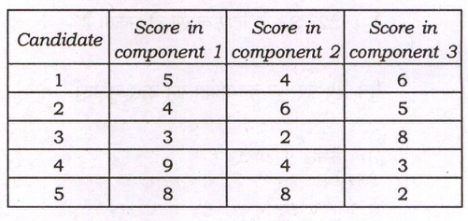
In a recruitment process, the selection of candidates is based on their performance in three components. The weightages of the components 1, 2 and 3 are 0.2, 0.3 and 0.5, respectively. Use the data given below and find the cutoff score if exactly three candidates are to be selected:

CandidateScore in component 1Score in component 2Score in component 3
1546
2465
3328
4943
5882
Table of scores of five candidates in components 1, 2 and 3.
From UPSC's question paper.
Answer & explanation

Answer: (a) 5.1

Weighted scores are 5·2, 5·1, 5·2, 4·5 and 5·0 for candidates 1 to 5. The top three are 5·2, 5·2 and 5·1, so a cutoff of 5·1 selects exactly three.

  1. Candidate 1: 0·2 × 5 + 0·3 × 4 + 0·5 × 6 = 1 + 1·2 + 3 = 5·2.
  2. Candidate 2: 0·8 + 1·8 + 2·5 = 5·1.
  3. Candidate 3: 0·6 + 0·6 + 4 = 5·2.
  4. Candidate 4: 1·8 + 1·2 + 1·5 = 4·5.
  5. Candidate 5: 1·6 + 2·4 + 1 = 5·0.
  6. Ranked: 5·2, 5·2, 5·1, 5·0, 4·5. For exactly three selections the cutoff is 5·1 (a cutoff of 5·2 would select only two).

Remember · Weighted score = Σ(weight × score). The cutoff is the lowest score among those who must be selected.

Question and answer: UPSC's provisional GS Paper II (2026, Series A) — paper ↗ · answer key ↗. Explanation: Minimalist IAS, checked 1 Oct 2026 (how we verify). Permalink ·

A question is given followed by two Statements I and II. Consider the Question and the Statements and mark the correct option.

Question:

What is the smallest 1-digit number having exactly 4 distinct factors?

  1. Statement I: 2 is one of the factors.
  2. Statement II: 3 is one of the factors.

Which one of the following is correct in respect of the above Question and the Statements?

Answer & explanation

Answer: (d) The Question can be answered even without using any of the Statements.

Among one-digit numbers only 6 (factors 1, 2, 3, 6) and 8 (factors 1, 2, 4, 8) have exactly four factors, so the smallest is 6. The question answers itself; the statements add nothing.

  1. List factor counts for 1–9: only 6 (1, 2, 3, 6) and 8 (1, 2, 4, 8) have exactly 4 factors.
  2. The smallest such number is 6 — found from the question alone.
  3. The statements (2 and 3 are factors) are true of 6 but are not needed.
  • ✗ Statement I Not needed: the question already fixes the answer as 6.
  • ✗ Statement II Not needed: 6 is found without it.

Remember · In data sufficiency, first try the question alone; if it is already settled, choose 'even without using any of the Statements'.

Question and answer: UPSC's official GS Paper II (2025, Series A) — paper ↗ · answer key ↗. Explanation: Minimalist IAS, checked 30 Sept 2026 (how we verify). Permalink ·

A question is given followed by two Statements I and II. Consider the Question and the Statements and mark the correct option.

Question:

Let P, Q, R, S be distinct non-zero digits. If PP × PQ = RRSS, where P ≤ 3 and Q ≤ 4, then what is Q equal to?

  1. Statement I: R = 1.
  2. Statement II: S = 2.

Which one of the following is correct in respect of the above Question and the Statements?

Answer & explanation

Answer: (d) The Question can be answered even without using any of the Statements.

Dividing both sides by 11 gives P × PQ = 100R + S, which must be at least 100. With P ≤ 3 and Q ≤ 4, only 33 × 34 = 1122 works, so Q = 4 without using either statement.

  1. PP = 11 × P and RRSS = 1100R + 11S = 11 × (100R + S). So P × PQ = 100R + S.
  2. R is non-zero, so P × PQ must be at least 100. P = 1 gives at most 1 × 14 = 14; P = 2 gives at most 2 × 24 = 48. Too small.
  3. P = 3: 3 × (30 + Q) = 90 + 3Q reaches 100 only for Q = 4, giving 102, so R = 1 and S = 2.
  4. Check: 33 × 34 = 1122, and the digits 3, 4, 1, 2 are distinct.
  5. Q = 4 follows from the question alone; neither statement is needed.
  • ✗ Statement I Not needed: R = 1 already follows from the question itself.
  • ✗ Statement II Not needed: S = 2 also follows from the question itself.

Remember · PP and RRSS are multiples of 11 — divide it out first. Digit limits often settle the question on their own.

Question and answer: UPSC's official GS Paper II (2025, Series A) — paper ↗ · answer key ↗. Explanation: Minimalist IAS, checked 30 Sept 2026 (how we verify). Permalink ·

A question is given followed by two Statements I and II. Consider the Question and the Statements and mark the correct option.

Question:

How is Q related to P?

  1. Statement I: P has two sisters, R and S.
  2. Statement II: R’s father is the brother of Q.

Which one of the following is correct in respect of the above Question and the Statements?

Answer & explanation

Answer: (d) The Question cannot be answered even using any of the Statements.

Together the statements show that Q is a brother or sister of P's father, but Q's gender is never given. Q could be P's uncle or aunt, so the relation cannot be fixed even with both statements.

  1. Statement I alone tells us about P's sisters but nothing about Q.
  2. Statement II alone links Q to R's father, but not to P.
  3. Together: R is P's sister, so R's father is P's father, and Q is a sibling of P's father.
  4. Q's gender is not given, so Q could be P's paternal uncle or aunt.
  5. The question cannot be answered even using both statements.
  • ✗ Statement I Says nothing about Q.
  • ✗ Statement II Links Q only to R's father; even combined with I, Q may be P's uncle or aunt.

Remember · In relation-based sufficiency items, check gender: a relation that depends on an unknown gender is not determined.

Question and answer: UPSC's official GS Paper II (2025, Series A) — paper ↗ · answer key ↗. Explanation: Minimalist IAS, checked 30 Sept 2026 (how we verify). Permalink ·

A question is given followed by two Statements I and II. Consider the Question and the Statements and mark the correct option.

Question:

In a football match, team P playing against Q was behind by 3 goals with 10 minutes remaining. Does team P win the match?

  1. Statement I: Team P scored 4 goals in the last 10 minutes.
  2. Statement II: Team Q scored a total of 4 goals in the match.

Which one of the following is correct in respect of the above Question and the Statements?

Answer & explanation

Answer: (d) The Question cannot be answered even using any of the Statements.

Even combined, the statements allow two outcomes. If Q had 3 goals with 10 minutes left, the match ends 4–4; if Q already had 4, P wins 5–4. So whether P won cannot be decided.

  1. Let Q have g goals with 10 minutes left; P then had g − 3.
  2. Statement I alone: P ends with g + 1 goals, but Q may also have scored in those 10 minutes. Not sufficient.
  3. Statement II alone: Q ends with 4 goals, but P's final score is unknown. Not sufficient.
  4. Together: P ends with g + 1 and Q with 4, where g is 3 or 4 (P had g − 3 ≥ 0, and Q's final 4 ≥ g).
  5. g = 3 gives a 4–4 draw; g = 4 gives a 5–4 win for P. Both fit, so the question cannot be answered.
  • ✗ Statement I P's 4 late goals could be matched by Q's own late goals.
  • ✗ Statement II Q's total is known but P's is not; even with I, the result can be 4–4 or 5–4.

Remember · Before choosing 'both together', build two cases that fit both statements; if they give different answers, the data are insufficient.

Question and answer: UPSC's official GS Paper II (2025, Series A) — paper ↗ · answer key ↗. Explanation: Minimalist IAS, checked 30 Sept 2026 (how we verify). Permalink ·

A question is given followed by two Statements I and II. Consider the Question and the Statements and mark the correct option.

Question:

Is (p + q)² − 4pq, where p, q are natural numbers, positive?

  1. Statement I: p < q.
  2. Statement II: p > q.

Which one of the following is correct in respect of the above Question and the Statements?

Answer & explanation

Answer: (b) The Question can be answered by using either Statement alone.

The expression simplifies to (p − q)², which is positive unless p = q. Each statement on its own rules out p = q, so the question can be answered using either statement alone.

  1. (p + q)² − 4pq = p² + 2pq + q² − 4pq = (p − q)².
  2. (p − q)² is positive exactly when p ≠ q; it is 0 when p = q.
  3. Without the statements, p = q is possible, so the question cannot be answered alone.
  4. Statement I (p < q) gives p ≠ q, so the expression is positive. Statement II (p > q) also gives p ≠ q.
  5. Either statement alone is sufficient.
  • ✓ Statement I p < q means p ≠ q, so (p − q)² > 0 — the answer is 'yes'.
  • ✓ Statement II p > q also means p ≠ q, so (p − q)² > 0 — the answer is 'yes'.

Remember · Simplify before judging sufficiency: (p + q)² − 4pq = (p − q)², so only whether p ≠ q matters.

Question and answer: UPSC's official GS Paper II (2025, Series A) — paper ↗ · answer key ↗. Explanation: Minimalist IAS, checked 30 Sept 2026 (how we verify). Permalink ·

A Question is given followed by two Statements I and II. Consider the Question and the Statements.

  1. Question: What are the values of m and n, where m and n are natural numbers?
  2. Statement–I: m + n > mn and m > n.
  3. Statement–II: The product of m and n is 24.

Which one of the following is correct in respect of the above Question and the Statements?

Answer & explanation

Answer: (c) The Question can be answered by using both the Statements together, but cannot be answered using either Statement alone

m + n > mn with m > n forces n = 1, but leaves m open; mn = 24 alone allows several pairs. Together, n = 1 and m = 24.

  1. m + n > mn is the same as mn − m − n + 1 < 1, i.e. (m − 1)(n − 1) < 1.
  2. For natural numbers this means (m − 1)(n − 1) = 0; since m > n ≥ 1, n = 1. Statement I fixes n = 1 but any m ≥ 2 works, so it is not sufficient.
  3. Statement II alone: mn = 24 allows (24, 1), (12, 2), (8, 3), (6, 4) and their reversals, so it is not sufficient.
  4. Together: n = 1 and mn = 24 give m = 24. Check: 24 + 1 = 25 > 24.

Remember · Rewrite m + n > mn as (m − 1)(n − 1) < 1; with natural numbers, one of them must be 1.

Question and answer: UPSC's official GS Paper II (2024, Series A) — paper ↗ · answer key ↗. Explanation: Minimalist IAS, checked 30 Sept 2026 (how we verify). Permalink ·

A Question is given followed by two Statements I and II. Consider the Question and the Statements.

  1. Question: What is the time required to download the software?
  2. Statement–I: The size of the software is 12 megabytes.
  3. Statement–II: The transfer rate is 2.4 kilobytes per second.

Which one of the following is correct in respect of the above Question and the Statements?

Answer & explanation

Answer: (c) The Question can be answered by using both the Statements together, but cannot be answered using either Statement alone

Download time = size ÷ transfer rate. Statement I gives only the size and Statement II only the rate; together they fix the time.

  1. Time = size of the software ÷ transfer rate.
  2. Statement I gives the size (12 megabytes) but no rate, so it is not sufficient.
  3. Statement II gives the rate (2.4 kilobytes per second) but no size, so it is not sufficient.
  4. Together: 12 megabytes = 12,000 kilobytes (taking 1 MB = 1000 KB), so time = 12,000 ÷ 2.4 = 5,000 seconds; with 1 MB = 1024 KB it is 5,120 seconds. Either way the time is fixed.

Remember · In data sufficiency, write the formula first and tick off which statement supplies each quantity.

Question and answer: UPSC's official GS Paper II (2024, Series A) — paper ↗ · answer key ↗. Explanation: Minimalist IAS, checked 30 Sept 2026 (how we verify). Permalink ·

A Question is given followed by two Statements I and II. Consider the Question and the Statements.

  1. Question: What are the unique values of x and y, where x, y are distinct natural numbers?
  2. Statement–I: x / y is odd.
  3. Statement–II: xy = 12

Which one of the following is correct in respect of the above Question and the Statements?

Answer & explanation

Answer: (c) The Question can be answered by using both the Statements together, but cannot be answered using either Statement alone

‘x/y is odd’ alone allows endless pairs, and xy = 12 alone allows six ordered pairs. Together, of the pairs with product 12, only x = 6, y = 2 gives an odd quotient (3).

  1. Statement I alone: x = 3y, 5y, 7y, …, for example (3, 1), (5, 1), (6, 2); not unique.
  2. Statement II alone: (1, 12), (2, 6), (3, 4), (4, 3), (6, 2), (12, 1); not unique.
  3. Together, test x/y for each pair: 12/1 = 12 (even), 6/2 = 3 (odd); 4/3, 3/4, 2/6 and 1/12 are not whole numbers.
  4. Only x = 6, y = 2 works, so both statements together answer the question.

Remember · When one statement gives a short list, test each item on it against the other statement.

Question and answer: UPSC's official GS Paper II (2024, Series A) — paper ↗ · answer key ↗. Explanation: Minimalist IAS, checked 30 Sept 2026 (how we verify). Permalink ·

A Question is given followed by two Statements I and II. Consider the Question and the Statements.

A certain amount was distributed among X, Y and Z.

  1. Question: Who received the least amount?
  2. Statement–I: X received 4/5 of what Y and Z together received.
  3. Statement–II: Y received 2/7 of what X and Z together received.

Which one of the following is correct in respect of the above Question and the Statements?

Answer & explanation

Answer: (c) The Question can be answered by using both the Statements together, but cannot be answered using either Statement alone

Statement I makes X’s share 4/9 of the total and Statement II makes Y’s share 2/9; together Z gets 3/9, so Y received the least. Either statement alone leaves the split between the other two open.

  1. Statement I: X = (4/5)(Y + Z), so X : (Y + Z) = 4 : 5 and X = 4/9 of the total. Y and Z share 5/9 in an unknown way, so it is not sufficient.
  2. Statement II: Y = (2/7)(X + Z), so Y = 2/9 of the total. X and Z share 7/9 in an unknown way (X could even be less than Y), so it is not sufficient.
  3. Together: X = 4/9 and Y = 2/9, so Z = 1 − 6/9 = 3/9.
  4. Y received the least.

Remember · ‘A gets p/q of what the others get’ means A’s share is p/(p + q) of the total.

Question and answer: UPSC's official GS Paper II (2024, Series A) — paper ↗ · answer key ↗. Explanation: Minimalist IAS, checked 30 Sept 2026 (how we verify). Permalink ·

A Question is given followed by two Statements I and II. Consider the Question and the Statements.

  1. Question: If the average marks in a class are 60, then what is the number of students in the class?
  2. Statement–I: The highest marks in the class are 70 and the lowest marks are 50.
  3. Statement–II: Exclusion of highest and lowest marks from the class does not change the average.

Which one of the following is correct in respect of the above Question and the Statements?

Answer & explanation

Answer: (d) The Question cannot be answered even by using both the Statements together

Statement II only tells us that the highest and lowest marks add up to 120 (twice the average). Statement I confirms 70 + 50 = 120, but neither statement says anything about how many students there are.

  1. Let there be n students, with total marks 60n.
  2. Statement II: (60n − H − L) ÷ (n − 2) = 60 gives H + L = 120, which is true for any n.
  3. Statement I: H = 70 and L = 50, consistent with H + L = 120, but n is still free.
  4. Example: marks 50, 60, 70 (n = 3) and 50, 60, 60, 70 (n = 4) both fit everything. So the question cannot be answered.

Remember · If a statement holds for every value of the unknown, it cannot fix that unknown; test two different cases.

Question and answer: UPSC's official GS Paper II (2024, Series A) — paper ↗ · answer key ↗. Explanation: Minimalist IAS, checked 30 Sept 2026 (how we verify). Permalink ·

A Question is given followed by two Statements I and II. Consider the Question and the Statements.

There are three distinct prime numbers whose sum is a prime number.

  1. Question: What are those three numbers?
  2. Statement–I: Their sum is less than 23.
  3. Statement–II: One of the numbers is 5.

Which one of the following is correct in respect of the above Question and the Statements?

Answer & explanation

Answer: (a) The Question can be answered by using one of the Statements alone, but cannot be answered using the other Statement alone

Three distinct primes with a prime sum must all be odd, because including 2 makes the sum even. With the sum below 23, the only possibility is 3 + 5 + 11 = 19, so Statement I alone suffices. Statement II allows 3, 5, 11 and 5, 7, 11 and more.

  1. If 2 is one of them, the sum is 2 + odd + odd = even (and more than 2), so not prime. All three must be odd primes.
  2. Statement I: odd-prime triples with sum below 23 are 3 + 5 + 7 = 15, 3 + 5 + 11 = 19, 3 + 5 + 13 = 21 and 3 + 7 + 11 = 21; only 19 is prime. So the numbers are 3, 5 and 11: sufficient.
  3. Statement II: triples containing 5 with a prime sum include {3, 5, 11} (19), {5, 7, 11} (23) and {3, 5, 23} (31), so it is not sufficient.
  4. So the question can be answered by one statement (I) alone but not by the other.

Remember · A prime sum of three distinct primes cannot include 2 (the sum turns even). Start listing from the smallest odd primes.

Question and answer: UPSC's official GS Paper II (2024, Series A) — paper ↗ · answer key ↗. Explanation: Minimalist IAS, checked 30 Sept 2026 (how we verify). Permalink ·

A Question is given followed by two Statements I and II. Consider the Question and the Statements.

  1. Question: Is (x + y) an integer?
  2. Statement–I: (2x + y) is an integer.
  3. Statement–II: (x + 2y) is an integer.

Which one of the following is correct in respect of the above Question and the Statements?

Answer & explanation

Answer: (d) The Question cannot be answered even by using both the Statements together

Neither statement alone fixes x + y. Even together they only make 3(x + y) an integer, so x + y can be a fraction such as 2/3 (x = y = 1/3) or an integer (x = y = 1).

  1. Statement I alone: x = 0.5, y = 0 gives 2x + y = 1 but x + y = 0.5; x = y = 1 gives x + y = 2. Not sufficient.
  2. Statement II alone: the same examples with x and y swapped show it is not sufficient.
  3. Together: adding them, 3x + 3y is an integer, so x + y is only known to be an integer divided by 3.
  4. x = y = 1/3 gives 2x + y = 1 and x + 2y = 1, yet x + y = 2/3; x = y = 1 gives x + y = 2. Both fit, so the answer is still open.

Remember · In ‘is it an integer?’ questions, try fractions like 1/3 or 1/2; they often break an apparent ‘yes’.

Question and answer: UPSC's official GS Paper II (2024, Series A) — paper ↗ · answer key ↗. Explanation: Minimalist IAS, checked 30 Sept 2026 (how we verify). Permalink ·

A Question is given followed by two Statements I and II. Consider the Question and the Statements.

A person buys three articles p, q and r for ₹50. The price of the article q is ₹16 which is the least.

  1. Question: What is the price of the article p?
  2. Statement–I: The cost of p is not more than that of r.
  3. Statement–II: The cost of r is not more than that of p.

Which one of the following is correct in respect of the above Question and the Statements?

Answer & explanation

Answer: (c) The Question can be answered by using both the Statements together, but cannot be answered using either Statement alone

p + r = 50 − 16 = 34, with both more than 16. Statement I gives p ≤ 17 and Statement II gives p ≥ 17, so together p = ₹17; either alone leaves a range, since prices need not be whole rupees.

  1. p + r = 50 − 16 = 34, and p and r are both more than 16 because q is the least.
  2. Statement I (p ≤ r): p ≤ 17, so 16 < p ≤ 17; p could be ₹16.50 or ₹17. Not sufficient.
  3. Statement II (r ≤ p): p ≥ 17, so 17 ≤ p < 18. Not sufficient.
  4. Together, p ≤ r and r ≤ p give p = r = 34 ÷ 2 = ₹17.
  5. Note: only if prices had to be whole rupees would each statement alone give ₹17; the question does not say so.

Remember · In data sufficiency, don’t assume whole numbers unless told. ‘Not more than’ in both directions means equality.

Question and answer: UPSC's official GS Paper II (2024, Series A) — paper ↗ · answer key ↗. Explanation: Minimalist IAS, checked 30 Sept 2026 (how we verify). Permalink ·

A Question is given followed by two Statements I and II. Consider the Question and the Statements.

P, Q, R and S appeared in a test.

  1. Question: Has P scored more marks than Q?
  2. Statement–I: The sum of the marks scored by P and Q is equal to the sum of the marks scored by R and S.
  3. Statement–II: The sum of the marks scored by P and S is more than the sum of the marks scored by Q and R.

Which one of the following is correct in respect of the above Question and the Statements?

Answer & explanation

Answer: (d) The Question cannot be answered even by using both the Statements together

Combining the statements gives only P > R and S > Q; nothing compares P with Q directly. Examples with P above Q and with P below Q both satisfy the data.

  1. Statement I alone: P + Q = R + S says nothing about P versus Q.
  2. Statement II alone: P + S > Q + R also depends on S and R, so it is not sufficient.
  3. Together: putting R = P + Q − S into Statement II gives 2S > 2Q, i.e. S > Q; similarly P > R. Neither compares P with Q.
  4. Example: P = 5, Q = 1, R = 4, S = 2 (P > Q) and P = 5, Q = 6, R = 4, S = 7 (P < Q) both satisfy I and II. So the question cannot be answered.

Remember · Combine the equations to see what they really fix, then build two examples that give opposite answers.

Question and answer: UPSC's official GS Paper II (2024, Series A) — paper ↗ · answer key ↗. Explanation: Minimalist IAS, checked 30 Sept 2026 (how we verify). Permalink ·

A Question is given followed by two Statements I and II. Consider the Question and the Statements.

Age of each of P and Q is less than 100 years but more than 10 years. If you interchange the digits of the age of P, the number represents the age of Q.

  1. Question: What is the difference of their ages?
  2. Statement–I: The age of P is greater than the age of Q.
  3. Statement–II: The sum of their ages is 11/6 times their difference.

Which one of the following is correct in respect of the above Question and the Statements?

Answer & explanation

Answer: (a) The Question can be answered by using one of the Statements alone, but cannot be answered using the other Statement alone

With ages 10a + b and 10b + a, Statement II gives 11(a + b) = (11/6) × 9|a − b|, i.e. 2(a + b) = 3|a − b|, whose only solution is 51 and 15. The difference is 36 whichever is older, so Statement II alone suffices; Statement I alone does not.

  1. Let the ages be 10a + b and 10b + a, with a and b non-zero digits. Sum = 11(a + b); difference = 9|a − b|.
  2. Statement I alone only says which one is older, so it is not sufficient.
  3. Statement II: 11(a + b) = (11/6) × 9|a − b|, which simplifies to 2(a + b) = 3|a − b|.
  4. If a > b: 2a + 2b = 3a − 3b, so a = 5b; b = 1 gives a = 5 (b = 2 would need a = 10). The ages are 51 and 15, in some order.
  5. Difference = 36 either way, so Statement II alone answers the question.
  6. Check: 51 + 15 = 66 = (11/6) × 36.

Remember · For a number and its reverse: sum = 11(a + b), difference = 9(a − b). Ask only what the question actually needs.

Question and answer: UPSC's official GS Paper II (2024, Series A) — paper ↗ · answer key ↗. Explanation: Minimalist IAS, checked 30 Sept 2026 (how we verify). Permalink ·

Question: Is p greater than q?

  1. Statement-1: p × q is greater than zero.
  2. Statement-2: p² is greater than q².

Which one of the following is correct in respect of the above Question and the Statements?

Answer & explanation

Answer: (d) The Question cannot be answered even by using both the Statements together.

Statement 1 says p and q have the same sign; Statement 2 says p is larger than q in size. Even together, p = 3, q = 1 gives 'yes' while p = −3, q = −1 gives 'no', so the Question cannot be answered.

  1. Statement 1 alone: p × q > 0 means p and q have the same sign. p = 3, q = 1 (yes) and p = 1, q = 3 (no) — not sufficient.
  2. Statement 2 alone: p² > q² means p is larger in size than q. p = 3, q = 1 (yes) and p = −3, q = 1 (no) — not sufficient.
  3. Both together: same sign and larger size. p = 3, q = 1 gives p > q, but p = −3, q = −1 gives p < q.
  4. So the Question cannot be answered even with both Statements.

Remember · In inequality data sufficiency, always test negative numbers; products and squares hide signs.

Question and answer: UPSC's official GS Paper II (2023, Series A) — paper ↗ · answer key ↗. Explanation: Minimalist IAS, checked 30 Sept 2026 (how we verify). Permalink ·

Question: Is (p + q − r) greater than (p − q + r), where p, q and r are integers?

  1. Statement-1: (p − q) is positive.
  2. Statement-2: (p − r) is negative.

Which one of the following is correct in respect of the above Question and the Statements?

Answer & explanation

Answer: (c) The Question can be answered by using both the Statements together, but cannot be answered using either Statement alone.

(p + q − r) > (p − q + r) simplifies to q > r. Statement 1 gives q < p and Statement 2 gives p < r; neither alone compares q with r, but together q < p < r, so q < r and the answer is a definite 'no'.

  1. (p + q − r) − (p − q + r) = 2q − 2r, so the Question is simply: is q > r?
  2. Statement 1: p − q > 0, i.e. q < p. Nothing about r — not sufficient.
  3. Statement 2: p − r < 0, i.e. p < r. Nothing about q — not sufficient.
  4. Together: q < p < r, so q < r and the expression is not greater — a definite answer.
  5. So both Statements together are needed and are sufficient.

Remember · Simplify the question first; in data sufficiency a firm 'no' answers the question just as well as a firm 'yes'.

Question and answer: UPSC's official GS Paper II (2023, Series A) — paper ↗ · answer key ↗. Explanation: Minimalist IAS, checked 30 Sept 2026 (how we verify). Permalink ·

In a party, 75 persons took tea, 60 persons took coffee and 15 persons took both tea and coffee. No one taking milk takes tea. Each person takes at least one drink.

Question: How many persons attended the party?

  1. Statement-1: 50 persons took milk.
  2. Statement-2: Number of persons who attended the party is five times the number of persons who took milk only.

Which one of the following is correct in respect of the above Question and the Statements?

Answer & explanation

Answer: (a) The Question can be answered by using one of the Statements alone, but cannot be answered using the other Statement alone.

People taking tea or coffee number 75 + 60 − 15 = 120; everyone else took milk only. Statement 2 gives 120 + m = 5m, so m = 30 and 150 attended. Statement 1 does not say how many of the 50 milk drinkers also took coffee, so it cannot fix the total.

  1. Persons taking tea or coffee = 75 + 60 − 15 = 120.
  2. Everyone else takes milk only (milk drinkers never take tea). Let m = number taking milk only; total = 120 + m.
  3. Statement 1: 50 took milk, but some of them may also have taken coffee, so m is not fixed — not sufficient.
  4. Statement 2: 120 + m = 5m gives m = 30, so total = 150 — sufficient.
  5. So one Statement alone answers the Question and the other does not.

Remember · In set-based sufficiency, write the total as 'known union + unknown only-group' and see which statement pins down that group.

Question and answer: UPSC's official GS Paper II (2023, Series A) — paper ↗ · answer key ↗. Explanation: Minimalist IAS, checked 30 Sept 2026 (how we verify). Permalink ·

Consider a 3-digit number.

Question: What is the number?

  1. Statement-1: The sum of the digits of the number is equal to the product of the digits.
  2. Statement-2: The number is divisible by the sum of the digits of the number.

Which one of the following is correct in respect of the above Question and the Statements?

Answer & explanation

Answer: (d) The Question cannot be answered even by using both the Statements together.

Digits whose sum equals their product can only be 1, 2 and 3, so Statement 1 leaves six numbers. Adding Statement 2, the number must be divisible by 6, but both 132 and 312 qualify, so the number still cannot be fixed.

  1. Statement 1: for the digits of a 3-digit number, sum = product only for 1, 2, 3 (1 + 2 + 3 = 6 = 1 × 2 × 3).
  2. So the number is one of 123, 132, 213, 231, 312, 321 — not unique.
  3. Statement 2 alone: many numbers are divisible by their digit sum (for example 100, 102, 108) — not sufficient.
  4. Together: the digit sum is 6, so the number must be even and divisible by 3; both 132 and 312 work.
  5. Two answers remain, so the Question cannot be answered even with both Statements.

Remember · Data sufficiency needs one unique answer; two cases surviving both statements prove insufficiency.

Question and answer: UPSC's official GS Paper II (2023, Series A) — paper ↗ · answer key ↗. Explanation: Minimalist IAS, checked 30 Sept 2026 (how we verify). Permalink ·

For five children with ages a < b < c < d < e; any two successive ages differ by 2 years.

Question: What is the age of the youngest child?

  1. Statement-1: The age of the eldest is 3 times the youngest.
  2. Statement-2: The average age of the children is 8 years.

Which one of the following is correct in respect of the above Question and the Statements?

Answer & explanation

Answer: (b) The Question can be answered by using either Statement alone.

The ages are a, a + 2, a + 4, a + 6 and a + 8. Statement 1 gives a + 8 = 3a, so a = 4; Statement 2 gives an average (the middle age) of a + 4 = 8, so a = 4. Each Statement alone answers the Question.

  1. Ages: a, a + 2, a + 4, a + 6, a + 8.
  2. Statement 1: eldest = 3 × youngest → a + 8 = 3a → a = 4. Sufficient.
  3. Statement 2: the average of five equally spaced ages is the middle age: a + 4 = 8 → a = 4. Sufficient.
  4. So either Statement alone is enough.

Remember · For equally spaced values, the average equals the middle term — a quick route to the unknown.

Question and answer: UPSC's official GS Paper II (2023, Series A) — paper ↗ · answer key ↗. Explanation: Minimalist IAS, checked 30 Sept 2026 (how we verify). Permalink ·

Consider the Question and two Statements given below:

  1. Question: Is x an integer?
  2. Statement–1: x/3 is not an integer.
  3. Statement–2: 3x is an integer.

Which one of the following is correct in respect of the Question and the Statements?

Answer & explanation

Answer: (d) Both Statement–1 and Statement–2 are not sufficient to answer the Question

x = 1 and x = 1/3 both satisfy both statements, but one is an integer and the other is not. So the statements cannot settle the question even when used together.

  1. Statement–1 alone: x = 1 gives x/3 = 1/3 (not an integer) and x is an integer; x = 1/2 gives x/3 = 1/6 and x is not an integer. Not sufficient.
  2. Statement–2 alone: x = 1 gives 3x = 3 and x = 1/3 gives 3x = 1; both are integers, yet only one x is an integer. Not sufficient.
  3. Together: x = 1 fits both (1/3 is not an integer, 3 is) and so does x = 1/3 (1/9 is not an integer, 1 is). One is an integer, the other is not.
  4. So even both statements together are not sufficient.

Remember · Data sufficiency: find two values that satisfy every statement yet give different answers — one such pair proves insufficiency.

Question and answer: UPSC's official GS Paper II (2022, Series A) — paper ↗ · answer key ↗. Explanation: Minimalist IAS, checked 30 Sept 2026 (how we verify). Permalink ·

Consider the Question and two Statements given below:

  1. Question: Is Z brother of X?
  2. Statement–1: X is a brother of Y and Y is a brother of Z.
  3. Statement–2: X, Y and Z are siblings.

Which one of the following is correct in respect of the Question and the Statements?

Answer & explanation

Answer: (d) Both Statement–1 and Statement–2 are not sufficient to answer the Question

Both statements tell us X, Y and Z are siblings, and Statement–1 shows X and Y are male, but nothing tells us whether Z is male. Z could be X’s brother or sister, so even together the statements are not sufficient.

  1. Statement–1: X is a brother of Y and Y is a brother of Z, so X and Y are male and all three are siblings. Z’s gender is not given.
  2. Statement–2: X, Y and Z are siblings — again Z’s gender is not given.
  3. Together they still do not say whether Z is male, so Z may be X’s brother or X’s sister.
  4. Neither statement alone nor both together can answer the question.

Remember · ‘Is Z a brother?’ needs Z’s gender; statements that fix only other people’s gender cannot answer it.

Question and answer: UPSC's official GS Paper II (2022, Series A) — paper ↗ · answer key ↗. Explanation: Minimalist IAS, checked 30 Sept 2026 (how we verify). Permalink ·

Consider the Question and two Statements given below in respect of three cities P, Q and R in a State:

  1. Question: How far is city P from city Q?
  2. Statement–1: City Q is 18 km from city R.
  3. Statement–2: City P is 43 km from city R.

Which one of the following is correct in respect of the Question and the Statements?

Answer & explanation

Answer: (d) Both Statement–1 and Statement–2 are not sufficient to answer the Question

Distances from R to P and to Q fix the distance PQ only if we know their directions from R. Without directions, PQ can be anything from 43 − 18 = 25 km to 43 + 18 = 61 km.

  1. Statement–1 gives only QR = 18 km and Statement–2 gives only PR = 43 km; neither alone mentions PQ.
  2. Together: if P and Q lie on the same side of R in a straight line, PQ = 43 − 18 = 25 km; on opposite sides, PQ = 43 + 18 = 61 km; in other directions, anything in between.
  3. PQ is not fixed, so both statements together are still not sufficient.

Remember · Two distances from a common point give only a range (difference to sum) unless directions are known.

Question and answer: UPSC's official GS Paper II (2022, Series A) — paper ↗ · answer key ↗. Explanation: Minimalist IAS, checked 30 Sept 2026 (how we verify). Permalink ·

Six persons A, B, C, D, E and F are sitting equidistant from each other around a circular table (facing the centre of the table).

Consider the Question and two Statements given below:

  1. Question: Who is sitting on the immediate left of A?
  2. Statement–1: B is sitting opposite to C and D is sitting opposite to E.
  3. Statement–2: F is sitting on the immediate left of B.

Which one of the following is correct in respect of the Question and the Statements?

Answer & explanation

Answer: (d) Both Statement–1 and Statement–2 are not sufficient to answer the Question

Together the statements fix A opposite F, B next to F and C opposite B, which settles who is on A’s right (C) but not on A’s left: that seat can hold D or E. So even both statements are not sufficient.

  1. Statement–2 alone says nothing about A’s neighbours. Not sufficient.
  2. Statement–1 alone: with B–C and D–E opposite, A and F must be opposite each other, but A’s neighbours are still open. Not sufficient.
  3. Together: number the seats 1 to 6 clockwise with A at 1, so F is at 4. For people facing the centre, the immediate left is the next seat clockwise. F on B’s immediate left puts B at 3, and C (opposite B) at 6.
  4. D and E take seats 2 and 5 in either order. A’s immediate left is seat 2, which can be D or E.
  5. So both statements together are still not sufficient. (With the opposite left–right convention the picture is only mirrored, and A’s left is again D or E.)

Remember · In seating data sufficiency, draw the combined arrangement and look for a pair of people who can still swap.

Question and answer: UPSC's official GS Paper II (2022, Series A) — paper ↗ · answer key ↗. Explanation: Minimalist IAS, checked 30 Sept 2026 (how we verify). Permalink ·