Minimalist IAS
CSAT

CSAT · 58 questions

Data interpretation & sufficiency

Every UPSC CSAT question on this topic, 2016–2026, newest first. Tap an option to check yourself; the answer and explanation open below it.

Data interpretation & sufficiency questions per year: 2016: 0, 2017: 1, 2018: 13, 2019: 0, 2020: 6, 2021: 5, 2022: 7, 2023: 5, 2024: 10, 2025: 5, 2026: 6 Asked in 9 of 11 years · most in 2018 (13)

UPSC syllabus: “Basic numeracy (numbers and their relations, orders of magnitude, etc.) (Class X level), Data interpretation (charts, graphs, tables, data sufficiency etc. — Class X level);” See the full syllabus →

Consider two Statements and a Question:

  1. Statement-1: Priya is 4 ranks below Seema and is 31st from the bottom.
  2. Statement-2: Ena is 2 ranks above Seema and is 37th from the bottom.
  3. Question: What is Seema’s rank from the top in the class of 40 students?

Which one of the following is correct in respect of the Statements and the Question?

Answer & explanation

Answer: (c) Either Statement-1 alone or Statement-2 alone is sufficient to answer the Question

Each statement on its own places Seema 35th from the bottom (31 + 4, or 37 − 2). In a class of 40 that is 40 − 35 + 1 = 6th from the top, so either statement alone is enough.

  1. Statement-1: Priya is 31st from the bottom and 4 ranks below Seema, so Seema is 31 + 4 = 35th from the bottom.
  2. Rank from top = 40 − 35 + 1 = 6. Statement-1 alone answers the Question.
  3. Statement-2: Ena is 37th from the bottom and 2 ranks above Seema, so Seema is 37 − 2 = 35th from the bottom — again 6th from the top.
  4. Each statement alone is sufficient.
  • ✗ (a) Statement-1 alone gives Seema's rank (6th from the top).
  • ✗ (b) Statement-2 alone also gives 6th from the top.
  • ✓ (c) Either statement alone fixes Seema at 35th from the bottom, i.e. 6th from the top.
  • ✗ (d) Combining is not needed, since each statement alone is enough.

Remember · Rank from top + rank from bottom = total + 1. In data sufficiency, test each statement alone before combining.

Question and answer: UPSC's official GS Paper II (2021, Series A) — paper ↗ · answer key ↗. Explanation: Minimalist IAS, checked 30 Sept 2026 (how we verify). Permalink ·
Consider two Statements and a Question:

  1. Statement-1: Each of A and D is heavier than each of B, E and F, but none of them is the heaviest.
  2. Statement-2: A is heavier than D, but is lighter than C.
  3. Question: Who is the heaviest among A, B, C, D and E?

Which one of the following is correct in respect of the Statements and the Question?

Answer & explanation

Answer: (c) Both Statement-1 and Statement-2 are required to answer the Question — UPSC also accepted (d)

Statement-2 gives C > A > D, and Statement-1 adds that A and D are heavier than B and E; only together do they show that C is the heaviest of the five. UPSC's final key accepted both (c) and (d), because when both statements are required it is also true that neither alone is sufficient.

  1. Statement-1: A and D are heavier than B, E and F, but C is never compared with anyone, and 'the heaviest' may be someone outside the list — so it cannot name the heaviest of A, B, C, D, E.
  2. Statement-2: C > A > D, but B and E are not compared with C — not sufficient alone.
  3. Together: C > A > D, and A, D > B, E, so C is heavier than all the others — C is the heaviest.
  4. Both statements are required (c). That also makes 'neither statement alone is sufficient' (d) true, and UPSC accepted both.
  • ✗ (a) Statement-1 never places C, so it cannot settle who is heaviest among the five.
  • ✗ (b) Statement-2 says nothing about B and E relative to C.
  • ✓ (c) Combining gives C > A > D, with A and D both heavier than B and E, so C is the heaviest.
  • ✓ (d) Since both statements are needed, neither alone is sufficient — literally true, and accepted by UPSC.

Remember · In data sufficiency, 'both are required' also means 'neither alone suffices' — watch for overlapping options.

Question and answer: UPSC's official GS Paper II (2021, Series A) — paper ↗ · answer key ↗. Explanation: Minimalist IAS, checked 30 Sept 2026 (how we verify). Permalink ·

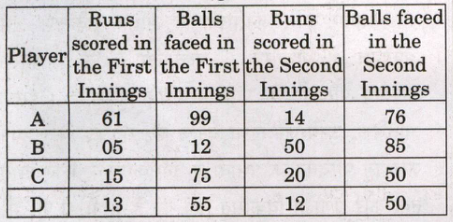
Consider the following Table:

PlayerRuns scored in the First InningsBalls faced in the First InningsRuns scored in the Second InningsBalls faced in the Second Innings
A61991476
B05125085
C15752050
D13551250
A table of runs scored and balls faced by players A, B, C and D in the first and second innings of a Test Match.
From UPSC's question paper.

Who is the fastest run scorer in the Test Match?

Answer & explanation

Answer: (b) B

Speed of scoring is runs per ball over the whole match. B scores 55 runs off 97 balls (about 0.57 a ball), ahead of A (75 off 175), C (35 off 125) and D (25 off 105).

  1. Fastest scorer = highest total runs ÷ total balls across both innings.
  2. A: (61 + 14) ÷ (99 + 76) = 75 ÷ 175 ≈ 0.43 runs per ball.
  3. B: (5 + 50) ÷ (12 + 85) = 55 ÷ 97 ≈ 0.57.
  4. C: 35 ÷ 125 = 0.28; D: 25 ÷ 105 ≈ 0.24.
  5. B has the highest rate, so B is the fastest run scorer.
  6. Check: only B scores more than half a run per ball (55 > 97 ÷ 2).

Remember · Compare ratios of totals, not innings by innings; a simple benchmark (here half a run per ball) often settles it.

Question and answer: UPSC's official GS Paper II (2021, Series A) — paper ↗ · answer key ↗. Explanation: Minimalist IAS, checked 1 Oct 2026 (how we verify). Permalink ·

Consider two Statements and a Question:

  1. Statement-1: The last day of the month is a Wednesday.
  2. Statement-2: The third Saturday of the month was the seventeenth day.
  3. Question: What day is the fourteenth of the given month?

Which one of the following is correct in respect of the Statements and the Question?

Answer & explanation

Answer: (b) Statement-2 alone is sufficient to answer the Question

Knowing the third Saturday is the 17th fixes every date: Saturdays fall on the 3rd, 10th and 17th, so the 14th is a Wednesday. The last day being a Wednesday does not help without knowing how many days the month has.

  1. Statement-2: the third Saturday is the 17th, so Saturdays fall on the 3rd, 10th and 17th.
  2. The 14th is 4 days after Saturday the 10th — a Wednesday. Statement-2 alone answers the Question.
  3. Statement-1: the last day is a Wednesday, but the month may have 28, 29, 30 or 31 days, so the 14th could be Wednesday, Tuesday, Monday or Sunday — not sufficient.
  4. So Statement-2 alone is sufficient.
  • ✗ (a) Without the month's length, the last day being Wednesday leaves four possibilities for the 14th.
  • ✓ (b) Saturday the 17th means Saturday the 10th, so the 14th is a Wednesday.
  • ✗ (c) Statement-1 is not needed.
  • ✗ (d) Statement-2 alone is sufficient.

Remember · A dated weekday fixes the whole month; a 'last day' clue also needs the month's length.

Question and answer: UPSC's official GS Paper II (2021, Series A) — paper ↗ · answer key ↗. Explanation: Minimalist IAS, checked 30 Sept 2026 (how we verify). Permalink ·

A pie diagram shows the percentage distribution of proteins, water and other dry elements in the human body. Given that proteins correspond to 16% and water corresponds to 70%. If both proteins and the other dry elements correspond to p%, then what is the central angle of the sector representing p on the pie diagram?

Answer & explanation

Answer: (c) 108°

Everything other than water is 100 − 70 = 30%, so p = 30 (the 16% for proteins is not needed). Its sector angle is 30% of 360°, i.e. 108°.

  1. Proteins + water + other dry elements = 100%, so proteins + other dry elements = 100 − 70 = 30%; p = 30.
  2. Central angle = 30% of 360° = 0.3 × 360° = 108°.
  3. Check: water's sector is 70% of 360° = 252°, and 252° + 108° = 360°.

Remember · Pie-chart angle = percentage × 3.6°; use the complement when that is quicker.

Question and answer: UPSC's official GS Paper II (2021, Series A) — paper ↗ · answer key ↗. Explanation: Minimalist IAS, checked 30 Sept 2026 (how we verify). Permalink ·