Minimalist IAS
CSAT

CSAT · 58 questions

Data interpretation & sufficiency

Every UPSC CSAT question on this topic, 2016–2026, newest first. Tap an option to check yourself; the answer and explanation open below it.

Data interpretation & sufficiency questions per year: 2016: 0, 2017: 1, 2018: 13, 2019: 0, 2020: 6, 2021: 5, 2022: 7, 2023: 5, 2024: 10, 2025: 5, 2026: 6 Asked in 9 of 11 years · most in 2018 (13)

UPSC syllabus: “Basic numeracy (numbers and their relations, orders of magnitude, etc.) (Class X level), Data interpretation (charts, graphs, tables, data sufficiency etc. — Class X level);” See the full syllabus →

CSAT 2026 · Q1

Medium Provisional key

Directions for the following 5 (five) items: Each item in this section contains a question followed by two statements. Answer each item using the following instructions and mark your response on the Answer Sheet accordingly.

Question: X receives three coins of different denominations: 1, 2, 5, 10 and 20. If the total amount received by X is m, does X receive a coin of denomination 5?

  1. Statement I: m is not a prime number.
  2. Statement II: The sum of the digits of m is greater than 5.
Answer & explanation

Answer: (a) Select this option if the question can be answered using one of these statements alone, but cannot be answered using other statement

There are only ten ways to pick three different coins, so list their totals. Every total whose digits add up to more than 5 includes the 5-coin, so Statement II settles it; Statement I leaves 32 (2 + 10 + 20) as an exception.

  1. Three different coins from {1, 2, 5, 10, 20} can be chosen in 10 ways.
  2. With the 5-coin: 1+2+5 = 8, 1+5+10 = 16, 1+5+20 = 26, 2+5+10 = 17, 2+5+20 = 27, 5+10+20 = 35.
  3. Without the 5-coin: 1+2+10 = 13, 1+2+20 = 23, 1+10+20 = 31, 2+10+20 = 32.
  4. Statement I (m not prime): m can be 8, 16, 26, 27, 35 (5-coin present) or 32 (5-coin absent). Not sufficient.
  5. Statement II (digit sum > 5): 8, 16, 26, 17, 27, 35 have digit sums 8, 7, 8, 8, 9, 8; the totals without the 5-coin have digit sums 4, 5, 4, 5. So m always includes the 5-coin. Sufficient.
  6. One statement alone works and the other does not.
  • ✗ Statement I Not sufficient alone: non-prime totals include 32 = 2 + 10 + 20, which has no 5-coin, as well as 8, 16, 26, 27 and 35, which do.
  • ✓ Statement II Sufficient alone: every total with digit sum above 5 (8, 16, 17, 26, 27, 35) uses the 5-coin; totals without it (13, 23, 31, 32) have digit sums of only 4 or 5.

Remember · In data sufficiency with a small finite set, list every case first, then test each statement against the list.

Question and answer: UPSC's provisional GS Paper II (2026, Series A) — paper ↗ · answer key ↗. Explanation: Minimalist IAS, checked 30 Sept 2026 (how we verify). Permalink ·
CSAT 2026 · Q2

Medium Provisional key

Directions for the following 5 (five) items: Each item in this section contains a question followed by two statements. Answer each item using the following instructions and mark your response on the Answer Sheet accordingly.

Question: For two distinct real numbers x and y, which of them is bigger?

  1. Statement I: x² < y < 1
  2. Statement II: y < √x < 1
Answer & explanation

Answer: (d) Select this option if the question cannot be answered even using any of the statements

Both statements together only trap y between x² and √x, and for 0 < x < 1 the number x itself lies inside that gap. So y can sit on either side of x and the question stays open.

  1. Statement I: x = 0.9, y = 0.85 fits (0.81 < 0.85 < 1) and gives x > y; x = 0.1, y = 0.5 also fits and gives y > x. Not sufficient.
  2. Statement II: √x < 1 means 0 ≤ x < 1. x = 0.25, y = 0.4 fits (0.4 < 0.5) with y > x; x = 0.25, y = 0.1 fits with y < x. Not sufficient.
  3. Together: x² < y < √x with 0 < x < 1. Take x = 0.25: y must lie between 0.0625 and 0.5.
  4. y = 0.4 gives y > x, y = 0.1 gives y < x. Still not decided.
  5. Check: for 0 < x < 1, x² < x < √x, so x always lies inside the allowed range of y.
  • ✗ Statement I Not sufficient alone: x = 0.9, y = 0.85 and x = 0.1, y = 0.5 both satisfy it but order x and y differently.
  • ✗ Statement II Not sufficient alone: with x = 0.25, both y = 0.4 and y = 0.1 are below √x = 0.5, yet one is above x and one below.

Remember · For numbers between 0 and 1, x² < x < √x. A range that straddles x never decides which is bigger.

Question and answer: UPSC's provisional GS Paper II (2026, Series A) — paper ↗ · answer key ↗. Explanation: Minimalist IAS, checked 30 Sept 2026 (how we verify). Permalink ·

CSAT 2026 · Q3

Easy Provisional key

Directions for the following 5 (five) items: Each item in this section contains a question followed by two statements. Answer each item using the following instructions and mark your response on the Answer Sheet accordingly.

Question: If x and y are integers, then is x even?

  1. Statement I: x²y² is even.
  2. Statement II: 1 + x² + y² is odd.
Answer & explanation

Answer: (c) Select this option if the question can be answered using both the statements together, but cannot be answered using either statement alone

Statement I says at least one of x and y is even; Statement II says x and y have the same parity. Only together do they force both to be even, which answers the question.

  1. Statement I: x²y² = (xy)² is even, so xy is even, so at least one of x, y is even. x could be odd (x = 1, y = 2). Not sufficient.
  2. Statement II: 1 + x² + y² is odd, so x² + y² is even, so x and y are both even or both odd. Not sufficient.
  3. Together: they share parity and at least one is even, so both are even. x is even — answered.
  4. Check: x = 1, y = 1 satisfies II but not I; x = 2, y = 2 satisfies both.
  • ✗ Statement I Not sufficient alone: x = 1, y = 2 gives x²y² = 4 (even) with x odd, while x = 2, y = 1 gives x even.
  • ✗ Statement II Not sufficient alone: it only says x and y have the same parity; x = y = 1 and x = y = 2 both fit.

Remember · Parity items: turn each statement into a plain rule (at least one even / same parity), then combine the rules.

Question and answer: UPSC's provisional GS Paper II (2026, Series A) — paper ↗ · answer key ↗. Explanation: Minimalist IAS, checked 30 Sept 2026 (how we verify). Permalink ·

CSAT 2026 · Q4

Medium Provisional key

Directions for the following 5 (five) items: Each item in this section contains a question followed by two statements. Answer each item using the following instructions and mark your response on the Answer Sheet accordingly.

Question: X is a collection of certain odd numbers whereas Y is a collection of certain even numbers. T consists of the numbers all of which are either from X or from Y. Is every number of T from Y?

  1. Statement I: The sum of any two numbers belonging to T is even.
  2. Statement II: If both p and q are picked from T, then (p − 1)q is even.
Answer & explanation

Answer: (d) Select this option if the question cannot be answered even using any of the statements

Each statement only tells us that T cannot mix odd and even numbers. An all-odd T and an all-even T satisfy both statements, so whether T comes wholly from Y cannot be decided.

  1. Statement I: the sum of two numbers is even only when both have the same parity. So T is all odd or all even. Not sufficient.
  2. Statement II: if T is all odd, p − 1 is even, so (p − 1)q is even. If T is all even, q is even, so (p − 1)q is even. Both cases fit.
  3. A mixed T fails II: an even p and an odd q give (odd) × (odd) = odd. So II also means 'all odd or all even'. Not sufficient.
  4. Together: an all-odd T (from X) and an all-even T (from Y) satisfy both statements. Still not answered.
  • ✗ Statement I Not sufficient alone: T = {1, 3} and T = {2, 4} both have even pairwise sums.
  • ✗ Statement II Not sufficient alone: for T = {1, 3}, p − 1 is always even; for T = {2, 4}, q is always even. Both give (p − 1)q even.

Remember · When every statement is satisfied by two opposite cases, even combined, mark 'cannot be answered'.

Question and answer: UPSC's provisional GS Paper II (2026, Series A) — paper ↗ · answer key ↗. Explanation: Minimalist IAS, checked 30 Sept 2026 (how we verify). Permalink ·

CSAT 2026 · Q5

Easy Provisional key

Directions for the following 5 (five) items: Each item in this section contains a question followed by two statements. Answer each item using the following instructions and mark your response on the Answer Sheet accordingly.

Question: If x, y and z are integers, each greater than 1, then is x a prime number?

  1. Statement I: xy² = 116
  2. Statement II: xz = 261
Answer & explanation

Answer: (a) Select this option if the question can be answered using one of these statements alone, but cannot be answered using other statement

Factorise both numbers: 116 = 2² × 29 and 261 = 3² × 29. The first leaves only y = 2 and x = 29, a prime; the second allows x = 3, 9, 29 or 87, so it cannot decide.

  1. 116 = 2² × 29. With y > 1, the only square factor is y² = 4, so y = 2 and x = 29.
  2. 29 is prime, so Statement I alone answers the question (yes).
  3. 261 = 3² × 29. With x, z > 1, x can be 3, 9, 29 or 87.
  4. 3 and 29 are prime but 9 and 87 are not, so Statement II alone cannot answer.
  5. One statement alone works and the other does not.
  • ✓ Statement I Sufficient alone: 116 = 4 × 29 forces y = 2 and x = 29, which is prime.
  • ✗ Statement II Not sufficient alone: 261 = 9 × 29 allows x = 3 or 29 (prime) and x = 9 or 87 (not prime).

Remember · Prime factorisation first; then ask which factor splits are allowed by the given conditions (here, every variable > 1).

Question and answer: UPSC's provisional GS Paper II (2026, Series A) — paper ↗ · answer key ↗. Explanation: Minimalist IAS, checked 30 Sept 2026 (how we verify). Permalink ·

CSAT 2026 · Q70

Medium Provisional key

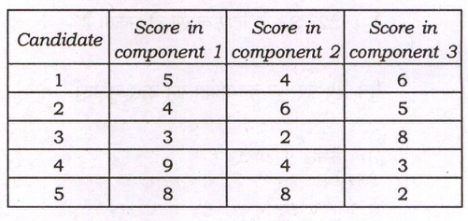
In a recruitment process, the selection of candidates is based on their performance in three components. The weightages of the components 1, 2 and 3 are 0.2, 0.3 and 0.5, respectively. Use the data given below and find the cutoff score if exactly three candidates are to be selected:

CandidateScore in component 1Score in component 2Score in component 3
1546
2465
3328
4943
5882
Table of scores of five candidates in components 1, 2 and 3.
From UPSC's question paper.
Answer & explanation

Answer: (a) 5.1

Weighted scores are 5·2, 5·1, 5·2, 4·5 and 5·0 for candidates 1 to 5. The top three are 5·2, 5·2 and 5·1, so a cutoff of 5·1 selects exactly three.

  1. Candidate 1: 0·2 × 5 + 0·3 × 4 + 0·5 × 6 = 1 + 1·2 + 3 = 5·2.
  2. Candidate 2: 0·8 + 1·8 + 2·5 = 5·1.
  3. Candidate 3: 0·6 + 0·6 + 4 = 5·2.
  4. Candidate 4: 1·8 + 1·2 + 1·5 = 4·5.
  5. Candidate 5: 1·6 + 2·4 + 1 = 5·0.
  6. Ranked: 5·2, 5·2, 5·1, 5·0, 4·5. For exactly three selections the cutoff is 5·1 (a cutoff of 5·2 would select only two).

Remember · Weighted score = Σ(weight × score). The cutoff is the lowest score among those who must be selected.

Question and answer: UPSC's provisional GS Paper II (2026, Series A) — paper ↗ · answer key ↗. Explanation: Minimalist IAS, checked 1 Oct 2026 (how we verify). Permalink ·