Minimalist IAS
CSAT

CSAT · 58 questions

Data interpretation & sufficiency

Every UPSC CSAT question on this topic, 2016–2026, newest first. Tap an option to check yourself; the answer and explanation open below it.

Data interpretation & sufficiency questions per year: 2016: 0, 2017: 1, 2018: 13, 2019: 0, 2020: 6, 2021: 5, 2022: 7, 2023: 5, 2024: 10, 2025: 5, 2026: 6 Asked in 9 of 11 years · most in 2018 (13)

UPSC syllabus: “Basic numeracy (numbers and their relations, orders of magnitude, etc.) (Class X level), Data interpretation (charts, graphs, tables, data sufficiency etc. — Class X level);” See the full syllabus →

Two Statements S1 and S2 are given below followed by a Question:

  1. S1.There are not more than two figures on any page of a 51-page book.
  2. S2.There is at least one figure on every page.
  3. Question: Are there more than 100 figures in that book?

Which one of the following is correct in respect of the above Statements and the Question?

Answer & explanation

Answer: (c) S1 and S2 together are not sufficient to answer the Question.

S1 caps the book at 2 × 51 = 102 figures and S2 guarantees at least 51. Together they only place the total between 51 and 102, which may or may not exceed 100.

  1. S1: at most 2 figures on each of 51 pages, so at most 102 figures — could be above or below 100.
  2. S2: at least 1 figure per page, so at least 51 figures — no upper limit.
  3. Together: between 51 and 102. Both 101 and 60 are possible, so the Question cannot be answered.

Remember · In data sufficiency, find the range each statement allows; if the range still straddles the question's cut-off, the data are insufficient.

Question and answer: UPSC's official GS Paper II (2020, Series A) — paper ↗ · answer key ↗. Explanation: Minimalist IAS, checked 30 Sept 2026 (how we verify). Permalink ·
Two Statements S1 and S2 are given below with regard to four numbers P, Q, R and S followed by a Question:

  1. S1.R is greater than P as well as Q.
  2. S2.S is not the largest one.
  3. Question: Among four numbers P, Q, R and S, which one is the largest?

Which one of the following is correct in respect of the above Statements and the Question?

Answer & explanation

Answer: (c) S1 and S2 together are sufficient to answer the Question, but neither S1 alone nor S2 alone is sufficient to answer the Question.

S1 makes R bigger than P and Q but says nothing about S; S2 rules out S but says nothing about P, Q and R. Together, S is not the largest and R beats P and Q, so R is the largest.

  1. S1 alone: R > P and R > Q, but S could exceed R — not sufficient.
  2. S2 alone: the largest is one of P, Q, R — not sufficient.
  3. Together: S is not the largest and R is above P and Q, so R is the largest.

Remember · Test each statement alone, then together; choose (c) only when neither alone works but the pair does.

Question and answer: UPSC's official GS Paper II (2020, Series A) — paper ↗ · answer key ↗. Explanation: Minimalist IAS, checked 30 Sept 2026 (how we verify). Permalink ·

Two Statements S1 and S2 are given below followed by a Question:

  1. S1.n is a prime number.
  2. S2.n leaves a remainder of 1 when divided by 4.
  3. Question: If n is a unique natural number between 10 and 20, then what is n?

Which one of the following is correct in respect of the above Statements and the Question?

Answer & explanation

Answer: (d) S1 and S2 together are not sufficient to answer the Question.

Between 10 and 20 the primes are 11, 13, 17 and 19; of these, 13 and 17 both leave remainder 1 on division by 4. Even together the statements leave two possible values of n, so they are not sufficient.

  1. S1: n = 11, 13, 17 or 19.
  2. S2: n = 13 or 17 (the numbers between 10 and 20 that are 1 more than a multiple of 4).
  3. Together: 13 and 17 both satisfy S1 and S2, so n is still not fixed.

Remember · In number data sufficiency, list every value that fits; if more than one survives, the data are insufficient.

Question and answer: UPSC's official GS Paper II (2020, Series A) — paper ↗ · answer key ↗. Explanation: Minimalist IAS, checked 30 Sept 2026 (how we verify). Permalink ·

Two Statements S1 and S2 are given below with regard to two numbers followed by a Question:

  1. S1.Their product is 21.
  2. S2.Their sum is 10.
  3. Question: What are the two numbers?

Which one of the following is correct in respect of the above Statements and the Question?

Answer & explanation

Answer: (c) S1 and S2 together are sufficient to answer the Question, but neither S1 alone nor S2 alone is sufficient to answer the Question.

A product of 21 alone allows 3 and 7, 1 and 21 and many other pairs, and a sum of 10 alone allows endless pairs. Together, the numbers are the roots of t² − 10t + 21 = 0, which are exactly 3 and 7.

  1. S1 alone: 3 × 7, 1 × 21, 2 × 10·5 … — not unique.
  2. S2 alone: 3 + 7, 4 + 6, 5 + 5 … — not unique.
  3. Together: the numbers satisfy t² − 10t + 21 = 0, i.e. (t − 3)(t − 7) = 0, so they are 3 and 7.

Remember · Two numbers are fixed by their sum and product together: they are the roots of t² − (sum)t + (product) = 0.

Question and answer: UPSC's official GS Paper II (2020, Series A) — paper ↗ · answer key ↗. Explanation: Minimalist IAS, checked 30 Sept 2026 (how we verify). Permalink ·

Three Statements S1, S2 and S3 are given below followed by a Question:

  1. S1.C is younger than D, but older than A and B.
  2. S2.D is the oldest.
  3. S3.A is older than B.
  4. Question: Who among A, B, C and D is the youngest?

Which one of the following is correct in respect of the above Statements and the Question?

Answer & explanation

Answer: (d) S1 and S3 together are sufficient to answer the Question.

S1 puts D above C and C above both A and B, so the youngest is A or B. S3 settles that pair: A is older than B, so B is the youngest. S2 adds nothing S1 did not already give.

  1. S1: D > C > A and D > C > B, so the youngest is A or B — S1 alone is not enough.
  2. S2 only repeats that D is the oldest, so S1 and S2 together still leave A or B.
  3. S2 and S3: A > B, but C's position is unknown — C could be youngest.
  4. S1 and S3: D > C > A > B, so B is the youngest.

Remember · Find what each statement leaves open, then pick the statement that closes exactly that gap.

Question and answer: UPSC's official GS Paper II (2020, Series A) — paper ↗ · answer key ↗. Explanation: Minimalist IAS, checked 30 Sept 2026 (how we verify). Permalink ·

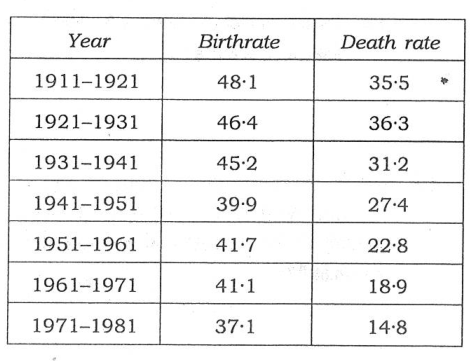
Consider the following data:

YearBirthrateDeath rate
1911–192148·135·5
1921–193146·436·3
1931–194145·231·2
1941–195139·927·4
1951–196141·722·8
1961–197141·118·9
1971–198137·114·8
A table of birth rate and death rate for each decade from 1911–1921 to 1971–1981.
From UPSC's question paper.

For which period was the natural growth rate maximum?

Answer & explanation

Answer: (d) 1971–1981

Natural growth rate is birth rate minus death rate. The gaps for the four offered periods are 12·6, 12·5, 22·2 and 22·3, so 1971–1981 is the highest, just ahead of 1961–1971.

  1. 1911–1921: 48·1 − 35·5 = 12·6.
  2. 1941–1951: 39·9 − 27·4 = 12·5.
  3. 1961–1971: 41·1 − 18·9 = 22·2.
  4. 1971–1981: 37·1 − 14·8 = 22·3 — the maximum.
  5. Check: the periods not offered are lower too (10·1, 14·0, 18·9).

Remember · Natural growth = birth rate − death rate. Compute only the offered periods, and compute the close ones exactly.

Question and answer: UPSC's official GS Paper II (2020, Series A) — paper ↗ · answer key ↗. Explanation: Minimalist IAS, checked 1 Oct 2026 (how we verify). Permalink ·