Minimalist IAS
CSAT

CSAT · 58 questions

Data interpretation & sufficiency

Every UPSC CSAT question on this topic, 2016–2026, newest first. Tap an option to check yourself; the answer and explanation open below it.

Data interpretation & sufficiency questions per year: 2016: 0, 2017: 1, 2018: 13, 2019: 0, 2020: 6, 2021: 5, 2022: 7, 2023: 5, 2024: 10, 2025: 5, 2026: 6 Asked in 9 of 11 years · most in 2018 (13)
Timed · 30 minutes a set Practise Data interpretation & sufficiency as timed tests 3 sets of about 20 questions with UPSC's CSAT marking. Start practising

UPSC syllabus: “Basic numeracy (numbers and their relations, orders of magnitude, etc.) (Class X level), Data interpretation (charts, graphs, tables, data sufficiency etc. — Class X level);” Sub-topics in the detailed syllabus →

दो कथनों और एक प्रश्न पर विचार कीजिए :

  1. कथन-1: प्रिया, सीमा से 4 स्थान नीचे है और सबसे निचले स्थान से 31वें स्थान पर है ।
  2. कथन-2: ईना, सीमा से 2 स्थान ऊपर है और सबसे निचले स्थान से 37वें स्थान पर है ।
  3. प्रश्न: 40 विद्यार्थियों की कक्षा में, शीर्ष स्थान से सीमा का कौन-सा स्थान है ?

कथनों और प्रश्न के संदर्भ में, निम्नलिखित में से कौन-सा सही है ?

Read this question in English

Consider two Statements and a Question:

Statement-1. Priya is 4 ranks below Seema and is 31st from the bottom.

Statement-2. Ena is 2 ranks above Seema and is 37th from the bottom.

Question. What is Seema’s rank from the top in the class of 40 students?

Which one of the following is correct in respect of the Statements and the Question?

(a) Statement-1 alone is not sufficient to answer the Question · (b) Statement-2 alone is not sufficient to answer the Question · (c) Either Statement-1 alone or Statement-2 alone is sufficient to answer the Question · (d) Both Statement-1 and Statement-2 are required to answer the Question

उत्तर और व्याख्या · explanation in English

Answer: (c) प्रश्न का उत्तर देने के लिए या तो केवल कथन-1 या केवल कथन-2 पर्याप्त है

Each statement on its own places Seema 35th from the bottom (31 + 4, or 37 − 2). In a class of 40 that is 40 − 35 + 1 = 6th from the top, so either statement alone is enough.

  1. Statement-1: Priya is 31st from the bottom and 4 ranks below Seema, so Seema is 31 + 4 = 35th from the bottom.
  2. Rank from top = 40 − 35 + 1 = 6. Statement-1 alone answers the Question.
  3. Statement-2: Ena is 37th from the bottom and 2 ranks above Seema, so Seema is 37 − 2 = 35th from the bottom — again 6th from the top.
  4. Each statement alone is sufficient.
  • ✗ (a) Statement-1 alone gives Seema's rank (6th from the top).
  • ✗ (b) Statement-2 alone also gives 6th from the top.
  • ✓ (c) Either statement alone fixes Seema at 35th from the bottom, i.e. 6th from the top.
  • ✗ (d) Combining is not needed, since each statement alone is enough.

Remember · Rank from top + rank from bottom = total + 1. In data sufficiency, test each statement alone before combining.

Question and answer: UPSC's official GS Paper II (2021, Series A) — paper ↗ · answer key ↗. Explanation: Minimalist IAS, checked 30 Sept 2026 (how we verify). Permalink ·
दो कथनों और एक प्रश्न पर विचार कीजिए :

  1. कथन-1: A और D में से प्रत्येक, B, E और F में प्रत्येक से अधिक भारी है, किंतु उनमें से कोई भी सबसे अधिक भारी नहीं है ।
  2. कथन-2: A, D से अधिक भारी है, किंतु C से हल्का है ।
  3. प्रश्न: A, B, C, D और E में सबसे अधिक भारी कौन है ?

कथनों और प्रश्न के संदर्भ में, निम्नलिखित में से कौन-सा सही है ?

Read this question in English

Consider two Statements and a Question:

Statement-1. Each of A and D is heavier than each of B, E and F, but none of them is the heaviest.

Statement-2. A is heavier than D, but is lighter than C.

Question. Who is the heaviest among A, B, C, D and E?

Which one of the following is correct in respect of the Statements and the Question?

(a) Statement-1 alone is sufficient to answer the Question · (b) Statement-2 alone is sufficient to answer the Question · (c) Both Statement-1 and Statement-2 are required to answer the Question · (d) Neither Statement-1 alone nor Statement-2 alone is sufficient to answer the Question

उत्तर और व्याख्या · explanation in English

Answer: (c) प्रश्न का उत्तर देने के लिए कथन-1 और कथन-2 दोनों की आवश्यकता है — UPSC also accepted (d)

Statement-2 gives C > A > D, and Statement-1 adds that A and D are heavier than B and E; only together do they show that C is the heaviest of the five. UPSC's final key accepted both (c) and (d), because when both statements are required it is also true that neither alone is sufficient.

  1. Statement-1: A and D are heavier than B, E and F, but C is never compared with anyone, and 'the heaviest' may be someone outside the list — so it cannot name the heaviest of A, B, C, D, E.
  2. Statement-2: C > A > D, but B and E are not compared with C — not sufficient alone.
  3. Together: C > A > D, and A, D > B, E, so C is heavier than all the others — C is the heaviest.
  4. Both statements are required (c). That also makes 'neither statement alone is sufficient' (d) true, and UPSC accepted both.
  • ✗ (a) Statement-1 never places C, so it cannot settle who is heaviest among the five.
  • ✗ (b) Statement-2 says nothing about B and E relative to C.
  • ✓ (c) Combining gives C > A > D, with A and D both heavier than B and E, so C is the heaviest.
  • ✓ (d) Since both statements are needed, neither alone is sufficient — literally true, and accepted by UPSC.

Remember · In data sufficiency, 'both are required' also means 'neither alone suffices' — watch for overlapping options.

Question and answer: UPSC's official GS Paper II (2021, Series A) — paper ↗ · answer key ↗. Explanation: Minimalist IAS, checked 30 Sept 2026 (how we verify). Permalink ·

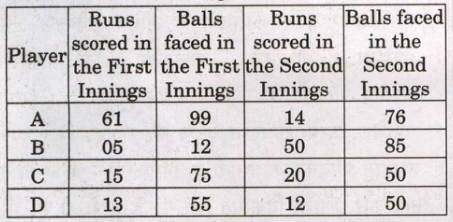
निम्नलिखित सारणी पर विचार कीजिए :

खिलाड़ीपहली पारी में बनाए गए रनपहली पारी में खेली गई गेंदेंदूसरी पारी में बनाए गए रनदूसरी पारी में खेली गई गेंदें
A61991476
B05125085
C15752050
D13551250
A table of runs scored and balls faced by players A, B, C and D in the first and second innings of a Test Match.
From UPSC's question paper.

इस टेस्ट मैच में, सबसे तेज़ रन बनाने वाला कौन है ?

Read this question in English

Consider the following Table:

Who is the fastest run scorer in the Test Match?

(a) A · (b) B · (c) C · (d) D

उत्तर और व्याख्या · explanation in English

Answer: (b) B

Speed of scoring is runs per ball over the whole match. B scores 55 runs off 97 balls (about 0.57 a ball), ahead of A (75 off 175), C (35 off 125) and D (25 off 105).

  1. Fastest scorer = highest total runs ÷ total balls across both innings.
  2. A: (61 + 14) ÷ (99 + 76) = 75 ÷ 175 ≈ 0.43 runs per ball.
  3. B: (5 + 50) ÷ (12 + 85) = 55 ÷ 97 ≈ 0.57.
  4. C: 35 ÷ 125 = 0.28; D: 25 ÷ 105 ≈ 0.24.
  5. B has the highest rate, so B is the fastest run scorer.
  6. Check: only B scores more than half a run per ball (55 > 97 ÷ 2).

Remember · Compare ratios of totals, not innings by innings; a simple benchmark (here half a run per ball) often settles it.

Question and answer: UPSC's official GS Paper II (2021, Series A) — paper ↗ · answer key ↗. Explanation: Minimalist IAS, checked 1 Oct 2026 (how we verify). Permalink ·

दो कथनों और एक प्रश्न पर विचार कीजिए :

  1. कथन-1: किसी माह का अंतिम दिन बुधवार है ।
  2. कथन-2: इस माह का तृतीय शनिवार उसका 17वाँ दिन है ।
  3. प्रश्न: इस माह के 14वें दिन कौन-सा वार है ?

कथनों और प्रश्न के संदर्भ में, निम्नलिखित में से कौन-सा सही है ?

Read this question in English

Consider two Statements and a Question:

Statement-1. The last day of the month is a Wednesday.

Statement-2. The third Saturday of the month was the seventeenth day.

Question. What day is the fourteenth of the given month?

Which one of the following is correct in respect of the Statements and the Question?

(a) Statement-1 alone is sufficient to answer the Question · (b) Statement-2 alone is sufficient to answer the Question · (c) Both Statement-1 and Statement-2 are required to answer the Question · (d) Neither Statement-1 alone nor Statement-2 alone is sufficient to answer the Question

उत्तर और व्याख्या · explanation in English

Answer: (b) प्रश्न का उत्तर देने के लिए केवल कथन-2 पर्याप्त है

Knowing the third Saturday is the 17th fixes every date: Saturdays fall on the 3rd, 10th and 17th, so the 14th is a Wednesday. The last day being a Wednesday does not help without knowing how many days the month has.

  1. Statement-2: the third Saturday is the 17th, so Saturdays fall on the 3rd, 10th and 17th.
  2. The 14th is 4 days after Saturday the 10th — a Wednesday. Statement-2 alone answers the Question.
  3. Statement-1: the last day is a Wednesday, but the month may have 28, 29, 30 or 31 days, so the 14th could be Wednesday, Tuesday, Monday or Sunday — not sufficient.
  4. So Statement-2 alone is sufficient.
  • ✗ (a) Without the month's length, the last day being Wednesday leaves four possibilities for the 14th.
  • ✓ (b) Saturday the 17th means Saturday the 10th, so the 14th is a Wednesday.
  • ✗ (c) Statement-1 is not needed.
  • ✗ (d) Statement-2 alone is sufficient.

Remember · A dated weekday fixes the whole month; a 'last day' clue also needs the month's length.

Question and answer: UPSC's official GS Paper II (2021, Series A) — paper ↗ · answer key ↗. Explanation: Minimalist IAS, checked 30 Sept 2026 (how we verify). Permalink ·

एक वृत्तारेख (पाई आरेख), मानव शरीर में प्रोटीन, जल तथा अन्य शुष्क तत्त्वों के प्रतिशतता वितरण को दर्शाता है । यह दिया गया है कि प्रोटीन 16% है तथा जल 70% है । यदि प्रोटीन तथा अन्य शुष्क तत्त्व — दोनों को मिलाकर p% है, तो वृत्तारेख में p को निरूपित करने वाले त्रिज्यखंड (सेक्टर) का केंद्रीय कोण कितना है ?

Read this question in English

A pie diagram shows the percentage distribution of proteins, water and other dry elements in the human body. Given that proteins correspond to 16% and water corresponds to 70%. If both proteins and the other dry elements correspond to p%, then what is the central angle of the sector representing p on the pie diagram?

(a) 54° · (b) 96° · (c) 108° · (d) 120°

उत्तर और व्याख्या · explanation in English

Answer: (c) 108°

Everything other than water is 100 − 70 = 30%, so p = 30 (the 16% for proteins is not needed). Its sector angle is 30% of 360°, i.e. 108°.

  1. Proteins + water + other dry elements = 100%, so proteins + other dry elements = 100 − 70 = 30%; p = 30.
  2. Central angle = 30% of 360° = 0.3 × 360° = 108°.
  3. Check: water's sector is 70% of 360° = 252°, and 252° + 108° = 360°.

Remember · Pie-chart angle = percentage × 3.6°; use the complement when that is quicker.

Question and answer: UPSC's official GS Paper II (2021, Series A) — paper ↗ · answer key ↗. Explanation: Minimalist IAS, checked 30 Sept 2026 (how we verify). Permalink ·

The Syllabus X-Ray of this topic

1 of its 2 sub-topics is Core

1 Core · 1 High · 0 Steady · 0 Rare

  • Core #6Data sufficiency · 38 questions
  • HighTables, charts & graphs · 20 questions

The X-Ray ranks all 928 sub-topics of the UPSC syllabus by what UPSC has asked since 2016. The 6 CSAT Core sub-topics are behind 50% of CSAT questions.

See the whole X-Ray →