Minimalist IAS
CSAT

CSAT · 132 questions

Arithmetic: percentage, ratio, averages, time & work

Every UPSC CSAT question on this topic, 2016–2026, newest first. Tap an option to check yourself; the answer and explanation open below it.

Arithmetic: percentage, ratio, averages, time & work questions per year: 2016: 16, 2017: 11, 2018: 8, 2019: 15, 2020: 15, 2021: 16, 2022: 13, 2023: 2, 2024: 11, 2025: 9, 2026: 16 Asked in 11 of 11 years · most in 2026 (16)
Timed · 30 minutes a set Practise Arithmetic: percentage, ratio, averages, time & work as timed tests 7 sets of about 20 questions with UPSC's CSAT marking. Start practising

UPSC syllabus: “Basic numeracy (numbers and their relations, orders of magnitude, etc.) (Class X level), Data interpretation (charts, graphs, tables, data sufficiency etc. — Class X level);” Sub-topics in the detailed syllabus →

नीचे दिए गए चित्र में A और B दो वाहनों के वेग के आलेख (ग्राफ) दिए गए हैं। सरलरेखा OKP किसी भी क्षण में वाहन A के वेग को दर्शाती है, जबकि क्षैतिज सरलरेखा CKD किसी भी क्षण में वाहन B के वेग को दर्शाती है। चित्र में, D वह बिन्दु है जहाँ P से क्षैतिज रेखा CKD पर लम्ब इस प्रकार मिलता है कि PD = 1/2 LD :
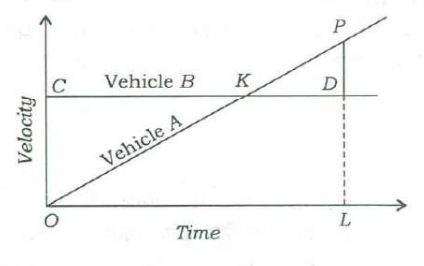
Velocity–time graph: A's velocity rises along a straight line from the origin O through K to P; B's velocity is the horizontal line C–K–D; P lies above time L, D is on B's line directly below P, and PL is dotted down to the time axis.
From UPSC's question paper.

समय अंतराल OL में वाहन A और वाहन B द्वारा तय की गई दूरियों के बीच क्या अनुपात है?

Read this question in English

The figure drawn below gives the velocity graphs of two vehicles A and B. The straight line OKP represents the velocity of vehicle A at any instant, whereas the horizontal straight line CKD represents the velocity of vehicle B at any instant. In the figure, D is the point where perpendicular from P meets the horizontal line CKD such that PD = 1/2 LD:

What is the ratio between the distances covered by vehicles A and B in the time interval OL?

(a) 1: 2 · (b) 2: 3 · (c) 3: 4 · (d) 1: 1

उत्तर और व्याख्या · explanation in English

Answer: (c) 3 : 4

Distance is the area under a velocity–time graph. A's distance is the triangle OLP and B's is the rectangle of height LD over OL; since PL = 3/2 × LD, the triangle is 3/4 of the rectangle.

  1. Let LD (B's constant velocity) = 2 units; then PD = 1 and A's velocity at time L is PL = PD + DL = 3.
  2. Distance of B in time OL = rectangle = OL × 2 = 2 × OL.
  3. Distance of A in time OL = triangle OLP = 1/2 × OL × 3 = 1.5 × OL.
  4. Ratio A : B = 1.5 : 2 = 3 : 4.

Remember · On a velocity–time graph, distance = area under the line: a triangle for steady acceleration from rest, a rectangle for constant speed.

Question and answer: UPSC's official GS Paper II (2018, Series A) — paper ↗ · answer key ↗. Explanation: Minimalist IAS, checked 1 Oct 2026 (how we verify). Permalink ·

200 मीटर लम्बी एक ट्रेन 40 कि॰ मी॰ प्रति घंटा की दर से चल रही है। रेलवे लाइन के निकट खड़े किसी व्यक्ति को यह ट्रेन कितने सेकंड में पार करेगी?

Read this question in English

A train 200 metres long is moving at the rate of 40 kmph. In how many seconds will it cross a man standing near the railway line?

(a) 12 · (b) 15 · (c) 16 · (d) 18

उत्तर और व्याख्या · explanation in English

Answer: (d) 18

To pass a man standing still, the train covers only its own length, 200 m. At 40 km/h, which is 100/9 m/s, that takes 18 seconds.

  1. Distance to cover = length of the train = 200 m (the man adds no length).
  2. Speed: 40 km/h = 40 × 5/18 = 100/9 m/s.
  3. Time = 200 ÷ (100/9) = 18 seconds.
  4. Check: in 18 s at 40 km/h the train covers 40,000 × 18 ÷ 3600 = 200 m.

Remember · A train passing a pole or a standing person covers only its own length; convert km/h to m/s by multiplying by 5/18.

Question and answer: UPSC's official GS Paper II (2018, Series A) — paper ↗ · answer key ↗. Explanation: Minimalist IAS, checked 30 Sept 2026 (how we verify). Permalink ·

एक पुस्तक विक्रेता ने ₹ x प्रति पुस्तक की दर से भूगोल की ‘a’ पुस्तकें बेचीं, ₹ (x + 2) प्रति पुस्तक की दर से इतिहास की ‘a + 2’ पुस्तकें बेचीं तथा ₹ (x − 2) प्रति पुस्तक की दर से गणित की ‘a − 2’ पुस्तकें बेचीं। उसकी कुल बिक्री (₹ में) कितनी है?

Read this question in English

A bookseller sold ‘a’ number of Geography textbooks at the rate of ₹x per book, ‘a + 2’ number of History textbooks at the rate of ₹(x + 2) per book and ‘a − 2’ number of Mathematics textbooks at the rate of ₹(x − 2) per book. What is his total sale in ₹?

(a) 3x + 3a · (b) 3ax + 8 · (c) 9ax · (d) x³a³

उत्तर और व्याख्या · explanation in English

Answer: (b) 3ax + 8

Total sale = ax + (a + 2)(x + 2) + (a − 2)(x − 2). The terms 2a + 2x and −2a − 2x cancel, leaving 3ax + 8.

  1. Geography: a × x = ax.
  2. History: (a + 2)(x + 2) = ax + 2a + 2x + 4.
  3. Mathematics: (a − 2)(x − 2) = ax − 2a − 2x + 4.
  4. Sum: 3ax + 8.
  5. Check with a = 3, x = 5: 15 + 5 × 7 + 1 × 3 = 53, and 3 × 3 × 5 + 8 = 53.

Remember · Check algebraic options by putting small numbers into both the question and each option.

Question and answer: UPSC's official GS Paper II (2018, Series A) — paper ↗ · answer key ↗. Explanation: Minimalist IAS, checked 30 Sept 2026 (how we verify). Permalink ·

दो व्यक्ति A और B किसी वृत्तीय मार्ग पर दौड़ रहे हैं। प्रारंभ में B, A से आगे है तथा उनकी स्थितियाँ वृत्त के केन्द्र पर 30° का कोण बनाती हैं। जब A, उस बिन्दु पर पहुँचता है जो कि उसके प्रारम्भिक बिन्दु से व्यासतः सम्मुख है, तब वह B से मिलता है। A और B की चालों में क्या अनुपात है, यदि वे एकसमान चाल से दौड़ रहे हैं?

Read this question in English

Two persons, A and B are running on a circular track. At the start, B is ahead of A and their positions make an angle of 30° at the centre of the circle. When A reaches the point diametrically opposite to his starting point, he meets B. What is the ratio of speeds of A and B, if they are running with uniform speeds?

(a) 6: 5 · (b) 4: 3 · (c) 6: 1 · (d) 4: 2

उत्तर और व्याख्या · explanation in English

Answer: (a) 6 : 5

A covers half the track, 180°. B started 30° ahead and is caught at that same point, so B covered 180° − 30° = 150° in the same time. The speeds are in the ratio 180 : 150 = 6 : 5.

  1. A runs from his start to the diametrically opposite point: an arc of 180°.
  2. B started 30° ahead in the direction of running and is met there: B runs 180° − 30° = 150°.
  3. Same time, so speed ratio = arc ratio = 180 : 150 = 6 : 5.

Remember · On a circular track, measure distances as angles; in equal time, the speed ratio equals the ratio of arcs covered.

Question and answer: UPSC's official GS Paper II (2018, Series A) — paper ↗ · answer key ↗. Explanation: Minimalist IAS, checked 30 Sept 2026 (how we verify). Permalink ·

किसी परीक्षा में पास होने के लिए एक विद्यार्थी को 40% अंक चाहिए। मान लीजिए कि उसे 30 अंक मिलते हैं तथा वह 30 अंकों से अनुत्तीर्ण हो जाता है, तो परीक्षा में अधिकतम अंक कितने हैं?

Read this question in English

A student has to get 40% marks to pass in an examination. Suppose he gets 30 marks and fails by 30 marks, then what are the maximum marks in the examination?

(a) 100 · (b) 120 · (c) 150 · (d) 300

उत्तर और व्याख्या · explanation in English

Answer: (c) 150

Scoring 30 and falling 30 short means the pass mark is 60. If 60 is 40% of the maximum, the maximum is 60 ÷ 0.4 = 150.

  1. Pass mark = marks scored + shortfall = 30 + 30 = 60.
  2. 40% of maximum = 60, so maximum = 60 × 100 ÷ 40 = 150.
  3. Check: 40% of 150 = 60, and 60 − 30 = 30.

Remember · Pass mark = marks scored + shortfall; divide it by the pass percentage to get the maximum marks.

Question and answer: UPSC's official GS Paper II (2018, Series A) — paper ↗ · answer key ↗. Explanation: Minimalist IAS, checked 30 Sept 2026 (how we verify). Permalink ·

कोई दुकानदार किसी वस्तु को ₹ 40 में बेचकर X % लाभ कमाता है। तथापि, जब वह उस वस्तु को ₹ 20 में बेचता है, तो उसे उतने ही प्रतिशत की हानि होती है। वस्तु की मूल लागत कितनी है?

Read this question in English

A shopkeeper sells an article at ₹40 and gets X% profit. However, when he sells it at ₹20, he faces same percentage of loss. What is the original cost of the article?

(a) ₹10 · (b) ₹20 · (c) ₹30 · (d) ₹40

उत्तर और व्याख्या · explanation in English

Answer: (c) ₹ 30

An equal percentage profit and loss on the same cost means the two selling prices lie equally far above and below the cost. The cost is the average of ₹40 and ₹20, i.e. ₹30 (profit and loss both 33⅓%).

  1. Let the cost be C. Then 40 = C(1 + X/100) and 20 = C(1 − X/100).
  2. Adding the two: 60 = 2C, so C = ₹30.
  3. Check: ₹40 is 33⅓% above ₹30, and ₹20 is 33⅓% below it.

Remember · Same percentage profit and loss on one cost price: the cost is the average of the two selling prices.

Question and answer: UPSC's official GS Paper II (2018, Series A) — paper ↗ · answer key ↗. Explanation: Minimalist IAS, checked 30 Sept 2026 (how we verify). Permalink ·

एक लिफ्ट में 18 वयस्क या 30 बच्चों को ले जाने की क्षमता है। लिफ्ट में 12 वयस्कों के साथ कितने बच्चे आ सकते हैं?

Read this question in English

A lift has the capacity of 18 adults or 30 children. How many children can board the lift with 12 adults?

(a) 6 · (b) 10 · (c) 12 · (d) 15

उत्तर और व्याख्या · explanation in English

Answer: (b) 10

18 adults take the same space as 30 children, so one adult equals 5/3 of a child. 12 adults use the space of 20 children, leaving room for 10.

  1. 18 adults = 30 children, so 1 adult = 30/18 = 5/3 children.
  2. 12 adults = 12 × 5/3 = 20 children's worth of space.
  3. Room left = 30 − 20 = 10 children.
  4. Check: 12 adults fill 12/18 = 2/3 of the lift; the remaining 1/3 of 30 children is 10.

Remember · Convert everything to one unit (here child-spaces), subtract what is used, and read off what remains.

Question and answer: UPSC's official GS Paper II (2018, Series A) — paper ↗ · answer key ↗. Explanation: Minimalist IAS, checked 30 Sept 2026 (how we verify). Permalink ·

किसी व्यक्ति ने ₹22,800 कीमत का रेफ्रीजरेटर 12·5% चक्रवृद्धि ब्याज (वार्षिक) पर खरीदा। पहले वर्ष के अंत पर उसने ₹8,650 एवं दूसरे वर्ष के अंत पर ₹9,125 चुकाए। ऋण पूरा चुकाने के लिए उसे तीसरे वर्ष के अंत में कितने रुपये का भुगतान करना होगा?

Read this question in English

A person bought a refrigerator worth ₹22,800 with 12.5% interest compounded yearly. At the end of first year he paid ₹8,650 and at the end of second year ₹9,125. How much will he have to pay at the end of third year to clear the debt?

(a) ₹9,990 · (b) ₹10,000 · (c) ₹10,590 · (d) ₹11,250

उत्तर और व्याख्या · explanation in English

Answer: (d) ₹11,250

Add a year's interest (12.5%, one-eighth) to the balance and subtract each payment. The balance falls to ₹17,000 after year 1 and ₹10,000 after year 2, so year 3 needs ₹10,000 × 1.125 = ₹11,250.

  1. Year 1: 22,800 × 1.125 = 25,650; after paying 8,650 the balance is 17,000.
  2. Year 2: 17,000 × 1.125 = 19,125; after paying 9,125 the balance is 10,000.
  3. Year 3: 10,000 × 1.125 = 11,250 clears the debt.
  4. Check: ₹10,000 is only the balance at the start of year 3; it still earns a year's interest.

Remember · For instalments at compound interest, roll the balance forward: add the year's interest, subtract the payment. 12.5% is one-eighth.

Question and answer: UPSC's official GS Paper II (2018, Series A) — paper ↗ · answer key ↗. Explanation: Minimalist IAS, checked 30 Sept 2026 (how we verify). Permalink ·

The Syllabus X-Ray of this topic

1 of its 7 sub-topics is Core

1 Core · 2 High · 4 Steady · 0 Rare

  • Core #5Word problems & equations · 40 questions
  • HighPercentages, profit & loss · 33 questions
  • HighAverages & ages · 19 questions

The X-Ray ranks all 928 sub-topics of the UPSC syllabus by what UPSC has asked since 2016. The 6 CSAT Core sub-topics are behind 50% of CSAT questions.

See the whole X-Ray →