Polity & Governance
POCSO Act, 2012: Features, Implementation Gaps, and Age-of-Consent Debate — UPSC Notes
By Shivam Singh, Founder & Mentor, Minimalist IAS
· 12 min read

The Protection of Children from Sexual Offences (POCSO) Act, 2012 is India’s dedicated law against sexual assault, sexual harassment and pornographic exploitation of children, defined as anyone below 18. It is gender-neutral, runs cases through Special Courts with a child-friendly trial, and prevails over any inconsistent law. The law is strong on paper; the gap lies in enforcement, with 86.6% of POCSO cases pending trial at the end of 2023 (NCRB).
Why in news: The Delhi High Court held that a marriage claimed to be valid under Muslim personal law does not, by itself, give immunity from prosecution under POCSO or the Bharatiya Nyaya Sanhita (BNS) for sexual intercourse with a wife below 18. It refused to quash the FIR against a man who had married a 16-year-old; guilt will be decided at trial.
Syllabus mapping
Prelims: Indian Polity and Governance; rights issues; current events of national importance.
GS Paper 2: mechanisms, laws and institutions for the protection of vulnerable sections; role of the judiciary.
GS Paper 1: social issues: child marriage, issues relating to women and children.
GS Paper 4: duty to report, the best interest of the child, institutional accountability.
Why a separate law was needed?
Gap in the IPC: sexual offences were framed around women; abuse of boys was poorly covered.
No child-friendly procedure: children faced repeated questioning, open courts and the accused face to face.
Constitutional mandate: Article 15(3) (special laws for children); Article 39(e)–(f) (protection from abuse and exploitation).
International commitment: India ratified the UN Convention on the Rights of the Child in 1992.
Key features of the POCSO Act
Who is protected: every person below 18, boy or girl; the Act makes no exception for consent or marriage.
Offences covered: penetrative and non-penetrative sexual assault (and aggravated forms), sexual harassment, use of a child for pornography.
Aggravated offences: abuse by police, armed forces, public servants, staff of institutions or relatives attracts higher punishment.
2019 amendment: death penalty added for aggravated penetrative sexual assault; higher minimum sentences; three graded offences for storing or possessing child sexual abuse material, by purpose (failing to delete or report; intent to transmit or display; commercial use).
Overriding effect (Section 42A): POCSO is in addition to other laws, but prevails where they conflict.
Monitoring: National and State Commissions for Protection of Child Rights (NCPCR, SCPCRs).
How does a POCSO case move through the system?
The procedure is where POCSO differs most from ordinary criminal law:
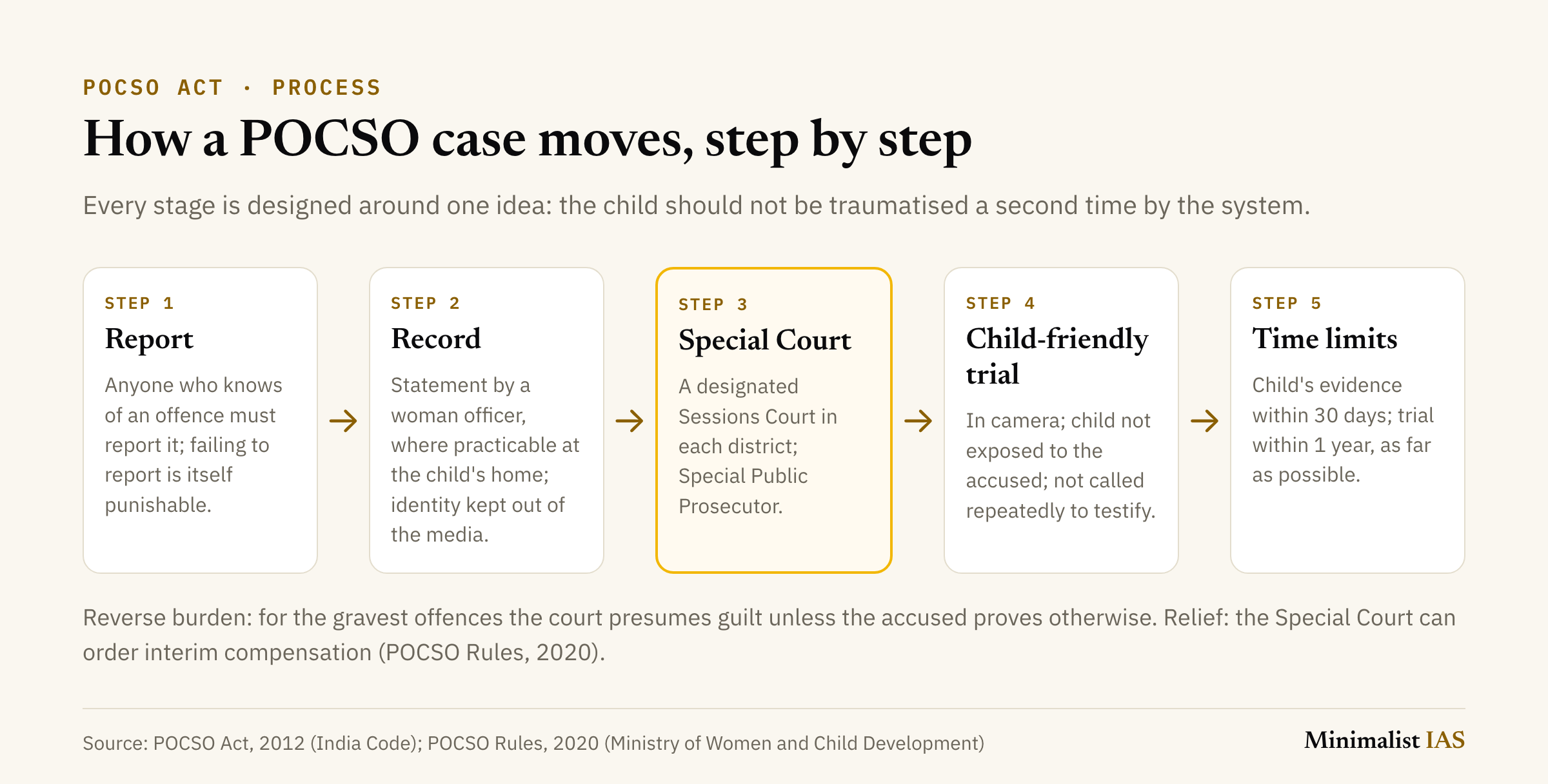
Reporting → FIR: anyone aware of an offence must report it (Section 19); police must report the case to the Special Court and the Child Welfare Committee within 24 hours.
Child-sensitive recording: statement at the child’s home or chosen place, never detaining the child at a police station at night; a support person under the POCSO Rules, 2020.
Trial: Special Court; in camera; child testifies through a screen or video link, not face to face.
Reverse burden (Section 29): for penetrative, aggravated and other sexual assault offences, the court presumes the accused committed, abetted or attempted the offence unless proved otherwise.
Mental state (Section 30): culpable intent is presumed; the accused must disprove it beyond reasonable doubt, not merely on a preponderance of probability.
Relief: interim and final compensation ordered by the Special Court (POCSO Rules, 2020).
POCSO thus changes not only what is punished but how it is proved, which is its sharpest break from the IPC-era approach.
Significance
Gender-neutral protection: recognises that boys are abused too, a first in Indian criminal law.
Breaks institutional silence: mandatory reporting makes schools, hospitals and hostels accountable.
Victim-centred justice: in-camera trials, identity protection and compensation reduce secondary trauma.
Deterrence: graded punishments, strengthened in 2019, signal zero tolerance.
Issues and challenges
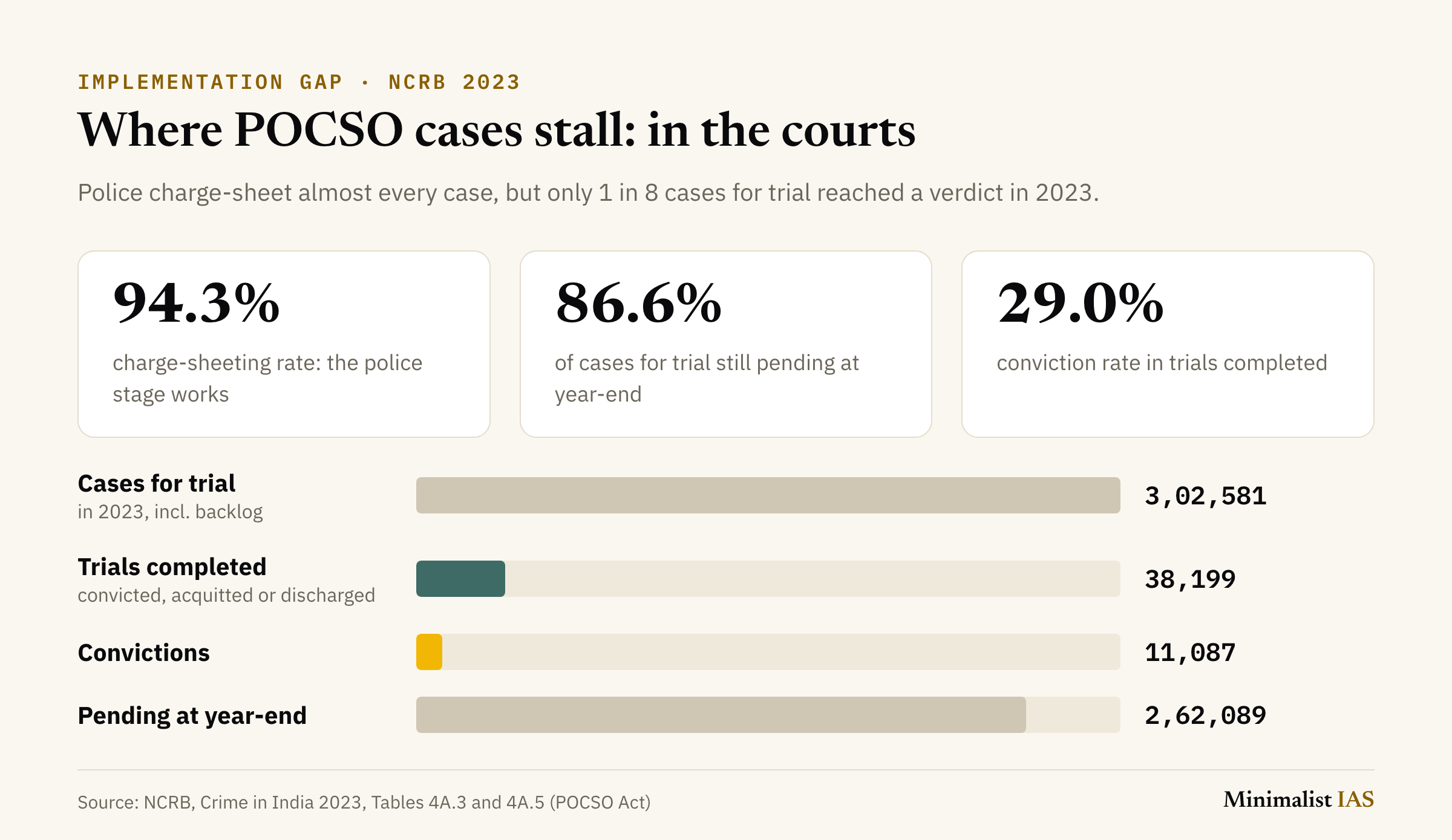
Problem: cases are registered and charge-sheeted, but they pile up in court.
Scale: 69,191 POCSO cases registered in 2024, 36.9% of all crimes against children (NCRB, Crime in India 2024), up from 67,694 in 2023.
Pendency: 2.62 lakh cases pending trial at the end of 2023 (86.6%); the one-year trial limit is directory, not mandatory.
Low conviction: of trials completed in 2023, 29.0% ended in conviction.
Court capacity: 398 exclusive POCSO courts functional in April 2026, against a pendency counted in lakhs.
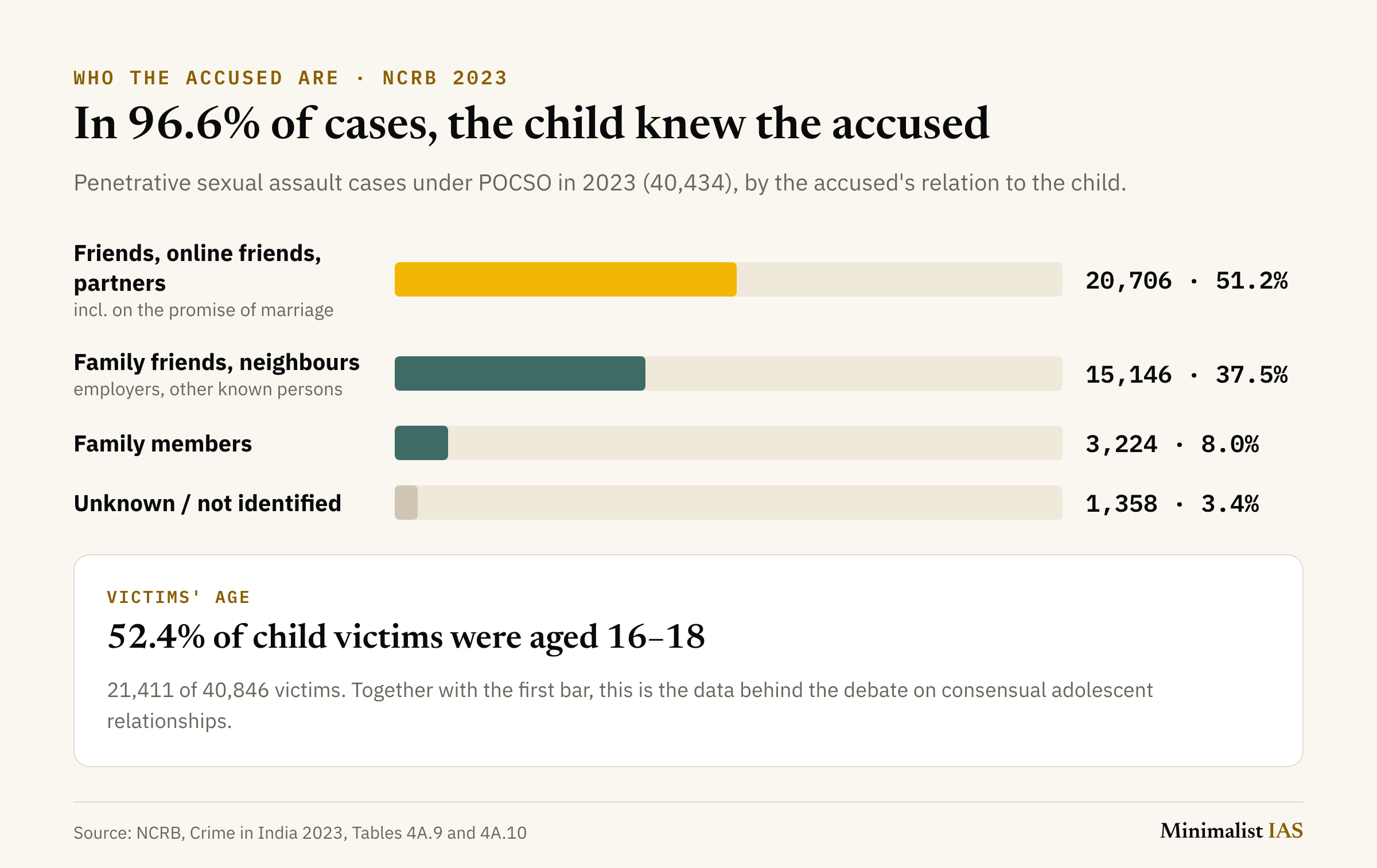
Adolescent cases: friends, online friends or partners are the accused in 51.2% of penetrative assault cases, and 52.4% of victims are 16–18 (NCRB 2023); NCRB does not record whether a relationship was consensual.
Reporting vs health care: mandatory reporting can deter adolescents from seeking care; the Delhi case surfaced during a hospital visit for pregnancy.
Death penalty debate: with 96.6% of accused known to the child, critics warn it may discourage families from reporting.
Online abuse: child sexual exploitative and abuse material spreads faster than forensic and cyber-investigation capacity.
The age-of-consent debate
Under POCSO, consent given by anyone below 18 has no legal effect, and the Act has no close-in-age exception. The debate is how to keep that protective line while avoiding the prosecution of consensual adolescent relationships.
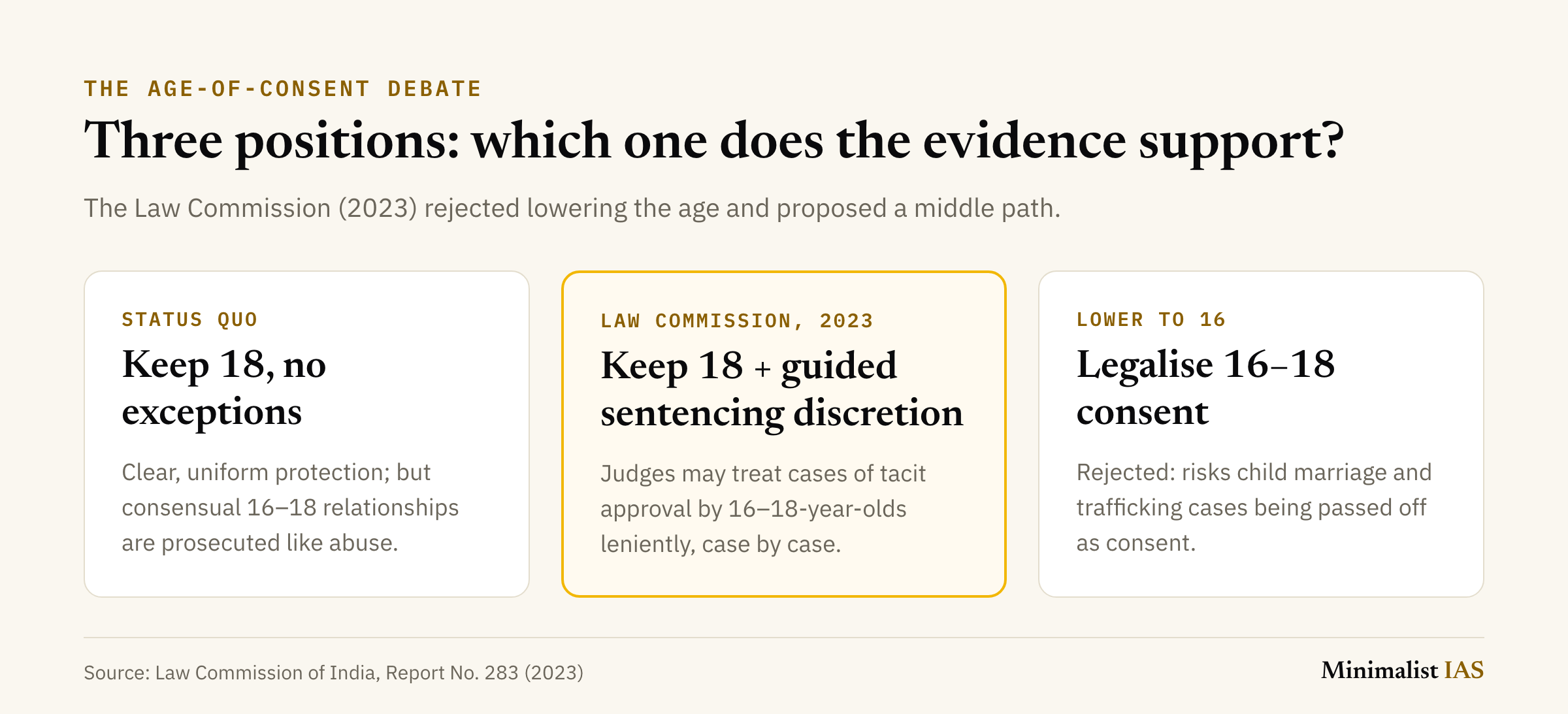
Case for 18: children are vulnerable to grooming and coercion; consent is hard to test in court; a lower age could shield child marriage and trafficking.
Critique: adolescent relationships are criminalised; some cases are filed by families against relationships or elopements they oppose, including inter-caste and inter-faith ones.
Law Commission, Report No. 283 (2023): retain 18; allow guided judicial discretion in sentencing where there is tacit approval in fact, though not consent in law, from a child aged 16–18.
The real question: not “protect or lower the age”, but how to keep 18 while distinguishing abuse from adolescent relationships.
Current relevance: can personal law override POCSO?
No. Personal law may govern whether a marriage is valid, but whether a sexual act is a crime is decided by POCSO and the BNS, both of which fix the age at 18.
The case: a man, then nearly 28, married a girl aged 16 under Muslim personal law; the petition sought to quash the FIR for rape (BNS) and aggravated penetrative sexual assault (POCSO).
The plea: personal law allows a girl who has attained puberty to marry, so marital relations cannot be criminal.
The ruling (Delhi High Court, 2026): “puberty” cannot replace the statutory age of 18; marriage does not advance a child’s age. The FIR stands and the trial court will decide guilt.
BNS link: the marital exception to rape applies only where the wife is not under 18, the position set by Independent Thought (2017).
Judicial evolution: a 2022 Delhi High Court bench had held that POCSO may not apply after a valid Muslim marriage; the Karnataka and Kerala High Courts (2022) took the opposite view, which the 2026 ruling now follows.
Three laws, three questions: validity of marriage (personal law; Prohibition of Child Marriage Act, 2006, where child marriages are voidable) is distinct from criminality of the act (POCSO, BNS).
Landmark judgments and milestones
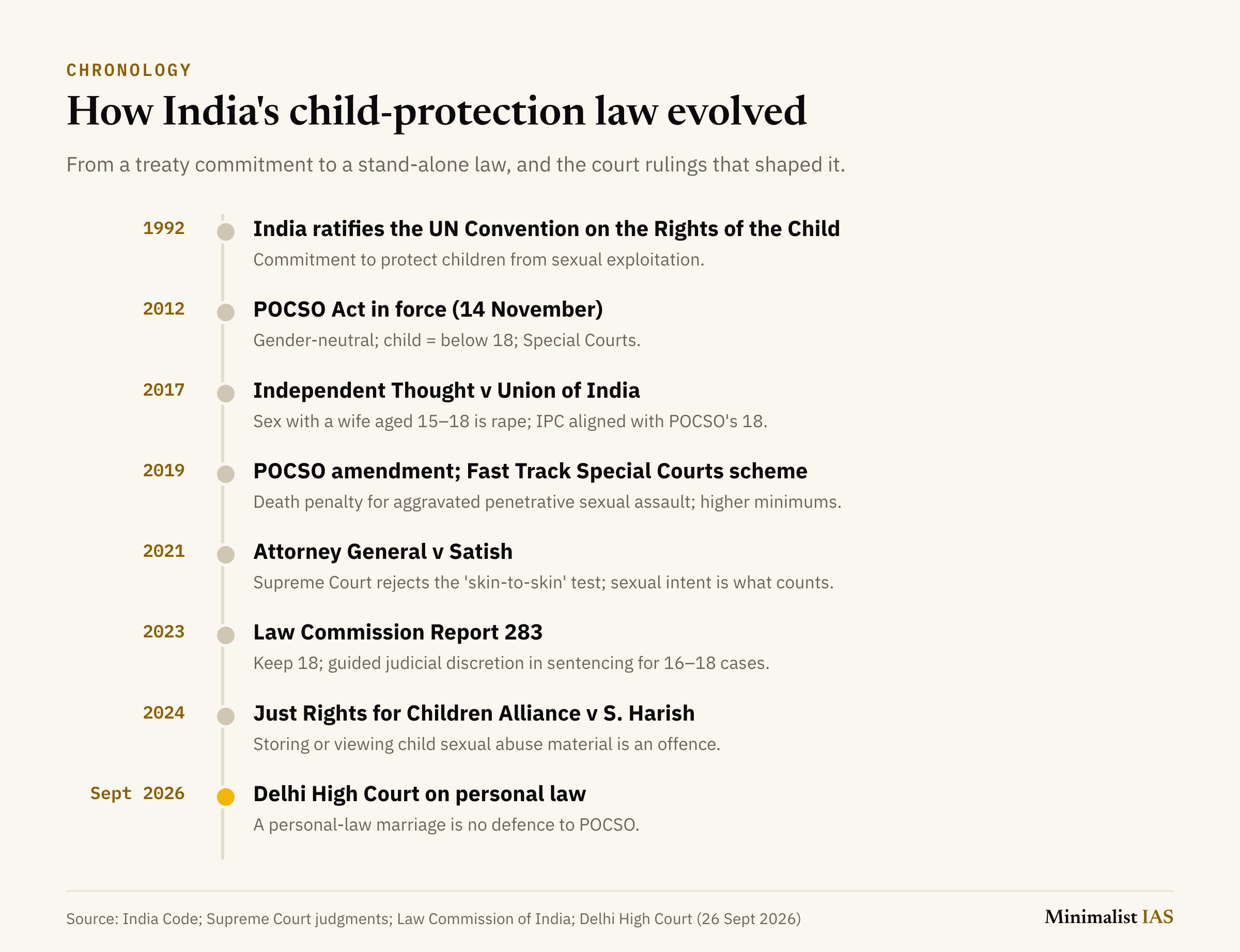
Independent Thought v Union of India (2017): read down the marital exception to rape for wives aged 15–18, aligning the IPC with POCSO.
Attorney General for India v Satish (2021): rejected the “skin-to-skin” test; sexual intent, not the manner of contact, decides sexual assault.
Just Rights for Children Alliance v S. Harish (2024): storing or possessing child sexual abuse material with the intent specified in the Act is an offence even without transmission; urged the term “child sexual exploitative and abuse material” (CSEAM) in place of “child pornography”.
Delhi High Court (2026): personal law gives no immunity from POCSO or the BNS for sexual acts with a wife below 18.
Steps taken
POCSO Rules, 2020: police verification of staff in schools and child-care institutions; interim compensation by the Special Court; support persons.
Fast Track Special Courts (scheme launched 2019): 775 FTSCs, including 398 exclusive POCSO courts, functional in 29 States/UTs (April 2026); the scheme has been temporarily extended till September 2026, so its renewal is a live issue.
Awareness and reporting: Child Helpline 1098 (now under Mission Vatsalya) and NCPCR’s POCSO e-Box, both publicised in NCERT textbooks for Classes 6–12.
Mission Vatsalya: the umbrella scheme for child protection services, including Child Welfare Committees.
Way forward
Clear the backlog: more exclusive POCSO courts, trained Special Public Prosecutors, filled forensic-lab vacancies.
Protect witnesses: support persons for every child to reduce hostility and repeated trauma.
Guided discretion: implement the Law Commission's sentencing approach for consensual 16–18 cases rather than lowering the age.
Prevention: age-appropriate education on body safety; enforce the Prohibition of Child Marriage Act, 2006 alongside POCSO.
Data: publish court-wise POCSO disposal data to track the one-year trial target.
POCSO has given India a specialised, gender-neutral framework for protecting everyone below 18, and the 2026 Delhi High Court ruling reaffirms that neither marriage nor personal law moves that line. The challenge now lies in implementation: timely investigation, forensic capacity, enough Special Courts, child-sensitive trials and a calibrated response to adolescent relationships.
Using POCSO in a Mains answer
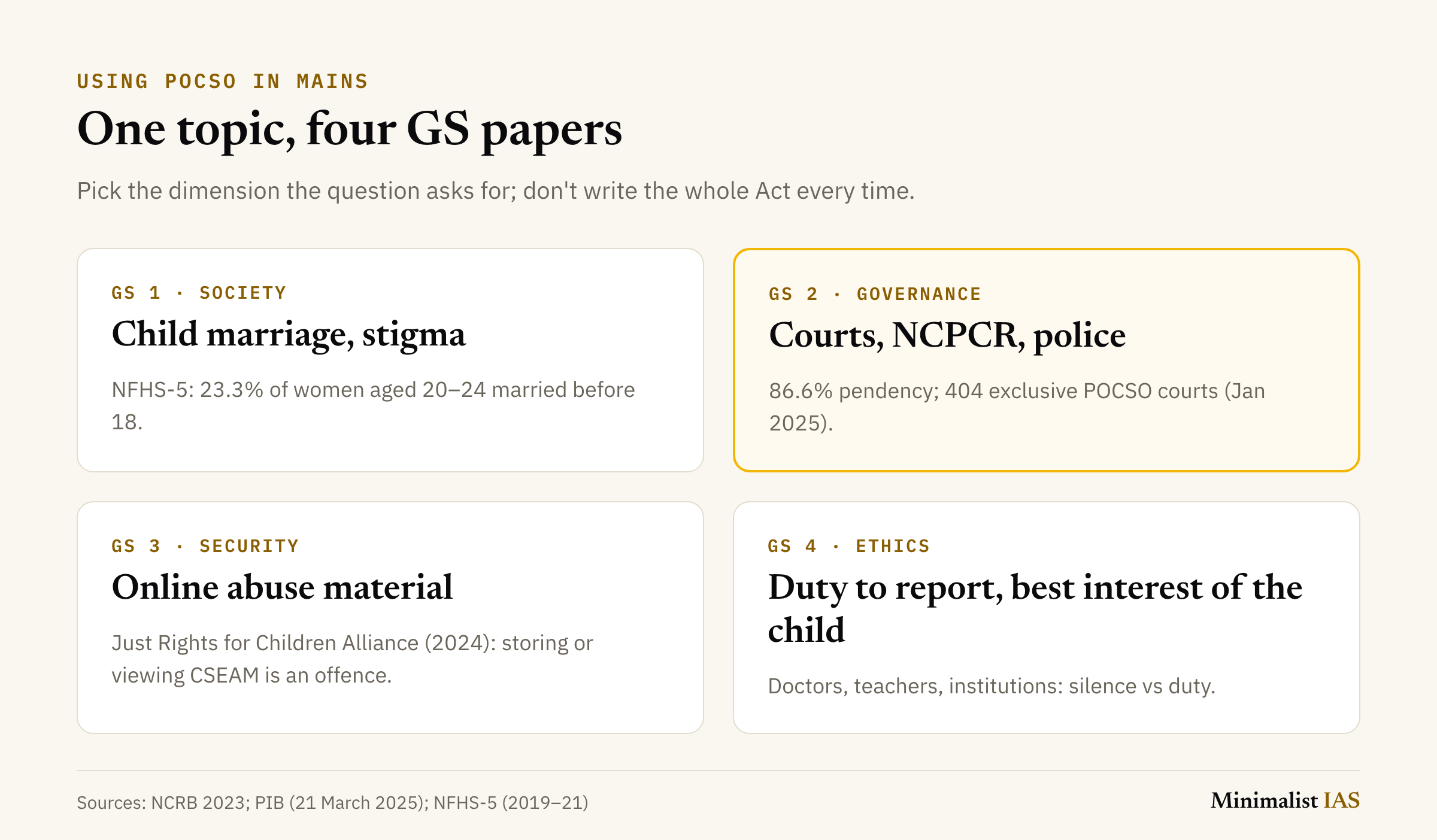
Introduction: define POCSO as a gender-neutral, child-centred special law for everyone below 18; add one data point (NCRB 2023: 86.6% pendency).
Body — design: mandatory reporting, Special Courts, presumptions of guilt and intent, in-camera trial, identity protection, compensation.
Body — gaps: pendency and court capacity, forensic delays, hostile witnesses, adolescent cases, online abuse material.
Way forward: more exclusive POCSO courts, trained prosecutors, support persons, Law Commission’s sentencing discretion, court-wise data.
Conclusion: child protection needs institutional capacity and prevention, not only stricter punishment.
Related PYQs
UPSC CSE Mains 2015, GS Paper II:
“Discuss the possible factors that inhibit India from enacting for its citizens a uniform civil code as provided for in the Directive Principles of State Policy.” The POCSO vs personal law rulings are a current example.
UPSC CSE Mains 2018, GS Paper II:
“Multiplicity of various commissions for the vulnerable sections of the society leads to problems of overlapping jurisdiction and duplication of functions. Is it better to merge all commissions into an umbrella Human Rights Commission? Argue your case.” Use the NCPCR's monitoring role under POCSO.
Mentor’s note
UPSC tests concepts, not section numbers: who is a child, the gender-neutral design, the 2019 amendment, the overriding effect, and who monitors the Act.
In Mains, open with data (NCRB 2023: 86.6% pendency, 29.0% conviction), then write features → issues → way forward. One data point per argument beats a list of provisions.
Don't write that POCSO created the NCPCR. The NCPCR was set up under the Commissions for Protection of Child Rights Act, 2005; POCSO only gives it monitoring duties.
On the age of consent, cite the Law Commission's Report 283 position rather than offering your own opinion.
Target Prelims MCQs
Q1. Consider the following statements about the Protection of Children from Sexual Offences (POCSO) Act, 2012:
The Act is gender-neutral with respect to the child victim.
The death penalty introduced in 2019 applies to every offence of penetrative sexual assault on a child below 16 years of age.
The National Commission for Protection of Child Rights was established under the POCSO Act.
How many of the above statements are correct?
(a) Only one
(b) Only two
(c) All three
(d) None
Answer: (a) Only one
Explanation:
Statement 1 is correct: a child is any person below 18, boy or girl.
Statement 2 is incorrect: the death penalty applies only to aggravated penetrative sexual assault; for a child below 16, the minimum for penetrative sexual assault is 20 years, extendable to life.
Statement 3 is incorrect: the NCPCR was set up under the Commissions for Protection of Child Rights Act, 2005; POCSO only assigns it monitoring.
Q2. Consider the following statements:
Statement-I: A marriage valid under a personal law does not exempt a husband from prosecution under the Protection of Children from Sexual Offences (POCSO) Act, 2012 for sexual acts with his wife who is below 18 years of age.
Statement-II: The POCSO Act defines a child as any person below 18 years of age and has overriding effect over any other law to the extent of inconsistency.
Which one of the following is correct in respect of the above statements?
(a) Both Statement-I and Statement-II are correct and Statement-II explains Statement-I
(b) Both Statement-I and Statement-II are correct, but Statement-II does not explain Statement-I
(c) Statement-I is correct, but Statement-II is incorrect
(d) Statement-I is incorrect, but Statement-II is correct
Answer: (a) Both Statement-I and Statement-II are correct and Statement-II explains Statement-I
Explanation:
Statement-I is correct: the Delhi High Court (2026) and the Karnataka and Kerala High Courts (2022) held that a personal-law marriage is no defence.
Statement-II is correct: the Act fixes 18 with no exception for marriage and overrides inconsistent laws.
Statement-II explains Statement-I, because it is precisely this definition and overriding effect that keep a married minor within POCSO.
Q3. Which of the following are features of the trial of offences under the POCSO Act, 2012?
The trial is held in camera.
The media may not disclose the identity of the child.
The child must identify the accused face to face in open court.
Select the correct answer using the code given below.
(a) 1 and 2 only
(b) 2 and 3 only
(c) 1 and 3 only
(d) 1, 2 and 3
Answer: (a) 1 and 2 only
Explanation:
Statements 1 and 2 are correct: trials are held in camera and the child's identity is protected.
Statement 3 is incorrect: the Special Court must ensure the child is not exposed to the accused while testifying, for example through a screen, curtain or video link.
Q4. With reference to the Supreme Court’s judgment in Independent Thought v Union of India (2017), which one of the following statements is correct?
(a) It struck down the marital-rape exception for all married women.
(b) It held that sexual intercourse by a man with his wife aged between 15 and 18 years is rape.
(c) It lowered the age of consent under the POCSO Act to 16 years.
(d) It declared all child marriages in India void from the outset.
Answer: (b) It held that sexual intercourse by a man with his wife aged between 15 and 18 years is rape.
Explanation:
(a) is incorrect: the exception was read down only for wives below 18.
(b) is correct.
(c) is incorrect: the age under POCSO remains 18; the judgment aligned the IPC with it.
(d) is incorrect: the Court did not rule on the validity of child marriages, which remain voidable under the Prohibition of Child Marriage Act, 2006.
Mains practice questions
Despite a stringent law, cases under the POCSO Act show high pendency and low conviction. Examine the reasons and suggest measures. (Answer in 150 words; 10 Marks)
The age of consent under the POCSO Act protects children but also criminalises consensual adolescent relationships. Critically examine, with reference to the recommendations of the Law Commission of India. (Answer in 250 words; 15 Marks)
Abbreviations & terminology
POCSO: Protection of Children from Sexual Offences Act, 2012
NCPCR / SCPCR: National / State Commission for Protection of Child Rights
NCRB: National Crime Records Bureau
FTSC: Fast Track Special Court
BNS: Bharatiya Nyaya Sanhita, 2023
CSEAM: Child Sexual Exploitative and Abuse Material
NFHS: National Family Health Survey
Frequently asked questions (FAQs)
What is the POCSO Act?
The Protection of Children from Sexual Offences Act, 2012 is India’s law against sexual assault, sexual harassment and pornographic exploitation of anyone below 18. It provides for Special Courts, a child-friendly trial held in camera, and a time-bound procedure.
Is the POCSO Act gender-neutral?
Yes. The Act defines a child as any person below 18, so it protects boys and girls equally, and its offences can be committed by a person of any gender.
Is reporting mandatory under the POCSO Act?
Yes. Section 19 requires anyone who knows or suspects that a sexual offence against a child has been committed to inform the Special Juvenile Police Unit or the local police, and failure to report is itself punishable.
Does the POCSO Act shift the burden of proof to the accused?
Yes. Under Sections 29 and 30, the Special Court presumes that the accused committed the sexual offence and had a culpable mental state unless the contrary is proved, and the accused must disprove that mental state beyond reasonable doubt.
Does POCSO apply to consensual relationships between 16- and 17-year-olds?
Yes. Under POCSO, consent given by anyone below 18 has no legal effect, and there is no close-in-age exception. The Law Commission of India, in Report No. 283 (2023), advised keeping the age at 18 but suggested guided judicial discretion in sentencing for cases involving tacit approval by children aged 16 to 18.
Does POCSO override personal law?
Yes. Under Section 42A, the Act prevails over any inconsistent law. The Karnataka and Kerala High Courts (2022) and the Delhi High Court (2026) have held that a marriage valid under personal law is no defence to a POCSO offence against a wife below 18.
What is the conviction rate under the POCSO Act?
According to NCRB’s Crime in India 2023, the conviction rate in POCSO trials completed that year was 29.0%, and 86.6% of POCSO cases for trial were still pending at the end of the year.
Key takeaways
POCSO protects everyone below 18, is gender-neutral, and overrides inconsistent laws, including personal law.
The weak link is the courts: 86.6% pendency and a 29.0% conviction rate (NCRB 2023).
The live reform is sentencing discretion for consensual 16–18 cases, not lowering the age of consent.
Related reading
Practise previous-year Polity and Social Justice questions in the free PYQ vault
Revise the NCERT basics of Indian Polity in NCERT Foundations
Sources
The Protection of Children from Sexual Offences Act, 2012 — India Code
The Protection of Children from Sexual Offences (Amendment) Act, 2019 — Ministry of Women and Child Development%20Act,%202019.pdf)
NCRB, Crime in India 2023, Volume I (Tables 4A.3, 4A.5, 4A.9, 4A.10)
NCRB, Crime in India 2024: crimes against children, as reported by IndiaSpend
Fast Track Special Courts — PIB, Ministry of Law and Justice, July 2026
22nd Law Commission submits Report No. 283 on the age of consent — PIB
Bilal & Anr v State Govt of NCT of Delhi (Delhi High Court, 2026) — Bar & Bench
Independent Thought v Union of India (2017) — Supreme Court Observer
Just Rights for Children Alliance v S. Harish (2024) — Supreme Court Observer
Minimalist IAS static notes — by Shivam Singh.
Spotted an error or something outdated? Tell us — we correct it.
About the author
Shivam Singh
Founder & Mentor, Minimalist IAS
Shivam has been through every stage of the exam himself — Prelims, repeated Mains attempts across UPSC and state civil services, and the interview board. For 7 years he has mentored aspirants one-to-one, helping 100+ clear various stages of the exam, including final selections.
More about Shivam →