Polity & Governance
Two Election Commissioners Filed 14 Objections in 10 Months — India Only Found Out This Week
By Shivam Singh, Founder & Mentor, Minimalist IAS
· Updated · 6 min read
By Shivam Singh, Minimalist IAS Mentor Team · Last updated: September 26, 2026
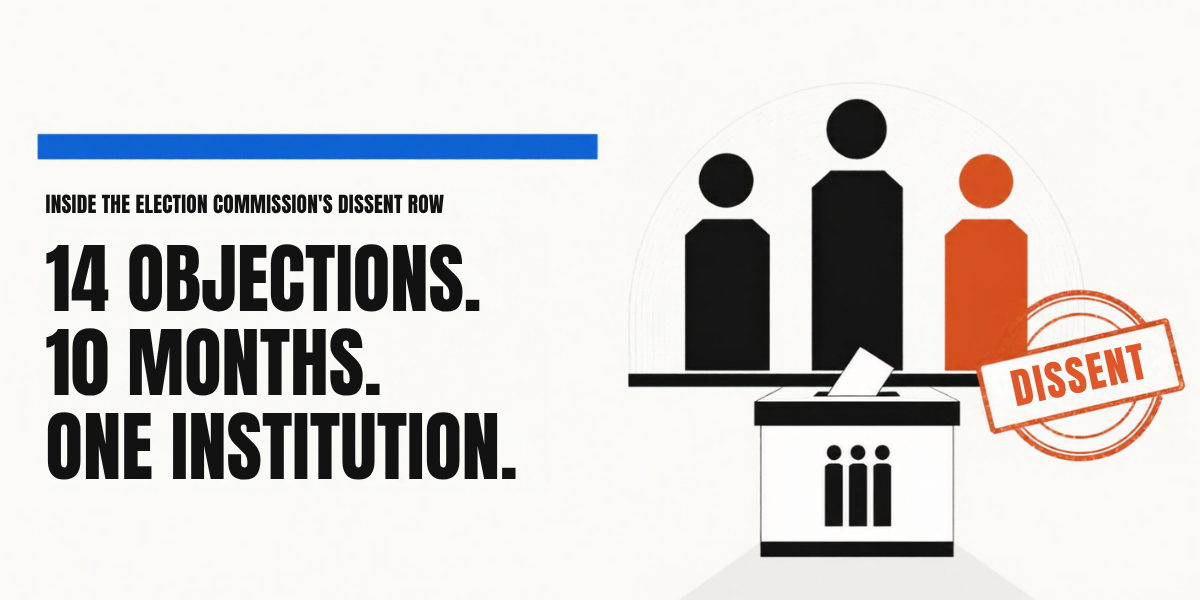
Two of India's three Election Commissioners — Sukhbir Singh Sandhu and Vivek Joshi — objected to Election Commission decisions at least 14 times in 10 months, mostly over the Special Intensive Revision (SIR) of electoral rolls. The ECI's official line: every final decision, including on SIR, was unanimous.
What Actually Happened?
1. The Objections
Commissioners Sandhu and Joshi recorded formal dissent notes 14 times between roughly September 2025 and September 2026.
The friction centred on SIR-related calls: changes to Form 6, and centralised control of the electoral roll database.
Some decisions, reports say, were issued without both Commissioners being informed first.
2. The ECI's Defence
The Commission's response: "Differing views and observations are a normal part of internal deliberations."
Its position: every officer is "fully authorised" to raise concerns — and every final decision, SIR included, was unanimous.
3. The Political Fallout
Youth Congress protests broke out; an effigy of CEC Gyanesh Kumar was burned in Patna.
Opposition leaders demanded his removal; AAP's Arvind Kejriwal went further, calling for his arrest.
Example: Former CEC S.Y. Quraishi publicly questioned the validity of elections held on the back of the SIR exercise — even though, as you'll see below, that exact question was already settled by the Supreme Court four months earlier.
Untangling Two Different Questions
Is SIR legal? — Settled. Supreme Court, 27 May 2026.
Is the ECI functioning properly as a 3-member body? — Unsettled. That's this story.
Example: It's the difference between asking "was the exam conducted fairly?" (yes, courts checked) versus "did the exam committee members agree with each other while setting the paper?" (murky, and now public).
How Does the Election Commission Actually Decide Things?
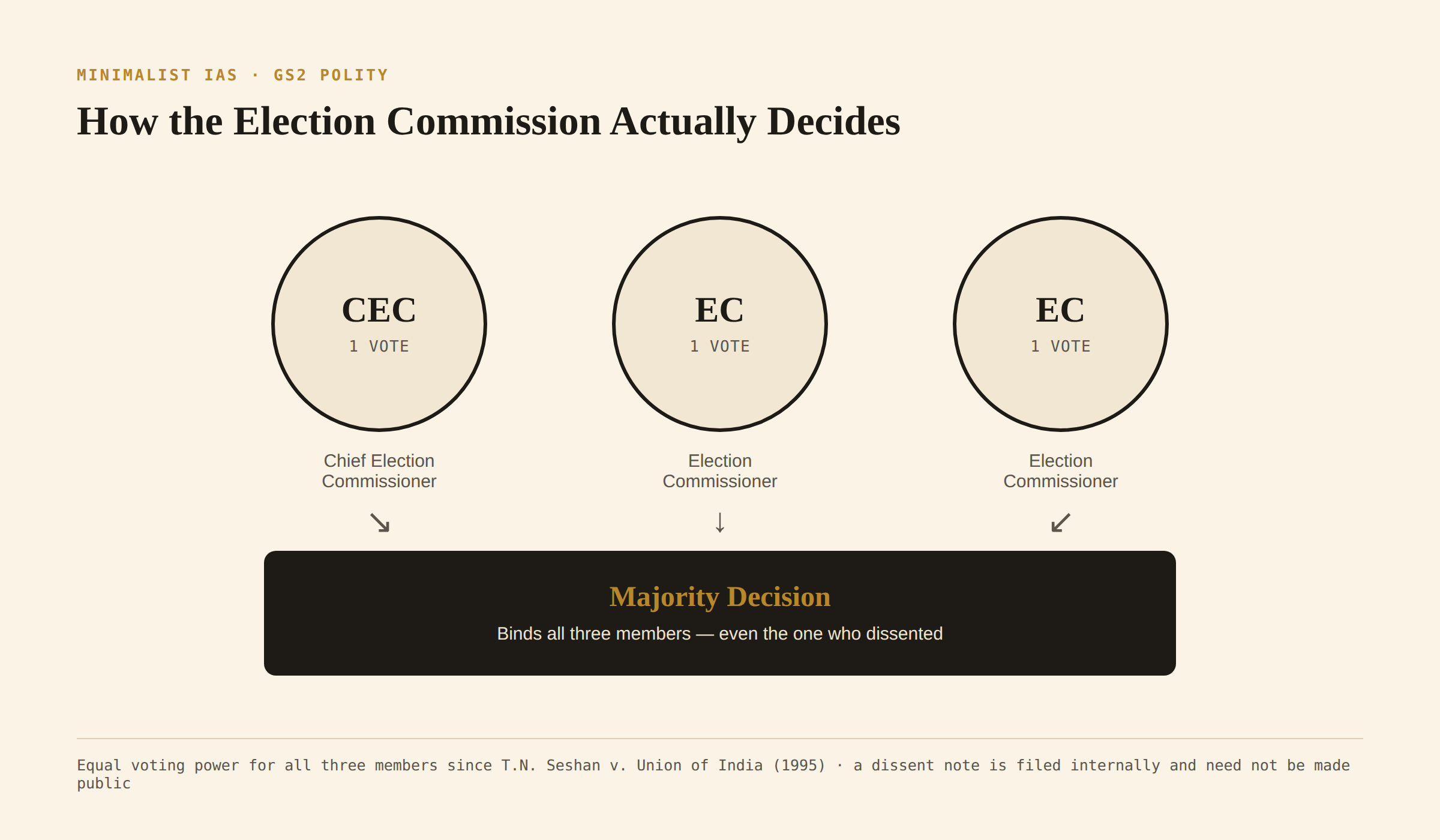
The ECI is a 3-member body: the CEC + 2 Election Commissioners.
Since T.N. Seshan v. Union of India (1995), all three have equal voting power — the CEC has no veto or superior say.
Decisions are taken by majority and bind the whole Commission — even the member who disagreed.
A dissent note doesn't cancel a decision. It's filed internally — it doesn't have to be made public.
Example — this isn't new: In 2019, Commissioner Ashok Lavasa dissented on the EC's clean chits to PM Modi and Amit Shah over Model Code violations. His note wasn't attached to the final order — the EC said its own rules had no provision for that. He later resigned to join the Asian Development Bank.
Why Can't the Public Just "Remove the CEC"?
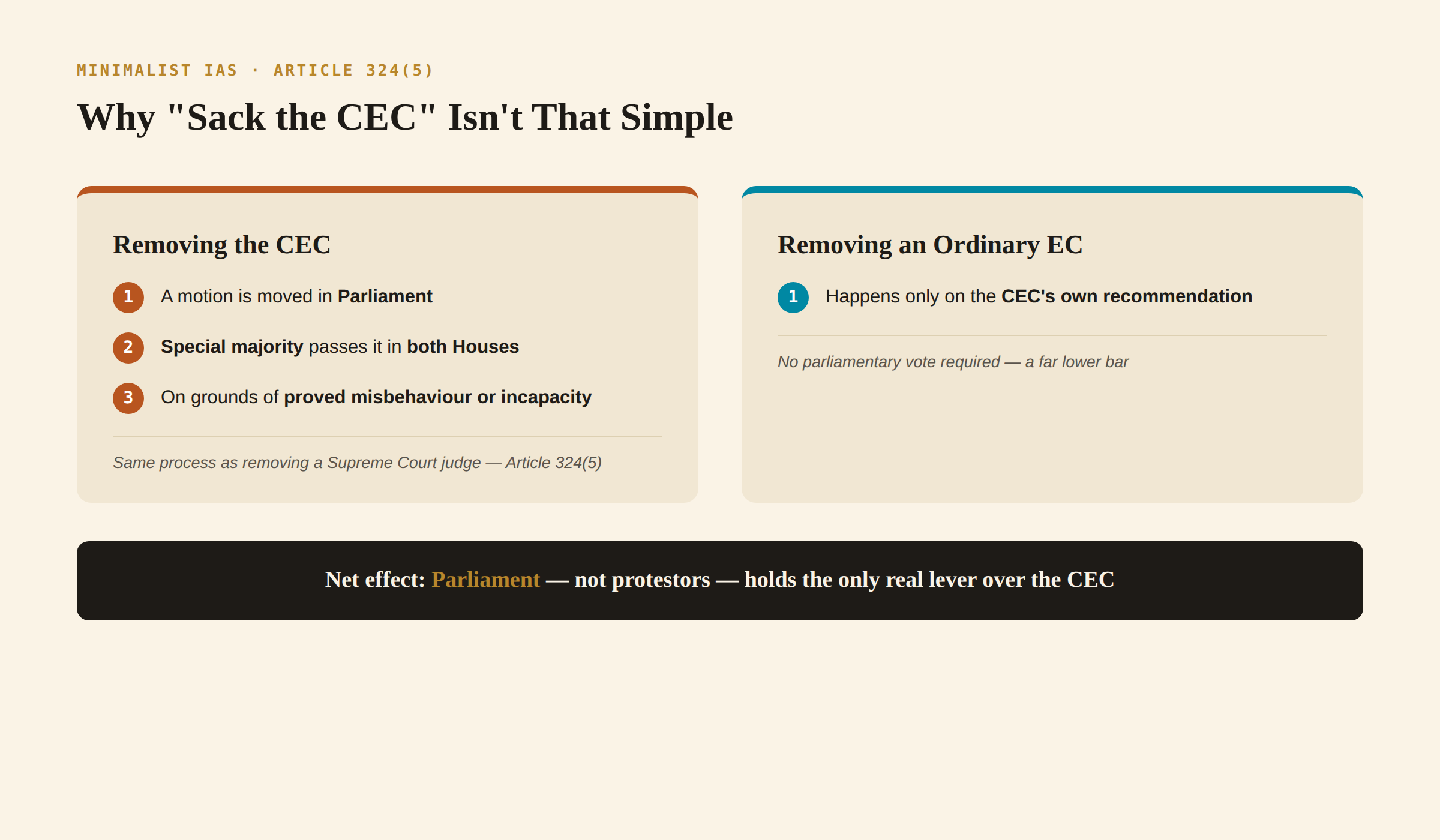
Removing the CEC needs the same process as removing a Supreme Court judge: a motion passed by special majority in both Houses of Parliament, on grounds of proved misbehaviour or incapacity.
Removing an ordinary EC is comparatively simpler — it happens only on the CEC's own recommendation.
Net effect: Parliament — not protestors, not the dissenting Commissioners — holds the only real lever over the CEC. That's why this plays out as slogans, not procedure.
Déjà Vu — The ECI Has Been Here Before
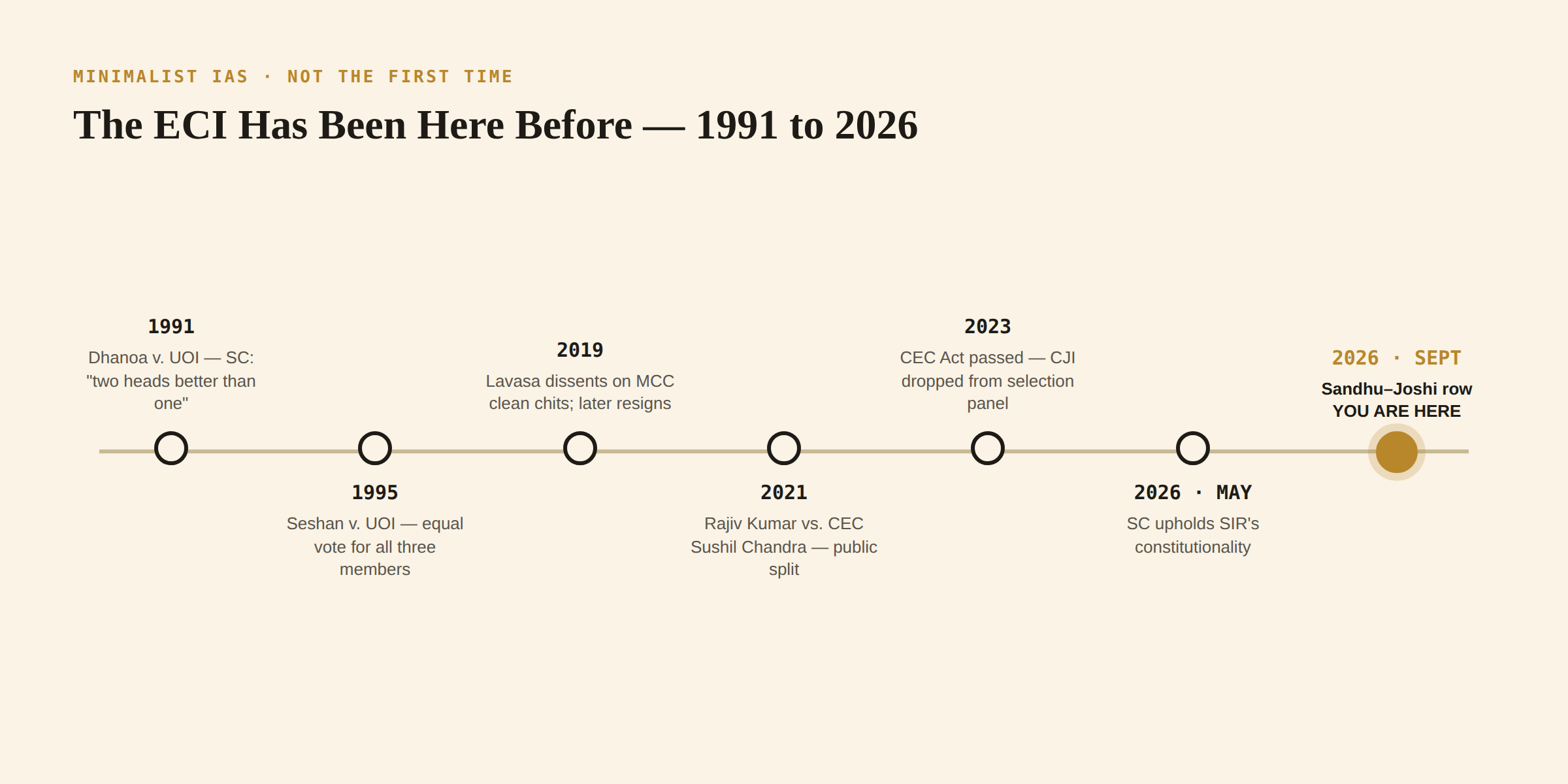
Year | What Happened |
1991 | Dhanoa v. UOI — SC: "two heads better than one" |
1995 | Seshan v. UOI — SC: equal vote for all three members |
2019 | Lavasa dissents on MCC clean chits; later resigns |
2021 | Rajiv Kumar vs. CEC Sushil Chandra — public split over Covid-era poll criticism |
2023 | CEC Act passed — CJI dropped from the selection panel |
2026 (May) | SC upholds SIR's constitutionality |
2026 (Sept) | Sandhu–Joshi row — you are here |
The UPSC Lens — Why This Actually Matters
This isn't just a political spat. It's a live case study in a theme UPSC keeps returning to: the independence of constitutional bodies from executive influence — the same debate that surrounds the CBI, CVC, and CAG.
GS2 angle: Tests whether you understand Article 324 as a design for insulation, not just a factual provision to memorise.
The real tension: Institutional stability (majority rule, "unanimous" public decisions) vs. transparency (should dissent be visible to voters?).
The deeper question courts have grappled with: Can the judiciary step in to fix an appointments process Parliament hasn't fixed itself? Anoop Baranwal said yes — Parliament then legislated a different answer in 2023.
Exam-ready framing: Every time this story resurfaces (1991, 1995, 2019, 2021, 2026), the same fault line reappears — a multi-member body designed for balance, tested by how it handles disagreement.
Way Forward — In the Words of Those Who've Actually Ruled on This
The strongest word on this doesn't come from a politician — it comes from the Supreme Court itself, in Anoop Baranwal v. Union of India (2023 SCC OnLine SC 216):
"A pliable Election Commission, an unfair and biased overseer of the foundational exercise of adult franchise, which lies at the heart of democracy, who obliges the powers that be, perhaps offers the surest gateway to acquisition and retention of power."
The Court's own fix — an interim selection panel of the PM + Leader of Opposition + Chief Justice of India — was the law until Parliament replaced it with the 2023 Act, which dropped the CJI. Restoring that balance remains a live demand in Parliament and before courts.
The Law Commission of India, 255th Report (2015) on Electoral Reforms had already recommended making the CEC/EC appointment process "more independent and broad-based" — a full eight years before Anoop Baranwal forced the issue.
What's still missing: a clear, published rule on when a dissent note gets attached to a final order — instead of case-by-case discretion, as happened with Lavasa in 2019 and now, reportedly, with Sandhu and Joshi.
ECI at a Glance — Know Your Constitutional Body
1. What it is: A permanent, independent constitutional body — not set up by a separate law.
2. Constitutional basis: Article 324 (Part XV, Articles 324–329).
3. Established: 25 January 1950 — now marked as National Voters' Day.
4. Composition: CEC + as many ECs as the President fixes. Briefly multi-member in 1989–90; permanently multi-member (3 members) since 1 October 1993.
5. Appointment: President, on the advice of a Selection Committee — PM (Chair) + Leader of Opposition (Lok Sabha) + one PM-nominated Union Cabinet Minister — under the CEC and Other ECs Act, 2023.
6. Tenure: 6 years, or till age 65, whichever comes first. No reappointment.
7. Salary & status: Now equal to a Cabinet Secretary (2023 Act) — earlier equal to a Supreme Court judge (1991 Act).
8. Removal: CEC — same as a Supreme Court judge (Art. 324(5)). Other ECs — only on the CEC's recommendation.
9. How it decides: By majority vote; all three members have equal say (T.N. Seshan v. UOI, 1995).
10. Core functions: Conducts elections to Parliament, State Legislatures, President & Vice-President (local body polls are the State Election Commissions' job — Art. 243K/243ZA); prepares/revises electoral rolls; registers parties & allots symbols; enforces the Model Code of Conduct.
11. Related articles: Art. 325 (no roll discrimination) · Art. 326 (universal adult suffrage) · Art. 327–328 (Parliament/State power over election laws) · Art. 329 (bar on court interference, except via election petition).
12. Landmark cases: S.S. Dhanoa v. UOI (1991) · T.N. Seshan v. UOI (1995) · Anoop Baranwal v. UOI (2023).
GS Tag
GS Paper 2 — Polity & Governance (Constitutional Bodies, Election Commission, Article 324) · Prelims + Mains · relevant for State PSC/SSC/banking polity sections too.
Previous Year Questions (verified)
Prelims 2017: Consider the following statements:
The Election Commission of India is a five-member body.
Union Ministry of Home Affairs decides the election schedule for general elections and bye-elections.
Election Commission resolves disputes relating to splits/mergers of recognised political parties.
Which is/are correct?
→ Answer: 3 only
Mains 2022 (GS2, 15 marks): "Discuss the role of the Election Commission of India in light of the evolution of the Model Code of Conduct."
Practice Questions
"The Election Commission's collegial character is tested not by its unanimous decisions but by how it handles internal dissent." Discuss, with reference to constitutional safeguards for Commissioners' independence. (15 marks, 250 words)
Critically examine the changes introduced by the CEC and Other Election Commissioners Act, 2023 to the appointment process. (10 marks, 150 words)
FAQs
What's the ECI dissent row about?
Two of three Election Commissioners objected to ECI decisions 14 times over 10 months, mostly on SIR. The ECI says every final decision was unanimous.
Is SIR itself illegal?
No — the Supreme Court upheld it on 27 May 2026. This row is about internal process, not SIR's validity.
How does the ECI actually decide things?
Three members, equal votes, majority rules — settled by T.N. Seshan v. UOI (1995).
Can the CEC be removed over this?
Only like a Supreme Court judge — a special-majority Parliament vote on proved misbehaviour. A very high bar.
Has this happened before?
Yes — Ashok Lavasa (2019) and Rajiv Kumar vs. Sushil Chandra (2021).
What changed in how Commissioners get appointed?
The 2023 Act replaced the CJI with a PM-nominated minister on the selection panel — a departure from what the Supreme Court had ordered in Anoop Baranwal (2023).
Spotted an error or something outdated? Tell us — we correct it.
About the author
Shivam Singh
Founder & Mentor, Minimalist IAS
Shivam has been through every stage of the exam himself — Prelims, repeated Mains attempts across UPSC and state civil services, and the interview board. For 7 years he has mentored aspirants one-to-one, helping 100+ clear various stages of the exam, including final selections.
More about Shivam →