Minimalist IAS
CSAT

CSAT · 113 questions

Puzzles, arrangements & general mental ability

Every UPSC CSAT question on this topic, 2016–2026, newest first. Tap an option to check yourself; the answer and explanation open below it.

Puzzles, arrangements & general mental ability questions per year: 2016: 19, 2017: 18, 2018: 17, 2019: 10, 2020: 3, 2021: 10, 2022: 5, 2023: 7, 2024: 8, 2025: 8, 2026: 8 Asked in 11 of 11 years · most in 2016 (19)

UPSC syllabus: “General mental ability;” See the full syllabus →

Showing 61–90 of 113, newest first.

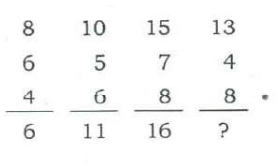
Consider the following pattern of numbers:

8101513
6574
4688
61116?
Four columns of three numbers, each ruled off with a result below it: 8, 6, 4 → 6; 10, 5, 6 → 11; 15, 7, 8 → 16; 13, 4, 8 → ?.
From UPSC's question paper.

What is the number at? in the above pattern?

Answer & explanation

Answer: (a) 17

In each column the result is the first number plus the third minus the second: 8 + 4 − 6 = 6, 10 + 6 − 5 = 11 and 15 + 8 − 7 = 16. The last column gives 13 + 8 − 4 = 17.

  1. Column 1: 8 + 4 − 6 = 6. Column 2: 10 + 6 − 5 = 11. Column 3: 15 + 8 − 7 = 16.
  2. The same rule — top + bottom − middle — fits all three complete columns.
  3. Column 4: 13 + 8 − 4 = 17.

Remember · In column puzzles, try simple combinations (+, −, ×) of the entries on every complete column before filling the gap.

Question and answer: UPSC's official GS Paper II (2018, Series A) — paper ↗ · answer key ↗. Explanation: Minimalist IAS, checked 1 Oct 2026 (how we verify). Permalink ·
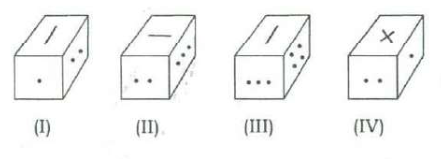
Directions for the following 3 (three) items: Rotated positions of a single solid are shown below. The various faces of the solid are marked with different symbols like dots, cross and line. Answer the three items that follow the given figures.

Four views (I)–(IV) of one rectangular block, each showing its top, front and right faces: (I) line, one dot, two dots; (II) line, two dots, three dots; (III) line, three dots, four dots; (IV) cross, two dots, one dot.
From UPSC's question paper.

What is the symbol on the face opposite to that containing a single dot?

Answer & explanation

Answer: (b) Three dots

The line is on top in views (I)–(III), so the four dot-faces all touch it and form the ring around the solid, and the cross, the sixth face, is opposite the line. Around the ring the order is one, two, three, four dots, so one dot is opposite three dots.

  1. Views (I)–(III) all have the line on top and between them show one, two, three and four dots on the sides: all four dot-faces touch the line.
  2. The only face left, the cross, must be opposite the line.
  3. Side faces in order: (I) one then two; (II) two then three; (III) three then four — the ring runs 1, 2, 3, 4.
  4. In a ring of four faces, alternate faces are opposite: one dot is opposite three dots (and two dots opposite four dots).
  5. Check with (IV): cross on top, two dots in front, one dot on the right — one and two dots are adjacent, as the ring requires.

Remember · A face seen beside four different faces is opposite the sixth; the other four then form a ring in which alternate faces are opposite.

Question and answer: UPSC's official GS Paper II (2018, Series A) — paper ↗ · answer key ↗. Explanation: Minimalist IAS, checked 1 Oct 2026 (how we verify). Permalink ·
Directions for the following 3 (three) items: Rotated positions of a single solid are shown below. The various faces of the solid are marked with different symbols like dots, cross and line. Answer the three items that follow the given figures.

Uses the same figure as Q14 ↑

What is the symbol on the face opposite to that containing two dots?

Answer & explanation

Answer: (c) Four dots

Two dots is seen next to one dot, three dots, the line and the cross, but never next to four dots. The face it never touches — four dots — is its opposite.

  1. Faces seen beside two dots: one dot (I, IV), three dots (II), the line (II) and the cross (IV).
  2. That is four of the five other faces; four dots never appears with two dots.
  3. So four dots is opposite two dots.
  4. Check: the ring of side faces runs 1, 2, 3, 4, and alternate faces of a ring of four are opposite.

Remember · The opposite face is the one never seen together with the given face in any of the views.

Question and answer: UPSC's official GS Paper II (2018, Series A) — paper ↗ · answer key ↗. Explanation: Minimalist IAS, checked 1 Oct 2026 (how we verify). Permalink ·

Directions for the following 3 (three) items: Rotated positions of a single solid are shown below. The various faces of the solid are marked with different symbols like dots, cross and line. Answer the three items that follow the given figures.

Uses the same figure as Q14 ↑

What is the symbol on the face opposite to that containing the cross?

Answer & explanation

Answer: (c) Line

The line is seen beside one, two, three and four dots across views (I)–(III). The only face it never touches is the cross, so the cross is opposite the line.

  1. Faces beside the line: one and two dots (I), two and three dots (II), three and four dots (III).
  2. That covers four of the five other faces; the cross never appears with the line.
  3. So the cross is opposite the line.
  4. Check with (IV): with the cross on top, dot-faces fill the sides, as expected for the face opposite the line.

Remember · A face that appears next to four others is opposite the sixth — the quickest opposite-face test for dice and blocks.

Question and answer: UPSC's official GS Paper II (2018, Series A) — paper ↗ · answer key ↗. Explanation: Minimalist IAS, checked 1 Oct 2026 (how we verify). Permalink ·

Directions for the following 2 (two) items: Read the following information and answer the two items that follow.

The plan of an office block for six officers A, B, C, D, E and F is as follows: Both B and C occupy offices to the right of the corridor (as one enters the office block) and A occupies on the left of the corridor. E and F occupy offices on opposite sides of the corridor but their offices do not face each other. The offices of C and D face each other. E does not have a corner office. F’s office is further down the corridor than A’s, but on the same side.

If E sits in his office and faces the corridor, whose office is to his left?

Answer & explanation

Answer: (c) C

The offices, from the entrance, are D, A, F on the left and C, E, B on the right. Sitting in the middle office on the right and facing the corridor, E has the entrance end on his left — and C's office is there.

  1. Sides: B and C are on the right, A on the left. D faces C, so D is on the left; F is on A's side, so F is on the left, and E is on the right.
  2. Each side has three offices. E has no corner office, so E is in the middle office on the right.
  3. F does not face E, so F is not in the middle; F is further down than A, so F has the far-end office on the left.
  4. D must face C; the middle office on the right is E's, so C and D take the offices nearest the entrance. A is left-middle and B right far-end.
  5. Layout from the entrance — left side: D, A, F; right side: C, E, B.
  6. E sits on the right side facing the corridor, i.e. facing across towards the left side; his left hand then points back towards the entrance, where C's office is.

Remember · In corridor puzzles, fix each person's side first, then use 'corner', 'faces' and 'further down'; finally turn the map to the person's own facing.

Question and answer: UPSC's official GS Paper II (2018, Series A) — paper ↗ · answer key ↗. Explanation: Minimalist IAS, checked 30 Sept 2026 (how we verify). Permalink ·

Directions for the following 2 (two) items: Read the following information and answer the two items that follow.

The plan of an office block for six officers A, B, C, D, E and F is as follows: Both B and C occupy offices to the right of the corridor (as one enters the office block) and A occupies on the left of the corridor. E and F occupy offices on opposite sides of the corridor but their offices do not face each other. The offices of C and D face each other. E does not have a corner office. F’s office is further down the corridor than A’s, but on the same side.

Who is/are F’s immediate neighbour/neighbours?

Answer & explanation

Answer: (a) A only

F has the corner office at the far end of the left side, with A's office beside it (D, A, F from the entrance). B's office faces F across the corridor but is not beside it, so A is F's only immediate neighbour.

  1. Sides: B and C are on the right, A on the left. D faces C, so D is on the left; F is on A's side, so F is on the left, and E is on the right.
  2. Each side has three offices. E has no corner office, so E is in the middle office on the right.
  3. F does not face E, so F is not in the middle; F is further down than A, so F has the far-end office on the left.
  4. D must face C; the middle office on the right is E's, so C and D take the offices nearest the entrance. A is left-middle and B right far-end.
  5. Layout from the entrance — left side: D, A, F; right side: C, E, B.
  6. F is at the end of the left side, so the only office beside F is A's; B, across the corridor, faces F rather than adjoins it.

Remember · Neighbours share a wall on the same side; an office across the corridor is 'facing', not 'next to'.

Question and answer: UPSC's official GS Paper II (2018, Series A) — paper ↗ · answer key ↗. Explanation: Minimalist IAS, checked 30 Sept 2026 (how we verify). Permalink ·

Directions for the following 6 (six) items: Read the information given below and answer the six items that follow.

A, B, C and D are students. They are studying in four different cities, viz., P, Q, R and S (not necessarily in that order). They are studying in Science college, Arts college, Commerce college and Engineering college (not necessarily in that order), which are situated in four different States, viz., Gujarat, Rajasthan, Assam and Kerala (not necessarily in that order). Further, it is given that—

  1. i.D is studying in Assam
  2. ii.Arts college is located in city S which is in Rajasthan
  3. iii.A is studying in Commerce college
  4. iv.B is studying in city Q
  5. v.Science college is located in Kerala

A is studying in

Answer & explanation

Answer: (b) Gujarat

Science and Arts take Kerala and Rajasthan, leaving Gujarat and Assam for Commerce and Engineering. D is in Assam and cannot be in A's Commerce college, so Engineering is in Assam and A's Commerce college is in Gujarat.

  1. Science is in Kerala and Arts in Rajasthan (city S), so Commerce and Engineering are in Gujarat and Assam.
  2. D is in Assam, so D studies Commerce or Engineering; Commerce is A's, so D is in Engineering — in Assam — and A's Commerce college is in Gujarat.
  3. B and C share Science and Arts. B is in city Q, but Arts is in city S, so B is in Science (Kerala, city Q) and C in Arts (Rajasthan, city S).
  4. A and D are in cities P and R, in an order the data do not fix.
  5. Result: A — Commerce, Gujarat; B — Science, Kerala, city Q; C — Arts, Rajasthan, city S; D — Engineering, Assam.
  6. So A studies in Gujarat; Rajasthan is C's State, Kerala is B's, and city Q is B's city.

Remember · In grid puzzles, place the fixed pairs first (college with State), then use the 'who is where' clues to settle the two-way choices.

Question and answer: UPSC's official GS Paper II (2018, Series A) — paper ↗ · answer key ↗. Explanation: Minimalist IAS, checked 30 Sept 2026 (how we verify). Permalink ·

Directions for the following 6 (six) items: Read the information given below and answer the six items that follow.

A, B, C and D are students. They are studying in four different cities, viz., P, Q, R and S (not necessarily in that order). They are studying in Science college, Arts college, Commerce college and Engineering college (not necessarily in that order), which are situated in four different States, viz., Gujarat, Rajasthan, Assam and Kerala (not necessarily in that order). Further, it is given that—

  1. i.D is studying in Assam
  2. ii.Arts college is located in city S which is in Rajasthan
  3. iii.A is studying in Commerce college
  4. iv.B is studying in city Q
  5. v.Science college is located in Kerala

Science college is located in

Answer & explanation

Answer: (a) city Q

B is in city Q. B cannot be in the Arts college, which is in city S, and Commerce and Engineering belong to A and D, so B is in the Science college — which places Science in city Q.

  1. Science is in Kerala and Arts in Rajasthan (city S), so Commerce and Engineering are in Gujarat and Assam.
  2. D is in Assam, so D studies Commerce or Engineering; Commerce is A's, so D is in Engineering — in Assam — and A's Commerce college is in Gujarat.
  3. B and C share Science and Arts. B is in city Q, but Arts is in city S, so B is in Science (Kerala, city Q) and C in Arts (Rajasthan, city S).
  4. A and D are in cities P and R, in an order the data do not fix.
  5. Result: A — Commerce, Gujarat; B — Science, Kerala, city Q; C — Arts, Rajasthan, city S; D — Engineering, Assam.
  6. B studies Science and is in city Q, so the Science college is in city Q.

Remember · In grid puzzles, place the fixed pairs first (college with State), then use the 'who is where' clues to settle the two-way choices.

Question and answer: UPSC's official GS Paper II (2018, Series A) — paper ↗ · answer key ↗. Explanation: Minimalist IAS, checked 30 Sept 2026 (how we verify). Permalink ·

Directions for the following 6 (six) items: Read the information given below and answer the six items that follow.

A, B, C and D are students. They are studying in four different cities, viz., P, Q, R and S (not necessarily in that order). They are studying in Science college, Arts college, Commerce college and Engineering college (not necessarily in that order), which are situated in four different States, viz., Gujarat, Rajasthan, Assam and Kerala (not necessarily in that order). Further, it is given that—

  1. i.D is studying in Assam
  2. ii.Arts college is located in city S which is in Rajasthan
  3. iii.A is studying in Commerce college
  4. iv.B is studying in city Q
  5. v.Science college is located in Kerala

C is studying in

Answer & explanation

Answer: (b) Rajasthan

Once A (Commerce), D (Engineering) and B (Science, city Q) are placed, C is left with the Arts college, which is in city S in Rajasthan.

  1. Science is in Kerala and Arts in Rajasthan (city S), so Commerce and Engineering are in Gujarat and Assam.
  2. D is in Assam, so D studies Commerce or Engineering; Commerce is A's, so D is in Engineering — in Assam — and A's Commerce college is in Gujarat.
  3. B and C share Science and Arts. B is in city Q, but Arts is in city S, so B is in Science (Kerala, city Q) and C in Arts (Rajasthan, city S).
  4. A and D are in cities P and R, in an order the data do not fix.
  5. Result: A — Commerce, Gujarat; B — Science, Kerala, city Q; C — Arts, Rajasthan, city S; D — Engineering, Assam.
  6. C studies in the Arts college in city S, Rajasthan; Science and city Q are B's, and Gujarat is A's.

Remember · In grid puzzles, place the fixed pairs first (college with State), then use the 'who is where' clues to settle the two-way choices.

Question and answer: UPSC's official GS Paper II (2018, Series A) — paper ↗ · answer key ↗. Explanation: Minimalist IAS, checked 30 Sept 2026 (how we verify). Permalink ·

Directions for the following 6 (six) items: Read the information given below and answer the six items that follow.

A, B, C and D are students. They are studying in four different cities, viz., P, Q, R and S (not necessarily in that order). They are studying in Science college, Arts college, Commerce college and Engineering college (not necessarily in that order), which are situated in four different States, viz., Gujarat, Rajasthan, Assam and Kerala (not necessarily in that order). Further, it is given that—

  1. i.D is studying in Assam
  2. ii.Arts college is located in city S which is in Rajasthan
  3. iii.A is studying in Commerce college
  4. iv.B is studying in city Q
  5. v.Science college is located in Kerala

Which one of the following statements is correct?

Answer & explanation

Answer: (a) D is not studying in city S.

City S holds the Arts college, which is C's, so D — in the Engineering college in Assam — cannot be in city S. The other statements contradict the solved grid: A is in Commerce in Gujarat, and Engineering is in Assam.

  1. Science is in Kerala and Arts in Rajasthan (city S), so Commerce and Engineering are in Gujarat and Assam.
  2. D is in Assam, so D studies Commerce or Engineering; Commerce is A's, so D is in Engineering — in Assam — and A's Commerce college is in Gujarat.
  3. B and C share Science and Arts. B is in city Q, but Arts is in city S, so B is in Science (Kerala, city Q) and C in Arts (Rajasthan, city S).
  4. A and D are in cities P and R, in an order the data do not fix.
  5. Result: A — Commerce, Gujarat; B — Science, Kerala, city Q; C — Arts, Rajasthan, city S; D — Engineering, Assam.
  6. (a) is true because city S is C's; (b) and (c) fail since A is in Commerce in Gujarat; (d) fails since Engineering is in Assam.

Remember · In grid puzzles, place the fixed pairs first (college with State), then use the 'who is where' clues to settle the two-way choices.

Question and answer: UPSC's official GS Paper II (2018, Series A) — paper ↗ · answer key ↗. Explanation: Minimalist IAS, checked 30 Sept 2026 (how we verify). Permalink ·

Directions for the following 6 (six) items: Read the information given below and answer the six items that follow.

A, B, C and D are students. They are studying in four different cities, viz., P, Q, R and S (not necessarily in that order). They are studying in Science college, Arts college, Commerce college and Engineering college (not necessarily in that order), which are situated in four different States, viz., Gujarat, Rajasthan, Assam and Kerala (not necessarily in that order). Further, it is given that—

  1. i.D is studying in Assam
  2. ii.Arts college is located in city S which is in Rajasthan
  3. iii.A is studying in Commerce college
  4. iv.B is studying in city Q
  5. v.Science college is located in Kerala

Which one of the following statements is correct regarding Engineering college?

Answer & explanation

Answer: (d) D is studying there.

D is in Assam, and only Commerce or Engineering can be in Assam; since Commerce is A's, D studies in the Engineering college.

  1. Science is in Kerala and Arts in Rajasthan (city S), so Commerce and Engineering are in Gujarat and Assam.
  2. D is in Assam, so D studies Commerce or Engineering; Commerce is A's, so D is in Engineering — in Assam — and A's Commerce college is in Gujarat.
  3. B and C share Science and Arts. B is in city Q, but Arts is in city S, so B is in Science (Kerala, city Q) and C in Arts (Rajasthan, city S).
  4. A and D are in cities P and R, in an order the data do not fix.
  5. Result: A — Commerce, Gujarat; B — Science, Kerala, city Q; C — Arts, Rajasthan, city S; D — Engineering, Assam.
  6. Engineering is D's college, in Assam; B is in Science, C in Arts, and Gujarat has the Commerce college.

Remember · In grid puzzles, place the fixed pairs first (college with State), then use the 'who is where' clues to settle the two-way choices.

Question and answer: UPSC's official GS Paper II (2018, Series A) — paper ↗ · answer key ↗. Explanation: Minimalist IAS, checked 30 Sept 2026 (how we verify). Permalink ·

Directions for the following 6 (six) items: Read the information given below and answer the six items that follow.

A, B, C and D are students. They are studying in four different cities, viz., P, Q, R and S (not necessarily in that order). They are studying in Science college, Arts college, Commerce college and Engineering college (not necessarily in that order), which are situated in four different States, viz., Gujarat, Rajasthan, Assam and Kerala (not necessarily in that order). Further, it is given that—

  1. i.D is studying in Assam
  2. ii.Arts college is located in city S which is in Rajasthan
  3. iii.A is studying in Commerce college
  4. iv.B is studying in city Q
  5. v.Science college is located in Kerala

Which one of the following statements is correct?

Answer & explanation

Answer: (a) Engineering college is located in Assam.

D, who is in Assam, studies Engineering, so the Engineering college is in Assam. City Q is B's city in Kerala, C is in Rajasthan and B is in Kerala, so the other three statements are false.

  1. Science is in Kerala and Arts in Rajasthan (city S), so Commerce and Engineering are in Gujarat and Assam.
  2. D is in Assam, so D studies Commerce or Engineering; Commerce is A's, so D is in Engineering — in Assam — and A's Commerce college is in Gujarat.
  3. B and C share Science and Arts. B is in city Q, but Arts is in city S, so B is in Science (Kerala, city Q) and C in Arts (Rajasthan, city S).
  4. A and D are in cities P and R, in an order the data do not fix.
  5. Result: A — Commerce, Gujarat; B — Science, Kerala, city Q; C — Arts, Rajasthan, city S; D — Engineering, Assam.
  6. (a) holds; city Q is in Kerala (not Assam), C is in Rajasthan and B is in Kerala.

Remember · In grid puzzles, place the fixed pairs first (college with State), then use the 'who is where' clues to settle the two-way choices.

Question and answer: UPSC's official GS Paper II (2018, Series A) — paper ↗ · answer key ↗. Explanation: Minimalist IAS, checked 30 Sept 2026 (how we verify). Permalink ·

Consider the sequence given below:

4/12/95, 1/1/96, 29/1/96, 26/2/96, ....

What is the next term of the series?

Answer & explanation

Answer: (b) 25/3/96

Each date is 28 days after the one before. 26 February 1996 plus 28 days is 25 March, because 1996 is a leap year and February has 29 days.

  1. 4 December 1995 to 1 January 1996: 27 days to the end of December + 1 = 28 days.
  2. 1 January to 29 January: 28 days; 29 January to 26 February: 2 + 26 = 28 days.
  3. 1996 is divisible by 4, so February 1996 has 29 days.
  4. 26 February + 28 days: 3 days to 29 February, then 25 more — 25 March 1996.

Remember · In date sequences, find the constant gap in days and watch for leap years when crossing February.

Question and answer: UPSC's official GS Paper II (2018, Series A) — paper ↗ · answer key ↗. Explanation: Minimalist IAS, checked 30 Sept 2026 (how we verify). Permalink ·

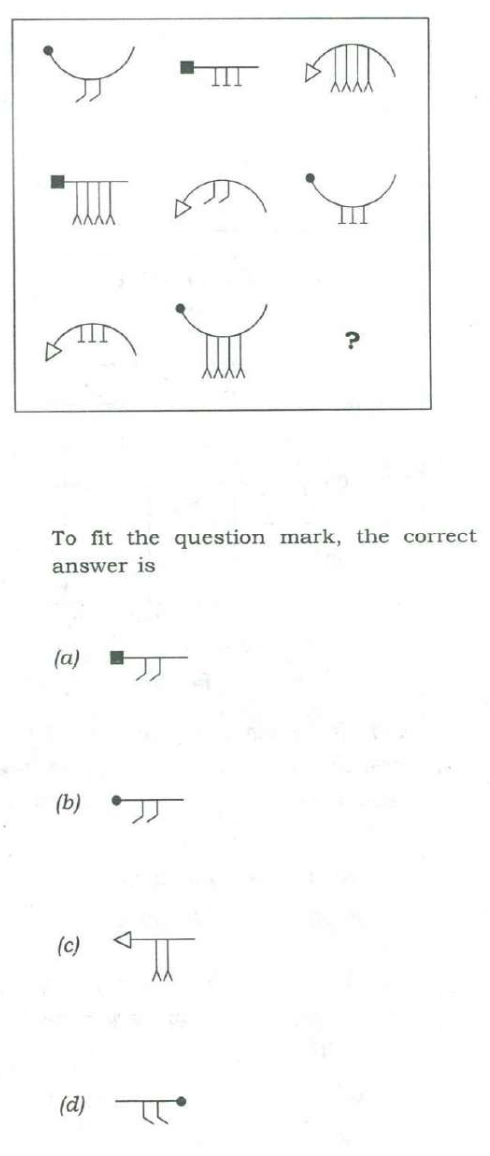
Consider the figures given below:

A 3 × 3 grid of line figures; the last cell is ‘?’. Each figure joins one of three bodies (a U-shaped curve with a dot, a straight bar with a solid square, an arc ending in a triangle) to one of three leg sets (two bent legs, three short T-shaped legs, four long forked legs). The four options are also drawn as figures.
From UPSC's question paper.

To fit the question mark, the correct answer is

Answer & explanation

Answer: (a) Figure: a straight bar with a solid square at its left end and two bent legs

Each row and each column uses each body once and each set of legs once. The last row already has the arc-with-triangle and U-with-dot bodies, and the T-shaped and forked legs, so the missing figure is the bar with a square and two bent legs — (a).

  1. Bodies: U-curve with dot, straight bar with square, arc with triangle. Legs: two bent, three T-shaped, four forked.
  2. Row 1: U + two bent; bar + three T; arc + four forked. Row 2: bar + four forked; arc + two bent; U + three T.
  3. Row 3 has arc + three T and U + four forked, so it lacks the bar body and the two bent legs.
  4. Column 3 agrees: arc and U are used, so the bar is missing; forked and T-shaped legs are used, so two bent legs are missing.
  5. Only (a) — a bar with a square and two bent legs — fits.

Remember · In 3 × 3 figure matrices, split each figure into parts and check that each part appears once in every row and column.

Question and answer: UPSC's official GS Paper II (2018, Series A) — paper ↗ · answer key ↗. Explanation: Minimalist IAS, checked 1 Oct 2026 (how we verify). Permalink ·

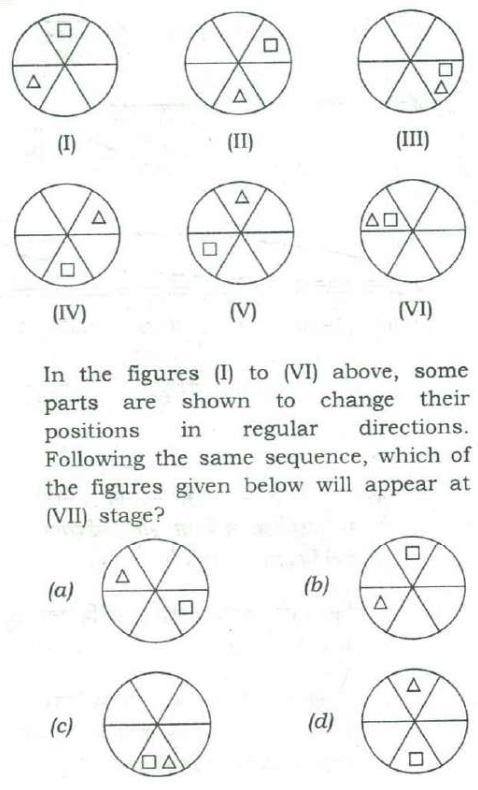
Consider the following figures:

Six circles (I)–(VI), each cut into six sectors by a horizontal line and two diagonals, holding a small square and a small triangle. Square: top, upper right, lower right, bottom, lower left, upper left. Triangle: lower left, bottom, lower right, upper right, top, upper left. The four options are drawn as circles too.
From UPSC's question paper.

In the figures (I) to (VI) above, some parts are shown to change their positions in regular directions. Following the same sequence, which of the figures given below will appear at (VII) stage?

Answer & explanation

Answer: (b) Figure: square in the top sector, triangle in the lower-left sector

The square moves one sector clockwise at each step and the triangle one sector anticlockwise. At stage (VII) the square returns to the top and the triangle to the lower left — option (b).

  1. Name the sectors clockwise: top, upper right, lower right, bottom, lower left, upper left.
  2. Square in (I)–(VI): top, upper right, lower right, bottom, lower left, upper left — one step clockwise each time.
  3. Triangle in (I)–(VI): lower left, bottom, lower right, upper right, top, upper left — one step anticlockwise each time.
  4. Stage (VII): the square moves from upper left to top; the triangle moves from upper left to lower left.
  5. Check: after six steps both are back where they were in (I), as expected in a six-sector circle.

Remember · Track each moving part separately — its direction and step size; after a full cycle the figure repeats.

Question and answer: UPSC's official GS Paper II (2018, Series A) — paper ↗ · answer key ↗. Explanation: Minimalist IAS, checked 1 Oct 2026 (how we verify). Permalink ·

Lakshmi, her brother, her daughter and her son are badminton players. A game of doubles is about to begin:

  1. i.Lakshmi’s brother is directly across the net from her daughter.
  2. ii.Her son is diagonally across the net from the worst player’s sibling.
  3. iii.The best player and the worst player are on the same side of the net.

Who is the best player?

Answer & explanation

Answer: (a) Her brother

The brother and the daughter face each other, so Lakshmi and her son are also on opposite sides. Whichever side the son takes, clue (ii) puts the worst player on the brother's side of the net, and clue (iii) then makes the brother the best player.

  1. Siblings: Lakshmi and her brother; the daughter and the son.
  2. Clue (i): the brother and daughter are on opposite sides, directly facing; so Lakshmi and her son are on opposite sides too.
  3. Case 1 — the son partners the brother: the son is diagonally across from the daughter, so the worst player's sibling is the daughter and the worst is the son. By (iii) the best is his partner, the brother.
  4. Case 2 — the son partners the daughter: the son is diagonally across from the brother, so the worst player's sibling is the brother and the worst is Lakshmi. The best is her partner — again the brother.
  5. Both cases give the brother as the best player.

Remember · When the clues allow two layouts, work out both; if they agree on the person asked about, that is the answer.

Question and answer: UPSC's official GS Paper II (2018, Series A) — paper ↗ · answer key ↗. Explanation: Minimalist IAS, checked 30 Sept 2026 (how we verify). Permalink ·

If second and fourth Saturdays and all the Sundays are taken as only holidays for an office, what would be the minimum number of possible working days of any month of any year?

Answer & explanation

Answer: (b) 22

Working days are fewest in a short month with many holidays. Every month has exactly two holiday Saturdays, so only the Sundays vary: a 28-day February has exactly 4 Sundays, giving 6 holidays and 22 working days. Longer months add more days than holidays.

  1. Every month has a 2nd and a 4th Saturday, so there are always exactly 2 holiday Saturdays; only the number of Sundays varies.
  2. February (28 days): exactly 4 Sundays → 4 + 2 = 6 holidays → 28 − 6 = 22 working days.
  3. February in a leap year (29 days): at most 5 Sundays → 7 holidays → 29 − 7 = 22 working days.
  4. 30-day month: at most 5 Sundays → 7 holidays → 23 working days. 31-day month: at most 5 Sundays → 7 holidays → 24.
  5. Minimum = 22.
  6. Check: no month can have 6 Sundays, since that needs at least 36 days.

Remember · For 'minimum working days', test the shortest month with the most holidays — February, including the leap-year case.

Question and answer: UPSC's official GS Paper II (2017, Series A) — paper ↗ · answer key ↗. Explanation: Minimalist IAS, checked 30 Sept 2026 (how we verify). Permalink ·

Four tests—Physics, Chemistry, Mathematics and Biology are to be conducted on four consecutive days, not necessarily in the same order. The Physics test is held before the test which is conducted after Biology. Chemistry is conducted exactly after two tests are held. Which is the last test held?

Answer & explanation

Answer: (c) Mathematics

Chemistry is on day 3. Biology cannot be last, since a test follows it, and cannot be first, since Physics must come before the test after Biology. So Biology is on day 2, Physics on day 1, and Mathematics is left for day 4.

  1. 'Exactly after two tests are held' puts Chemistry on day 3.
  2. Some test is held after Biology, so Biology is not on day 4.
  3. If Biology were on day 1, the test after it would be on day 2, and Physics would have to be on day 1 — already taken. So Biology is not on day 1.
  4. So Biology is on day 2; the test after it is Chemistry (day 3), and Physics is before that — day 1.
  5. Order: Physics, Biology, Chemistry, Mathematics. The last test is Mathematics.

Remember · Fix the absolute clue first (a definite day), then test the remaining slots against each relative clue.

Question and answer: UPSC's official GS Paper II (2017, Series A) — paper ↗ · answer key ↗. Explanation: Minimalist IAS, checked 30 Sept 2026 (how we verify). Permalink ·

The sum of income of A and B is more than that of C and D taken together. The sum of income of A and C is the same as that of B and D taken together. Moreover, A earns half as much as the sum of the income of B and D. Whose income is the highest?

Answer & explanation

Answer: (b) B

A is half of B + D, and A + C equals B + D, so C = A. Then A + B > C + D gives B > D, and since A is the average of B and D, B is above A. B has the highest income.

  1. A = (B + D)/2, so B + D = 2A.
  2. A + C = B + D = 2A, so C = A.
  3. A + B > C + D becomes A + B > A + D, so B > D.
  4. A is the average of B and D with B > D, so B > A > D. With C = A, the order is B > A = C > D.
  5. B has the highest income.

Remember · Turn each sentence into an equation or inequality and substitute; one equality (here C = A) usually unlocks the ranking.

Question and answer: UPSC's official GS Paper II (2017, Series A) — paper ↗ · answer key ↗. Explanation: Minimalist IAS, checked 30 Sept 2026 (how we verify). Permalink ·

15 students failed in a class of 52. After removing the names of failed students, a merit order list has been prepared in which the position of Ramesh is 22nd from the top. What is his position from the bottom?

Answer & explanation

Answer: (c) 16th

Only the 52 − 15 = 37 students who passed are in the merit list. With 21 above Ramesh, 37 − 22 = 15 are below him, so he is 16th from the bottom.

  1. Students in the merit list = 52 − 15 = 37.
  2. Position from bottom = total − position from top + 1 = 37 − 22 + 1 = 16.
  3. Check: 21 above + Ramesh + 15 below = 37.

Remember · Rank from top + rank from bottom = total + 1 — but first count only those actually in the list.

Question and answer: UPSC's official GS Paper II (2017, Series A) — paper ↗ · answer key ↗. Explanation: Minimalist IAS, checked 30 Sept 2026 (how we verify). Permalink ·

In a group of six women, there are four tennis players, four postgraduates in Sociology, one postgraduate in Commerce and three bank employees. Vimala and Kamla are the bank employees while Amala and Komala are unemployed. Komala and Nirmala are among the tennis players. Amala, Kamla, Komala and Nirmala are postgraduates in Sociology of whom two are bank employees. If Shyamala is a postgraduate in Commerce, who among the following is both a tennis player and a bank employee?

Answer & explanation

Answer: (c) Nirmala

Two of the four Sociology postgraduates are bank employees. Amala and Komala are unemployed, so the two are Kamla and Nirmala. Nirmala is also a tennis player, so she is both.

  1. Sociology postgraduates: Amala, Kamla, Komala, Nirmala — two of them are bank employees.
  2. Amala and Komala are unemployed, so those two are Kamla and Nirmala.
  3. Bank employees (three): Vimala, Kamla and Nirmala.
  4. Tennis players include Komala and Nirmala; of these only Nirmala is a bank employee.
  5. Check the other options: Amala and Komala are unemployed, and Shyamala is not one of the three bank employees.

Remember · In grouping puzzles, start with the clue naming a small closed set ('of whom two are…') and eliminate using the negative facts.

Question and answer: UPSC's official GS Paper II (2017, Series A) — paper ↗ · answer key ↗. Explanation: Minimalist IAS, checked 30 Sept 2026 (how we verify). Permalink ·

A watch loses 2 minutes in every 24 hours while another watch gains 2 minutes in every 24 hours. At a particular instant, the two watches showed an identical time. Which of the following statements is correct if 24-hour clock is followed?

Answer & explanation

Answer: (d) None of the above statements is correct.

Each day the two watches drift 4 minutes further apart. On a 24-hour dial they show the same time again only when the gap is a full 24 hours (1440 minutes), which takes 360 days. None of 30, 90 or 120 days works.

  1. One watch loses 2 min and the other gains 2 min a day, so the gap between them grows by 4 min a day.
  2. On a 24-hour clock the two dials match again when the gap reaches 24 × 60 = 1440 min.
  3. Days needed = 1440 ÷ 4 = 360.
  4. Check: after 120 days the gap is only 480 min (8 hours), so options (a) to (c) all fail.

Remember · Two clocks agree again when their total gap equals one full dial: 720 minutes on a 12-hour clock, 1440 minutes on a 24-hour clock.

Question and answer: UPSC's official GS Paper II (2017, Series A) — paper ↗ · answer key ↗. Explanation: Minimalist IAS, checked 30 Sept 2026 (how we verify). Permalink ·

A clock strikes once at 1 o’clock, twice at 2 o’clock and thrice at 3 o’clock, and so on. If it takes 12 seconds to strike at 5 o’clock, what is the time taken by it to strike at 10 o’clock?

Answer & explanation

Answer: (b) 24 seconds

Why not the tempting option · UPSC's key, 24 seconds, treats the time as proportional to the number of strikes (2.4 s a strike). The textbook method counts the gaps between strikes — 4 gaps in 12 s, so 9 gaps at 10 o'clock make 27 s — but 27 is not among the options, so the paper plainly intends the simple proportion. In the exam, if the gap method gives no option, switch to proportion; (b) is the only option that fits the data.

UPSC's key takes the striking time as proportional to the number of strikes: 5 strikes take 12 seconds, so each strike accounts for 2.4 seconds and 10 strikes take 24 seconds. This is the only option that fits the data.

  1. Read the data as 'each strike takes the same time': 12 s ÷ 5 strikes = 2.4 s a strike.
  2. At 10 o'clock the clock strikes 10 times: 10 × 2.4 = 24 s, option (b).
  3. Check the alternative: counting only the gaps between strikes (4 gaps of 3 s, then 9 gaps) gives 27 s, which is not offered, so that reading cannot be what the paper intends.

Remember · In a clock-strike question, first try the gap method (strikes − 1); if the result is not among the options, use simple proportion, as UPSC did here.

Question and answer: UPSC's official GS Paper II (2017, Series A) — paper ↗ · answer key ↗. Explanation: Minimalist IAS, checked 1 Oct 2026 (how we verify). Permalink ·

Six boys A, B, C, D, E and F play a game of cards. Each has a pack of 10 cards. F borrows 2 cards from A and gives away 5 to C who in turn gives 3 to B while B gives 6 to D who passes on 1 to E. Then the number of cards possessed by D and E is equal to the number of cards possessed by

Answer & explanation

Answer: (b) B, C and F

After all the transfers A has 8, B 7, C 12, D 15, E 11 and F 7 cards. D and E together hold 26, the same as B, C and F together (7 + 12 + 7).

  1. Start: everyone has 10 cards.
  2. F borrows 2 from A: A = 8, F = 12. F gives 5 to C: F = 7, C = 15.
  3. C gives 3 to B: C = 12, B = 13. B gives 6 to D: B = 7, D = 16. D gives 1 to E: D = 15, E = 11.
  4. D + E = 15 + 11 = 26.
  5. B + C + F = 7 + 12 + 7 = 26. (A + B + C = 27, A + B + F = 22, A + C + F = 27.)
  6. Check: total = 8 + 7 + 12 + 15 + 11 + 7 = 60, the same as at the start.

Remember · Track transfers in a small table and confirm the total stays unchanged — a quick guard against slips.

Question and answer: UPSC's official GS Paper II (2017, Series A) — paper ↗ · answer key ↗. Explanation: Minimalist IAS, checked 30 Sept 2026 (how we verify). Permalink ·

In a test, Randhir obtained more marks than the total marks obtained by Kunal and Debu. The total marks obtained by Kunal and Shankar are more than those of Randhir. Sonal obtained more marks than Shankar. Neha obtained more marks than Randhir. Who amongst them obtained highest marks?

Answer & explanation

Answer: (d) Data are inadequate

Neha scores above Randhir, and Sonal above Shankar, but no clue compares Neha with Sonal. Either of them can come out on top, so the data are inadequate.

  1. Clues: Randhir > Kunal + Debu; Kunal + Shankar > Randhir; Sonal > Shankar; Neha > Randhir.
  2. Randhir is below Neha, and Kunal and Debu are below Randhir; Shankar is below Sonal. So only Neha or Sonal can be highest.
  3. No clue links Neha and Sonal.
  4. Example: Kunal 10, Debu 5, Randhir 20, Shankar 15, Sonal 16, Neha 25 — Neha is highest. Change Sonal to 30 and Sonal is highest. All clues hold both times.

Remember · In ranking puzzles, find who can still be on top; if two candidates are never compared, the data are inadequate.

Question and answer: UPSC's official GS Paper II (2017, Series A) — paper ↗ · answer key ↗. Explanation: Minimalist IAS, checked 30 Sept 2026 (how we verify). Permalink ·

The outer surface of a 4 cm × 4 cm × 4 cm cube is painted completely in red. It is sliced parallel to the faces to yield sixty four 1 cm × 1 cm × 1 cm small cubes. How many small cubes do not have painted faces?

Answer & explanation

Answer: (a) 8

Only the small cubes that touch no outer face stay unpainted. Peeling a 1 cm layer off every side leaves a 2 × 2 × 2 core, so 8 small cubes have no painted face.

  1. A 4 × 4 × 4 cube gives 64 small cubes.
  2. Cubes with no painted face form the inner block: (4 − 2) × (4 − 2) × (4 − 2).
  3. (4 − 2)³ = 2³ = 8.
  4. Check: 8 corner cubes + 24 edge cubes + 24 face-centre cubes = 56 painted, and 56 + 8 = 64.

Remember · For an n × n × n painted cube, the unpainted small cubes number (n − 2)³.

Question and answer: UPSC's official GS Paper II (2017, Series A) — paper ↗ · answer key ↗. Explanation: Minimalist IAS, checked 30 Sept 2026 (how we verify). Permalink ·

Consider the following:

A, B, C, D, E, F, G and H are standing in a row facing North.

B is not neighbour of G.

F is to the immediate right of G and neighbour of E.

G is not at the extreme end.

A is sixth to the left of E.

H is sixth to the right of C.

Which one of the following is correct in respect of the above?

Answer & explanation

Answer: (c) G is to the immediate right of D.

'Sixth to the left/right' in a row of eight forces the pairs A–E and C–H into places 1 & 7 and 2 & 8. F must stand next to E, which works only with A at 1 and E at 7. The row is A C B D G F E H, so G is to the immediate right of D.

  1. Number the places 1–8 from left to right; facing North, a person's right is the higher number.
  2. A is sixth to the left of E: (A, E) = (1, 7) or (2, 8). H is sixth to the right of C: (C, H) = (1, 7) or (2, 8). The two pairs must take different sets.
  3. Case C = 1, H = 7, A = 2, E = 8: E's only neighbour is place 7 (H), so F cannot be next to E — rejected.
  4. So A = 1, C = 2, E = 7, H = 8. F must be at 6 (next to E) and G at 5 (immediately left of F); G is not at an end.
  5. B and D fill places 3 and 4; B is not next to G (5), so B = 3 and D = 4.
  6. Row: A C B D G F E H. G (5) is immediately right of D (4).
  7. Check the others: C is to the right of A, not the left; D's neighbours are B and G; A and E are at 1 and 7, not both ends.

Remember · In linear seating, 'k-th to the left' clues with a large k allow few places — list them first, then test the adjacency clues.

Question and answer: UPSC's official GS Paper II (2017, Series A) — paper ↗ · answer key ↗. Explanation: Minimalist IAS, checked 30 Sept 2026 (how we verify). Permalink ·

Directions for the following 3 (three) items: Consider the given information and answer the three items that follow.

A, B, C, D, E, F and G are Lecturers from different cities—Hyderabad, Delhi, Shillong, Kanpur, Chennai, Mumbai and Srinagar (not necessarily in the same order) who participated in a conference. Each one of them is specialized in a different subject, viz., Economics, Commerce, History, Sociology, Geography, Mathematics and Statistics (not necessarily in the same order). Further

  1. 1.Lecturer from Kanpur is specialized in Geography
  2. 2.Lecturer D is from Shillong
  3. 3.Lecturer C from Delhi is specialized in Sociology
  4. 4.Lecturer B is specialized in neither History nor Mathematics
  5. 5.Lecturer A who is specialized in Economics does not belong to Hyderabad
  6. 6.Lecturer F who is specialized in Commerce belongs to Srinagar
  7. 7.Lecturer G who is specialized in Statistics belongs to Chennai

Who is specialized in Geography?

Answer & explanation

Answer: (a) B

Once the direct clues are placed, History, Geography and Mathematics are left for B, D and E. Clue 4 rules out History and Mathematics for B, so B is the Geography lecturer (and hence the one from Kanpur).

  1. Direct clues: C – Delhi – Sociology; D – Shillong; F – Srinagar – Commerce; G – Chennai – Statistics; A – Economics.
  2. Cities left for A, B and E: Hyderabad, Kanpur, Mumbai. A is not from Hyderabad (clue 5), and Kanpur's lecturer teaches Geography while A teaches Economics — so A is from Mumbai.
  3. Subjects left for B, D and E: History, Geography, Mathematics. B teaches neither History nor Mathematics (clue 4), so B teaches Geography.
  4. Geography goes with Kanpur (clue 1), so B is from Kanpur, and the last city, Hyderabad, goes to E.
  5. D and E share History and Mathematics in some order — the data do not decide which.
  6. Geography: B.

Remember · In matching grids, place every direct clue first, then use 'neither/nor' and 'does not' clues to eliminate; the last blanks fall into place.

Question and answer: UPSC's official GS Paper II (2017, Series A) — paper ↗ · answer key ↗. Explanation: Minimalist IAS, checked 30 Sept 2026 (how we verify). Permalink ·

Directions for the following 3 (three) items: Consider the given information and answer the three items that follow.

A, B, C, D, E, F and G are Lecturers from different cities—Hyderabad, Delhi, Shillong, Kanpur, Chennai, Mumbai and Srinagar (not necessarily in the same order) who participated in a conference. Each one of them is specialized in a different subject, viz., Economics, Commerce, History, Sociology, Geography, Mathematics and Statistics (not necessarily in the same order). Further

  1. 1.Lecturer from Kanpur is specialized in Geography
  2. 2.Lecturer D is from Shillong
  3. 3.Lecturer C from Delhi is specialized in Sociology
  4. 4.Lecturer B is specialized in neither History nor Mathematics
  5. 5.Lecturer A who is specialized in Economics does not belong to Hyderabad
  6. 6.Lecturer F who is specialized in Commerce belongs to Srinagar
  7. 7.Lecturer G who is specialized in Statistics belongs to Chennai

To which city does the Lecturer specialized in Economics belong?

Answer & explanation

Answer: (b) Mumbai

The Economics lecturer is A. Only Hyderabad, Kanpur and Mumbai are free; clue 5 rules out Hyderabad, and Kanpur's lecturer teaches Geography, so A must be from Mumbai.

  1. Direct clues: C – Delhi – Sociology; D – Shillong; F – Srinagar – Commerce; G – Chennai – Statistics; A – Economics.
  2. Cities left for A, B and E: Hyderabad, Kanpur, Mumbai. A is not from Hyderabad (clue 5), and Kanpur's lecturer teaches Geography while A teaches Economics — so A is from Mumbai.
  3. Subjects left for B, D and E: History, Geography, Mathematics. B teaches neither History nor Mathematics (clue 4), so B teaches Geography.
  4. Geography goes with Kanpur (clue 1), so B is from Kanpur, and the last city, Hyderabad, goes to E.
  5. D and E share History and Mathematics in some order — the data do not decide which.
  6. Economics is A's subject, and A is from Mumbai.

Remember · When a city is tied to a subject (Kanpur–Geography), anyone with a different subject is ruled out of that city at once.

Question and answer: UPSC's official GS Paper II (2017, Series A) — paper ↗ · answer key ↗. Explanation: Minimalist IAS, checked 30 Sept 2026 (how we verify). Permalink ·

Directions for the following 3 (three) items: Consider the given information and answer the three items that follow.

A, B, C, D, E, F and G are Lecturers from different cities—Hyderabad, Delhi, Shillong, Kanpur, Chennai, Mumbai and Srinagar (not necessarily in the same order) who participated in a conference. Each one of them is specialized in a different subject, viz., Economics, Commerce, History, Sociology, Geography, Mathematics and Statistics (not necessarily in the same order). Further

  1. 1.Lecturer from Kanpur is specialized in Geography
  2. 2.Lecturer D is from Shillong
  3. 3.Lecturer C from Delhi is specialized in Sociology
  4. 4.Lecturer B is specialized in neither History nor Mathematics
  5. 5.Lecturer A who is specialized in Economics does not belong to Hyderabad
  6. 6.Lecturer F who is specialized in Commerce belongs to Srinagar
  7. 7.Lecturer G who is specialized in Statistics belongs to Chennai

Who of the following belongs to Hyderabad?

Answer & explanation

Answer: (b) E

A (Economics) must be from Mumbai, and B, the Geography lecturer, must be from Kanpur. The only city left, Hyderabad, therefore belongs to E.

  1. Direct clues: C – Delhi – Sociology; D – Shillong; F – Srinagar – Commerce; G – Chennai – Statistics; A – Economics.
  2. Cities left for A, B and E: Hyderabad, Kanpur, Mumbai. A is not from Hyderabad (clue 5), and Kanpur's lecturer teaches Geography while A teaches Economics — so A is from Mumbai.
  3. Subjects left for B, D and E: History, Geography, Mathematics. B teaches neither History nor Mathematics (clue 4), so B teaches Geography.
  4. Geography goes with Kanpur (clue 1), so B is from Kanpur, and the last city, Hyderabad, goes to E.
  5. D and E share History and Mathematics in some order — the data do not decide which.
  6. Hyderabad: E.

Remember · Solve the whole grid once; later questions on the same set then take seconds.

Question and answer: UPSC's official GS Paper II (2017, Series A) — paper ↗ · answer key ↗. Explanation: Minimalist IAS, checked 30 Sept 2026 (how we verify). Permalink ·