Minimalist IAS
CSAT

CSAT · 113 questions

Puzzles, arrangements & general mental ability

Every UPSC CSAT question on this topic, 2016–2026, newest first. Tap an option to check yourself; the answer and explanation open below it.

Puzzles, arrangements & general mental ability questions per year: 2016: 19, 2017: 18, 2018: 17, 2019: 10, 2020: 3, 2021: 10, 2022: 5, 2023: 7, 2024: 8, 2025: 8, 2026: 8 Asked in 11 of 11 years · most in 2016 (19)

UPSC syllabus: “General mental ability;” See the full syllabus →

Images of consonants of the English alphabet (Capitals) are observed in a mirror. What is the number of images of these which do not look like their original shapes?

Answer & explanation

Answer: (b) 14

A capital letter looks unchanged in a mirror only if it is symmetric about a vertical line. Of the 21 consonants, only H, M, T, V, W, X and Y are, so 14 consonants look different.

  1. The alphabet has 26 − 5 = 21 consonants (leaving out A, E, I, O, U).
  2. A mirror flips left and right, so only letters symmetric about a vertical line look the same.
  3. Such consonants: H, M, T, V, W, X, Y — 7 letters.
  4. Consonants whose images look different: 21 − 7 = 14.
  5. Check: B, C, D, F, G, J, K, L, N, P, Q, R, S, Z — 14 letters.

Remember · Mirror-symmetric capitals: A, H, I, M, O, T, U, V, W, X, Y — learn the list once.

Question and answer: UPSC's official GS Paper II (2021, Series A) — paper ↗ · answer key ↗. Explanation: Minimalist IAS, checked 30 Sept 2026 (how we verify). Permalink ·
Seven books P, Q, R, S, T, U and V are placed side by side. R, Q and T have blue covers and other books have red covers. Only S and U are new books and the rest are old. P, R and S are law reports; the rest are Gazetteers. Books of old Gazetteers with blue covers are

Answer & explanation

Answer: (c) Q and T

Write the three sets — blue covers (Q, R, T), old books (all but S and U) and Gazetteers (all but P, R and S) — and take what is common. Only Q and T are in all three.

  1. Blue covers: Q, R, T.
  2. Old books: all except S and U → P, Q, R, T, V.
  3. Gazetteers: all except the law reports P, R, S → Q, T, U, V.
  4. Common to all three: Q and T (R is a law report; U is new and red).

Remember · For multi-attribute questions, list each set and intersect; one mismatch eliminates an option.

Question and answer: UPSC's official GS Paper II (2021, Series A) — paper ↗ · answer key ↗. Explanation: Minimalist IAS, checked 30 Sept 2026 (how we verify). Permalink ·

Replace the incorrect term by the correct term in the given sequence

3, 2, 7, 4, 13, 10, 21, 18, 31, 28, 43, 40

where odd terms and even terms follow the same pattern.

Answer & explanation

Answer: (a) 0

The odd-place terms rise by 4, 6, 8, 10, 12. The even-place terms follow the same steps only from 4 onwards, so their first term should be 4 − 4 = 0, not 2.

  1. Odd places: 3, 7, 13, 21, 31, 43 — differences 4, 6, 8, 10, 12.
  2. Even places: 2, 4, 10, 18, 28, 40 — differences 2, 6, 8, 10, 12.
  3. Only the first even-place difference breaks the pattern; to match, the first even term must be 4 − 4 = 0.
  4. So the incorrect term 2 should be replaced by 0.
  5. Check: each even-place term is then 3 less than the odd-place term before it — 0, 4, 10, 18, 28, 40.

Remember · In an alternating series, split it into two sub-series and compare their differences; the misfit shows itself.

Question and answer: UPSC's official GS Paper II (2021, Series A) — paper ↗ · answer key ↗. Explanation: Minimalist IAS, checked 30 Sept 2026 (how we verify). Permalink ·

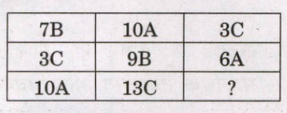
Following is a matrix of certain entries. The entries follow a certain trend row-wise. Choose the missing entry (?) accordingly.

7B10A3C
3C9B6A
10A13C?
A 3 × 3 matrix in boxes: row 1 — 7B, 10A, 3C; row 2 — 3C, 9B, 6A; row 3 — 10A, 13C, ?.
From UPSC's question paper.
Answer & explanation

Answer: (c) 3B

In each row the third number is the second minus the first, and the letters A, B and C each appear once. Row 3 therefore needs 13 − 10 = 3 with the letter B: 3B.

  1. Numbers, row 1: 10 − 7 = 3; row 2: 9 − 3 = 6 — the third number is the second minus the first.
  2. Row 3: 13 − 10 = 3.
  3. Letters: each row uses A, B and C once; row 3 already has A and C, so it needs B.
  4. The missing entry is 3B.

Remember · In matrix puzzles treat numbers and letters as separate patterns, and check each rule against every row.

Question and answer: UPSC's official GS Paper II (2021, Series A) — paper ↗ · answer key ↗. Explanation: Minimalist IAS, checked 1 Oct 2026 (how we verify). Permalink ·

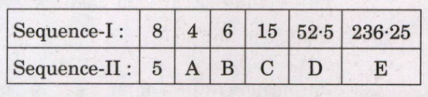
You are given two identical sequences in two rows:

Sequence-I:8461552·5236·25
Sequence-II:5ABCDE
A two-row table: Sequence-I — 8, 4, 6, 15, 52.5, 236.25; Sequence-II — 5, A, B, C, D, E.
From UPSC's question paper.

What is the entry in the place of C for the Sequence-II?

Answer & explanation

Answer: (c) 9.375

Sequence-I multiplies by 0.5, 1.5, 2.5, 3.5 and 4.5 in turn. Starting from 5, Sequence-II runs 2.5, 3.75, 9.375, so C = 9.375.

  1. Sequence-I: 8 × 0.5 = 4, 4 × 1.5 = 6, 6 × 2.5 = 15, 15 × 3.5 = 52.5, 52.5 × 4.5 = 236.25 — the multiplier rises by 1 each time.
  2. Sequence-II from 5: A = 5 × 0.5 = 2.5, B = 2.5 × 1.5 = 3.75.
  3. C = 3.75 × 2.5 = 9.375.
  4. Check: D = 9.375 × 3.5 = 32.8125 — option (d) is the next term, a trap; (a) is A.

Remember · When terms first fall and then shoot up, test multipliers; options often offer the neighbouring terms as traps.

Question and answer: UPSC's official GS Paper II (2021, Series A) — paper ↗ · answer key ↗. Explanation: Minimalist IAS, checked 1 Oct 2026 (how we verify). Permalink ·

In the English alphabet, the first 4 letters are written in opposite order; and the next 4 letters are written in opposite order and so on; and at the end Y and Z are interchanged. Which will be the fourth letter to the right of the 13th letter?

Answer & explanation

Answer: (b) T

After reversing each block of four, the 13th place holds P (block PONM). Four places to its right is the 17th place, which starts the next block TSRQ — so the letter is T.

  1. Reverse each block of four: DCBA HGFE LKJI PONM TSRQ XWVU, and then Y Z become Z Y.
  2. Places 1–12 hold D C B A H G F E L K J I, so the 13th letter is P.
  3. The fourth letter to its right is in the 17th place: places 13–17 are P, O, N, M, T.
  4. The answer is T.

Remember · Work with positions: in reversed blocks of four, place 4k − 3 holds the letter numbered 4k.

Question and answer: UPSC's official GS Paper II (2021, Series A) — paper ↗ · answer key ↗. Explanation: Minimalist IAS, checked 30 Sept 2026 (how we verify). Permalink ·

Which day is 10th October, 2027?

Answer & explanation

Answer: (a) Sunday

Counting odd days gives 4 for the years 2001–2026 and 3 for 2027 up to 10 October — 7 in all, i.e. none left over, so the day is Sunday. A quicker route: this very paper was held on Sunday, 10 October 2021, and six years with one leap day add exactly 7 days.

  1. Odd days up to the end of 2000: 0 (every 400 years has 0 odd days).
  2. 2001–2026: 26 years with 6 leap years (2004, 2008, 2012, 2016, 2020, 2024), so 26 + 6 = 32 odd days; 32 = 4 × 7 + 4, leaving 4.
  3. 2027 up to 10 October: Jan 3, Feb 0, Mar 3, Apr 2, May 3, Jun 2, Jul 3, Aug 3, Sep 2, Oct 3 — total 24, leaving 3.
  4. Total = 4 + 3 = 7 odd days, i.e. 0, so 10 October 2027 is a Sunday.
  5. Check: 10 October 2021 (the date of this paper) was a Sunday; 2022–2027 add 6 + 1 (for 29 February 2024) = 7 days — Sunday again.

Remember · Anchor on a date you know: each ordinary year moves the weekday on by 1 and each leap year by 2.

Question and answer: UPSC's official GS Paper II (2021, Series A) — paper ↗ · answer key ↗. Explanation: Minimalist IAS, checked 30 Sept 2026 (how we verify). Permalink ·

What is the value of ‘X’ in the sequence 2, 7, 22, 67, 202, X, 1822?

Answer & explanation

Answer: (c) 607

Every term is three times the previous one plus 1. So X = 202 × 3 + 1 = 607, and 607 × 3 + 1 = 1822 confirms it.

  1. 2 × 3 + 1 = 7, 7 × 3 + 1 = 22, 22 × 3 + 1 = 67, 67 × 3 + 1 = 202 — each term is 3 × previous + 1.
  2. X = 202 × 3 + 1 = 607.
  3. Check: 607 × 3 + 1 = 1822, the next term.

Remember · When terms roughly triple, test '× 3 ± k', and always verify with the term after the blank.

Question and answer: UPSC's official GS Paper II (2021, Series A) — paper ↗ · answer key ↗. Explanation: Minimalist IAS, checked 30 Sept 2026 (how we verify). Permalink ·

At which one of the following times, do the hour hand and the minute hand of the clock make an angle of 180° with each other?

Answer & explanation

Answer: (d) Between 7:05 hours and 7:10 hours

At 7:00 the hour hand is 210° ahead of the minute hand, and the minute hand gains 5.5° every minute. The gap falls to 180° after 30 ÷ 5.5 = 5 5/11 minutes — just after 7:05.

  1. Angle between the hands = |30H − 5.5M| degrees (H = hour, M = minutes).
  2. At 7:00 the angle is 30 × 7 = 210°, and it shrinks by 5.5° each minute.
  3. 210 − 5.5M = 180 gives M = 30 ÷ 5.5 = 5 5/11 minutes.
  4. The hands are opposite at 7:05 5/11, i.e. between 7:05 and 7:10.
  5. Check: at 7:05 the angle is 210 − 27.5 = 182.5°, still above 180°.

Remember · Angle = |30H − 5.5M|; the minute hand gains 5.5° a minute on the hour hand.

Question and answer: UPSC's official GS Paper II (2021, Series A) — paper ↗ · answer key ↗. Explanation: Minimalist IAS, checked 30 Sept 2026 (how we verify). Permalink ·

In the series _b_a_ba_b_abab_aab; fill in the six blanks ( _ ) using one of the following given four choices such that the series follows a specific order.

Answer & explanation

Answer: (d) ababab

Filling the blanks with a, b, a, b, a, b turns the series into abbaab abbaab abbaab — one six-letter block repeated three times. None of the other choices produces a repeating block.

  1. The series has 18 places, so look for a repeating block of 6 (or 3, 9).
  2. Fill the blanks with a, b, a, b, a, b: abbaababbaababbaab.
  3. This splits as abbaab | abbaab | abbaab — the same block three times.
  4. Check: bababa gives bbaabbaabbababaaab, which has no repeating block.

Remember · For letter-series gaps, count the length and test whether the filled series splits into equal repeating blocks.

Question and answer: UPSC's official GS Paper II (2021, Series A) — paper ↗ · answer key ↗. Explanation: Minimalist IAS, checked 30 Sept 2026 (how we verify). Permalink ·