Minimalist IAS
CSAT

CSAT · 113 questions

Puzzles, arrangements & general mental ability

Every UPSC CSAT question on this topic, 2016–2026, newest first. Tap an option to check yourself; the answer and explanation open below it.

Puzzles, arrangements & general mental ability questions per year: 2016: 19, 2017: 18, 2018: 17, 2019: 10, 2020: 3, 2021: 10, 2022: 5, 2023: 7, 2024: 8, 2025: 8, 2026: 8 Asked in 11 of 11 years · most in 2016 (19)

UPSC syllabus: “General mental ability;” See the full syllabus →

Showing 31–60 of 113, newest first.

The letters of the word “INCOMPREHENSIBILITIES” are arranged alphabetically in reverse order. How many positions of the letter/letters will remain unchanged?

Answer & explanation

Answer: (c) Two

In reverse alphabetical order the 21 letters read TSSRPONNMLIIIIIHEEECB. The five I's fill positions 11 to 15, and the original word has I at positions 13 and 15, so exactly two positions stay the same.

  1. Letters (21): I × 5, E × 3, N × 2, S × 2 and one each of B, C, H, L, M, O, P, R, T.
  2. Reverse alphabetical order: T S S R P O N N M L I I I I I H E E E C B.
  3. The I's now occupy positions 11 to 15.
  4. In INCOMPREHENSIBILITIES, I stands at positions 1, 13, 15, 17 and 19 — so positions 13 and 15 match.
  5. Check the rest one by one (1: I vs T, 11: N vs I, 16: L vs H, 20: E vs C …): no other match. Two positions stay unchanged.

Remember · For 'unchanged positions', write the new order with position numbers; check the block of the most repeated letter first — matches usually hide there.

Question and answer: UPSC's official GS Paper II (2023, Series A) — paper ↗ · answer key ↗. Explanation: Minimalist IAS, checked 30 Sept 2026 (how we verify). Permalink ·
Two friends X and Y start running and they run together for 50 m in the same direction and reach a point. X turns right and runs 60 m, while Y turns left and runs 40 m. Then X turns left and runs 50 m and stops, while Y turns right and runs 50 m and then stops. How far are the two friends from each other now?

Answer & explanation

Answer: (a) 100 m

After the first turn the two run in opposite directions, so they end up 60 + 40 = 100 m apart on one line. The next turns send both of them 50 m in the same direction, which does not change the gap.

  1. Take the common first run as 50 m north, ending at a point O.
  2. X turns right (east) and runs 60 m; Y turns left (west) and runs 40 m. They are now 60 + 40 = 100 m apart on an east–west line.
  3. X, facing east, turns left and so runs north 50 m; Y, facing west, turns right and so also runs north 50 m.
  4. Both moved 50 m north, so they are still 100 m apart.

Remember · Equal moves in the same direction never change the distance between two people; only the unequal or opposite legs count.

Question and answer: UPSC's official GS Paper II (2022, Series A) — paper ↗ · answer key ↗. Explanation: Minimalist IAS, checked 30 Sept 2026 (how we verify). Permalink ·
Which date of June 2099 among the following is Sunday?

Answer & explanation

Answer: (d) 7

Count odd days from the end of 2000: 31 December 2098 falls on a Wednesday, and January to May 2099 add 4 more odd days, so 31 May 2099 is a Sunday. One week later, 7 June 2099, is also a Sunday.

  1. 2000 years contain 0 odd days, so 31 December 2000 was a Sunday.
  2. From 2001 to 2098 there are 98 years, of which 24 are leap years (2004, 2008, …, 2096). Odd days = 98 + 24 = 122, and 122 ÷ 7 leaves 3.
  3. So 31 December 2098 is Sunday + 3 = Wednesday.
  4. 1 January to 31 May 2099 (2099 is not a leap year): 31 + 28 + 31 + 30 + 31 = 151 days; 151 ÷ 7 leaves 4.
  5. 31 May 2099 is Wednesday + 4 = Sunday, so 1 June 2099 is a Monday and 7 June 2099 is a Sunday.
  6. Check: 5 June 2022 (the day of this exam) was a Sunday. Up to 5 June 2099 there are 77 years and 19 leap days: 96 days, which leaves 5 on division by 7. So 5 June 2099 is a Friday and 7 June a Sunday.

Remember · Calendar items: 400 years give 0 odd days; add ordinary years plus leap years, reduce mod 7, then add month days.

Question and answer: UPSC's official GS Paper II (2022, Series A) — paper ↗ · answer key ↗. Explanation: Minimalist IAS, checked 30 Sept 2026 (how we verify). Permalink ·

Three persons A, B and C are standing in a queue not necessarily in the same order. There are 4 persons between A and B, and 7 persons between B and C. If there are 11 persons ahead of C and 13 behind A, what could be the minimum number of persons in the queue?

Answer & explanation

Answer: (a) 22

C is 12th from the front, so B is 4th or 20th, and A is then 9th, 15th or 25th. With 13 people behind A, the queue has A’s place + 13 people, which is smallest when A is 9th: 22.

  1. 11 persons are ahead of C, so C is 12th from the front.
  2. 7 persons between B and C means B is 8 places from C: 4th or 20th.
  3. 4 persons between A and B means A is 5 places from B: if B is 4th, A is 9th; if B is 20th, A is 15th or 25th.
  4. 13 persons are behind A, so the queue has (A’s place + 13) persons: 22, 28 or 38.
  5. The minimum is 22, with B 4th, A 9th and C 12th.
  6. Check: between B (4th) and A (9th) stand places 5–8, i.e. 4 persons; between B (4th) and C (12th) stand places 5–11, i.e. 7 persons; behind A (9th) stand places 10–22, i.e. 13 persons.

Remember · Queue items: ‘k persons between’ means a gap of k + 1 places; list the cases and take the minimum.

Question and answer: UPSC's official GS Paper II (2022, Series A) — paper ↗ · answer key ↗. Explanation: Minimalist IAS, checked 30 Sept 2026 (how we verify). Permalink ·

Eight students A, B, C, D, E, F, G and H sit around a circular table, equidistant from each other, facing the centre of the table, not necessarily in the same order. B and D sit neither adjacent to C nor opposite to C. A sits in between E and D, and F sits in between B and H. Which one of the following is definitely correct?

Answer & explanation

Answer: (d) None of the above

The conditions allow more than one seating. In one valid seating C faces G but E does not face F; in another E faces F but C does not face G; and B can never sit beside A. So none of (a), (b) and (c) is definitely correct.

  1. A sits between E and D, so E, A, D occupy three adjacent seats; F sits between B and H, so B, F, H occupy three adjacent seats. C and G take the two seats left.
  2. A’s two neighbours are E and D, so B can never sit next to A — (a) is never true.
  3. Valid seating 1 (clockwise): A, D, G, B, F, H, C, E. B and D are neither next to nor opposite C. Here C is opposite G, but E is opposite B, not F.
  4. Valid seating 2 (clockwise): A, D, H, F, B, G, C, E. Again B and D are neither next to nor opposite C. Here E is opposite F, but C is opposite H, not G.
  5. (b) fails in seating 2 and (c) fails in seating 1, so none of the statements is definitely correct.

Remember · For ‘definitely correct’, build two valid arrangements; any option that fails in either one is out.

Question and answer: UPSC's official GS Paper II (2022, Series A) — paper ↗ · answer key ↗. Explanation: Minimalist IAS, checked 30 Sept 2026 (how we verify). Permalink ·

Consider the following statements:

  1. 1.Between 3:16 p.m. and 3:17 p.m., both hour hand and minute hand coincide.
  2. 2.Between 4:58 p.m. and 4:59 p.m., both minute hand and second hand coincide.

Which of the above statements is/are correct?

Answer & explanation

Answer: (c) Both 1 and 2

The hour and minute hands meet 16 4/11 minutes after 3 o’clock, i.e. between 3:16 and 3:17. The second hand catches the minute hand about 58.98 seconds after 4:58, i.e. before 4:59. Both statements are correct.

  1. At 3:00 the hour hand is 90° ahead of the minute hand. The minute hand moves 6° a minute and the hour hand 0.5°, so the minute hand gains 5.5° a minute.
  2. It catches up after 90 ÷ 5.5 = 180/11 = 16 4/11 minutes, about 3:16:22 — between 3:16 and 3:17. Statement 1 is correct.
  3. t seconds after 4:58, the minute hand is at the 58 + t/60 minute mark and the second hand at the t mark. They meet when t = 58 + t/60, i.e. t = 58 × 60/59 ≈ 58.98 s.
  4. That is before 4:59, so statement 2 is also correct.
  • ✓ 1. The hands coincide at 3:16 4/11, inside the stated minute.
  • ✓ 2. The second hand passes the minute hand about 58.98 seconds after 4:58, before 4:59.

Remember · Clock overlaps: gap ÷ relative speed. Minute hand gains 5.5° per minute on the hour hand.

Question and answer: UPSC's official GS Paper II (2022, Series A) — paper ↗ · answer key ↗. Explanation: Minimalist IAS, checked 30 Sept 2026 (how we verify). Permalink ·

Images of consonants of the English alphabet (Capitals) are observed in a mirror. What is the number of images of these which do not look like their original shapes?

Answer & explanation

Answer: (b) 14

A capital letter looks unchanged in a mirror only if it is symmetric about a vertical line. Of the 21 consonants, only H, M, T, V, W, X and Y are, so 14 consonants look different.

  1. The alphabet has 26 − 5 = 21 consonants (leaving out A, E, I, O, U).
  2. A mirror flips left and right, so only letters symmetric about a vertical line look the same.
  3. Such consonants: H, M, T, V, W, X, Y — 7 letters.
  4. Consonants whose images look different: 21 − 7 = 14.
  5. Check: B, C, D, F, G, J, K, L, N, P, Q, R, S, Z — 14 letters.

Remember · Mirror-symmetric capitals: A, H, I, M, O, T, U, V, W, X, Y — learn the list once.

Question and answer: UPSC's official GS Paper II (2021, Series A) — paper ↗ · answer key ↗. Explanation: Minimalist IAS, checked 30 Sept 2026 (how we verify). Permalink ·

Seven books P, Q, R, S, T, U and V are placed side by side. R, Q and T have blue covers and other books have red covers. Only S and U are new books and the rest are old. P, R and S are law reports; the rest are Gazetteers. Books of old Gazetteers with blue covers are

Answer & explanation

Answer: (c) Q and T

Write the three sets — blue covers (Q, R, T), old books (all but S and U) and Gazetteers (all but P, R and S) — and take what is common. Only Q and T are in all three.

  1. Blue covers: Q, R, T.
  2. Old books: all except S and U → P, Q, R, T, V.
  3. Gazetteers: all except the law reports P, R, S → Q, T, U, V.
  4. Common to all three: Q and T (R is a law report; U is new and red).

Remember · For multi-attribute questions, list each set and intersect; one mismatch eliminates an option.

Question and answer: UPSC's official GS Paper II (2021, Series A) — paper ↗ · answer key ↗. Explanation: Minimalist IAS, checked 30 Sept 2026 (how we verify). Permalink ·

Replace the incorrect term by the correct term in the given sequence

3, 2, 7, 4, 13, 10, 21, 18, 31, 28, 43, 40

where odd terms and even terms follow the same pattern.

Answer & explanation

Answer: (a) 0

The odd-place terms rise by 4, 6, 8, 10, 12. The even-place terms follow the same steps only from 4 onwards, so their first term should be 4 − 4 = 0, not 2.

  1. Odd places: 3, 7, 13, 21, 31, 43 — differences 4, 6, 8, 10, 12.
  2. Even places: 2, 4, 10, 18, 28, 40 — differences 2, 6, 8, 10, 12.
  3. Only the first even-place difference breaks the pattern; to match, the first even term must be 4 − 4 = 0.
  4. So the incorrect term 2 should be replaced by 0.
  5. Check: each even-place term is then 3 less than the odd-place term before it — 0, 4, 10, 18, 28, 40.

Remember · In an alternating series, split it into two sub-series and compare their differences; the misfit shows itself.

Question and answer: UPSC's official GS Paper II (2021, Series A) — paper ↗ · answer key ↗. Explanation: Minimalist IAS, checked 30 Sept 2026 (how we verify). Permalink ·

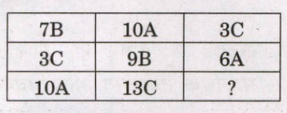
Following is a matrix of certain entries. The entries follow a certain trend row-wise. Choose the missing entry (?) accordingly.

7B10A3C
3C9B6A
10A13C?
A 3 × 3 matrix in boxes: row 1 — 7B, 10A, 3C; row 2 — 3C, 9B, 6A; row 3 — 10A, 13C, ?.
From UPSC's question paper.
Answer & explanation

Answer: (c) 3B

In each row the third number is the second minus the first, and the letters A, B and C each appear once. Row 3 therefore needs 13 − 10 = 3 with the letter B: 3B.

  1. Numbers, row 1: 10 − 7 = 3; row 2: 9 − 3 = 6 — the third number is the second minus the first.
  2. Row 3: 13 − 10 = 3.
  3. Letters: each row uses A, B and C once; row 3 already has A and C, so it needs B.
  4. The missing entry is 3B.

Remember · In matrix puzzles treat numbers and letters as separate patterns, and check each rule against every row.

Question and answer: UPSC's official GS Paper II (2021, Series A) — paper ↗ · answer key ↗. Explanation: Minimalist IAS, checked 1 Oct 2026 (how we verify). Permalink ·

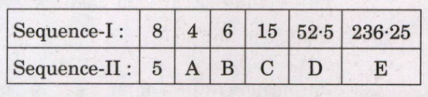
You are given two identical sequences in two rows:

Sequence-I:8461552·5236·25
Sequence-II:5ABCDE
A two-row table: Sequence-I — 8, 4, 6, 15, 52.5, 236.25; Sequence-II — 5, A, B, C, D, E.
From UPSC's question paper.

What is the entry in the place of C for the Sequence-II?

Answer & explanation

Answer: (c) 9.375

Sequence-I multiplies by 0.5, 1.5, 2.5, 3.5 and 4.5 in turn. Starting from 5, Sequence-II runs 2.5, 3.75, 9.375, so C = 9.375.

  1. Sequence-I: 8 × 0.5 = 4, 4 × 1.5 = 6, 6 × 2.5 = 15, 15 × 3.5 = 52.5, 52.5 × 4.5 = 236.25 — the multiplier rises by 1 each time.
  2. Sequence-II from 5: A = 5 × 0.5 = 2.5, B = 2.5 × 1.5 = 3.75.
  3. C = 3.75 × 2.5 = 9.375.
  4. Check: D = 9.375 × 3.5 = 32.8125 — option (d) is the next term, a trap; (a) is A.

Remember · When terms first fall and then shoot up, test multipliers; options often offer the neighbouring terms as traps.

Question and answer: UPSC's official GS Paper II (2021, Series A) — paper ↗ · answer key ↗. Explanation: Minimalist IAS, checked 1 Oct 2026 (how we verify). Permalink ·

In the English alphabet, the first 4 letters are written in opposite order; and the next 4 letters are written in opposite order and so on; and at the end Y and Z are interchanged. Which will be the fourth letter to the right of the 13th letter?

Answer & explanation

Answer: (b) T

After reversing each block of four, the 13th place holds P (block PONM). Four places to its right is the 17th place, which starts the next block TSRQ — so the letter is T.

  1. Reverse each block of four: DCBA HGFE LKJI PONM TSRQ XWVU, and then Y Z become Z Y.
  2. Places 1–12 hold D C B A H G F E L K J I, so the 13th letter is P.
  3. The fourth letter to its right is in the 17th place: places 13–17 are P, O, N, M, T.
  4. The answer is T.

Remember · Work with positions: in reversed blocks of four, place 4k − 3 holds the letter numbered 4k.

Question and answer: UPSC's official GS Paper II (2021, Series A) — paper ↗ · answer key ↗. Explanation: Minimalist IAS, checked 30 Sept 2026 (how we verify). Permalink ·

Which day is 10th October, 2027?

Answer & explanation

Answer: (a) Sunday

Counting odd days gives 4 for the years 2001–2026 and 3 for 2027 up to 10 October — 7 in all, i.e. none left over, so the day is Sunday. A quicker route: this very paper was held on Sunday, 10 October 2021, and six years with one leap day add exactly 7 days.

  1. Odd days up to the end of 2000: 0 (every 400 years has 0 odd days).
  2. 2001–2026: 26 years with 6 leap years (2004, 2008, 2012, 2016, 2020, 2024), so 26 + 6 = 32 odd days; 32 = 4 × 7 + 4, leaving 4.
  3. 2027 up to 10 October: Jan 3, Feb 0, Mar 3, Apr 2, May 3, Jun 2, Jul 3, Aug 3, Sep 2, Oct 3 — total 24, leaving 3.
  4. Total = 4 + 3 = 7 odd days, i.e. 0, so 10 October 2027 is a Sunday.
  5. Check: 10 October 2021 (the date of this paper) was a Sunday; 2022–2027 add 6 + 1 (for 29 February 2024) = 7 days — Sunday again.

Remember · Anchor on a date you know: each ordinary year moves the weekday on by 1 and each leap year by 2.

Question and answer: UPSC's official GS Paper II (2021, Series A) — paper ↗ · answer key ↗. Explanation: Minimalist IAS, checked 30 Sept 2026 (how we verify). Permalink ·

What is the value of ‘X’ in the sequence 2, 7, 22, 67, 202, X, 1822?

Answer & explanation

Answer: (c) 607

Every term is three times the previous one plus 1. So X = 202 × 3 + 1 = 607, and 607 × 3 + 1 = 1822 confirms it.

  1. 2 × 3 + 1 = 7, 7 × 3 + 1 = 22, 22 × 3 + 1 = 67, 67 × 3 + 1 = 202 — each term is 3 × previous + 1.
  2. X = 202 × 3 + 1 = 607.
  3. Check: 607 × 3 + 1 = 1822, the next term.

Remember · When terms roughly triple, test '× 3 ± k', and always verify with the term after the blank.

Question and answer: UPSC's official GS Paper II (2021, Series A) — paper ↗ · answer key ↗. Explanation: Minimalist IAS, checked 30 Sept 2026 (how we verify). Permalink ·

At which one of the following times, do the hour hand and the minute hand of the clock make an angle of 180° with each other?

Answer & explanation

Answer: (d) Between 7:05 hours and 7:10 hours

At 7:00 the hour hand is 210° ahead of the minute hand, and the minute hand gains 5.5° every minute. The gap falls to 180° after 30 ÷ 5.5 = 5 5/11 minutes — just after 7:05.

  1. Angle between the hands = |30H − 5.5M| degrees (H = hour, M = minutes).
  2. At 7:00 the angle is 30 × 7 = 210°, and it shrinks by 5.5° each minute.
  3. 210 − 5.5M = 180 gives M = 30 ÷ 5.5 = 5 5/11 minutes.
  4. The hands are opposite at 7:05 5/11, i.e. between 7:05 and 7:10.
  5. Check: at 7:05 the angle is 210 − 27.5 = 182.5°, still above 180°.

Remember · Angle = |30H − 5.5M|; the minute hand gains 5.5° a minute on the hour hand.

Question and answer: UPSC's official GS Paper II (2021, Series A) — paper ↗ · answer key ↗. Explanation: Minimalist IAS, checked 30 Sept 2026 (how we verify). Permalink ·

In the series _b_a_ba_b_abab_aab; fill in the six blanks ( _ ) using one of the following given four choices such that the series follows a specific order.

Answer & explanation

Answer: (d) ababab

Filling the blanks with a, b, a, b, a, b turns the series into abbaab abbaab abbaab — one six-letter block repeated three times. None of the other choices produces a repeating block.

  1. The series has 18 places, so look for a repeating block of 6 (or 3, 9).
  2. Fill the blanks with a, b, a, b, a, b: abbaababbaababbaab.
  3. This splits as abbaab | abbaab | abbaab — the same block three times.
  4. Check: bababa gives bbaabbaabbababaaab, which has no repeating block.

Remember · For letter-series gaps, count the length and test whether the filled series splits into equal repeating blocks.

Question and answer: UPSC's official GS Paper II (2021, Series A) — paper ↗ · answer key ↗. Explanation: Minimalist IAS, checked 30 Sept 2026 (how we verify). Permalink ·

If in a particular year 12th January is a Sunday, then which one of the following is correct?

Answer & explanation

Answer: (c) 12th July is a Sunday if the year is a leap year.

From 12 January to 12 July is 181 days in an ordinary year and 182 days in a leap year. 182 is exactly 26 weeks, so in a leap year 12 July falls on the same day, Sunday.

  1. Days from 12 January to 12 July: January 31, February 28 or 29, March 31, April 30, May 31, June 30.
  2. Ordinary year: 181 days = 25 weeks + 6 days, so 12 July is Saturday.
  3. Leap year: 182 days = 26 weeks exactly, so 12 July is Sunday.
  4. 15 July is then Tuesday (ordinary year) or Wednesday (leap year), never Sunday — (a), (b) and (d) fail.

Remember · Count days between the two dates and divide by 7; the remainder is the number of weekdays to move forward.

Question and answer: UPSC's official GS Paper II (2020, Series A) — paper ↗ · answer key ↗. Explanation: Minimalist IAS, checked 30 Sept 2026 (how we verify). Permalink ·

Consider the following sequence of numbers:

5 1 4 7 3 9 8 5 7 2 6 3 1 5 8 6 3 8 5 2 2 4 3 4 9 6

How many odd numbers are followed by the odd number in the above sequence?

Answer & explanation

Answer: (b) 6

Scan the 26 digits once and mark every place where an odd digit is immediately followed by another odd digit. There are six such places: 5-1, 7-3, 3-9, 5-7, 3-1 and 1-5.

  1. Pairs in order: 5-1 ✓, 1-4, 4-7, 7-3 ✓, 3-9 ✓, 9-8, 8-5, 5-7 ✓, 7-2, 2-6, 6-3, 3-1 ✓, 1-5 ✓, 5-8 …
  2. After 5-8 the odd digits are 3, 5, 3 and 9, and each is followed by an even digit (8, 2, 4, 6).
  3. Total odd-odd pairs = 6.

Remember · For adjacency counts, scan pairs left to right in one pass and tick each hit; do not restart counting.

Question and answer: UPSC's official GS Paper II (2020, Series A) — paper ↗ · answer key ↗. Explanation: Minimalist IAS, checked 30 Sept 2026 (how we verify). Permalink ·

A is 16th from the left end in a row of boys and V is 18th from the right end. G is 11th from A towards the right and 3rd from V towards the right end. How many boys are there in the row?

Answer & explanation

Answer: (b) 41

G is 11 places to the right of A, so G is 27th from the left. G is also 3 places to the right of V, so V is 24th from the left. V is 18th from the right, so the row has 24 + 18 − 1 = 41 boys.

  1. A is 16th from the left; G is 11th to A's right, so G is 16 + 11 = 27th from the left.
  2. G is 3rd to V's right, so V is 27 − 3 = 24th from the left.
  3. V is 18th from the right, so total = 24 + 18 − 1 = 41.
  4. Check: G is then 41 − 27 + 1 = 15th from the right, which is 3 places right of V (18th).

Remember · Convert every position to one end, then total = position from left + position from right − 1.

Question and answer: UPSC's official GS Paper II (2020, Series A) — paper ↗ · answer key ↗. Explanation: Minimalist IAS, checked 30 Sept 2026 (how we verify). Permalink ·

A solid cube is painted yellow, blue and black such that opposite faces are of same colour. The cube is then cut into 36 cubes of two different sizes such that 32 cubes are small and the other four cubes are big. None of the faces of the bigger cubes is painted blue. How many cubes have only one face painted?

Answer & explanation

Answer: (c) 8

The only cut that works is a 4 × 4 × 4 cube with four 2 × 2 × 2 blocks. To keep the big blocks off both blue faces they must fill the middle two layers, leaving 16 small cubes in the top layer and 16 in the bottom. Only the 4 central cubes of each of these layers have a single painted face.

  1. 36 cubes of two sizes fit a 4 × 4 × 4 cube: 4 big cubes of 2 × 2 × 2 (4 × 8 = 32 units) and 32 unit cubes; 32 + 32 = 64.
  2. Let the two blue faces be the top and the bottom. A big cube is 2 units tall, so it avoids both only if it sits in the middle two layers.
  3. The 4 big cubes fill the middle 4 × 4 × 2 block; the top and bottom 4 × 4 × 1 layers hold 16 + 16 = 32 small cubes.
  4. Each big cube stands at a corner of the middle block and shows one yellow and one black face — two painted faces.
  5. In the top layer, 4 corner cubes have 3 painted faces, 8 edge cubes have 2, and the 4 central cubes have only the blue top painted. The bottom layer is the same.
  6. Cubes with exactly one face painted = 4 + 4 = 8.

Remember · Fix the cut first, place the pieces with the restriction, then count painted faces layer by layer.

Question and answer: UPSC's official GS Paper II (2019, Series A) — paper ↗ · answer key ↗. Explanation: Minimalist IAS, checked 30 Sept 2026 (how we verify). Permalink ·

Mr ‘X’ has three children. The birthday of the first child falls on the 5th Monday of April, that of the second one falls on the 5th Thursday of November. On which day is the birthday of his third child, which falls on 20th December?

Answer & explanation

Answer: (b) Thursday

Only one start works for both clues: 1 April a Sunday, which makes 1 November a Thursday. Counting forward from there, 20 December is a Thursday.

  1. April has 30 days (4 weeks + 2 days), so it has a 5th Monday only if 1 April is a Monday or a Sunday.
  2. November also has 30 days, so it has a 5th Thursday only if 1 November is a Thursday or a Wednesday.
  3. Days from 1 April to 1 November = 30 + 31 + 30 + 31 + 31 + 30 + 31 = 214 = 30 weeks + 4 days, so 1 November falls 4 weekdays after 1 April.
  4. 1 April Monday → 1 November Friday (no 5th Thursday). 1 April Sunday → 1 November Thursday, which fits.
  5. 1 December = 1 November + 30 days = Thursday + 2 = Saturday.
  6. 20 December = 1 December + 19 days = Saturday + 5 = Thursday.

Remember · In a 30-day month only the weekdays of the 1st and 2nd occur five times; link months by counting odd days.

Question and answer: UPSC's official GS Paper II (2019, Series A) — paper ↗ · answer key ↗. Explanation: Minimalist IAS, checked 30 Sept 2026 (how we verify). Permalink ·

A wall clock moves 10 minutes fast in every 24 hours. The clock was set right to show the correct time at 8:00 a.m. on Monday. When the clock shows the time 6:00 p.m. on Wednesday, what is the correct time?

Answer & explanation

Answer: (a) 5:36 p.m.

The clock shows 24 h 10 min for every 24 real hours. It shows 58 hours gone, which is 58 × 1440/1450 = 57.6 real hours (57 h 36 min), so the correct time is 5:36 p.m. on Wednesday.

  1. From 8:00 a.m. Monday to 6:00 p.m. Wednesday the clock shows 48 + 10 = 58 hours.
  2. Shown time : real time = 24 h 10 min : 24 h = 1450 : 1440.
  3. Real time = 58 × 1440/1450 = 57.6 h = 57 h 36 min.
  4. Correct time = Monday 8:00 a.m. + 57 h 36 min = Wednesday 5:36 p.m.
  5. Check: gain = 10 min × 57.6/24 = 24 min, and 6:00 − 0:24 = 5:36.

Remember · For a fast or slow clock, convert shown time to real time by the ratio real : shown, not by a flat subtraction.

Question and answer: UPSC's official GS Paper II (2019, Series A) — paper ↗ · answer key ↗. Explanation: Minimalist IAS, checked 30 Sept 2026 (how we verify). Permalink ·

Consider the following sequence that follows some arrangement:

c_accaa_aa_bc_b

The letters that appear in the gaps are

Answer & explanation

Answer: (b) cbbb

With c, b, b, b the series reads ccacc | aabaa | bbcbb — three five-letter blocks, each of the form x x y x x. No other option keeps this shape.

  1. The series has 15 places; split into blocks of five: c _ a c c | a a _ a a | _ b c _ b.
  2. Each block has the shape x x y x x: c c a c c needs c; a a b a a needs b.
  3. The third block b b c b b needs b in both gaps.
  4. Gaps in order: c, b, b, b.
  5. Check: option (a) would make the first block c a a c c, which breaks the pattern.

Remember · For letter-gap series, split the string into equal blocks (4, 5 or 6 letters) and look for a repeating shape.

Question and answer: UPSC's official GS Paper II (2019, Series A) — paper ↗ · answer key ↗. Explanation: Minimalist IAS, checked 30 Sept 2026 (how we verify). Permalink ·

Which year has the same calendar as that of 2009?

Answer & explanation

Answer: (d) 2015

A year repeats 2009's calendar when the odd days carried forward total a multiple of 7 and it is also a non-leap year. From 2009 the odd days add up to 1 + 1 + 1 + 2 + 1 + 1 = 7 by the start of 2015, and 2015 is not a leap year.

  1. Odd days carried by each year: 2009 → 1, 2010 → 1, 2011 → 1, 2012 (leap) → 2, 2013 → 1, 2014 → 1.
  2. Total to the start of 2015 = 7, a full week, so 1 January 2015 falls on the same weekday as 1 January 2009.
  3. 2015, like 2009, is not a leap year, so the whole calendar matches.
  4. Check: 2016 would carry 8 odd days (≡ 1) and is a leap year, so it cannot match.

Remember · Same calendar = total odd days ≡ 0 (mod 7) and the same leap-year status.

Question and answer: UPSC's official GS Paper II (2019, Series A) — paper ↗ · answer key ↗. Explanation: Minimalist IAS, checked 30 Sept 2026 (how we verify). Permalink ·

If every alternative letter of the English alphabet from B onwards (including B) is written in lower case (small letters) and the remaining letters are capitalized, then how is the first month of the second half of the year written?

Answer & explanation

Answer: (d) jUlY

From B onwards every alternate letter — B, D, F … the even-numbered letters — is written small, and the odd-numbered letters are capitals. In JULY, J (10th) and L (12th) are small, U (21st) and Y (25th) are capitals: jUlY.

  1. Small letters: B, D, F, H, J, L, N, P, R, T, V, X, Z — the even positions.
  2. Capitals: A, C, E, …, U, W, Y — the odd positions.
  3. The first month of the second half of the year is July.
  4. J = 10th → j; U = 21st → U; L = 12th → l; Y = 25th → Y.
  5. Result: jUlY.

Remember · Turn 'every alternate letter from B' into positions — the even-numbered letters — then check each letter's position.

Question and answer: UPSC's official GS Paper II (2019, Series A) — paper ↗ · answer key ↗. Explanation: Minimalist IAS, checked 30 Sept 2026 (how we verify). Permalink ·

In the sequence 1, 5, 7, 3, 5, 7, 4, 3, 5, 7, how many such 5s are there which are not immediately preceded by 3 but are immediately followed by 7?

Answer & explanation

Answer: (a) 1

The sequence has three 5s. The first is preceded by 1 and followed by 7; the other two are both preceded by 3. Only one 5 meets both conditions.

  1. 5s are at positions 2, 5 and 9: (1, 5, 7), (3, 5, 7), (3, 5, 7).
  2. Position 2: preceded by 1, followed by 7 → counts.
  3. Positions 5 and 9: preceded by 3 → excluded.
  4. Count = 1.

Remember · Mark every target symbol first, then test both neighbours of each; don't count by eye.

Question and answer: UPSC's official GS Paper II (2019, Series A) — paper ↗ · answer key ↗. Explanation: Minimalist IAS, checked 30 Sept 2026 (how we verify). Permalink ·

Directions for the following 3 (three) items: Read the following information and answer the three items that follow:

Six students A, B, C, D, E and F appeared in several tests. Either C or F scores the highest. Whenever C scores the highest, then E scores the least. Whenever F scores the highest, B scores the least.

In all the tests they got different marks; D scores higher than A, but they are close competitors; A scores higher than B; C scores higher than A.

If F stands second in the ranking, then the position of B is

Answer & explanation

Answer: (c) Fifth

If F is second, C must be first, and then E is last. Places 3, 4 and 5 go to D, A and B in that order (D above A, A above B), so B is fifth.

  1. Either C or F is first; F is second, so C is first.
  2. C first → E is sixth (least).
  3. D, A and B fill places 3–5 with D above A and A above B.
  4. Order: C, F, D, A, B, E — B is fifth.

Remember · Apply the 'either–or' rule first; it fixes the top and bottom, leaving a short chain to slot in.

Question and answer: UPSC's official GS Paper II (2019, Series A) — paper ↗ · answer key ↗. Explanation: Minimalist IAS, checked 30 Sept 2026 (how we verify). Permalink ·

Directions for the following 3 (three) items: Read the following information and answer the three items that follow:

Six students A, B, C, D, E and F appeared in several tests. Either C or F scores the highest. Whenever C scores the highest, then E scores the least. Whenever F scores the highest, B scores the least.

In all the tests they got different marks; D scores higher than A, but they are close competitors; A scores higher than B; C scores higher than A.

If B scores the least, the rank of C will be

Answer & explanation

Answer: (d) Second or third

If C were first, E would be last; B is last, so F is first. D and A are close competitors — adjacent, with D just above A — and C is above A, so C must be above the D–A pair. With E free to go anywhere in places 2–5, C is second or third.

  1. B last means C is not first (C first would force E last), so F is first.
  2. Places 2–5 hold C, D, A and E; D is just above A (close competitors) and C is above A.
  3. C cannot sit between D and A, so C is above D.
  4. Possible orders: F, C, D, A, E, B / F, C, E, D, A, B / F, E, C, D, A, B.
  5. C is second or third.

Remember · 'Close competitors' means adjacent ranks; treat such a pair as one block when listing arrangements.

Question and answer: UPSC's official GS Paper II (2019, Series A) — paper ↗ · answer key ↗. Explanation: Minimalist IAS, checked 30 Sept 2026 (how we verify). Permalink ·

Directions for the following 3 (three) items: Read the following information and answer the three items that follow:

Six students A, B, C, D, E and F appeared in several tests. Either C or F scores the highest. Whenever C scores the highest, then E scores the least. Whenever F scores the highest, B scores the least.

In all the tests they got different marks; D scores higher than A, but they are close competitors; A scores higher than B; C scores higher than A.

If E is ranked third, then which one of the following is correct?

Answer & explanation

Answer: (b) C gets more marks than E

E third means E is not last, so C cannot be first; F is first and B last. D and A must sit together in places 4 and 5, leaving place 2 for C — above E.

  1. E is third, so E is not last; hence C is not first (C first forces E last).
  2. So F is first and B is sixth.
  3. Places 2, 4 and 5 remain for C, D and A, with D immediately above A.
  4. D and A take places 4 and 5; C takes place 2.
  5. Order: F, C, E, D, A, B — C scores more than E; A is fifth and D fourth, so (c) and (d) fail.

Remember · Use each 'whenever' rule in reverse too: if E is not last, C cannot be first.

Question and answer: UPSC's official GS Paper II (2019, Series A) — paper ↗ · answer key ↗. Explanation: Minimalist IAS, checked 30 Sept 2026 (how we verify). Permalink ·

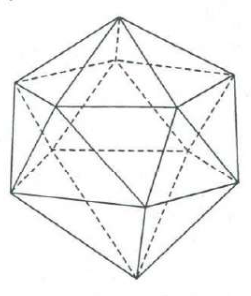
Consider the following three-dimensional figure:

A regular icosahedron drawn as a wire frame, with hidden edges dashed: 12 vertices, 30 edges and triangular faces all round.
From UPSC's question paper.

How many triangles does the above figure have?

Answer & explanation

Answer: (b) 20

The solid is a regular icosahedron, and every one of its faces is a triangle. Its edges close into no triangles other than the faces, so the count is simply the number of faces: 20.

  1. Identify the solid: every face is a triangle and five faces meet at each vertex — a regular icosahedron.
  2. Count the faces in three layers: 5 around the top vertex, 5 around the bottom vertex and a band of 10 in the middle.
  3. 5 + 10 + 5 = 20 triangular faces.
  4. No three edges outside a face close into a triangle, so there are no extra triangles to add.
  5. Check: Euler's formula V − E + F = 2 with 12 vertices and 30 edges gives F = 20.

Remember · For a solid made of triangular faces, count faces layer by layer and confirm with Euler's formula V − E + F = 2.

Question and answer: UPSC's official GS Paper II (2018, Series A) — paper ↗ · answer key ↗. Explanation: Minimalist IAS, checked 1 Oct 2026 (how we verify). Permalink ·