CSAT · Data interpretation & sufficiency · Set 1 of 3
Data interpretation & sufficiency: practice set 1
20 questions UPSC asked between 2017 and 2026, 30 minutes, negative marking — your score as soon as you submit.
Pick up where you left off
20
questions
30 min
at the exam's pace
50
maximum marks
Data interpretation & sufficiency has 3 sets of about 20 questions — together, every question UPSC has asked on it since 2016. This is set 1; when you finish, the next one is a tap away.
1Answer in any order: skip, mark for review and come back from the question palette.
2Submit when you're done, or the 30 min timer submits for you. Close the page and come back any time — your answers are saved in this browser.
3See your score straight away. Sign up free (or log in) for the full report and every question with UPSC's answer and a step-by-step solution.
Marking, as in the exam: +2.5 for a correct answer, −0.83 for a wrong one, 0 if you leave it. CSAT is qualifying: 33%.
Questions from the latest paper are scored against UPSC's provisional answer key (the final key comes out after the final result).
What's in this test
Year
Questions
Easy
Medium
Hard
2026
2
0
2
0
2025
2
1
1
0
2024
3
1
2
0
2023
2
0
2
0
2022
2
2
0
0
2021
2
2
0
0
2020
2
2
0
0
2018
4
1
2
1
2017
1
1
0
0
Difficulty is the Vault's own rating of each question; subjects and topics follow the official syllabus.
The timer starts when you press Start. Your progress is saved in this browser.
You have an attempt in progress
About this test
How is this test marked?
As in UPSC's CSAT (GS Paper II): 2.5 marks for each correct answer and a third of that (0.83) deducted for each wrong one. A question you leave scores nothing. The maximum here is 50.
How long do I get?
30 minutes — the exam's pace (80 questions in 2 hours) for 20 questions. When the time runs out, your answers are submitted as they stand.
How are the sets made?
Every question UPSC has asked on Data interpretation & sufficiency since 2016 is in one of the 3 sets of about 20, each mixing years (a passage always comes with all its questions). Questions UPSC dropped from evaluation are left out. Take them in any order; the sets page shows which you've done.
Is it free?
Yes. Anyone can take the test and see their score straight away. A free sign-up shows the full report and every question with UPSC's answer and a step-by-step solution.
Data interpretation & sufficiency · Set 1 · Set 1 of 3
0 of 20 answered
⏱ 30:00
Question 1 of 20 · CSAT 2026, Q1
Directions for the following 5 (five) items: Each item in this section contains a question followed by two statements. Answer each item using the following instructions and mark your response on the Answer Sheet accordingly.
Question: X receives three coins of different denominations: 1, 2, 5, 10 and 20. If the total amount received by X is m, does X receive a coin of denomination 5?
Statement I:m is not a prime number.
Statement II:The sum of the digits of m is greater than 5.
Question 2 of 20 · CSAT 2026, Q4
Directions for the following 5 (five) items: Each item in this section contains a question followed by two statements. Answer each item using the following instructions and mark your response on the Answer Sheet accordingly.
Question: X is a collection of certain odd numbers whereas Y is a collection of certain even numbers. T consists of the numbers all of which are either from X or from Y. Is every number of T from Y?
Statement I:The sum of any two numbers belonging to T is even.
Statement II:If both p and q are picked from T, then (p − 1)q is even.
Question 3 of 20 · CSAT 2025, Q68
A question is given followed by two Statements I and II. Consider the Question and the Statements and mark the correct option.
Question:
What is the smallest 1-digit number having exactly 4 distinct factors?
Statement I:2 is one of the factors.
Statement II:3 is one of the factors.
Which one of the following is correct in respect of the above Question and the Statements?
Question 4 of 20 · CSAT 2025, Q73
A question is given followed by two Statements I and II. Consider the Question and the Statements and mark the correct option.
Question:
In a football match, team P playing against Q was behind by 3 goals with 10 minutes remaining. Does team P win the match?
Statement I:Team P scored 4 goals in the last 10 minutes.
Statement II:Team Q scored a total of 4 goals in the match.
Which one of the following is correct in respect of the above Question and the Statements?
Question 5 of 20 · CSAT 2024, Q60
A Question is given followed by two Statements I and II. Consider the Question and the Statements.
Question:What is the time required to download the software?
Statement–I:The size of the software is 12 megabytes.
Statement–II:The transfer rate is 2.4 kilobytes per second.
Which one of the following is correct in respect of the above Question and the Statements?
Question 6 of 20 · CSAT 2024, Q66
A Question is given followed by two Statements I and II. Consider the Question and the Statements.
Question:If the average marks in a class are 60, then what is the number of students in the class?
Statement–I:The highest marks in the class are 70 and the lowest marks are 50.
Statement–II:Exclusion of highest and lowest marks from the class does not change the average.
Which one of the following is correct in respect of the above Question and the Statements?
Question 7 of 20 · CSAT 2024, Q69
A Question is given followed by two Statements I and II. Consider the Question and the Statements.
A person buys three articles p, q and r for ₹50. The price of the article q is ₹16 which is the least.
Question:What is the price of the article p?
Statement–I:The cost of p is not more than that of r.
Statement–II:The cost of r is not more than that of p.
Which one of the following is correct in respect of the above Question and the Statements?
Question 8 of 20 · CSAT 2023, Q56
Question: Is p greater than q?
Statement-1:p × q is greater than zero.
Statement-2:p² is greater than q².
Which one of the following is correct in respect of the above Question and the Statements?
Question 9 of 20 · CSAT 2023, Q59
Consider a 3-digit number.
Question: What is the number?
Statement-1:The sum of the digits of the number is equal to the product of the digits.
Statement-2:The number is divisible by the sum of the digits of the number.
Which one of the following is correct in respect of the above Question and the Statements?
Question 10 of 20 · CSAT 2022, Q25
Consider the Question and two Statements given below:
Question:Is Z brother of X?
Statement–1:X is a brother of Y and Y is a brother of Z.
Statement–2:X, Y and Z are siblings.
Which one of the following is correct in respect of the Question and the Statements?
Question 11 of 20 · CSAT 2022, Q49
Consider the Question and two Statements given below:
Question:What is the age of Manisha?
Statement–1:Manisha is 24 years younger than her mother.
Statement–2:5 years later, the ages of Manisha and her mother will be in the ratio 3:5.
Which one of the following is correct in respect of the Question and the Statements?
Question 12 of 20 · CSAT 2021, Q38
Consider two Statements and a Question:
Statement-1:Priya is 4 ranks below Seema and is 31st from the bottom.
Statement-2:Ena is 2 ranks above Seema and is 37th from the bottom.
Question:What is Seema’s rank from the top in the class of 40 students?
Which one of the following is correct in respect of the Statements and the Question?
Question 13 of 20 · CSAT 2021, Q47
Consider two Statements and a Question:
Statement-1:The last day of the month is a Wednesday.
Statement-2:The third Saturday of the month was the seventeenth day.
Question:What day is the fourteenth of the given month?
Which one of the following is correct in respect of the Statements and the Question?
Question 14 of 20 · CSAT 2020, Q28
Two Statements S1 and S2 are given below with regard to four numbers P, Q, R and S followed by a Question:
S1.R is greater than P as well as Q.
S2.S is not the largest one.
Question:Among four numbers P, Q, R and S, which one is the largest?
Which one of the following is correct in respect of the above Statements and the Question?
Question 15 of 20 · CSAT 2020, Q36
Three Statements S1, S2 and S3 are given below followed by a Question:
S1.C is younger than D, but older than A and B.
S2.D is the oldest.
S3.A is older than B.
Question:Who among A, B, C and D is the youngest?
Which one of the following is correct in respect of the above Statements and the Question?
Question 16 of 20 · CSAT 2018, Q12
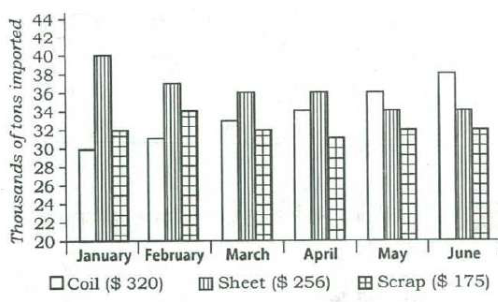
Directions for the following 3 (three) items: The following three items are based on the graph given below which shows imports of three different types of steel over a period of six months of a year. Study the graph and answer the three items that follow.
The figures in the brackets indicate the average cost per ton over six months period.
Month
Coil ($ 320)
Sheet ($ 256)
Scrap ($ 175)
January
30
40
32
February
31
37
34
March
33
36
32
April
34
36
31
May
36
34
32
June
38
34
32
What was the approximate total value (in $) of sheet steel imported over the six months period?
Question 17 of 20 · CSAT 2018, Q63
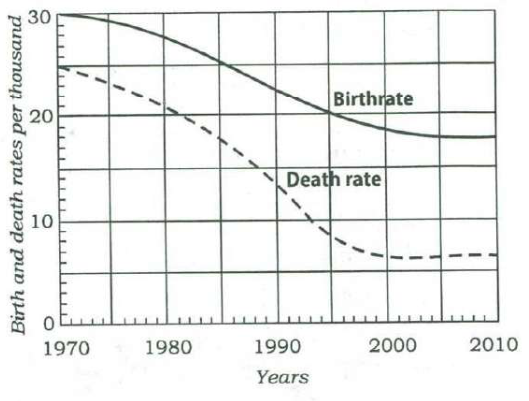
Directions for the following 2 (two) items: Consider the following graph in which the birthrate and death rate of a country are given, and answer the two items that follow.
Looking at the graph, it can be inferred that from 1990 to 2010
Question 18 of 20 · CSAT 2018, Q67
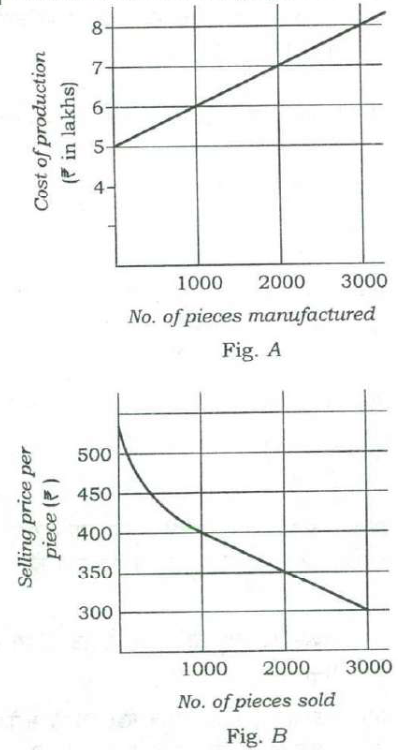
Consider the following figures A and B:
No. of pieces
Cost of production (₹ in lakhs), Fig. A
Selling price per piece (₹), Fig. B
1000
6
400
2000
7
350
3000
8
300
The manufacturing cost and projected sales for a product are shown in the above figures A and B respectively. What is the minimum number of pieces that should be manufactured to avoid a loss?
Question 19 of 20 · CSAT 2018, Q74
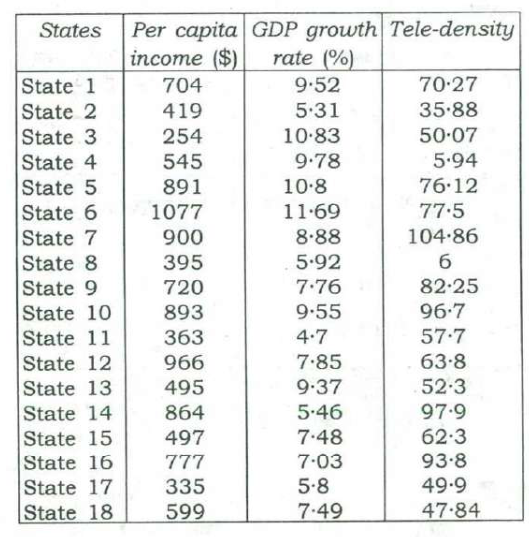
Directions for the following 2 (two) items: The following table gives the GDP growth rate and Tele-density data of different States of a country in a particular year. Study the table and answer the two items that follow.
With reference to the above table, which of the following is/are the most logical and rational inference/inferences that can be made?
1.Higher per capita income is generally associated with higher Tele-density.
2.Higher GDP growth rate always ensures higher per capita income.
3.Higher GDP growth rate does not necessarily ensure higher Tele-density.
States
Per capita income ($)
GDP growth rate (%)
Tele-density
State 1
704
9·52
70·27
State 2
419
5·31
35·88
State 3
254
10·83
50·07
State 4
545
9·78
5·94
State 5
891
10·8
76·12
State 6
1077
11·69
77·5
State 7
900
8·88
104·86
State 8
395
5·92
6
State 9
720
7·76
82·25
State 10
893
9·55
96·7
State 11
363
4·7
57·7
State 12
966
7·85
63·8
State 13
495
9·37
52·3
State 14
864
5·46
97·9
State 15
497
7·48
62·3
State 16
777
7·03
93·8
State 17
335
5·8
49·9
State 18
599
7·49
47·84
Select the correct answer using the code given below.
Question 20 of 20 · CSAT 2017, Q52
If for a sample data
Mean < Median < Mode
then the distribution is
Keyboard: A–D to choose, ←→ to move, M to mark for review.
Time ran out, so your answers were submitted automatically.
Loading your answers…
We couldn't load the answers just now. Your attempt is saved.
🔒
Sign up free to see where you lost marks
Your detailed report (correct, wrong and skipped, subject-wise breakdown, answer sheet) and every question with its answer and explanation are for Minimalist IAS members. Membership is free.