Ethics
Probity in Governance: Meaning, Accountability and Ethical Governance — UPSC Ethics Notes
By Shivam Singh, Founder & Mentor, Minimalist IAS
· 10 min read
WhatsApp Telegram
Probity in governance means uprightness in public life: honesty, transparency and accountability in how public power, money and office are used, backed by rules that make wrongdoing visible and costly. It sits in the GS Paper IV syllabus alongside RTI, codes of ethics and conduct, citizen’s charters and the utilisation of public funds. India ranked 91st of 182 countries on Transparency International’s Corruption Perceptions Index 2025, with a score of 39 out of 100.
Why in news: According to news reports, an IAS officer whom a judicial commission held responsible, in a supervisory capacity, for lapses before the Indore water-contamination deaths has been posted as a district Collector. It asks how accountability should follow an adverse finding; the findings are before the High Court and are not a conviction.
Syllabus mapping
GS Paper IV: ‘Probity in Governance: Concept of public service; Philosophical basis of governance and probity; Information sharing and transparency in government, Right to Information, Codes of Ethics, Codes of Conduct, Citizen’s Charters, Work culture, Quality of service delivery, Utilization of public funds, challenges of corruption.’
Also useful in: Essay and GS Paper II. Neighbouring values: objectivity, empathy and attitude.
What is probity in governance, and how is it different from integrity, accountability and transparency?
The four words are used loosely in answers, so the first task is to separate them; every later section builds on these definitions.
Term | What it means | Test question | Example |
|---|---|---|---|
Integrity | A person’s inner consistency of values and action | Does the officer act the same when unobserved? | Refusing a bribe nobody would ever find out about |
Probity | Integrity shown in public dealings and made checkable by rules | Can the decision be traced, justified and audited? | A tender awarded on recorded criteria |
Accountability | Answerability for decisions and their consequences | Who answers if this fails, and what follows? | Inquiry, penalty or reform after a failure |
Transparency | Openness of information and process | Can a citizen see the file and the reasons? | Proactive disclosure of rules and decisions |
Analogy: integrity is the honest shopkeeper; probity is the shopkeeper who also issues a bill and keeps the ledger open to audit; accountability is what happens when the ledger does not tally.
Concept of public service: office is held in trust for citizens; every decision must be justifiable in public interest.
Philosophical basis of governance and probity
Once probity is defined as trusteeship of power, the next question is where that idea comes from; Indian and modern thought point the same way.
Kautilya (Arthashastra): the ruler’s duty is the welfare of subjects; it catalogues how revenue is embezzled and tests officials’ honesty, so probity is policed, not assumed.
Gandhi’s trusteeship: wealth beyond an honourable livelihood belongs to the community; extended to office, power is a trust held for the public (source: Gandhi, *Harijan*, 1939).
Nolan Committee (UK, 1995): seven principles of public life: selflessness, integrity, objectivity, accountability, openness, honesty and leadership.
Constitutional base: the rule of law and equality (Article 14), the right to know as part of free speech (Article 19(1)(a), recognised in *State of UP v Raj Narain*, 1975), and the safeguard of a hearing before dismissal (Article 311).
Instruments of probity: RTI, codes, charters, Lokpal and the law
Philosophy needs machinery; India’s instruments arrived in layers, each answering a different gap, as the timeline shows.
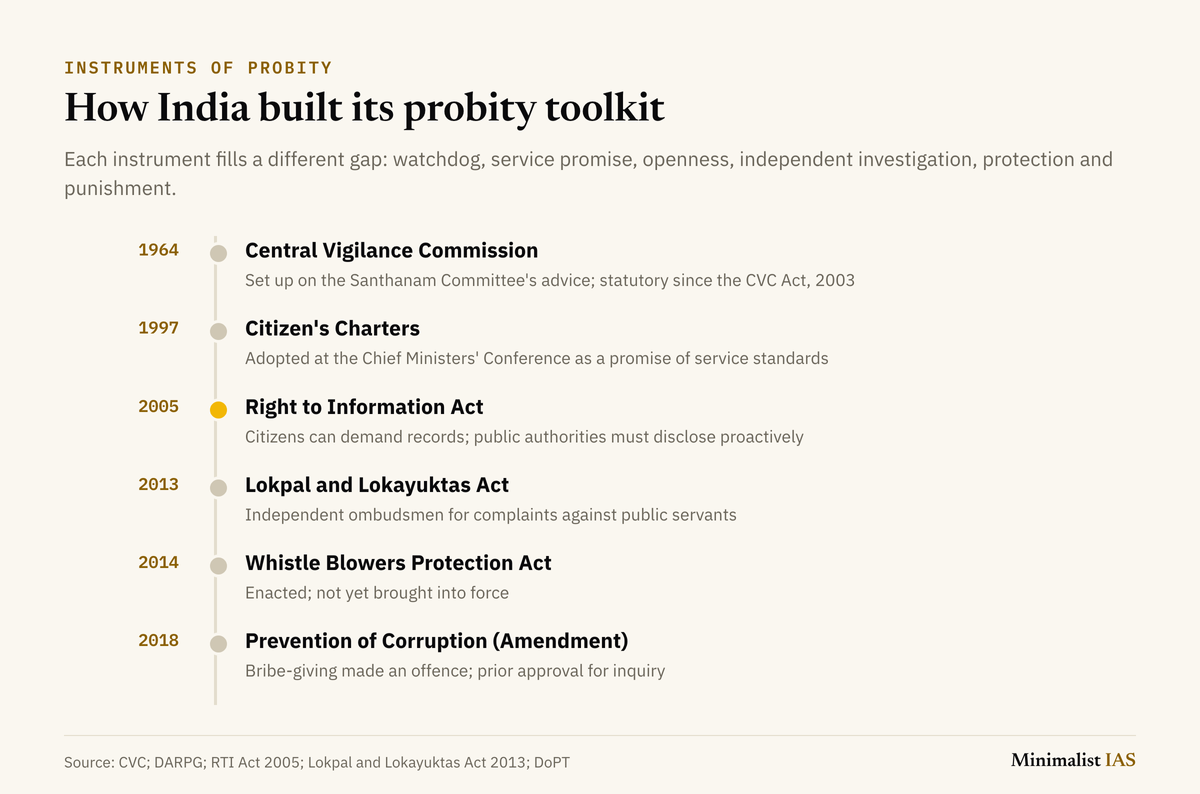
Right to Information Act, 2005 (transparency): citizens can demand records from public authorities; public authorities must also disclose key information on their own (proactive disclosure). Reply within 30 days, and within 48 hours where life or liberty is involved; appeals go to Information Commissioners.
RTI under strain: the Digital Personal Data Protection Act, 2023 rewrote RTI’s personal-information exemption; the government says it prevents misuse, critics say it drops the public-interest test.
Citizen’s Charters (service quality): a public promise of service standards, timelines and a grievance route. They began with the Chief Ministers’ Conference of 1997, and the Sevottam framework (2005) later rated service delivery.
Lokpal and Lokayuktas Act, 2013 (independent investigation): ombudsman bodies for complaints of corruption against public servants; in force since January 2014, with States required to appoint Lokayuktas within a year.
Whistle Blowers Protection Act, 2014 (protection): shields those who expose wrongdoing, but has not been brought into force; the government says it needs amendment first.
Central Vigilance Commission (watchdog): set up in 1964 on the Santhanam Committee’s advice; statutory since the CVC Act, 2003.
Prevention of Corruption (Amendment) Act, 2018: made giving a bribe a specific offence (with relief for those forced to pay who report within seven days) and added prior approval before inquiry into official decisions. In January 2026 a two-judge bench of the Supreme Court split on the validity of that approval rule and referred it to a larger bench.
Code of Ethics vs Code of Conduct
The Second ARC’s Ethics in Governance report (4th Report, 2007) separated two documents that answers often blur.
Feature | Code of Ethics | Code of Conduct |
|---|---|---|
Nature | Statement of values and principles | Specific do’s and don’ts |
Content | Probity, impartiality, public good, commitment to the Constitution | Gifts, outside employment, political activity, property returns |
Enforcement | Guides judgement; the 2nd ARC wanted statutory backing | Enforceable through service rules, with disciplinary action |
Position in India | Not yet in place as a single code; proposed in the 2nd ARC’s model | In operation (for example, the Conduct Rules for Central and All India Services) |
How is accountability enforced when administration fails?
Instruments set expectations; accountability is what happens when they are breached, and it works through several channels at once.
Commissions of inquiry: fact-finding bodies under the Commissions of Inquiry Act, 1952; the report must be tabled with a memorandum of action taken within six months, but findings are recommendatory, not a verdict.
Disciplinary route: suspension (a holding step, not a punishment), a departmental inquiry under the discipline and appeal rules, and penalties up to dismissal after a reasonable hearing (Article 311).
Financial, judicial and social: CAG audit and the Public Accounts Committee test public spending; courts, the Lokpal, CVC and social audits examine complaints and performance.
The Indore example: according to press reports, a one-member commission appointed by the Madhya Pradesh High Court examined the contamination deaths (at least 35, as reported). It reportedly held three officials responsible for lapses, including an IAS officer in a supervisory role, who was later named a district Collector. The posting pits due process (no penalty without a hearing) against public trust.
Probity audit: was the decision lawful? Was it recorded with reasons? Was it open to scrutiny? Did failure carry a consequence?
Challenges to probity and what the data shows
These tools exist, yet the gaps between law and practice explain why probity remains a Mains staple.

Data (Transparency International, CPI 2025): India 91st of 182, score 39/100, against 38 in 2024 and a global average of 42. It measures perceived public-sector corruption, and TI cautions against reading small yearly moves as reform.
Weak enforcement: slow trials and delayed sanction blunt the law; the Whistle Blowers Act is not in force.
Discretion without reasons: postings, tenders and approvals rest on unrecorded judgement.
Hollow instruments: charters are not legally enforceable; RTI faces pendency and exemption disputes; no statutory code of ethics.
Culture and public funds: fear of retaliation and loyalty over rules; unspent allocations and leakage both defeat development goals.
Way forward
Law: bring the Whistle Blowers Act into force with a workable amendment; give the 2nd ARC’s code of ethics statutory form.
Transparency: proactive disclosure of tenders, postings and inquiry outcomes; keep RTI’s public-interest test.
Service delivery: enforceable service guarantees with time limits and penalties, as in the Madhya Pradesh Public Services Guarantee Act, 2010; e-procurement and file tracking to cut discretion.
Accountability: time-bound action on inquiry findings, and neutral postings until a due-process decision on officers named by a commission.
Culture: case-based ethics training and merit-based postings.
Probity therefore needs both a rulebook and a habit: laws that make wrongdoing visible, and an administrative culture that treats an adverse finding as a duty to act, not an embarrassment to manage.
Worked example: a delayed tender file
Situation: a municipal water-pipeline tender is approved by the committee, then sits unexplained for weeks before the next approval; sewage later seeps into the supply line.
Probity audit: lawful (approval within limits), recorded (no reason for the delay), open (the file was not visible to the public), answerable (no one owned the lapse).
Using probity in a Mains answer
Introduction: define probity in one line and separate it from integrity (inner) and accountability (answerability).
Body, instruments and gaps: RTI, codes, charters, Lokpal, CVC, whistle-blower law; name one gap in each.
Way forward and conclusion: the four-question audit, a statutory code of ethics, enforceable service guarantees; probity is a public trust that must be visible, checkable and enforced.
Related PYQs
UPSC CSE Mains 2019, GS Paper IV:
“What do you understand by probity in governance ? Based on your understanding of the term, suggest measures for ensuring probity in government.” (150 words; 10 marks)
Use: define, then legal, institutional and cultural measures.
UPSC CSE Mains 2019, GS Paper IV:
“Explain the basic principles of citizens charter movement and bring out its importance.” (150 words; 10 marks)
Use: state the principles and tie them to service delivery.
UPSC CSE Mains 2024, GS Paper IV:
“The ‘Code of Conduct’ and ‘Code of Ethics’ are the sources of guidance in public administration. There is code of conduct already in operation, whereas code of ethics is not yet put in place. Suggest a suitable model for code of ethics to maintain integrity, probity and transparency in governance.” (150 words; 10 marks)
Use: the table above, then a 2nd ARC-based model.
UPSC CSE Mains 2021, GS Paper IV:
“An independent and empowered social audit mechanism is an absolute must in every sphere of public service, including judiciary, to ensure performance, accountability and ethical conduct. Elaborate.” (150 words; 10 marks)
Use: link social audit to accountability and public funds.
See the detailed explanations: Mains 2019 · Mains 2021 · Mains 2024 in the free PYQ vault, with year-wise analysis. Free to browse; free sign-up to download.
Mentor’s note
Don’t use integrity and probity as synonyms. Say integrity is a personal quality and probity is integrity made visible and auditable through rules and records.
Anchor codes questions in the 2nd ARC. The 2024 question rewarded a model of a code of ethics; name the 4th Report (2007) and its three-part design.
Treat case studies as probity audits. Use the four questions and recommend a time-bound, reasoned step.
Prelims traps and 60-second revision
Traps: (1) The Whistle Blowers Protection Act, 2014 is enacted but not in force. (2) A Citizen’s Charter is an administrative promise, not a legal right. (3) CPI measures perceived corruption, not actual corruption. (4) Code of ethics = values; code of conduct = enforceable rules. (5) A commission of inquiry’s findings are recommendatory.
Q: Who gave the seven principles of public life? The Nolan Committee (UK, 1995).
Q: Which report separated codes of ethics and conduct? The Second ARC’s 4th Report, Ethics in Governance (2007).
Q: Which 2018 change targeted the bribe-giver? Giving a bribe became a specific offence under the Prevention of Corruption Act.
Q: What are the four probity-audit questions? Lawful, recorded, open, answerable.
Target Prelims MCQs
Consider the following statements:
The Prevention of Corruption (Amendment) Act, 2018 made giving a bribe to a public servant a specific offence.
The Central Vigilance Commission was given statutory status by the CVC Act, 2003.
The Lokpal and Lokayuktas Act, 2013 required the States to appoint Lokayuktas within a year of its commencement.
How many of the above statements are correct?
(a) Only one
(b) Only two
(c) All three
(d) None
Answer: (c) All three
Explanation:
Statement 1 is correct: bribe-giving became a distinct offence in 2018.
Statement 2 is correct: the Commission, set up in 1964, became statutory through the 2003 Act.
Statement 3 is correct: the 2013 Act gave States a one-year window.
Consider the following statements:
Statement-I: A Citizen’s Charter cannot by itself be enforced in a court of law as a legal right.
Statement-II: A Citizen’s Charter is an organisation’s administrative commitment to service standards, not a statute.
Which one of the following is correct in respect of the above statements?
(a) Both Statement-I and Statement-II are correct and Statement-II explains Statement-I
(b) Both Statement-I and Statement-II are correct, but Statement-II does not explain Statement-I
(c) Statement-I is correct, but Statement-II is incorrect
(d) Statement-I is incorrect, but Statement-II is correct
Answer: (a) Both Statement-I and Statement-II are correct and Statement-II explains Statement-I
Explanation:
Statement-I is correct: a charter creates expectations, not an enforceable right, unless a law (such as a Public Services Guarantee Act) backs it.
Statement-II is correct: a charter is a self-declared commitment of the organisation.
(a) is correct: because it is only an administrative commitment, it cannot be enforced as a legal right.
Mains practice questions
“Transparency without accountability is display, and accountability without transparency is guesswork.” Examine this statement in the context of the RTI Act and citizen’s charters in India. (Answer in 150 words; 10 Marks)
When a commission of inquiry names a civil servant for lapses, how should administration balance due process with public trust? Critically examine, and suggest institutional reforms to make accountability for administrative failure effective. (Answer in 250 words; 15 Marks)
**Case study: You are the Chief Secretary of a State. A judicial commission has held an officer responsible, in a supervisory capacity, for lapses that preceded deaths from contaminated water supply. In a routine reshuffle the officer is proposed as a District Collector. No departmental inquiry has been completed, and families and the media are protesting.
(a) Identify the ethical issues and stakeholders. (b) Evaluate the options and choose one. (c) What systemic reform would you propose to prevent such situations? (Answer in 250 words; 20 Marks)**
Frequently asked questions (FAQs)
What is probity in governance?
Probity in governance is honesty, transparency and accountability in the exercise of public office and use of public resources, secured through rules, records and answerability.
What is the difference between a code of ethics and a code of conduct?
A code of ethics states values and principles; a code of conduct lists specific, enforceable do’s and don’ts. The 2nd ARC’s 4th Report (2007) recommended both.
Is the Whistle Blowers Protection Act in force?
No. The Act received assent in 2014 but has not been notified to come into force; the government has said it needs amendments first.
Related reading
Sources
UPSC: Civil Services Examination syllabus and previous question papers
Transparency International: Corruption Perceptions Index 2025
Minimalist IAS static notes — by Shivam Singh.
Spotted an error or something outdated? Tell us — we correct it.
About the author
Shivam Singh
Founder & Mentor, Minimalist IAS
Shivam has been through every stage of the exam himself — Prelims, repeated Mains attempts across UPSC and state civil services, and the interview board. For 7 years he has mentored aspirants one-to-one, helping 100+ clear various stages of the exam, including final selections.
More about Shivam →