Ethics
Objectivity, Impartiality and Non-Partisanship: Values for Civil Servants — UPSC Ethics Notes
By Shivam Singh, Founder & Mentor, Minimalist IAS
· Updated · 10 min read
WhatsApp Telegram
Objectivity, impartiality and non-partisanship are foundational values in the GS Paper IV syllabus: objectivity means deciding on evidence and merit, impartiality means treating like cases alike without favour or prejudice, and non-partisanship means serving every elected government with equal loyalty. The Nolan principles of public life (UK, 1995) and the All India Services (Conduct) Rules, as amended in 2014, put these values into rules.
Why in news: The Allahabad High Court (October 2026) asked how a political label, ‘andolanjeevi’, entered a District Magistrate’s National Security Act detention grounds against a journalist, and reserved judgment. The allegations are untested and no verdict has been reported.
Updated (October 2026): judgment in the case is reserved, so it is framed as an open question; the Nolan wording is dated correctly; added a worked example, Prelims traps and a 60-second revision.
Syllabus mapping
GS Paper IV: ‘Aptitude and foundational values for Civil Service, integrity, impartiality and non-partisanship, objectivity, dedication to public service, empathy, tolerance and compassion towards the weaker sections.’
Linked: the executive and civil services (GS II); Essay.
What do objectivity, impartiality and non-partisanship mean?
The syllabus lists the three values together, so first separate them; their neighbours are in Empathy, compassion and tolerance in civil services.

Value | Core idea | Its opposite | In a civil servant’s work |
|---|---|---|---|
Objectivity | Decide on evidence, facts and merit | Decisions on belief, label or hunch | Detention grounds that state facts, not ideology |
Impartiality | Treat like cases alike | Favour or prejudice towards a person or group | Relief given on need, not caste or connection |
Non-partisanship | Serve every government with equal loyalty | Party leaning; taking sides | Implementing a new government’s policy without sabotage or advocacy |
Remember it as the three Es: Evidence (objectivity), Equals (impartiality), Every government (non-partisanship).
Analogy: a match referee. Replay evidence settles the call (objectivity), one law applies to both teams (impartiality), and the referee officiates the same way whoever owns the club next season (non-partisanship).
Neutrality is not indifference: a civil servant stays committed to constitutional values — equality, liberty and the rule of law.
Why do these values matter?
Knowing the meanings is not enough; UPSC also asks why a permanent service needs them.
Rule of law: an order is the State acting on a citizen; if it rests on bias, the citizen’s rights are the first casualty.
Quasi-judicial powers: detention, licences, penalties and benefits affect liberty and livelihood, so reasons must be testable by a court.
Continuity: governments change but the civil service is permanent; trust needs the same professional service for every government and the same treatment for every citizen.
Two IAS examples: T.N. Seshan, Chief Election Commissioner from 1990, enforced spending limits on every contestant (impartiality); J.M. Lyngdoh declined the early Gujarat elections a ruling party wanted in 2002 (non-partisanship).
Where do the rules sit?
These values would stay slogans without rules, so here is where each one is written down.
Source | What it provides |
|---|---|
Constitution | Equality before law (Article 14); safeguards against arbitrary dismissal (Article 311); safeguards for the detained (Article 22) |
All India Services (Conduct) Rules, 1968 | 2014 amendment (Rule 3): political neutrality; merit, fairness and impartiality; accountability and transparency. Rule 5: no membership of, or association with, a political party |
Nolan Committee (UK, 1995) | Seven principles of public life, including objectivity; the present wording of each dates from a 2013 review |
Second ARC, 4th Report (2007) | ‘Ethics in Governance’: codes of ethics and conduct for public servants |
T.S.R. Subramanian v. Union of India (2013) | Supreme Court steps to protect civil servants from arbitrary pressure: oral instructions to be recorded in writing, assured minimum tenure |

Seven principles: selflessness, integrity, objectivity, accountability, openness, honesty, leadership.
Objectivity (Nolan, present wording): decide impartially, fairly and on merit, using the best evidence and without discrimination or bias.
Where are these values tested?
Rules matter most when pressure arrives, and in an officer’s working life it comes in five forms.
Political pressure: an instruction to favour or target someone; record it in writing (T.S.R. Subramanian).
Personal bias and public mood: caste, religion or ideology colouring an order; media or crowd pressure to act harshly.
Loyalty clash: loyalty to a superior versus duty to law; duty to the Constitution wins.
Loaded language: political labels in an official record show a closed mind.
Case anchor: the ‘andolanjeevi’ detention order
The last form, loaded language, is the live question in a Noida case, which is pending, so treat it as an open question and not a finding.
The detention: a District Magistrate detained a journalist under the National Security Act in May 2026, following the Noida workers’ protest; the detention grounds used the label ‘andolanjeevi’.
The Court’s questions (October 2026): Justice Atul Sreedharan asked how the term found its way into an official document; the Bench also asked how ideology, reading material or organisational ties alone could support preventive detention.
Status: judgment reserved; no verdict reported by mid-October 2026. The petitioner’s and the State’s claims are untested.
What the law requires: under Article 22 the detainee is told the grounds and may represent against them; detention beyond three months needs an Advisory Board’s report of sufficient cause (Article 22(4)); the NSA caps detention at 12 months. See Article 22 explained.
A related ruling: in September 2026 the High Court quashed another Noida-protest NSA detention (Aakriti Chaudhary); the Supreme Court stayed the costs and strictures against the District Magistrate but left the quashing in force.
GS4 lesson: a label in an official record is a red flag for objectivity; an order should read as facts and reasons, not adjectives.
A four-step test for any order
Courts judge such orders on the record, which suggests a test you can apply in any answer.
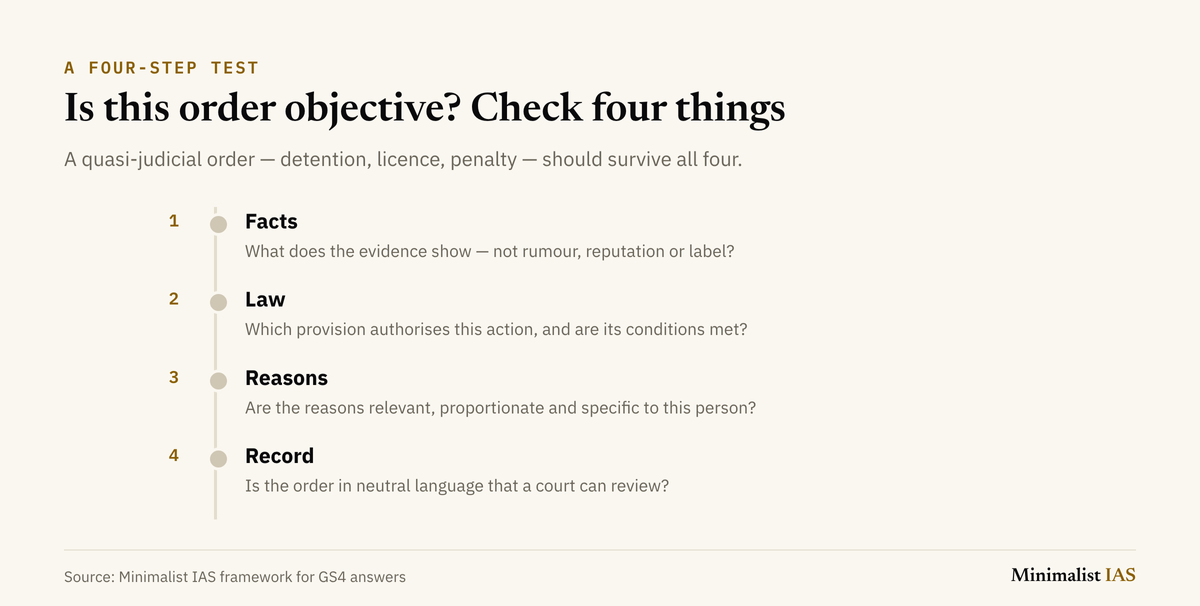
Facts: what does the evidence show — not rumour, reputation or label?
Law: which provision authorises this action, and are its conditions met?
Reasons: are they relevant, proportionate and specific to this person?
Record: is the order in neutral language that a court can review?
Worked example: the flood-relief list
Situation: after floods, a tehsildar prepares the relief list; a local MLA asks that his supporters be listed first.
Facts and law: assess damage house by house; the relief norms, not the MLA’s request, decide eligibility.
Reasons: rank by loss and need, whatever the household’s politics.
Record: note the request in the file and inform the superior, the T.S.R. Subramanian safeguard in practice. The list is now objective (evidence), impartial (one norm for all) and non-partisan (the MLA’s party is irrelevant).
Related PYQs
UPSC has tested these exact distinctions in GS Paper IV, so read the questions before the answer structure.
UPSC CSE Mains 2016, GS Paper IV:
“Why should impartiality and non-partisanship be considered as foundational values in public services, especially in the present day socio-political context ? Illustrate your answer with examples.”
Use: define each value, give one example each, link to Article 14.
UPSC CSE Mains 2021, GS Paper IV:
“Should impartial and being non-partisan be considered as indispensable qualities to make a successful civil servant? Discuss with illustrations.”
Use: argue both are indispensable because success rests on public trust.
UPSC CSE Mains 2026, GS Paper IV (case study, 250 words; 20 marks):
“(a) Discuss the ethical issues that need to be addressed in this case. (b) What are the options open to Rajan? Which option would ensure protection of his non-partisan image without compromising ethics?”
Use: a District Magistrate faces an ethnic conflict in which local officials have turned partisan; apply equal protection and visible neutrality.
See the detailed explanations: Mains 2016 · Mains 2021 · Mains 2026 in the free PYQ vault, with year-wise analysis. Free to browse; free sign-up to download.
Using these values in a GS4 answer
Those questions reward a fixed shape, which you can build in six moves.
Introduction: define the value in one line and link it to the syllabus or the Nolan principle.
Body — meaning and rules: separate the three values with a different example each; cite the AIS Rules 2014, Nolan principles, T.S.R. Subramanian and Article 22.
Body — attitude: values are held attitudes; link them to the ABC model in Attitude in ethics: content, structure and function.
Case studies: stakeholders → ethical issues → options with pros and cons → decision with reasons → what to record and whom to inform.
Conclusion: objectivity protects citizens’ rights and the credibility of administration.
Mentor’s note
Don’t treat the three values as synonyms. Define each in one line and use a different example for each; UPSC asked about impartiality and non-partisanship together in GS Paper IV in 2016 and again in 2021.
Quote rules, not slogans. Name the Nolan objectivity descriptor, the 2014 amendment to the AIS Conduct Rules and its Rule 5 bar on party links, and T.S.R. Subramanian, instead of writing ‘ethical’ in general terms.
In case studies, keep neutrality active. The 2026 question asked which option protects a non-partisan image without compromising ethics; answer with equal protection and relief on record, not inaction.
Prelims traps and 60-second revision
Nolan is British: the seven principles are the UK Committee’s (1995); India’s own texts are the AIS Rules, the Second ARC and T.S.R. Subramanian.
Objectivity is about evidence; impartiality is about people: do not swap their definitions.
Neutrality is not indifference: the officer stays committed to the Constitution.
Article 22(4): detention beyond three months needs an Advisory Board; the NSA ceiling is 12 months.
Article 311 is dismissal; Article 14 is equality: neither is the detention safeguard.
Q: What does each value mean in one line? Objectivity: decide on evidence; impartiality: like cases alike; non-partisanship: every government alike.
Q: When did the AIS Conduct Rules add political neutrality? The 2014 amendment (Rule 3).
Q: How long can preventive detention run without an Advisory Board? Three months (Article 22(4)).
Q: What did T.S.R. Subramanian (2013) say on oral instructions? Record them in writing.
Target Prelims MCQs
Consider the following statements:
The Nolan principles of public life include objectivity and openness.
The All India Services (Conduct) Rules, 1968 were amended in 2014 to include political neutrality among the duties of members.
In T.S.R. Subramanian v. Union of India (2013), the Supreme Court held that civil servants may act on oral instructions without recording them.
How many of the above statements are correct?
(a) Only one
(b) Only two
(c) All three
(d) None
Answer: (b) Only two
Explanation:
Statement 1 is correct: objectivity and openness are two of the seven principles.
Statement 2 is correct: the 2014 amendment added political neutrality to the duties in Rule 3.
Statement 3 is incorrect: the Court directed that oral instructions be recorded in writing.
Consider the following statements:
Statement-I: A person detained under a preventive detention law cannot be held for more than three months unless an Advisory Board reports sufficient cause for longer detention.
Statement-II: Preventive detention deprives a person of liberty without trial, so the Constitution lays down procedural safeguards for it in Article 22.
Which one of the following is correct in respect of the above statements?
(a) Both Statement-I and Statement-II are correct and Statement-II explains Statement-I
(b) Both Statement-I and Statement-II are correct, but Statement-II does not explain Statement-I
(c) Statement-I is correct, but Statement-II is incorrect
(d) Statement-I is incorrect, but Statement-II is correct
Answer: (a) Both Statement-I and Statement-II are correct and Statement-II explains Statement-I
Explanation:
Statement-I is correct: Article 22(4) allows detention beyond three months only on an Advisory Board’s report of sufficient cause.
Statement-II is correct and explains Statement-I: because liberty is taken away without trial, the Constitution adds safeguards such as the three-month limit and Advisory Board review.
Mains practice questions
Distinguish between objectivity, impartiality and non-partisanship. Illustrate with examples from public administration. (Answer in 150 words; 10 Marks)
An administrative order that records political labels instead of facts undermines both citizens’ rights and public trust. Discuss the values at stake and the safeguards that can prevent such orders. (Answer in 250 words; 15 Marks)
Case study: You are a District Magistrate. An intelligence note describes a young journalist, who has written critically about a factory’s labour practices and joined a workers’ march, as ‘violent’ and ‘anti-national’. The police recommend preventive detention before the next march, and a local political leader wants him ‘dealt with’. (a) What ethical issues arise? (b) Evaluate your options. (c) What would you do, and why? (Answer in 250 words; 20 Marks)
Abbreviations & terminology
Preventive detention: detention to stop a feared future act, without trial.
Advisory Board: the panel that tests whether detention beyond three months has sufficient cause.
Sine ira et studio: Latin for ‘without anger or partiality’ (Weber’s ideal official).
Frequently asked questions (FAQs)
What is the difference between objectivity, impartiality and non-partisanship?
Objectivity means deciding on evidence and merit. Impartiality means treating like cases alike, without favour or prejudice. Non-partisanship means serving every elected government with equal loyalty, without leaning towards or against any party.
What are the Nolan principles?
They are seven principles of public life set out by the UK’s Nolan Committee in 1995: selflessness, integrity, objectivity, accountability, openness, honesty and leadership. UPSC uses them as a benchmark for ethical conduct in public office.
Which rules require IAS officers to be politically neutral?
The All India Services (Conduct) Rules, 1968, as amended in 2014, list political neutrality, merit, fairness and impartiality as duties. Rule 5 separately bars membership of, or association with, a political party.
What safeguards apply to preventive detention?
Under Article 22, the detainee must be told the grounds and can represent against them; detention beyond three months needs an Advisory Board’s report of sufficient cause. The National Security Act caps detention at 12 months.
Related reading
Empathy, compassion and tolerance in civil services: meaning, differences and application
Attitude in ethics: content, structure, function, change and expectations
Sources
Constitution of India — Articles 14, 22 and 311 (Legislative Department)
LiveLaw — Allahabad High Court on the ‘andolanjeevi’ term in an NSA detention
Bar & Bench — Supreme Court partly stays the High Court order in the Akriti Chaudhary matter
LiveLaw — Supreme Court on oral instructions to civil servants (T.S.R. Subramanian)
Minimalist IAS static notes — by Shivam Singh.
Spotted an error or something outdated? Tell us — we correct it.
About the author
Shivam Singh
Founder & Mentor, Minimalist IAS
Shivam has been through every stage of the exam himself — Prelims, repeated Mains attempts across UPSC and state civil services, and the interview board. For 7 years he has mentored aspirants one-to-one, helping 100+ clear various stages of the exam, including final selections.
More about Shivam →