Economy
Economics Nobel 2026 and India’s Inflation: Hall, Woodford, Inflation Targeting and the RBI Hike
By Shivam Singh, Founder & Mentor, Minimalist IAS
· Updated · 6 min read
WhatsApp Telegram
The 2026 Economics Nobel went to Robert Hall and Michael Woodford for building the microeconomic foundations of macroeconomic stabilisation: how the choices of households and firms, shaped by what they expect, decide whether inflation and output can be steadied. For India it matters because CPI inflation rose to 5.54% in September 2026, and the RBI’s inflation-targeting framework depends on exactly these expectations.
Why in news: Robert E. Hall (Stanford) and Michael Woodford (Columbia) won the 2026 Sveriges Riksbank Prize in Economic Sciences “for microeconomic foundations of macroeconomic stabilisation”. India’s CPI inflation rose to 5.54% in September 2026, the highest since October 2024, soon after the RBI raised the repo rate to 5.5%.
Updated (October 2026): facts re-checked against MoSPI’s September release; added why a rate hike cannot cure a food-led price rise.
Key facts at a glance
The prize: formally the Sveriges Riksbank Prize in Economic Sciences in Memory of Alfred Nobel; instituted 1968, first awarded 1969; not one of Nobel’s original five prizes.
The laureates: Hall (1978 paper on consumption) and Woodford (2003 book Interest and Prices).
India’s print: CPI inflation 5.54% in September 2026 (4.83% in August); food 7.74%; rural 6.08%, urban 4.88%; new base year 2024=100.
RBI’s response: repo rate raised 25 bps to 5.5% in October 2026, reported as a move to ‘calibrated tightening’.
What did Hall and Woodford show?
The prize rests on one idea: expectations belong inside the model.
Old method: macro models leaned on statistical links, such as the Phillips curve (a trade-off between unemployment and inflation).
Why it failed: such links break when policy or expectations change, as the 1970s stagflation (high inflation with weak growth) showed.
Hall: people plan spending around lifetime income, not this month’s pay, so a temporary tax cut moves spending less than a lasting one.
Woodford: firms set prices looking ahead, so what a central bank is believed to do next shapes inflation today.
Analogy: a trusted teacher needs only a stern look. A believed central bank keeps expected inflation near target and needs smaller rate moves.
How does this connect to India’s inflation targeting?
Woodford’s point about credibility is the logic behind India’s own framework.
Origin: Urjit Patel Committee (2014), Monetary Policy Framework Agreement (2015), RBI Act amendment (2016).
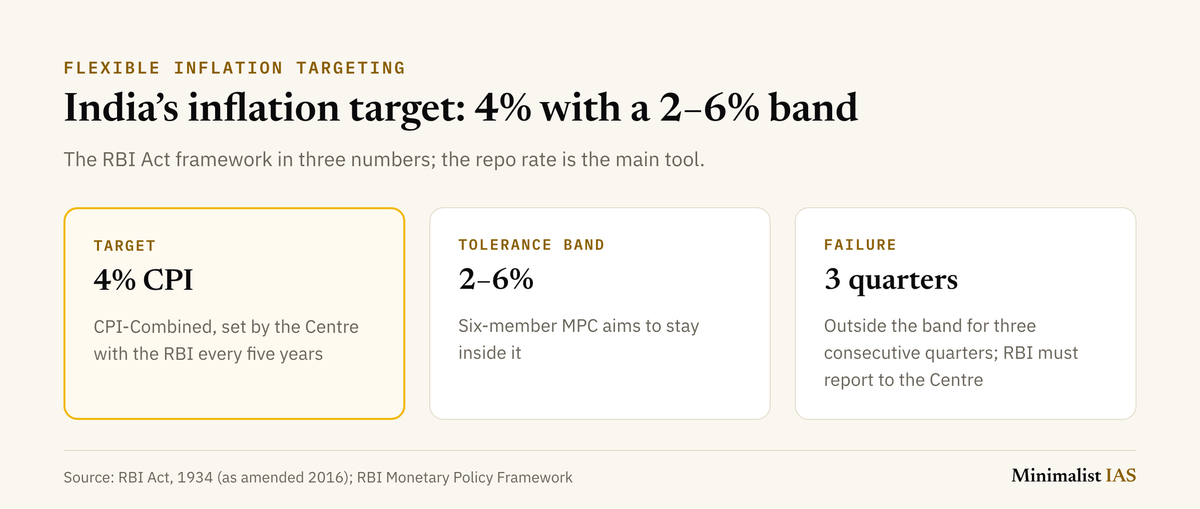
Target: 4% CPI-Combined with a 2–6% band, set by the Centre in consultation with the RBI every five years.
Who decides: the six-member MPC fixes the repo rate to meet it.
Failure: inflation outside the band for three consecutive quarters, after which the RBI reports reasons and remedial steps to the Centre.
Taylor rule (1993): raise the policy rate by more than the rise in inflation, so the real rate climbs.
Why is inflation at a two-year high?
That framework is now being tested: September’s print of 5.54% is inside the 6% ceiling, but it is the highest in almost two years.

Headline vs core: core strips out food and fuel, the volatile parts, so a food-led jump says little about underlying demand.
Supply shock (cost-push): onion inflation was about 108% in September, and the RBI cites deficient monsoon rain, El Niño and high energy prices as risks to the outlook.
Demand shock (demand-pull): too much spending chasing limited goods; a rate hike works directly here.
RBI’s logic: rates cannot grow crops; they anchor expectations so a supply shock does not become a wage-price spiral.
Caution: the series moved to base 2024=100 in 2026; compare with older base years carefully.
The decision itself is covered in the repo rate hike explainer.
CPI vs WPI
Every inflation story quotes two indices, and UPSC tests which one the RBI uses.
Point | CPI | WPI |
|---|---|---|
Measures | Retail prices paid by consumers | Wholesale prices of goods |
Compiled by | NSO, MoSPI | Office of the Economic Adviser, DPIIT |
Services | Included | Not captured |
Weight of food | Higher | Lower |
RBI’s target index | Yes (CPI-Combined) | No |
Prelims traps
1. Target index: headline CPI-Combined, not WPI and not core.
2. Failure: three consecutive quarters outside the 2–6% band, not one, not two.
3. Who sets the target: the Centre, in consultation with the RBI; the RBI does not set it alone.
4. The prize: not an original Nobel prize; instituted by Sveriges Riksbank in 1968.
How to use this in the UPSC exam
With the facts and traps in place, the exam use is simple. GS Paper III (Indian Economy: inflation, monetary policy). Prelims: the FIT framework, CPI vs WPI and MPC composition are repeat territory (PYQs below). Mains: use the Nobel to argue that expectations and credibility matter as much as the rate, then weigh how far monetary policy can tame a supply shock and where fiscal action must step in. The external side is in India’s forex reserves and the West Asia oil shock.
Mentor’s note
Don’t write that the RBI targets WPI or core inflation. Prelims 2020 tested this directly; the target index is CPI-Combined.
Don’t put words in the laureates’ mouths. Say their models rest on households’ and firms’ choices and expectations; attribute no India-specific advice to them.
Split any inflation answer by cause. Demand-pull and cost-push need different remedies; pair RBI action with supply-side measures such as buffer stocks.
Practice: Prelims MCQ
Consider the following statements:
Statement-I: A rise in the repo rate is more effective against demand-pull inflation than against inflation caused by a spike in crude oil prices.
Statement-II: A higher repo rate reduces borrowing and spending, but it cannot raise the supply of crude oil or food.
Which one of the following is correct in respect of the above statements?
(a) Both Statement-I and Statement-II are correct and Statement-II explains Statement-I
(b) Both Statement-I and Statement-II are correct, but Statement-II does not explain Statement-I
(c) Statement-I is correct, but Statement-II is incorrect
(d) Statement-I is incorrect, but Statement-II is correct
Answer: (a)
Explanation:
Statement-I is correct: a hike cools demand directly, so it suits demand-pull inflation and does little against a supply shock.
Statement-II is correct and explains Statement-I: the repo rate works on demand and cannot add supply, which is why it is weaker against cost-push inflation.
Related PYQs
UPSC CSE Prelims 2020
Consider the following statements:
1. The weightage of food in Consumer Price Index (CPI) is higher than that in Wholesale Price Index (WPI).
2. The WPI does not capture changes in the prices of services, which CPI does.
3. Reserve Bank of India has now adopted WPI as its key measure of inflation and to decide on changing the key policy rates.
Which of the statements given above is/are correct?
(a) 1 and 2 only
(b) 2 only
(c) 3 only
(d) 1, 2 and 3
Answer: (a) 1 and 2 only
Use: statement 3 is the trap; the target is CPI, whichever base year is in use.
UPSC CSE Prelims 2017
Which of the following statements is/are correct regarding the Monetary Policy Committee (MPC)?
1. It decides the RBI’s benchmark interest rates.
2. It is a 12-member body including the Governor of RBI and is reconstituted every year.
3. It functions under the chairmanship of the Union Finance Minister.
Select the correct answer using the code given below:
(a) 1 only
(b) 1 and 2 only
(c) 3 only
(d) 2 and 3 only
Answer: (a) 1 only
Use: the MPC has six members, the Governor chairs it, and it sets the repo rate.
See the detailed explanations: Prelims 2017 · Prelims 2020 in the free PYQ vault, with year-wise analysis. Free to browse; free sign-up to download.
Practice: Mains question
In the light of the 2026 Nobel for the microeconomic foundations of macroeconomic stabilisation, examine why central-bank credibility matters for controlling inflation. How far can monetary policy contain inflation driven by supply shocks in India? (Answer in 250 words; 15 Marks)
60-second revision
Which index is the target defined on? CPI-Combined, 4% with a 2–6% band.
What makes the framework fail? Three consecutive quarters outside the band.
What did Hall and Woodford add? Models built on household and firm choices and expectations.
Why is a hike weak against food-led inflation? It cools demand but cannot raise supply.
Who compiles CPI and WPI? NSO (MoSPI); Office of the Economic Adviser (DPIIT).
Frequently asked questions (FAQs)
What is the current inflation rate in India?
India’s CPI inflation was 5.54% in September 2026, up from 4.83% in August (MoSPI, provisional, 2024 base). Food inflation was 7.74%.
Who won the 2026 Nobel Prize in Economics?
Robert E. Hall of Stanford and Michael Woodford of Columbia won the 2026 Sveriges Riksbank Prize in Economic Sciences “for microeconomic foundations of macroeconomic stabilisation”.
What is the RBI’s inflation target?
4% CPI-Combined inflation with a 2–6% tolerance band, set by the Centre in consultation with the RBI every five years under the RBI Act, 1934, as amended in 2016.
What is the difference between CPI and WPI?
CPI tracks retail prices, includes services and is compiled by the NSO. WPI tracks wholesale goods prices, excludes services and comes from DPIIT. The RBI targets CPI.
Related reading
Sources
From The Daily UPSC Brief, 13 October 2026 — by Shivam Singh.
Spotted an error or something outdated? Tell us — we correct it.
About the author
Shivam Singh
Founder & Mentor, Minimalist IAS
Shivam has been through every stage of the exam himself — Prelims, repeated Mains attempts across UPSC and state civil services, and the interview board. For 7 years he has mentored aspirants one-to-one, helping 100+ clear various stages of the exam, including final selections.
More about Shivam →