Economy
Demographic Dividend in India: Meaning, Window of Opportunity and the Jobs Challenge — UPSC Notes
By Shivam Singh, Founder & Mentor, Minimalist IAS
· 9 min read
WhatsApp Telegram
The demographic dividend is the growth potential that arises when a country's working-age population (15–64) grows faster than its dependent young and old. India's window opened around 2005–06 and may last till about 2055–56 (UNFPA), but the dividend is only a potential: it pays off only if the young find jobs, skills and good health — and the World Bank now warns that jobs are falling far short of entrants across the Global South.
Why in news: A World Bank warning says about 1.2 billion young people in the Global South will reach working age over the next decade, while economies may create only about 400 million viable jobs — a gap of about 800 million.
Syllabus mapping
Prelims: Economic and Social Development (demographics, employment, inclusion).
GS Paper 1: population and associated issues.
GS Paper 3: Indian economy — growth, development and employment; inclusive growth.
What is the demographic dividend?
Meaning (UNFPA): economic growth potential from a shift in age structure, when the working-age share is larger than the non-working-age share.
Key ratio: dependency ratio = dependants (0–14 and 65+) per 100 working-age persons (15–64); a falling ratio opens the window.
Why it helps: more earners per dependant → higher savings and investment, more labour, lower spending pressure per worker.
Not to confuse: demographic dividend (age structure) vs demographic transition (the shift from high to low birth and death rates that produces it).
Key features of India's demographic window
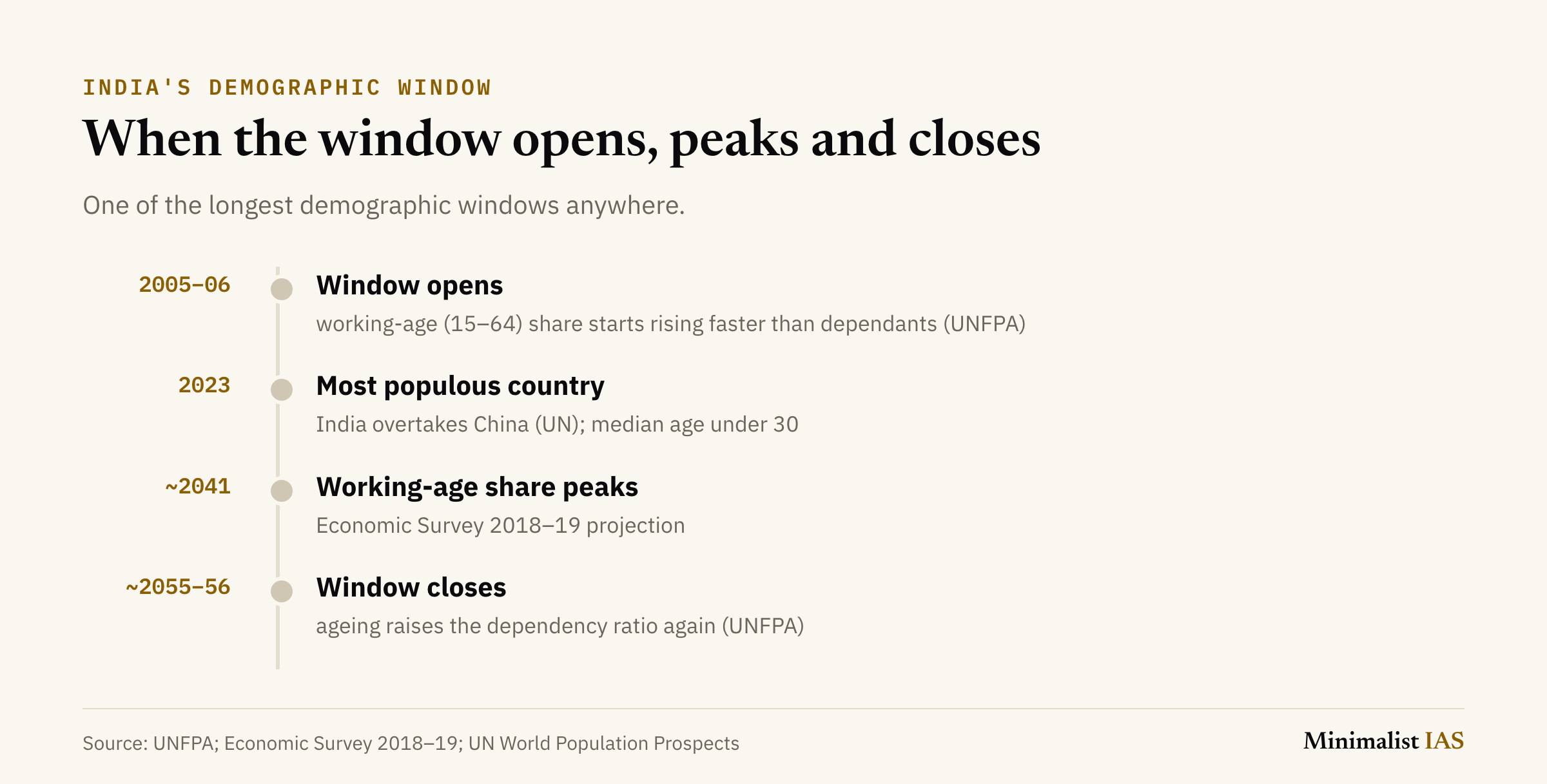
Duration: about 2005–06 to 2055–56 (UNFPA) — one of the longest windows anywhere.
Peak: the working-age share is projected to peak around 2041 (Economic Survey 2018–19).
Size: India became the world's most populous country in 2023 (UN); median age under 30.
Fertility: total fertility rate 2.0 (NFHS-5, 2019–21), below the replacement level of 2.1.
Uneven across States: Bihar's TFR about 3.0 vs Kerala's 1.8 (NFHS-5) → the South ages first, the North stays young longer.
How does a young population become a dividend?
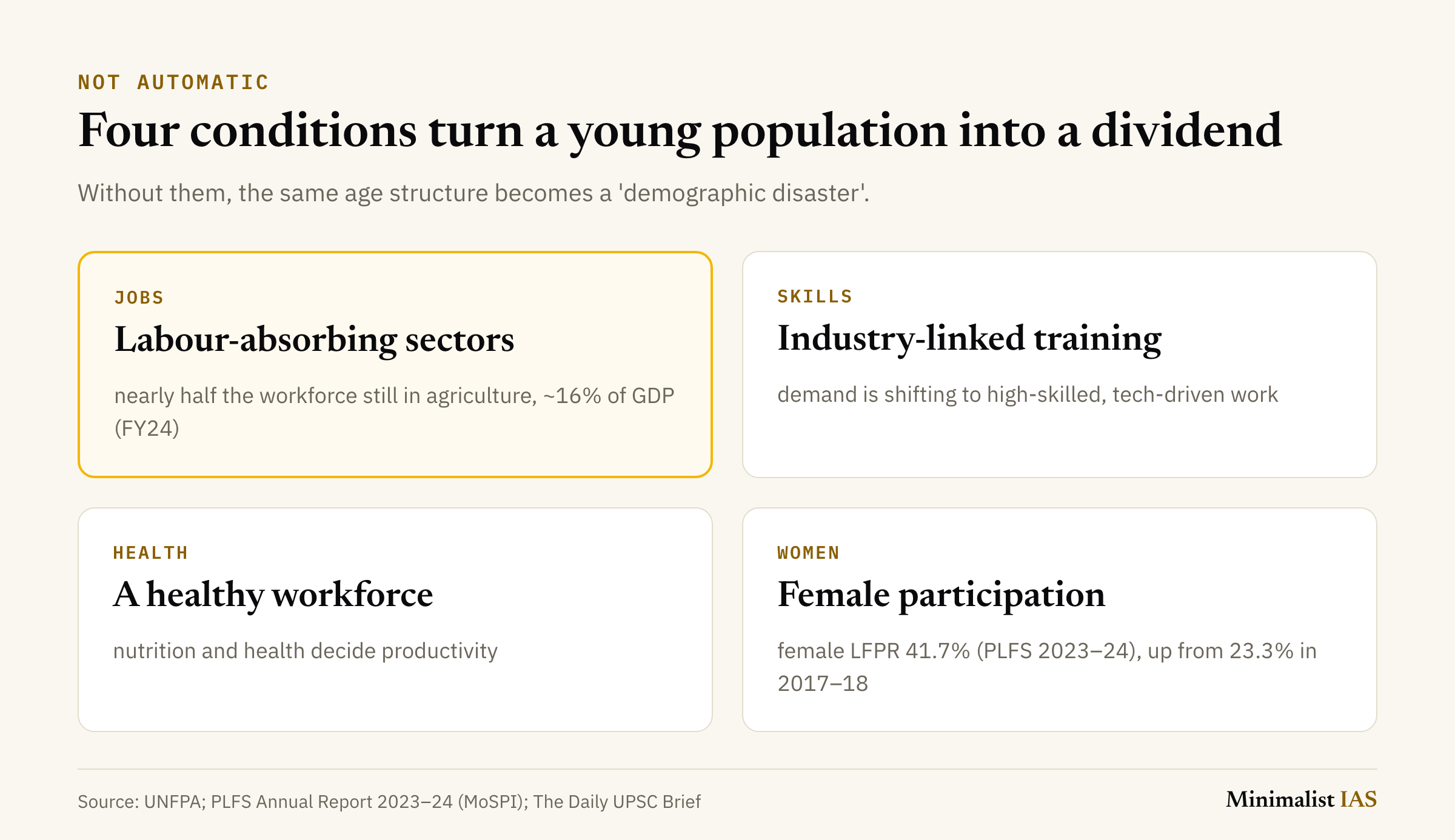
Jobs: productive, labour-absorbing employment outside farming.
Skills: education and training matched to what employers need.
Health: nutrition and healthcare decide a worker's productivity.
Women at work: a dividend counted on half the population is half a dividend.
Takeaway: age structure opens the door; policy decides whether the economy walks through it.
Significance
Growth: a larger labour force and higher savings can lift potential growth for decades.
Fiscal space: fewer dependants per worker → more room for investment in infrastructure and human capital.
Global role: a young India can supply workers to ageing economies — the logic of India's migration and mobility pacts.
Lesson from East Asia: the 'miracle' economies used their window for labour-intensive manufacturing exports.
Issues and challenges
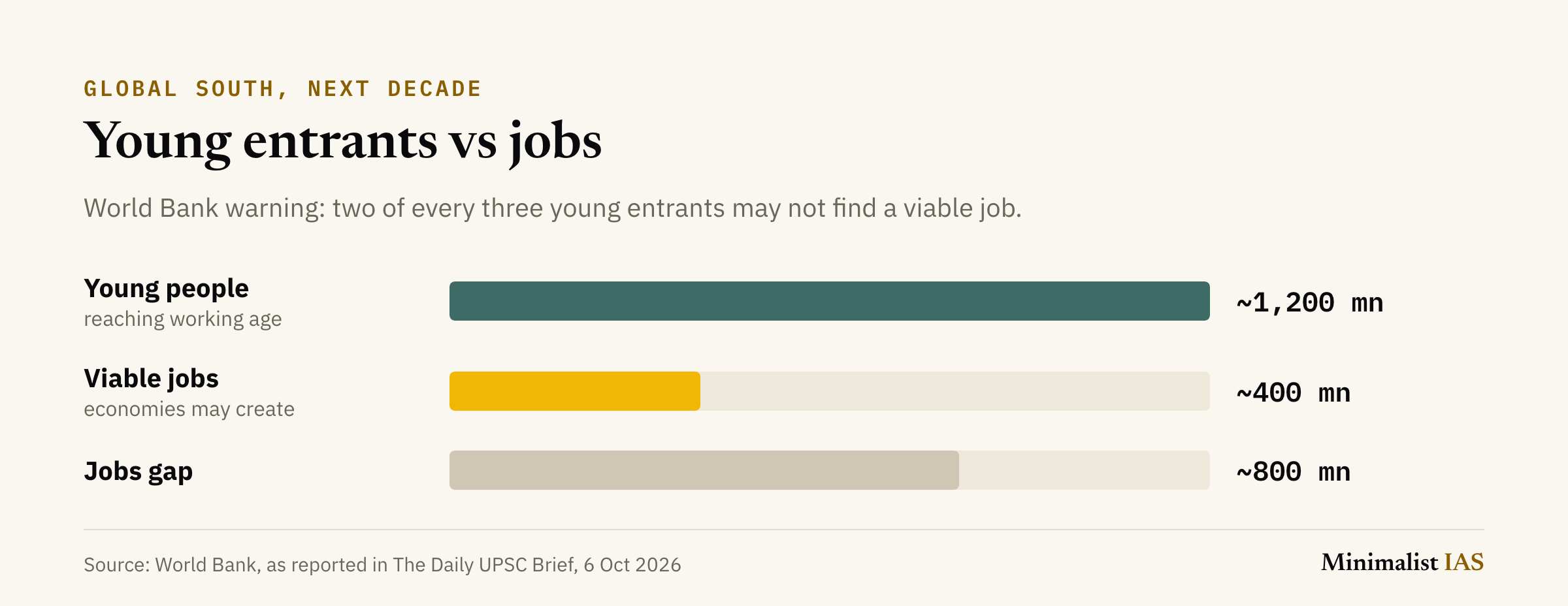
Jobs gap (World Bank): ~1.2 billion young entrants vs ~400 million viable jobs in the Global South over the next decade.
Structural lag: nearly half of India's workforce is still in agriculture, which produced only about 16% of GDP in FY24.
Female participation: female LFPR 41.7% (PLFS 2023–24) — up from 23.3% in 2017–18, but still far below men's.
Broken ladder: automation cuts the labour intensity of light manufacturing → premature deindustrialisation.
Skills mismatch: demand rewards high-skilled, tech-driven work; youth without digital access or vocational training are left behind.
Social risk: prolonged youth joblessness erodes trust, fuels unrest and pushes distress migration.
The 'dividend or disaster' debate
Optimistic view: India's long window, young median age and digital public infrastructure give it decades to convert numbers into growth.
Sceptical view: the manufacturing route that East Asia used is narrowing; jobless growth could turn the bulge into a burden.
Official position: the Economic Survey 2018–19 framed the window as time-bound, peaking around 2041, and called for policies on health, education and ageing in advance.
The real question: which sectors will absorb labour at scale — agri-tech and food processing, the care economy, tourism, green manufacturing?
Current relevance: can India still catch the dividend?
Yes, but only with labour-absorbing growth: the window is open until the mid-2050s, while the jobs it needs are not yet being created at scale.
The warning: the World Bank's jobs gap applies across the Global South, India included.
Job engines named: agri-tech and food processing, the care economy (nurses, elder care), tourism, green manufacturing.
Policy levers: simpler regulation for small firms, reliable power and logistics, skills tied to industry demand.
Shift in thinking: from 'how many young people' to 'how many productive jobs' — GDP growth alone does not decide the outcome.
Milestones
Around 2005–06: India's demographic window opens (UNFPA).
2015: Skill India Mission and Pradhan Mantri Kaushal Vikas Yojana launched.
2018–19: Economic Survey projects the working-age share to peak around 2041.
2020: National Education Policy brings vocational exposure into school education.
2023: India becomes the world's most populous country (UN).
Steps taken
Skilling: Skill India Mission and PMKVY (2015) for short-term, industry-linked training.
Education: NEP 2020 — vocational education from school, multiple entry and exit in higher education.
Labour data: the Periodic Labour Force Survey (MoSPI) tracks participation and unemployment, including for women and youth.
Women's participation: female LFPR rose from 23.3% (2017–18) to 41.7% (2023–24), PLFS.
Way forward
Labour-absorbing sectors: agro-processing, care economy, tourism, construction and green manufacturing.
Small firms: simpler regulation and credit so MSMEs can grow and hire.
Skills that match jobs: apprenticeships and industry-designed courses over certificates.
Women at work: safe transport, childcare and flexible work to lift female participation.
Plan for ageing early: southern States need elder-care and pension systems now; northern States need jobs for a longer bulge.
India's demographic window is long but not permanent, and the age structure alone guarantees nothing. Whether the next three decades bring a dividend now depends on how fast the economy creates productive, labour-absorbing jobs — especially for women and for the youth leaving farms.
Using the demographic dividend in a Mains answer
Introduction: define it (UNFPA) and give India's window (about 2005–06 to 2055–56, peak around 2041).
Body — opportunity: savings, labour supply, fiscal space; the East Asian example.
Body — gaps: agriculture's share of workers vs GDP; female LFPR 41.7% (PLFS 2023–24); premature deindustrialisation; skills mismatch.
Way forward: labour-absorbing sectors, MSMEs, apprenticeships, women's participation, State-specific plans.
Conclusion: a dividend is earned through jobs, not delivered by demography.
Related PYQs
UPSC CSE Prelims 2011: "India is regarded as a country with 'Demographic Dividend'. This is due to (a) its high population in the age group below 15 years (b) its high population in the age group of 15–64 years (c) its high population in the age group above 65 years (d) its high total population" Answer: (b). UPSC tests the 15–64 definition directly.
UPSC CSE Mains 2023, GS Paper III: "Most of the unemployment in India is structural in nature. Examine the methodology adopted to compute unemployment in the country and suggest improvements." Structural unemployment is the core risk to the dividend; cite PLFS data.
Mentor’s note
Define with the age band. UPSC's 2011 question turned on '15–64'; write the dependency ratio the same way in Mains.
Don't call the dividend automatic. It is a potential — name the four conditions (jobs, skills, health, women's participation) and back at least one with PLFS data.
Add the State lens. A line on Bihar vs Kerala fertility (NFHS-5) shows the examiner you know India has many demographic clocks, not one.
Target Prelims MCQs
Q1. With reference to the demographic dividend, consider the following statements:
It refers to the growth potential created when the working-age share of the population rises relative to dependants.
Once the working-age share rises, the dividend accrues automatically, irrespective of employment generation.
According to UNFPA, India's demographic window opened around 2005–06 and is expected to last till about 2055–56.
**Which of the statements given above is/are correct?
(a) 1 and 2 only
(b) 2 and 3 only
(c) 1 and 3 only
(d) 1, 2 and 3**
Answer: (c) 1 and 3 only
Explanation:
Statement 1 is correct: this is the UNFPA meaning of the dividend.
Statement 2 is incorrect: the dividend is only a potential; without jobs, skills and health it can become a burden.
Statement 3 is correct: UNFPA puts India's window at roughly 2005–06 to 2055–56.
Q2. Consider the following statements:
**Statement-I: A falling dependency ratio can raise a country's savings rate.
Statement-II: When the dependency ratio falls, there are more working-age earners for every dependant.**
**Which one of the following is correct in respect of the above statements?
(a) Both Statement-I and Statement-II are correct and Statement-II explains Statement-I
(b) Both Statement-I and Statement-II are correct, but Statement-II does not explain Statement-I
(c) Statement-I is correct, but Statement-II is incorrect
(d) Statement-I is incorrect, but Statement-II is correct**
Answer: (a) Both Statement-I and Statement-II are correct and Statement-II explains Statement-I
Explanation:
Statement-I is correct: a lower dependency burden frees household and public income for saving and investment.
Statement-II is correct and explains Statement-I: more earners per dependant is precisely why consumption needs fall relative to income, allowing higher savings.
Q3. Consider the following pairs:
Total fertility rate of India, NFHS-5 (2019–21) : 2.0
Peak of India's working-age share, Economic Survey 2018–19 : around 2041
Female labour force participation rate, PLFS 2023–24 : below 25%
**How many of the pairs given above are correctly matched?
(a) Only one
(b) Only two
(c) All three
(d) None**
Answer: (b) Only two
Explanation:
Pair 1 is correctly matched: NFHS-5 recorded a TFR of 2.0, below the replacement level of 2.1.
Pair 2 is correctly matched: the Survey projected the working-age share to peak around 2041.
Pair 3 is incorrectly matched: female LFPR was 41.7% in 2023–24; it was 23.3% in 2017–18.
Mains practice questions
India's demographic dividend is a time-bound opportunity, not a guarantee. Examine. (Answer in 150 words; 10 Marks)
In the light of the shrinking labour intensity of manufacturing, discuss the sectors and policies that can help India convert its working-age population into a demographic dividend. (Answer in 250 words; 15 Marks)
Abbreviations & terminology
UNFPA: United Nations Population Fund
TFR: total fertility rate — average children per woman over her reproductive life
LFPR: labour force participation rate
PLFS: Periodic Labour Force Survey (MoSPI)
NFHS: National Family Health Survey
Dependency ratio: dependants (0–14, 65+) per 100 persons aged 15–64
Premature deindustrialisation: manufacturing's share of jobs peaking at lower income levels than in earlier industrialisers
Frequently asked questions (FAQs)
What is the demographic dividend?
The demographic dividend is the economic growth potential that arises from a change in a population's age structure, mainly when the working-age population (15–64) is larger than the dependent population of children and the elderly.
When will India's demographic dividend end?
According to UNFPA, India's demographic window opened around 2005–06 and is expected to last till about 2055–56. The Economic Survey 2018–19 projected the working-age share to peak around 2041.
What is the dependency ratio?
The dependency ratio is the number of dependants — people aged 0–14 and 65 and above — for every 100 people of working age (15–64). A falling dependency ratio opens the demographic window.
Is the demographic dividend automatic?
No. A favourable age structure only creates a potential. The dividend is realised only if the working-age population finds productive jobs and has the skills, health and opportunities, including for women, to work.
What is the difference between demographic dividend and demographic transition?
Demographic transition is the long shift from high to low birth and death rates. The demographic dividend is the growth opportunity created during that transition, when the working-age share is at its highest.
Why is female labour force participation important for the demographic dividend?
Women are half the working-age population, so low participation shrinks the effective dividend. India's female LFPR rose from 23.3% in 2017–18 to 41.7% in 2023–24 (PLFS), but remains well below the male rate.
Key takeaways
India's window: about 2005–06 to 2055–56 (UNFPA), peaking around 2041 (Economic Survey 2018–19).
The dividend needs jobs, skills, health and women's participation — female LFPR 41.7% (PLFS 2023–24).
The World Bank's jobs gap (1.2 billion entrants vs 400 million jobs) makes labour-absorbing sectors the central policy question.
Related reading
Census 2027: caste count, the boundary freeze and what the data will decide
Practise previous-year Society and Economy questions in the free PYQ vault
Revise the NCERT basics of population geography in NCERT Foundations
Sources
Minimalist IAS static notes — by Shivam Singh.
Spotted an error or something outdated? Tell us — we correct it.
About the author
Shivam Singh
Founder & Mentor, Minimalist IAS
Shivam has been through every stage of the exam himself — Prelims, repeated Mains attempts across UPSC and state civil services, and the interview board. For 7 years he has mentored aspirants one-to-one, helping 100+ clear various stages of the exam, including final selections.
More about Shivam →