Economy
GST Council (Article 279A): Composition, Voting and Cooperative Federalism — UPSC Notes
By Shivam Singh, Founder & Mentor, Minimalist IAS
· 10 min read
WhatsApp Telegram
The GST Council is a constitutional body under Article 279A, chaired by the Union Finance Minister, that recommends Goods and Services Tax rates, laws and rules to the Centre and the States. Created by the 101st Amendment in 2016, it pools the taxing powers of both levels of government; in April–September 2026, gross GST collections reached ₹12.46 lakh crore, up 11.6% on a year earlier.
Why in news: Ahead of a GST Council meeting, the Union Finance Minister reported gross GST collections of ₹12.46 lakh crore for April–September 2026, up 11.6%, a year after the Next-Gen GST rate cuts. Process reforms on registration, returns, refunds, disputes and input tax credit are headed to the Council.
Syllabus mapping
Prelims: Indian Polity and Governance (constitutional bodies, amendments); Economic and Social Development (fiscal policy, taxation).
GS Paper 3: mobilisation of resources; effects of liberalisation on the economy (tax reforms).
GS Paper 2: functions and responsibilities of the Union and the States; issues and challenges pertaining to the federal structure.
Why was the GST Council needed?
Cascading taxes: separate Central and State indirect taxes meant tax on tax; credit did not flow across the chain.
Fragmented market: different State taxes, entry taxes and check-posts split India into many markets.
The idea: the Kelkar Task Force (2004) first proposed a comprehensive GST — one market with an unbroken credit chain.
The constitutional problem: the Constitution divided taxing powers strictly; a shared tax needed a shared forum.
The answer: the 101st Amendment Act, 2016 gave both levels concurrent power (Article 246A) and a joint body to decide together (Article 279A).
Key features of the GST Council
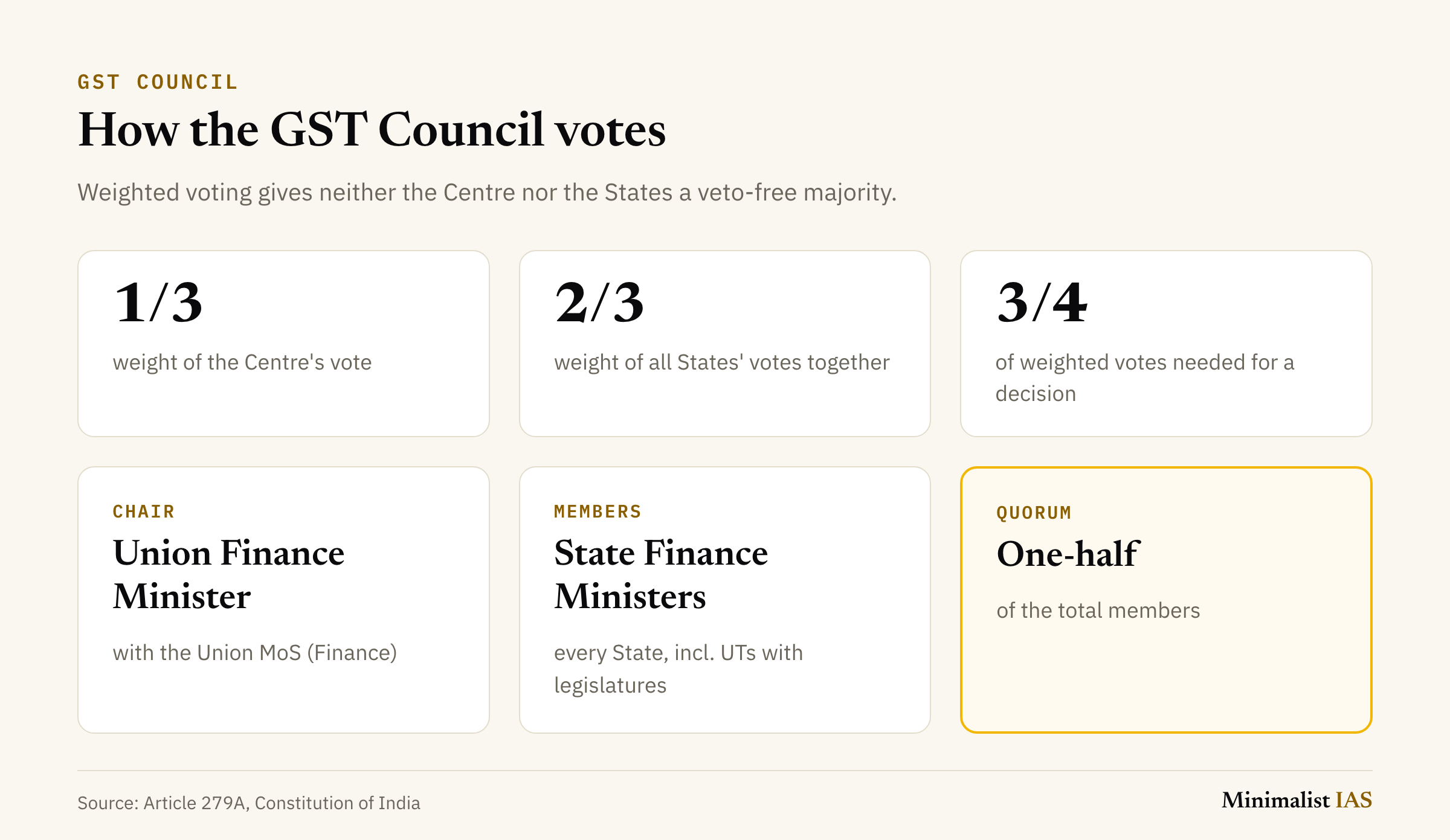
Constitutional basis: Article 279A, inserted by the 101st Amendment Act, 2016; constituted by the President.
Chair and members: Union Finance Minister (chair), Union Minister of State for Finance, and the Finance or Taxation Minister of every State, including Union Territories with legislatures.
Weighted voting: Centre one-third, all States together two-thirds; a decision needs three-fourths of the weighted votes cast.
What it means: the Centre cannot pass a proposal alone, and the States cannot pass one without the Centre.
Quorum: one-half of the total members.
What it recommends: taxes to be subsumed, goods and services to be taxed or exempted, rates and slabs, model GST laws, place-of-supply rules, thresholds, special provisions for specified States.
Petroleum products: crude, petrol, diesel, ATF and natural gas are within GST law but not yet taxed under it — the Council must recommend the date.
Disputes: the Council must set up a mechanism to settle disputes among the Centre and the States.
How does GST work between the Centre and the States?
Concurrent power (Article 246A): Parliament and State legislatures can both make GST laws.
Intra-State supply: CGST (Centre) + SGST (State) on the same transaction.
Inter-State supply (Article 269A): IGST is levied and collected by the Centre and apportioned between the Union and the States.
Credit chain: input tax credit (ITC) lets a business offset tax already paid on its inputs → tax falls only on value added.
Destination principle: tax accrues to the State where goods or services are consumed.
Takeaway: the Council is the hinge — it keeps the 'one nation, one tax' design uniform although 30-plus legislatures hold the power to tax.
Significance
Cooperative federalism: the first permanent constitutional forum where the Union and States take joint decisions on taxes.
One market: a uniform rate structure and an unbroken credit chain across States.
Formalisation: registrations stood at about 1.71 crore at end-August 2026, up nearly 15% in a year.
Revenue buoyancy: after the 2025 rate cuts, taxable supplies rose 25.8% (Oct 2025–Jul 2026) and gross collections 11.6% (Apr–Sep 2026).
Issues and challenges
Problem: collections are rising, but the Council's design and the GST's coverage still leave gaps in fiscal autonomy and in the credit chain.
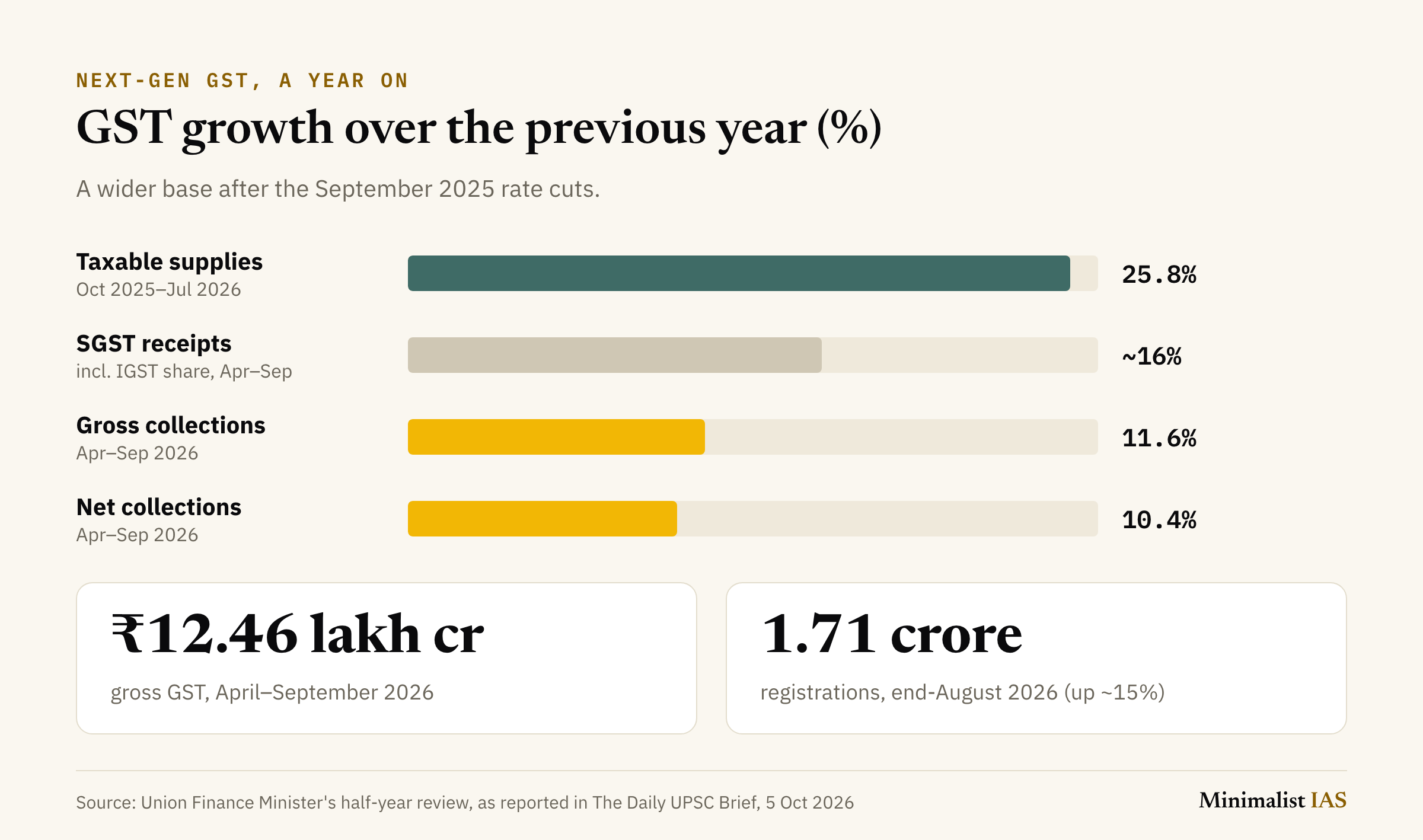
Refunds and working capital: about ₹1.80 lakh crore refunded in April–September 2026; net collections grew slower (10.4%) than gross (11.6%).
Broken credit chain: petroleum products remain outside GST taxation → no ITC on them for businesses using fuel.
Fiscal autonomy: States gave up independent indirect taxes; the five-year compensation guarantee (14% annual growth on the 2015–16 base) ended in June 2022.
Voting arithmetic: the Centre's one-third weight alone can block any proposal; States need about three in eight of those present and voting to block one.
Process burden: registration, returns, refunds and disputes are the focus of the next reform round — proposals, not yet law.
The binding-recommendations debate
The question: are the Council's recommendations binding on Parliament and the State legislatures?
Case for binding: uniform rates are the point of GST; a State deviating breaks the single market.
Case against: Article 246A gives legislatures their own power to tax; a binding Council would make them rubber stamps.
The ruling — Union of India v. Mohit Minerals (2022): the Supreme Court held the recommendations persuasive, not binding; they are the product of collaborative dialogue between equal federal units.
The real question: consensus. The Council has worked through near-unanimity, and the judgment keeps that as a political, not legal, compulsion.
Current relevance: has Next-Gen GST widened the base?
So far, yes: a year after the rates were rationalised, both taxable supplies and collections are growing in double digits.
The reform: from September 2025, two main slabs (5% and 18%) plus 40% on select luxury and 'sin' goods.
The result: taxable supplies up 25.8% (Oct 2025–Jul 2026); every month from June to September 2026 grew in double digits.
For States: SGST receipts, including their share of IGST settlements, grew about 16% in April–September 2026.
Compliance: on-time GSTR-3B filing rose 12.6% in April–July 2026; the share of tax paid through credits rose.
Next step: process reforms — registration, returns, refunds, disputes, ITC flow — before the Council.
Landmark judgments and milestones
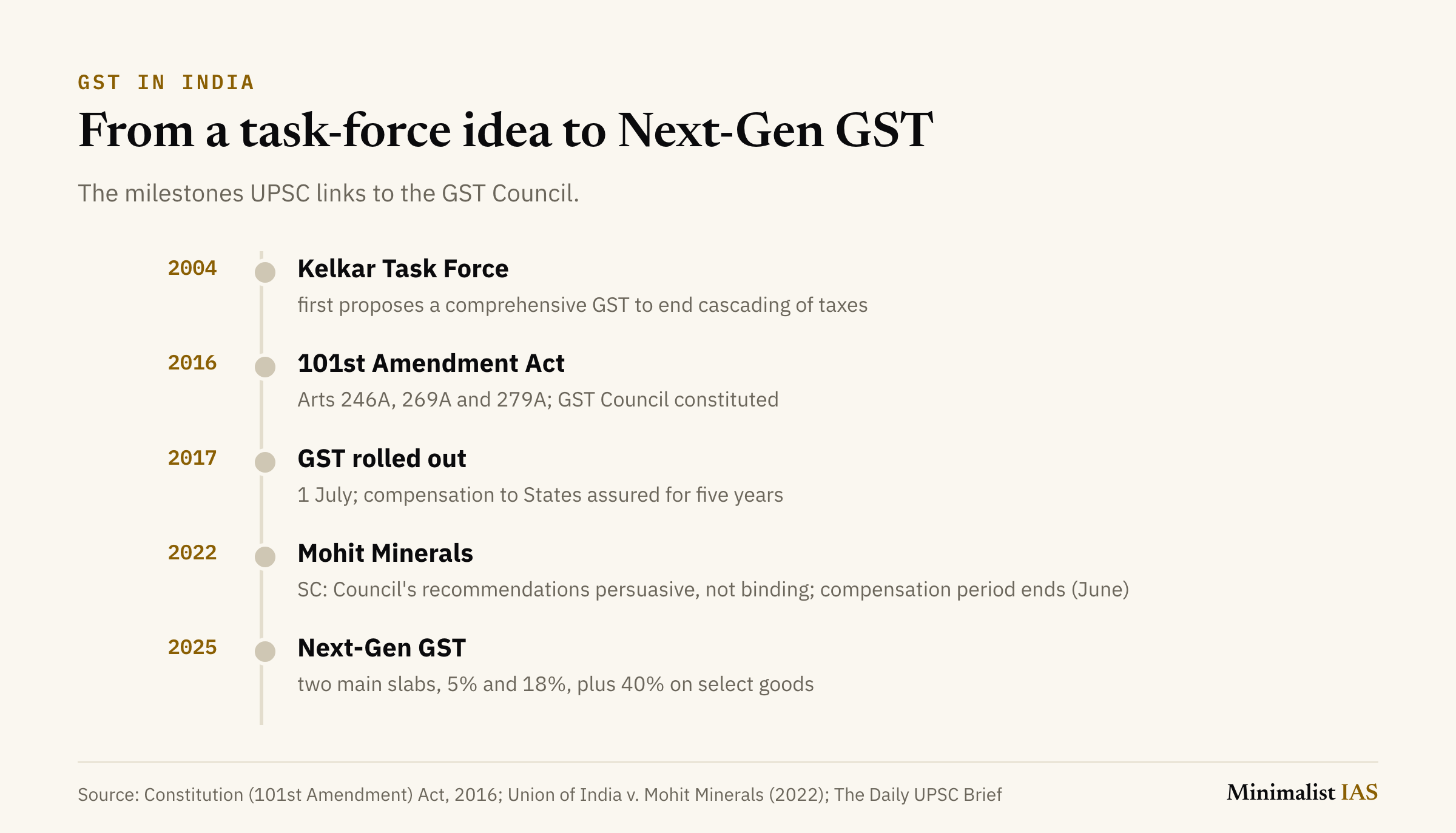
Kelkar Task Force (2004): first proposed a comprehensive GST to end cascading.
101st Amendment Act (2016): Articles 246A, 269A and 279A; ratified by more than half the State legislatures, as Article 368(2) requires for amendments affecting States' powers.
GST rollout (2017): subsumed most Central and State indirect taxes; GST (Compensation to States) Act, 2017 assured five years of compensation.
Union of India v. Mohit Minerals (2022): recommendations persuasive, not binding.
Next-Gen GST (2025): rate rationalisation to two main slabs plus a 40% rate.
Steps taken
Rate rationalisation: 5% and 18% main slabs from September 2025.
Compliance tools: monthly summary return (GSTR-3B); on-time filing up 12.6% in April–July 2026.
Wider base: registrations about 1.71 crore at end-August 2026.
Dispute mechanism: Article 279A requires the Council to provide one for Centre–State and inter-State disputes.
Way forward
Simplify process: faster registration, simpler returns, time-bound refunds — the agenda now before the Council.
Complete the credit chain: a phased road map for bringing petroleum products under GST taxation.
Strengthen consensus: use Article 279A's dispute mechanism instead of letting disagreements reach the courts.
Protect State finances: predictable IGST settlement and transparent data for States that gave up their own taxes.
The GST Council has turned a divided tax system into a shared one, and the Next-Gen GST data show that simpler rates can widen the base. The test now lies in process: refunds, returns and the credit chain decide whether 'one nation, one tax' feels simple to the taxpayer.
Using the GST Council in a Mains answer
Introduction: define the Council (Article 279A, 101st Amendment, 2016) and add one data point (₹12.46 lakh crore gross GST, April–September 2026, up 11.6%).
Body — design: weighted voting (1/3 : 2/3, three-fourths majority), concurrent power under Article 246A, IGST under Article 269A.
Body — gaps: petroleum outside GST taxation, end of compensation (2022), Mohit Minerals and the limits of a non-binding forum.
Way forward: process reforms, a petroleum road map, the dispute mechanism.
Conclusion: the Council as India's working model of cooperative fiscal federalism — built on consensus, not compulsion.
Related PYQs
UPSC CSE Prelims 2017: "What is/are the most likely advantages of implementing 'Goods and Services Tax (GST)'? 1. It will replace multiple taxes collected by multiple authorities and will thus create a single market in India. 2. It will drastically reduce the 'Current Account Deficit' of India and will enable it to increase its foreign exchange reserves. 3. It will enormously increase the growth and size of economy of India and will enable it to overtake China in the near future." Answer: (a) 1 only. The single-market logic is the one UPSC accepts.
UPSC CSE Mains 2020, GS Paper III: "Explain the rationale behind the Goods and Services Tax (Compensation to States) Act of 2017. How has COVID-19 impacted the GST compensation fund and created new federal tensions?" Use the compensation guarantee and the Council's role in resolving the shortfall.
Mentor’s note
Get the voting arithmetic exact. Centre one-third, all States two-thirds, decisions by three-fourths of weighted votes, quorum one-half. Prelims frames distractors by swapping these fractions.
Don't write that the Council's decisions bind legislatures. Mohit Minerals (2022) held them persuasive; quote the case by name in GS2 federalism answers.
Keep the three Articles apart: 246A (who can tax), 269A (IGST on inter-State supply), 279A (the Council). Most errors in answers come from mixing them.
Target Prelims MCQs
Q1. With reference to the GST Council, consider the following statements:
It was constituted under Article 279A, inserted by the Constitution (One Hundred and First Amendment) Act, 2016.
The vote of the Union Government carries a weight of one-third of the total votes cast, and decisions require a three-fourths majority of weighted votes.
The recommendations of the Council are binding on Parliament and the State legislatures.
**Which of the statements given above is/are correct?
(a) 1 and 2 only
(b) 2 and 3 only
(c) 1 and 3 only
(d) 1, 2 and 3**
Answer: (a) 1 and 2 only
Explanation:
Statement 1 is correct: Article 279A came with the 101st Amendment Act, 2016.
Statement 2 is correct: the Centre has one-third weight, all States together two-thirds, and decisions need three-fourths of weighted votes.
Statement 3 is incorrect: in Union of India v. Mohit Minerals (2022), the Supreme Court held the recommendations persuasive, not binding.
Q2. Consider the following statements:
Integrated GST on inter-State supplies is levied and collected by the Government of India.
The Union Finance Minister is the Chairperson of the GST Council.
The quorum for a meeting of the GST Council is one-half of its total members.
The Finance Ministers of all Union Territories are members of the GST Council.
**How many of the above statements are correct?
(a) Only one
(b) Only two
(c) Only three
(d) All four**
Answer: (c) Only three
Explanation:
Statement 1 is correct: Article 269A — IGST is levied and collected by the Centre and apportioned between the Union and the States.
Statement 2 is correct: the Union Finance Minister chairs the Council.
Statement 3 is correct: one-half of the total members constitutes the quorum.
Statement 4 is incorrect: only Union Territories with legislatures are represented, because Article 366(26B) defines 'State' for the GST provisions to include them.
Q3. Consider the following statements:
**Statement-I: The recommendations of the GST Council are not binding on Parliament and the State legislatures.
Statement-II: Under Article 279A, decisions of the GST Council require a majority of not less than three-fourths of the weighted votes of the members present and voting.**
**Which one of the following is correct in respect of the above statements?
(a) Both Statement-I and Statement-II are correct and Statement-II explains Statement-I
(b) Both Statement-I and Statement-II are correct, but Statement-II does not explain Statement-I
(c) Statement-I is correct, but Statement-II is incorrect
(d) Statement-I is incorrect, but Statement-II is correct**
Answer: (b) Both Statement-I and Statement-II are correct, but Statement-II does not explain Statement-I
Explanation:
Statement-I is correct: Mohit Minerals (2022) held the recommendations persuasive; the reason is the legislatures' own power to tax under Article 246A.
Statement-II is correct: this is the voting rule in Article 279A — but how the Council decides says nothing about whether its decisions bind legislatures, so it does not explain Statement-I.
Mains practice questions
The GST Council is often described as a model of cooperative federalism. Examine this view in the light of the Supreme Court's judgment in Union of India v. Mohit Minerals (2022). (Answer in 150 words; 10 Marks)
Rate rationalisation alone cannot complete the GST reform. Discuss the process reforms needed to realise the idea of 'one nation, one tax', and the role of the GST Council in them. (Answer in 250 words; 15 Marks)
Abbreviations & terminology
GST: Goods and Services Tax
CGST / SGST / IGST: Central / State / Integrated GST
ITC: input tax credit — credit for tax paid on inputs
GSTR-3B: monthly summary GST return
ATF: aviation turbine fuel
Cascading: tax charged on a price that already includes tax
Frequently asked questions (FAQs)
What is the GST Council?
The GST Council is a constitutional body under Article 279A of the Constitution, created by the 101st Amendment Act, 2016. It recommends GST rates, exemptions, model laws and rules to the Union and the States.
Who are the members of the GST Council?
The Union Finance Minister chairs the GST Council. Its other members are the Union Minister of State for Finance and the Finance or Taxation Minister of every State, including Union Territories with legislatures.
How does voting work in the GST Council?
The Centre's vote carries one-third of the weight and all States together two-thirds. A decision needs a three-fourths majority of the weighted votes of members present and voting, so neither side can carry a proposal alone.
Are GST Council recommendations binding?
No. In Union of India v. Mohit Minerals (2022), the Supreme Court held that the GST Council's recommendations are persuasive, not binding, because Parliament and the State legislatures both have power to make GST laws under Article 246A.
Which Article deals with the GST Council?
Article 279A deals with the GST Council. The 101st Amendment also inserted Article 246A, which lets Parliament and State legislatures make GST laws, and Article 269A, under which the Centre levies IGST on inter-State supplies.
Are petrol and diesel under GST?
Petroleum crude, petrol, diesel, aviation turbine fuel and natural gas are within the GST framework but are not yet taxed under it. They will be taxed under GST only from a date the GST Council recommends.
What is Next-Gen GST?
Next-Gen GST is the rate rationalisation in force from September 2025, with two main slabs of 5% and 18% and a 40% rate on select luxury and 'sin' goods. In its first year, taxable supplies rose 25.8%.
Key takeaways
Article 279A, 101st Amendment (2016): Union FM chairs; Centre one-third weight, States two-thirds, decisions by three-fourths.
Mohit Minerals (2022): recommendations persuasive, not binding — consensus is political, not legal.
Next-Gen GST widened the base (gross ₹12.46 lakh crore in April–September 2026, up 11.6%); process reform is the next test.
Related reading
RBI September Bulletin: why India's economy is called resilient
Practise previous-year Economy questions in the free PYQ vault
Revise the NCERT basics of the Indian economy in NCERT Foundations
Sources
The Constitution of India (Articles 246A, 269A, 279A) — Legislative Department
Union of India v. Mohit Minerals Pvt. Ltd. (2022) — Supreme Court of India
Minimalist IAS static notes — by Shivam Singh.
Spotted an error or something outdated? Tell us — we correct it.
About the author
Shivam Singh
Founder & Mentor, Minimalist IAS
Shivam has been through every stage of the exam himself — Prelims, repeated Mains attempts across UPSC and state civil services, and the interview board. For 7 years he has mentored aspirants one-to-one, helping 100+ clear various stages of the exam, including final selections.
More about Shivam →