Environment & Ecology
Great Nicobar Project: Why the Supreme Court Let the Forest Rights Challenge Go On — Strategy, Ecology and the Shompen
By Shivam Singh, Founder & Mentor, Minimalist IAS
· 6 min read
WhatsApp Telegram
The Great Nicobar project is a ₹72,000-crore plan for a transshipment port, an airport, a township and a power plant on forest land at India's southern tip, and its legality under the Forest Rights Act is now before the Calcutta High Court. The Supreme Court has refused the Centre's plea to stay that case, observing that preserving a tribe's culture is a constitutionally protected fundamental right.
Why in news: The Supreme Court declined to stay Calcutta High Court proceedings on the Great Nicobar project and asked the High Court to decide quickly. The Centre called the project of 'immense' strategic importance and said the Shompen would lose no habitation.
Key facts at a glance
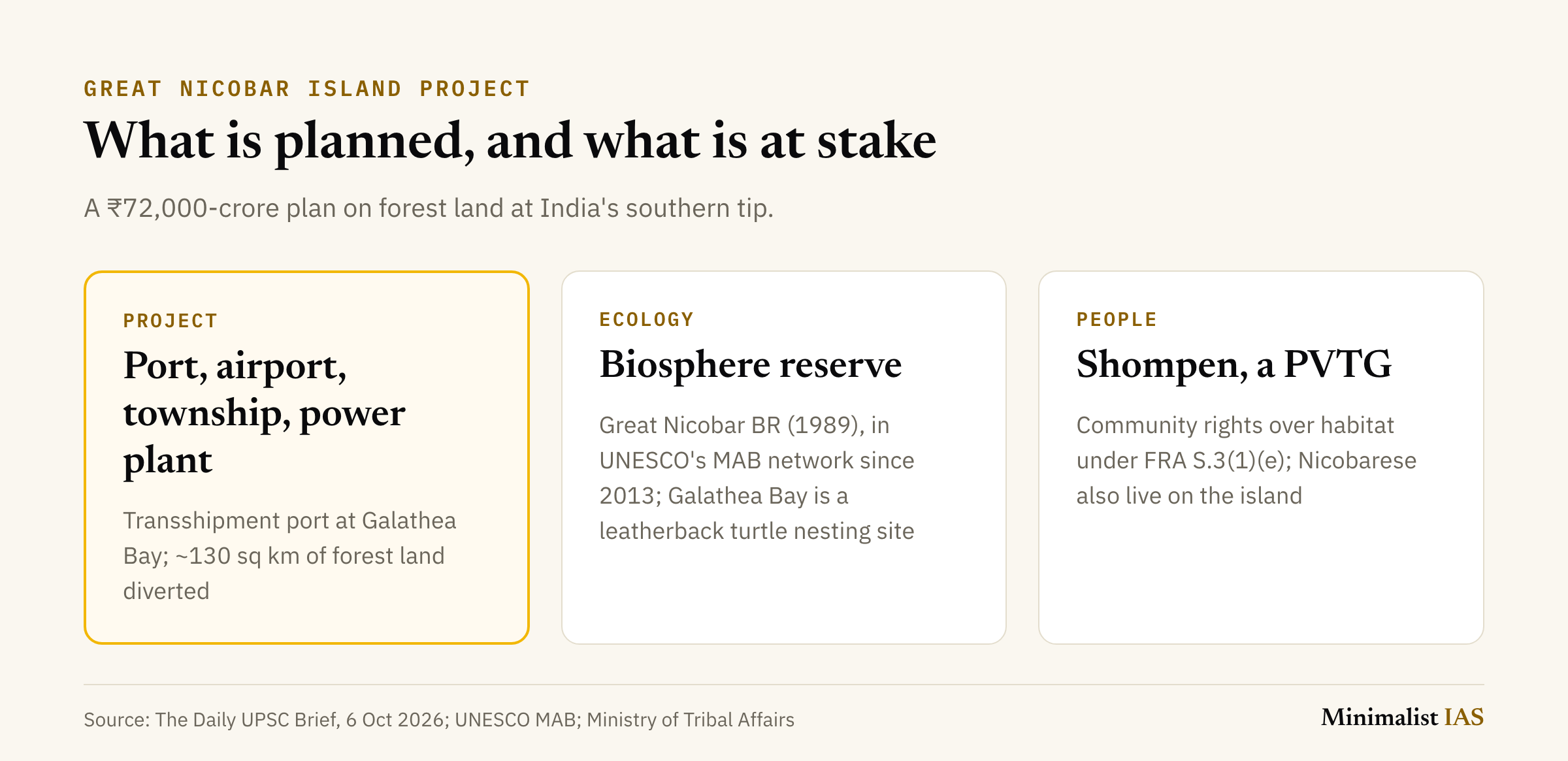
Project: transshipment port at Galathea Bay, greenfield airport, township and power plant; about ₹72,000 crore.
Land: over 160 sq km, including about 130 sq km of forest land.
Planner and implementer: conceived under NITI Aayog; implemented by the Andaman and Nicobar Islands Integrated Development Corporation (ANIIDCO).
People: the Shompen (a little over 200) and the Nicobarese (about 1,000) live on the island.
Ecology: Great Nicobar Biosphere Reserve (1989), in UNESCO's Man and the Biosphere network since 2013.
Why does India want a port here?
Location: about 40 nautical miles from the East–West international shipping route, near the Malacca Strait approach.
Natural depth: over 20 m at Galathea Bay — enough for large container ships.
Dependence: India's transshipment cargo is now handled largely at Colombo, Singapore and Klang.
Security: a base for maritime domain awareness at the Six Degree Channel, between Great Nicobar and Indonesia's Sumatra.
What is the legal challenge?
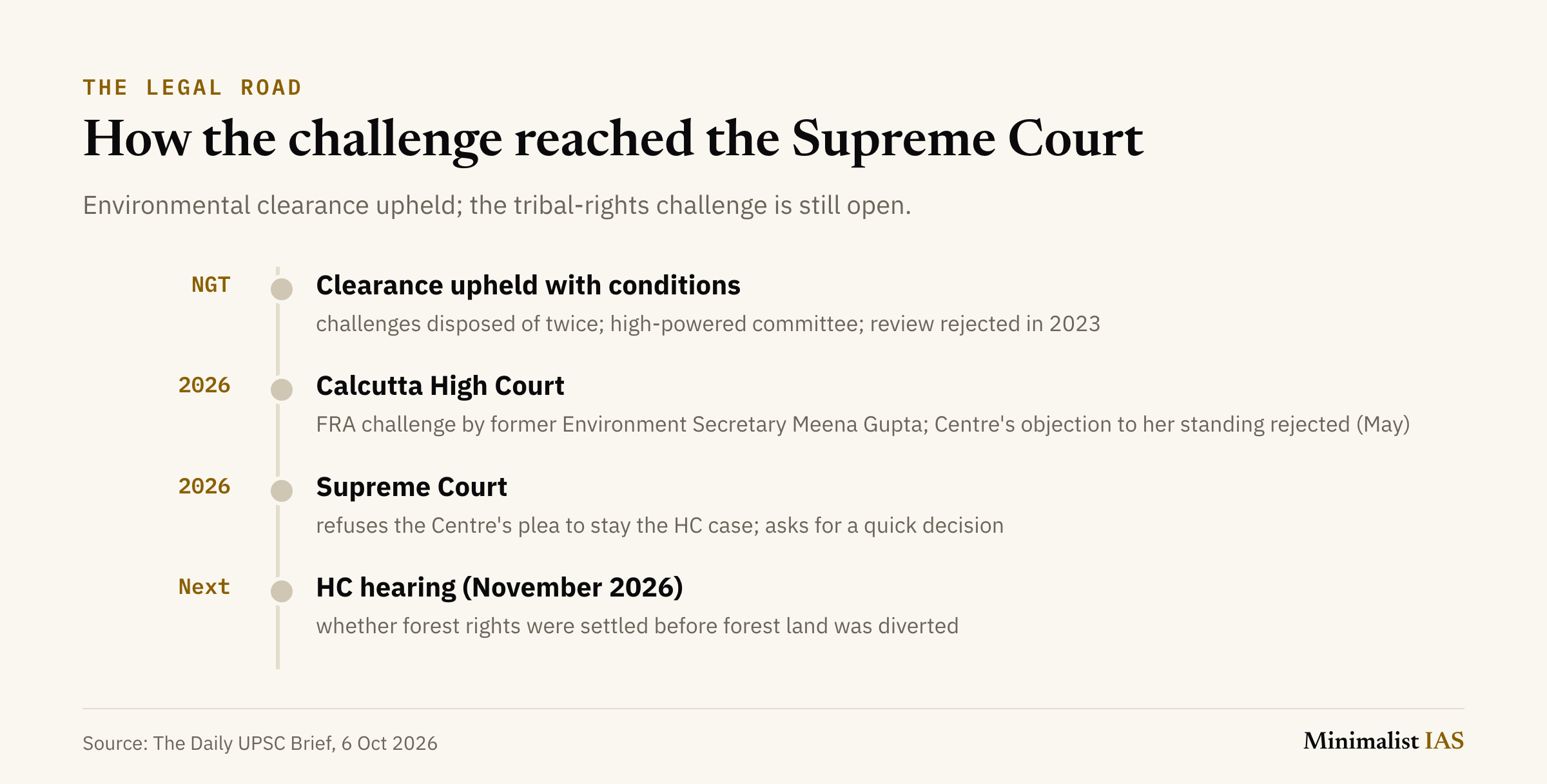
Two tracks: environmental clearance (NGT) vs forest rights (Calcutta High Court).
NGT: twice disposed of challenges, upheld the clearance with conditions and a high-powered committee; review rejected in 2023.
FRA challenge: former Environment Secretary Meena Gupta argues the project violates the Forest Rights Act, 2006 and threatens the island's ecology and tribes.
Supreme Court: refused to stay the High Court case; Justice Bagchi said preservation of culture is a constitutionally protected fundamental right.
Core question: were forest rights recognised and settled before forest land was diverted?
Who are the Shompen, and what protects them?
PVTG status: one of the five PVTGs of the Andaman and Nicobar Islands, with the Great Andamanese, Jarawa, Onge and Sentinelese.
What a PVTG is: an administrative sub-category of STs — pre-agricultural technology, low literacy, economic backwardness, stagnant or declining population; 75 PVTGs across 18 States and one UT.
Forest Rights Act, 2006: Section 3(1)(e) gives PVTGs community rights over their habitat and habitation.
Island law: the Andaman and Nicobar Islands (Protection of Aboriginal Tribes) Regulation, 1956 restricts entry into tribal reserves.
Constitutional angle: Article 29(1) — the right of any section of citizens to conserve its distinct culture.
The development vs conservation debate
For the project: strategic presence near a chokepoint; a domestic transshipment hub; jobs and connectivity for a remote UT.
Against: large-scale tree loss in rainforest; leatherback nesting beach at Galathea Bay; a seismically active zone (2004 tsunami); risk to an isolated PVTG.
Precedent: Orissa Mining Corporation v. MoEF (Niyamgiri, 2013) let the Gram Sabhas decide on mining affecting the Dongria Kondh's religious and cultural rights.
The real question: not whether India needs the port, but whether consent and rights under the FRA came first.
Why it matters for UPSC
GS Paper 3 (conservation, environmental impact assessment; infrastructure: ports; security challenges in border areas) and GS Paper 2 (welfare schemes and laws for vulnerable sections; role of the judiciary). Prelims tests the PVTG criteria, the A&N tribes, biosphere reserves and the FRA. In Mains, Great Nicobar is the defining current case of strategic infrastructure versus tribal rights and a fragile ecosystem.
Related PYQs
UPSC CSE Prelims 2019: "Consider the following statements about Particularly Vulnerable Tribal Groups (PVTGs) in India: 1. PVTGs reside in 18 States and one Union Territory. 2. A stagnant or declining population is one of the criteria for determining PVTG status. 3. There are 95 PVTGs officially notified in the country so far. 4. Irular and Konda Reddi tribes are included in the list of PVTGs. Which of the statements given above are correct?" Answer: (c) 1, 2 and 4.
UPSC CSE Mains 2017, GS Paper I: "What are the two major legal initiatives by the State since Independence addressing discrimination against Scheduled Tribes (STs)?" The Forest Rights Act, 2006 is one; Great Nicobar shows it being tested in court.
Mentor’s note
Keep the two legal tracks apart. The NGT has upheld the environmental clearance; the open question in the High Court is forest rights under the FRA. Answers that merge them lose precision.
PVTG is not a constitutional category. It is an administrative sub-category of Scheduled Tribes; there is no separate Schedule for it — a repeated Prelims trap.
Balance, don't take sides. Pair the strategic case (shipping route, transshipment dependence) with the rights case (FRA, Niyamgiri) and end on process: consent, settled rights, independent ecological monitoring.
Practice: Prelims MCQ
With reference to Great Nicobar Island, consider the following statements:
The Shompen, who live on the island, are classified as a Particularly Vulnerable Tribal Group.
The Great Nicobar Biosphere Reserve is part of UNESCO's World Network of Biosphere Reserves.
Particularly Vulnerable Tribal Groups are listed in a separate Schedule of the Constitution.
**How many of the above statements are correct?
(a) Only one
(b) Only two
(c) All three
(d) None**
Answer: (b) Only two
Explanation:
Statement 1 is correct: the Shompen are one of the five PVTGs of the Andaman and Nicobar Islands.
Statement 2 is correct: the reserve, set up in 1989, joined UNESCO's Man and the Biosphere network in 2013.
Statement 3 is incorrect: PVTGs are an administrative sub-category of Scheduled Tribes identified by the Union government; there is no separate constitutional Schedule.
Practice: Mains question
Strategic infrastructure in ecologically fragile tribal areas must rest on settled rights and informed consent. Discuss with reference to the Great Nicobar project. (Answer in 250 words; 15 Marks)
Terms to know
PVTG: Particularly Vulnerable Tribal Group
FRA: Scheduled Tribes and Other Traditional Forest Dwellers (Recognition of Forest Rights) Act, 2006
NGT: National Green Tribunal
ANIIDCO: Andaman and Nicobar Islands Integrated Development Corporation
MAB: UNESCO's Man and the Biosphere Programme
Transshipment: moving cargo from one ship to another at an intermediate port
Frequently asked questions (FAQs)
What is the Great Nicobar project?
The Great Nicobar project is a ₹72,000-crore plan to build a transshipment port at Galathea Bay, a greenfield airport, a township and a power plant on Great Nicobar Island, involving about 130 sq km of forest land.
Why did the Supreme Court refuse to stay the Great Nicobar case?
The Supreme Court declined the Centre's plea to stay Calcutta High Court proceedings on a Forest Rights Act challenge and asked the High Court to decide quickly. Justice Bagchi observed that preservation of culture is a constitutionally protected fundamental right.
Who are the Shompen?
The Shompen are a hunter-gatherer people of Great Nicobar Island, numbering a little over 200. They are one of the five Particularly Vulnerable Tribal Groups of the Andaman and Nicobar Islands.
How does the Forest Rights Act protect PVTGs?
Section 3(1)(e) of the Forest Rights Act, 2006 recognises the community rights of PVTGs over their habitat and habitation. The Act also bars the eviction of forest dwellers until the recognition and verification of their rights is complete, which is why rights must be settled before forest land is diverted.
Why is Great Nicobar strategically important?
Great Nicobar lies about 40 nautical miles from the East–West international shipping route near the Malacca Strait approach, and Galathea Bay has a natural depth of over 20 metres, which suits a transshipment port.
Key takeaways
₹72,000-crore port–airport–township plan on about 130 sq km of forest land at India's southern tip.
Environmental clearance is upheld by the NGT; the Forest Rights Act challenge continues in the Calcutta High Court.
The Shompen are a PVTG; PVTG is an administrative, not constitutional, category.
Related reading
Why Karnataka rejected the Western Ghats eco-sensitive area draft
Practise previous-year Environment questions in the free PYQ vault
Sources
Particularly Vulnerable Tribal Groups — Ministry of Tribal Affairs
Great Nicobar Biosphere Reserve — UNESCO Man and the Biosphere Programme
From The Daily UPSC Brief, 6 October 2026 — by Shivam Singh.
Spotted an error or something outdated? Tell us — we correct it.
About the author
Shivam Singh
Founder & Mentor, Minimalist IAS
Shivam has been through every stage of the exam himself — Prelims, repeated Mains attempts across UPSC and state civil services, and the interview board. For 7 years he has mentored aspirants one-to-one, helping 100+ clear various stages of the exam, including final selections.
More about Shivam →