Economy
RBI September Bulletin: Why India’s Economy Is Called Resilient Despite the West Asia Oil Shock
By Shivam Singh, Founder & Mentor, Minimalist IAS
· Updated · 3 min read

The Reserve Bank of India’s September 2026 bulletin says the Indian economy has stayed resilient despite a West Asia-driven spike in crude oil prices, helped by record foreign exchange reserves of $766 billion — enough for 11.2 months of goods imports. It flags rising inflation and global bond-yield pressures as the main downside risks.
In the news (26 September 2026): The RBI’s September bulletin said the Indian economy stayed resilient in the face of a West Asia-driven crude oil price spike, even as inflation and global bond-yield pressures pose downside risks.
Key facts at a glance
The shock: Escalating West Asia conflict sharply raised crude oil prices in September, reviving concerns about global supply-chain disruption and inflation.
Inflation signal: Headline CPI inflation picked up in August 2026, and core inflation (excluding precious metals) has also risen from recent lows.
Fiscal spillover: Rising sovereign bond yields in advanced economies are straining government finances globally, even as India’s high-frequency indicators show resilient demand.
Reserve strength: Record forex reserves and strong FCNR(B) deposit inflows are supporting system liquidity and credit growth despite the external turbulence.
How adequate are India’s forex reserves?
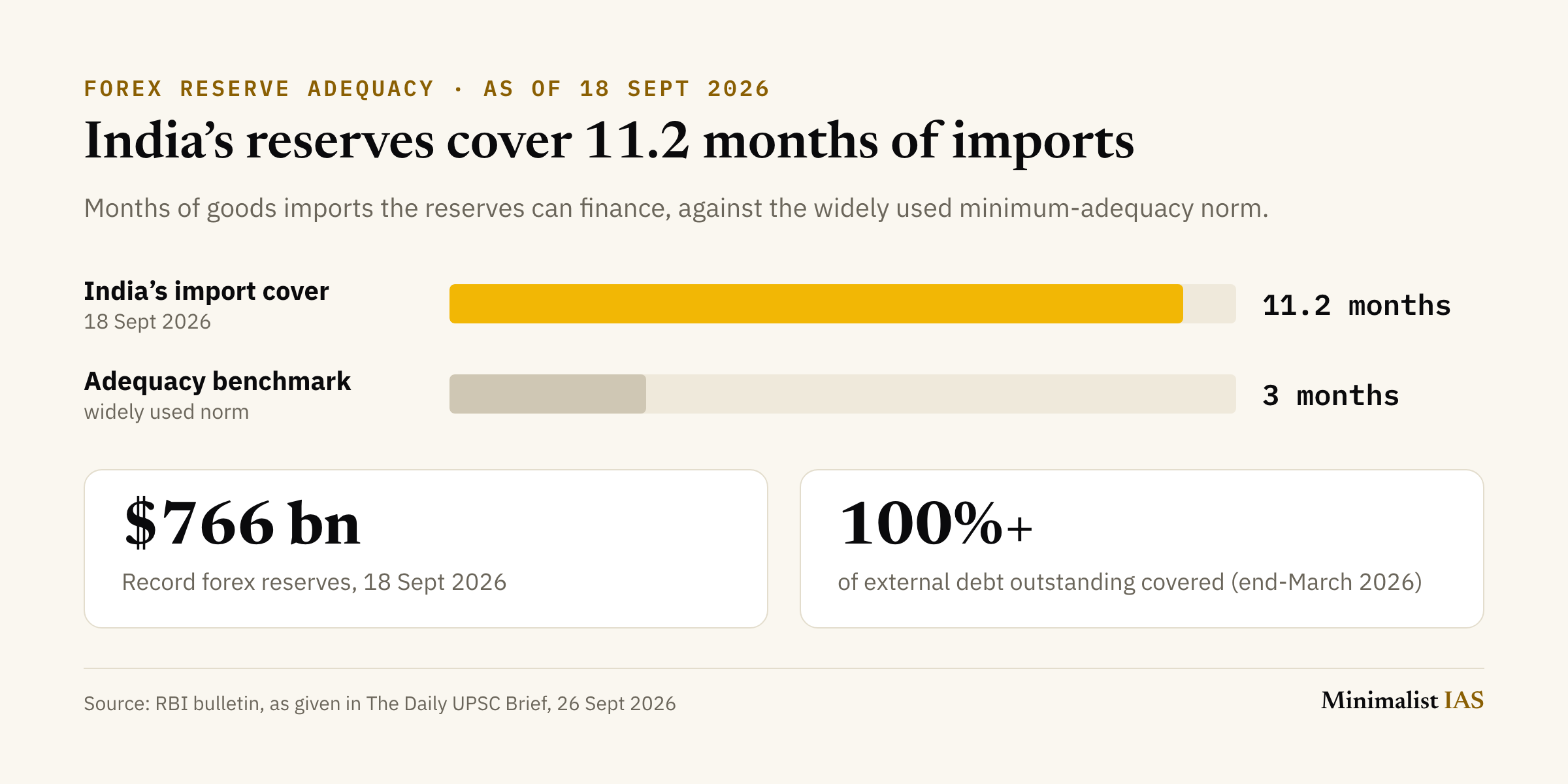
Level: a record $766 billion as of 18 September 2026.
Import cover: 11.2 months of goods imports.
External debt coverage: more than 100% of external debt outstanding (end-March 2026).
Benchmark: three months of import cover is the widely used minimum-adequacy norm.
Why it matters for UPSC
GS Paper 3 (Economy): use this to discuss import-cover adequacy benchmarks, how global crude and bond-yield shocks transmit to a domestic economy, and instruments such as FCNR(B) schemes used to defend the balance of payments.
Practice: Prelims MCQ
With reference to India’s foreign exchange reserves, consider the following statements:
Foreign Currency Non-Resident (Bank) or FCNR(B) deposits are a source of India’s external liabilities, not its foreign exchange reserves.
A country is generally considered to have a comfortable import cover if its reserves can finance more than three months of imports.
Which of the statements given above is/are correct? (a) 1 only (b) 2 only (c) Both 1 and 2 (d) Neither 1 nor 2
Answer: (c) Both 1 and 2. FCNR(B) deposits are bank liabilities owed to NRI depositors, distinct from reserve assets, though inflows can support systemic liquidity. Three months of import cover is the widely used minimum-adequacy benchmark; India’s 11.2 months is well above it.
Terms to know
RBI: Reserve Bank of India
CPI: Consumer Price Index
FCNR(B): Foreign Currency Non-Resident (Bank) deposits
Frequently asked questions
How large are India’s foreign exchange reserves in September 2026?
India’s forex reserves reached a record $766 billion as of 18 September 2026, covering 11.2 months of goods imports and more than 100% of external debt outstanding at end-March 2026.
What is import cover?
Import cover is the number of months of imports a country’s foreign exchange reserves can finance. Three months is the widely used minimum-adequacy benchmark.
Are FCNR(B) deposits part of India’s forex reserves?
No. FCNR(B) deposits are bank liabilities owed to non-resident Indian depositors and are distinct from reserve assets, though their inflows can support systemic liquidity.
What risks did the RBI bulletin flag?
A West Asia-driven crude oil spike, a pick-up in headline CPI inflation in August 2026 with rising core inflation, and rising sovereign bond yields in advanced economies.
Key takeaways
Resilient demand plus record reserves is the RBI’s case for India absorbing the West Asia oil shock.
11.2 months of import cover is nearly four times the three-month adequacy norm.
Inflation and global bond yields are the risks to watch.
Related reading
From The Daily UPSC Brief, 26 September 2026 — by Shivam Singh.
Spotted an error or something outdated? Tell us — we correct it.
About the author
Shivam Singh
Founder & Mentor, Minimalist IAS
Shivam has been through every stage of the exam himself — Prelims, repeated Mains attempts across UPSC and state civil services, and the interview board. For 7 years he has mentored aspirants one-to-one, helping 100+ clear various stages of the exam, including final selections.
More about Shivam →