Polity & Governance
Legislative Councils in India: Creation, Composition, Powers and Role — UPSC Notes
By Shivam Singh, Founder & Mentor, Minimalist IAS
· 9 min read
WhatsApp Telegram
A Legislative Council (Vidhan Parishad) is the optional second chamber of a State legislature, created or abolished by Parliament under Article 169 on the Assembly's request, and capped at one-third of the Assembly (never below 40 members). Six States have one today: Andhra Pradesh, Telangana, Uttar Pradesh, Bihar, Maharashtra and Karnataka. A Council can delay an ordinary Bill but cannot defeat it, which is why the Assembly prevails.
Why in news: In October 2026, elections to 28 graduates' and teachers' seats in the Councils of Uttar Pradesh (11), Bihar (8), Maharashtra (5) and Karnataka (4) put Legislative Councils back in focus.
Syllabus mapping
Prelims: ‘Indian Polity and Governance — Constitution, Political System, Panchayati Raj, Public Policy, Rights Issues, etc.’
GS Paper II: ‘Parliament and State legislatures—structure, functioning, conduct of business, powers & privileges and issues arising out of these.’
Why do some States have a Legislative Council?
The syllabus covers State legislatures; the Constitution makes the second chamber a State choice.
Basis: Article 168 allows one House or two; Article 169 lets Parliament create or abolish the second.
Purpose: a revising chamber that slows hasty law and brings in graduates, teachers, local bodies and experts.
Result: an optional House, so Councils differ State to State and change with politics.
Key features of Legislative Councils
The choice of a second House comes with fixed rules on size, electors, tenure and presiding officer.

Size (Art 171): at most one-third of the Assembly's strength, and never fewer than 40 members.
Electorates: local authorities 1/3; Assembly members 1/3 (choosing non-members); graduates 1/12; teachers 1/12; Governor's nominees 1/6 (the remainder).
Method: the four elected groups vote by proportional representation through the single transferable vote.
Nominees: the Governor picks people with special knowledge of literature, science, art, the co-operative movement and social service.
Tenure (Art 172): a permanent House, not subject to dissolution; one-third of members retire every second year (a six-year term).
Qualification (Art 173): at least 30 years of age, against 25 for the Assembly; the anti-defection law applies to members.
Chairman (Art 182): chosen by the Council from its own members, not nominated by the Governor.
How is a Legislative Council created or abolished?
Because the House is optional, the Constitution lets Parliament, on the State's request, add or remove it by ordinary law.
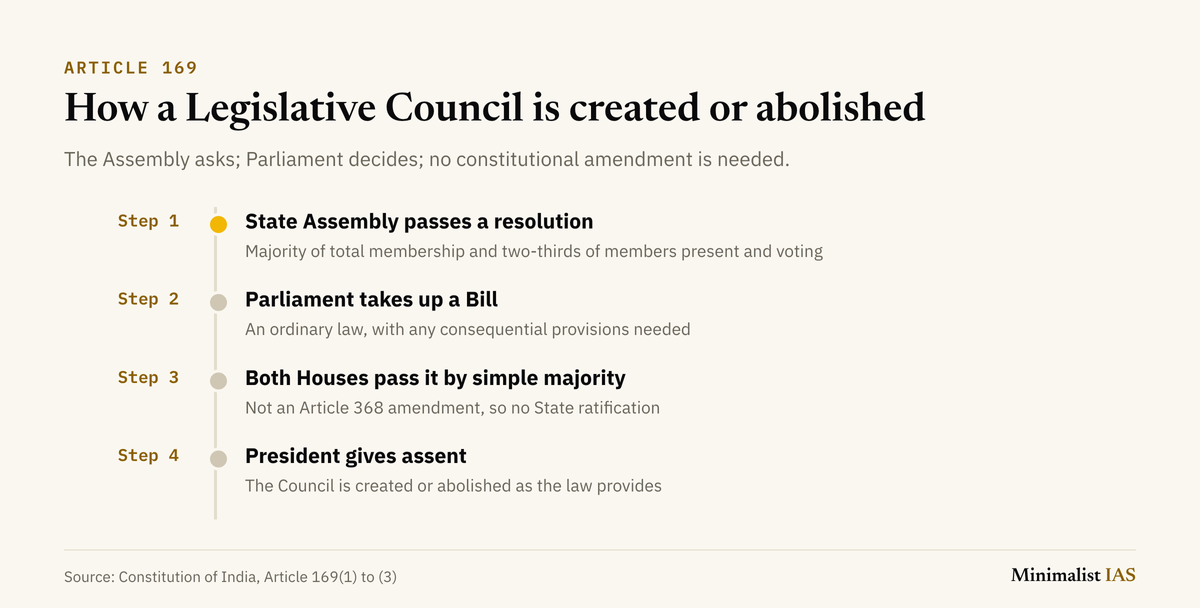
Resolution: the Assembly needs a majority of its total membership and two-thirds of members present and voting (Art 169(1)).
Law: Parliament passes a Bill that can carry the consequential changes needed (Art 169(2)).
Not an amendment: Article 169(3) says such a law is not an Article 368 amendment, so it needs a simple majority and no State ratification.
Who decides: the State asks, but Parliament is free to act or not; the Council exists only once the law is made.
Takeaway: the State proposes, Parliament disposes, and no constitutional amendment is involved.
Legislative Council vs Rajya Sabha vs Legislative Assembly
A Council looks like a State Rajya Sabha, but its powers are far weaker; the three differ as follows.
Feature | Legislative Council | Rajya Sabha | Legislative Assembly |
|---|---|---|---|
Creation | Optional; Parliament's law under Art 169 | Part of Parliament (Art 79–80) | Every State has one |
Size | At most 1/3 of Assembly; minimum 40 | Maximum 250 (Art 80) | 60 to 500 (Art 170), small States excepted |
Members chosen by | Local bodies, MLAs, graduates, teachers; Governor nominates 1/6 | Elected by elected MLAs through STV; 12 nominated by the President | Direct adult-suffrage vote |
Tenure | Permanent; 1/3 retire every 2 years | Permanent; 1/3 retire every 2 years | 5 years; can be dissolved |
Presiding officer | Chairman, elected by the Council | Vice-President (ex officio) | Speaker |
Ordinary Bill | Delays only: 3 months, then 1 month (Art 197) | Equal; deadlock goes to a joint sitting (Art 108) | Prevails |
Money Bill | Cannot introduce; 14 days to recommend (Art 198) | Cannot introduce; 14 days to recommend (Art 109) | Introduces and decides |
Ministry | Not answerable to it (Art 164(2)) | Not answerable to it | Council of Ministers answerable (Art 164(2)) |
Remember it as: the Council has Rajya Sabha's looks and tenure, but not its joint sitting. Ministers may sit in the Council (Art 164(4)), yet they answer to the Assembly alone.
What can a Legislative Council do, and what can it not?
The table's Bill rows show the limit; the working of Articles 197 and 198 explains it.
Ordinary Bill: if the Council rejects it, amends it unacceptably or sits on it for three months, the Assembly may pass it again (Art 197(1)).
Second passage: if the Council again rejects it or delays it beyond one month, the Bill is deemed passed in the Assembly's form (Art 197(2)).
No joint sitting: unlike Parliament, the two State Houses never sit together.
Money Bill: introduced only in the Assembly; the Council returns it within 14 days with recommendations, or it is deemed passed (Art 198).
No role in: a no-confidence motion, or in voting demands for grants.
Prelims traps on Legislative Councils
Not an amendment: a law under Article 169 is not an Article 368 amendment.
Two majorities: the Assembly resolution needs a majority of total membership and two-thirds of those present and voting.
Cap and floor: at most one-third of the Assembly, but never below 40.
Chairman: elected by the Council; the Governor does not nominate him.
Not dissolved: the Council is permanent; only the Assembly can be dissolved.
Elections: MLCs do not vote in the Presidential or Rajya Sabha elections.
Delay, not veto: three months, then one month for an ordinary Bill; 14 days for a Money Bill.
Worked example: what does the one-third cap mean?
Telangana's Assembly has 119 members; one-third is under 40, so the floor of 40 applies and its Council has 40 members. Andhra Pradesh's Assembly has 175, and 175 ÷ 3 = 58.3, so its Council has 58.
Where do Councils exist, and why have they come and gone?
The rules explain the form; the record shows how fragile the House is in practice.

Today: Uttar Pradesh 100, Maharashtra 78, Bihar and Karnataka 75 each, Andhra Pradesh 58, Telangana 40 members.
1969: West Bengal and Punjab abolished theirs; 1985–86: Andhra Pradesh and Tamil Nadu followed (PRS).
2007: Andhra Pradesh revived its Council, 22 years after abolishing it.
2019: the Jammu and Kashmir Reorganisation Act abolished its Council when the State became a Union Territory; the Union Territory now has a one-House Assembly.
2020–21: Andhra Pradesh's Assembly resolved in January 2020 to abolish its Council after it sent the three-capitals Bills to a select committee; the Assembly withdrew that resolution in November 2021.
Not created: Assam (2010) and Rajasthan (2012) Assemblies resolved to create Councils; Parliament has enacted neither.
Are Legislative Councils needed?
These swings frame the debate: is the second House a safeguard or a luxury?
Case for: a revising chamber for hasty Bills; a voice for teachers, graduates and local bodies; a route for experts.
Critique: it can delay but not defeat a Bill; costs public money; the Constituent Assembly's K T Shah warned it would ‘aid party bosses’ to hand out patronage (PRS).
The real question: whether the delay Councils add buys scrutiny that the Assembly's own committees and longer sittings do not.
Way forward
The remedies follow the critique: settle the rule, then raise the quality.
A consistent policy: decide Article 169 requests on a stated test, not the party in power.
Quality of nominees: use the Governor's one-sixth for genuine experts in the five listed fields.
Real review work: refer Bills to committees and publish the Council's amendments and delay.
Councils remain a State's option, decided finally by Parliament; their worth lies in the scrutiny they add, not in who controls them.
Using Legislative Councils in a Mains answer
Introduction: Articles 168 to 171 allow a second chamber as a State's choice, not a federal requirement.
Body — constitutional: Articles 169, 171, 172, 197 and 198; compare with Rajya Sabha.
Body — political and functional: abolition and revival in Andhra Pradesh and Tamil Nadu; a revising role, but delay without veto.
Way forward: a consistent policy under Article 169 and better nominees.
Conclusion: judge Councils by the scrutiny they add.
Related PYQs
UPSC CSE Prelims 2015:
Consider the following statements :
1. The Legislative Council of a State in India can be larger in size than half of the Legislative Assembly of that particular State.
2. The Governor of a State nominates the Chairman of Legislative Council of that particular State.
Which of the statements given above is/are correct?
(a) 1 only
(b) 2 only
(c) Both 1 and 2
(d) Neither 1 nor 2
Answer: (d) Neither 1 nor 2
Use: statement 1 breaks the one-third cap; statement 2 swaps Article 182 for the Governor.
UPSC CSE Mains 2021, GS Paper II:
Explain the constitutional provisions under which Legislative Councils are established. Review the working and current status of Legislative Councils with suitable illustrations. (250 words; 15 marks)
Use: answer in three parts (provisions, working, current status with the six States and the Andhra Pradesh and Jammu and Kashmir changes).
See the detailed explanations: Prelims 2015 · Mains 2021 in the free PYQ vault, with year-wise analysis. Free to browse; free sign-up to download.
Mentor’s note
Split your answer as Mains 2021 did. It asked three things: provisions, working and current status. Name the six States and one recent change.
Don’t write that a Council ‘delays a Bill by three months’. Article 197 gives three months the first time and one month the second; a Money Bill gets 14 days.
Anchor on Article 169(3) and Article 197. The first shows no constitutional amendment is needed; the second shows why the Assembly prevails with no joint sitting.
Prelims 2015 baited size and the Chairman. Learn the cap (one-third, minimum 40) and Article 182 (the Council elects its Chairman).
60-second revision
Q: Who creates or abolishes a Council? Parliament by law, after an Assembly resolution (Art 169).
Q: Size limits? At most one-third of the Assembly, never below 40 (Art 171).
Q: Seat split? 1/3, 1/3, 1/12, 1/12 and 1/6 (Governor).
Q: How far can it block a Bill? Three months, then one month; Money Bill 14 days; no joint sitting.
Q: Which States have one? Andhra Pradesh, Telangana, Uttar Pradesh, Bihar, Maharashtra, Karnataka.
Target Prelims MCQs
Consider the following statements about the Legislative Council of a State:
It is not subject to dissolution, and about one-third of its members retire every second year.
Its Chairman is nominated by the Governor from among its members.
A Money Bill can be introduced in it with the Governor's recommendation.
How many of the above statements are correct?
(a) Only one
(b) Only two
(c) All three
(d) None
Answer: (a) Only one
Explanation:
Statement 1 is correct: Article 172(2) makes the Council permanent, with one-third retiring every second year.
Statement 2 is incorrect: under Article 182 the Council chooses its own Chairman.
Statement 3 is incorrect: under Article 198 a Money Bill cannot be introduced in the Council at all.
Consider the following pairs:
Local authorities : one-third of the Council's seats
Teachers : one-twelfth of the Council's seats
Members of the Legislative Assembly (electing non-members) : one-sixth of the Council's seats
How many of the pairs given above are correctly matched?
(a) Only one
(b) Only two
(c) All three
(d) None
Answer: (b) Only two
Explanation:
Pairs 1 and 2 are correct: Article 171(3) gives local authorities one-third and teachers one-twelfth.
Pair 3 is incorrect: Assembly members elect one-third; the Governor's nominees are the remaining one-sixth.
Consider the following statements:
Statement-I: A State Legislative Council cannot permanently block an ordinary Bill passed by the Assembly.
Statement-II: If the Council rejects such a Bill or delays it beyond three months, the Assembly may pass it again, and the Bill is deemed passed if the Council again rejects it or delays it beyond one month.
Which one of the following is correct in respect of the above statements?
(a) Both Statement-I and Statement-II are correct and Statement-II explains Statement-I
(b) Both Statement-I and Statement-II are correct, but Statement-II does not explain Statement-I
(c) Statement-I is correct, but Statement-II is incorrect
(d) Statement-I is incorrect, but Statement-II is correct
Answer: (a) Both Statement-I and Statement-II are correct and Statement-II explains Statement-I
Explanation:
Both statements are correct: Article 197(1) and (2) let the Assembly override the Council.
(a) is correct: the override in Statement-II is exactly why the Council cannot block the Bill permanently.
Mains practice questions
Compare the legislative powers of a State Legislative Council with those of the Rajya Sabha. (Answer in 150 words; 10 Marks)
Legislative Councils have been created and abolished with changes of government, as in Andhra Pradesh and Tamil Nadu. Critically examine the case for and against second chambers in the States. (Answer in 250 words; 15 Marks)
Frequently asked questions (FAQs)
What is a Legislative Council in India?
A Legislative Council (Vidhan Parishad) is the optional upper House of a State legislature. Six States have one: Andhra Pradesh, Telangana, Uttar Pradesh, Bihar, Maharashtra and Karnataka.
How is a Legislative Council created or abolished?
Parliament does it by ordinary law under Article 169, after the State Assembly passes a resolution by a majority of its total membership and two-thirds of members present and voting.
What is the difference between the Legislative Council and the Rajya Sabha?
Both are permanent Houses with one-third retiring every second year. Rajya Sabha has equal powers over ordinary Bills with a joint sitting; a Council can only delay them.
Can a Legislative Council reject a Money Bill?
No. A Money Bill cannot be introduced in the Council. It may recommend changes within 14 days, which the Assembly can accept or ignore.
Related reading
Anti-Defection Law and the Speaker: Madras HC's Two-Month Deadline Explained
Practise previous-year Polity questions in the free PYQ vault
Revise the NCERT basics of Indian Polity in NCERT Foundations
Sources
Minimalist IAS static notes — by Shivam Singh.
Spotted an error or something outdated? Tell us — we correct it.
About the author
Shivam Singh
Founder & Mentor, Minimalist IAS
Shivam has been through every stage of the exam himself — Prelims, repeated Mains attempts across UPSC and state civil services, and the interview board. For 7 years he has mentored aspirants one-to-one, helping 100+ clear various stages of the exam, including final selections.
More about Shivam →Struggling to structure answers on Legislative Councils in India?
Reading model answers shows the standard; writing under exam pressure reveals your actual blind spots. Write your answer to any question on Legislative Councils in India, upload your handwritten PDF copy, and Shivam will personally evaluate your first answer — highlighting structural flow, examiner traps, and high-yield value additions.







