Minimalist IAS
CSAT

CSAT · 132 questions

Arithmetic: percentage, ratio, averages, time & work

Every UPSC CSAT question on this topic, 2016–2026, newest first. Tap an option to check yourself; the answer and explanation open below it.

Arithmetic: percentage, ratio, averages, time & work questions per year: 2016: 16, 2017: 11, 2018: 8, 2019: 15, 2020: 15, 2021: 16, 2022: 13, 2023: 2, 2024: 11, 2025: 9, 2026: 16 Asked in 11 of 11 years · most in 2026 (16)

UPSC syllabus: “Basic numeracy (numbers and their relations, orders of magnitude, etc.) (Class X level), Data interpretation (charts, graphs, tables, data sufficiency etc. — Class X level);” See the full syllabus →

Showing 91–120 of 132, newest first.

X, Y and Z are three contestants in a race of 1000 m. Assume that all run with different uniform speeds. X gives Y a start of 40 m and X gives Z a start of 64 m. If Y and Z were to compete in a race of 1000 m, how many metres start will Y give to Z?

Answer & explanation

Answer: (b) 25

While X runs 1000 m, Y runs 960 m and Z 936 m. So while Y runs 1000 m, Z runs 1000 × 936/960 = 975 m, and Y can give Z a start of 25 m.

  1. X gives Y 40 m: while X runs 1000 m, Y runs 960 m.
  2. X gives Z 64 m: in the same time Z runs 936 m.
  3. Speed ratio Y : Z = 960 : 936.
  4. While Y runs 1000 m, Z runs 1000 × 936/960 = 975 m.
  5. Start Y gives Z = 1000 − 975 = 25 m.

Remember · Turn 'starts' into distances run in the same time, then scale to the new race length.

Question and answer: UPSC's official GS Paper II (2019, Series A) — paper ↗ · answer key ↗. Explanation: Minimalist IAS, checked 30 Sept 2026 (how we verify). Permalink ·
Ena was born 4 years after her parents’ marriage. Her mother is three years younger than her father and 24 years older than Ena, who is 13 years old. At what age did Ena’s father get married?

Answer & explanation

Answer: (b) 23 years

Ena is 13, her mother 37 and her father 40. The marriage took place 13 + 4 = 17 years ago, when the father was 40 − 17 = 23.

  1. Ena = 13; mother = 13 + 24 = 37; father = 37 + 3 = 40.
  2. The marriage was 4 years before Ena's birth: 13 + 4 = 17 years ago.
  3. Father's age at marriage = 40 − 17 = 23 years.

Remember · Fix everyone's present age first, then move all of them back by the same number of years.

Question and answer: UPSC's official GS Paper II (2019, Series A) — paper ↗ · answer key ↗. Explanation: Minimalist IAS, checked 30 Sept 2026 (how we verify). Permalink ·

Rakesh had money to buy 8 mobile handsets of a specific company. But the retailer offered very good discount on that particular handset. Rakesh could buy 10 mobile handsets with the amount he had. What was the discount the retailer offered?

Answer & explanation

Answer: (b) 20%

The same money buys 10 handsets instead of 8, so the new price is 8/10 of the old one — a 20% discount. 25% is the rise in quantity, not the fall in price.

  1. Let the price be ₹100; Rakesh has 8 × 100 = ₹800.
  2. ₹800 now buys 10 handsets, so the discounted price = ₹80.
  3. Discount = (100 − 80)/100 × 100% = 20%.

Remember · With fixed money, price × quantity is constant: quantities 8 : 10 mean prices 10 : 8.

Question and answer: UPSC's official GS Paper II (2019, Series A) — paper ↗ · answer key ↗. Explanation: Minimalist IAS, checked 30 Sept 2026 (how we verify). Permalink ·

The average marks of 100 students are given to be 40. It was found later that marks of one student were 53 which were misread as 83. The corrected mean marks are

Answer & explanation

Answer: (b) 39.7

The total was overstated by 83 − 53 = 30 marks, so the correct total is 3970 and the mean is 39.7.

  1. Recorded total = 100 × 40 = 4000.
  2. Excess from the misreading = 83 − 53 = 30.
  3. Correct total = 4000 − 30 = 3970; correct mean = 3970/100 = 39.7.
  4. Shortcut: the mean falls by 30/100 = 0.3.

Remember · One wrong entry shifts the mean by (wrong − right) ÷ n.

Question and answer: UPSC's official GS Paper II (2019, Series A) — paper ↗ · answer key ↗. Explanation: Minimalist IAS, checked 30 Sept 2026 (how we verify). Permalink ·

In a group of 15 people; 7 can read French, 8 can read English while 3 of them can read neither of these two languages. The number of people who can read exactly one language is

Answer & explanation

Answer: (b) 9

Twelve people read at least one language. French and English readers add to 15, so 3 read both, and 12 − 3 = 9 read exactly one.

  1. At least one language = 15 − 3 = 12.
  2. Both = 7 + 8 − 12 = 3.
  3. Exactly one = 12 − 3 = 9 (French only 4, English only 5).

Remember · Exactly one = (at least one) − (both); get 'both' from A + B − (at least one).

Question and answer: UPSC's official GS Paper II (2019, Series A) — paper ↗ · answer key ↗. Explanation: Minimalist IAS, checked 30 Sept 2026 (how we verify). Permalink ·

A family has two children along with their parents. The average of the weights of the children and their mother is 50 kg. The average of the weights of the children and their father is 52 kg. If the weight of the father is 60 kg, then what is the weight of the mother?

Answer & explanation

Answer: (d) 54 kg

Children plus mother weigh 150 kg and children plus father 156 kg, so the father is 6 kg heavier than the mother. With the father at 60 kg, the mother weighs 54 kg.

  1. Children + mother = 3 × 50 = 150 kg.
  2. Children + father = 3 × 52 = 156 kg.
  3. Father − mother = 156 − 150 = 6 kg.
  4. Mother = 60 − 6 = 54 kg.
  5. Check: children = 156 − 60 = 96, and 96 + 54 = 150.

Remember · When two averages share members, subtract the totals — the shared part cancels.

Question and answer: UPSC's official GS Paper II (2019, Series A) — paper ↗ · answer key ↗. Explanation: Minimalist IAS, checked 30 Sept 2026 (how we verify). Permalink ·

Sunita cuts a sheet of paper into three pieces. Length of first piece is equal to the average of the three single digit odd prime numbers. Length of the second piece is equal to that of the first plus one-third the length of the third. The third piece is as long as the other two pieces together. The length of the original sheet of paper is

Answer & explanation

Answer: (d) 30 units

The single-digit odd primes are 3, 5 and 7, so the first piece is 5 units. With the third piece T, the second is 5 + T/3 and T = 10 + T/3, so T = 15, the second piece is 10 and the sheet is 30 units.

  1. Single-digit odd primes: 3, 5, 7; average = 15/3 = 5, so the first piece = 5.
  2. Let the third piece be T; the second = 5 + T/3.
  3. Third = first + second: T = 5 + 5 + T/3 → 2T/3 = 10 → T = 15.
  4. Second = 5 + 15/3 = 10.
  5. Sheet = 5 + 10 + 15 = 30 units.
  6. Check: the third piece (15) equals 5 + 10.

Remember · If one part equals the sum of the others, the whole is twice that part.

Question and answer: UPSC's official GS Paper II (2019, Series A) — paper ↗ · answer key ↗. Explanation: Minimalist IAS, checked 30 Sept 2026 (how we verify). Permalink ·

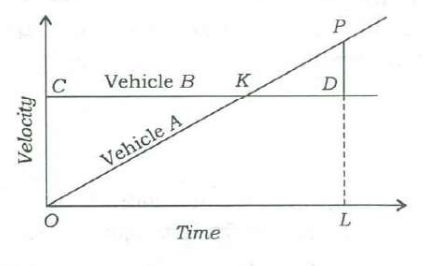
The figure drawn below gives the velocity graphs of two vehicles A and B. The straight line OKP represents the velocity of vehicle A at any instant, whereas the horizontal straight line CKD represents the velocity of vehicle B at any instant. In the figure, D is the point where perpendicular from P meets the horizontal line CKD such that PD = 1/2 LD:

Velocity–time graph: A's velocity rises along a straight line from the origin O through K to P; B's velocity is the horizontal line C–K–D; P lies above time L, D is on B's line directly below P, and PL is dotted down to the time axis.
From UPSC's question paper.

What is the ratio between the distances covered by vehicles A and B in the time interval OL?

Answer & explanation

Answer: (c) 3: 4

Distance is the area under a velocity–time graph. A's distance is the triangle OLP and B's is the rectangle of height LD over OL; since PL = 3/2 × LD, the triangle is 3/4 of the rectangle.

  1. Let LD (B's constant velocity) = 2 units; then PD = 1 and A's velocity at time L is PL = PD + DL = 3.
  2. Distance of B in time OL = rectangle = OL × 2 = 2 × OL.
  3. Distance of A in time OL = triangle OLP = 1/2 × OL × 3 = 1.5 × OL.
  4. Ratio A : B = 1.5 : 2 = 3 : 4.

Remember · On a velocity–time graph, distance = area under the line: a triangle for steady acceleration from rest, a rectangle for constant speed.

Question and answer: UPSC's official GS Paper II (2018, Series A) — paper ↗ · answer key ↗. Explanation: Minimalist IAS, checked 1 Oct 2026 (how we verify). Permalink ·

A train 200 metres long is moving at the rate of 40 kmph. In how many seconds will it cross a man standing near the railway line?

Answer & explanation

Answer: (d) 18

To pass a man standing still, the train covers only its own length, 200 m. At 40 km/h, which is 100/9 m/s, that takes 18 seconds.

  1. Distance to cover = length of the train = 200 m (the man adds no length).
  2. Speed: 40 km/h = 40 × 5/18 = 100/9 m/s.
  3. Time = 200 ÷ (100/9) = 18 seconds.
  4. Check: in 18 s at 40 km/h the train covers 40,000 × 18 ÷ 3600 = 200 m.

Remember · A train passing a pole or a standing person covers only its own length; convert km/h to m/s by multiplying by 5/18.

Question and answer: UPSC's official GS Paper II (2018, Series A) — paper ↗ · answer key ↗. Explanation: Minimalist IAS, checked 30 Sept 2026 (how we verify). Permalink ·

A bookseller sold ‘a’ number of Geography textbooks at the rate of ₹x per book, ‘a + 2’ number of History textbooks at the rate of ₹(x + 2) per book and ‘a − 2’ number of Mathematics textbooks at the rate of ₹(x − 2) per book. What is his total sale in ₹?

Answer & explanation

Answer: (b) 3ax + 8

Total sale = ax + (a + 2)(x + 2) + (a − 2)(x − 2). The terms 2a + 2x and −2a − 2x cancel, leaving 3ax + 8.

  1. Geography: a × x = ax.
  2. History: (a + 2)(x + 2) = ax + 2a + 2x + 4.
  3. Mathematics: (a − 2)(x − 2) = ax − 2a − 2x + 4.
  4. Sum: 3ax + 8.
  5. Check with a = 3, x = 5: 15 + 5 × 7 + 1 × 3 = 53, and 3 × 3 × 5 + 8 = 53.

Remember · Check algebraic options by putting small numbers into both the question and each option.

Question and answer: UPSC's official GS Paper II (2018, Series A) — paper ↗ · answer key ↗. Explanation: Minimalist IAS, checked 30 Sept 2026 (how we verify). Permalink ·

Two persons, A and B are running on a circular track. At the start, B is ahead of A and their positions make an angle of 30° at the centre of the circle. When A reaches the point diametrically opposite to his starting point, he meets B. What is the ratio of speeds of A and B, if they are running with uniform speeds?

Answer & explanation

Answer: (a) 6: 5

A covers half the track, 180°. B started 30° ahead and is caught at that same point, so B covered 180° − 30° = 150° in the same time. The speeds are in the ratio 180 : 150 = 6 : 5.

  1. A runs from his start to the diametrically opposite point: an arc of 180°.
  2. B started 30° ahead in the direction of running and is met there: B runs 180° − 30° = 150°.
  3. Same time, so speed ratio = arc ratio = 180 : 150 = 6 : 5.

Remember · On a circular track, measure distances as angles; in equal time, the speed ratio equals the ratio of arcs covered.

Question and answer: UPSC's official GS Paper II (2018, Series A) — paper ↗ · answer key ↗. Explanation: Minimalist IAS, checked 30 Sept 2026 (how we verify). Permalink ·

A student has to get 40% marks to pass in an examination. Suppose he gets 30 marks and fails by 30 marks, then what are the maximum marks in the examination?

Answer & explanation

Answer: (c) 150

Scoring 30 and falling 30 short means the pass mark is 60. If 60 is 40% of the maximum, the maximum is 60 ÷ 0.4 = 150.

  1. Pass mark = marks scored + shortfall = 30 + 30 = 60.
  2. 40% of maximum = 60, so maximum = 60 × 100 ÷ 40 = 150.
  3. Check: 40% of 150 = 60, and 60 − 30 = 30.

Remember · Pass mark = marks scored + shortfall; divide it by the pass percentage to get the maximum marks.

Question and answer: UPSC's official GS Paper II (2018, Series A) — paper ↗ · answer key ↗. Explanation: Minimalist IAS, checked 30 Sept 2026 (how we verify). Permalink ·

A shopkeeper sells an article at ₹40 and gets X% profit. However, when he sells it at ₹20, he faces same percentage of loss. What is the original cost of the article?

Answer & explanation

Answer: (c) ₹30

An equal percentage profit and loss on the same cost means the two selling prices lie equally far above and below the cost. The cost is the average of ₹40 and ₹20, i.e. ₹30 (profit and loss both 33⅓%).

  1. Let the cost be C. Then 40 = C(1 + X/100) and 20 = C(1 − X/100).
  2. Adding the two: 60 = 2C, so C = ₹30.
  3. Check: ₹40 is 33⅓% above ₹30, and ₹20 is 33⅓% below it.

Remember · Same percentage profit and loss on one cost price: the cost is the average of the two selling prices.

Question and answer: UPSC's official GS Paper II (2018, Series A) — paper ↗ · answer key ↗. Explanation: Minimalist IAS, checked 30 Sept 2026 (how we verify). Permalink ·

A lift has the capacity of 18 adults or 30 children. How many children can board the lift with 12 adults?

Answer & explanation

Answer: (b) 10

18 adults take the same space as 30 children, so one adult equals 5/3 of a child. 12 adults use the space of 20 children, leaving room for 10.

  1. 18 adults = 30 children, so 1 adult = 30/18 = 5/3 children.
  2. 12 adults = 12 × 5/3 = 20 children's worth of space.
  3. Room left = 30 − 20 = 10 children.
  4. Check: 12 adults fill 12/18 = 2/3 of the lift; the remaining 1/3 of 30 children is 10.

Remember · Convert everything to one unit (here child-spaces), subtract what is used, and read off what remains.

Question and answer: UPSC's official GS Paper II (2018, Series A) — paper ↗ · answer key ↗. Explanation: Minimalist IAS, checked 30 Sept 2026 (how we verify). Permalink ·

A person bought a refrigerator worth ₹22,800 with 12.5% interest compounded yearly. At the end of first year he paid ₹8,650 and at the end of second year ₹9,125. How much will he have to pay at the end of third year to clear the debt?

Answer & explanation

Answer: (d) ₹11,250

Add a year's interest (12.5%, one-eighth) to the balance and subtract each payment. The balance falls to ₹17,000 after year 1 and ₹10,000 after year 2, so year 3 needs ₹10,000 × 1.125 = ₹11,250.

  1. Year 1: 22,800 × 1.125 = 25,650; after paying 8,650 the balance is 17,000.
  2. Year 2: 17,000 × 1.125 = 19,125; after paying 9,125 the balance is 10,000.
  3. Year 3: 10,000 × 1.125 = 11,250 clears the debt.
  4. Check: ₹10,000 is only the balance at the start of year 3; it still earns a year's interest.

Remember · For instalments at compound interest, roll the balance forward: add the year's interest, subtract the payment. 12.5% is one-eighth.

Question and answer: UPSC's official GS Paper II (2018, Series A) — paper ↗ · answer key ↗. Explanation: Minimalist IAS, checked 30 Sept 2026 (how we verify). Permalink ·

If there is a policy that 1/3rd of a population of community has migrated every year from one place to some other place, what is the leftover population of that community after the sixth year, if there is no further growth in the population during this period?

Answer & explanation

Answer: (d) 64/729th part of the population

Each year one-third leaves, so two-thirds of the previous year's population remains. The fraction compounds, so after six years the population left is (2/3)⁶ = 64/729 of the original.

  1. After one year, 1 − 1/3 = 2/3 of the population remains.
  2. The same fraction applies to what is left each year, so after 6 years the remainder is (2/3)⁶.
  3. (2/3)⁶ = 2⁶/3⁶ = 64/729.
  4. Check: the denominator must be 3⁶ = 729 and the numerator 2⁶ = 64; only (d) has both.

Remember · Repeated fractional loss compounds: after n rounds of losing 1/k, the remainder is (1 − 1/k)ⁿ, not 1 − n/k.

Question and answer: UPSC's official GS Paper II (2017, Series A) — paper ↗ · answer key ↗. Explanation: Minimalist IAS, checked 30 Sept 2026 (how we verify). Permalink ·

There are three pillars X, Y and Z of different heights. Three spiders A, B and C start to climb on these pillars simultaneously. In one chance, A climbs on X by 6 cm but slips down 1 cm. B climbs on Y by 7 cm but slips down 3 cm. C climbs on Z by 6.5 cm but slips down 2 cm. If each of them requires 40 chances to reach the top of the pillars, what is the height of the shortest pillar?

Answer & explanation

Answer: (b) 163 cm

A spider does not slip back in the chance in which it reaches the top, so height = 39 net gains + one full climb. That gives X = 201 cm, Y = 163 cm and Z = 182 cm; the shortest pillar is 163 cm.

  1. Net gain per chance: A = 6 − 1 = 5 cm, B = 7 − 3 = 4 cm, C = 6.5 − 2 = 4.5 cm.
  2. In the 40th chance each spider reaches the top and does not slip, so height = 39 × (net gain) + (full climb).
  3. X = 39 × 5 + 6 = 201 cm; Y = 39 × 4 + 7 = 163 cm; Z = 39 × 4.5 + 6.5 = 182 cm.
  4. Shortest pillar = 163 cm (Y).
  5. Check for Y: after 38 chances B is at 152 cm and reaches only 159 cm in the 39th climb, so it truly needs the 40th.

Remember · Climb-and-slip problems: the last climb has no slip. Height = (n − 1) × net gain + one full climb.

Question and answer: UPSC's official GS Paper II (2017, Series A) — paper ↗ · answer key ↗. Explanation: Minimalist IAS, checked 30 Sept 2026 (how we verify). Permalink ·

Gopal bought a cell phone and sold it to Ram at 10% profit. Then Ram wanted to sell it back to Gopal at 10% loss. What will be Gopal’s position if he agreed?

Answer & explanation

Answer: (c) Gain 1%

Take Gopal's cost as ₹100. Ram pays ₹110 and offers the phone back at 10% less, ₹99 — ₹1 below what Gopal first paid, a 1% gain. UPSC's options compare this buy-back price with Gopal's original cost.

  1. Let Gopal's cost be ₹100.
  2. Sold to Ram at 10% profit: ₹110.
  3. Ram sells it back at 10% loss on his cost: 110 × 0.9 = ₹99.
  4. Gopal gets back for ₹99 the phone that first cost him ₹100: a gain of ₹1 on ₹100 = 1%.
  5. Note: counting both deals, Gopal ends ₹11 ahead (+110 − 99); no option matches that, so the options measure only the buy-back price against his original cost.

Remember · A rise of x% then a fall of x% leaves the price x²/100 % below the start: 10% up, 10% down → 1% lower.

Question and answer: UPSC's official GS Paper II (2017, Series A) — paper ↗ · answer key ↗. Explanation: Minimalist IAS, checked 30 Sept 2026 (how we verify). Permalink ·

Suppose the average weight of 9 persons is 50 kg. The average weight of the first 5 persons is 45 kg, whereas the average weight of the last 5 persons is 55 kg. Then the weight of the 5th person will be

Answer & explanation

Answer: (c) 50 kg

The first five and the last five together cover all nine persons, with the 5th person counted twice. So the 5th person's weight = (5 × 45 + 5 × 55) − 9 × 50 = 500 − 450 = 50 kg.

  1. Total of 9 persons = 9 × 50 = 450 kg.
  2. First 5 = 5 × 45 = 225 kg; last 5 = 5 × 55 = 275 kg.
  3. 225 + 275 = 500 kg, which counts the 5th person twice.
  4. 5th person = 500 − 450 = 50 kg.

Remember · When two overlapping groups together cover everyone, (sum of the groups) − (grand total) = the overlap.

Question and answer: UPSC's official GS Paper II (2017, Series A) — paper ↗ · answer key ↗. Explanation: Minimalist IAS, checked 30 Sept 2026 (how we verify). Permalink ·

P = (40% of A) + (65% of B) and Q = (50% of A) + (50% of B), where A is greater than B.

In this context, which of the following statements is correct?

Answer & explanation

Answer: (d) None of the above can be concluded with certainty.

P − Q = 0.15B − 0.10A, and its sign depends on how much bigger A is than B. If A is less than 1.5 times B, P is larger; if more, Q is larger; at exactly 1.5 times they are equal. So nothing can be concluded.

  1. P − Q = (0.40A + 0.65B) − (0.50A + 0.50B) = 0.15B − 0.10A.
  2. P > Q when 0.15B > 0.10A, i.e. A < 1.5B; Q > P when A > 1.5B; P = Q when A = 1.5B.
  3. A > B allows all three: A = 1.2, B = 1 gives P > Q; A = 3, B = 1 gives Q > P; A = 1.5, B = 1 gives P = Q.
  4. So the comparison cannot be fixed.

Remember · Subtract the two expressions and study the sign; if it depends on a ratio the question does not fix, the answer is 'cannot be determined'.

Question and answer: UPSC's official GS Paper II (2017, Series A) — paper ↗ · answer key ↗. Explanation: Minimalist IAS, checked 30 Sept 2026 (how we verify). Permalink ·

In a city, 12% of households earn less than ₹ 30,000 per year, 6% households earn more than ₹ 2,00,000 per year, 22% households earn more than ₹ 1,00,000 per year and 990 households earn between ₹ 30,000 and ₹ 1,00,000 per year. How many households earn between ₹ 1,00,000 and ₹ 2,00,000 per year?

Answer & explanation

Answer: (b) 240

The 22% earning above ₹1,00,000 includes the 6% above ₹2,00,000, so 16% earn between ₹1,00,000 and ₹2,00,000. The 990 households between ₹30,000 and ₹1,00,000 are the remaining 66%, which makes 1500 households in all; 16% of 1500 = 240.

  1. Above ₹1,00,000: 22%. Below ₹30,000: 12%. So ₹30,000–₹1,00,000: 100 − 22 − 12 = 66%.
  2. 66% = 990 households, so the total = 990 ÷ 0.66 = 1500.
  3. ₹1,00,000–₹2,00,000: 22% − 6% = 16% (the 22% already includes the 6% above ₹2,00,000).
  4. 16% of 1500 = 240.

Remember · 'More than X' groups are cumulative; subtract the higher band to get the slab in between before converting to numbers.

Question and answer: UPSC's official GS Paper II (2017, Series A) — paper ↗ · answer key ↗. Explanation: Minimalist IAS, checked 30 Sept 2026 (how we verify). Permalink ·

There is a milk sample with 50% water in it. If 1/3rd of this milk is added to equal amount of pure milk, then water in the new mixture will fall down to

Answer & explanation

Answer: (a) 25%

Take the one-third portion as 1 litre: it holds 0.5 litre of water. Adding 1 litre of pure milk makes 2 litres with the same 0.5 litre of water, which is 25%.

  1. Let the portion taken (1/3rd of the sample) be 1 litre; at 50% water it has 0.5 litre of water.
  2. Add an equal amount (1 litre) of pure milk, which has no water: total 2 litres.
  3. Water = 0.5 ÷ 2 = 25%.

Remember · Adding an equal amount of the pure component halves the concentration; the size of the portion taken does not matter.

Question and answer: UPSC's official GS Paper II (2017, Series A) — paper ↗ · answer key ↗. Explanation: Minimalist IAS, checked 30 Sept 2026 (how we verify). Permalink ·

A freight train left Delhi for Mumbai at an average speed of 40 km/hr. Two hours later, an express train left Delhi for Mumbai, following the freight train on a parallel track at an average speed of 60 km/hr. How far from Delhi would the express train meet the freight train?

Answer & explanation

Answer: (c) 240 km

The freight train has an 80 km lead when the express starts. The express closes the gap at 20 km/h, taking 4 hours, by which time it has run 60 × 4 = 240 km from Delhi.

  1. Lead of the freight train when the express starts = 40 × 2 = 80 km.
  2. Relative speed = 60 − 40 = 20 km/h, so time to catch up = 80 ÷ 20 = 4 h.
  3. Distance of the express from Delhi = 60 × 4 = 240 km.
  4. Check: the freight train has run 40 × 6 = 240 km in 6 hours.

Remember · Catch-up time = head start ÷ relative speed; then distance = the chaser's speed × that time.

Question and answer: UPSC's official GS Paper II (2017, Series A) — paper ↗ · answer key ↗. Explanation: Minimalist IAS, checked 30 Sept 2026 (how we verify). Permalink ·

P works thrice as fast as Q, whereas P and Q together can work four times as fast as R. If P, Q and R together work on a job, in what ratio should they share the earnings?

Answer & explanation

Answer: (a) 3: 1: 1

Working together for the same time, each person's share of the earnings follows his rate of work. With P = 3Q and P + Q = 4R, we get 4Q = 4R, so R = Q and the ratio is 3 : 1 : 1.

  1. Let Q's rate be 1 unit a day; then P's rate = 3.
  2. P + Q = 4 = 4 × R's rate, so R's rate = 1.
  3. Working for the same time, their shares follow their rates: P : Q : R = 3 : 1 : 1.

Remember · When people work together for the same time, split the earnings in the ratio of their work rates.

Question and answer: UPSC's official GS Paper II (2017, Series A) — paper ↗ · answer key ↗. Explanation: Minimalist IAS, checked 30 Sept 2026 (how we verify). Permalink ·

The average rainfall in a city for the first four days was recorded to be 0.40 inch. The rainfall on the last two days was in the ratio of 4: 3. The average of six days was 0.50 inch. What was the rainfall on the fifth day?

Answer & explanation

Answer: (c) 0.80 inch

The six days total 6 × 0.50 = 3.00 inches and the first four days 4 × 0.40 = 1.60 inches, so the last two days had 1.40 inches. Split in the ratio 4 : 3, the fifth day had 1.40 × 4/7 = 0.80 inch.

  1. Total for six days = 6 × 0.50 = 3.00 inches.
  2. Total for the first four days = 4 × 0.40 = 1.60 inches.
  3. Last two days = 3.00 − 1.60 = 1.40 inches.
  4. Fifth day : sixth day = 4 : 3, so the fifth day = 1.40 × 4/7 = 0.80 inch.
  5. Check: sixth day = 0.60 inch, and 1.60 + 0.80 + 0.60 = 3.00.

Remember · Turn averages into totals first, then split the remaining total in the given ratio.

Question and answer: UPSC's official GS Paper II (2017, Series A) — paper ↗ · answer key ↗. Explanation: Minimalist IAS, checked 30 Sept 2026 (how we verify). Permalink ·

The monthly incomes of X and Y are in the ratio of 4: 3 and their monthly expenses are in the ratio of 3: 2. However, each saves ₹ 6,000 per month. What is their total monthly income?

Answer & explanation

Answer: (b) ₹ 42,000

Let incomes be 4k and 3k and expenses 3m and 2m. Equal savings give 4k − 3m = 3k − 2m, so k = m, and then 4k − 3k = ₹6,000 gives k = ₹6,000. Total income = 7k = ₹42,000.

  1. Incomes: 4k and 3k; expenses: 3m and 2m.
  2. Savings: 4k − 3m = 6000 and 3k − 2m = 6000.
  3. Subtracting: k − m = 0, so m = k. Then 4k − 3k = k = 6000.
  4. Total income = 4k + 3k = 7 × 6000 = ₹42,000.
  5. Check: X earns ₹24,000 and spends ₹18,000; Y earns ₹18,000 and spends ₹12,000 — each saves ₹6,000.

Remember · When both save the same amount, equate the two savings expressions first — it links the two ratio multipliers.

Question and answer: UPSC's official GS Paper II (2017, Series A) — paper ↗ · answer key ↗. Explanation: Minimalist IAS, checked 30 Sept 2026 (how we verify). Permalink ·

There are some nectar-filled flowers on a tree and some bees are hovering on it. If one bee lands on each flower, one bee will be left out. If two bees land on each flower, one flower will be left out. The number of flowers and bees respectively are:

Answer & explanation

Answer: (c) 3 and 4

One bee per flower leaves a bee over, so bees = flowers + 1. Two per flower leaves a flower empty, so bees = 2 × (flowers − 1). Together these give 3 flowers and 4 bees.

  1. Let f = flowers and b = bees.
  2. One bee per flower, one bee left: b = f + 1.
  3. Two bees per flower, one flower left: b = 2(f − 1).
  4. f + 1 = 2f − 2, so f = 3 and b = 4.
  5. Check: 4 bees on 3 flowers, one each, leaves 1 bee; two each fills 2 flowers and leaves 1 flower empty.

Remember · Turn each 'left over' condition into an equation — or simply test each option against both conditions.

Question and answer: UPSC's official GS Paper II (2016, Series A) — paper ↗ · answer key ↗. Explanation: Minimalist IAS, checked 30 Sept 2026 (how we verify). Permalink ·

There is an order of 19000 quantity of a particular product from a customer. The firm produces 1000 quantity of that product per day out of which 5% are unfit for sale. In how many days will the order be completed?

Answer & explanation

Answer: (c) 20

Only 95% of each day's 1000 units can be sold, which is 950 units a day. The order of 19000 therefore takes 19000 ÷ 950 = 20 days.

  1. Usable output per day = 95% of 1000 = 950.
  2. Days needed = 19000 ÷ 950 = 20.
  3. Check: 20 × 950 = 19000.

Remember · Divide the order by the usable output per day, not the gross output.

Question and answer: UPSC's official GS Paper II (2016, Series A) — paper ↗ · answer key ↗. Explanation: Minimalist IAS, checked 30 Sept 2026 (how we verify). Permalink ·

A class starts at 11:00 am and lasts till 2:27 pm. Four periods of equal duration are held during this interval. After every period, a rest of 5 minutes is given to the students. The exact duration of each period is:

Answer & explanation

Answer: (a) 48 minutes

The class lasts 207 minutes. Four periods have three 5-minute rests between them, since the last period ends the class, so each period is (207 − 15) ÷ 4 = 48 minutes.

  1. 11:00 am to 2:27 pm = 3 h 27 min = 207 minutes.
  2. Four periods have three rests between them: 3 × 5 = 15 minutes.
  3. Teaching time = 207 − 15 = 192 minutes; each period = 192 ÷ 4 = 48 minutes.
  4. Check: 48 + 5 + 48 + 5 + 48 + 5 + 48 = 207.

Remember · n periods in a block have n − 1 breaks between them: subtract the breaks, then divide by n.

Question and answer: UPSC's official GS Paper II (2016, Series A) — paper ↗ · answer key ↗. Explanation: Minimalist IAS, checked 30 Sept 2026 (how we verify). Permalink ·

30 g of sugar was mixed in 180 ml water in a vessel A, 40 g of sugar was mixed in 280 ml of water in vessel B and 20 g of sugar was mixed in 100 ml of water in vessel C. The solution in vessel B is:

Answer & explanation

Answer: (d) less sweet than that in C

Sweetness depends on sugar per unit of water. A has 30/180 = 1/6, B has 40/280 = 1/7 and C has 20/100 = 1/5 g per ml, so B is the weakest and is less sweet than C.

  1. Sugar per ml of water — A: 30/180 = 1/6; B: 40/280 = 1/7; C: 20/100 = 1/5.
  2. 1/7 < 1/6 < 1/5, so B is the least sweet of the three.
  3. So B is less sweet than C (and than A); (a), (b) and (c) are false.

Remember · Compare concentrations as ratios; reducing each to a simple fraction (1/5, 1/6, 1/7) makes the order obvious.

Question and answer: UPSC's official GS Paper II (2016, Series A) — paper ↗ · answer key ↗. Explanation: Minimalist IAS, checked 30 Sept 2026 (how we verify). Permalink ·