Minimalist IAS
CSAT

CSAT · 132 questions

Arithmetic: percentage, ratio, averages, time & work

Every UPSC CSAT question on this topic, 2016–2026, newest first. Tap an option to check yourself; the answer and explanation open below it.

Arithmetic: percentage, ratio, averages, time & work questions per year: 2016: 16, 2017: 11, 2018: 8, 2019: 15, 2020: 15, 2021: 16, 2022: 13, 2023: 2, 2024: 11, 2025: 9, 2026: 16 Asked in 11 of 11 years · most in 2026 (16)

UPSC syllabus: “Basic numeracy (numbers and their relations, orders of magnitude, etc.) (Class X level), Data interpretation (charts, graphs, tables, data sufficiency etc. — Class X level);” See the full syllabus →

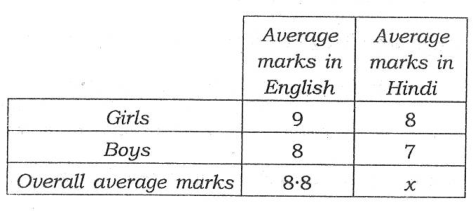
Consider the following data:

Average marks in EnglishAverage marks in Hindi
Girls98
Boys87
Overall average marks8·8x
A table of average marks in English and Hindi: girls 9 and 8, boys 8 and 7; overall average 8·8 in English and x in Hindi.
From UPSC's question paper.

What is the value of x in the above table?

Answer & explanation

Answer: (a) 7.8

The overall English average of 8·8 lies four times nearer the girls' 9 than the boys' 8, so girls outnumber boys 4 : 1. Using the same weights on Hindi gives (4 × 8 + 1 × 7)/5 = 7·8.

  1. Let there be g girls and b boys. English: 9g + 8b = 8·8(g + b).
  2. So 0·2g = 0·8b, giving g : b = 4 : 1.
  3. Hindi: x = (4 × 8 + 1 × 7)/5 = 39/5 = 7·8.
  4. Check: English with the same weights = (4 × 9 + 8)/5 = 44/5 = 8·8.

Remember · Use the known overall average to find the group ratio, then apply that ratio to the other subject.

Question and answer: UPSC's official GS Paper II (2020, Series A) — paper ↗ · answer key ↗. Explanation: Minimalist IAS, checked 1 Oct 2026 (how we verify). Permalink ·

The average age of a teacher and three students is 20 years. If all the three students are of same age and the difference between the age of the teacher and each student is 20 years, then what is the age of the teacher?

Answer & explanation

Answer: (c) 35 years

The four ages total 80. If each student is s years old, the teacher is s + 20, so 4s + 20 = 80 gives s = 15 and the teacher is 35.

  1. Total of the four ages = 4 × 20 = 80.
  2. Let each student be s years; the teacher is s + 20.
  3. 3s + (s + 20) = 80, so 4s = 60 and s = 15.
  4. Teacher = 15 + 20 = 35 years.
  5. Check: (35 + 15 + 15 + 15)/4 = 80/4 = 20.

Remember · Turn an average into a total first; then express every person in one unknown.

Question and answer: UPSC's official GS Paper II (2020, Series A) — paper ↗ · answer key ↗. Explanation: Minimalist IAS, checked 30 Sept 2026 (how we verify). Permalink ·

A person bought a car and sold it for ₹ 3,00,000. If he incurred a loss of 20%, then how much did he spend to buy the car?

Answer & explanation

Answer: (d) ₹ 3,75,000

A 20% loss means the selling price is 80% of the cost. So the cost is 3,00,000 ÷ 0·8 = ₹ 3,75,000.

  1. Selling price = 80% of cost price.
  2. Cost price = 3,00,000 ÷ 0·8 = ₹ 3,75,000.
  3. Check: 20% of 3,75,000 = 75,000, and 3,75,000 − 75,000 = 3,00,000.

Remember · Loss and profit percentages are on cost price: CP = SP ÷ (1 − loss%).

Question and answer: UPSC's official GS Paper II (2020, Series A) — paper ↗ · answer key ↗. Explanation: Minimalist IAS, checked 30 Sept 2026 (how we verify). Permalink ·

A shop owner offers the following discount options on an article to a customer:

  1. 1.Successive discounts of 10% and 20%, and then pay a service tax of 10%
  2. 2.Successive discounts of 20% and 10%, and then pay a service tax of 10%
  3. 3.Pay a service tax of 10% first, then successive discounts of 20% and 10%

Which one of the following is correct?

Answer & explanation

Answer: (d) All the options are equally good for the customer.

Each option multiplies the price by the same three factors — 0·9, 0·8 and 1·1 — only in a different order. Multiplication does not depend on order, so the customer pays the same in every case.

  1. Take the price as ₹ 100.
  2. Option 1: 100 × 0·9 × 0·8 × 1·1 = ₹ 79·2.
  3. Option 2: 100 × 0·8 × 0·9 × 1·1 = ₹ 79·2.
  4. Option 3: 100 × 1·1 × 0·8 × 0·9 = ₹ 79·2.
  5. All three cost the same, so all options are equally good.

Remember · Successive percentage changes are multiplying factors; their order never changes the final result.

Question and answer: UPSC's official GS Paper II (2020, Series A) — paper ↗ · answer key ↗. Explanation: Minimalist IAS, checked 30 Sept 2026 (how we verify). Permalink ·

In adult population of a city, 40% men and 30% women are married. What is the percentage of married adult population if no man marries more than one woman and no woman marries more than one man; and there are no widows and widowers?

Answer & explanation

Answer: (c) 34 2/7%

Every married man has exactly one wife in the city, so married men equal married women: 40% of men = 30% of women, which makes men : women = 3 : 4. Then 1·2 + 1·2 = 2·4 of every 7 adults are married, i.e. 34 2/7%.

  1. Married men = married women, so 0·4M = 0·3W, giving M : W = 3 : 4.
  2. Take 3 men and 4 women: married men = 0·4 × 3 = 1·2, married women = 0·3 × 4 = 1·2.
  3. Married adults = 2·4 out of 7 = 24/70 = 12/35.
  4. 12/35 × 100 = 240/7 = 34 2/7%.

Remember · In marriage-count problems, equate married men and married women first; that fixes the ratio of the two groups.

Question and answer: UPSC's official GS Paper II (2020, Series A) — paper ↗ · answer key ↗. Explanation: Minimalist IAS, checked 30 Sept 2026 (how we verify). Permalink ·

A sum of ₹ 2,500 is distributed among X, Y and Z in the ratio 1/2: 3/4: 5/6. What is the difference between the maximum share and the minimum share?

Answer & explanation

Answer: (c) ₹ 400

Clearing the fractions by multiplying by 12 turns the ratio into 6 : 9 : 10, a total of 25 parts worth ₹ 100 each. The largest share (10 parts) exceeds the smallest (6 parts) by 4 parts, or ₹ 400.

  1. Multiply 1/2 : 3/4 : 5/6 by 12 to get 6 : 9 : 10.
  2. Total parts = 25; one part = 2,500 ÷ 25 = ₹ 100.
  3. Maximum − minimum = (10 − 6) × 100 = ₹ 400.
  4. Check: shares 600 + 900 + 1,000 = 2,500.

Remember · For a ratio of fractions, multiply every term by the LCM of the denominators to get whole-number parts.

Question and answer: UPSC's official GS Paper II (2020, Series A) — paper ↗ · answer key ↗. Explanation: Minimalist IAS, checked 30 Sept 2026 (how we verify). Permalink ·

In a class, there are three groups A, B and C. If one student from group A and two students from group B are shifted to group C, then what happens to the average weight of the students of the class?

Answer & explanation

Answer: (c) It remains the same.

Shifting students between groups inside the class changes the group averages but not the class as a whole: the same students with the same total weight remain. So the class average stays the same.

  1. Class average = total weight of all students ÷ number of students in the class.
  2. Moving students from A and B to C keeps every student in the class.
  3. Both the total weight and the head count are unchanged, so the class average is unchanged.

Remember · Ask which total is being averaged; moving members within that total leaves its average unchanged.

Question and answer: UPSC's official GS Paper II (2020, Series A) — paper ↗ · answer key ↗. Explanation: Minimalist IAS, checked 30 Sept 2026 (how we verify). Permalink ·

A bottle contains 20 litres of liquid A. 4 litres of liquid A is taken out of it and replaced by same quantity of liquid B. Again 4 litres of the mixture is taken out and replaced by same quantity of liquid B. What is the ratio of quantity of liquid A to that of liquid B in the final mixture?

Answer & explanation

Answer: (c) 16: 9

Each removal takes away 4/20 = 1/5 of whatever A is present, leaving 4/5 of it. After two rounds A = 20 × (4/5)² = 12·8 litres and B = 7·2 litres, a ratio of 16 : 9.

  1. After the first replacement: A = 20 − 4 = 16 litres.
  2. Second removal takes 1/5 of the mixture, so A falls to 16 × 4/5 = 12·8 litres.
  3. B = 20 − 12·8 = 7·2 litres.
  4. A : B = 12·8 : 7·2 = 128 : 72 = 16 : 9.

Remember · Repeated replace-and-remove: remaining original = initial × (1 − removed/total)ⁿ.

Question and answer: UPSC's official GS Paper II (2020, Series A) — paper ↗ · answer key ↗. Explanation: Minimalist IAS, checked 30 Sept 2026 (how we verify). Permalink ·

The average score of a batsman after his 50th innings was 46.4. After 60th innings, his average score increases by 2.6. What was his average score in the last ten innings?

Answer & explanation

Answer: (c) 62

Turn both averages into totals: 50 × 46·4 = 2320 and 60 × 49 = 2940. The last ten innings added 620 runs, an average of 62.

  1. Runs after 50 innings = 50 × 46·4 = 2320.
  2. New average = 46·4 + 2·6 = 49; runs after 60 innings = 60 × 49 = 2940.
  3. Runs in the last 10 innings = 2940 − 2320 = 620.
  4. Average of the last 10 = 620 ÷ 10 = 62.

Remember · Averages over different counts: convert each to a total, subtract, and divide by the new count.

Question and answer: UPSC's official GS Paper II (2020, Series A) — paper ↗ · answer key ↗. Explanation: Minimalist IAS, checked 30 Sept 2026 (how we verify). Permalink ·

As a result of 25% hike in the price of rice per kg, a person is able to purchase 6 kg less rice for ₹ 1,200. What was the original price of rice per kg?

Answer & explanation

Answer: (b) ₹ 40

A 25% price rise means the same money buys 1/1·25 = 4/5 of the earlier quantity, i.e. 1/5 less. That lost fifth is 6 kg, so ₹ 1,200 used to buy 30 kg, at ₹ 40 a kg.

  1. New price = 5/4 of old, so quantity for ₹ 1,200 becomes 4/5 of the old quantity — a fall of 1/5.
  2. 1/5 of old quantity = 6 kg, so old quantity = 30 kg.
  3. Original price = 1,200 ÷ 30 = ₹ 40 per kg.
  4. Check: new price ₹ 50 buys 1,200 ÷ 50 = 24 kg, which is 6 kg less.

Remember · Price up by 1/n means quantity down by 1/(n + 1) for the same spending; here 25% = 1/4, so quantity falls by 1/5.

Question and answer: UPSC's official GS Paper II (2020, Series A) — paper ↗ · answer key ↗. Explanation: Minimalist IAS, checked 30 Sept 2026 (how we verify). Permalink ·

A person X can complete 20% of work in 8 days and another person Y can complete 25% of the same work in 6 days. If they work together, in how many days will 40% of the work be completed?

Answer & explanation

Answer: (a) 6

X would finish the whole work in 40 days and Y in 24 days, so together they do 1/40 + 1/24 = 1/15 of it each day. 40% of the work therefore takes 0·4 × 15 = 6 days.

  1. X: 20% in 8 days, so 100% in 40 days. Y: 25% in 6 days, so 100% in 24 days.
  2. Together per day: 1/40 + 1/24 = 3/120 + 5/120 = 8/120 = 1/15.
  3. Whole work together = 15 days; 40% of it = 0·4 × 15 = 6 days.
  4. Check: in 6 days X does 6/40 = 15% and Y does 6/24 = 25%; total 40%.

Remember · Convert partial work to full-job time first, add daily rates, then scale to the fraction of work asked.

Question and answer: UPSC's official GS Paper II (2020, Series A) — paper ↗ · answer key ↗. Explanation: Minimalist IAS, checked 30 Sept 2026 (how we verify). Permalink ·

A car travels from a place X to place Y at an average speed of v km/hr, from Y to X at an average speed of 2v km/hr, again from X to Y at an average speed of 3v km/hr and again from Y to X at an average speed of 4v km/hr. Then the average speed of the car for the entire journey

Answer & explanation

Answer: (b) lies between v and 2v km/hr

All four legs cover the same distance, so the slow legs take the most time and pull the average down. Total time = (d/v)(1 + 1/2 + 1/3 + 1/4) = 25d/12v for a distance of 4d, giving an average of 48v/25 = 1·92v.

  1. Let XY = d km. Total distance = 4d.
  2. Total time = d/v + d/2v + d/3v + d/4v = (d/v)(12 + 6 + 4 + 3)/12 = 25d/12v.
  3. Average speed = 4d ÷ (25d/12v) = 48v/25 = 1·92v.
  4. 1·92v lies between v and 2v.

Remember · For equal distances at different speeds, average speed is the harmonic mean — always closer to the slower speeds.

Question and answer: UPSC's official GS Paper II (2020, Series A) — paper ↗ · answer key ↗. Explanation: Minimalist IAS, checked 30 Sept 2026 (how we verify). Permalink ·

A man takes half time in rowing a certain distance downstream than upstream. What is the ratio of the speed in still water to the speed of current?

Answer & explanation

Answer: (d) 3: 1

Half the time over the same distance means the downstream speed is twice the upstream speed. So b + c = 2(b − c), which gives b = 3c: still-water speed : current = 3 : 1.

  1. Let the speed in still water be b and the current c.
  2. Downstream time is half the upstream time, so downstream speed = 2 × upstream speed.
  3. b + c = 2(b − c), so b = 3c.
  4. b : c = 3 : 1.
  5. Check: b = 3, c = 1 gives speeds 4 and 2 — half the time downstream.

Remember · Same distance: time ratio is the inverse of speed ratio. Downstream = b + c, upstream = b − c.

Question and answer: UPSC's official GS Paper II (2020, Series A) — paper ↗ · answer key ↗. Explanation: Minimalist IAS, checked 30 Sept 2026 (how we verify). Permalink ·

A vessel full of water weighs 40 kg. If it is one-third filled, its weight becomes 20 kg. What is the weight of the empty vessel?

Answer & explanation

Answer: (a) 10 kg

Going from full to one-third full removes two-thirds of the water and 20 kg of weight, so the full water weighs 30 kg. The empty vessel is 40 − 30 = 10 kg.

  1. Full: vessel + water = 40 kg. One-third full: vessel + water/3 = 20 kg.
  2. Subtracting: (2/3) × water = 20 kg, so water = 30 kg.
  3. Empty vessel = 40 − 30 = 10 kg.
  4. Check: 10 + 30/3 = 20 kg.

Remember · Subtract the two readings: the difference belongs to the water alone, which fixes the water's full weight.

Question and answer: UPSC's official GS Paper II (2020, Series A) — paper ↗ · answer key ↗. Explanation: Minimalist IAS, checked 30 Sept 2026 (how we verify). Permalink ·

A frog tries to come out of a dried well 4.5 m deep with slippery walls. Every time the frog jumps 30 cm, slides down 15 cm. What is the number of jumps required for the frog to come out of the well?

Answer & explanation

Answer: (b) 29

Each jump-and-slide gains a net 15 cm, but the final jump does not slide back. The frog needs to be within 30 cm of the top, i.e. at 420 cm, before its last jump; 28 jumps with slides get it there, and the 29th jump takes it out.

  1. Well depth = 450 cm; net gain per jump-and-slide = 30 − 15 = 15 cm.
  2. The last jump of 30 cm must start from at least 450 − 30 = 420 cm.
  3. 420 ÷ 15 = 28 jumps (with slides) to reach 420 cm.
  4. The 29th jump lifts it from 420 to 450 cm and out — 29 jumps.
  5. Check: after 27 jumps it is at 405 cm; the 28th reaches only 435 cm and slides back to 420 cm.

Remember · Climb-and-slip problems: subtract the last full jump from the height, count net gains to reach that point, then add one jump.

Question and answer: UPSC's official GS Paper II (2020, Series A) — paper ↗ · answer key ↗. Explanation: Minimalist IAS, checked 30 Sept 2026 (how we verify). Permalink ·