History & Culture
Ramappa Temple and the Coal Mine Row: Why a UNESCO World Heritage Site Needs More Than a 300-Metre Buffer
By Shivam Singh, Founder & Mentor, Minimalist IAS
· 6 min read
WhatsApp Telegram
The Ramappa (Rudreshwara) Temple in Telangana, a 13th-century Kakatiya temple and a UNESCO World Heritage Site since 2021, is at the centre of a row over a proposed opencast coal mine about 5 km downstream. Heritage groups fear that groundwater moving towards a 300-metre-deep pit could wash out the soil beneath the temple's sand-box foundation, while India's legal buffer around the monument extends only 300 metres.
Why in news: Heritage groups led by the Kakatiya Heritage Trust (KHT) have urged the Centre to drop a proposed Singareni Collieries Company Ltd (SCCL) opencast coal mine at Venkatapur in Mulugu district, fearing harm to the Ramappa Temple and its lake.
Key facts at a glance
Location: Palampet village, Mulugu district, Telangana; the main Shiva temple of a walled complex.
Builder: Recharla Rudra, a general of Kakatiya ruler Ganapati Deva; completed in 1213 CE.
Name: popularly named after its sculptor, Ramappa; the presiding deity is Rudreshwara (Shiva).
Engineering: light 'floating' bricks in the superstructure; a sand-filled ('sand-box') foundation that cushions tremors.
World Heritage status: inscribed in 2021 (44th session of the World Heritage Committee) under criteria (i) and (iii), as India's 39th World Heritage Site.
The proposal: SCCL opencast mine about 5 km downstream of Ramappa Lake, excavated to about 300 m.
Why does a mine 5 km away worry conservationists?
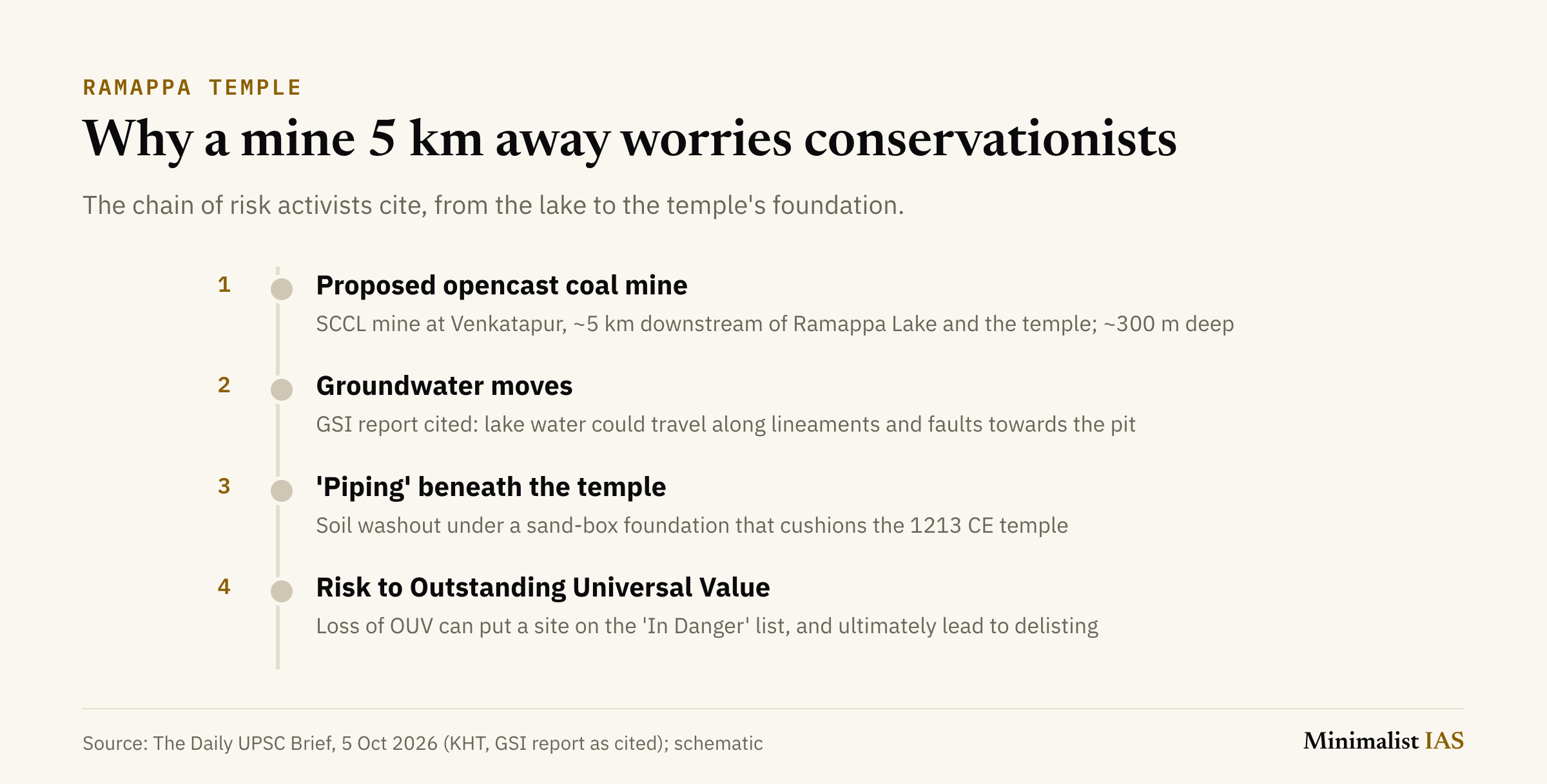
Groundwater path: former NIT-Warangal professor M. Pandu Ranga Rao cites a Geological Survey of India (GSI) report: lake water could move along lineaments and faults towards the pit.
'Piping': soil washout beneath the foundation; activists say distress signs are already visible on the nearly 800-year-old structure.
Mobilisation: activists have met Coal and Mines Minister G. Kishan Reddy and plan protests from 15 villages.
Takeaway: the risk travels underground, so distance alone does not measure it.
How does the World Heritage system protect a site?
The treaty: UNESCO's World Heritage Convention, adopted by the General Conference in 1972; India ratified it in 1977.
Who inscribes: the 21-member World Heritage Committee, advised by ICOMOS (cultural sites) and IUCN (natural sites).
Test for listing: Outstanding Universal Value (OUV) under at least one of 10 criteria; a site is cultural, natural or mixed.
Safeguard: seriously threatened sites go on the 'List of World Heritage in Danger'; loss of OUV can lead to delisting.
India link: India hosted the 46th Committee session in New Delhi (2024); Khangchendzonga National Park is its only mixed site.
Not to confuse: intangible heritage (e.g. Garba, Durga Puja in Kolkata) is listed under a separate 2003 UNESCO Convention.
Where Indian law stops — and why it matters here
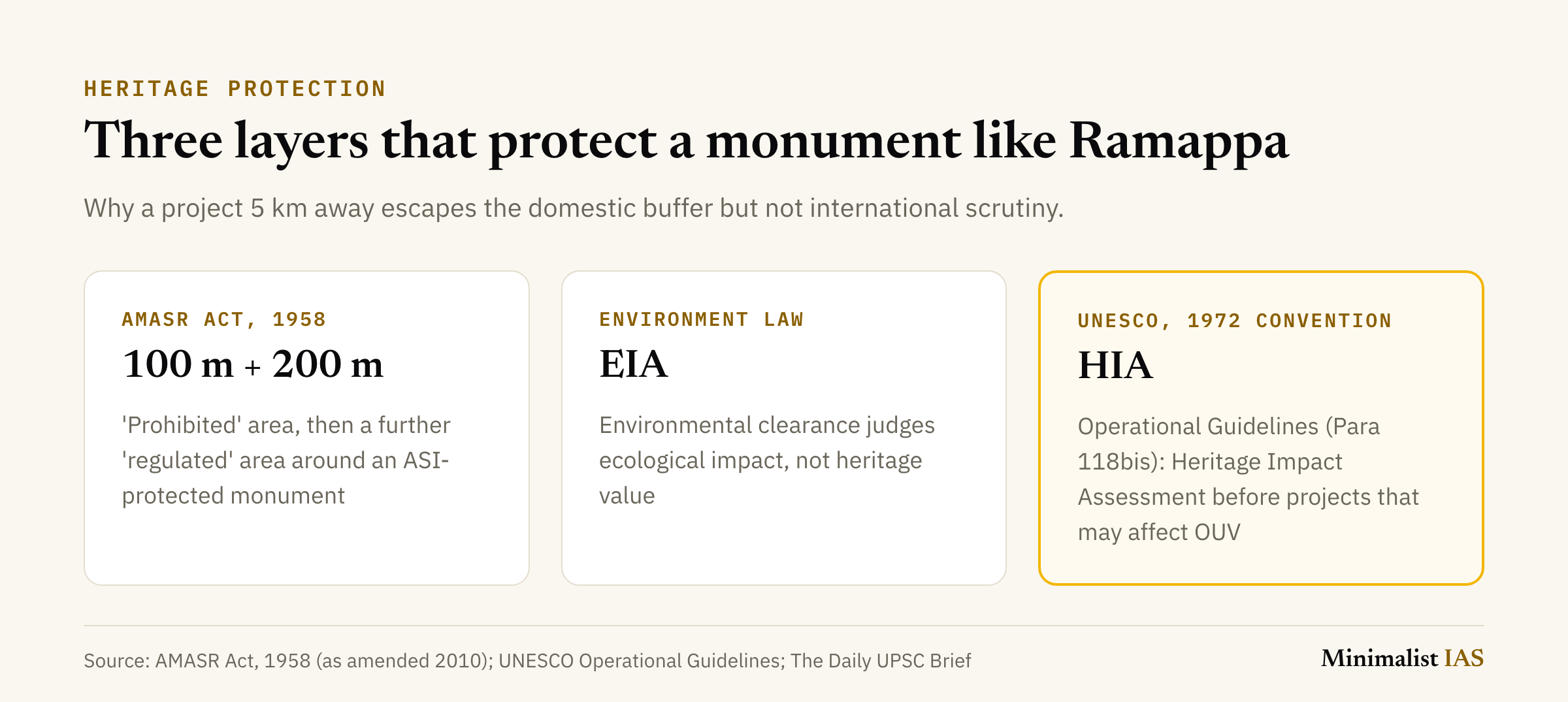
AMASR Act, 1958: a 100 m 'prohibited' area and a further 200 m 'regulated' area around ASI-protected monuments.
The gap: a mine 5 km away lies far outside this 300 m envelope.
Environmental clearance (EIA): weighs ecology and pollution, not the heritage value of a site.
UNESCO's answer: Operational Guidelines (Para 118bis) ask States Parties to carry out Heritage Impact Assessments (HIA) before projects that could affect OUV.
Why it matters for UPSC
GS Paper 1 (Indian culture: art forms and architecture; conservation of heritage) and GS Paper 3 (conservation, environmental impact assessment). Prelims tests the Kakatiya facts, the World Heritage institutions and the difference between the tangible and intangible lists. In Mains, Ramappa is a ready example of development versus conservation: clearances need a heritage lens, because the statutory buffer covers only a monument's immediate surroundings.
Related PYQs
UPSC CSE Prelims 2017: "Which one of the following was a very important seaport in the Kakatiya kingdom? (a) Kakinada (b) Motupalli (c) Machilipatnam (Masulipatnam) (d) Nelluru" Answer: (b) Motupalli. UPSC tests the Kakatiyas beyond their temples.
UPSC CSE Mains 2018, GS Paper I: "Safeguarding the Indian Art Heritage is the need of the moment. Comment." Ramappa gives a current, specific case: a World Heritage Site exposed by a gap between domestic buffers and international duties.
Mentor’s note
Separate the two lists. The World Heritage List (1972 Convention) is for monuments and natural sites; the Representative List of Intangible Cultural Heritage (2003 Convention) is for living traditions such as Garba. Mixing them is a classic Prelims trap.
Know who decides. The World Heritage Committee inscribes sites, on the advice of ICOMOS or IUCN; the UNESCO General Conference only adopted the Convention.
In Mains, name the gap precisely: the AMASR buffer is 300 m in all, while UNESCO's Operational Guidelines expect a Heritage Impact Assessment for any project that may affect OUV. That one contrast lifts a generic "heritage vs development" answer.
Practice: Prelims MCQ
Consider the following pairs:
Ramappa Temple : Kakatiya dynasty
Khangchendzonga National Park : Mixed World Heritage Site
Durga Puja in Kolkata : World Heritage List
**How many of the pairs given above are correctly matched?
(a) Only one
(b) Only two
(c) All three
(d) None**
Answer: (b) Only two
Explanation:
Pair 1 is correctly matched: the temple was built in 1213 CE by Recharla Rudra, a general of the Kakatiya ruler Ganapati Deva.
Pair 2 is correctly matched: Khangchendzonga National Park is India's only mixed (cultural and natural) World Heritage Site.
Pair 3 is incorrectly matched: Durga Puja in Kolkata is on UNESCO's Representative List of the Intangible Cultural Heritage of Humanity, under the 2003 Convention, not on the World Heritage List.
Practice: Mains question
The proposed coal mine near the Ramappa Temple shows that India's legal buffers around protected monuments may not be enough to safeguard World Heritage Sites. Examine. (Answer in 150 words; 10 Marks)
Terms to know
KHT: Kakatiya Heritage Trust
SCCL: Singareni Collieries Company Ltd
GSI: Geological Survey of India
OUV: Outstanding Universal Value
ICOMOS / IUCN: International Council on Monuments and Sites / International Union for Conservation of Nature
AMASR: Ancient Monuments and Archaeological Sites and Remains Act, 1958
HIA / EIA: Heritage Impact Assessment / Environmental Impact Assessment
ASI: Archaeological Survey of India
Frequently asked questions (FAQs)
Who built the Ramappa Temple?
The Ramappa Temple was built in 1213 CE by Recharla Rudra, a general of the Kakatiya ruler Ganapati Deva. It is popularly named after its sculptor, Ramappa, while its presiding deity is Rudreshwara (Shiva).
When did Ramappa Temple become a UNESCO World Heritage Site?
The Kakatiya Rudreshwara (Ramappa) Temple was inscribed on the World Heritage List in 2021, at the 44th session of the World Heritage Committee, becoming India's 39th World Heritage Site.
Why is a coal mine near the Ramappa Temple opposed?
Heritage groups fear that a proposed opencast coal mine about 5 km downstream, dug to about 300 metres, could draw groundwater along geological faults towards the pit and wash out the soil ('piping') beneath the temple's sand-box foundation.
Who decides which sites become World Heritage Sites?
The 21-member World Heritage Committee inscribes sites on the World Heritage List, advised by ICOMOS on cultural sites and IUCN on natural sites. A site must show Outstanding Universal Value under at least one of ten criteria.
What is the protected area around a monument under Indian law?
Under the Ancient Monuments and Archaeological Sites and Remains (AMASR) Act, 1958, an ASI-protected monument has a 100-metre prohibited area and a further 200-metre regulated area around it.
Key takeaways
Ramappa (1213 CE, Kakatiya) is famed for floating bricks and a sand-box foundation; a World Heritage Site since 2021.
The risk from the mine is underground — groundwater and 'piping' — not distance alone.
India's AMASR buffer covers 300 m; UNESCO expects a Heritage Impact Assessment for any project that may affect OUV.
Related reading
Why Karnataka rejected the Western Ghats eco-sensitive area draft
Practise previous-year Art & Culture questions in the free PYQ vault
Sources
Kakatiya Rudreshwara (Ramappa) Temple, Telangana — UNESCO World Heritage Centre
Operational Guidelines for the Implementation of the World Heritage Convention — UNESCO
From The Daily UPSC Brief, 5 October 2026 — by Shivam Singh.
Spotted an error or something outdated? Tell us — we correct it.
About the author
Shivam Singh
Founder & Mentor, Minimalist IAS
Shivam has been through every stage of the exam himself — Prelims, repeated Mains attempts across UPSC and state civil services, and the interview board. For 7 years he has mentored aspirants one-to-one, helping 100+ clear various stages of the exam, including final selections.
More about Shivam →