Minimalist IAS
CSAT

CSAT · 43 questions

Counting, permutations & probability

Every UPSC CSAT question on this topic, 2016–2026, newest first. Tap an option to check yourself; the answer and explanation open below it.

Counting, permutations & probability questions per year: 2016: 4, 2017: 3, 2018: 4, 2019: 4, 2020: 2, 2021: 3, 2022: 8, 2023: 11, 2024: 1, 2025: 0, 2026: 3 Asked in 10 of 11 years · most in 2023 (11)

UPSC syllabus: “Basic numeracy (numbers and their relations, orders of magnitude, etc.) (Class X level), Data interpretation (charts, graphs, tables, data sufficiency etc. — Class X level);” See the full syllabus →

How many diagonals can be drawn by joining the vertices of an octagon?

Answer & explanation

Answer: (a) 20

Any two of the 8 vertices can be joined in C(8, 2) = 28 ways. Eight of those joins are the sides, so 20 are diagonals.

  1. Lines joining two vertices: C(8, 2) = 8 × 7 ÷ 2 = 28.
  2. Of these, 8 are sides of the octagon.
  3. Diagonals = 28 − 8 = 20.
  4. Check with the formula n(n − 3)/2 = 8 × 5 ÷ 2 = 20.

Remember · Diagonals of an n-sided polygon = n(n − 3)/2: each vertex joins n − 3 non-adjacent vertices, and each diagonal is counted twice.

Question and answer: UPSC's official GS Paper II (2018, Series A) — paper ↗ · answer key ↗. Explanation: Minimalist IAS, checked 30 Sept 2026 (how we verify). Permalink ·
While writing all the numbers from 700 to 1000, how many numbers occur in which the digit at hundred’s place is greater than the digit at ten’s place, and the digit at ten’s place is greater than the digit at unit’s place?

Answer & explanation

Answer: (c) 85

Fix the hundreds digit h (7, 8 or 9). Any two different digits smaller than h, written in decreasing order, give exactly one valid number, so the count is C(7, 2) + C(8, 2) + C(9, 2) = 21 + 28 + 36 = 85.

  1. Hundreds digit 7: tens and units are two different digits from 0–6, written in decreasing order: C(7, 2) = 21.
  2. Hundreds digit 8: two digits from 0–7: C(8, 2) = 28.
  3. Hundreds digit 9: two digits from 0–8: C(9, 2) = 36.
  4. 1000 does not qualify. Total = 21 + 28 + 36 = 85.
  5. Check for 7: tens digit 6 allows 6 numbers (760–765), tens 5 allows 5, and so on: 6 + 5 + 4 + 3 + 2 + 1 = 21.

Remember · For strictly decreasing digits, choosing the digits fixes their order: count with combinations, not arrangements.

Question and answer: UPSC's official GS Paper II (2018, Series A) — paper ↗ · answer key ↗. Explanation: Minimalist IAS, checked 30 Sept 2026 (how we verify). Permalink ·

A bag contains 15 red balls and 20 black balls. Each ball is numbered either 1 or 2 or 3. 20% of the red balls are numbered 1 and 40% of them are numbered 3. Similarly, among the black balls, 45% are numbered 2 and 30% are numbered 3. A boy picks a ball at random. He wins if the ball is red and numbered 3 or if it is black and numbered 1 or 2. What are the chances of his winning?

Answer & explanation

Answer: (b) 4/7

Winning balls are the red ones numbered 3 (40% of 15 = 6) and the black ones numbered 1 or 2 (70% of 20 = 14). That is 20 winning balls out of 35, a chance of 4/7.

  1. Red numbered 3: 40% of 15 = 6.
  2. Black numbered 3: 30% of 20 = 6, so black numbered 1 or 2 = 20 − 6 = 14.
  3. Winning balls = 6 + 14 = 20 out of 35.
  4. Probability = 20/35 = 4/7.

Remember · Count the favourable balls directly; use a complement (100% − 30%) when it is quicker than adding separate percentages.

Question and answer: UPSC's official GS Paper II (2018, Series A) — paper ↗ · answer key ↗. Explanation: Minimalist IAS, checked 30 Sept 2026 (how we verify). Permalink ·

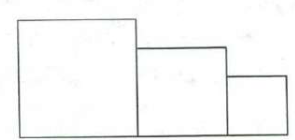
For a sports meet, a winners’ stand comprising three wooden blocks is in the following form:

A winners' stand of three rectangular blocks side by side: the tallest on the left, a middle-height block next to it and the shortest on the right.
From UPSC's question paper.

There are six different colours available to choose from and each of the three wooden blocks is to be painted such that no two of them has the same colour. In how many different ways can the winners’ stand be painted?

Answer & explanation

Answer: (a) 120

The three blocks are different (first, second and third place), so the order of colours matters. With six colours and no repeats there are 6 × 5 × 4 = 120 ways.

  1. The blocks differ in height, so each assignment of colours to blocks is a different painting.
  2. Tallest block: 6 choices; next block: 5; last block: 4.
  3. Ways = 6 × 5 × 4 = 120 (that is, ⁶P₃).

Remember · When the positions are distinct, use permutations: n × (n − 1) × … for as many positions as are filled.

Question and answer: UPSC's official GS Paper II (2018, Series A) — paper ↗ · answer key ↗. Explanation: Minimalist IAS, checked 1 Oct 2026 (how we verify). Permalink ·